
Report Feature
Infection Control Cart Market Trends and Forecast
The future of the global infection control cart market looks promising with opportunities in the intensive care unit, operating room, ambulatory surgery center, and long term acute care markets. The global infection control cart market is expected to grow with a CAGR of 4.6% from 2025 to 2031. The major drivers for this market are the increasing focus on hospital infection prevention, the rising healthcare standards for patient safety, and the growing demand for efficient infection control solutions.• Lucintel forecasts that, within the type category, plastic material is expected to witness higher growth over the forecast period.
• Within the application category, intensive care unit is expected to witness the highest growth.
• In terms of region, APAC is expected to witness the highest growth over the forecast period. Gain valuable insights for your business decisions with our comprehensive 150+ page report. Sample figures with some insights are shown below.
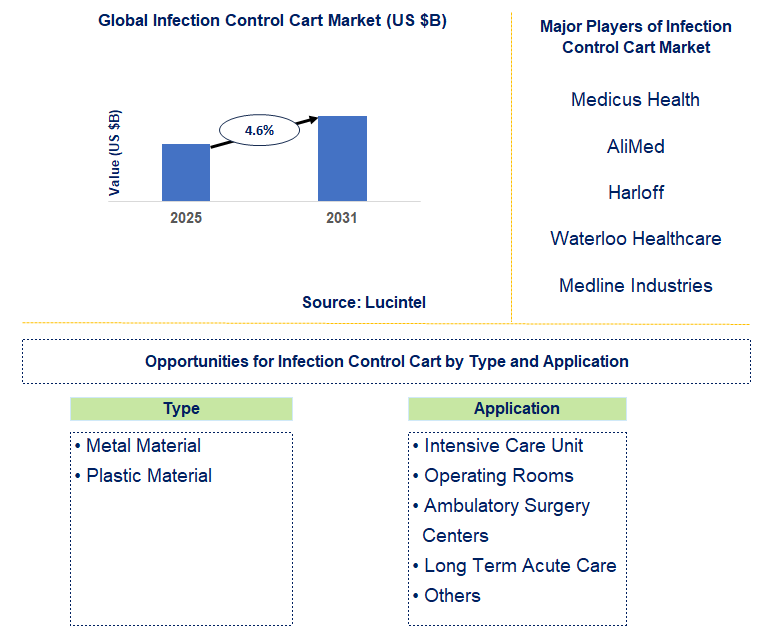

Emerging Trends in the Infection Control Cart Market
The medical infection control cart market is being reshaped by several key trends, reflecting a broader industry shift toward interconnected, intelligent, and specialized healthcare equipment. These trends are influencing cart design, materials, and technological capabilities, positioning medical infection control carts as a crucial component of a modern hospital’s infection control strategy.• Integration with IoT and Smart Systems: A key trend is the integration of infection control carts with the Internet of Things (IoT) for real-time tracking and inventory management. The impact is a significant improvement in workflow efficiency and patient safety. These "smart" carts can automatically track inventory levels, monitor usage patterns, and send alerts for restocking.
• Enhanced Antimicrobial and Seamless Design: The market is seeing a trend toward the use of advanced antimicrobial coatings and seamless, non-porous materials. The impact is a more effective barrier to the spread of pathogens. This design is crucial for high-risk environments and makes the carts easier to clean and disinfect, reducing the risk of healthcare-associated infections.
• Focus on Ergonomics and Customization: There is an emerging trend of creating highly ergonomic and customizable infection control carts to suit the specific needs of different hospital departments. The impact is an improved user experience and reduced physical strain on healthcare professionals. This trend ensures that the carts are not only functional but also comfortable and efficient to use.
• Development of Telemedicine and Computing Carts: A key trend is the development of medical carts that are specifically designed for telemedicine and electronic health record (EHR) integration. The impact is a more comprehensive point-of-care solution. These carts allow healthcare workers to access patient records and conduct virtual consultations from the patient's bedside, minimizing exposure and increasing efficiency.
• Growth of Modular and Upgradable Carts: This trend involves creating infection control carts with a modular design that allows for easy component upgrades and replacements. The impact is a longer product lifespan and a lower total cost of ownership. This appeals to hospitals that need a flexible solution that can evolve with their changing needs and technological advancements. These emerging trends are fundamentally reshaping the infection control cart market, making products more intelligent, hygienic, and user-friendly. The focus on IoT integration and antimicrobial design is creating new value in infection control, while the emphasis on ergonomics and modularity is transforming how hospitals manage their equipment.

Recent Development in the Infection Control Cart Market
The infection control cart market is witnessing a dynamic period of development, driven by a global emphasis on improving hospital-acquired infection (HAI) prevention. These developments are centered on enhancing cart functionality, material science, and data integration to meet the evolving needs of healthcare facilities and professionals.• Adoption of Electronic Locking Systems: A key development is the widespread adoption of electronic locking systems for infection control carts. The impact is enhanced security for medications and supplies. This technology ensures that only authorized personnel can access the contents of the cart, which is crucial for managing controlled substances and preventing misuse.
• Introduction of Advanced Polymer Materials: Manufacturers are now using advanced polymer materials that are more durable, lightweight, and resistant to harsh cleaning agents. The impact is a longer-lasting and more hygienic product. These materials can withstand frequent disinfection without degrading, which is critical for maintaining infection control standards.
• Development of Specialization for Procedures: Recent developments include the creation of carts with specialized configurations for specific medical procedures. The impact is a more streamlined and efficient workflow for medical professionals. These carts come pre-configured with the necessary supplies and instruments, reducing preparation time and potential for error.
• Increased Focus on Ergonomic Design: There has been an increased focus on the ergonomic design of infection control carts to reduce physical strain on healthcare workers. The impact is a safer and more comfortable working environment. Features like adjustable height, silent casters, and lightweight construction are now standard to minimize injuries.
• Integration with Supply Chain Management Software: The market is seeing a growing trend of integrating infection control carts with hospital supply chain management software. The impact is a more efficient and accurate inventory process. This allows hospitals to track the usage of supplies in real-time, ensuring that carts are always fully stocked. These recent developments are collectively transforming the infection control cart market into a more sophisticated and user-friendly industry. The focus on security, durability, and ergonomic design is improving the quality of the products and fundamentally changing how hospitals manage their infection control and supply chain protocols.
Strategic Growth Opportunities in the Infection Control Cart Market
The infection control cart market offers strategic growth opportunities across key applications, driven by a growing need for efficiency and precision in various medical fields. These opportunities are focused on expanding into new segments and leveraging the cart's advantages to provide solutions for specific industry needs.• Targeting the Long-Term Care Sector: A significant growth opportunity is to expand into the long-term care and nursing home sectors. The impact is a high-volume customer base that requires durable and easy-to-use carts for managing patient care and infection control. This is a largely untapped market with significant growth potential.
• Expansion into Ambulatory Surgical Centers: The rapidly growing number of ambulatory surgical centers (ASCs) is a high-potential growth opportunity. The impact is a demand for specialized, compact, and cost-effective carts. ASCs need carts that are easy to maneuver and can be quickly disinfected between procedures.
• Serving the Diagnostic Imaging Sector: There is an opportunity to create specialized infection control carts for the diagnostic imaging sector, particularly for mobile x-ray and ultrasound. The impact is a new revenue stream and a broader market. These carts need to be configured to hold and transport sensitive equipment while maintaining infection control standards.
• Focusing on Home Healthcare Applications: The shift toward home-based healthcare presents an untapped growth opportunity. The impact is a demand for smaller, more portable carts for in-home patient care. These carts can be designed to hold and transport necessary supplies for managing infectious diseases in a home setting.
• Providing Retrofit and Upgrade Services: The large installed base of older carts creates a growth opportunity in providing upgrade and retrofit services. The impact is a sustained revenue stream. Companies can offer new, more hygienic surfaces, electronic locks, and other features to improve the functionality of existing carts without a full replacement. These strategic growth opportunities highlight the market's potential beyond its traditional base. By focusing on high-volume applications in long-term care and ASCs, expanding into new sectors like diagnostic imaging and home healthcare, and providing services for existing customers, the market can achieve significant and sustainable growth.
Infection Control Cart Market Driver and Challenges
The infection control cart market is propelled by a combination of powerful drivers and significant challenges. The major drivers, including the growing number of hospital-acquired infections and a global focus on patient safety, are fueling expansion. However, it must also address key challenges related to high costs and the need for standardized designs to ensure sustained growth. The factors responsible for driving the infection control cart market include: 1. Rising Incidence of HAIs: The increasing prevalence of hospital-acquired infections (HAIs) is a primary driver. Infection control carts are a frontline defense against the spread of these infections. This fuels a constant demand for high-quality, reliable carts to improve infection control protocols and enhance patient safety in hospitals. 2. Growing Focus on Patient Safety: The global emphasis on patient safety and the implementation of stringent safety regulations are major drivers. This is leading hospitals to invest in equipment that reduces the risk of cross-contamination. Infection control carts, with their dedicated storage and easy-to-clean surfaces, are a key component of this strategy. 3. Technological Integration: The integration of technologies like electronic locks, RFID tracking, and barcode scanners into infection control carts is a major driver. This allows for better inventory management, improved security, and more efficient clinical workflows, making the carts more valuable and attractive to healthcare institutions. 4. Expanding Healthcare Infrastructure: The rapid expansion of healthcare infrastructure in emerging economies is a significant driver. As these countries build new hospitals and clinics, there is a growing demand for essential medical equipment, including infection control carts, which are a cornerstone of modern infection control practices. 5. Rising Geriatric Population: The aging global population is leading to an increase in hospital admissions and a higher prevalence of chronic and infectious diseases. This demographic shift is driving the need for more infection control carts to manage the increased patient load and ensure that contagious diseases are contained. Challenges in the infection control cart market are: 1. High Cost of Advanced Carts: The production of highly advanced carts with integrated technology and premium materials is a significant challenge due to the high costs involved. This can make these models prohibitively expensive for smaller clinics or hospitals with limited budgets, slowing market growth in certain regions. 2. Competition from DIY Solutions: In some healthcare facilities, there is a tendency to create makeshift or "do-it-yourself" carts from standard utility carts. This poses a challenge as it bypasses the need for specialized, professionally designed products, which can limit the market for dedicated infection control carts. 3. Maintenance and Training Requirements: The maintenance and training required for high-tech infection control carts can be a significant challenge. These carts have complex electronic components that may require specialized repair. Additionally, staff must be properly trained to use all features, which adds to the operational cost for hospitals. The infection control cart market is experiencing robust growth driven by the demands of a modern healthcare system and the power of technological innovation. However, it must strategically address challenges related to high costs and competition from less-specialized alternatives. Successfully navigating these factors will be crucial for the market's continued expansion and its essential role in preventing the spread of infections.List of Infection Control Cart Companies
Companies in the market compete on the basis of product quality offered. Major players in this market focus on expanding their manufacturing facilities, R&D investments, infrastructural development, and leverage integration opportunities across the value chain. With these strategies infection control cart companies cater increasing demand, ensure competitive effectiveness, develop innovative products & technologies, reduce production costs, and expand their customer base. Some of the infection control cart companies profiled in this report include-• Medicus Health
• AliMed
• Harloff
• Waterloo Healthcare
• Medline Industries
• Capsa Healthcare
• Lakeside Manufacturing
• Metro
• LaPastilla
• MPD Medical System
Infection Control Cart Market by Segment
The study includes a forecast for the global infection control cart market by type, application, and region.Infection Control Cart Market by Type [Value from 2019 to 2031]:
• Metal Material
• Plastic Material
Infection Control Cart Market by Application [Value from 2019 to 2031]:
• Intensive Care Unit
• Operating Rooms
• Ambulatory Surgery Centers
• Long Term Acute Care
• Others
Infection Control Cart Market by Region [Value from 2019 to 2031]:
• North America
• Europe
• Asia Pacific
• The Rest of the World
Country Wise Outlook for the Infection Control Cart Market
The medical infection control cart market is witnessing a wave of innovation driven by a heightened global focus on preventing hospital-acquired infections (HAIs). Recent developments are centered on integrating smart technologies, improving ergonomics, and using advanced materials to enhance the functionality and durability of these critical healthcare tools, making them more effective in preventing the spread of infectious diseases.• United States: The U.S. market is leading the charge in integrating smart features into infection control carts. Recent developments include the adoption of carts with RFID tracking, electronic locking systems for medication security, and integrated barcode scanners. This focus on technology is driven by the need to streamline workflows, improve inventory management, and enhance overall compliance with strict infection control protocols.
• China: China’s market is rapidly expanding, with significant growth in both domestic production and the adoption of advanced carts in modern hospitals. Recent developments include local manufacturers improving the quality and design of their carts, offering cost-effective solutions. This is driven by a large-scale upgrade of healthcare infrastructure and a growing awareness of infection control standards.
• Germany: Germany's market is characterized by a strong emphasis on precision engineering and quality. Recent developments are centered on the use of high-quality, seamless materials for easy cleaning and disinfection. The market is also seeing a push for highly customizable and modular designs to meet the specific needs of various hospital departments and to optimize clinical workflows.
• India: The Indian market is experiencing a significant increase in demand for infection control carts, fueled by government initiatives to improve healthcare infrastructure. Recent developments include a strong demand for durable, affordable carts and an increase in local manufacturing. The focus is on providing robust and practical solutions for the country's diverse range of healthcare facilities.
• Japan: Japan's market is mature and technologically advanced. Recent developments show a focus on creating lightweight and ergonomic infection control carts that are easy for staff to maneuver. The market sees a strong demand for carts with a long lifespan and easy maintenance, reflecting a focus on long-term value and efficiency in hospital operations.

Features of the Global Infection Control Cart Market
Market Size Estimates: Infection control cart market size estimation in terms of value ($B). Trend and Forecast Analysis: Market trends (2019 to 2024) and forecast (2025 to 2031) by various segments and regions. Segmentation Analysis: Infection control cart market size by type, application, and region in terms of value ($B). Regional Analysis: Infection control cart market breakdown by North America, Europe, Asia Pacific, and Rest of the World. Growth Opportunities: Analysis of growth opportunities in different types, applications, and regions for the infection control cart market. Strategic Analysis: This includes M&A, new product development, and competitive landscape of the infection control cart market. Analysis of competitive intensity of the industry based on Porter’s Five Forces model.
FAQ
Q1. What is the growth forecast for infection control cart market? Answer: The global infection control cart market is expected to grow with a CAGR of 4.6% from 2025 to 2031. Q2. What are the major drivers influencing the growth of the infection control cart market? Answer: The major drivers for this market are the increasing focus on hospital infection prevention, the rising healthcare standards for patient safety, and the growing demand for efficient infection control solutions. Q3. What are the major segments for infection control cart market? Answer: The future of the infection control cart market looks promising with opportunities in the intensive care unit, operating room, ambulatory surgery center, and long term acute care markets. Q4. Who are the key infection control cart market companies? Answer: Some of the key infection control cart companies are as follows:• Medicus Health
• AliMed
• Harloff
• Waterloo Healthcare
• Medline Industries
• Capsa Healthcare
• Lakeside Manufacturing
• Metro
• LaPastilla
• MPD Medical System Q5. Which infection control cart market segment will be the largest in future? Answer: Lucintel forecasts that, within the type category, plastic material is expected to witness higher growth over the forecast period. Q6. In infection control cart market, which region is expected to be the largest in next 5 years? Answer: In terms of region, APAC is expected to witness the highest growth over the forecast period. Q7. Do we receive customization in this report? Answer: Yes, Lucintel provides 10% customization without any additional cost.
Table of Contents
Methodology
- In-depth interviews of the major players in this market
- Detailed secondary research from competitors’ financial statements and published data
- Extensive searches of published works, market, and database information pertaining to industry news, company press releases, and customer intentions
- A compilation of the experiences, judgments, and insights of Lucintel’s professionals, who have analyzed and tracked this market over the years.


Buy Now
Choose a license that fits your team. Instant PDF delivery.
Prices exclude taxes. Instant delivery. Custom licensing available on request.
Key Questions
- • What are some of the most promising, high-growth opportunities for the infection control cart market by type (metal material and plastic material), application (intensive care unit, operating rooms, ambulatory surgery centers, long term acute care, and others), and region (North America, Europe, Asia Pacific, and the Rest of the World)?
- • Which segments will grow at a faster pace and why?
- • Which region will grow at a faster pace and why?
- • What are the key factors affecting market dynamics? What are the key challenges and business risks in this market?
- • What are the business risks and competitive threats in this market?
- • What are the emerging trends in this market and the reasons behind them?
- • What are some of the changing demands of customers in the market?
- • What are the new developments in the market? Which companies are leading these developments?
- • Who are the major players in this market? What strategic initiatives are key players pursuing for business growth?
- • What are some of the competing products in this market and how big of a threat do they pose for loss of market share by material or product substitution?
- • What M&A activity has occurred in the last 5 years and what has its impact been on the industry? For any questions related to Infection Control Cart Market, Infection Control Cart Market Size, Infection Control Cart Market Growth, Infection Control Cart Market Analysis, Infection Control Cart Market Report, Infection Control Cart Market Share, Infection Control Cart Market Trends, Infection Control Cart Market Forecast, Infection Control Cart Companies, write Lucintel analyst at email: helpdesk@lucintel.com. We will be glad to get back to you soon.


