
Report Feature
Infant Incubator Market Trends and Forecast
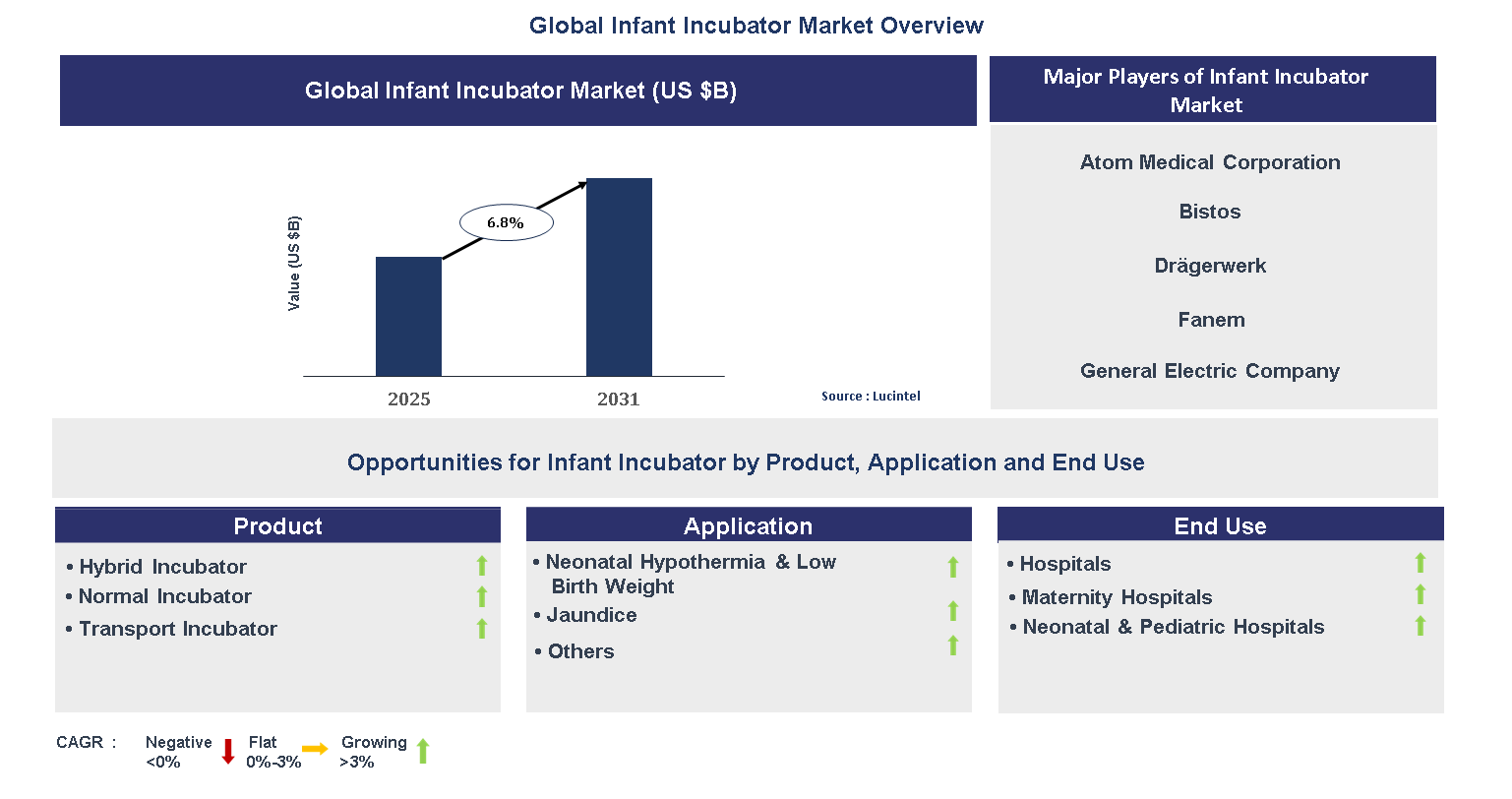
The future of the global infant incubator market looks promising with opportunities in the hospital, maternity hospital, and neonatal & pediatric hospital markets. The global infant incubator market is expected to grow with a CAGR of 6.8% from 2025 to 2031. The major drivers for this market are the increasing prevalence of preterm births, the rising demand for advanced neonatal care, and the growing investments in healthcare infrastructure.• Lucintel forecasts that, within the product category, normal incubator is expected to witness the highest growth over the forecast period.
• Within the end use category, hospital is expected to witness the highest growth.
• In terms of region, APAC is expected to witness the highest growth over the forecast period. Gain valuable insights for your business decisions with our comprehensive 150+ page report. Sample figures with some insights are shown below.
Emerging Trends in the Infant Incubator Market
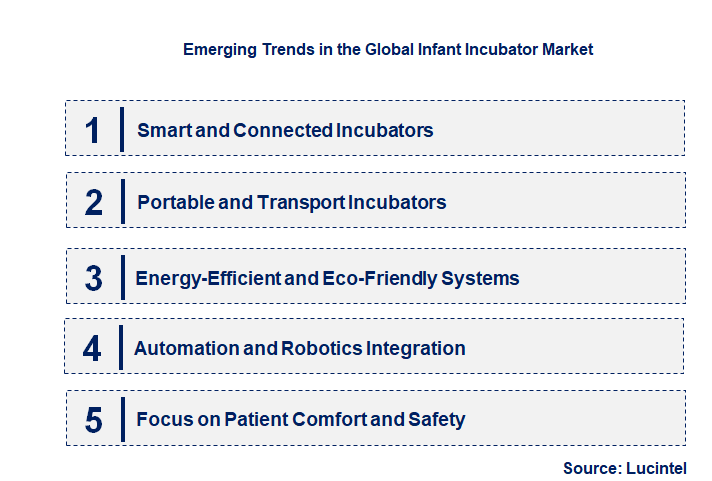
The infant incubator market is being shaped by innovations that enhance neonatal safety, comfort, and clinical efficiency. Emerging trends are centered around digital integration, portability, energy efficiency, and sustainable design. These advancements are redefining how hospitals, clinics, and healthcare providers deliver round-the-clock monitoring and thermal support for premature and low-birth-weight infants.• Smart and Connected Incubators: The integration of IoT and AI technologies is enabling real-time monitoring of vital signs and automated temperature control. These intelligent systems improve neonatal outcomes through predictive alerts and remote supervision, enhancing caregiver response and data-driven decision-making.
• Portable and Transport Incubators: Lightweight, portable designs are expanding neonatal care access in remote and emergency settings. These incubators maintain temperature stability during transport, allowing safe movement of newborns between facilities and improving survival rates in low-resource regions.
• Energy-Efficient and Eco-Friendly Systems: Manufacturers are developing incubators with reduced energy consumption and sustainable materials. These innovations lower operational costs while supporting global environmental goals, making advanced neonatal care more accessible in resource-constrained hospitals.
• Automation and Robotics Integration: Automated systems are reducing manual intervention in neonatal care. Robotics-enabled incubators assist in temperature regulation, humidity control, and data logging, ensuring continuous, precise monitoring and improved clinical efficiency.
• Focus on Patient Comfort and Safety: Design improvements emphasizing infant comfort, reduced noise, and controlled light exposure are enhancing developmental outcomes. Advanced air circulation systems and ergonomic structures minimize infection risk while promoting a safer healing environment. Emerging trends in smart technologies, portability, sustainability, and safety are reshaping the infant incubator landscape. These advancements enhance accessibility and precision in neonatal care, supporting better outcomes and future-ready healthcare environments.
Recent Development in the Infant Incubator Market
The infant incubator market is advancing through key developments in digital technology, automation, and design innovation. Manufacturers and healthcare institutions are prioritizing precision, ease of use, and improved monitoring capabilities to strengthen neonatal intensive care delivery and ensure the highest standards of infant safety.• Development of Smart Control Systems: Integration of AI-driven sensors and automated controls is allowing accurate environmental adjustments within incubators, enhancing neonatal stability and reducing caregiver workload.
• Expansion of Neonatal Care Facilities: Healthcare providers are investing in modern neonatal intensive care units equipped with advanced incubators to improve treatment accessibility and outcomes.
• Innovation in Material and Design: New lightweight, durable, and easy-to-clean materials are improving ergonomics, hygiene, and operational efficiency for caregivers.
• Remote Monitoring Capability: Wireless connectivity features are enabling real-time monitoring of infants’ vital signs and incubator conditions, allowing immediate response and continuous data tracking.
• Collaborative Research Initiatives: Partnerships among manufacturers, hospitals, and academic institutions are driving innovation in incubator technology, focusing on sustainability, comfort, and energy efficiency. Recent developments in automation, materials, and remote monitoring are transforming the infant incubator market. These innovations are fostering safer, smarter, and more accessible neonatal care worldwide.
Strategic Growth Opportunities in the Infant Incubator Market
The infant incubator market presents strong growth opportunities across diverse applications in neonatal care. Healthcare providers are leveraging new incubator designs and functionalities to enhance survival rates, treatment outcomes, and care quality for premature and vulnerable infants across different healthcare environments.• Neonatal Intensive Care Units: Increasing adoption of advanced incubators in NICUs is improving thermal stability, infection control, and patient monitoring for critical infants.
• Maternity Hospitals: Hospitals are integrating smart incubators to ensure continuous thermal regulation and enhance care efficiency for newborns in postnatal wards.
• Transport and Emergency Care: Portable incubators designed for stable thermal control during transport are enabling safe transfers of premature infants between medical facilities.
• Home-Based Neonatal Care: Compact incubators for home use are supporting early discharge programs, allowing continuous monitoring under professional supervision.
• Rural and Community Healthcare: Affordable and energy-efficient incubators are expanding access to neonatal care in remote and underserved regions, improving infant survival rates. Strategic growth across key neonatal applications reflects a global commitment to improving early-life care. By integrating advanced technology and accessibility-focused design, the infant incubator market is enabling equitable and efficient neonatal health services.
Infant Incubator Market Driver and Challenges
The infant incubator market is influenced by technological innovation, economic factors, and healthcare regulations. Growing focus on neonatal care quality, hospital modernization, and digital transformation drives market expansion. However, challenges including high costs, regulatory constraints, and limited technical expertise continue to shape adoption patterns across different regions. The factors responsible for driving the infant incubator market include: 1. Technological Advancement: Integration of digital sensors, automation, and smart monitoring improves performance accuracy and patient safety, enhancing the quality of neonatal care. 2. Rising Preterm Birth Rates: Increasing cases of premature births are driving demand for advanced infant incubators with reliable temperature control and monitoring capabilities. 3. Improved Healthcare Infrastructure: Expansion of neonatal intensive care units and modern hospitals is boosting incubator adoption globally. 4. Government Support for Neonatal Care: Public initiatives promoting infant health and funding hospital equipment upgrades are accelerating incubator deployment. 5. Growing Focus on Patient Safety: Enhanced awareness of neonatal care standards is increasing demand for incubators with infection control and safety compliance features. Challenges in the infant incubator market are: 1. High Equipment Costs: The significant investment required for advanced incubators limits accessibility in smaller healthcare centers. 2. Regulatory Barriers: Complex approval processes and regional compliance standards slow down product commercialization. 3. Shortage of Skilled Personnel: Lack of trained neonatal technicians and healthcare professionals affects efficient use and maintenance of incubator systems. Technological innovation and healthcare expansion are propelling the infant incubator market forward. However, overcoming cost, regulatory, and workforce challenges remains crucial for achieving broader accessibility and equitable neonatal care delivery worldwide.List of Infant Incubator Companies
Companies in the market compete on the basis of product quality offered. Major players in this market focus on expanding their manufacturing facilities, R&D investments, infrastructural development, and leverage integration opportunities across the value chain. With these strategies infant incubator companies cater increasing demand, ensure competitive effectiveness, develop innovative products & technologies, reduce production costs, and expand their customer base. Some of the infant incubator companies profiled in this report include-• Atom Medical Corporation
• Bistos
• Drägerwerk
• Fanem
• General Electric Company
• Medicor Elektronika
• Médipréma Group
• Ningbo David Medical Device
• Phoenix Medical System
• Zhengzhou Dison Instrument
Infant Incubator Market by Segment
The study includes a forecast for the global infant incubator market by product, application, end use, and region.Infant Incubator Market by Product [Value from 2019 to 2031]:
• Hybrid Incubator
• Normal Incubator
• Transport Incubator
Infant Incubator Market by Application [Value from 2019 to 2031]:
• Neonatal Hypothermia & Low Birth Weight
• Jaundice
• Others
Infant Incubator Market by End Use [Value from 2019 to 2031]:
• Hospitals
• Maternity Hospitals
• Neonatal & Pediatric Hospitals
Infant Incubator Market by Region [Value from 2019 to 2031]:
• North America
• Europe
• Asia Pacific
• The Rest of the World
Country Wise Outlook for the Infant Incubator Market
The infant incubator market is evolving as healthcare systems focus on improving neonatal outcomes through technological advancement and enhanced care delivery. Developments in smart monitoring, temperature control, and portable incubator design are transforming neonatal intensive care globally. The United States, China, Germany, India, and Japan are leading this evolution through innovation, accessibility, and infrastructure modernization.• United States: The U.S. market is witnessing advancements in intelligent infant incubators with integrated sensors, real-time data analytics, and wireless monitoring. These innovations enable healthcare professionals to ensure precise temperature and humidity regulation, improving neonatal survival rates. Strategic collaborations between hospitals and medical device firms are driving the adoption of connected neonatal care solutions.
• Chin: China’s infant incubator market is strengthening through increased domestic production and technology transfer from global firms. Local manufacturers are emphasizing cost-effective, high-performance devices to serve both urban and rural healthcare facilities. Government initiatives supporting neonatal care improvement are accelerating accessibility and affordability across hospitals and clinics.
• Germany: Germany continues to lead in advanced engineering for infant incubators. The focus on ergonomic designs, safety compliance, and energy efficiency enhances neonatal comfort and clinical workflow. Collaborations between research institutes and medical technology firms are promoting development of highly reliable, digitally integrated incubator systems for intensive care units.
• India: India’s infant incubator market is growing through initiatives aimed at enhancing neonatal intensive care facilities. Public and private hospitals are adopting modern incubators with digital controls and mobility features to reach underserved regions. Affordable models and partnerships with global manufacturers are improving access and outcomes in neonatal healthcare.
• Japan: Japan’s market is progressing through precision engineering and automation in neonatal care. Smart incubators equipped with automated environmental regulation and digital tracking systems ensure optimal care for premature infants. Integration of robotics and AI-assisted monitoring further strengthens Japan’s position in advanced neonatal technology innovation.

Features of the Global Infant Incubator Market
Market Size Estimates: Infant incubator market size estimation in terms of value ($B). Trend and Forecast Analysis: Market trends (2019 to 2024) and forecast (2025 to 2031) by various segments and regions. Segmentation Analysis: Infant incubator market size by product, application, end use, and region in terms of value ($B). Regional Analysis: Infant incubator market breakdown by North America, Europe, Asia Pacific, and Rest of the World. Growth Opportunities: Analysis of growth opportunities in different products, applications, end uses, and regions for the infant incubator market. Strategic Analysis: This includes M&A, new product development, and competitive landscape of the infant incubator market. Analysis of competitive intensity of the industry based on Porter’s Five Forces model.
FAQ
Q1. What is the growth forecast for infant incubator market? Answer: The global infant incubator market is expected to grow with a CAGR of 6.8% from 2025 to 2031. Q2. What are the major drivers influencing the growth of the infant incubator market? Answer: The major drivers for this market are the increasing prevalence of preterm births, the rising demand for advanced neonatal care, and the growing investments in healthcare infrastructure. Q3. What are the major segments for infant incubator market? Answer: The future of the infant incubator market looks promising with opportunities in the hospital, maternity hospital, and neonatal & pediatric hospital markets. Q4. Who are the key infant incubator market companies? Answer: Some of the key infant incubator companies are as follows:• Atom Medical Corporation
• Bistos
• Drägerwerk
• Fanem
• General Electric Company
• Medicor Elektronika
• Médipréma Group
• Ningbo David Medical Device
• Phoenix Medical System
• Zhengzhou Dison Instrument Q5. Which infant incubator market segment will be the largest in future? Answer: Lucintel forecasts that, within the product category, normal incubator is expected to witness the highest growth over the forecast period. Q6. In infant incubator market, which region is expected to be the largest in next 5 years? Answer: In terms of region, APAC is expected to witness the highest growth over the forecast period. Q7. Do we receive customization in this report? Answer: Yes, Lucintel provides 10% customization without any additional cost.
Table of Contents
List of Figures
List of Tables
Methodology
- In-depth interviews of the major players in this market
- Detailed secondary research from competitors’ financial statements and published data
- Extensive searches of published works, market, and database information pertaining to industry news, company press releases, and customer intentions
- A compilation of the experiences, judgments, and insights of Lucintel’s professionals, who have analyzed and tracked this market over the years.


Buy Now
Choose a license that fits your team. Instant PDF delivery.
Prices exclude taxes. Instant delivery. Custom licensing available on request.
Key Questions
- • What are some of the most promising, high-growth opportunities for the infant incubator market by product (hybrid incubator, normal incubator, and transport incubator), application (neonatal hypothermia & low birth weight, jaundice, and others), end use (hospitals, maternity hospitals, and neonatal & pediatric hospitals), and region (North America, Europe, Asia Pacific, and the Rest of the World)?
- • Which segments will grow at a faster pace and why?
- • Which region will grow at a faster pace and why?
- • What are the key factors affecting market dynamics? What are the key challenges and business risks in this market?
- • What are the business risks and competitive threats in this market?
- • What are the emerging trends in this market and the reasons behind them?
- • What are some of the changing demands of customers in the market?
- • What are the new developments in the market? Which companies are leading these developments?
- • Who are the major players in this market? What strategic initiatives are key players pursuing for business growth?
- • What are some of the competing products in this market and how big of a threat do they pose for loss of market share by material or product substitution?
- • What M&A activity has occurred in the last 5 years and what has its impact been on the industry? For any questions related to Infant Incubator Market, Infant Incubator Market Size, Infant Incubator Market Growth, Infant Incubator Market Analysis, Infant Incubator Market Report, Infant Incubator Market Share, Infant Incubator Market Trends, Infant Incubator Market Forecast, Infant Incubator Companies, write Lucintel analyst at email: helpdesk@lucintel.com. We will be glad to get back to you soon.


