
Report Feature
Inertial Guidance Solution Market Trends and Forecast
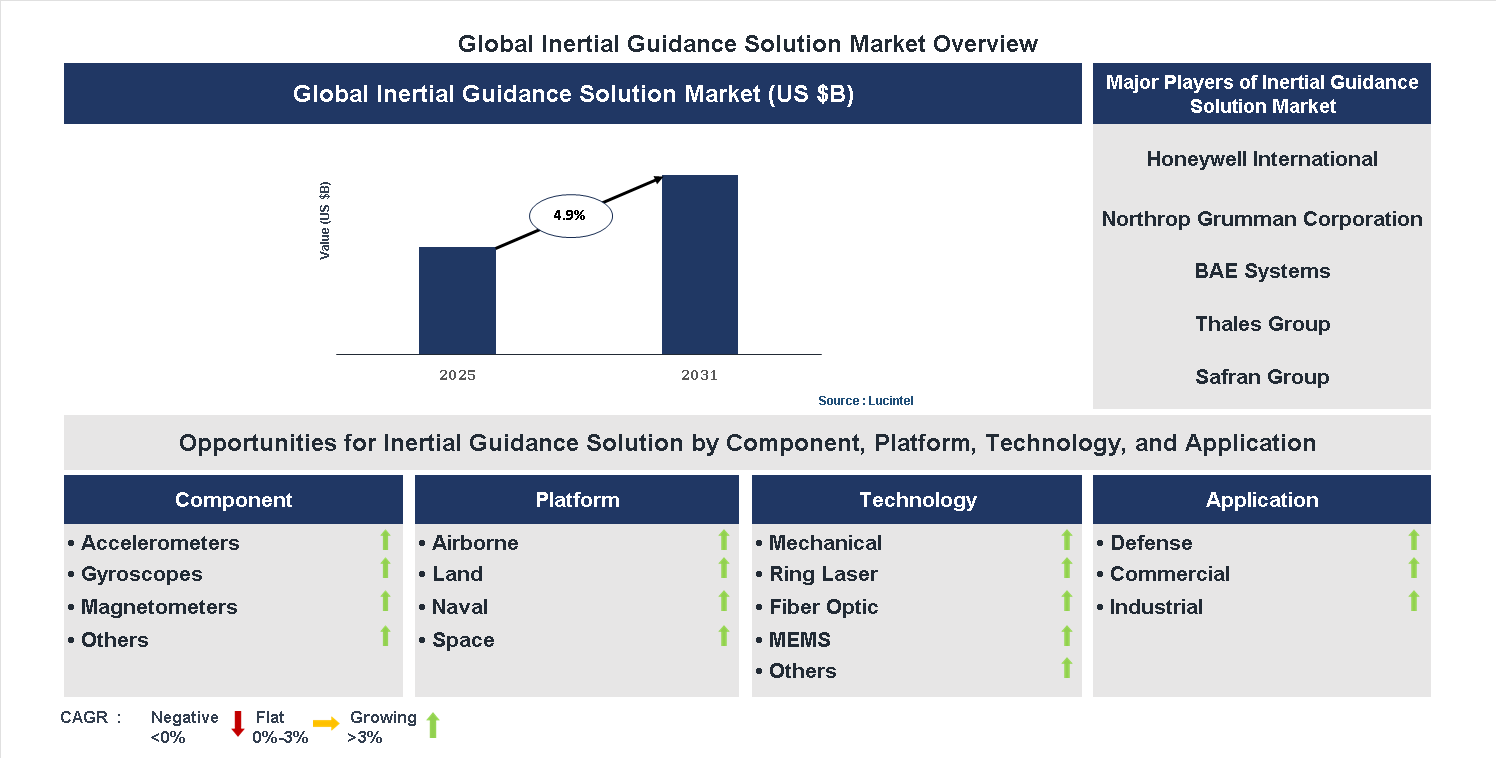
The future of the global inertial guidance solution market looks promising with opportunities in the defense, commercial, and industrial markets. The global inertial guidance solution market is expected to grow with a CAGR of 4.9% from 2025 to 2031. The major drivers for this market are the increasing demand for precision navigation systems, the rising defense aerospace modernization programs, and the growing adoption of autonomous vehicle technologies.• Lucintel forecasts that, within the component category, gyroscope is expected to witness the highest growth over the forecast period.
• Within the application category, defense is expected to witness the highest growth.
• In terms of region, APAC is expected to witness the highest growth over the forecast period. Gain valuable insights for your business decisions with our comprehensive 150+ page report. Sample figures with some insights are shown below.
Emerging Trends in the Inertial Guidance Solution Market
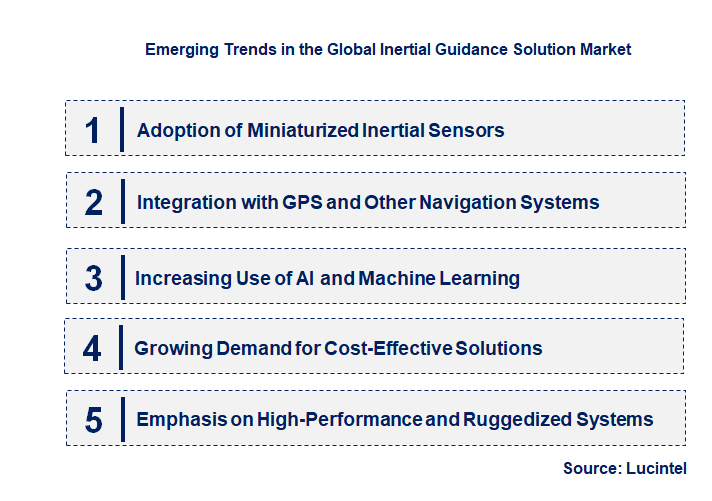
The inertial guidance solution market is experiencing rapid evolution driven by technological advancements, increasing demand for precision in defense and aerospace applications, and the integration of innovative systems. As industries seek more reliable, accurate, and cost-effective navigation solutions, emerging trends are shaping the future landscape of this market. These developments are not only enhancing existing capabilities but also opening new avenues for applications across various sectors. Understanding these key trends is essential for stakeholders aiming to stay competitive and leverage new opportunities in this dynamic environment.• Adoption of Miniaturized Inertial Sensors: The trend toward miniaturization involves developing smaller, lightweight inertial sensors that maintain high accuracy. This shift enables integration into compact devices such as drones, autonomous vehicles, and portable systems, expanding the market beyond traditional defense and aerospace sectors. The miniaturization enhances mobility, reduces costs, and improves system efficiency, making inertial guidance solutions more versatile and accessible for a broader range of applications.
• Integration with GPS and Other Navigation Systems: Combining inertial guidance with GPS and other positioning technologies creates hybrid systems that offer enhanced accuracy and reliability. This integration mitigates the limitations of standalone inertial systems, such as signal loss or interference, especially in challenging environments like tunnels or urban canyons. The result is more robust navigation solutions suitable for autonomous vehicles, military operations, and maritime applications, significantly improving operational effectiveness and safety.
• Increasing Use of AI and Machine Learning: Incorporating artificial intelligence and machine learning algorithms into inertial guidance systems allows for real-time data processing, anomaly detection, and predictive maintenance. These advancements improve system accuracy, reduce calibration time, and enable adaptive performance in dynamic environments. AI-driven inertial solutions are particularly valuable in autonomous navigation, robotics, and defense, where precision and reliability are critical, thus transforming traditional inertial guidance into smarter, more autonomous systems.
• Growing Demand for Cost-Effective Solutions: As the market expands, there is a rising need for affordable inertial guidance systems without compromising performance. Innovations in manufacturing processes, materials, and design are driving down costs, making these solutions accessible to smaller organizations and emerging markets. Cost-effective systems facilitate wider adoption across commercial sectors, including logistics, agriculture, and consumer electronics, thereby broadening the market scope and fostering competitive growth.
• Emphasis on High-Performance and Ruggedized Systems: The demand for high-performance inertial guidance solutions capable of operating in extreme conditions is increasing. Ruggedized systems are designed to withstand harsh environments such as high vibration, temperature fluctuations, and shock. This trend is critical for military, aerospace, and industrial applications where reliability and durability are paramount. The focus on ruggedization ensures consistent performance, enhances safety, and extends the lifespan of guidance systems in demanding operational scenarios. In summary, these emerging trends are fundamentally reshaping the inertial guidance solution market by enhancing system capabilities, expanding application areas, and reducing costs. The integration of advanced technologies and focus on robustness are driving innovation, making inertial guidance solutions more accurate, reliable, and accessible. As a result, the market is poised for significant growth, with new opportunities emerging across defense, aerospace, autonomous vehicles, and commercial sectors.
Recent Development in the Inertial Guidance Solution Market
The inertial guidance solution market is experiencing rapid growth driven by technological advancements and increasing demand across various sectors. Innovations in sensor accuracy, integration with autonomous systems, and expanding applications in defense, aerospace, and commercial industries are fueling this expansion. As industries seek more reliable and precise navigation systems, market players are investing heavily in R&D. These developments are transforming the landscape, creating new opportunities, and challenging existing providers to innovate continuously to meet evolving customer needs.• Technological Advancements in Sensor Accuracy: The development of highly precise inertial sensors enhances navigation accuracy, reducing reliance on GPS signals. This progress is crucial for autonomous vehicles, military applications, and aerospace, where GPS signals may be unreliable or unavailable. Improved sensor technology leads to better performance, increased safety, and expanded use cases, thereby driving market growth. Companies investing in miniaturization and robustness are gaining competitive advantages, making inertial guidance solutions more versatile and accessible.
• Integration with Autonomous Systems: The integration of inertial guidance with autonomous vehicles and drones is revolutionizing navigation capabilities. This synergy allows for precise positioning even in GPS-denied environments, essential for military, commercial, and industrial applications. As autonomous systems become more prevalent, demand for reliable inertial guidance solutions increases. This integration enhances operational efficiency, safety, and autonomy, prompting manufacturers to develop more sophisticated, compact, and cost-effective systems to meet market needs.
• Expansion in Defense and Aerospace Applications: Defense and aerospace sectors are increasingly adopting inertial guidance solutions for missile navigation, aircraft, and space exploration. The need for highly accurate, reliable, and resistant systems in harsh environments is driving innovation. These applications demand advanced technology capable of functioning independently of external signals, ensuring mission success. The growth in defense budgets and space exploration initiatives further accelerates market expansion, encouraging R&D investments and strategic collaborations among industry players.
• Growing Demand in Commercial Sector: Commercial sectors such as shipping, mining, and construction are adopting inertial guidance for improved operational efficiency and safety. The ability to operate in GPS-compromised environments makes these solutions attractive for underground mining, large-scale construction, and maritime navigation. The increasing adoption of autonomous commercial vehicles also boosts demand. Market players are focusing on developing scalable, cost-effective solutions tailored for commercial applications, which significantly contribute to overall market growth and diversification.
• Advances in Miniaturization and Cost Reduction: Innovations in miniaturization and manufacturing processes are making inertial guidance systems more affordable and easier to integrate into various platforms. Cost reduction enables wider adoption across small and medium-sized enterprises, expanding the market reach. Smaller, lightweight systems are ideal for portable and embedded applications, increasing versatility. These advancements are crucial for penetrating new markets, fostering innovation, and maintaining competitive advantage, ultimately accelerating overall market growth and technological adoption. Conclusion (80 Words) – These recent developments are significantly transforming the inertial guidance solution market by enhancing accuracy, expanding application scope, and reducing costs. The integration with autonomous systems and increased adoption in defense, aerospace, and commercial sectors are driving robust growth. Miniaturization and technological innovations are making solutions more accessible and versatile. Collectively, these trends are fostering a dynamic, competitive environment that is poised to shape the future of navigation and guidance technologies across multiple industries.
Strategic Growth Opportunities in the Inertial Guidance Solution Market
The inertial guidance solution market is experiencing rapid expansion driven by technological advancements and increasing demand across various sectors such as defense, aerospace, and autonomous vehicles. As industries seek more precise navigation and positioning systems, growth opportunities are emerging in both established and emerging markets. Companies are investing heavily in innovation, integration, and regional expansion to capitalize on these trends. This dynamic environment offers significant potential for stakeholders to enhance their market share and develop cutting-edge solutions that meet evolving customer needs.• Integration of Inertial Guidance with Autonomous Systems: The increasing adoption of autonomous vehicles and drones necessitates highly accurate navigation systems. Integrating inertial guidance solutions with GPS and other sensors enhances reliability, especially in GPS-denied environments. This integration improves operational efficiency, safety, and precision, creating substantial growth opportunities for providers. As autonomous technology advances, demand for sophisticated inertial guidance systems that can operate seamlessly in complex scenarios is expected to surge, driving innovation and market expansion.
• Growing Demand in Defense and Military Applications: Defense sectors worldwide are investing heavily in inertial guidance solutions for missile systems, submarines, and military aircraft. The need for secure, accurate, and resistant navigation systems in hostile environments fuels this demand. Governments are prioritizing the modernization of military hardware, which includes upgrading inertial guidance components. This trend offers lucrative opportunities for market players to develop advanced, ruggedized, and miniaturized systems tailored for defense applications, thereby expanding their market presence and revenue streams.
• Expansion of Aerospace and Satellite Navigation Markets: The aerospace industry’s focus on precise navigation for commercial and military aircraft, as well as satellite-based systems, is boosting inertial guidance adoption. Innovations in miniaturization and enhanced accuracy are enabling new applications in space exploration and satellite positioning. As space missions become more complex, inertial guidance solutions are critical for ensuring mission success. This expansion opens avenues for R&D investments and strategic partnerships, fostering growth in both aerospace and satellite navigation markets.
• Increasing Adoption in Oil & Gas and Mining Industries: Harsh environments in oil, gas, and mining sectors demand robust navigation solutions that can operate independently of external signals. Inertial guidance systems provide reliable positioning in underground or underwater operations where GPS signals are unavailable. The rising need for safety, efficiency, and operational precision in these industries presents significant growth opportunities. Companies developing rugged, high-performance inertial guidance solutions are poised to benefit from this trend, expanding their market footprint in resource extraction sectors.
• Technological Advancements in Miniaturization and Accuracy: Continuous innovation in sensor technology, algorithms, and materials is leading to smaller, more accurate inertial guidance systems. These advancements enable integration into a broader range of devices, including wearable technology, small drones, and portable equipment. The push for higher precision at lower costs fuels R&D investments, creating opportunities for new entrants and existing players to develop next-generation solutions. This trend is expected to significantly enhance market competitiveness and open new application domains. In conclusion, these growth opportunities are poised to significantly influence the inertial guidance solution market by fostering innovation, expanding application areas, and driving regional development. Companies that capitalize on these trends through strategic investments and technological advancements will be well-positioned to lead in this evolving landscape, ultimately contributing to the market’s sustained growth and diversification.
Inertial Guidance Solution Market Driver and Challenges
The inertial guidance solution market is influenced by a variety of technological, economic, and regulatory factors that shape its growth trajectory. Rapid advancements in sensor technology, increasing demand for precision in military and commercial applications, and supportive government policies are key drivers. Conversely, challenges such as high development costs, regulatory hurdles, and technological complexity pose significant barriers. Understanding these drivers and challenges is essential for stakeholders to navigate the evolving landscape effectively and capitalize on emerging opportunities. The factors responsible for driving the inertial guidance solution market include:-• Technological Innovation: The continuous development of advanced inertial sensors and miniaturization techniques enhances the accuracy and reliability of guidance systems, making them more suitable for diverse applications. This innovation drives market growth by enabling new use cases in aerospace, defense, and autonomous vehicles. As sensor technology becomes more affordable and precise, manufacturers can deliver more sophisticated solutions, fueling demand. Additionally, integration with other navigation systems like GPS further boosts performance, expanding market potential.
• Increasing Defense Spending: Governments worldwide are increasing their defense budgets to modernize military capabilities, which significantly impacts the inertial guidance market. These systems are critical for missile guidance, aircraft navigation, and naval applications, ensuring strategic superiority. Rising geopolitical tensions and the need for advanced defense infrastructure lead to higher procurement of inertial guidance solutions. This sustained investment creates a robust demand pipeline, encouraging innovation and expansion within the industry.
• Growing Adoption in Commercial Sectors: Beyond defense, inertial guidance solutions are increasingly adopted in commercial sectors such as aerospace, autonomous vehicles, and industrial automation. The rise of autonomous drones and self-driving cars relies heavily on precise navigation systems, propelling market growth. Additionally, the oil and gas industry uses inertial systems for wellbore positioning, and logistics companies employ them for fleet management. This diversification of applications broadens the market scope and accelerates technological development.
• Regulatory and Standardization Frameworks: The implementation of strict safety and quality standards by regulatory bodies fosters trust and reliability in inertial guidance systems. Compliance with international standards ensures market acceptance and facilitates global trade. Governments and industry consortia are working towards harmonizing regulations, which reduces barriers to entry and encourages innovation. These frameworks also promote the development of more robust, secure, and interoperable solutions, further stimulating market growth. The challenges facing this inertial guidance solution market include:-
• High Development and Manufacturing Costs: Developing advanced inertial guidance systems involves significant investment in research, high-precision components, and testing. These costs can be prohibitive for smaller players and may slow down innovation. Additionally, manufacturing complexities and the need for rigorous quality control increase overall expenses, impacting pricing strategies and market competitiveness. This financial barrier can limit market entry and restrict the proliferation of cutting-edge solutions, especially in emerging economies.
• Technological Complexity and Integration Issues: Inertial guidance systems require sophisticated integration with other navigation and control systems, which can be technically challenging. Ensuring compatibility, accuracy, and robustness across diverse platforms demands extensive R&D and testing. Technological complexity can lead to delays in product development and deployment, and integration issues may compromise system performance, affecting end-user confidence and market adoption.
• Regulatory and Geopolitical Barriers: Stringent export controls, sanctions, and evolving regulatory landscapes can hinder the global trade of inertial guidance solutions. Geopolitical tensions may restrict access to key components or markets, limiting growth opportunities. Additionally, compliance with varying national standards can increase costs and complicate international expansion. These barriers pose significant risks to market players seeking to operate on a global scale and can slow down overall industry development. In summary, the inertial guidance solution market is driven by technological advancements, increased defense and commercial demand, and supportive regulatory frameworks. However, high costs, technological complexities, and regulatory barriers present notable challenges. These factors collectively influence the market’s growth potential, requiring stakeholders to innovate strategically and navigate regulatory landscapes carefully. Overall, the market’s future will depend on balancing these drivers and challenges to foster sustainable growth and technological progress.
List of Inertial Guidance Solution Companies
Companies in the market compete on the basis of product quality offered. Major players in this market focus on expanding their manufacturing facilities, R&D investments, infrastructural development, and leverage integration opportunities across the value chain. With these strategies inertial guidance solution companies cater increasing demand, ensure competitive effectiveness, develop innovative products & technologies, reduce production costs, and expand their customer base. Some of the inertial guidance solution companies profiled in this report include-• Honeywell International
• Northrop Grumman Corporation
• BAE Systems
• Thales Group
• Safran Group
• Raytheon Technologies Corporation
• General Electric Company
• Rockwell Collins
• KVH Industries
• Trimble
Inertial Guidance Solution Market by Segment
The study includes a forecast for the global inertial guidance solution market by component, platform, technology, application, and region.Inertial Guidance Solution Market by Component [Value from 2019 to 2031]:
• Accelerometers
• Gyroscopes
• Magnetometers
• Others
Inertial Guidance Solution Market by Platform [Value from 2019 to 2031]:
• Airborne
• Land
• Naval
• Space
Inertial Guidance Solution Market by Technology [Value from 2019 to 2031]:
• Mechanical
• Ring Laser
• Fiber Optic
• MEMS
• Others
Inertial Guidance Solution Market by Application [Value from 2019 to 2031]:
• Defense
• Commercial
• Industrial
Inertial Guidance Solution Market by Region [Value from 2019 to 2031]:
• North America
• Europe
• Asia Pacific
• The Rest of the World
Country Wise Outlook for the Inertial Guidance Solution Market
The inertial guidance solution market has experienced significant advancements driven by technological innovation, increased defense spending, and the growing demand for precision in navigation systems across various sectors. Countries are investing heavily in research and development to enhance the accuracy, reliability, and integration capabilities of inertial guidance systems. These developments are crucial for applications in defense, aerospace, autonomous vehicles, and industrial automation. As the market evolves, regional players are adopting new strategies to gain competitive advantages, leading to rapid technological progress and expanding market opportunities worldwide.• United States: The US market has seen substantial growth due to increased defense budgets and technological innovation. Major defense contractors are developing advanced inertial guidance systems with enhanced accuracy and miniaturization for military applications. The adoption of inertial navigation in autonomous vehicles and aerospace is also rising, supported by government initiatives and private sector investments. The US continues to lead in R&D, with several startups and established companies pushing the boundaries of inertial technology.
• China: China is rapidly expanding its inertial guidance market, driven by military modernization and technological self-reliance goals. The country has made significant progress in developing indigenous inertial navigation systems, reducing dependence on foreign technology. Chinese firms are focusing on integrating inertial guidance with other navigation systems like GPS and BeiDou for improved accuracy. The government’s strategic investments in defense and aerospace sectors are fueling market growth and innovation.
• Germany: Germany remains a key player in the inertial guidance market, primarily through its strong aerospace and defense industries. The country emphasizes high-precision, reliable systems for military and commercial applications. German companies are investing in the development of miniaturized and energy-efficient inertial sensors, with a focus on integration into autonomous systems and industrial automation. Collaboration with European partners is also fostering technological advancements and market expansion.
• India: India is witnessing rapid growth in inertial guidance solutions, driven by defense modernization and the expansion of the aerospace sector. The government’s "Make in India" initiative encourages local manufacturing and innovation in inertial navigation systems. Indian companies are developing cost-effective and robust systems for military applications, including missile guidance and autonomous vehicles. Strategic partnerships with global firms are enhancing technological capabilities and market reach.
• Japan: Japan’s inertial guidance market is characterized by high technological sophistication and integration with advanced robotics and aerospace systems. The country invests heavily in research to improve sensor accuracy, durability, and miniaturization. Japanese firms are focusing on applications in space exploration, autonomous vehicles, and defense. The government’s emphasis on innovation and collaboration with international partners continues to drive market development and technological progress.

Features of the Global Inertial Guidance Solution Market
Market Size Estimates: Inertial guidance solution market size estimation in terms of value ($B). Trend and Forecast Analysis: Market trends (2019 to 2024) and forecast (2025 to 2031) by various segments and regions. Segmentation Analysis: Inertial guidance solution market size by various segments, such as by component, platform, technology, application, and region in terms of value ($B). Regional Analysis: Inertial guidance solution market breakdown by North America, Europe, Asia Pacific, and Rest of the World. Growth Opportunities: Analysis of growth opportunities in different components, platforms, technologies, applications, and regions for the inertial guidance solution market. Strategic Analysis: This includes M&A, new product development, and competitive landscape of the inertial guidance solution market. Analysis of competitive intensity of the industry based on Porter’s Five Forces model.
FAQ
Q1. What is the growth forecast for inertial guidance solution market? Answer: The global inertial guidance solution market is expected to grow with a CAGR of 4.9% from 2025 to 2031. Q2. What are the major drivers influencing the growth of the inertial guidance solution market? Answer: The major drivers for this market are the increasing demand for precision navigation systems, the rising defense aerospace modernization programs, and the growing adoption of autonomous vehicle technologies. Q3. What are the major segments for inertial guidance solution market? Answer: The future of the inertial guidance solution market looks promising with opportunities in the defense, commercial, and industrial markets. Q4. Who are the key inertial guidance solution market companies? Answer: Some of the key inertial guidance solution companies are as follows:• Honeywell International
• Northrop Grumman Corporation
• BAE Systems
• Thales Group
• Safran Group
• Raytheon Technologies Corporation
• General Electric Company
• Rockwell Collins
• KVH Industries
• Trimble Q5. Which inertial guidance solution market segment will be the largest in future? Answer: Lucintel forecasts that, within the component category, gyroscope is expected to witness the highest growth over the forecast period. Q6. In inertial guidance solution market, which region is expected to be the largest in next 5 years? Answer: In terms of region, APAC is expected to witness the highest growth over the forecast period. Q7. Do we receive customization in this report? Answer: Yes, Lucintel provides 10% customization without any additional cost.
Table of Contents
List of Figures
List of Tables
Methodology
- In-depth interviews of the major players in this market
- Detailed secondary research from competitors’ financial statements and published data
- Extensive searches of published works, market, and database information pertaining to industry news, company press releases, and customer intentions
- A compilation of the experiences, judgments, and insights of Lucintel’s professionals, who have analyzed and tracked this market over the years.


Buy Now
Choose a license that fits your team. Instant PDF delivery.
Prices exclude taxes. Instant delivery. Custom licensing available on request.
Key Questions
- • What are some of the most promising, high-growth opportunities for the inertial guidance solution market by component (accelerometers, gyroscopes, magnetometers, and others), platform (airborne, land, naval, and space), technology (mechanical, ring laser, fiber optic, MEMS, and others), application (defense, commercial, and industrial), and region (North America, Europe, Asia Pacific, and the Rest of the World)?
- • Which segments will grow at a faster pace and why?
- • Which region will grow at a faster pace and why?
- • What are the key factors affecting market dynamics? What are the key challenges and business risks in this market?
- • What are the business risks and competitive threats in this market?
- • What are the emerging trends in this market and the reasons behind them?
- • What are some of the changing demands of customers in the market?
- • What are the new developments in the market? Which companies are leading these developments?
- • Who are the major players in this market? What strategic initiatives are key players pursuing for business growth?
- • What are some of the competing products in this market and how big of a threat do they pose for loss of market share by material or product substitution?
- • What M&A activity has occurred in the last 6 years and what has its impact been on the industry? For any questions related to Inertial Guidance Solution Market, Inertial Guidance Solution Market Size, Inertial Guidance Solution Market Growth, Inertial Guidance Solution Market Analysis, Inertial Guidance Solution Market Report, Inertial Guidance Solution Market Share, Inertial Guidance Solution Market Trends, Inertial Guidance Solution Market Forecast, Inertial Guidance Solution Companies, write Lucintel analyst at email: helpdesk@lucintel.com. We will be glad to get back to you soon.


