
'
...

The Impact of COVID-19 is included in Industrial Workwear Market Report. Buy it today to get an advantage.

Request the impact of COVID-19 on your product or industry


Industrial Workwear Market Trends and Forecast

The future of the global industrial workwear market looks promising with opportunities in the oil & gas, manufacturing, construction, mining, chemical, and pharmaceutical/health care markets. The global industrial workwear market is expected to reach an estimated $31 billion by 2035 with a CAGR of 4.6% from 2026 to 2035. The major drivers for this market are the increasing focus on worker safety standards, the rising demand from manufacturing & construction, and the growing adoption of durable protective clothing.

• Lucintel forecasts that, within the product type category, protective workwear is expected to witness higher growth over the forecast period.
• Within the end use category, manufacturing is expected to witness the highest growth.
• In terms of region, APAC is expected to witness the highest growth over the forecast period.
Gain valuable insights for your business decisions with our comprehensive 150+ page report. Sample figures with some insights are shown below.

Industrial Workwear Market Trends and Forecast

Emerging Trends in the Industrial Workwear Market

The industrial workwear market is experiencing rapid evolution driven by technological advancements, changing safety regulations, and shifting workforce needs. As industries prioritize safety, comfort, and sustainability, manufacturers are innovating to meet these demands. The market is also influenced by digital transformation, customization, and the growing emphasis on eco-friendly materials. These developments are reshaping how companies select, design, and utilize workwear, leading to increased efficiency, safety, and environmental responsibility. Understanding these emerging trends is crucial for stakeholders aiming to stay competitive and meet the evolving expectations of the industrial workforce.

• Adoption of Smart Workwear: Integration of wearable technology such as sensors and GPS in workwear enhances safety and productivity. These smart garments can monitor vital signs, detect hazardous conditions, and provide real-time data to workers and managers. This trend improves incident response times, reduces workplace accidents, and optimizes operational efficiency. As IoT technology advances, smart workwear is becoming more affordable and widespread, transforming traditional safety gear into connected, intelligent solutions that support worker health and safety.
• Focus on Sustainability and Eco-Friendly Materials: Increasing environmental awareness is driving demand for sustainable workwear made from recycled, biodegradable, or organic materials. Manufacturers are adopting eco-friendly fabrics to reduce carbon footprints and comply with stricter regulations. This trend appeals to environmentally conscious companies and workers, fostering brand loyalty and corporate responsibility. The shift towards sustainable materials also encourages innovation in textile manufacturing, leading to durable, comfortable, and environmentally friendly workwear options that align with global sustainability goals.
• Customization and Personalization: Companies seek tailored workwear to improve worker comfort, safety, and brand identity. Advances in digital printing and manufacturing enable on-demand customization, including logos, colors, and fit adjustments. Personalized workwear enhances employee morale and safety by ensuring proper fit and visibility. This trend allows brands to differentiate themselves in competitive markets and meet specific industry standards. The ability to quickly produce customized designs also reduces inventory costs and waste, making workwear more adaptable to diverse industrial environments.
• Increased Use of Advanced Fabrics: Innovations in textile technology have led to the development of high-performance fabrics that offer superior durability, breathability, and resistance to chemicals, flames, and water. These fabrics improve worker safety and comfort, especially in hazardous environments. The adoption of advanced textiles also extends the lifespan of workwear, reducing replacement costs and waste. As industries demand more resilient and functional apparel, manufacturers are investing heavily in research to create fabrics that meet the rigorous standards of various industrial sectors.
• Digital Supply Chain and E-Commerce Platforms: The rise of online platforms and digital supply chains streamlines procurement, inventory management, and distribution of workwear. Companies can now order customized products quickly, track shipments in real-time, and manage stock levels efficiently. This trend reduces lead times, lowers costs, and enhances supply chain transparency. E-commerce solutions also facilitate direct engagement with customers, providing tailored recommendations and improving overall service quality. As digital integration deepens, the market becomes more agile, responsive, and customer-centric, supporting rapid adaptation to industry needs.

These emerging trends are fundamentally transforming the industrial workwear market by integrating technology, promoting sustainability, enabling customization, and optimizing supply chains. These developments are leading to safer, more efficient, and environmentally responsible work environments, ultimately reshaping industry standards and expectations.
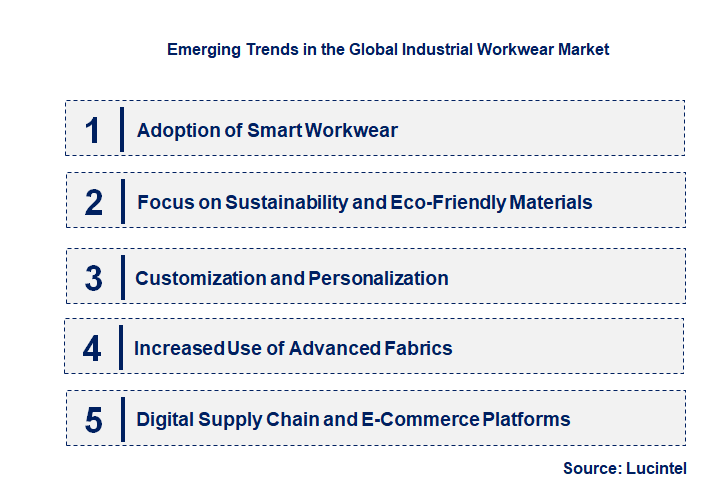
Emerging Trends in the Industrial Workwear Market

Recent Development in the Industrial Workwear Market

The industrial workwear market is experiencing rapid growth driven by increasing safety regulations, technological advancements, and expanding industrial sectors worldwide. As industries prioritize worker safety and operational efficiency, demand for durable, innovative, and customizable workwear is rising. Market players are investing in sustainable materials and smart textiles to meet evolving needs. These developments are shaping a competitive landscape, offering new opportunities for manufacturers and suppliers to cater to diverse industrial environments and enhance worker protection.

• Adoption of Smart Textiles for Enhanced Safety : The integration of smart textiles with sensors and responsive features is revolutionizing industrial workwear. These textiles can monitor vital signs, detect hazardous gases, and provide real-time alerts, significantly improving worker safety. This innovation reduces accidents and health risks, making workwear more functional and appealing. As industries adopt these technologies, market demand for high-tech workwear is expected to surge, opening avenues for new product development and customization.
• Expansion of Sustainable and Eco-Friendly Materials : The shift towards sustainability is influencing workwear manufacturing, with a focus on eco-friendly fabrics like recycled polyester, organic cotton, and biodegradable materials. These sustainable options appeal to environmentally conscious companies and consumers. They also meet stricter regulations on waste and emissions. The adoption of green materials enhances brand reputation and compliance, driving growth in eco-friendly workwear segments and encouraging innovation in sustainable textile production.
• Customization and Personalization of Workwear : Companies increasingly seek tailored workwear solutions to meet specific safety standards, branding, and comfort requirements. Customization options include logo embroidery, color coding, and ergonomic designs. This trend enhances worker identity, safety, and morale, while also providing companies with branding opportunities. The demand for personalized workwear is expanding across industries such as construction, manufacturing, and logistics, fostering growth in specialized manufacturing and design services.
• Integration of Advanced Protective Features : The development of workwear with advanced protective features like flame resistance, chemical resistance, and high visibility is crucial for hazardous environments. Innovations include lightweight, breathable fabrics with enhanced durability. These features improve worker safety and comfort, reducing injury risks. As safety standards tighten globally, the market for high-performance protective workwear is expanding, encouraging manufacturers to invest in research and development for more effective protective solutions.
• Digital Supply Chain and E-Commerce Platforms : The rise of digital platforms streamlines procurement, customization, and distribution of workwear. E-commerce solutions enable companies to access a wider range of products, compare options, and order in bulk efficiently. Digital supply chains reduce lead times and inventory costs, improving responsiveness to market demands. This technological shift enhances customer experience, fosters global reach, and supports small and medium-sized enterprises in accessing quality workwear, thereby accelerating market growth.

These developments are significantly transforming the industrial workwear market by fostering innovation, sustainability, and efficiency. The integration of smart textiles, eco-friendly materials, customization, advanced protective features, and digital platforms is expanding market opportunities. As safety and environmental standards become more stringent, these trends are driving growth, encouraging manufacturers to innovate and adapt. Overall, these advancements are making workwear more effective, sustainable, and accessible, positively impacting the market’s future trajectory.

Strategic Growth Opportunities in the Industrial Workwear Market

The industrial workwear market is experiencing significant growth driven by increasing safety regulations, rising industrialization, and a focus on worker protection. Innovations in fabric technology, customization options, and expanding applications across various sectors such as construction, manufacturing, and oil & gas are creating new opportunities. Market players are investing in sustainable materials and smart textiles to meet evolving demands. This dynamic environment offers numerous avenues for strategic expansion, product diversification, and technological advancements to capture a larger market share.

• Expansion Into Emerging Markets: Growing industrial activities in regions like Asia-Pacific and Africa present substantial opportunities for market expansion. Increasing infrastructure projects, urbanization, and government initiatives to improve worker safety are driving demand for durable, compliant workwear. Local manufacturing and tailored product offerings can help companies penetrate these markets effectively, leveraging cost advantages and regional preferences to establish a strong presence.
• Development Of Advanced, High-Performance Fabrics: Innovation in fabric technology is crucial for meeting industry demands for durability, comfort, and safety. Incorporating features like flame resistance, water repellency, and breathability enhances product value. Smart textiles with embedded sensors for health monitoring and temperature regulation are emerging trends. These advancements enable companies to differentiate their offerings, cater to specialized sectors, and command premium pricing, fueling market growth.
• Customization And Personalization Of Workwear: Tailoring workwear to specific industry needs and individual preferences is gaining importance. Custom options include branding, ergonomic designs, and functional features like pockets and reflective strips. Personalization enhances worker safety, comfort, and company branding. Digital printing and modular designs facilitate quick customization, enabling brands to build loyalty and meet diverse client requirements across sectors such as construction, manufacturing, and logistics.
• Focus On Sustainability And Eco-Friendly Materials: The shift towards sustainable practices is influencing workwear manufacturing. Use of recycled fabrics, biodegradable materials, and eco-friendly dyes reduces environmental impact. Companies adopting green initiatives appeal to environmentally conscious clients and comply with regulations. Sustainable workwear also offers branding advantages and aligns with corporate social responsibility goals, driving demand in sectors like oil & gas, construction, and government projects.
• Integration Of Smart Technologies And Wearable Devices: Incorporating IoT and wearable tech into workwear enhances safety and productivity. Features like GPS tracking, health monitoring sensors, and communication devices enable real-time data collection and worker safety management. These innovations are particularly valuable in hazardous environments, remote locations, and large-scale industrial sites. The integration of smart technology positions companies as innovative leaders and opens new revenue streams through value-added, tech-enabled workwear solutions.

The overall market outlook is positively influenced by these growth opportunities, fostering innovation, expanding geographic reach, and addressing evolving safety and sustainability standards. Companies that strategically leverage these trends can achieve competitive advantages, increase market share, and meet the increasing demands of diverse industrial sectors. This dynamic landscape promises sustained growth and diversification in the industrial workwear market.

Industrial Workwear Market Driver and Challenges

The industrial workwear market is influenced by a variety of technological, economic, and regulatory factors that shape its growth and development. Advances in fabric technology and customization options drive innovation, while economic fluctuations impact demand across industries. Regulatory standards concerning safety and environmental compliance also play a crucial role in shaping product offerings and market strategies. Additionally, evolving workforce safety regulations and increasing awareness about worker protection influence market dynamics. These factors collectively create a complex environment where technological advancements, economic stability, and regulatory compliance are essential for sustained growth and competitiveness.

The factors responsible for driving the industrial workwear market include:-
• Technological Innovation: The development of advanced fabrics such as flame-resistant, waterproof, and breathable materials enhances the safety and comfort of workwear, encouraging adoption across various industries. Innovations in manufacturing processes, including automation and customization, improve product quality and reduce costs, making workwear more accessible and appealing to a broader customer base. These technological advancements enable companies to meet stringent safety standards while maintaining durability and comfort, thus fueling market growth.
• Growing Industrialization: Rapid industrial development in emerging economies increases demand for industrial workwear as safety regulations tighten and workforce numbers expand. Sectors such as construction, manufacturing, and oil & gas require specialized protective clothing, which drives market expansion. The rise in infrastructure projects and urbanization further amplifies the need for durable, high-performance workwear, creating significant opportunities for manufacturers to cater to a growing customer base.
• Increasing Focus on Worker Safety and Regulations: Governments and industry bodies are implementing stricter safety standards and regulations to protect workers from occupational hazards. This regulatory environment compels companies to upgrade their workwear to meet safety compliance, including features like high visibility, flame resistance, and chemical protection. As a result, demand for certified, compliant workwear increases, fostering market growth while also encouraging innovation in safety features.
• Expansion of E-commerce and Distribution Channels: The rise of online retail platforms and specialized distribution channels has made industrial workwear more accessible to a wider audience. E-commerce enables manufacturers to reach remote and small-scale customers efficiently, reducing distribution costs and offering a broader product range. This digital shift enhances market penetration, accelerates sales cycles, and provides valuable consumer insights, thereby supporting market expansion.
• Sustainability and Eco-friendly Materials: Growing environmental awareness prompts manufacturers to develop sustainable workwear using eco-friendly fabrics and processes. The demand for biodegradable, recyclable, and low-impact materials aligns with corporate social responsibility initiatives and regulatory pressures. Adoption of sustainable practices not only appeals to environmentally conscious consumers but also helps companies comply with evolving environmental standards, thus driving innovation and growth in the market.

The challenges facing the industrial workwear market include:-
• Fluctuating Raw Material Prices: The cost of raw materials such as cotton, polyester, and specialized fabrics significantly impacts manufacturing expenses. Price volatility due to supply chain disruptions, geopolitical tensions, or environmental factors can lead to increased costs, affecting profit margins and pricing strategies. Manufacturers may face difficulties in maintaining consistent product quality and affordability, which can hinder market growth and competitiveness.
• Regulatory Compliance and Certification Costs: Meeting stringent safety and environmental standards requires significant investment in testing, certification, and compliance processes. These costs can be burdensome, especially for small and medium-sized enterprises, potentially limiting innovation and market entry. Additionally, evolving regulations necessitate continuous updates to product designs and manufacturing practices, posing ongoing challenges for industry players.
• Market Fragmentation and Intense Competition: The industrial workwear market is highly fragmented with numerous regional and global players competing for market share. Price wars, product differentiation, and brand loyalty are critical factors influencing competitiveness. This intense rivalry can lead to reduced profit margins and increased marketing expenses, making it challenging for companies to sustain growth and innovate effectively in a competitive landscape.

The industrial workwear market is shaped by technological advancements, industrial growth, regulatory requirements, and sustainability trends, which collectively drive demand and innovation. However, challenges such as raw material price fluctuations, compliance costs, and market fragmentation pose significant hurdles. Navigating these drivers and challenges requires strategic agility, innovation, and a focus on quality and sustainability. Overall, the markets future depends on how effectively industry players adapt to evolving technological, economic, and regulatory landscapes to meet the growing safety and sustainability demands.

List of Industrial Workwear Companies

Companies in the market compete on the basis of product quality offered. Major players in this market focus on expanding their manufacturing facilities, R&D investments, infrastructural development, and leverage integration opportunities across the value chain. With these strategies industrial workwear companies cater increasing demand, ensure competitive effectiveness, develop innovative products & technologies, reduce production costs, and expand their customer base. Some of the industrial workwear companies profiled in this report include-
• VF Corporation
• Carhartt Inc.
• Cintas Corporation
• Honeywell International
• 3M Company
• Aramark
• Fristads Kansas Group
• Alsico NV
• Lakeland Industries
• Ansell Ltd.

Industrial Workwear Market by Segment

The study includes a forecast for the global industrial workwear market by product type, gender, distribution channel, end use, and region.

Industrial Workwear Market by Product Type [Value from 2019 to 2035]:


• General Workwear
• Protective Workwear

Industrial Workwear Market by Gender [Value from 2019 to 2035]:


• Male
• Female

Industrial Workwear Market by Distribution Channel [Value from 2019 to 2035]:


• Offline Channels
• Online Channels

Industrial Workwear Market by End Use [Value from 2019 to 2035]:


• Oil & Gas
• Manufacturing
• Construction
• Mining
• Chemicals
• Pharmaceuticals/Health Care
• Others

Industrial Workwear Market by Region [Value from 2019 to 2035]:


• North America
• Europe
• Asia Pacific
• The Rest of the World

Country Wise Outlook for the Industrial Workwear Market

The industrial workwear market has experienced significant shifts driven by technological advancements, evolving safety standards, and increasing demand for sustainable materials. As industries modernize and prioritize worker safety and comfort, countries are adopting innovative solutions and expanding their market share. The United States, China, Germany, India, and Japan are key players, each contributing unique developments based on regional needs and technological capabilities. These countries are investing in eco-friendly fabrics, smart textiles, and enhanced safety features to meet regulatory requirements and worker expectations. The following summaries highlight recent key developments in each countrys industrial workwear market.

• United States: The U.S. market has seen a surge in demand for high-performance, flame-resistant, and moisture-wicking fabrics. Companies are integrating smart textiles with embedded sensors for real-time health monitoring. Sustainability initiatives are also prominent, with increased adoption of recycled and organic materials. Regulatory standards continue to evolve, prompting manufacturers to innovate in safety features and ergonomic designs. The growth of e-commerce platforms has expanded access to diverse product ranges, boosting market competitiveness.
• China: China remains the largest producer and consumer of industrial workwear, focusing on cost-effective manufacturing and technological innovation. Recent developments include the adoption of advanced textile processing techniques to improve durability and comfort. The market is witnessing a shift towards eco-friendly fabrics, driven by government policies promoting sustainability. Additionally, there is a rising trend in customized workwear solutions tailored to specific industry needs, such as construction and manufacturing. Digitalization of supply chains has enhanced efficiency and product traceability.
• Germany: Germanys market emphasizes high-quality, safety-compliant workwear, driven by strict European Union regulations. Recent advancements include the integration of smart textiles with enhanced protective features and ergonomic designs. The focus on sustainability is evident through increased use of biodegradable and recycled materials. German companies are investing in innovative manufacturing processes, such as 3D knitting and laser cutting, to improve precision and reduce waste. The market also benefits from strong R&D activities aimed at developing multifunctional workwear for various industrial sectors.
• India: The Indian industrial workwear market is rapidly expanding, fueled by industrial growth and infrastructure development. Recent developments include the adoption of affordable, durable fabrics suitable for diverse climatic conditions. There is a growing emphasis on safety standards, with increased demand for high-visibility and protective gear. Local manufacturers are adopting automation and modern textile technologies to improve product quality and reduce costs. The market is also witnessing a shift towards sustainable materials, driven by government initiatives and increasing awareness among consumers.
• Japan: Japans market is characterized by technological innovation and a focus on worker safety and comfort. Recent advancements include the development of lightweight, breathable fabrics with antimicrobial properties. The integration of wearable technology for health monitoring and safety alerts is gaining traction. Japanese companies are investing in eco-friendly materials and sustainable manufacturing practices. The market also emphasizes ergonomic design and multifunctionality, catering to specialized industries such as electronics, automotive, and construction. Continuous R&D efforts aim to enhance durability and safety features of workwear products.

Lucintel Analytics Dashboard

Features of the Global Industrial Workwear Market

Market Size Estimates: Industrial workwear market size estimation in terms of value ($B).
Trend and Forecast Analysis: Market trends (2019 to 2025) and forecast (2026 to 2035) by various segments and regions.
Segmentation Analysis: Industrial workwear market size by various segments, such as by product type, gender, distribution channel, end use, and region in terms of value ($B).
Regional Analysis: Industrial workwear market breakdown by North America, Europe, Asia Pacific, and Rest of the World.
Growth Opportunities: Analysis of growth opportunities in different product types, genders, distribution channels, end uses, and regions for the industrial workwear market.
Strategic Analysis: This includes M&A, new product development, and competitive landscape of the industrial workwear market.
Analysis of competitive intensity of the industry based on Porter’s Five Forces model.

Lucintel Consulting Services

FAQ

Q1. What is the industrial workwear market size?
Answer: The global industrial workwear market is expected to reach an estimated $31 billion by 2035.
Q2. What is the growth forecast for industrial workwear market?
Answer: The global industrial workwear market is expected to grow with a CAGR of 4.6% from 2026 to 2035.
Q3. What are the major drivers influencing the growth of the industrial workwear market?
Answer: The major drivers for this market are the increasing focus on worker safety standards, the rising demand from manufacturing & construction, and the growing adoption of durable protective clothing.
Q4. What are the major segments for industrial workwear market?
Answer: The future of the industrial workwear market looks promising with opportunities in the oil & gas, manufacturing, construction, mining, chemical, and pharmaceutical/health care markets.
Q5. Who are the key industrial workwear market companies?
Answer: Some of the key industrial workwear companies are as follows:
• VF Corporation
• Carhartt Inc.
• Cintas Corporation
• Honeywell International
• 3M Company
• Aramark
• Fristads Kansas Group
• Alsico NV
• Lakeland Industries
• Ansell Ltd.
Q6. Which industrial workwear market segment will be the largest in future?
Answer: Lucintel forecasts that, within the product type category, protective workwear is expected to witness higher growth over the forecast period.
Q7. In industrial workwear market, which region is expected to be the largest in next 5 years?
Answer: In terms of region, APAC is expected to witness the highest growth over the forecast period.
Q8. Do we receive customization in this report?
Answer: Yes, Lucintel provides 10% customization without any additional cost.

This report answers following 11 key questions:

Q.1. What are some of the most promising, high-growth opportunities for the industrial workwear market by product type (general workwear and protective workwear), gender (male and female), distribution channel (offline channels and online channels), end use (oil & gas, manufacturing, construction, mining, chemicals, pharmaceuticals/health care, and others), and region (North America, Europe, Asia Pacific, and the Rest of the World)?
Q.2. Which segments will grow at a faster pace and why?
Q.3. Which region will grow at a faster pace and why?
Q.4. What are the key factors affecting market dynamics? What are the key challenges and business risks in this market?
Q.5. What are the business risks and competitive threats in this market?
Q.6. What are the emerging trends in this market and the reasons behind them?
Q.7. What are some of the changing demands of customers in the market?
Q.8. What are the new developments in the market? Which companies are leading these developments?
Q.9. Who are the major players in this market? What strategic initiatives are key players pursuing for business growth?
Q.10. What are some of the competing products in this market and how big of a threat do they pose for loss of market share by material or product substitution?
Q.11. What M&A activity has occurred in the last 7 years and what has its impact been on the industry?

For any questions related to Industrial Workwear Market, Industrial Workwear Market Size, Industrial Workwear Market Growth, Industrial Workwear Market Analysis, Industrial Workwear Market Report, Industrial Workwear Market Share, Industrial Workwear Market Trends, Industrial Workwear Market Forecast, Industrial Workwear Companies, write Lucintel analyst at email: helpdesk@lucintel.com. We will be glad to get back to you soon.
                                           Table of Contents

            1. Executive Summary

            2. Market Overview

                        2.1 Background and Classifications
                        2.2 Supply Chain

            3. Market Trends & Forecast Analysis

                        3.1 Macroeconomic Trends and Forecasts
                        3.2 Industry Drivers and Challenges
                        3.3 PESTLE Analysis
                        3.4 Patent Analysis
                        3.5 Regulatory Environment
                        3.6 Global Industrial Workwear Market Trends and Forecast

            4. Global Industrial Workwear Market by Product Type

                        4.1 Overview
                        4.2 Attractiveness Analysis by Product Type
                        4.3 General Workwear : Trends and Forecast (2019 to 2035)
                        4.4 Protective Workwear : Trends and Forecast (2019 to 2035)

            5. Global Industrial Workwear Market by Gender

                        5.1 Overview
                        5.2 Attractiveness Analysis by Gender
                        5.3 Male : Trends and Forecast (2019 to 2035)
                        5.4 Female : Trends and Forecast (2019 to 2035)

            6. Global Industrial Workwear Market by Distribution Channel

                        6.1 Overview
                        6.2 Attractiveness Analysis by Distribution Channel
                        6.3 Offline Channels : Trends and Forecast (2019 to 2035)
                        6.4 Online Channels : Trends and Forecast (2019 to 2035)

            7. Global Industrial Workwear Market by End Use

                        7.1 Overview
                        7.2 Attractiveness Analysis by End Use
                        7.3 Oil & Gas : Trends and Forecast (2019 to 2035)
                        7.4 Manufacturing : Trends and Forecast (2019 to 2035)
                        7.5 Construction : Trends and Forecast (2019 to 2035)
                        7.6 Mining : Trends and Forecast (2019 to 2035)
                        7.7 Chemicals : Trends and Forecast (2019 to 2035)
                        7.8 Pharmaceuticals/Health Care : Trends and Forecast (2019 to 2035)
                        7.9 Others : Trends and Forecast (2019 to 2035)

            8. Regional Analysis

                        8.1 Overview
                        8.2 Global Industrial Workwear Market by Region

            9. North American Industrial Workwear Market

                        9.1 Overview
                        9.2 North American Industrial Workwear Market by Product Type
                        9.3 North American Industrial Workwear Market by End Use
                        9.4 The United States Industrial Workwear Market
                        9.5 Canadian Industrial Workwear Market
                        9.6 Mexican Industrial Workwear Market

            10. European Industrial Workwear Market

                        10.1 Overview
                        10.2 European Industrial Workwear Market by Product Type
                        10.3 European Industrial Workwear Market by End Use
                        10.4 German Industrial Workwear Market
                        10.5 French Industrial Workwear Market
                        10.6 Italian Industrial Workwear Market
                        10.7 Spanish Industrial Workwear Market
                        10.8 The United Kingdom Industrial Workwear Market

            11. APAC Industrial Workwear Market

                        11.1 Overview
                        11.2 APAC Industrial Workwear Market by Product Type
                        11.3 APAC Industrial Workwear Market by End Use
                        11.4 Chinese Industrial Workwear Market
                        11.5 Indian Industrial Workwear Market
                        11.6 Japanese Industrial Workwear Market
                        11.7 South Korean Industrial Workwear Market
                        11.8 Indonesian Industrial Workwear Market

            12. ROW Industrial Workwear Market

                        12.1 Overview
                        12.2 ROW Industrial Workwear Market by Product Type
                        12.3 ROW Industrial Workwear Market by End Use
                        12.4 Middle Eastern Industrial Workwear Market
                        12.5 South American Industrial Workwear Market
                        12.6 African Industrial Workwear Market

            13. Competitor Analysis

                        13.1 Product Portfolio Analysis
                        13.2 Operational Integration
                        13.3 Porter’s Five Forces Analysis
                                    • Competitive Rivalry
                                    • Bargaining Power of Buyers
                                    • Bargaining Power of Suppliers
                                    • Threat of Substitutes
                                    • Threat of New Entrants
                        13.4 Market Share Analysis

            14. Opportunities & Strategic Analysis

                        14.1 Value Chain Analysis
                        14.2 Growth Opportunity Analysis
                                    14.2.1 Growth Opportunity by Product Type
                                    14.2.2 Growth Opportunity by Gender
                                    14.2.3 Growth Opportunity by Distribution Channel
                                    14.2.4 Growth Opportunity by End Use
                        14.3 Emerging Trends in the Global Industrial Workwear Market
                        14.4 Strategic Analysis
                                    14.4.1 New Product Development
                                    14.4.2 Certification and Licensing
                                    14.4.3 Mergers, Acquisitions, Agreements, Collaborations, and Joint Ventures

            15. Company Profiles of the Leading Players Across the Value Chain

                        15.1 Competitive Analysis Overview
                        15.2 VF Corporation
                                    • Company Overview
                                    • Industrial Workwear Market Business Overview
                                    • New Product Development
                                    • Merger, Acquisition, and Collaboration
                                    • Certification and Licensing
                        15.3 Carhartt Inc.
                                    • Company Overview
                                    • Industrial Workwear Market Business Overview
                                    • New Product Development
                                    • Merger, Acquisition, and Collaboration
                                    • Certification and Licensing
                        15.4 Cintas Corporation
                                    • Company Overview
                                    • Industrial Workwear Market Business Overview
                                    • New Product Development
                                    • Merger, Acquisition, and Collaboration
                                    • Certification and Licensing
                        15.5 Honeywell International
                                    • Company Overview
                                    • Industrial Workwear Market Business Overview
                                    • New Product Development
                                    • Merger, Acquisition, and Collaboration
                                    • Certification and Licensing
                        15.6 3M Company
                                    • Company Overview
                                    • Industrial Workwear Market Business Overview
                                    • New Product Development
                                    • Merger, Acquisition, and Collaboration
                                    • Certification and Licensing
                        15.7 Aramark
                                    • Company Overview
                                    • Industrial Workwear Market Business Overview
                                    • New Product Development
                                    • Merger, Acquisition, and Collaboration
                                    • Certification and Licensing
                        15.8 Fristads Kansas Group
                                    • Company Overview
                                    • Industrial Workwear Market Business Overview
                                    • New Product Development
                                    • Merger, Acquisition, and Collaboration
                                    • Certification and Licensing
                        15.9 Alsico NV
                                    • Company Overview
                                    • Industrial Workwear Market Business Overview
                                    • New Product Development
                                    • Merger, Acquisition, and Collaboration
                                    • Certification and Licensing
                        15.10 Lakeland Industries
                                    • Company Overview
                                    • Industrial Workwear Market Business Overview
                                    • New Product Development
                                    • Merger, Acquisition, and Collaboration
                                    • Certification and Licensing
                        15.11 Ansell Ltd.
                                    • Company Overview
                                    • Industrial Workwear Market Business Overview
                                    • New Product Development
                                    • Merger, Acquisition, and Collaboration
                                    • Certification and Licensing

            16. Appendix

                        16.1 List of Figures
                        16.2 List of Tables
                        16.3 Research Methodology
                        16.4 Disclaimer
                        16.5 Copyright
                        16.6 Abbreviations and Technical Units
                        16.7 About Us
                        16.8 Contact Us

                                               List of Figures


            Chapter 1

                        Figure 1.1: Trends and Forecast for the Global Industrial Workwear Market

            Chapter 2

                        Figure 2.1: Usage of Industrial Workwear Market
                        Figure 2.2: Classification of the Global Industrial Workwear Market
                        Figure 2.3: Supply Chain of the Global Industrial Workwear Market

            Chapter 3

                        Figure 3.1: Trends of the Global GDP Growth Rate
                        Figure 3.2: Trends of the Global Population Growth Rate
                        Figure 3.3: Trends of the Global Inflation Rate
                        Figure 3.4: Trends of the Global Unemployment Rate
                        Figure 3.5: Trends of the Regional GDP Growth Rate
                        Figure 3.6: Trends of the Regional Population Growth Rate
                        Figure 3.7: Trends of the Regional Inflation Rate
                        Figure 3.8: Trends of the Regional Unemployment Rate
                        Figure 3.9: Trends of Regional Per Capita Income
                        Figure 3.10: Forecast for the Global GDP Growth Rate
                        Figure 3.11: Forecast for the Global Population Growth Rate
                        Figure 3.12: Forecast for the Global Inflation Rate
                        Figure 3.13: Forecast for the Global Unemployment Rate
                        Figure 3.14: Forecast for the Regional GDP Growth Rate
                        Figure 3.15: Forecast for the Regional Population Growth Rate
                        Figure 3.16: Forecast for the Regional Inflation Rate
                        Figure 3.17: Forecast for the Regional Unemployment Rate
                        Figure 3.18: Forecast for Regional Per Capita Income
                        Figure 3.19: Driver and Challenges of the Industrial Workwear Market

            Chapter 4

                        Figure 4.1: Global Industrial Workwear Market by Product Type in 2019, 2025, and 2035
                        Figure 4.2: Trends of the Global Industrial Workwear Market ($B) by Product Type
                        Figure 4.3: Forecast for the Global Industrial Workwear Market ($B) by Product Type
                        Figure 4.4: Trends and Forecast for General Workwear in the Global Industrial Workwear Market (2019-2035)
                        Figure 4.5: Trends and Forecast for Protective Workwear in the Global Industrial Workwear Market (2019-2035)

            Chapter 5

                        Figure 5.1: Global Industrial Workwear Market by Gender in 2019, 2025, and 2035
                        Figure 5.2: Trends of the Global Industrial Workwear Market ($B) by Gender
                        Figure 5.3: Forecast for the Global Industrial Workwear Market ($B) by Gender
                        Figure 5.4: Trends and Forecast for Male in the Global Industrial Workwear Market (2019-2035)
                        Figure 5.5: Trends and Forecast for Female in the Global Industrial Workwear Market (2019-2035)

            Chapter 6

                        Figure 6.1: Global Industrial Workwear Market by Distribution Channel in 2019, 2025, and 2035
                        Figure 6.2: Trends of the Global Industrial Workwear Market ($B) by Distribution Channel
                        Figure 6.3: Forecast for the Global Industrial Workwear Market ($B) by Distribution Channel
                        Figure 6.4: Trends and Forecast for Offline Channels in the Global Industrial Workwear Market (2019-2035)
                        Figure 6.5: Trends and Forecast for Online Channels in the Global Industrial Workwear Market (2019-2035)

            Chapter 7

                        Figure 7.1: Global Industrial Workwear Market by End Use in 2019, 2025, and 2035
                        Figure 7.2: Trends of the Global Industrial Workwear Market ($B) by End Use
                        Figure 7.3: Forecast for the Global Industrial Workwear Market ($B) by End Use
                        Figure 7.4: Trends and Forecast for Oil & Gas in the Global Industrial Workwear Market (2019-2035)
                        Figure 7.5: Trends and Forecast for Manufacturing in the Global Industrial Workwear Market (2019-2035)
                        Figure 7.6: Trends and Forecast for Construction in the Global Industrial Workwear Market (2019-2035)
                        Figure 7.7: Trends and Forecast for Mining in the Global Industrial Workwear Market (2019-2035)
                        Figure 7.8: Trends and Forecast for Chemicals in the Global Industrial Workwear Market (2019-2035)
                        Figure 7.9: Trends and Forecast for Pharmaceuticals/Health Care in the Global Industrial Workwear Market (2019-2035)
                        Figure 7.10: Trends and Forecast for Others in the Global Industrial Workwear Market (2019-2035)

            Chapter 8

                        Figure 8.1: Trends of the Global Industrial Workwear Market ($B) by Region (2019-2025)
                        Figure 8.2: Forecast for the Global Industrial Workwear Market ($B) by Region (2026-2035)

            Chapter 9

                        Figure 9.1: Trends and Forecast for the North American Industrial Workwear Market (2019-2035)
                        Figure 9.2: North American Industrial Workwear Market by Product Type in 2019, 2025, and 2035
                        Figure 9.3: Trends of the North American Industrial Workwear Market ($B) by Product Type (2019-2025)
                        Figure 9.4: Forecast for the North American Industrial Workwear Market ($B) by Product Type (2026-2035)
                        Figure 9.5: North American Industrial Workwear Market by Gender in 2019, 2025, and 2035
                        Figure 9.6: Trends of the North American Industrial Workwear Market ($B) by Gender (2019-2025)
                        Figure 9.7: Forecast for the North American Industrial Workwear Market ($B) by Gender (2026-2035)
                        Figure 9.8: Trends and Forecast for the United States Industrial Workwear Market ($B) (2019-2035)
                        Figure 9.9: Trends and Forecast for the Mexican Industrial Workwear Market ($B) (2019-2035)
                        Figure 9.10: Trends and Forecast for the Canadian Industrial Workwear Market ($B) (2019-2035)

            Chapter 10

                        Figure 10.1: Trends and Forecast for the European Industrial Workwear Market (2019-2035)
                        Figure 10.2: European Industrial Workwear Market by Product Type in 2019, 2025, and 2035
                        Figure 10.3: Trends of the European Industrial Workwear Market ($B) by Product Type (2019-2025)
                        Figure 10.4: Forecast for the European Industrial Workwear Market ($B) by Product Type (2026-2035)
                        Figure 10.5: European Industrial Workwear Market by Gender in 2019, 2025, and 2035
                        Figure 10.6: Trends of the European Industrial Workwear Market ($B) by Gender (2019-2025)
                        Figure 10.7: Forecast for the European Industrial Workwear Market ($B) by Gender (2026-2035)
                        Figure 10.8: Trends and Forecast for the German Industrial Workwear Market ($B) (2019-2035)
                        Figure 10.9: Trends and Forecast for the French Industrial Workwear Market ($B) (2019-2035)
                        Figure 10.10: Trends and Forecast for the Spanish Industrial Workwear Market ($B) (2019-2035)
                        Figure 10.11: Trends and Forecast for the Italian Industrial Workwear Market ($B) (2019-2035)
                        Figure 10.12: Trends and Forecast for the United Kingdom Industrial Workwear Market ($B) (2019-2035)

            Chapter 11

                        Figure 11.1: Trends and Forecast for the APAC Industrial Workwear Market (2019-2035)
                        Figure 11.2: APAC Industrial Workwear Market by Product Type in 2019, 2025, and 2035
                        Figure 11.3: Trends of the APAC Industrial Workwear Market ($B) by Product Type (2019-2025)
                        Figure 11.4: Forecast for the APAC Industrial Workwear Market ($B) by Product Type (2026-2035)
                        Figure 11.5: APAC Industrial Workwear Market by Gender in 2019, 2025, and 2035
                        Figure 11.6: Trends of the APAC Industrial Workwear Market ($B) by Gender (2019-2025)
                        Figure 11.7: Forecast for the APAC Industrial Workwear Market ($B) by Gender (2026-2035)
                        Figure 11.8: Trends and Forecast for the Japanese Industrial Workwear Market ($B) (2019-2035)
                        Figure 11.9: Trends and Forecast for the Indian Industrial Workwear Market ($B) (2019-2035)
                        Figure 11.10: Trends and Forecast for the Chinese Industrial Workwear Market ($B) (2019-2035)
                        Figure 11.11: Trends and Forecast for the South Korean Industrial Workwear Market ($B) (2019-2035)
                        Figure 11.12: Trends and Forecast for the Indonesian Industrial Workwear Market ($B) (2019-2035)

            Chapter 12

                        Figure 12.1: Trends and Forecast for the ROW Industrial Workwear Market (2019-2035)
                        Figure 12.2: ROW Industrial Workwear Market by Product Type in 2019, 2025, and 2035
                        Figure 12.3: Trends of the ROW Industrial Workwear Market ($B) by Product Type (2019-2025)
                        Figure 12.4: Forecast for the ROW Industrial Workwear Market ($B) by Product Type (2026-2035)
                        Figure 12.5: ROW Industrial Workwear Market by Gender in 2019, 2025, and 2035
                        Figure 12.6: Trends of the ROW Industrial Workwear Market ($B) by Gender (2019-2025)
                        Figure 12.7: Forecast for the ROW Industrial Workwear Market ($B) by Gender (2026-2035)
                        Figure 12.8: Trends and Forecast for the Middle Eastern Industrial Workwear Market ($B) (2019-2035)
                        Figure 12.9: Trends and Forecast for the South American Industrial Workwear Market ($B) (2019-2035)
                        Figure 12.10: Trends and Forecast for the African Industrial Workwear Market ($B) (2019-2035)

            Chapter 13

                        Figure 13.1: Porter’s Five Forces Analysis of the Global Industrial Workwear Market
                        Figure 13.2: Market Share (%) of Top Players in the Global Industrial Workwear Market (2025)

            Chapter 14

                        Figure 14.1: Growth Opportunities for the Global Industrial Workwear Market by Product Type
                        Figure 14.2: Growth Opportunities for the Global Industrial Workwear Market by Gender
                        Figure 14.3: Growth Opportunities for the Global Industrial Workwear Market by Distribution Channel
                        Figure 14.4: Growth Opportunities for the Global Industrial Workwear Market by End Use
                        Figure 14.5: Growth Opportunities for the Global Industrial Workwear Market by Region
                        Figure 14.6: Emerging Trends in the Global Industrial Workwear Market

                                               List of Tables


            Chapter 1

                        Table 1.1: Growth Rate (%, 2024-2025) and CAGR (%, 2026-2035) of the Industrial Workwear Market by Product Type, Gender, Distribution Channel, and End Use
                        Table 1.2: Attractiveness Analysis for the Industrial Workwear Market by Region
                        Table 1.3: Global Industrial Workwear Market Parameters and Attributes

            Chapter 3

                        Table 3.1: Trends of the Global Industrial Workwear Market (2019-2025)
                        Table 3.2: Forecast for the Global Industrial Workwear Market (2026-2035)

            Chapter 4

                        Table 4.1: Attractiveness Analysis for the Global Industrial Workwear Market by Product Type
                        Table 4.2: Market Size and CAGR of Various Product Type in the Global Industrial Workwear Market (2019-2025)
                        Table 4.3: Market Size and CAGR of Various Product Type in the Global Industrial Workwear Market (2026-2035)
                        Table 4.4: Trends of General Workwear in the Global Industrial Workwear Market (2019-2025)
                        Table 4.5: Forecast for General Workwear in the Global Industrial Workwear Market (2026-2035)
                        Table 4.6: Trends of Protective Workwear in the Global Industrial Workwear Market (2019-2025)
                        Table 4.7: Forecast for Protective Workwear in the Global Industrial Workwear Market (2026-2035)

            Chapter 5

                        Table 5.1: Attractiveness Analysis for the Global Industrial Workwear Market by Gender
                        Table 5.2: Market Size and CAGR of Various Gender in the Global Industrial Workwear Market (2019-2025)
                        Table 5.3: Market Size and CAGR of Various Gender in the Global Industrial Workwear Market (2026-2035)
                        Table 5.4: Trends of Male in the Global Industrial Workwear Market (2019-2025)
                        Table 5.5: Forecast for Male in the Global Industrial Workwear Market (2026-2035)
                        Table 5.6: Trends of Female in the Global Industrial Workwear Market (2019-2025)
                        Table 5.7: Forecast for Female in the Global Industrial Workwear Market (2026-2035)

            Chapter 6

                        Table 6.1: Attractiveness Analysis for the Global Industrial Workwear Market by Distribution Channel
                        Table 6.2: Market Size and CAGR of Various Distribution Channel in the Global Industrial Workwear Market (2019-2025)
                        Table 6.3: Market Size and CAGR of Various Distribution Channel in the Global Industrial Workwear Market (2026-2035)
                        Table 6.4: Trends of Offline Channels in the Global Industrial Workwear Market (2019-2025)
                        Table 6.5: Forecast for Offline Channels in the Global Industrial Workwear Market (2026-2035)
                        Table 6.6: Trends of Online Channels in the Global Industrial Workwear Market (2019-2025)
                        Table 6.7: Forecast for Online Channels in the Global Industrial Workwear Market (2026-2035)

            Chapter 7

                        Table 7.1: Attractiveness Analysis for the Global Industrial Workwear Market by End Use
                        Table 7.2: Market Size and CAGR of Various End Use in the Global Industrial Workwear Market (2019-2025)
                        Table 7.3: Market Size and CAGR of Various End Use in the Global Industrial Workwear Market (2026-2035)
                        Table 7.4: Trends of Oil & Gas in the Global Industrial Workwear Market (2019-2025)
                        Table 7.5: Forecast for Oil & Gas in the Global Industrial Workwear Market (2026-2035)
                        Table 7.6: Trends of Manufacturing in the Global Industrial Workwear Market (2019-2025)
                        Table 7.7: Forecast for Manufacturing in the Global Industrial Workwear Market (2026-2035)
                        Table 7.8: Trends of Construction in the Global Industrial Workwear Market (2019-2025)
                        Table 7.9: Forecast for Construction in the Global Industrial Workwear Market (2026-2035)
                        Table 7.10: Trends of Mining in the Global Industrial Workwear Market (2019-2025)
                        Table 7.11: Forecast for Mining in the Global Industrial Workwear Market (2026-2035)
                        Table 7.12: Trends of Chemicals in the Global Industrial Workwear Market (2019-2025)
                        Table 7.13: Forecast for Chemicals in the Global Industrial Workwear Market (2026-2035)
                        Table 7.14: Trends of Pharmaceuticals/Health Care in the Global Industrial Workwear Market (2019-2025)
                        Table 7.15: Forecast for Pharmaceuticals/Health Care in the Global Industrial Workwear Market (2026-2035)
                        Table 7.16: Trends of Others in the Global Industrial Workwear Market (2019-2025)
                        Table 7.17: Forecast for Others in the Global Industrial Workwear Market (2026-2035)

            Chapter 8

                        Table 8.1: Market Size and CAGR of Various Regions in the Global Industrial Workwear Market (2019-2025)
                        Table 8.2: Market Size and CAGR of Various Regions in the Global Industrial Workwear Market (2026-2035)

            Chapter 9

                        Table 9.1: Trends of the North American Industrial Workwear Market (2019-2025)
                        Table 9.2: Forecast for the North American Industrial Workwear Market (2026-2035)
                        Table 9.3: Market Size and CAGR of Various Product Type in the North American Industrial Workwear Market (2019-2025)
                        Table 9.4: Market Size and CAGR of Various Product Type in the North American Industrial Workwear Market (2026-2035)
                        Table 9.5: Market Size and CAGR of Various Gender in the North American Industrial Workwear Market (2019-2025)
                        Table 9.6: Market Size and CAGR of Various Gender in the North American Industrial Workwear Market (2026-2035)
                        Table 9.7: Trends and Forecast for the United States Industrial Workwear Market (2019-2035)
                        Table 9.8: Trends and Forecast for the Mexican Industrial Workwear Market (2019-2035)
                        Table 9.9: Trends and Forecast for the Canadian Industrial Workwear Market (2019-2035)

            Chapter 10

                        Table 10.1: Trends of the European Industrial Workwear Market (2019-2025)
                        Table 10.2: Forecast for the European Industrial Workwear Market (2026-2035)
                        Table 10.3: Market Size and CAGR of Various Product Type in the European Industrial Workwear Market (2019-2025)
                        Table 10.4: Market Size and CAGR of Various Product Type in the European Industrial Workwear Market (2026-2035)
                        Table 10.5: Market Size and CAGR of Various Gender in the European Industrial Workwear Market (2019-2025)
                        Table 10.6: Market Size and CAGR of Various Gender in the European Industrial Workwear Market (2026-2035)
                        Table 10.7: Trends and Forecast for the German Industrial Workwear Market (2019-2035)
                        Table 10.8: Trends and Forecast for the French Industrial Workwear Market (2019-2035)
                        Table 10.9: Trends and Forecast for the Spanish Industrial Workwear Market (2019-2035)
                        Table 10.10: Trends and Forecast for the Italian Industrial Workwear Market (2019-2035)
                        Table 10.11: Trends and Forecast for the United Kingdom Industrial Workwear Market (2019-2035)

            Chapter 11

                        Table 11.1: Trends of the APAC Industrial Workwear Market (2019-2025)
                        Table 11.2: Forecast for the APAC Industrial Workwear Market (2026-2035)
                        Table 11.3: Market Size and CAGR of Various Product Type in the APAC Industrial Workwear Market (2019-2025)
                        Table 11.4: Market Size and CAGR of Various Product Type in the APAC Industrial Workwear Market (2026-2035)
                        Table 11.5: Market Size and CAGR of Various Gender in the APAC Industrial Workwear Market (2019-2025)
                        Table 11.6: Market Size and CAGR of Various Gender in the APAC Industrial Workwear Market (2026-2035)
                        Table 11.7: Trends and Forecast for the Japanese Industrial Workwear Market (2019-2035)
                        Table 11.8: Trends and Forecast for the Indian Industrial Workwear Market (2019-2035)
                        Table 11.9: Trends and Forecast for the Chinese Industrial Workwear Market (2019-2035)
                        Table 11.10: Trends and Forecast for the South Korean Industrial Workwear Market (2019-2035)
                        Table 11.11: Trends and Forecast for the Indonesian Industrial Workwear Market (2019-2035)

            Chapter 12

                        Table 12.1: Trends of the ROW Industrial Workwear Market (2019-2025)
                        Table 12.2: Forecast for the ROW Industrial Workwear Market (2026-2035)
                        Table 12.3: Market Size and CAGR of Various Product Type in the ROW Industrial Workwear Market (2019-2025)
                        Table 12.4: Market Size and CAGR of Various Product Type in the ROW Industrial Workwear Market (2026-2035)
                        Table 12.5: Market Size and CAGR of Various Gender in the ROW Industrial Workwear Market (2019-2025)
                        Table 12.6: Market Size and CAGR of Various Gender in the ROW Industrial Workwear Market (2026-2035)
                        Table 12.7: Trends and Forecast for the Middle Eastern Industrial Workwear Market (2019-2035)
                        Table 12.8: Trends and Forecast for the South American Industrial Workwear Market (2019-2035)
                        Table 12.9: Trends and Forecast for the African Industrial Workwear Market (2019-2035)

            Chapter 13

                        Table 13.1: Product Mapping of Industrial Workwear Suppliers Based on Segments
                        Table 13.2: Operational Integration of Industrial Workwear Manufacturers
                        Table 13.3: Rankings of Suppliers Based on Industrial Workwear Revenue

            Chapter 14

                        Table 14.1: New Product Launches by Major Industrial Workwear Producers (2019-2025)
                        Table 14.2: Certification Acquired by Major Competitor in the Global Industrial Workwear Market

.

Buy full report or by chapter as follows

Price by License Type:
[-] Hide Chapter Details
[Chapter Number] [Chapter Name] [Chapter Number Of Pages] [Chapter Price]
Title/Chapter Name Pages Price
Full Report: Industrial Workwear Market Report: Trends, Forecast and Competitive Analysis to 2035 Full Report $ 4,850
A 150 Page Report
Lucintel has been in the business of market research and management consulting since 2000 and has published over 1000 market intelligence reports in various markets / applications and served over 1,000 clients worldwide. This study is a culmination of four months of full-time effort performed by Lucintel's analyst team. The analysts used the following sources for the creation and completion of this valuable report:
  • In-depth interviews of the major players in this market
  • Detailed secondary research from competitors’ financial statements and published data 
  • Extensive searches of published works, market, and database information pertaining to industry news, company press releases, and customer intentions
  • A compilation of the experiences, judgments, and insights of Lucintel’s professionals, who have analyzed and tracked this market over the years.
Extensive research and interviews are conducted across the supply chain of this market to estimate market share, market size, trends, drivers, challenges, and forecasts. Below is a brief summary of the primary interviews that were conducted by job function for this report.
 
Thus, Lucintel compiles vast amounts of data from numerous sources, validates the integrity of that data, and performs a comprehensive analysis. Lucintel then organizes the data, its findings, and insights into a concise report designed to support the strategic decision-making process. The figure below is a graphical representation of Lucintel’s research process. 
 

Please sign in below to get report brochure - Industrial Workwear Market Report.

At Lucintel, we respect your privacy and maintain the confidentiality of information / data provided by you
(Please enter your corporate email. * These fields are mandatory )

Follow us on

