
Report Feature
Industrial Starch Market Trends and Forecast
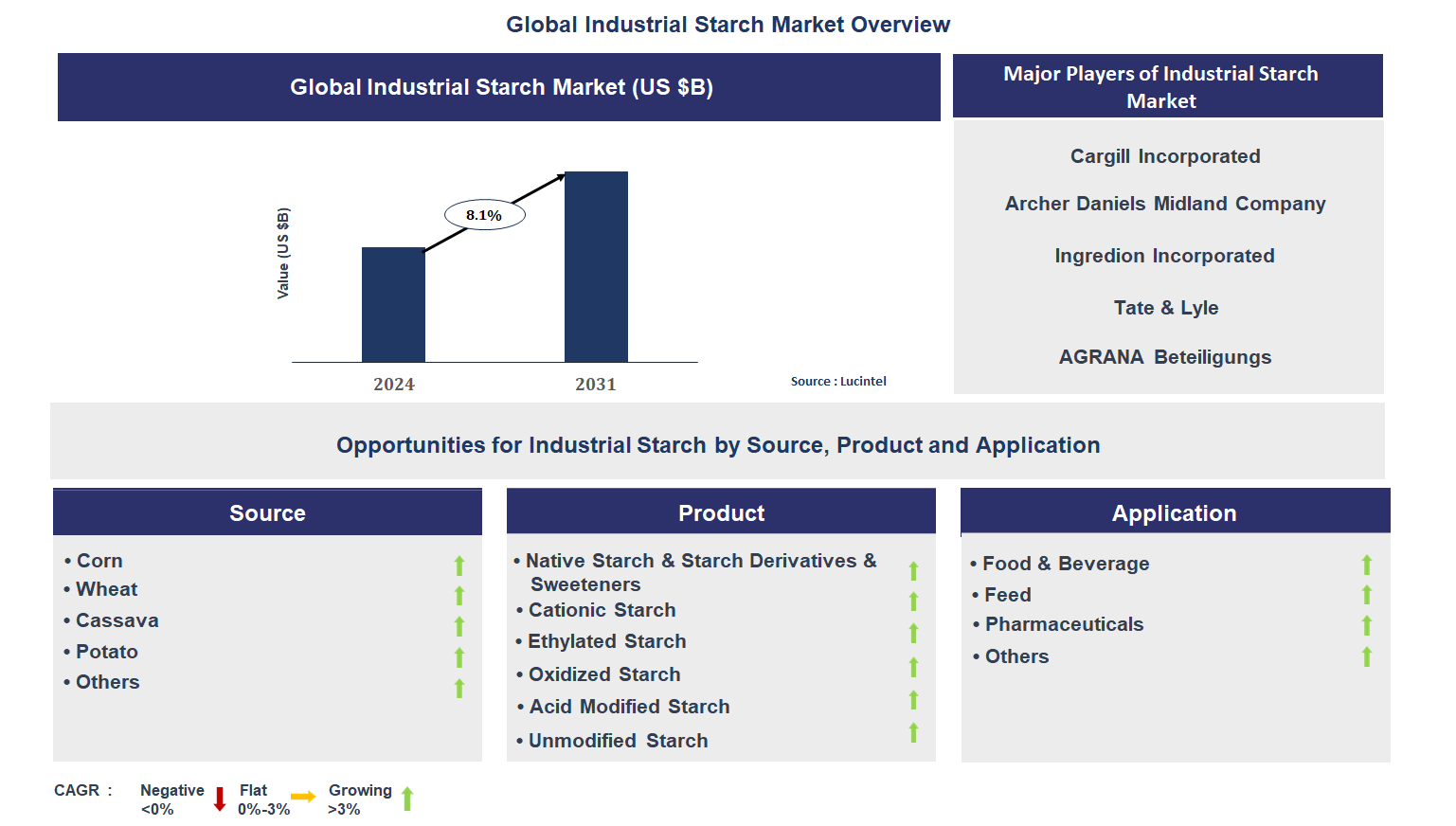
The future of the global industrial starch market looks promising with opportunities in the food & beverage, feed, and pharmaceutical markets. The global industrial starch market is expected to grow with a CAGR of 8.1% from 2025 to 2031. The major drivers for this market are the increasing demand for biodegradable packaging solutions, the rising need for starch in food applications, and the growing adoption in adhesives & paper production.• Lucintel forecasts that, within the source category, corn is expected to witness the highest growth over the forecast period.
• Within the application category, food & beverage is expected to witness the highest growth.
• In terms of region, APAC is expected to witness the highest growth over the forecast period. Gain valuable insights for your business decisions with our comprehensive 150+ page report. Sample figures with some insights are shown below.
Emerging Trends in the Industrial Starch Market
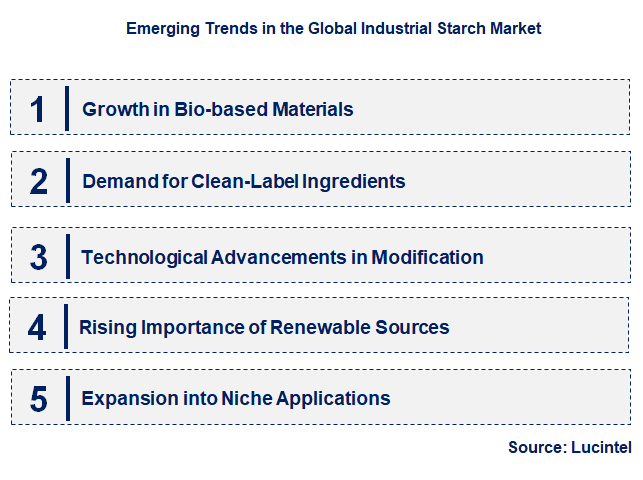
The industrial starch market is experiencing profound shifts as it adapts to global demands for sustainability and advanced functionality. These emerging trends are moving the industry beyond its traditional applications, pushing for innovation in product development, sourcing, and manufacturing processes. This is creating new opportunities and fundamentally reshaping the market landscape.• Growth in Bio-based Materials: This trend involves the increasing use of industrial starch as a raw material for biodegradable plastics, biopolymers, and other sustainable materials. Its impact is a reduction in reliance on fossil fuels for plastic production, offering an eco-friendly alternative and helping industries meet their environmental goals.
• Demand for Clean-Label Ingredients: The clean-label trend is driving the demand for native and non-GMO starches that are free from chemical modifications. This impacts the market by forcing manufacturers to develop and offer products that are perceived as more natural and healthy, appealing to health-conscious consumers and expanding their product portfolios.
• Technological Advancements in Modification: New technologies, such as enzymatic and physical modification methods, are enabling the creation of starches with superior and specific functionalities. This leads to the development of tailored starches for various applications, enhancing performance in food texture, pharmaceutical binding, and industrial processes.
• Rising Importance of Renewable Sources: There is a growing emphasis on sourcing starch from renewable crops to ensure a sustainable and stable supply chain. This trend mitigates the risks associated with raw material price volatility, promotes agricultural sustainability, and aligns with global efforts to reduce the environmental footprint of production.
• Expansion into Niche Applications: Industrial starch is finding new uses in high-value sectors such as pharmaceuticals, cosmetics, and personal care products. This is diversifying the market, creating new revenue streams, and positioning industrial starch as a versatile and indispensable ingredient for a wider range of specialized products. These emerging trends are fundamentally reshaping the industrial starch market, driving it towards greater innovation and sustainability. The focus is shifting from a commodity-based market to one that offers specialized, value-added solutions. By embracing these trends, the industry is poised for continued growth and will play a crucial role in a more bio-based global economy.
Recent Development in the Industrial Starch Market
The industrial starch market is currently undergoing significant developments driven by a combination of technological advancements, evolving consumer demands, and a global push towards sustainability. These recent changes are impacting production methods, product applications, and overall market dynamics, signaling a shift towards a more diversified and environmentally conscious industry.• Increased Production of Modified Starches: Manufacturers are investing in new facilities and technologies to produce a wider variety of modified starches. The impact of this is the creation of products with enhanced functionalities, such as improved texture, stability, and resistance to heat, which caters to the specific needs of the food, paper, and textile industries.
• Shift to Sustainable Sourcing Practices: There is a growing trend towards sourcing starch from sustainable and locally-grown crops to reduce environmental impact. This development’s impact is improved supply chain resilience, a lower carbon footprint, and a positive brand image for companies that align with consumer expectations for environmentally responsible sourcing.
• Expansion of Applications in Bioplastics: Industrial starch is increasingly being used as a key component in the production of bioplastics. The impact is a direct response to global efforts to reduce plastic waste and reliance on fossil fuels, creating a new and fast-growing market segment that offers a renewable and biodegradable alternative to traditional plastics.
• Integration of Smart Technology: The industrial starch sector is adopting smart technology, including automation and IoT, to optimize production processes. This development leads to increased operational efficiency, better quality control, and a reduction in waste. It also enables real-time monitoring of production lines to ensure consistent product quality and safety.
• Strategic Partnerships and Collaborations: Major industry players are forming partnerships to pool resources for research and development, and to expand their market reach. This development’s impact is an acceleration of innovation, the development of new products, and the creation of more robust supply chains that can better withstand market disruptions. These recent developments are collectively transforming the industrial starch market into a more dynamic and forward-thinking industry. The focus on advanced technology, sustainability, and market diversification is not only addressing current challenges but also creating a foundation for future growth and innovation.
Strategic Growth Opportunities in the Industrial Starch Market
Strategic growth opportunities in the industrial starch market are moving beyond traditional applications, driven by the demand for versatile, high-performance materials. These opportunities are focused on emerging and high-growth sectors where starch can provide innovative solutions, enabling manufacturers to diversify their revenue streams and capture new market share.• Bioplastics and Sustainable Packaging: There is a significant growth opportunity in using industrial starch to produce biodegradable plastics for packaging. This is driven by consumer demand and government regulations aimed at reducing plastic waste. The impact is a new, high-growth market for starch manufacturers and a contribution to a more sustainable global economy.
• Pharmaceutical and Nutraceutical Industry: The use of specialty starches as excipients, binders, and fillers in pharmaceuticals and health supplements presents a major growth opportunity. The impact is a stable, high-value market segment. Starches offer a natural, non-toxic alternative that is essential for tablet formulation and drug delivery systems.
• Adhesives and Binders for Paper: The paper and packaging industry offers a key opportunity for industrial starch, particularly as a binder and adhesive. The impact is driven by the rise in e-commerce and the demand for sustainable, high-quality packaging materials. Starch provides a cost-effective and strong binding solution for paper and cardboard products.
• Textiles and Technical Fabrics: There is an opportunity to expand the use of industrial starch in the textile industry for sizing and finishing applications. The impact is driven by the demand for high-performance and eco-friendly textiles. Starch improves the strength and quality of threads and fabrics while offering a biodegradable alternative to synthetic chemicals.
• Animal Feed and Nutrition: The animal feed industry offers a growing opportunity for industrial starch as a source of energy and a binder for feed pellets. This is driven by the expanding global demand for meat and dairy products. The impact is a reliable and large-scale application that provides a consistent market for starch manufacturers. These strategic growth opportunities are reshaping the industrial starch market by shifting its focus from a commodity-based industry to one that provides high-value, specialized solutions. By targeting these diverse and growing applications, manufacturers can ensure long-term profitability and play a vital role in meeting the needs of a more sustainable and technologically advanced global economy.
Industrial Starch Market Driver and Challenges
The industrial starch market is propelled by a combination of key drivers and faces significant challenges. The major drivers include increasing demand from diverse applications and a strong push for sustainability, while key challenges involve raw material price volatility and competition from synthetic alternatives. Navigating these factors is essential for sustained growth. The factors responsible for driving the industrial starch market include: 1. Expanding Food and Beverage Industry: The rapid growth of the food processing and convenience food sectors is a major driver. The implication is a continuous high demand for industrial starch, which is used as a thickener, stabilizer, and texturizer, ensuring a stable and expanding market for manufacturers. 2. Growth of Bio-based Products: The global move towards a bio-based economy is driving demand for industrial starch as a renewable raw material. The implication is a new market for starch-based bioplastics and adhesives, which provides manufacturers with a significant growth avenue and aligns them with environmental goals. 3. Versatility in Applications: Industrial starch’s use in a wide range of industries, including paper, textiles, and pharmaceuticals, is a key driver. The implication is that the market is not reliant on a single sector, which provides stability and resilience against economic downturns in a specific industry. 4. Increasing Demand for Clean-Label: Consumers’ preference for natural ingredients is driving the demand for native and non-GMO starches. The implication is a market shift that favors manufacturers who can produce clean-label products, creating a competitive advantage and a premium segment. 5. Technological Innovation: Ongoing advancements in starch modification technologies are a key driver. The implication is that manufacturers can create specialty starches with enhanced functionalities, allowing them to penetrate new, high-value markets and address specific customer needs more effectively. Challenges in the industrial starch market are: 1. Fluctuating Raw Material Prices: The price of raw materials like corn, potatoes, and wheat is susceptible to climate conditions and global trade policies. The implication is that manufacturers face unstable production costs, which can impact profitability and make it difficult to forecast and manage supply chain finances. 2. Competition from Alternatives: The industrial starch market faces competition from synthetic polymers and other natural gums and binders. The implication is that manufacturers must consistently innovate and demonstrate the superior performance and sustainability benefits of their products to remain competitive and retain market share. 3. Regulatory Hurdles and Standards: The industrial starch market is subject to various food safety, environmental, and trade regulations. The implication is that companies must invest in compliance and quality assurance, which can increase operational costs and present a barrier to entry for smaller players. The industrial starch market is poised for growth due to strong drivers, but it must effectively address significant challenges to achieve its full potential. By focusing on sustainability, technological innovation, and market diversification, the industry can mitigate risks and capitalize on opportunities to solidify its position as a key player in the global bio-based economy.List of Industrial Starch Companies
Companies in the market compete on the basis of product quality offered. Major players in this market focus on expanding their manufacturing facilities, R&D investments, infrastructural development, and leverage integration opportunities across the value chain. With these strategies industrial starch companies cater increasing demand, ensure competitive effectiveness, develop innovative products & technologies, reduce production costs, and expand their customer base. Some of the industrial starch companies profiled in this report include-• Cargill Incorporated
• Archer Daniels Midland Company
• Ingredion Incorporated
• Tate & Lyle
• AGRANA Beteiligungs
• Grain Processing Corporation
• Roquette Frères
• Tereos Group
• Royal Cosun
• Altia Industrial
Industrial Starch Market by Segment
The study includes a forecast for the global industrial starch market by source, product, application, and region.Industrial Starch Market by Source [Value from 2019 to 2031]:
• Corn
• Wheat
• Cassava
• Potato
• Others
Industrial Starch Market by Product [Value from 2019 to 2031]:
• Native Starch & Starch Derivatives & Sweeteners
• Cationic Starch
• Ethylated Starch
• Oxidized Starch
• Acid Modified Starch
• Unmodified Starch
Industrial Starch Market by Application [Value from 2019 to 2031]:
• Food & Beverage
• Feed
• Pharmaceuticals
• Others
Industrial Starch Market by Region [Value from 2019 to 2031]:
• North America
• Europe
• Asia Pacific
• The Rest of the World
Country Wise Outlook for the Industrial Starch Market
The industrial starch market is undergoing a significant transformation, driven by an increasing demand for bio-based products and a focus on sustainable manufacturing. Recent developments across key countries highlight a shift towards advanced applications, diversification of raw materials, and the integration of technology to meet evolving industry and consumer needs. This is reshaping the market for a more sustainable future.• United States: The U.S. industrial starch market is focused on innovation, particularly in the production of specialty and modified starches. Developments are driven by strong demand from the food and beverage industry for clean-label ingredients. The market is also seeing increased investment in starch-based bioplastics as a sustainable alternative to petroleum-based polymers.
• China: As a major producer and consumer, China’s industrial starch market is expanding with a strong emphasis on diversification and modernization. The country is leveraging its vast agricultural resources to produce a wider range of starch derivatives for high-growth sectors like pharmaceuticals and paper. Government policies are also supporting the shift towards sustainable, starch-based materials.
• Germany: The German industrial starch market is characterized by a focus on high-quality and functional starches for specialized applications. Developments are centered on leveraging advanced processing technologies to produce starch derivatives for the pharmaceutical and technical textiles sectors. The market is also actively responding to the European Union’s push for a circular economy.
• India: India’s industrial starch market is experiencing rapid growth, fueled by strong domestic demand from the food processing, paper, and textile industries. Recent developments are marked by a government push for ethanol blending, which is increasing the demand for corn starch. The market is also seeing new investments to meet the growing need for bio-based products.
• Japan: The Japanese market for industrial starch is known for its focus on high-performance and customized solutions. Key developments include a strong emphasis on research and development to create functional starches for applications in pharmaceuticals and cosmetics. The market is also actively exploring the use of starch-based materials for biodegradable packaging to meet sustainability goals.

Features of the Global Industrial Starch Market
Market Size Estimates: Industrial starch market size estimation in terms of value ($B). Trend and Forecast Analysis: Market trends (2019 to 2024) and forecast (2025 to 2031) by various segments and regions. Segmentation Analysis: Industrial starch market size by source, product, application, and region in terms of value ($B). Regional Analysis: Industrial starch market breakdown by North America, Europe, Asia Pacific, and Rest of the World. Growth Opportunities: Analysis of growth opportunities in different sources, products, applications, and regions for the industrial starch market. Strategic Analysis: This includes M&A, new product development, and competitive landscape of the industrial starch market. Analysis of competitive intensity of the industry based on Porter’s Five Forces model.
FAQ
Q1. What is the growth forecast for industrial starch market? Answer: The global industrial starch market is expected to grow with a CAGR of 8.1% from 2025 to 2031. Q2. What are the major drivers influencing the growth of the industrial starch market? Answer: The major drivers for this market are the increasing demand for biodegradable packaging solutions, the rising need for starch in food applications, and the growing adoption in adhesives & paper production. Q3. What are the major segments for industrial starch market? Answer: The future of the industrial starch market looks promising with opportunities in the food & beverage, feed, and pharmaceutical markets. Q4. Who are the key industrial starch market companies? Answer: Some of the key industrial starch companies are as follows:• Cargill Incorporated
• Archer Daniels Midland Company
• Ingredion Incorporated
• Tate & Lyle
• AGRANA Beteiligungs
• Grain Processing Corporation
• Roquette Frères
• Tereos Group
• Royal Cosun
• Altia Industrial Q5. Which industrial starch market segment will be the largest in future? Answer: Lucintel forecasts that, within the source category, corn is expected to witness the highest growth over the forecast period. Q6. In industrial starch market, which region is expected to be the largest in next 5 years? Answer: In terms of region, APAC is expected to witness the highest growth over the forecast period. Q7. Do we receive customization in this report? Answer: Yes, Lucintel provides 10% customization without any additional cost.
Table of Contents
List of Figures
List of Tables
Methodology
- In-depth interviews of the major players in this market
- Detailed secondary research from competitors’ financial statements and published data
- Extensive searches of published works, market, and database information pertaining to industry news, company press releases, and customer intentions
- A compilation of the experiences, judgments, and insights of Lucintel’s professionals, who have analyzed and tracked this market over the years.


Buy Now
Choose a license that fits your team. Instant PDF delivery.
Prices exclude taxes. Instant delivery. Custom licensing available on request.
Key Questions
- • What are some of the most promising, high-growth opportunities for the industrial starch market by source (corn, wheat, cassava, potato, and others), product (native starch & starch derivatives & sweeteners, cationic starch, ethylated starch, oxidized starch, acid modified starch, and unmodified starch), application (food & beverage, feed, pharmaceuticals, and others), and region (North America, Europe, Asia Pacific, and the Rest of the World)?
- • Which segments will grow at a faster pace and why?
- • Which region will grow at a faster pace and why?
- • What are the key factors affecting market dynamics? What are the key challenges and business risks in this market?
- • What are the business risks and competitive threats in this market?
- • What are the emerging trends in this market and the reasons behind them?
- • What are some of the changing demands of customers in the market?
- • What are the new developments in the market? Which companies are leading these developments?
- • Who are the major players in this market? What strategic initiatives are key players pursuing for business growth?
- • What are some of the competing products in this market and how big of a threat do they pose for loss of market share by material or product substitution?
- • What M&A activity has occurred in the last 5 years and what has its impact been on the industry? For any questions related to Industrial Starch Market, Industrial Starch Market Size, Industrial Starch Market Growth, Industrial Starch Market Analysis, Industrial Starch Market Report, Industrial Starch Market Share, Industrial Starch Market Trends, Industrial Starch Market Forecast, Industrial Starch Companies, write Lucintel analyst at email: helpdesk@lucintel.com. We will be glad to get back to you soon.


