
Report Feature
Industrial Solid-State Drive Market Trends and Forecast
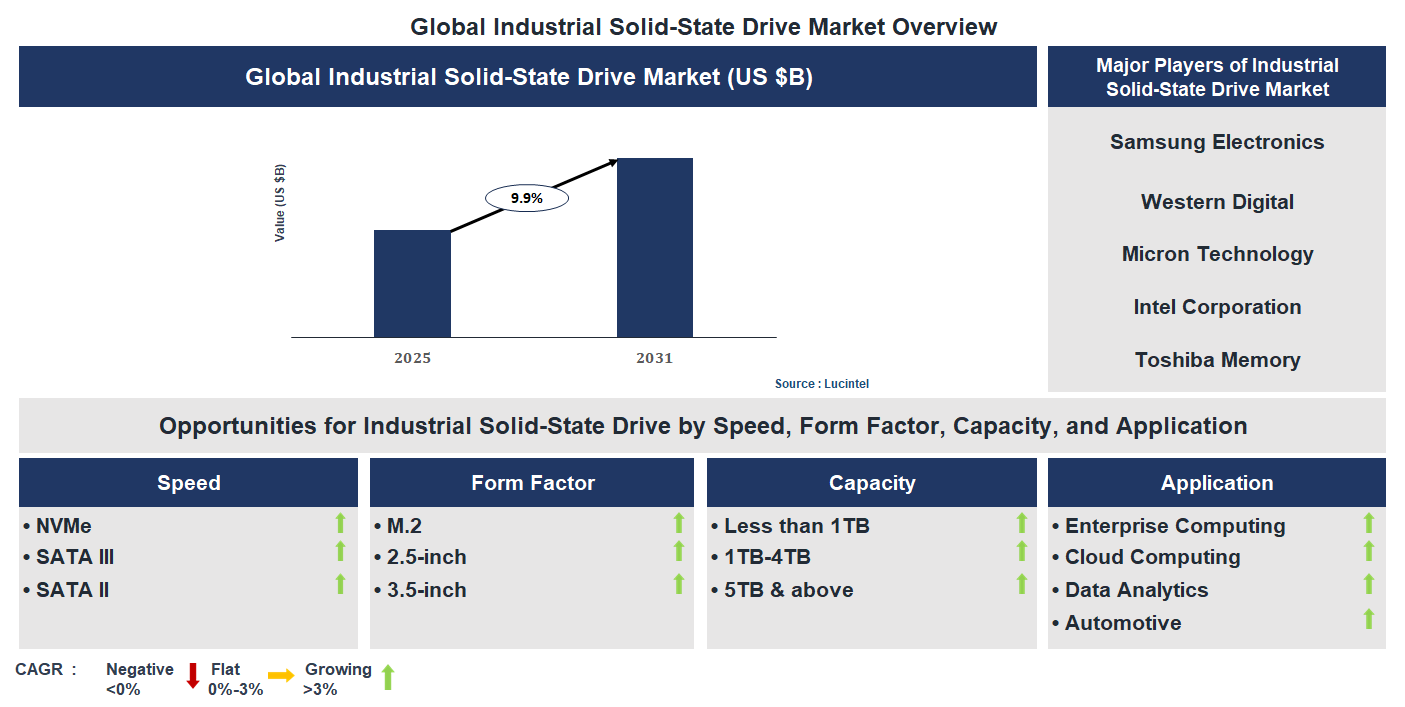
The future of the global industrial solid-state drive market looks promising with opportunities in the enterprise computing, cloud computing, data analytics, and automotive markets. The global industrial solid-state drive market is expected to grow with a CAGR of 9.9% from 2025 to 2031. The major drivers for this market are the increasing demand for high-speed data storage, the rising adoption of automation in industries, and the growing need for reliable data centers.• Lucintel forecasts that, within the form factor category, M.2 is expected to witness the highest growth over the forecast period.
• Within the application category, enterprise computing is expected to witness the highest growth.
• In terms of region, North America is expected to witness the highest growth over the forecast period. Gain valuable insights for your business decisions with our comprehensive 150+ page report. Sample figures with some insights are shown below.
Emerging Trends in the Industrial Solid-State Drive Market
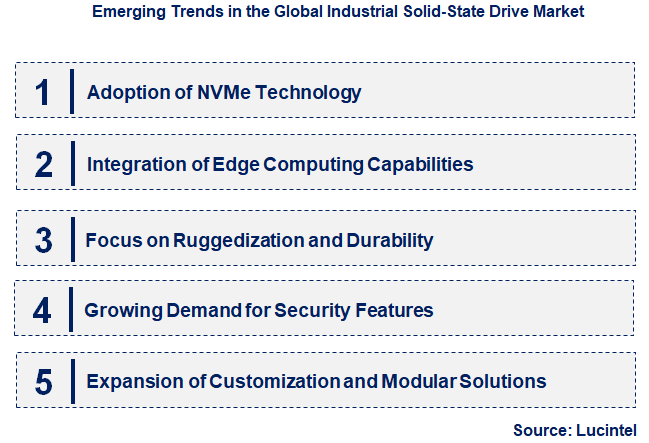
The industrial solid-state drive market is experiencing rapid growth driven by technological advancements, increasing demand for reliable data storage solutions, and the need for high-performance computing in various industrial applications. As industries evolve, the integration of innovative storage technologies is becoming essential to meet the demands of automation, IoT, and data analytics. These developments are not only enhancing operational efficiency but also transforming the competitive landscape. The following key trends highlight the major shifts shaping this market, reflecting its dynamic nature and future potential.• Adoption of NVMe Technology: NVMe (Non-Volatile Memory Express) technology is increasingly adopted in industrial SSDs due to its ability to deliver significantly higher data transfer speeds compared to traditional SATA drives. This trend enhances real-time data processing, critical for automation and industrial IoT applications. The low latency and high throughput of NVMe SSDs improve system responsiveness and efficiency, enabling industries to handle large volumes of data more effectively. As NVMe becomes more affordable and widespread, it is expected to become the standard for high-performance industrial storage solutions, driving market growth.
• Integration of Edge Computing Capabilities: Edge computing integration in industrial SSDs is gaining momentum, allowing data processing closer to the source rather than relying solely on centralized data centers. This trend reduces latency, enhances data security, and decreases bandwidth requirements. Industrial SSDs with embedded edge computing capabilities support real-time analytics and decision-making, which are vital for applications like predictive maintenance and autonomous machinery. The ability to process data locally improves operational efficiency and reduces downtime, making edge-enabled SSDs a critical component in Industry 4.0 initiatives and reshaping how data is managed in industrial environments.
• Focus on Ruggedization and Durability: Industrial SSDs are increasingly designed to withstand harsh environments, including extreme temperatures, vibration, shock, and humidity. This trend addresses the need for reliable storage solutions in challenging industrial settings such as manufacturing plants, oil and gas facilities, and outdoor installations. Ruggedized SSDs ensure data integrity and continuous operation under adverse conditions, reducing maintenance costs and downtime. The emphasis on durability is driving innovation in materials and design, making industrial SSDs more resilient and suitable for long-term deployment in demanding environments, thus expanding their market reach.
• Growing Demand for Security Features: As data security concerns intensify, industrial SSDs are incorporating advanced security features such as hardware encryption, secure erase, and authentication protocols. This trend is driven by stringent regulatory requirements and the increasing value of industrial data. Secure SSDs protect sensitive information from cyber threats and unauthorized access, ensuring compliance with industry standards. Enhanced security features also facilitate safe remote management and updates, which are crucial for industrial automation and IoT deployments. The focus on security is making industrial SSDs more trustworthy and appealing to sectors with high data protection needs.
• Expansion of Customization and Modular Solutions: The market is witnessing a rise in customizable and modular SSD solutions designed to meet specific industrial requirements. This trend allows manufacturers to select features such as capacity, form factor, interface, and durability levels, optimizing performance and cost-efficiency. Modular designs enable easier upgrades and maintenance, reducing total cost of ownership. Customization also supports niche applications, from small embedded systems to large-scale industrial setups. This flexibility is empowering industries to deploy tailored storage solutions that align with their operational needs, fostering innovation and expanding market opportunities. In summary, these emerging trends are collectively transforming the industrial solid-state drive market by enhancing performance, reliability, security, and customization. They are enabling industries to adopt more advanced, efficient, and resilient storage solutions, which are crucial for supporting the ongoing digital transformation and Industry 4.0 initiatives. As these trends continue to evolve, they will further accelerate market growth and innovation, shaping the future landscape of industrial data storage.
Recent Development in the Industrial Solid-State Drive Market
The industrial solid-state drive market is experiencing rapid growth driven by increasing demand for reliable, high-speed storage solutions across various industries. Advancements in technology, expanding applications in automation, and the need for enhanced data security are fueling market expansion. As industries adopt more sophisticated data management systems, the market is poised for significant development, creating opportunities for manufacturers and service providers to innovate and capture new segments.• Growing Adoption of Industrial SSDs: The increasing need for durable, high-performance storage in harsh environments is boosting demand for industrial SSDs. These drives offer superior speed, reliability, and resistance to extreme temperatures, vibrations, and shocks. Industries such as manufacturing, transportation, and energy are integrating industrial SSDs to improve operational efficiency and data integrity. This trend is expected to continue as digital transformation accelerates, making industrial SSDs essential for mission-critical applications.
• Technological Advancements in SSDs: Innovations like NVMe interfaces, PCIe Gen4, and 3D NAND technology are significantly enhancing SSD performance. These advancements enable faster data transfer rates, lower latency, and increased storage capacity, meeting the needs of high-performance industrial applications. Manufacturers investing in R&D are launching more sophisticated products, which are driving market growth. The evolution of these technologies is also facilitating the integration of SSDs into IoT and edge computing devices, expanding their industrial use cases.
• Rising Demand for Data Security and Reliability: As data becomes more critical, industries seek secure and reliable storage solutions. Industrial SSDs now incorporate advanced encryption, error correction, and power-loss protection features. These enhancements ensure data integrity and security in sensitive environments. The increasing adoption of cybersecurity protocols and compliance standards is further propelling demand. This focus on data security is making industrial SSDs a preferred choice for sectors like defense, healthcare, and finance, where data protection is paramount.
• Expansion of Automation and Industry 4.0: The shift towards automation and Industry 4.0 is creating a need for high-speed, reliable storage solutions to handle large volumes of data generated by smart factories and robotics. Industrial SSDs facilitate real-time data processing, predictive maintenance, and seamless machine-to-machine communication. Their ability to operate continuously in demanding environments makes them indispensable for modern industrial setups. This expansion is expected to drive sustained growth in the industrial SSD market as digitalization deepens across sectors.
• Increasing Investment in Smart Infrastructure: Governments and private enterprises are investing heavily in smart city projects, transportation systems, and energy grids, all requiring robust data storage solutions. Industrial SSDs support these initiatives by providing fast, durable, and scalable storage options. Their deployment enhances system responsiveness, data analysis, and operational efficiency. As infrastructure projects grow globally, the demand for industrial SSDs is set to rise, creating new opportunities for market players to expand their product offerings and market share. The overall impact of these developments is a robust growth trajectory for the industrial solid-state drive market, driven by technological innovation, increased application scope, and heightened focus on data security. These factors are fostering a competitive environment that encourages continuous improvement and diversification of product offerings, ultimately transforming industrial data management and storage solutions worldwide.
Strategic Growth Opportunities in the Industrial Solid-State Drive Market
The industrial solid-state drive market is experiencing rapid expansion driven by increasing demand for reliable, high-speed data storage solutions across various industrial applications. Advancements in technology, growing automation, and the need for enhanced data security are fueling market growth. Key opportunities lie in expanding applications, technological innovations, and strategic partnerships, which can significantly influence market dynamics. Companies that capitalize on these opportunities can gain competitive advantages and meet the evolving needs of industrial sectors worldwide.• Expansion into Industrial Automation and Manufacturing Sectors: Industrial SSDs are increasingly adopted in automation and manufacturing for real-time data processing, machine control, and predictive maintenance. The need for durable, high-performance storage solutions in harsh environments drives growth. As industries move toward Industry 4.0, the demand for reliable, fast, and rugged SSDs will surge, creating opportunities for manufacturers to develop tailored solutions that enhance operational efficiency and reduce downtime.
• Integration of Advanced Technologies like NVMe and PCIe: The adoption of NVMe and PCIe interfaces in industrial SSDs offers significant performance improvements over traditional storage. These technologies enable faster data transfer rates, lower latency, and better scalability, which are critical for demanding industrial applications. Companies investing in these innovations can meet the needs of high-speed data environments, such as robotics, AI, and IoT, thereby expanding their market share and enabling new use cases.
• Growing Demand for Rugged and Shock-Resistant SSDs: Industrial environments often involve exposure to extreme temperatures, vibrations, and shocks. Developing rugged, shock-resistant SSDs that maintain high performance under harsh conditions presents a substantial growth opportunity. Manufacturers focusing on durability and reliability can cater to sectors like aerospace, defense, and heavy machinery, where data integrity and device longevity are paramount, thus opening new revenue streams.
• Strategic Collaborations and Partnerships for Market Penetration: Collaborations between SSD manufacturers, industrial equipment providers, and technology firms can accelerate market penetration. Partnerships facilitate the development of customized solutions, shared expertise, and expanded distribution channels. Such strategic alliances enable companies to address specific industry needs, enhance product offerings, and accelerate adoption, ultimately strengthening their competitive position in the evolving industrial SSD landscape.
• Increasing Adoption of Edge Computing and IoT Devices: The proliferation of IoT and edge computing in industrial settings demands high-capacity, low-latency storage solutions. Industrial SSDs are essential for processing data locally, reducing latency, and ensuring real-time decision-making. As industries adopt more connected devices, the need for scalable, reliable storage will grow, creating opportunities for SSD providers to develop specialized products that support the expanding edge computing ecosystem. Conclusion: These growth opportunities are poised to significantly influence the industrial solid-state drive market by driving innovation, expanding application areas, and fostering strategic collaborations. Embracing technological advancements and addressing industry-specific challenges will enable market players to capitalize on emerging trends. Overall, these opportunities will contribute to sustained market growth, increased competitiveness, and the development of more resilient, high-performance storage solutions tailored to industrial needs.
Industrial Solid-State Drive Market Driver and Challenges
The industrial solid-state drive market is influenced by a variety of technological, economic, and regulatory factors that shape its growth trajectory. Rapid advancements in data storage technology, increasing demand for high-performance computing, and the need for reliable, durable storage solutions in industrial environments are key drivers. Additionally, economic factors such as the decreasing cost of SSDs and the expansion of industrial automation contribute significantly. Regulatory standards related to data security and environmental sustainability also impact market dynamics. Navigating these drivers and overcoming associated challenges is essential for stakeholders aiming to capitalize on emerging opportunities within this evolving landscape. The factors responsible for driving the industrial solid-state drive market include:-• Technological Advancements: The continuous evolution of SSD technology, including improvements in NAND flash memory and interface protocols, enhances performance, reliability, and energy efficiency. These innovations meet the demanding requirements of industrial applications such as automation, transportation, and energy management. As technology advances, industrial SSDs become more capable of handling high data throughput and harsh operating conditions, making them indispensable for mission-critical systems. This ongoing innovation fuels market growth by enabling new use cases and expanding the scope of industrial applications.
• Growing Adoption of Industrial Automation: The increasing integration of automation in manufacturing, logistics, and infrastructure projects drives demand for robust data storage solutions. Industrial SSDs provide the speed, durability, and reliability needed for real-time data processing and control systems. As industries aim for higher productivity and reduced downtime, the reliance on advanced storage solutions intensifies. This trend is further supported by Industry 4.0 initiatives, which emphasize smart factories and interconnected systems, thereby propelling the market forward.
• Rising Data Generation and Analytics: The proliferation of IoT devices, sensors, and connected machinery generates vast amounts of data that require efficient storage and quick retrieval. Industrial SSDs are crucial in managing this data influx, enabling real-time analytics and decision-making. The need for high-capacity, high-speed storage solutions in data centers and edge computing environments directly influences market expansion. As data-driven strategies become central to industrial operations, the demand for advanced SSDs continues to grow.
• Economic Factors and Cost Reduction: The decreasing costs of NAND flash memory and SSD manufacturing have made these storage devices more accessible to a broader range of industrial applications. Cost competitiveness encourages adoption across small and large enterprises, facilitating digital transformation initiatives. Additionally, the total cost of ownership benefits from the durability and low power consumption of SSDs, reducing maintenance and operational expenses. This economic trend supports market expansion by making high-performance storage solutions more affordable. The challenges facing this industrial solid-state drive market include:-
• Harsh Operating Conditions: Industrial environments often involve extreme temperatures, vibrations, dust, and moisture, which can compromise the performance and lifespan of SSDs. Designing rugged, reliable SSDs capable of withstanding such conditions requires significant technological innovation and increased costs. Failure to address these challenges can lead to system failures, data loss, and increased maintenance costs, hindering market growth. Overcoming these environmental hurdles is essential for widespread adoption in critical industrial sectors.
• Data Security and Regulatory Compliance: As industrial data becomes more valuable, ensuring its security against cyber threats is paramount. Implementing robust encryption, access controls, and compliance with data protection regulations adds complexity and cost to SSD deployment. Non-compliance or security breaches can result in legal penalties, financial losses, and damage to reputation. Navigating evolving regulatory landscapes and maintaining high security standards remain ongoing challenges for market participants.
• Rapid Technological Obsolescence: The fast pace of technological innovation in storage solutions can render existing SSDs obsolete quickly. Manufacturers face pressure to continuously innovate, which increases R&D costs and risks of product failure. Customers may delay upgrades due to high costs or compatibility issues, slowing market growth. Managing product lifecycle and ensuring backward compatibility are critical to sustaining market momentum amid rapid technological change. In summary, the industrial solid-state drive market is driven by technological innovations, automation, data proliferation, and economic factors that promote growth. However, challenges such as environmental durability, security concerns, and rapid obsolescence pose significant hurdles. The interplay of these drivers and challenges will shape the market’s evolution, requiring stakeholders to innovate continuously and address environmental and security issues proactively. Overall, the markets future hinges on balancing technological progress with resilience and security considerations, ensuring sustainable growth in industrial applications.
List of Industrial Solid-State Drive Companies
Companies in the market compete on the basis of product quality offered. Major players in this market focus on expanding their manufacturing facilities, R&D investments, infrastructural development, and leverage integration opportunities across the value chain. With these strategies industrial solid-state drive companies cater increasing demand, ensure competitive effectiveness, develop innovative products & technologies, reduce production costs, and expand their customer base. Some of the industrial solid-state drive companies profiled in this report include-• Samsung Electronics
• Western Digital
• Micron Technology
• Intel Corporation
• Toshiba Memory
• SK Hynix
• Seagate Technology
Industrial Solid-State Drive Market by Segment
The study includes a forecast for the global industrial solid-state drive market by speed, form factor, capacity, application, and region.Industrial Solid-State Drive Market by Speed [Value from 2019 to 2031]:
• NVMe
• SATA III
• SATA II
Industrial Solid-State Drive Market by Form Factor [Value from 2019 to 2031]:
• M.2
• 2.5-inch
• 3.5-inch
Industrial Solid-State Drive Market by Capacity [Value from 2019 to 2031]:
• Less than 1TB
• 1TB-4TB
• 5TB & above
Industrial Solid-State Drive Market by Application [Value from 2019 to 2031]:
• Enterprise Computing
• Cloud Computing
• Data Analytics
• Automotive
Industrial Solid-State Drive Market by Region [Value from 2019 to 2031]:
• North America
• Europe
• Asia Pacific
• The Rest of the World
Country Wise Outlook for the Industrial Solid-State Drive Market
The industrial solid-state drive market has experienced rapid growth driven by increasing demand for high-performance, reliable storage solutions across various sectors. Technological advancements, expanding industrial applications, and the need for faster data processing have fueled innovation and market expansion. Countries are adopting new standards and integrating advanced SSD technologies to enhance operational efficiency and data security. The competitive landscape is evolving with key players investing in R&D to develop more durable and energy-efficient SSDs. As industries move toward digital transformation, the markets trajectory indicates sustained growth and diversification of product offerings tailored to specific industrial needs.• United States: The U.S. market has seen significant advancements with increased adoption of industrial SSDs in manufacturing, aerospace, and defense sectors. Innovations focus on enhancing durability, data security, and speed, driven by government and private sector investments. Major companies are developing rugged SSDs capable of operating in extreme environments, supporting Industry 4.0 initiatives. The integration of AI and IoT has further boosted demand for high-capacity, reliable storage solutions. Regulatory standards for data security and environmental sustainability are influencing product development, making the U.S. a leader in industrial SSD innovation.
• China: China’s industrial SSD market is rapidly expanding, supported by government initiatives like Made in China 2025. The country is focusing on local manufacturing and reducing reliance on imports, leading to increased R&D investments. Chinese firms are developing cost-effective, high-performance SSDs tailored for manufacturing automation, smart cities, and rail infrastructure. The adoption of 5G technology is accelerating data transfer needs, prompting innovations in SSD technology. Additionally, China’s emphasis on industrial digitalization is driving demand for robust storage solutions, positioning it as a key player in the global industrial SSD landscape.
• Germany: Germany remains at the forefront of industrial SSD development, particularly in automotive, machinery, and industrial automation sectors. The focus is on creating highly reliable, energy-efficient SSDs that meet strict European standards for quality and sustainability. German companies are investing in research to improve SSD lifespan and resistance to harsh industrial conditions. The integration of SSDs with Industry 4.0 systems enhances real-time data processing and predictive maintenance. Germany’s emphasis on innovation and sustainability is fostering the development of eco-friendly SSD solutions, reinforcing its position as a leader in industrial technology.
• India: The Indian industrial SSD market is witnessing rapid growth driven by increasing investments in manufacturing, infrastructure, and smart city projects. Local manufacturers are emerging, offering affordable and reliable SSD solutions to meet rising demand. The government’s push for digital transformation and the Make in India initiative is encouraging adoption across sectors like automotive, electronics, and logistics. Innovations focus on cost reduction, energy efficiency, and compatibility with existing industrial systems. As India aims to become a global manufacturing hub, the demand for advanced storage solutions like industrial SSDs is expected to grow significantly, supported by favorable policies and expanding industrial infrastructure.
• Japan: Japan’s industrial SSD market is characterized by high-quality, innovative products tailored for robotics, automotive, and electronics industries. Japanese firms are investing heavily in R&D to develop SSDs with enhanced durability, speed, and energy efficiency. The focus is on integrating SSDs with IoT and AI systems for smarter manufacturing processes. Japan emphasizes sustainability and environmental standards, leading to eco-friendly SSD designs. The country’s advanced technological ecosystem and strong industrial base continue to drive the adoption of cutting-edge SSD solutions, ensuring Japan remains a key player in the global industrial SSD market.

Features of the Global Industrial Solid-State Drive Market
Market Size Estimates: Industrial solid-state drive market size estimation in terms of value ($B). Trend and Forecast Analysis: Market trends (2019 to 2024) and forecast (2025 to 2031) by various segments and regions. Segmentation Analysis: Industrial solid-state drive market size by various segments, such as by speed, form factor, capacity, application, and region in terms of value ($B). Regional Analysis: Industrial solid-state drive market breakdown by North America, Europe, Asia Pacific, and Rest of the World. Growth Opportunities: Analysis of growth opportunities in different speed, form factors, capacities, applications, and regions for the industrial solid-state drive market. Strategic Analysis: This includes M&A, new product development, and competitive landscape of the industrial solid-state drive market. Analysis of competitive intensity of the industry based on Porter’s Five Forces model.
FAQ
Q1. What is the growth forecast for industrial solid-state drive market? Answer: The global industrial solid-state drive market is expected to grow with a CAGR of 9.9% from 2025 to 2031. Q2. What are the major drivers influencing the growth of the industrial solid-state drive market? Answer: The major drivers for this market are the increasing demand for high-speed data storage, the rising adoption of automation in industries, and the growing need for reliable data centers. Q3. What are the major segments for industrial solid-state drive market? Answer: The future of the industrial solid-state drive market looks promising with opportunities in the enterprise computing, cloud computing, data analytics, and automotive markets. Q4. Who are the key industrial solid-state drive market companies? Answer: Some of the key industrial solid-state drive companies are as follows:• Samsung Electronics
• Western Digital
• Micron Technology
• Intel Corporation
• Toshiba Memory
• SK Hynix
• Seagate Technology Q5. Which industrial solid-state drive market segment will be the largest in future? Answer: Lucintel forecasts that, within the form factor category, M.2 is expected to witness the highest growth over the forecast period. Q6. In industrial solid-state drive market, which region is expected to be the largest in next 5 years? Answer: In terms of region, North America is expected to witness the highest growth over the forecast period. Q7. Do we receive customization in this report? Answer: Yes, Lucintel provides 10% customization without any additional cost.
Table of Contents
List of Figures
List of Tables
Methodology
- In-depth interviews of the major players in this market
- Detailed secondary research from competitors’ financial statements and published data
- Extensive searches of published works, market, and database information pertaining to industry news, company press releases, and customer intentions
- A compilation of the experiences, judgments, and insights of Lucintel’s professionals, who have analyzed and tracked this market over the years.


Buy Now
Choose a license that fits your team. Instant PDF delivery.
Prices exclude taxes. Instant delivery. Custom licensing available on request.
Key Questions
- • What are some of the most promising, high-growth opportunities for the industrial solid-state drive market by speed (NVMe, SATA III, and SATA II,), form factor (M.2, 2.5-inch, and 3.5-inch,), capacity (Less than 1TB, 1TB-4TB, and 5TB & above,), application (enterprise computing, cloud computing, data analytics, and automotive), and region (North America, Europe, Asia Pacific, and the Rest of the World)?
- • Which segments will grow at a faster pace and why?
- • Which region will grow at a faster pace and why?
- • What are the key factors affecting market dynamics? What are the key challenges and business risks in this market?
- • What are the business risks and competitive threats in this market?
- • What are the emerging trends in this market and the reasons behind them?
- • What are some of the changing demands of customers in the market?
- • What are the new developments in the market? Which companies are leading these developments?
- • Who are the major players in this market? What strategic initiatives are key players pursuing for business growth?
- • What are some of the competing products in this market and how big of a threat do they pose for loss of market share by material or product substitution?
- • What M&A activity has occurred in the last 6 years and what has its impact been on the industry? For any questions related to Industrial Solid-State Drive Market, Industrial Solid-State Drive Market Size, Industrial Solid-State Drive Market Growth, Industrial Solid-State Drive Market Analysis, Industrial Solid-State Drive Market Report, Industrial Solid-State Drive Market Share, Industrial Solid-State Drive Market Trends, Industrial Solid-State Drive Market Forecast, Industrial Solid-State Drive Companies, write Lucintel analyst at email: helpdesk@lucintel.com. We will be glad to get back to you soon.


