
Industrial Pipe Market Trends and Forecast
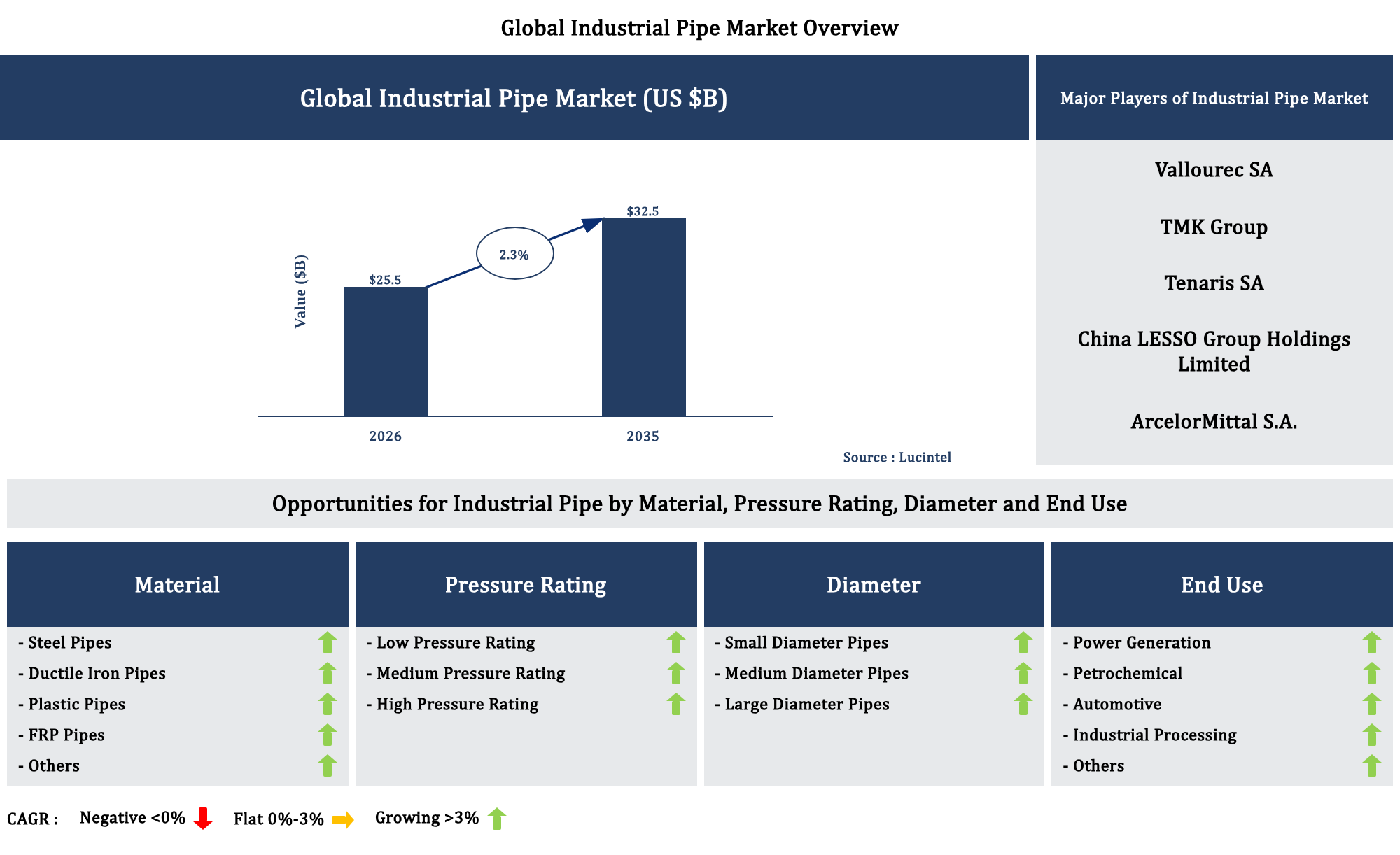
The future of the global industrial pipe market looks promising with opportunities in the power generation, petrochemical, automotive, and industrial processing markets. The global industrial pipe market is expected to reach an estimated $32,552 million by 2035 with a CAGR of 2.3% from 2026 to 2035. The major drivers for this market are the growing investment in water supply & sanitation infrastructure, the increasing need for replacement of old pipelines, and the rising demand for chemical industries.
• Lucintel forecasts that, within the material category, steel pipe is expected to witness higher growth over the forecast period.
• Within the end use category, industrial processing is expected to witness the highest growth.
• In terms of region, APAC is expected to witness the highest growth over the forecast period.
Gain valuable insights for your business decisions with our comprehensive 150+ page report. Sample figures with some insights are shown below.
Emerging Trends in the Industrial Pipe Market
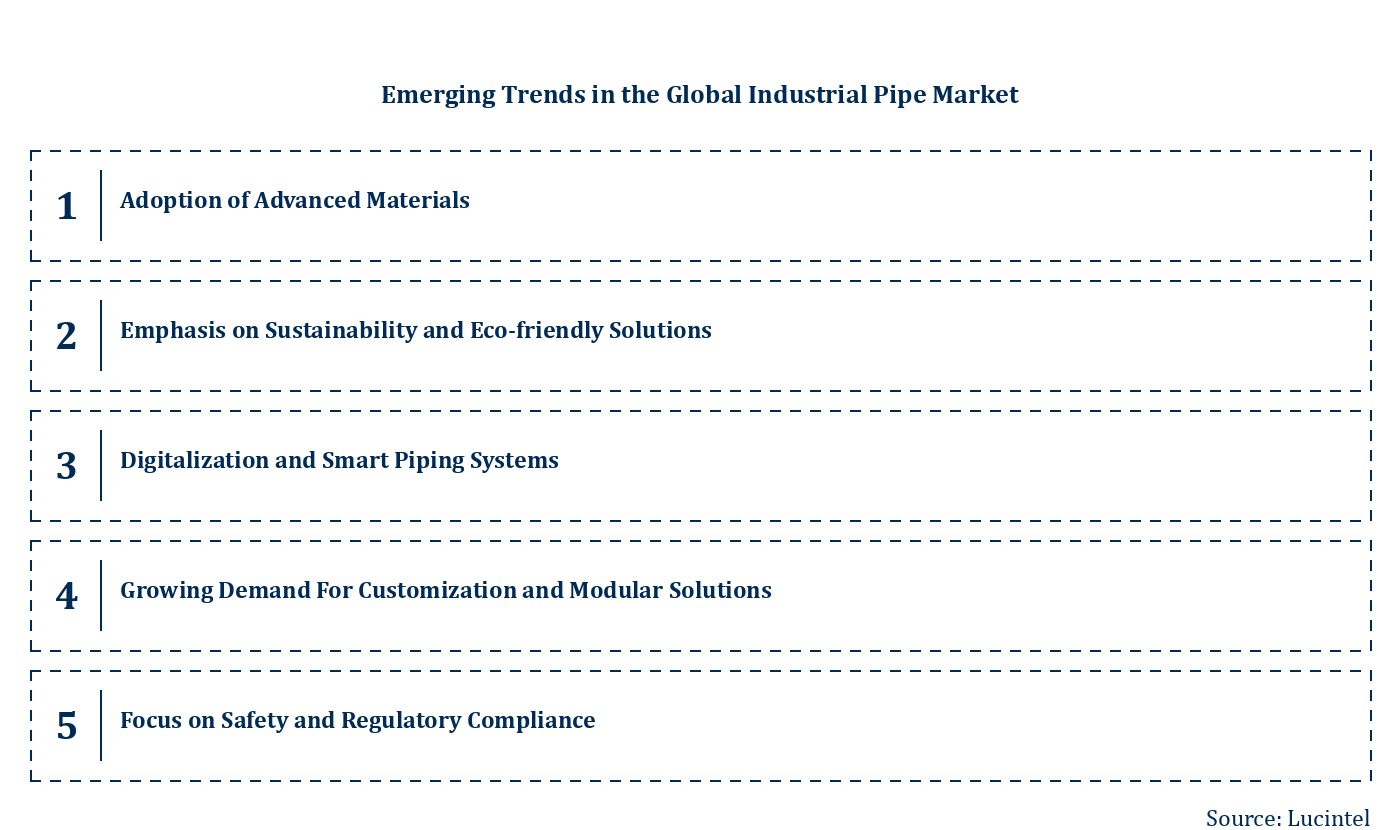
The industrial pipe market is experiencing significant transformation driven by technological advancements, environmental considerations, and evolving industry demands. As industries seek more efficient, sustainable, and cost-effective piping solutions, several emerging trends are shaping the future landscape of this market. These developments are not only enhancing operational efficiencies but also addressing regulatory and environmental challenges, leading to innovative product offerings and new market opportunities. Companies that adapt to these trends are poised to gain competitive advantages in a rapidly changing environment. Understanding these key trends is essential for stakeholders aiming to capitalize on future growth and sustainability in the industrial pipe sector.
• Adoption of Advanced Materials: The market is shifting towards high-performance materials such as composites, HDPE, and corrosion-resistant alloys. These materials offer enhanced durability, chemical resistance, and longevity, reducing maintenance costs and downtime. Their lightweight nature also facilitates easier installation and transportation. As industries prioritize sustainability and cost-efficiency, the demand for innovative materials is expected to grow, driving product development and expanding application scopes across sectors like oil & gas, water treatment, and construction.
• Emphasis on Sustainability and Eco-Friendly Solutions: Environmental regulations and corporate sustainability goals are pushing the market toward eco-friendly piping options. Biodegradable, recyclable, and low-impact materials are gaining popularity. Companies are investing in green manufacturing processes and products that minimize environmental footprints. This trend not only helps comply with stricter regulations but also appeals to environmentally conscious consumers and clients, fostering a shift towards sustainable practices that are expected to influence product innovation and market growth significantly.
• Digitalization and Smart Piping Systems: The integration of IoT, sensors, and automation in piping systems is revolutionizing the industry. Smart pipes enable real-time monitoring of flow, pressure, and temperature, facilitating predictive maintenance and reducing operational risks. Digital twin technology and data analytics optimize system performance and lifespan. This trend enhances operational efficiency, reduces downtime, and lowers maintenance costs, making piping systems more reliable and adaptable to complex industrial needs, thereby transforming traditional piping into intelligent infrastructure.
• Growing Demand for Customization and Modular Solutions: Industries are increasingly seeking tailored piping solutions that meet specific operational requirements. Modular piping systems allow for easier installation, upgrades, and maintenance, reducing downtime and costs. Customization ensures compatibility with existing infrastructure and compliance with industry standards. This trend supports rapid project deployment and flexibility, especially in sectors like oil & gas, chemical processing, and water management, where unique operational conditions demand specialized solutions.
• Focus on Safety and Regulatory Compliance: Stringent safety standards and regulations are driving innovations in pipe design and materials to prevent leaks, corrosion, and failures. Enhanced safety features, such as fire-resistant coatings and reinforced joints, are becoming standard. Compliance with international standards ensures market access and reduces legal risks. This focus on safety not only protects personnel and assets but also builds trust with clients and regulators, prompting continuous improvements in product quality and safety protocols across the industry.
These emerging trends are collectively reshaping the industrial pipe market by fostering innovation, sustainability, and efficiency. They are enabling companies to meet evolving regulatory requirements, reduce environmental impact, and deliver customized, intelligent solutions. As a result, the market is becoming more dynamic, competitive, and aligned with future industrial needs, paving the way for sustained growth and technological advancement.
Recent Developments in the Industrial Pipe Market
The industrial pipe market is experiencing rapid evolution driven by technological advancements, increasing infrastructure projects, and a shift towards sustainable materials. These developments are shaping the future landscape, offering new opportunities for growth and innovation. Stakeholders are focusing on enhancing product quality, expanding into emerging markets, and adopting eco-friendly practices. The following key developments highlight the current trajectory and potential of this dynamic industry.
• Digital Manufacturing Technologies: Revolutionizing Production Efficiency and Customization: The adoption of digital manufacturing, including automation and 3D printing, is significantly improving production efficiency in the industrial pipe market. These technologies enable rapid prototyping, reduce lead times, and allow for highly customized pipe solutions. As a result, manufacturers can meet specific client needs more effectively, reduce costs, and accelerate delivery schedules. This shift enhances competitiveness and opens new avenues for innovation within the industry.
• Sustainable and Eco-Friendly Materials: Promoting Environmental Responsibility and Market Expansion: The industry is increasingly integrating sustainable materials such as recycled plastics and bio-based composites to meet environmental regulations and consumer demand. These eco-friendly options reduce carbon footprints and improve the market’s sustainability profile. Companies adopting green materials are gaining a competitive edge, especially in regions with strict environmental policies. This development not only supports global sustainability goals but also broadens market reach into environmentally conscious sectors.
• Expansion into Emerging Markets: Unlocking New Growth Opportunities: Emerging markets in Asia, Africa, and Latin America are witnessing rapid urbanization and infrastructure development, creating substantial demand for industrial pipes. Companies are expanding their presence in these regions through strategic partnerships and localized manufacturing. This expansion offers significant growth potential, diversifies revenue streams, and mitigates risks associated with mature markets. It also facilitates access to new customer bases and raw materials, fostering long-term industry growth.
• Advanced Coating and Corrosion-Resistant Technologies: Enhancing Durability and Reducing Maintenance Costs: Innovations in coating technologies, such as epoxy and polymer linings, are improving pipe durability against corrosion and harsh environmental conditions. These advancements extend the lifespan of pipes, reduce maintenance costs, and minimize downtime for end-users. Industries like oil & gas, water treatment, and chemical processing benefit from these durable solutions. The focus on corrosion resistance is driving demand for high-performance pipes, ultimately strengthening market stability and customer satisfaction.
• Integration of IoT and Smart Monitoring Systems: Improving Asset Management and Operational Efficiency: The integration of IoT sensors and smart monitoring systems into industrial pipes enables real-time tracking of pressure, temperature, and structural integrity. This technology facilitates predictive maintenance, reduces unexpected failures, and optimizes operational efficiency. Industries can proactively address issues, extend pipe lifespan, and lower operational costs. The adoption of smart systems is transforming traditional pipe management, making the industry more data-driven and responsive to market needs.
The overall impact of these developments is a more innovative, sustainable, and efficient industrial pipe market. They are driving growth, expanding into new regions, and enhancing product performance, which collectively strengthen the industry’s competitive position and meet evolving customer demands.
Strategic Growth Opportunities in the Industrial Pipe Market
The industrial pipe market is experiencing significant growth driven by expanding infrastructure projects, technological advancements, and increasing demand across various industries such as oil & gas, water treatment, and manufacturing. Rising urbanization and industrialization in emerging economies further fuel this expansion. Companies are focusing on innovation, sustainability, and cost-effective solutions to capture market share. Strategic investments and partnerships are shaping the competitive landscape, creating numerous opportunities for growth. This dynamic environment offers promising prospects for stakeholders aiming to capitalize on evolving market needs and technological developments.
• Increasing Demand for Corrosion-Resistant Pipes in the Oil and Gas Industry: The oil and gas sector requires durable, corrosion-resistant pipes to withstand harsh environments, leading to increased adoption of materials like HDPE, FRP, and coated steel pipes. Growing exploration activities and pipeline projects in remote and offshore locations drive this demand. Additionally, stringent safety and environmental regulations push companies to invest in high-quality, long-lasting piping solutions, creating substantial growth opportunities for manufacturers specializing in corrosion-resistant materials.
• Rising Adoption of Smart and IoT-Enabled Pipelines for Enhanced Monitoring: The integration of IoT and smart technologies into pipeline systems allows real-time monitoring of flow, pressure, and structural integrity. This innovation improves operational efficiency, reduces maintenance costs, and prevents failures. As industries seek predictive maintenance and data-driven decision-making, the demand for intelligent pipeline solutions increases. Manufacturers investing in IoT-enabled pipes and sensors are positioned to benefit from this trend, especially in critical sectors like water management, oil & gas, and chemical processing.
• Growing Infrastructure Development in Emerging Economies Boosts Pipeline Demand: Rapid urbanization and industrial growth in regions such as Asia-Pacific, Africa, and Latin America drive extensive pipeline infrastructure projects. Governments and private sectors invest heavily in water supply, sewage, and energy transmission networks. This expansion creates a substantial market for various pipe types, including ductile iron, PVC, and steel pipes. Local manufacturing and strategic partnerships are crucial for meeting regional specifications and cost requirements, presenting significant growth prospects for industry players.
• Emphasis on Sustainable and Eco-Friendly Piping Solutions: Environmental concerns and regulatory pressures are prompting the adoption of sustainable piping options, such as recycled plastic pipes and biodegradable materials. These solutions reduce carbon footprints and promote circular economy principles. The shift towards green infrastructure projects, especially in water and wastewater management, opens new avenues for eco-friendly pipe manufacturers. Innovations in material science and government incentives further accelerate this trend, making sustainability a key driver of market growth.
• Expansion of the Water Treatment Sector Increases Demand for Specialized Pipes: The global focus on clean water access and wastewater treatment fuels demand for specialized pipes capable of handling high pressure, chemical resistance, and durability. Growing urban populations and stricter environmental standards necessitate advanced piping systems for filtration, desalination, and sewage management. Companies offering innovative, cost-effective, and durable piping solutions are poised to benefit from this expanding sector, especially in regions investing heavily in water infrastructure upgrades and environmental compliance.
The overall market outlook is positively influenced by these growth opportunities, promising increased revenues, technological innovation, and strategic collaborations. As industries prioritize sustainability, efficiency, and resilience, the industrial pipe market is set to experience sustained expansion, benefiting stakeholders across the supply chain.
Industrial Pipe Market Driver and Challenges
The industrial pipe market is influenced by a variety of technological, economic, and regulatory factors that shape its growth and development. Advances in manufacturing technologies, increasing infrastructure projects, and stringent safety and environmental regulations are key drivers. Economic conditions such as industrial expansion and urbanization further propel demand, while geopolitical stability impacts supply chains. Conversely, challenges like fluctuating raw material prices, environmental compliance costs, and market saturation pose significant hurdles. Understanding these drivers and challenges is essential for stakeholders to navigate the market effectively and capitalize on emerging opportunities.
The factors responsible for driving the industrial pipe market include:-
• Technological Innovation: The integration of advanced manufacturing processes, such as automation and robotics, enhances production efficiency and product quality. Innovations in materials, like corrosion-resistant alloys and composite pipes, expand application scopes. These technological advancements reduce costs and improve durability, making pipes suitable for diverse industries including oil & gas, water treatment, and construction. As technology continues to evolve, manufacturers can offer more specialized and sustainable solutions, driving market growth and competitiveness.
• Infrastructure Development: Rapid urbanization and infrastructure projects globally increase demand for industrial pipes. Governments and private sectors invest heavily in water supply systems, sewage networks, and transportation infrastructure, which require extensive piping solutions. These projects stimulate demand across residential, commercial, and industrial sectors. The expansion of pipelines for oil, gas, and other utilities further fuels growth, making infrastructure development a primary driver for the market’s expansion.
• Regulatory and Environmental Standards: Stringent safety, quality, and environmental regulations compel manufacturers to adopt higher standards. Compliance with standards such as ISO, ASTM, and local environmental laws ensures product safety and sustainability. These regulations encourage innovation in eco-friendly materials and manufacturing practices, which can open new market segments. While compliance increases costs, it ultimately promotes higher quality products and sustainable growth within the industry.
• Economic Growth and Industrialization: Economic expansion in emerging markets boosts demand for industrial pipes across various sectors. Increased manufacturing activities, urban development, and resource extraction require extensive piping infrastructure. As economies grow, investments in industrial facilities and utilities rise, directly impacting market demand. This economic momentum supports the development of new markets and enhances the overall size and scope of the industrial pipe industry.
• Technological Adoption in Manufacturing: The adoption of Industry 4.0 practices, including IoT and data analytics, optimizes production processes. These technologies enable real-time monitoring, predictive maintenance, and quality control, reducing waste and downtime. Enhanced manufacturing efficiency lowers costs and accelerates product delivery, making companies more competitive. As digital transformation continues, it fosters innovation and customization, further driving market growth and meeting evolving customer needs.
The challenges facing the industrial pipe market include:-
• Fluctuating Raw Material Prices: The cost of raw materials such as steel, plastics, and composites significantly impacts profit margins. Price volatility driven by global supply-demand dynamics, geopolitical tensions, and trade policies complicates procurement strategies. Manufacturers face difficulties in maintaining stable pricing and profitability, which can hinder investment and expansion plans. Managing raw material costs requires strategic sourcing and inventory management, but persistent fluctuations remain a major challenge for market stability.
• Environmental Compliance Costs: Increasing environmental regulations impose additional costs on manufacturing processes, including waste management, emissions control, and sustainable sourcing. Compliance often requires significant capital investment in new technologies and processes, raising production costs. Smaller players may struggle to meet these standards, leading to market consolidation. While environmental standards promote sustainability, they also pose financial and operational challenges that can slow market growth.
• Market Saturation and Competition: In mature markets, high competition and market saturation limit growth opportunities. Many established players compete on price, quality, and service, leading to price wars and reduced profit margins. New entrants face barriers such as high capital requirements and brand loyalty. This intense competition can stifle innovation and limit expansion, especially in regions where demand growth has plateaued, making it difficult for companies to sustain profitability.
The industrial pipe market is shaped by technological advancements, infrastructure investments, and regulatory frameworks that promote growth. However, challenges such as raw material price volatility, environmental compliance costs, and market saturation pose significant hurdles. These factors collectively influence market dynamics, requiring stakeholders to adapt strategically. While opportunities for innovation and expansion exist, navigating the complexities of costs and competition is crucial for sustained success. Overall, the market‘s future depends on balancing technological progress with effective management of regulatory and economic challenges.
List of Industrial Pipe Companies
Companies in the market compete on the basis of product quality offered. Major players in this market focus on expanding their manufacturing facilities, R&D investments, infrastructural development, and leverage integration opportunities across the value chain. With these strategies industrial pipe companies cater increasing demand, ensure competitive effectiveness, develop innovative products & technologies, reduce production costs, and expand their customer base. Some of the industrial pipe companies profiled in this report include-
• Vallourec SA
• TMK Group
• Tenaris SA
• China LESSO Group Holdings Limited
• ArcelorMittal S.A.
• Orbia
• Sekisui Chemical Co. Ltd.
• Advanced Drainage Systems, Inc.
• Saudi Arabian Amiantit Company
• Northwest Pipe Company
Industrial Pipe Market by Segment
The study includes a forecast for the global industrial pipe market by material, pressure rating, diameter, end use, and region.
Industrial Pipe Market by Material [Value from 2019 to 2035]:
• Steel Pipes
• Ductile Iron Pipes
• Plastic Pipes
• FRP Pipes
• Others
Industrial Pipe Market by Pressure Rating [Value from 2019 to 2035]:
• Low Pressure Rating
• Medium Pressure Rating
• High Pressure Rating
Industrial Pipe Market by Diameter [Value from 2019 to 2035]:
• Small Diameter Pipes
• Medium Diameter Pipes
• Large Diameter Pipes
Industrial Pipe Market by End Use [Value from 2019 to 2035]:
• Power Generation
• Petrochemical
• Automotive
• Industrial Processing
• Others
Industrial Pipe Market by Region [Value from 2019 to 2035]:
• North America
• Europe
• Asia Pacific
• The Rest of the World
Country Wise Outlook for the Industrial Pipe Market
The industrial pipe market has experienced significant shifts driven by technological advancements, regulatory changes, and increasing demand across various sectors such as construction, oil and gas, and manufacturing. Countries are focusing on innovation, sustainability, and infrastructure development to stay competitive. The United States, China, Germany, India, and Japan are key players, each contributing unique developments that influence global trends. These nations are investing in new materials, expanding manufacturing capacities, and adopting eco-friendly practices to meet rising demands and environmental standards. The following summaries highlight recent key developments in each country‘s industrial pipe market.
• United States: The U.S. market has seen increased adoption of corrosion-resistant and high-strength pipes, driven by infrastructure upgrades and energy sector growth. Innovations in pipe coatings and materials improve durability and lifespan. Regulatory standards are tightening, encouraging the use of environmentally friendly products. The focus on sustainable practices and pipeline safety has led to increased R&D investments. Additionally, the rise of renewable energy projects, such as hydrogen and biofuel pipelines, is creating new opportunities for advanced piping solutions.
• China: China continues to dominate the global market with rapid infrastructure development and urbanization. The country has expanded its production capacity for steel and plastic pipes, integrating automation and smart manufacturing techniques. There is a strong push towards eco-friendly and lightweight materials to reduce environmental impact. The government’s Belt and Road Initiative has spurred international pipeline projects, boosting exports. Innovations in corrosion-resistant coatings and flexible piping systems are gaining traction to meet diverse project needs across sectors like oil, gas, and water supply.
• Germany: Germany’s industrial pipe market emphasizes high-quality, precision-engineered products for its robust manufacturing and automotive sectors. The adoption of sustainable materials and energy-efficient manufacturing processes is prominent. Germany is investing in digitalization and Industry 4.0 technologies to optimize production and supply chain management. The focus on environmental standards has led to increased use of recyclable and eco-friendly pipes. Additionally, the country is advancing in the development of high-pressure and high-temperature pipes for chemical and power plant applications, ensuring safety and efficiency.
• India: India’s market is experiencing rapid growth driven by urbanization, infrastructure projects, and the expansion of the oil and gas sector. The adoption of cost-effective, durable, and corrosion-resistant pipes is increasing. Local manufacturers are adopting advanced manufacturing techniques to meet rising demand. The government’s initiatives for infrastructure development and smart cities are fueling pipeline projects. There is also a growing focus on sustainable and eco-friendly piping solutions, including plastic pipes that are lightweight and easy to install, supporting the country’s push for affordable infrastructure.
• Japan: Japan’s industrial pipe market is characterized by innovation in materials and manufacturing processes to meet stringent safety and environmental standards. The country is investing in high-performance pipes for its advanced manufacturing, energy, and transportation sectors. Emphasis is placed on developing corrosion-resistant and heat-resistant pipes for specialized applications. Japan is also exploring eco-friendly materials and recycling techniques to reduce environmental impact. The integration of IoT and automation in pipe manufacturing enhances quality control and efficiency, supporting the country’s goal of sustainable industrial growth and technological leadership.
Features of the Global Industrial Pipe Market
Market Size Estimates: Industrial pipe market size estimation in terms of value ($M).
Trend and Forecast Analysis: Market trends (2019 to 2025) and forecast (2026 to 2035) by various segments and regions.
Segmentation Analysis: Industrial pipe market size by various segments, such as by material, pressure rating, diameter, end use, and region in terms of value ($M).
Regional Analysis: Industrial pipe market breakdown by North America, Europe, Asia Pacific, and Rest of the World.
Growth Opportunities: Analysis of growth opportunities in different material, pressure rating, diameter, end use, and regions for the industrial pipe market.
Strategic Analysis: This includes M&A, new product development, and competitive landscape of the industrial pipe market.
Analysis of competitive intensity of the industry based on Porter’s Five Forces model.
FAQ
Q1. What is the industrial pipe market size?
Answer: The global industrial pipe market is expected to reach an estimated $32,552 million by 2035.
Q2. What is the growth forecast for industrial pipe market?
Answer: The global industrial pipe market is expected to grow with a CAGR of 2.3% from 2026 to 2035.
Q3. What are the major drivers influencing the growth of the industrial pipe market?
Answer: The major drivers for this market are the growing investment in water supply & sanitation infrastructure, the increasing need for replacement of old pipelines, and the rising demand for chemical industries.
Q4. What are the major segments for industrial pipe market?
Answer: The future of the industrial pipe market looks promising with opportunities in the power generation, petrochemical, automotive, and industrial processing markets.
Q5. Who are the key industrial pipe market companies?
Answer: Some of the key industrial pipe companies are as follows:
• Vallourec SA
• TMK Group
• Tenaris SA
• China LESSO Group Holdings Limited
• ArcelorMittal S.A.
• Orbia
• Sekisui Chemical Co. Ltd.
• Advanced Drainage Systems, Inc.
• Saudi Arabian Amiantit Company
• Northwest Pipe Company
Q6. Which industrial pipe market segment will be the largest in future?
Answer: Lucintel forecasts that, within the material category, steel pipe is expected to witness higher growth over the forecast period.
Q7. In industrial pipe market, which region is expected to be the largest in next 8 years?
Answer: In terms of region, APAC is expected to witness the highest growth over the forecast period.
Q8. Do we receive customization in this report?
Answer: Yes, Lucintel provides 10% customization without any additional cost.
This report answers following 11 key questions:
Q.1. What are some of the most promising, high-growth opportunities for the industrial pipe market by material (steel pipes, ductile iron pipes, plastic pipes, FRP pipes, and others), pressure rating (low pressure rating, medium pressure rating, and high pressure rating), diameter (small diameter pipes, medium diameter pipes, and large diameter pipes), end use (power generation, petrochemical, automotive, industrial processing, and others), and region (North America, Europe, Asia Pacific, and the Rest of the World)?
Q.2. Which segments will grow at a faster pace and why?
Q.3. Which region will grow at a faster pace and why?
Q.4. What are the key factors affecting market dynamics? What are the key challenges and business risks in this market?
Q.5. What are the business risks and competitive threats in this market?
Q.6. What are the emerging trends in this market and the reasons behind them?
Q.7. What are some of the changing demands of customers in the market?
Q.8. What are the new developments in the market? Which companies are leading these developments?
Q.9. Who are the major players in this market? What strategic initiatives are key players pursuing for business growth?
Q.10. What are some of the competing products in this market and how big of a threat do they pose for loss of market share by material or product substitution?
Q.11. What M&A activity has occurred in the last 5 years and what has its impact been on the industry?
For any questions related to Industrial Pipe Market, Industrial Pipe Market Size, Industrial Pipe Market Growth, Industrial Pipe Market Analysis, Industrial Pipe Market Report, Industrial Pipe Market Share, Industrial Pipe Market Trends, Industrial Pipe Market Forecast, Industrial Pipe Companies, write Lucintel analyst at email: helpdesk@lucintel.com. We will be glad to get back to you soon.
