
Close Lucintel Chat
Didn't Find What You're Looking for?
Call us at +1972 636 5056 or write at helpdesk@Lucintel.com
Ask an Expert Provide Custom Requirements Download Sample Report Search Available Reports
  • helpdesk@Lucintel.com
  • |
  • Call Lucintel +1 972 636 5056
  • |
  • Login
  • |
  • Register
  • |
  • Search
  • |
'
...

The Impact of COVID-19 is included in Industrial Lubricant Market Report. Buy it today to get an advantage.

Request the impact of COVID-19 on your product or industry


Industrial Lubricant Market Trends and Forecast

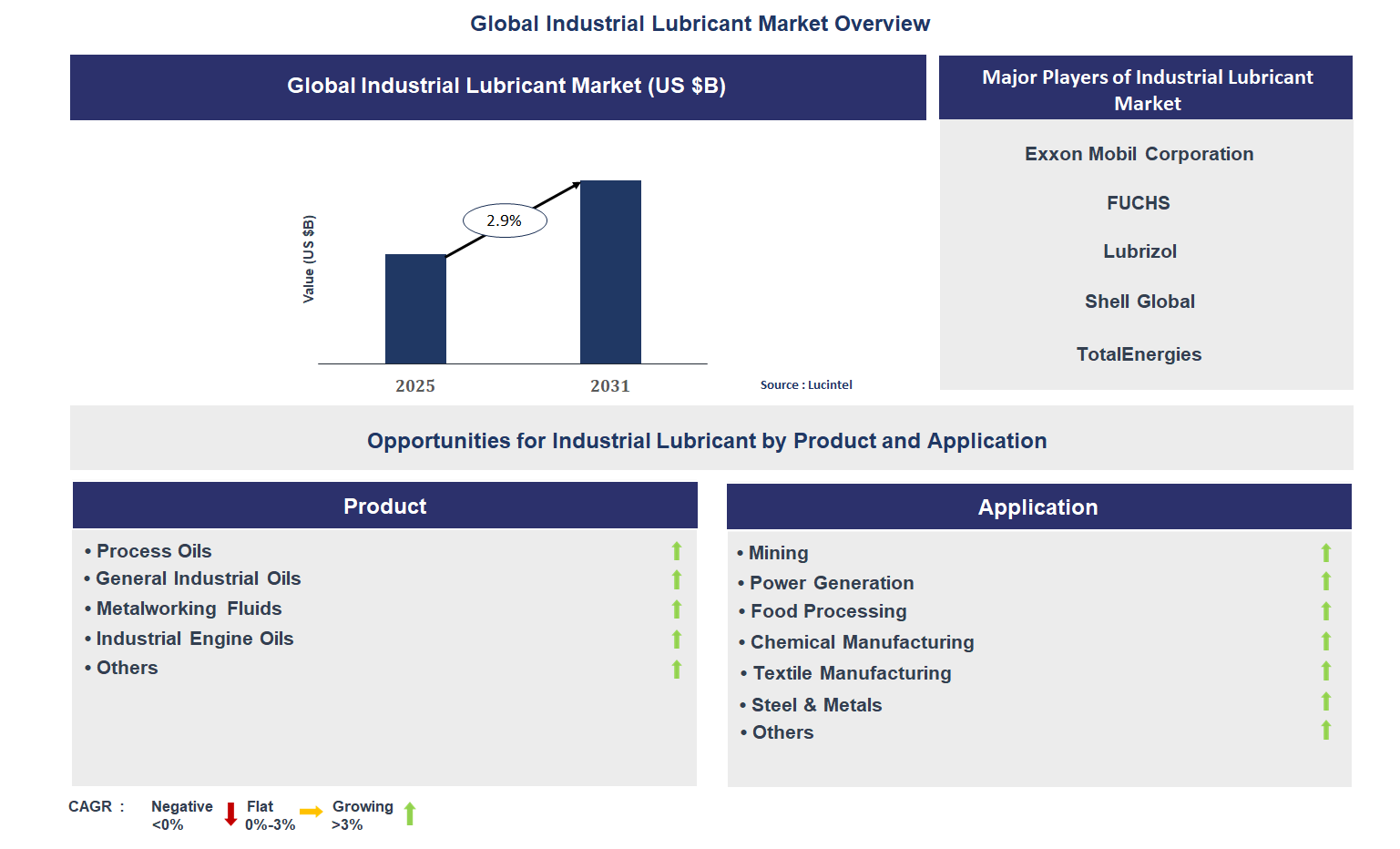
The future of the global industrial lubricant market looks promising with opportunities in the mining, power generation, food processing, chemical manufacturing, textile manufacturing, and steel & metal markets. The global industrial lubricant market is expected to grow with a CAGR of 2.9% from 2025 to 2031. The major drivers for this market are the increasing demand from manufacturing & automotive sectors, the rising adoption of high-performance lubricant solutions, and the growing industrialization across developing economies.

• Lucintel forecasts that, within the product category, process oil is expected to witness the highest growth over the forecast period.
• Within the application category, power generation is expected to witness the highest growth.
• In terms of region, APAC is expected to witness the highest growth over the forecast period.
Gain valuable insights for your business decisions with our comprehensive 150+ page report. Sample figures with some insights are shown below.
Industrial Lubricant Market Trends and Forecast

Emerging Trends in the Industrial Lubricant Market

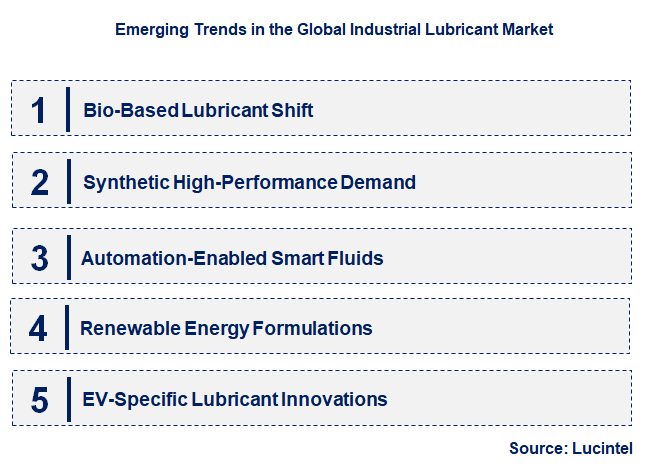
Industrial lubricant trends emphasize green transitions and tech integrations amid automation rises, with bio-based and smart fluids leading. Regulatory pressures and efficiency demands drive formulations for renewables and EVs. These evolutions prioritize durability, emission cuts, and predictive maintenance for resilient operations.
• Bio-Based Lubricant Shift: Formulations from renewables like sugarcane replace minerals, offering biodegradability for marine and food sectors. Compliance with OECD standards boosts adoption in regulated areas. Impact reduces ecological footprints, meets sustainability mandates, and opens premium markets, enhancing brand value and regulatory ease.
• Synthetic High-Performance Demand: Advanced oils with superior stability suit extreme conditions in aerospace and EVs, extending intervals. R&D investments yield low-friction variants. This trend cuts energy use, minimizes wear, and supports fuel efficiency, driving cost savings and innovation in high-stakes applications.
• Automation-Enabled Smart Fluids: IoT-integrated lubricants with sensors enable real-time monitoring for predictive upkeep in factories. Partnerships like Shell-SKF optimize cycles. Impact lowers failures, boosts uptime, and integrates with Industry 4.0, fostering data-driven efficiencies and reduced operational risks.
• Renewable Energy Formulations: Specialized greases for wind turbines and solar trackers withstand harsh weather, aiding clean power growth. Bio-additives enhance longevity. This expands applications, aligns with net-zero goals, and unlocks funding in green infrastructure for scalable energy transitions.
• EV-Specific Lubricant Innovations: Low-viscosity fluids for drivetrains and batteries address thermal management in electric fleets. OEM collaborations tailor solutions. Impact accelerates EV adoption, improves range, and diversifies from traditional engine oils, positioning firms in mobility shifts.
These trends reshape the industrial lubricant market by embedding sustainability and intelligence, expanding beyond legacy uses. They spur R&D, partnerships, and premiumization, balancing growth with eco-compliance while fortifying supply chains for global industrial evolutions.
Emerging Trends in the Industrial Lubricant Market

Recent Development in the Industrial Lubricant Market

Industrial lubricant developments spotlight eco-innovations and expansions amid manufacturing revivals. Global players launch bio-formulas and upgrade facilities, targeting automation and renewables. These advancements focus on durability and compliance, bridging efficiency gaps in high-demand sectors.
• ExxonMobil Synthetic Launch: High-performance synthetics for machinery enhance thermal stability in energy applications. Tailored for shale ops, they reduce friction effectively. Impact optimizes outputs, cuts maintenance, and supports U.S. export hubs with reliable, low-emission solutions.
• Shell-SKF Smart Fluid Pact: IoT-enabled lubricants integrate monitoring for factory automation, predicting failures. Deployed in Asian plants, they streamline upkeep. This elevates precision, minimizes downtime, and scales Industry 4.0 integrations for enhanced productivity.
• Fuchs IRMCO Acquisition: U.S. metal-forming specialist bolsters bio-lubricant portfolio for automotive. Expands sustainable options in Europe. Impact diversifies offerings, meets green standards, and accelerates adoption in precision manufacturing.
• Idemitsu Heavy Machinery Rollout: Advanced fluids for high-heat Japanese equipment improve gear longevity. Aligned with renewables, they resist extremes. This ensures resilience in offshore wind, boosts efficiency, and aligns with disaster-prone ops.
• PetroChina Patent Surge: Eco-synthetics for chemicals break import reliance, supporting Belt and Road projects. Local innovations lower costs. Impact fortifies supply, aids green transitions, and stimulates regional manufacturing growth.
These developments impact the industrial lubricant market by accelerating green tech and resilience. They drive efficiencies, compliance, and expansions, transforming operations toward sustainable, automated paradigms.

Strategic Growth Opportunities in the Industrial Lubricant Market

Industrial lubricant opportunities arise from sector diversifications like renewables and EVs, leveraging synthetics for precision. Infrastructure booms in emerging hubs unlock applications, with bio-blends enabling compliant scalability. These focus on tailored solutions for high-yield, adaptive ecosystems.
• Power Generation Upgrades: Bio-oils for turbines and grids support renewable integrations, reducing boil-off in solar farms. Subsidies spur retrofits. Impact scales clean energy, cuts outages, and attracts investments for reliable, low-carbon infrastructure.
• Heavy Equipment Maintenance: Synthetics for mining rigs endure abrasives, optimizing fleets in Asia-Pacific booms. Predictive tools extend life. This boosts extraction yields, lowers costs, and sustains operations in resource-heavy zones.
• Food Processing Compliance: Low-toxicity greases meet hygiene standards, enabling automated lines. Eco-formulas displace minerals. Impact ensures safety, expands clean-label production, and opens premium export channels.
• Metallurgy Fluid Innovations: High-stability coolants for forges enhance precision in EV battery metals. R&D yields recyclable variants. This accelerates supply chains, improves finishes, and aligns with circular economies.
• Chemical Manufacturing Blends: Corrosion-resistant process oils suit reactors, supporting pharma expansions. Custom viscosities fit harsh flows. Impact heightens throughput, ensures purity, and fosters specialized industrial growth.
These opportunities impact the industrial lubricant market by diversifying into green, high-tech niches. They fuel collaborations, innovations, and regional investments, propelling resilient, sustainable advancements worldwide.

Industrial Lubricant Market Driver and Challenges

Industrial lubricant dynamics weave technological, economic, and regulatory threads, with manufacturing surges offsetting eco-hurdles. Drivers like automation propel premium demands, while raw material swings challenge stability. This balance navigates toward innovative, compliant frameworks.
The factors responsible for driving the industrial lubricant market include:
1. Manufacturing Sector Expansion: Global industrialization, especially in Asia, heightens machinery needs for friction reduction. Infrastructure projects amplify equipment use. Implications include scaled efficiencies, job growth in maintenance, and tailored formulations for diverse operations.
2. Automotive Production Rise: EV and ICE fleets demand specialized synthetics for drivetrains and engines. Urbanization fuels vehicle parc. This enhances performance, supports mobility shifts, and drives aftermarket services for longevity.
3. Renewable Energy Adoption: Wind and solar require durable greases for harsh exposures. Policy incentives spur turbine installs. Implications unlock green segments, reduce fossil ties, and integrate with net-zero infrastructures.
4. Automation Tech Integration: Smart factories need sensor-compatible fluids for precision. Industry 4.0 investments optimize cycles. This minimizes failures, boosts data analytics, and enables predictive strategies for uptime.
5. Sustainability Regulation Push: Emission rules favor bio-based options, incentivizing low-toxicity R&D. Consumer eco-preferences align. Implications spur innovations, attract funding, and differentiate via compliant, ethical products.
Challenges in the industrial lubricant market are:
1. Raw Material Price Volatility: Crude fluctuations elevate base oil costs, squeezing margins. Geopolitical tensions worsen swings. This disrupts forecasting, raises end-prices, and pressures small producers.
2. Environmental Compliance Burdens: Stricter biodegradability mandates demand reformulations, hiking R&D spends. Regional variances complicate scaling. This slows transitions, increases fines risks, and tests global supply chains.
3. EV Transition Impacts: Reduced engine oil needs in electrics shrink traditional volumes. Infrastructure lags delay shifts. This erodes segments, forces diversification, and challenges legacy portfolios.
These drivers and challenges synthesize a vibrant industrial lubricant market, where innovations counter volatilities for net advancement. Drivers prevail, enabling sustainable expansions, while hurdles refine resilient, adaptive models for enduring efficiency.

List of Industrial Lubricant Companies

Companies in the market compete on the basis of product quality offered. Major players in this market focus on expanding their manufacturing facilities, R&D investments, infrastructural development, and leverage integration opportunities across the value chain. With these strategies industrial lubricant companies cater increasing demand, ensure competitive effectiveness, develop innovative products & technologies, reduce production costs, and expand their customer base. Some of the industrial lubricant companies profiled in this report include-
• Exxon Mobil Corporation
• FUCHS
• Lubrizol
• Shell Global
• TotalEnergies
• Klüber Lubrication
• Valvoline Global Operations
• Chevron Corporation
• Quaker Chemical Corporation
• Castrol Limited

Industrial Lubricant Market by Segment

The study includes a forecast for the global industrial lubricant market by product, application, and region.

Industrial Lubricant Market by Product [Value from 2019 to 2031]:


• Process Oils
• General Industrial Oils
• Metalworking Fluids
• Industrial Engine Oils
• Others

Industrial Lubricant Market by Application [Value from 2019 to 2031]:


• Mining
• Power Generation
• Food Processing
• Chemical Manufacturing
• Textile Manufacturing
• Steel & Metals
• Others

Industrial Lubricant Market by Region [Value from 2019 to 2031]:


• North America
• Europe
• Asia Pacific
• The Rest of the World

Country Wise Outlook for the Industrial Lubricant Market

The industrial lubricant market is advancing with sustainability mandates and automation surges, prioritizing eco-friendly formulations amid manufacturing expansions. Innovations in synthetic and bio-based products address efficiency needs, while regional policies boost adoption. In key economies, infrastructure and automotive growth drive demand, enhancing equipment longevity and operational resilience.
• United States: Focus on sustainability innovations from Chevron and Valvoline introduces bio-based lubricants for pharmaceuticals and food processing. Shale-driven manufacturing expands hydraulic fluid use, with online distribution channels improving accessibility. These shifts reduce emissions, extend machinery life, and align with emission controls, fostering cost efficiencies in diverse sectors.
• China: PetroChina and Sinopec lead patent surges in high-performance synthetics, supporting Made in China initiatives for green manufacturing. Automation in steel and chemicals boosts eco-friendly formulations, cutting energy use. This strengthens domestic supply, meets dual-carbon goals, and elevates export competitiveness in heavy industries.
• Germany: Fuchs Petrolub advances bio-based options under EU emission rules, targeting automotive and aerospace. High-Tech Strategy investments spur R&D for thermal-stable fluids, enhancing precision engineering. These efforts lower environmental impacts, comply with strict standards, and optimize heavy machinery performance in export-oriented sectors.
• India: Make in India policies accelerate lubricant demand in construction and mining via HPCL expansions. Synthetic launches for EVs and automation improve efficiency in textiles and power. This supports infrastructure booms, reduces downtime, and promotes localized production for economic uplift.
• Japan: Idemitsu Kosan rolls out high-temperature synthetics for heavy machinery, aligning with renewable energy pushes. ENEOS innovations in bio-oils enhance wind turbine reliability. These developments ensure seismic-resilient operations, cut volatility impacts, and integrate with precision manufacturing for sustained industrial output.

Lucintel Analytics Dashboard

Features of the Global Industrial Lubricant Market

Market Size Estimates: Industrial lubricant market size estimation in terms of value ($B).
Trend and Forecast Analysis: Market trends (2019 to 2024) and forecast (2025 to 2031) by various segments and regions.
Segmentation Analysis: Industrial lubricant market size by product, application, and region in terms of value ($B).
Regional Analysis: Industrial lubricant market breakdown by North America, Europe, Asia Pacific, and Rest of the World.
Growth Opportunities: Analysis of growth opportunities in different products, applications, and regions for the industrial lubricant market.
Strategic Analysis: This includes M&A, new product development, and competitive landscape of the industrial lubricant market.
Analysis of competitive intensity of the industry based on Porter’s Five Forces model.

Lucintel Consulting Services

FAQ

Q1. What is the growth forecast for industrial lubricant market?
Answer: The global industrial lubricant market is expected to grow with a CAGR of 2.9% from 2025 to 2031.
Q2. What are the major drivers influencing the growth of the industrial lubricant market?
Answer: The major drivers for this market are the increasing demand from manufacturing & automotive sectors, the rising adoption of high-performance lubricant solutions, and the growing industrialization across developing economies.
Q3. What are the major segments for industrial lubricant market?
Answer: The future of the industrial lubricant market looks promising with opportunities in the mining, power generation, food processing, chemical manufacturing, textile manufacturing, and steel & metal markets.
Q4. Who are the key industrial lubricant market companies?
Answer: Some of the key industrial lubricant companies are as follows:
• Exxon Mobil Corporation
• FUCHS
• Lubrizol
• Shell Global
• TotalEnergies
• Klüber Lubrication
• Valvoline Global Operations
• Chevron Corporation
• Quaker Chemical Corporation
• Castrol Limited
Q5. Which industrial lubricant market segment will be the largest in future?
Answer: Lucintel forecasts that, within the product category, process oil is expected to witness the highest growth over the forecast period.
Q6. In industrial lubricant market, which region is expected to be the largest in next 5 years?
Answer: In terms of region, APAC is expected to witness the highest growth over the forecast period.
Q7. Do we receive customization in this report?
Answer: Yes, Lucintel provides 10% customization without any additional cost.

This report answers following 11 key questions:

Q.1. What are some of the most promising, high-growth opportunities for the industrial lubricant market by product (process oils, general industrial oils, metalworking fluids, industrial engine oils, and others), application (mining, power generation, food processing, chemical manufacturing, textile manufacturing, steel & metals, and others), and region (North America, Europe, Asia Pacific, and the Rest of the World)?
Q.2. Which segments will grow at a faster pace and why?
Q.3. Which region will grow at a faster pace and why?
Q.4. What are the key factors affecting market dynamics? What are the key challenges and business risks in this market?
Q.5. What are the business risks and competitive threats in this market?
Q.6. What are the emerging trends in this market and the reasons behind them?
Q.7. What are some of the changing demands of customers in the market?
Q.8. What are the new developments in the market? Which companies are leading these developments?
Q.9. Who are the major players in this market? What strategic initiatives are key players pursuing for business growth?
Q.10. What are some of the competing products in this market and how big of a threat do they pose for loss of market share by material or product substitution?
Q.11. What M&A activity has occurred in the last 5 years and what has its impact been on the industry?

For any questions related to Industrial Lubricant Market, Industrial Lubricant Market Size, Industrial Lubricant Market Growth, Industrial Lubricant Market Analysis, Industrial Lubricant Market Report, Industrial Lubricant Market Share, Industrial Lubricant Market Trends, Industrial Lubricant Market Forecast, Industrial Lubricant Companies, write Lucintel analyst at email: helpdesk@lucintel.com. We will be glad to get back to you soon.
                                           Table of Contents

            1. Executive Summary

            2. Market Overview

                        2.1 Background and Classifications
                        2.2 Supply Chain

            3. Market Trends & Forecast Analysis

                        3.1 Macroeconomic Trends and Forecasts
                        3.2 Industry Drivers and Challenges
                        3.3 PESTLE Analysis
                        3.4 Patent Analysis
                        3.5 Regulatory Environment
                        3.6 Global Industrial Lubricant Market Trends and Forecast

            4. Global Industrial Lubricant Market by Product

                        4.1 Overview
                        4.2 Attractiveness Analysis by Product
                        4.3 Process Oils : Trends and Forecast 2025 to 2031
                        4.4 General Industrial Oils : Trends and Forecast 2025 to 2031
                        4.5 Metalworking Fluids : Trends and Forecast 2025 to 2031
                        4.6 Industrial Engine Oils : Trends and Forecast 2025 to 2031
                        4.7 Others : Trends and Forecast 2025 to 2031

            5. Global Industrial Lubricant Market by Application

                        5.1 Overview
                        5.2 Attractiveness Analysis by Application
                        5.3 Mining : Trends and Forecast 2025 to 2031
                        5.4 Power Generation : Trends and Forecast 2025 to 2031
                        5.5 Food Processing : Trends and Forecast 2025 to 2031
                        5.6 Chemical Manufacturing : Trends and Forecast 2025 to 2031
                        5.7 Textile Manufacturing : Trends and Forecast 2025 to 2031
                        5.8 Steel & Metals : Trends and Forecast 2025 to 2031
                        5.9 Others : Trends and Forecast 2025 to 2031

            6. Regional Analysis

                        6.1 Overview
                        6.2 Global Industrial Lubricant Market by Region

            7. North American Industrial Lubricant Market

                        7.1 Overview
                        7.2 North American Industrial Lubricant Market by Product
                        7.3 North American Industrial Lubricant Market by Application
                        7.4 The United States Industrial Lubricant Market
                        7.5 Canadian Industrial Lubricant Market
                        7.6 Mexican Industrial Lubricant Market

            8. European Industrial Lubricant Market

                        8.1 Overview
                        8.2 European Industrial Lubricant Market by Product
                        8.3 European Industrial Lubricant Market by Application
                        8.4 German Industrial Lubricant Market
                        8.5 French Industrial Lubricant Market
                        8.6 Italian Industrial Lubricant Market
                        8.7 Spanish Industrial Lubricant Market
                        8.8 The United Kingdom Industrial Lubricant Market

            9. APAC Industrial Lubricant Market

                        9.1 Overview
                        9.2 APAC Industrial Lubricant Market by Product
                        9.3 APAC Industrial Lubricant Market by Application
                        9.4 Chinese Industrial Lubricant Market
                        9.5 Indian Industrial Lubricant Market
                        9.6 Japanese Industrial Lubricant Market
                        9.7 South Korean Industrial Lubricant Market
                        9.8 Indonesian Industrial Lubricant Market

            10. ROW Industrial Lubricant Market

                        10.1 Overview
                        10.2 ROW Industrial Lubricant Market by Product
                        10.3 ROW Industrial Lubricant Market by Application
                        10.4 Middle Eastern Industrial Lubricant Market
                        10.5 South American Industrial Lubricant Market
                        10.6 African Industrial Lubricant Market

            11. Competitor Analysis

                        11.1 Product Portfolio Analysis
                        11.2 Operational Integration
                        11.3 Porter’s Five Forces Analysis
                                    • Competitive Rivalry
                                    • Bargaining Power of Buyers
                                    • Bargaining Power of Suppliers
                                    • Threat of Substitutes
                                    • Threat of New Entrants
                        11.4 Market Share Analysis

            12. Opportunities & Strategic Analysis

                        12.1 Value Chain Analysis
                        12.2 Growth Opportunity Analysis
                                    12.2.1 Growth Opportunity by Product
                                    12.2.2 Growth Opportunity by Application
                        12.3 Emerging Trends in the Global Industrial Lubricant Market
                        12.4 Strategic Analysis
                                    12.4.1 New Product Development
                                    12.4.2 Certification and Licensing
                                    12.4.3 Mergers, Acquisitions, Agreements, Collaborations, and Joint Ventures

            13. Company Profiles of the Leading Players Across the Value Chain

                        13.1 Competitive Analysis Overview
                        13.2 Exxon Mobil Corporation
                                    • Company Overview
                                    • Industrial Lubricant Market Business Overview
                                    • New Product Development
                                    • Merger, Acquisition, and Collaboration
                                    • Certification and Licensing
                        13.3 FUCHS
                                    • Company Overview
                                    • Industrial Lubricant Market Business Overview
                                    • New Product Development
                                    • Merger, Acquisition, and Collaboration
                                    • Certification and Licensing
                        13.4 Lubrizol
                                    • Company Overview
                                    • Industrial Lubricant Market Business Overview
                                    • New Product Development
                                    • Merger, Acquisition, and Collaboration
                                    • Certification and Licensing
                        13.5 Shell Global
                                    • Company Overview
                                    • Industrial Lubricant Market Business Overview
                                    • New Product Development
                                    • Merger, Acquisition, and Collaboration
                                    • Certification and Licensing
                        13.6 TotalEnergies
                                    • Company Overview
                                    • Industrial Lubricant Market Business Overview
                                    • New Product Development
                                    • Merger, Acquisition, and Collaboration
                                    • Certification and Licensing
                        13.7 Klüber Lubrication
                                    • Company Overview
                                    • Industrial Lubricant Market Business Overview
                                    • New Product Development
                                    • Merger, Acquisition, and Collaboration
                                    • Certification and Licensing
                        13.8 Valvoline Global Operations
                                    • Company Overview
                                    • Industrial Lubricant Market Business Overview
                                    • New Product Development
                                    • Merger, Acquisition, and Collaboration
                                    • Certification and Licensing
                        13.9 Chevron Corporation
                                    • Company Overview
                                    • Industrial Lubricant Market Business Overview
                                    • New Product Development
                                    • Merger, Acquisition, and Collaboration
                                    • Certification and Licensing
                        13.10 Quaker Chemical Corporation
                                    • Company Overview
                                    • Industrial Lubricant Market Business Overview
                                    • New Product Development
                                    • Merger, Acquisition, and Collaboration
                                    • Certification and Licensing
                        13.11 Castrol Limited
                                    • Company Overview
                                    • Industrial Lubricant Market Business Overview
                                    • New Product Development
                                    • Merger, Acquisition, and Collaboration
                                    • Certification and Licensing

            14. Appendix

                        14.1 List of Figures
                        14.2 List of Tables
                        14.3 Research Methodology
                        14.4 Disclaimer
                        14.5 Copyright
                        14.6 Abbreviations and Technical Units
                        14.7 About Us
                        14.8 Contact Us

                                               List of Figures


            Chapter 1

                        Figure 1.1: Trends and Forecast for the Global Industrial Lubricant Market

            Chapter 2

                        Figure 2.1: Usage of Industrial Lubricant Market
                        Figure 2.2: Classification of the Global Industrial Lubricant Market
                        Figure 2.3: Supply Chain of the Global Industrial Lubricant Market

            Chapter 3

                        Figure 3.1: Trends of the Global GDP Growth Rate
                        Figure 3.2: Trends of the Global Population Growth Rate
                        Figure 3.3: Trends of the Global Inflation Rate
                        Figure 3.4: Trends of the Global Unemployment Rate
                        Figure 3.5: Trends of the Regional GDP Growth Rate
                        Figure 3.6: Trends of the Regional Population Growth Rate
                        Figure 3.7: Trends of the Regional Inflation Rate
                        Figure 3.8: Trends of the Regional Unemployment Rate
                        Figure 3.9: Trends of Regional Per Capita Income
                        Figure 3.10: Forecast for the Global GDP Growth Rate
                        Figure 3.11: Forecast for the Global Population Growth Rate
                        Figure 3.12: Forecast for the Global Inflation Rate
                        Figure 3.13: Forecast for the Global Unemployment Rate
                        Figure 3.14: Forecast for the Regional GDP Growth Rate
                        Figure 3.15: Forecast for the Regional Population Growth Rate
                        Figure 3.16: Forecast for the Regional Inflation Rate
                        Figure 3.17: Forecast for the Regional Unemployment Rate
                        Figure 3.18: Forecast for Regional Per Capita Income
                        Figure 3.19: Driver and Challenges of the Industrial Lubricant Market

            Chapter 4

                        Figure 4.1: Global Industrial Lubricant Market by Product in 2019, 2024, and 2031
                        Figure 4.2: Trends of the Global Industrial Lubricant Market ($B) by Product
                        Figure 4.3: Forecast for the Global Industrial Lubricant Market ($B) by Product
                        Figure 4.4: Trends and Forecast for Process Oils in the Global Industrial Lubricant Market (2019-2031)
                        Figure 4.5: Trends and Forecast for General Industrial Oils in the Global Industrial Lubricant Market (2019-2031)
                        Figure 4.6: Trends and Forecast for Metalworking Fluids in the Global Industrial Lubricant Market (2019-2031)
                        Figure 4.7: Trends and Forecast for Industrial Engine Oils in the Global Industrial Lubricant Market (2019-2031)
                        Figure 4.8: Trends and Forecast for Others in the Global Industrial Lubricant Market (2019-2031)

            Chapter 5

                        Figure 5.1: Global Industrial Lubricant Market by Application in 2019, 2024, and 2031
                        Figure 5.2: Trends of the Global Industrial Lubricant Market ($B) by Application
                        Figure 5.3: Forecast for the Global Industrial Lubricant Market ($B) by Application
                        Figure 5.4: Trends and Forecast for Mining in the Global Industrial Lubricant Market (2019-2031)
                        Figure 5.5: Trends and Forecast for Power Generation in the Global Industrial Lubricant Market (2019-2031)
                        Figure 5.6: Trends and Forecast for Food Processing in the Global Industrial Lubricant Market (2019-2031)
                        Figure 5.7: Trends and Forecast for Chemical Manufacturing in the Global Industrial Lubricant Market (2019-2031)
                        Figure 5.8: Trends and Forecast for Textile Manufacturing in the Global Industrial Lubricant Market (2019-2031)
                        Figure 5.9: Trends and Forecast for Steel & Metals in the Global Industrial Lubricant Market (2019-2031)
                        Figure 5.10: Trends and Forecast for Others in the Global Industrial Lubricant Market (2019-2031)

            Chapter 6

                        Figure 6.1: Trends of the Global Industrial Lubricant Market ($B) by Region (2019-2024)
                        Figure 6.2: Forecast for the Global Industrial Lubricant Market ($B) by Region (2025-2031)

            Chapter 7

                        Figure 7.1: Trends and Forecast for the North American Industrial Lubricant Market (2019-2031)
                        Figure 7.2: North American Industrial Lubricant Market by Product in 2019, 2024, and 2031
                        Figure 7.3: Trends of the North American Industrial Lubricant Market ($B) by Product (2019-2024)
                        Figure 7.4: Forecast for the North American Industrial Lubricant Market ($B) by Product (2025-2031)
                        Figure 7.5: North American Industrial Lubricant Market by Application in 2019, 2024, and 2031
                        Figure 7.6: Trends of the North American Industrial Lubricant Market ($B) by Application (2019-2024)
                        Figure 7.7: Forecast for the North American Industrial Lubricant Market ($B) by Application (2025-2031)
                        Figure 7.8: Trends and Forecast for the United States Industrial Lubricant Market ($B) (2019-2031)
                        Figure 7.9: Trends and Forecast for the Mexican Industrial Lubricant Market ($B) (2019-2031)
                        Figure 7.10: Trends and Forecast for the Canadian Industrial Lubricant Market ($B) (2019-2031)

            Chapter 8

                        Figure 8.1: Trends and Forecast for the European Industrial Lubricant Market (2019-2031)
                        Figure 8.2: European Industrial Lubricant Market by Product in 2019, 2024, and 2031
                        Figure 8.3: Trends of the European Industrial Lubricant Market ($B) by Product (2019-2024)
                        Figure 8.4: Forecast for the European Industrial Lubricant Market ($B) by Product (2025-2031)
                        Figure 8.5: European Industrial Lubricant Market by Application in 2019, 2024, and 2031
                        Figure 8.6: Trends of the European Industrial Lubricant Market ($B) by Application (2019-2024)
                        Figure 8.7: Forecast for the European Industrial Lubricant Market ($B) by Application (2025-2031)
                        Figure 8.8: Trends and Forecast for the German Industrial Lubricant Market ($B) (2019-2031)
                        Figure 8.9: Trends and Forecast for the French Industrial Lubricant Market ($B) (2019-2031)
                        Figure 8.10: Trends and Forecast for the Spanish Industrial Lubricant Market ($B) (2019-2031)
                        Figure 8.11: Trends and Forecast for the Italian Industrial Lubricant Market ($B) (2019-2031)
                        Figure 8.12: Trends and Forecast for the United Kingdom Industrial Lubricant Market ($B) (2019-2031)

            Chapter 9

                        Figure 9.1: Trends and Forecast for the APAC Industrial Lubricant Market (2019-2031)
                        Figure 9.2: APAC Industrial Lubricant Market by Product in 2019, 2024, and 2031
                        Figure 9.3: Trends of the APAC Industrial Lubricant Market ($B) by Product (2019-2024)
                        Figure 9.4: Forecast for the APAC Industrial Lubricant Market ($B) by Product (2025-2031)
                        Figure 9.5: APAC Industrial Lubricant Market by Application in 2019, 2024, and 2031
                        Figure 9.6: Trends of the APAC Industrial Lubricant Market ($B) by Application (2019-2024)
                        Figure 9.7: Forecast for the APAC Industrial Lubricant Market ($B) by Application (2025-2031)
                        Figure 9.8: Trends and Forecast for the Japanese Industrial Lubricant Market ($B) (2019-2031)
                        Figure 9.9: Trends and Forecast for the Indian Industrial Lubricant Market ($B) (2019-2031)
                        Figure 9.10: Trends and Forecast for the Chinese Industrial Lubricant Market ($B) (2019-2031)
                        Figure 9.11: Trends and Forecast for the South Korean Industrial Lubricant Market ($B) (2019-2031)
                        Figure 9.12: Trends and Forecast for the Indonesian Industrial Lubricant Market ($B) (2019-2031)

            Chapter 10

                        Figure 10.1: Trends and Forecast for the ROW Industrial Lubricant Market (2019-2031)
                        Figure 10.2: ROW Industrial Lubricant Market by Product in 2019, 2024, and 2031
                        Figure 10.3: Trends of the ROW Industrial Lubricant Market ($B) by Product (2019-2024)
                        Figure 10.4: Forecast for the ROW Industrial Lubricant Market ($B) by Product (2025-2031)
                        Figure 10.5: ROW Industrial Lubricant Market by Application in 2019, 2024, and 2031
                        Figure 10.6: Trends of the ROW Industrial Lubricant Market ($B) by Application (2019-2024)
                        Figure 10.7: Forecast for the ROW Industrial Lubricant Market ($B) by Application (2025-2031)
                        Figure 10.8: Trends and Forecast for the Middle Eastern Industrial Lubricant Market ($B) (2019-2031)
                        Figure 10.9: Trends and Forecast for the South American Industrial Lubricant Market ($B) (2019-2031)
                        Figure 10.10: Trends and Forecast for the African Industrial Lubricant Market ($B) (2019-2031)

            Chapter 11

                        Figure 11.1: Porter’s Five Forces Analysis of the Global Industrial Lubricant Market
                        Figure 11.2: Market Share (%) of Top Players in the Global Industrial Lubricant Market (2024)

            Chapter 12

                        Figure 12.1: Growth Opportunities for the Global Industrial Lubricant Market by Product
                        Figure 12.2: Growth Opportunities for the Global Industrial Lubricant Market by Application
                        Figure 12.3: Growth Opportunities for the Global Industrial Lubricant Market by Region
                        Figure 12.4: Emerging Trends in the Global Industrial Lubricant Market

                                               List of Tables


            Chapter 1

                        Table 1.1: Growth Rate (%, 2023-2024) and CAGR (%, 2025-2031) of the Industrial Lubricant Market by Product and Application
                        Table 1.2: Attractiveness Analysis for the Industrial Lubricant Market by Region
                        Table 1.3: Global Industrial Lubricant Market Parameters and Attributes

            Chapter 3

                        Table 3.1: Trends of the Global Industrial Lubricant Market (2019-2024)
                        Table 3.2: Forecast for the Global Industrial Lubricant Market (2025-2031)

            Chapter 4

                        Table 4.1: Attractiveness Analysis for the Global Industrial Lubricant Market by Product
                        Table 4.2: Market Size and CAGR of Various Product in the Global Industrial Lubricant Market (2019-2024)
                        Table 4.3: Market Size and CAGR of Various Product in the Global Industrial Lubricant Market (2025-2031)
                        Table 4.4: Trends of Process Oils in the Global Industrial Lubricant Market (2019-2024)
                        Table 4.5: Forecast for Process Oils in the Global Industrial Lubricant Market (2025-2031)
                        Table 4.6: Trends of General Industrial Oils in the Global Industrial Lubricant Market (2019-2024)
                        Table 4.7: Forecast for General Industrial Oils in the Global Industrial Lubricant Market (2025-2031)
                        Table 4.8: Trends of Metalworking Fluids in the Global Industrial Lubricant Market (2019-2024)
                        Table 4.9: Forecast for Metalworking Fluids in the Global Industrial Lubricant Market (2025-2031)
                        Table 4.10: Trends of Industrial Engine Oils in the Global Industrial Lubricant Market (2019-2024)
                        Table 4.11: Forecast for Industrial Engine Oils in the Global Industrial Lubricant Market (2025-2031)
                        Table 4.12: Trends of Others in the Global Industrial Lubricant Market (2019-2024)
                        Table 4.13: Forecast for Others in the Global Industrial Lubricant Market (2025-2031)

            Chapter 5

                        Table 5.1: Attractiveness Analysis for the Global Industrial Lubricant Market by Application
                        Table 5.2: Market Size and CAGR of Various Application in the Global Industrial Lubricant Market (2019-2024)
                        Table 5.3: Market Size and CAGR of Various Application in the Global Industrial Lubricant Market (2025-2031)
                        Table 5.4: Trends of Mining in the Global Industrial Lubricant Market (2019-2024)
                        Table 5.5: Forecast for Mining in the Global Industrial Lubricant Market (2025-2031)
                        Table 5.6: Trends of Power Generation in the Global Industrial Lubricant Market (2019-2024)
                        Table 5.7: Forecast for Power Generation in the Global Industrial Lubricant Market (2025-2031)
                        Table 5.8: Trends of Food Processing in the Global Industrial Lubricant Market (2019-2024)
                        Table 5.9: Forecast for Food Processing in the Global Industrial Lubricant Market (2025-2031)
                        Table 5.10: Trends of Chemical Manufacturing in the Global Industrial Lubricant Market (2019-2024)
                        Table 5.11: Forecast for Chemical Manufacturing in the Global Industrial Lubricant Market (2025-2031)
                        Table 5.12: Trends of Textile Manufacturing in the Global Industrial Lubricant Market (2019-2024)
                        Table 5.13: Forecast for Textile Manufacturing in the Global Industrial Lubricant Market (2025-2031)
                        Table 5.14: Trends of Steel & Metals in the Global Industrial Lubricant Market (2019-2024)
                        Table 5.15: Forecast for Steel & Metals in the Global Industrial Lubricant Market (2025-2031)
                        Table 5.16: Trends of Others in the Global Industrial Lubricant Market (2019-2024)
                        Table 5.17: Forecast for Others in the Global Industrial Lubricant Market (2025-2031)"

            Chapter 6

                        Table 6.1: Market Size and CAGR of Various Regions in the Global Industrial Lubricant Market (2019-2024)
                        Table 6.2: Market Size and CAGR of Various Regions in the Global Industrial Lubricant Market (2025-2031)

            Chapter 7

                        Table 7.1: Trends of the North American Industrial Lubricant Market (2019-2024)
                        Table 7.2: Forecast for the North American Industrial Lubricant Market (2025-2031)
                        Table 7.3: Market Size and CAGR of Various Product in the North American Industrial Lubricant Market (2019-2024)
                        Table 7.4: Market Size and CAGR of Various Product in the North American Industrial Lubricant Market (2025-2031)
                        Table 7.5: Market Size and CAGR of Various Application in the North American Industrial Lubricant Market (2019-2024)
                        Table 7.6: Market Size and CAGR of Various Application in the North American Industrial Lubricant Market (2025-2031)
                        Table 7.7: Trends and Forecast for the United States Industrial Lubricant Market (2019-2031)
                        Table 7.8: Trends and Forecast for the Mexican Industrial Lubricant Market (2019-2031)
                        Table 7.9: Trends and Forecast for the Canadian Industrial Lubricant Market (2019-2031)

            Chapter 8

                        Table 8.1: Trends of the European Industrial Lubricant Market (2019-2024)
                        Table 8.2: Forecast for the European Industrial Lubricant Market (2025-2031)
                        Table 8.3: Market Size and CAGR of Various Product in the European Industrial Lubricant Market (2019-2024)
                        Table 8.4: Market Size and CAGR of Various Product in the European Industrial Lubricant Market (2025-2031)
                        Table 8.5: Market Size and CAGR of Various Application in the European Industrial Lubricant Market (2019-2024)
                        Table 8.6: Market Size and CAGR of Various Application in the European Industrial Lubricant Market (2025-2031)
                        Table 8.7: Trends and Forecast for the German Industrial Lubricant Market (2019-2031)
                        Table 8.8: Trends and Forecast for the French Industrial Lubricant Market (2019-2031)
                        Table 8.9: Trends and Forecast for the Spanish Industrial Lubricant Market (2019-2031)
                        Table 8.10: Trends and Forecast for the Italian Industrial Lubricant Market (2019-2031)
                        Table 8.11: Trends and Forecast for the United Kingdom Industrial Lubricant Market (2019-2031)

            Chapter 9

                        Table 9.1: Trends of the APAC Industrial Lubricant Market (2019-2024)
                        Table 9.2: Forecast for the APAC Industrial Lubricant Market (2025-2031)
                        Table 9.3: Market Size and CAGR of Various Product in the APAC Industrial Lubricant Market (2019-2024)
                        Table 9.4: Market Size and CAGR of Various Product in the APAC Industrial Lubricant Market (2025-2031)
                        Table 9.5: Market Size and CAGR of Various Application in the APAC Industrial Lubricant Market (2019-2024)
                        Table 9.6: Market Size and CAGR of Various Application in the APAC Industrial Lubricant Market (2025-2031)
                        Table 9.7: Trends and Forecast for the Japanese Industrial Lubricant Market (2019-2031)
                        Table 9.8: Trends and Forecast for the Indian Industrial Lubricant Market (2019-2031)
                        Table 9.9: Trends and Forecast for the Chinese Industrial Lubricant Market (2019-2031)
                        Table 9.10: Trends and Forecast for the South Korean Industrial Lubricant Market (2019-2031)
                        Table 9.11: Trends and Forecast for the Indonesian Industrial Lubricant Market (2019-2031)

            Chapter 10

                        Table 10.1: Trends of the ROW Industrial Lubricant Market (2019-2024)
                        Table 10.2: Forecast for the ROW Industrial Lubricant Market (2025-2031)
                        Table 10.3: Market Size and CAGR of Various Product in the ROW Industrial Lubricant Market (2019-2024)
                        Table 10.4: Market Size and CAGR of Various Product in the ROW Industrial Lubricant Market (2025-2031)
                        Table 10.5: Market Size and CAGR of Various Application in the ROW Industrial Lubricant Market (2019-2024)
                        Table 10.6: Market Size and CAGR of Various Application in the ROW Industrial Lubricant Market (2025-2031)
                        Table 10.7: Trends and Forecast for the Middle Eastern Industrial Lubricant Market (2019-2031)
                        Table 10.8: Trends and Forecast for the South American Industrial Lubricant Market (2019-2031)
                        Table 10.9: Trends and Forecast for the African Industrial Lubricant Market (2019-2031)

            Chapter 11

                        Table 11.1: Product Mapping of Industrial Lubricant Suppliers Based on Segments
                        Table 11.2: Operational Integration of Industrial Lubricant Manufacturers
                        Table 11.3: Rankings of Suppliers Based on Industrial Lubricant Revenue

            Chapter 12

                        Table 12.1: New Product Launches by Major Industrial Lubricant Producers (2019-2024)
                        Table 12.2: Certification Acquired by Major Competitor in the Global Industrial Lubricant Market

.

Buy full report or by chapter as follows

Limited Time Offer

Price by License Type:
[-] Hide Chapter Details
[Chapter Number] [Chapter Name] [Chapter Number Of Pages] [Chapter Price]
Title/Chapter Name Pages Price
Full Report: Industrial Lubricant Market Report: Trends, Forecast and Competitive Analysis to 2031 Full Report $ 2,990
A 150 Page Report
Lucintel has been in the business of market research and management consulting since 2000 and has published over 1000 market intelligence reports in various markets / applications and served over 1,000 clients worldwide. This study is a culmination of four months of full-time effort performed by Lucintel's analyst team. The analysts used the following sources for the creation and completion of this valuable report:
  • In-depth interviews of the major players in this market
  • Detailed secondary research from competitors’ financial statements and published data 
  • Extensive searches of published works, market, and database information pertaining to industry news, company press releases, and customer intentions
  • A compilation of the experiences, judgments, and insights of Lucintel’s professionals, who have analyzed and tracked this market over the years.
Extensive research and interviews are conducted across the supply chain of this market to estimate market share, market size, trends, drivers, challenges, and forecasts. Below is a brief summary of the primary interviews that were conducted by job function for this report.
 
Thus, Lucintel compiles vast amounts of data from numerous sources, validates the integrity of that data, and performs a comprehensive analysis. Lucintel then organizes the data, its findings, and insights into a concise report designed to support the strategic decision-making process. The figure below is a graphical representation of Lucintel’s research process. 
 

Please sign in below to get report brochure - Industrial Lubricant Market Report.

At Lucintel, we respect your privacy and maintain the confidentiality of information / data provided by you
(Please enter your corporate email. * These fields are mandatory )

Follow us on

