
Market Report · July 22, 2026

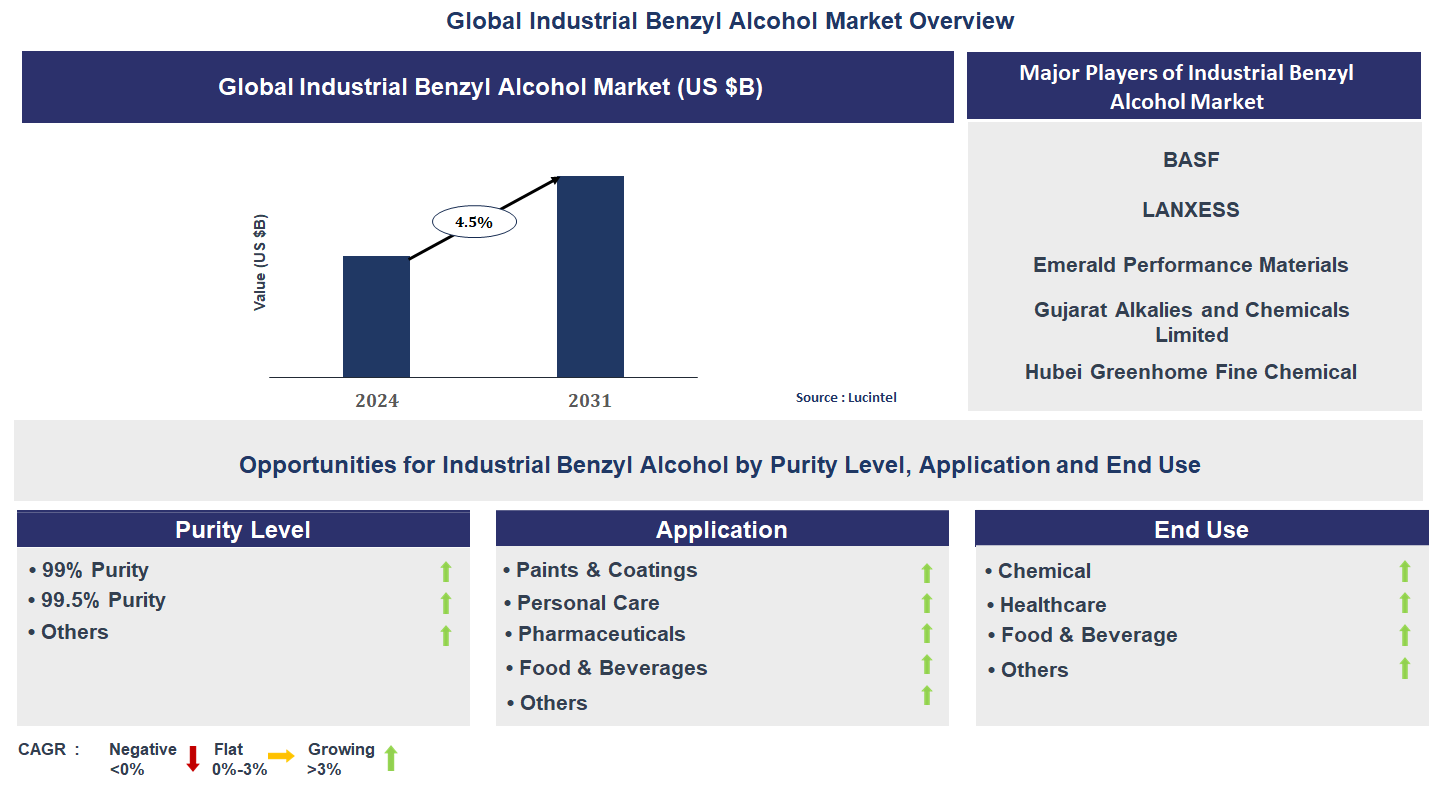
Key data points: The growth forecast = 4.5% annually for the next 7 years. Scroll below to get more insights. This market report covers trends, opportunities and forecasts in industrial benzyl alcohol market to 2031 by purity level (99% purity, 99.5% purity, and others), application (paints & coatings, personal care, pharmaceuticals, food & beverages, and others), end use (chemical, healthcare, food & beverage, and others), and region (North America, Europe, Asia Pacific, and the Rest of the World)
We'll send your sample report shortly.
• Lucintel forecasts that, within the purity level category, 99.5% purity is expected to witness higher growth over the forecast period.
• Within the end use category, chemical is expected to witness the highest growth.
• In terms of region, APAC is expected to witness the highest growth over the forecast period. Gain valuable insights for your business decisions with our comprehensive 150+ page report. Sample figures with some insights are shown below.
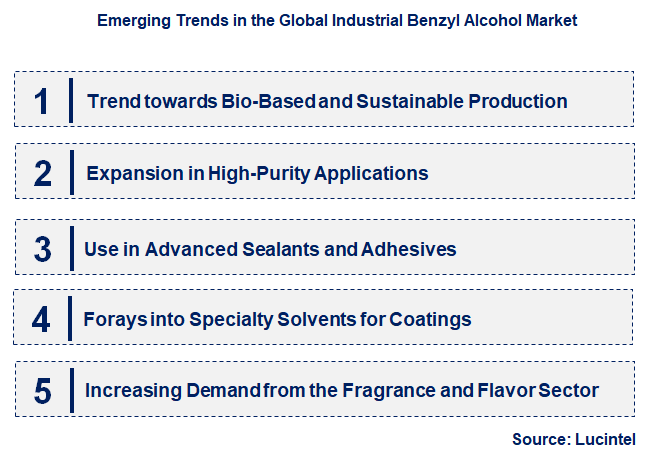
• Trend towards Bio-Based and Sustainable Production: A strong trend is emerging towards using bio-based and sustainable production processes for industrial benzyl alcohol. This is largely fueled by more stringent environmental standards and a worldwide movement towards a green economy. Businesses are looking into renewable feedstocks and cleaner synthesis processes to lower their carbon footprints. This development is propelling manufacturers to invest in green chemistry principles, which will earn them a competitive edge by winning over eco-friendly consumers and industries. This is the long-term trend that will redefine the market.
• Expansion in High-Purity Applications: One trend is the growing need for high-purity grades of industrial-grade benzyl alcohol. This is fueled by its application in advanced applications such as pharmaceuticals, medical devices, and electronics. These sectors need a compound with few impurities to function at its best and be safe. The market is witnessing a shift from commodity-grade products to niche, value-added products. This trend is compelling manufacturers to invest in high-level purification and quality control processes in order to achieve these tough requirements.
• Use in Advanced Sealants and Adhesives: Application of industrial benzyl alcohol in advanced sealants and adhesives is a new trend. Due to its solvent and crosslinking agent properties, it is a perfect ingredient to use in producing high-performance products that can withstand harsh conditions. This trend is being fueled by the demand for more resilient and dependable bonding solutions across segments such as automotive and construction. It is opening up a new, high-growth segment for the market and is prompting manufacturers to create specialized formulations.
• Forays into Specialty Solvents for Coatings: The market is witnessing a new trend where industrial benzyl alcohol is increasingly being used as a specialty solvent for waterborne and high-solids coatings. Its good solvency and low vapor pressure make it a good coalescing agent, improving the paint and coating film-forming properties. It is fueled by volatile organic compound (VOC) regulations and the industry’s need for cleaner, high-performance paint systems. It is generating a new source of growth and innovation.
• Increasing Demand from the Fragrance and Flavor Sector: There is an increasing trend towards using industrial benzyl alcohol as a fixative and solvent in the fragrance and flavor sector. Its pleasant, mild odor and low toxicity level make it a suitable carrier for fragrance compounds. This trend is being fueled by the increasing global demand for personal care products, perfumes, and food additives. It is broadening the market’s application base and opening a stable, high-value segment to producers. These trends are essentially transforming the industrial benzyl alcohol market into a more sustainable, technologically enabled, and application-specific industry. The emphasis is not merely on being a general-purpose solvent but on providing holistic solutions to address comprehensive challenges such as environmental compliance, product performance, and the niche requirements of next-generation industries. Those organizations that can effectively navigate these trends will be well-positioned to control the market in the foreseeable future.
• Strategic Capacity Expansion by Major Players: One of the major developments is the strategic addition of production capacity by leading players. Industries are making investments in new facilities and plants, especially in the Asia-Pacific region, to satisfy the increasing demand for industrial benzyl alcohol. This is important for maintaining a stable supply of the compound and avoiding volatility in prices. This also represents a long-term dedication from producers to the market and a projection of persistent growth, which is a primary reason end-users are looking for dependable suppliers.
• Greater Emphasis on Purity of the Product: There has been a strong progress towards the manufacture of high-purity grades of industrial benzyl alcohol. This is stimulated by the increasing needs of high-tech industries such as pharmaceuticals and electronics, where even trace amounts of impurities can render the final product ineffective. Companies are making investments in sophisticated purification technologies and quality assurance procedures to meet these demanding specifications.
• Expansion in Bio-Based Production: A significant recent trend is growth in research and development on bio-based production processes for benzyl alcohol. Spurred by intense environmental regulations and the global move towards environmentally friendly manufacturing, firms are looking into utilizing renewable feedstocks. Although still a specialty segment, this trend is a long-term one that will contribute to making the industry less fossil fuel-based and more sustainable.
• Increasing Adoption across the Fragrance and Flavor Market: The application of industrial benzyl alcohol as a major ingredient in the fragrance and flavor market is a significant trend. Its solvent and fixative properties mean that benzyl alcohol is being used increasingly as a carrier of aromatic compounds. This innovation is establishing benzyl alcohol as a key ingredient in a fast-expanding consumer market. It is creating new streams of revenue and is assisting in diversifying the market beyond its more traditional industrial uses, and thus reducing its vulnerability to downturns in any single sector.
• Blending with Advanced Resins and Coatings: Industrial benzyl alcohol has experienced a significant advancement in its blending with advanced coatings and resins. Due to its low volatility and satisfactory solvency, it is a perfect blend of the component in high-solids and waterborne systems that are replacing solvent-based paints increasingly. This growth is a direct result of regulation around volatile organic compounds (VOCs) and assisting in bringing the industry closer to more environmentally friendly formulations. This is one of the market’s principal growth areas. These advancements are transforming the industrial benzyl alcohol industry by making it change its focus from commodity-based to value-added business. The focus is now on innovation, specialization, and sustainability. By adopting these advancements, businesses are not only meeting present market demands but also are gearing up for future growth in an age that increasingly demands performance and environmental stewardship.
• Application in High-Purity Pharmaceuticals: One of the growth opportunities is in the use of industrial benzyl alcohol in high-purity pharmaceuticals. It is employed as a solvent and preservative in injectable medications and other pharmaceutical preparations. The high quality and purity standards of this industry make it possible for companies to charge a premium price for their product. With investment in the purification technologies and certifications required, companies can access this high-profit, stable segment of the market, which is less subject to economic fluctuations.
• Use in Advanced Electronics and Semiconductors: The semiconductor and electronics sectors are a primary growth opportunity. Industrial benzyl alcohol is utilized for the manufacture of electrical laminates, cleaning fluids, and advanced electronic component coatings. Miniaturization of electronic components and a need for more rugged and reliable semiconductors are fueling this opportunity. This application demands a very high level of product purity and consistency, enabling companies to charge a premium price and representing a strong entry barrier to rivals.
• Application in Environmentally Friendly Coatings and Inks: Industrial benzyl alcohol application in environmentally friendly coatings and inks represents a strategic growth opportunity. As rules on volatile organic compounds (VOCs) continue to tighten, the market for waterborne and high-solids systems is growing. The characteristics of benzyl alcohol as a coalescing agent and solvent create it as an excellent ingredient in these systems. Companies can ride the world’s wave of pursuing sustainability and become green chemistry leaders by targeting this use.
• Application as a Chemical Intermediate for Flavors and Fragrances: The use of industrial benzyl alcohol as a chemical intermediate for synthetic flavors and fragrances is a key growth opportunity. Its mild, pleasant scent and low toxicity make it an ideal starting material for creating a wide range of aromatic compounds. As demand for consumer products such as perfumes, cosmetics, and food additives grows around the world, so does demand for benzyl alcohol in this use. It is a high-margin, value-added application that generates a reliable source of revenues.
• Use in Adhesives and Sealants Market: The adhesives and sealants market is a strategic growth potential for industrial benzyl alcohol. It is utilized as a plasticizer and solvent to enhance the flexibility and processability of different adhesive products. With manufacturing industries such as automotive and construction looking for stronger and consistent bonding solutions, demand for high-performance adhesives continues to increase. This use diversifies the end-use industries of the market and offers a consistent source of revenue that is linked to worldwide economic growth. These strategic opportunities are affecting the industrial benzyl alcohol market by promoting specialization and diversification. The market is transforming from a commodity, generic business to one providing a broad array of value-added, application-specific solutions. By targeting these opportunities, businesses are not merely insuring their future success but also becoming integral partners in the creation of more efficient and sustainable technologies in various industries.
• BASF
• LANXESS
• Emerald Performance Materials
• Gujarat Alkalies and Chemicals Limited
• Hubei Greenhome Fine Chemical
• Wuhan Youji Industries
• Shimmer Chemicals
• Elan Chemical Company
• Avantor
• Merck
• 99% Purity
• 99.5% Purity
• Others
• Paints & Coatings
• Personal Care
• Pharmaceuticals
• Food & Beverages
• Others
• Chemical
• Healthcare
• Food & Beverage
• Others
• North America
• Europe
• Asia Pacific
• The Rest of the World
• United States: In the United States, demand from high-purity use in the pharmaceuticals and personal care industries is driving recent developments. The market is experiencing growing emphasis on technologies in production that deliver high-grade benzyl alcohol according to strict regulatory criteria. There is also an effort towards creating products that are more sustainable and environmentally friendly, in response to corporate and consumer pressures. This has promoted strategic innovations and partnerships targeting the creation of a more resilient and value-added supply chain.
• China: The industrial benzyl alcohol market in China is growing rapidly, driven by its status as a worldwide manufacturing center. Current trends are focused on major capacity increases to address climbing domestic and overseas demand. China is the largest producer and exporter, and the market is dominated by government policies and industrial development plans. Although the emphasis in the past has been on quantity and cost advantage, there is increasing emphasis on producing higher-purity grades to supply the nation’s growing pharmaceuticals and electronics industries.
• Germany: The German industrial benzyl alcohol industry is characterized by an intense focus on precision engineering and high-quality solutions. Recent trends are spurred by stringent European Union norms and sustainability. The industry is experiencing a shift towards green production technologies and the creation of bio-based benzyl alcohol. German firms are leaders in innovations in coatings and specialty chemicals, for which benzyl alcohol is employed to deliver high-performance, long-lasting, and weather-resistant products for the automotive and construction sectors.
• India: The Indian industrial market for benzyl alcohol is witnessing a change, driven by a fast-growing base of manufacturing and rising industrialization. Some of the recent trends include a pickup in demand from India’s expanding paints and coatings, and pharmaceutical industries. The market is being fueled by growing domestic production and enhanced recognition of the advantages of employing superior-quality chemical solvents. The trend is being away from primary, low-priced alternatives to superior performing and more reliable alternatives due to the quest for enhanced product quality and efficiency.
• Japan: Japan’s industrial market for benzyl alcohol is known for technological sophistication and intense emphasis on quality. Current trends are fueled by the nation’s cutting-edge electronics and automotive sectors. The market is moving towards highly specialized grades of benzyl alcohol for applications in high-end electronics production and high-performance adhesives. The companies are leaders in research and development, seeking new applications and streamlining manufacturing processes to meet the high standards of their precision-intensive industries. The market is shaped by a demand for long-lasting and dependable products.


• BASF
• LANXESS
• Emerald Performance Materials
• Gujarat Alkalies and Chemicals Limited
• Hubei Greenhome Fine Chemical
• Wuhan Youji Industries
• Shimmer Chemicals
• Elan Chemical Company
• Avantor
• Merck Q5. Which industrial benzyl alcohol market segment will be the largest in future? Answer: Lucintel forecasts that, within the purity level category, 99.5% purity is expected to witness higher growth over the forecast period. Q6. In industrial benzyl alcohol market, which region is expected to be the largest in next 5 years? Answer: In terms of region, APAC is expected to witness the highest growth over the forecast period. Q7. Do we receive customization in this report? Answer: Yes, Lucintel provides 10% customization without any additional cost.


Choose a license that fits your team. Instant PDF delivery.
Prices exclude taxes. Instant delivery. Custom licensing available on request.
Market Report · July 22, 2026
Market Report · July 22, 2026
Market Report · July 22, 2026
Trusted partner for strategic intelligence and business growth


Receive a complimentary market analysis tailored to your industry. Our analysts will identify key growth opportunities and competitive dynamics specific to your business.

Market size, growth rate, and key trend analysis for your specific sector.

Top competitor positioning and market share analysis.

Strategic recommendations backed by data-driven insights.
Get curated market intelligence and competitive moves straight to your inbox.
By subscribing, you agree to receive our monthly insights. Unsubscribe anytime.
Receive a complimentary market analysis tailored to your industry. Our analysts will identify key growth opportunities and competitive dynamics specific to your business.
Market size, growth rate, and key trend analysis for your specific sector.
Top competitor positioning and market share analysis.
Strategic recommendations backed by data-driven insights.
Get curated market intelligence, emerging trends, and competitive moves straight to your inbox each month.
By subscribing, you agree to receive our monthly insights. Unsubscribe anytime.
We'll send your sample report shortly.