
Report Feature
Induction Stove Market Trends and Forecast
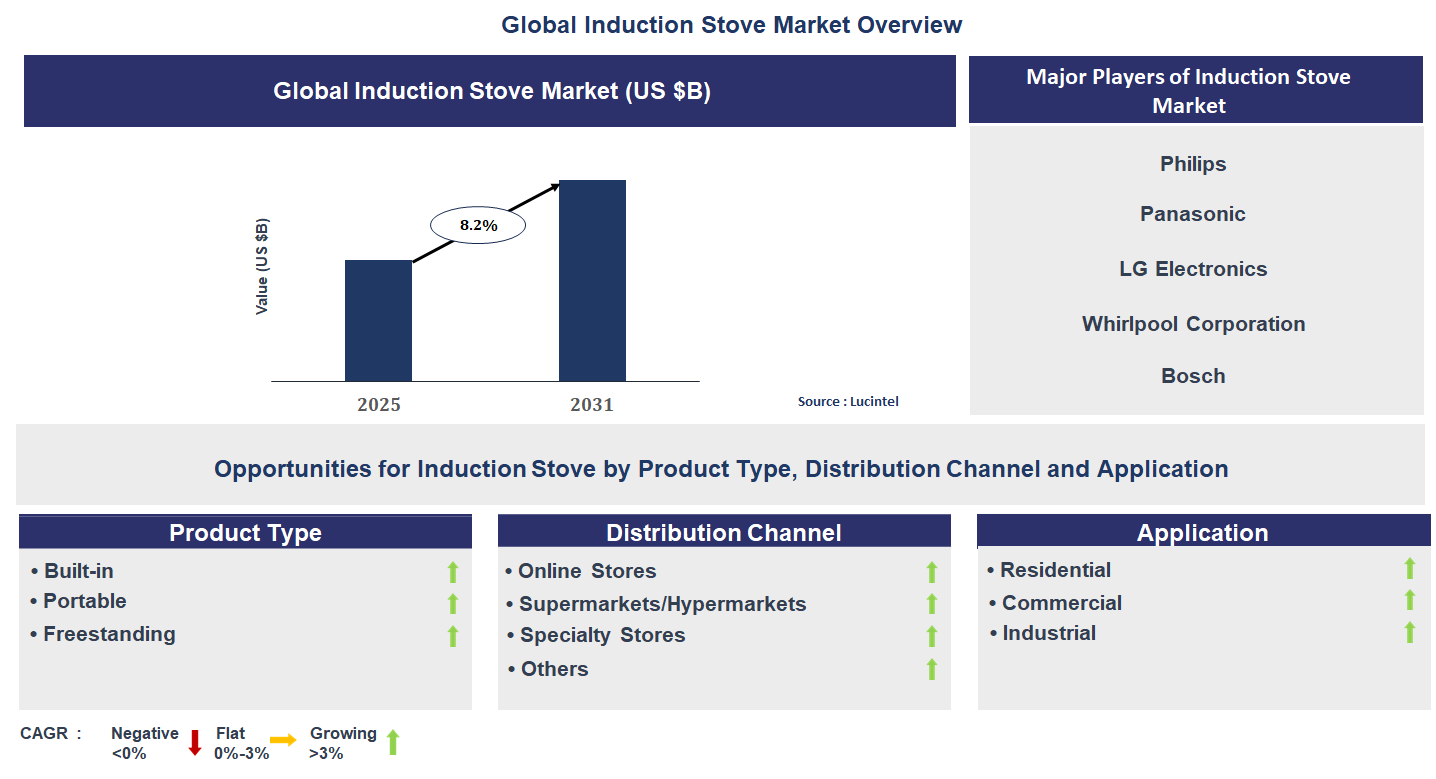
The future of the global induction stove market looks promising with opportunities in the residential, commercial, and industrial markets. The global induction stove market is expected to grow with a CAGR of 8.2% from 2025 to 2031. The major drivers for this market are the increasing demand for energy saving, the rising preference for safer cooking, and the growing adoption in residential kitchens.• Lucintel forecasts that, within the product type category, built-in is expected to witness the highest growth over the forecast period.
• Within the application category, residential is expected to witness the highest growth.
• In terms of region, APAC is expected to witness the highest growth over the forecast period. Gain valuable insights for your business decisions with our comprehensive 150+ page report. Sample figures with some insights are shown below.
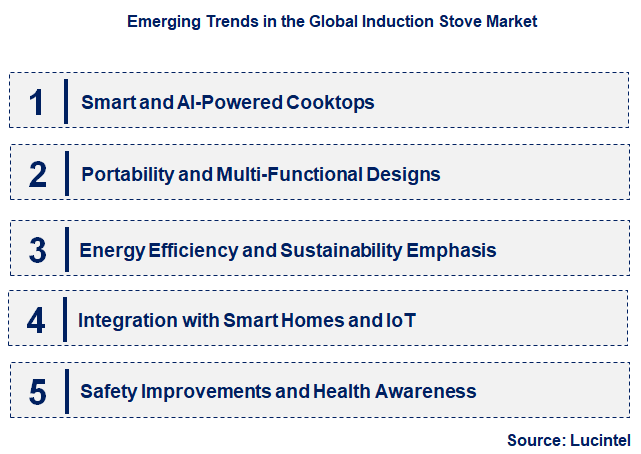
Emerging Trends in the Induction Stove Market
The induction stove industry is being transformed by changing consumer needs, emerging technologies, and sustainability demands. Rising demand for intelligent, energy-saving, and flexible cooking solutions is reflective of ongoing trends. Urbanization, reduced living space, and convergence with smart homes drive innovations. Emissions and energy use regulations further guide direction in the market. All of these trends combined increase consumer convenience, safety, and environmental footprint, making induction stoves an integral part of contemporary kitchens around the world.• Smart and AI-Powered Cooktops: Growing use of AI and smart controls enables dynamic temperature and mode adjustments, enhancing cooking precision and convenience. The features facilitate recipe learning and real-time safety monitoring, making cooking easier and safer.
• Portability and Multi-Functional Designs: Customers prefer portable, compact induction stoves with more burners and cooking features, allowing for versatile use in small kitchens or outdoors. These designs overcome space limitations without affecting performance.
• Energy Efficiency and Sustainability Emphasis: Government incentives and customer preference urge induction stoves as low-emission, energy-efficient alternatives to gas. Recycling-friendly materials and power optimization innovations meet eco-targets and save energy consumption costs.
• Integration with Smart Homes and IoT: Connectivity capabilities supporting remote operation, voice control, and interfacing with home automation systems enhance cooking convenience and flexibility, finding favor among tech-hungry buyers.
• Safety Improvements and Health Awareness: Induction cookers naturally provide safer cooking with minimized fire hazards and lower indoor air pollution. This trend is underscored in the face of escalating concerns regarding respiratory health and clean indoor spaces. These emerging trends have a profound impact on product innovation and consumer adoption, making induction stoves a necessity for contemporary, sustainable, and easy cooking.
Recent Development in the Induction Stove Market
The induction stove market has witnessed some key developments that indicate innovation, new applications, and competitive tactics. These developments are intended to enrich consumer experience and meet market needs for efficiency and sustainability.• Launch of Multi-Burner and Modular Units: New product series with multiple burners and add-on modules provide increased cooking flexibility, satisfying various household and commercial requirements. Such innovation addresses demand for adaptable and space-saving solutions.
• AI and Sensor Technology Upgrades: Improved AI integration enables cooktops to adjust cooking parameters dynamically, provide guided recipe support, and enhance safety through real-time monitoring, greatly enhancing user experience.
• Increased Commercial Kitchen Adoption: The commercial market is embracing induction cooktops more with quicker cooking times, cost savings, and less messiness, particularly from restaurants and catering operations that emphasize eco-friendliness.
• Government Incentives Drive Adoption: Policy environments and economic rebates in nations such as the US and throughout the EU motivate customers and enterprises to adopt induction stoves from gas, increasing market penetration.
• Increase in E-Commerce and Organized Retail: Digital channels and contemporary retailing platforms ensure wider accessibility, comparative shopping, and value-based buying, speeding up market development particularly in emerging economies. Together, these trends improve market competitiveness and consumer value and contribute to the shift toward clean cooking solutions.
Strategic Growth Opportunities in the Induction Stove Market
Market growth for induction stove offers opportunities in various applications ranging from household kitchens to industrial and institutional usage. Knowledge of these opportunities helps stakeholders identify areas of investment and innovation.• Household Kitchens: Rising urbanization boosts demand for space-efficient, efficient stoves for nuclear families and small families, spurring innovation in design and smart features to provide greater daily cooking convenience.
• Commercial Foodservice Industry: Restaurants and food catering businesses opt for induction cooktops in terms of energy conservation, quicker cooking, and cleaner spaces to promote sustainable foodservice practices and facilitate upscale culinary experiences.
• Smart Home Integration: Increased smart home ecosystem adoption brings opportunities to create IoT-equipped cooktops with remote control, automation, and custom cooking modes, attractive to tech-savvy consumers.
• Energy-Efficient Building Projects: Increasing green building projects and new residential developments feature induction stoves to achieve sustainability and energy efficiency requirements, generating strategic demand from developers.
• Institutional Kitchens: Mass cooking facilities in schools and hospitals increasingly utilize induction technology for safety, hygiene, and energy efficiency, creating opportunities for specialized commercial induction products. These market-specific growth prospects enable industry participants to innovate and win increasing market spaces in sync with changing lifestyle and regulatory paradigms.
Induction Stove Market Driver and Challenges
The growth of induction stove is driven by a combination of technological, economic, and regulatory drivers but also experiences challenges that have the potential to influence future adoption levels and industry strategies. The factors responsible for driving the induction stove market include: 1. Increased Energy Efficiency and Sustainability Legislation: Globally stricter policies favor cleaner cooking technologies with emission and energy reductions, which are powerful inducements for induction stove use. 2. Increased Consumer Health and Safety Consciousness: Indoor air quality and fire risks linked to gas cooking induce consumer demand for induction stoves providing cleaner, safer cooking conditions. 3. Smart Cooking Technology Advancements: The integration of AI, IoT, and sensor technology improves functionality, convenience, and safety, appealing to technologically oriented consumers and broadening applications. 4. Rising Disposable Income and Urbanization: Economic development and urbanization trends drive demand for contemporary, compact, and efficient kitchen appliances, widening potential consumer bases especially in developing markets. 5. Government Subsidies and Rebate Schemes: Economic subsidies for electric kitchen appliances reduce entry prices, speeding market penetration particularly in developed markets such as North America and Europe. Challenges in the induction stove market are: 1. Steep Initial Price: Even with cost savings in the long term, the initial cost of induction stoves acts as a barrier for price-conscious consumers particularly in developing economies. 2. Compatibility and Cookware Restraints: The requirement of special magnetic cookware restricts user choice and introduces added expense, which may slow down adoption. 3. Consumer Awareness and Education Gap: Inadequate awareness regarding induction technology advantages and myths might deter acceptance, calling for focused marketing and education initiatives. Overall, these drivers support healthy market growth while challenges call for strategic responses to guarantee extensive adoption and continued progress.List of Induction Stove Companies
Companies in the market compete on the basis of product quality offered. Major players in this market focus on expanding their manufacturing facilities, R&D investments, infrastructural development, and leverage integration opportunities across the value chain. With these strategies induction stove companies cater increasing demand, ensure competitive effectiveness, develop innovative products & technologies, reduce production costs, and expand their customer base. Some of the induction stove companies profiled in this report include-• Philips
• Panasonic
• LG Electronics
• Whirlpool Corporation
• Bosch
• Electrolux
• Midea Group
• Haier Group
• Samsung Electronics
• GE Appliances
Induction Stove Market by Segment
The study includes a forecast for the global induction stove market by product type, distribution channel, application, and region.Induction Stove Market by Product Type [Value from 2019 to 2031]:
• Built-in
• Portable
• Freestanding
Induction Stove Market by Distribution Channel [Value from 2019 to 2031]:
• Online Stores
• Supermarkets/Hypermarkets
• Specialty Stores
• Others
Induction Stove Market by Application [Value from 2019 to 2031]:
• Residential
• Commercial
• Industrial
Induction Stove Market by Region [Value from 2019 to 2031]:
• North America
• Europe
• Asia Pacific
• The Rest of the World
Country Wise Outlook for the Induction Stove Market
The global induction stove industry is witnessing robust growth influenced by increased urbanization, demand for efficient and safe cooking technologies from consumers, and incorporation of smart technologies. Clean energy and sustainability-promoting regulations accelerate the adoption further. Major markets like the United States, China, Germany, India, and Japan are experiencing customized innovations and expansions that align with local consumers preferences and regulations. This is creating a dynamic environment for varied technological developments, increased rivalry among dominant manufacturers, and expanded use across residential and commercial areas.• United States: US demand is spurred by policy incentives such as the Inflation Reduction Act encouraging electric appliances, joined by rising consumer interest in health and environmental gains. Greater utilization of smart induction stoves with networked features follows the contemporary kitchen trend. Providers solve issues such as inhomogeneous heating and product mobility to further simplify customer experience. Seasonal demand peaks due to holiday-driven replacements, and multi-burner units become popular for flexibility.
• China: China dominates manufacturing and consumption, spurred by urbanization growth and increasing disposable incomes. Multi-functional, space-saving designs are the innovation focus to cater to smaller living spaces. IoT and AI technological integration for enhanced precision and safety of cooking appeal to technology consumers. Energy efficiency and sustainability drive further accelerate the market growth, complemented by strong e-commerce channels and structured retail expansion.
• Germany: Germanys market expansion rests upon high energy efficiency standards and sustainability targets, promoting conversions from gas to electric stoves. Buyers value build quality, safety, and eco-friendly materials. High-tech features such as exact temperature control, smart sensor induction cooktops, and recyclable parts are core features. The market is helped by robust EU policy harmonization and government incentives favoring electrification.
• India: Fast urbanization and increasing middle-class incomes propel Indias induction stove market, fueled by increasing demand for energy-saving, convenient-to-use kitchen devices. The trend towards the nuclear family supports smaller, efficient stoves. The government promotes energy-saving appliances, spurring adoption through subsidies and campaigns. Affordability of products and online shopping accessibility further increase access to various consumer groups. Preset mode and touchscreen-controlled smart induction cooktops are becoming popular.
• Japan: Japan targets high-technology induction stoves that combine cutting-edge sensing, AI integration, and safety features that are ideal for small urban kitchens. Consumer desire is for premium quality, multi-zone cooktops, and smart home connectivity. Market development combines both aging demographics looking for safety improvement and younger consumers that demand contemporary convenience. Policies of sustainable electrification and incentives on smart appliances augment market growth.

Features of the Global Induction Stove Market
Market Size Estimates: Induction stove market size estimation in terms of value ($B). Trend and Forecast Analysis: Market trends (2019 to 2024) and forecast (2025 to 2031) by various segments and regions. Segmentation Analysis: Induction stove market size by product type, distribution channel, application, and region in terms of value ($B). Regional Analysis: Induction stove market breakdown by North America, Europe, Asia Pacific, and Rest of the World. Growth Opportunities: Analysis of growth opportunities in different product types, distribution channels, applications, and regions for the induction stove market. Strategic Analysis: This includes M&A, new product development, and competitive landscape of the induction stove market. Analysis of competitive intensity of the industry based on Porter’s Five Forces model.
FAQ
Q1. What is the growth forecast for induction stove market? Answer: The global induction stove market is expected to grow with a CAGR of 8.2% from 2025 to 2031. Q2. What are the major drivers influencing the growth of the induction stove market? Answer: The major drivers for this market are the increasing demand for energy saving, the rising preference for safer cooking, and the growing adoption in residential kitchens. Q3. What are the major segments for induction stove market? Answer: The future of the induction stove market looks promising with opportunities in the residential, commercial, and industrial markets. Q4. Who are the key induction stove market companies? Answer: Some of the key induction stove companies are as follows:• Philips
• Panasonic
• LG Electronics
• Whirlpool Corporation
• Bosch
• Electrolux
• Midea Group
• Haier Group
• Samsung Electronics
• GE Appliances Q5. Which induction stove market segment will be the largest in future? Answer: Lucintel forecasts that, within the product type category, built-in is expected to witness the highest growth over the forecast period. Q6. In induction stove market, which region is expected to be the largest in next 5 years? Answer: In terms of region, APAC is expected to witness the highest growth over the forecast period. Q7. Do we receive customization in this report? Answer: Yes, Lucintel provides 10% customization without any additional cost.
Table of Contents
List of Figures
List of Tables
Methodology
- In-depth interviews of the major players in this market
- Detailed secondary research from competitors’ financial statements and published data
- Extensive searches of published works, market, and database information pertaining to industry news, company press releases, and customer intentions
- A compilation of the experiences, judgments, and insights of Lucintel’s professionals, who have analyzed and tracked this market over the years.


Key Questions
- • What are some of the most promising, high-growth opportunities for the induction stove market by product type (built-in, portable, and freestanding), distribution channel (online stores, supermarkets/hypermarkets, specialty stores, and others), application (residential, commercial, and industrial), and region (North America, Europe, Asia Pacific, and the Rest of the World)?
- • Which segments will grow at a faster pace and why?
- • Which region will grow at a faster pace and why?
- • What are the key factors affecting market dynamics? What are the key challenges and business risks in this market?
- • What are the business risks and competitive threats in this market?
- • What are the emerging trends in this market and the reasons behind them?
- • What are some of the changing demands of customers in the market?
- • What are the new developments in the market? Which companies are leading these developments?
- • Who are the major players in this market? What strategic initiatives are key players pursuing for business growth?
- • What are some of the competing products in this market and how big of a threat do they pose for loss of market share by material or product substitution?
- • What M&A activity has occurred in the last 5 years and what has its impact been on the industry? For any questions related to Induction Stove Market, Induction Stove Market Size, Induction Stove Market Growth, Induction Stove Market Analysis, Induction Stove Market Report, Induction Stove Market Share, Induction Stove Market Trends, Induction Stove Market Forecast, Induction Stove Companies, write Lucintel analyst at email: helpdesk@lucintel.com. We will be glad to get back to you soon.


