
Market Report · July 31, 2026

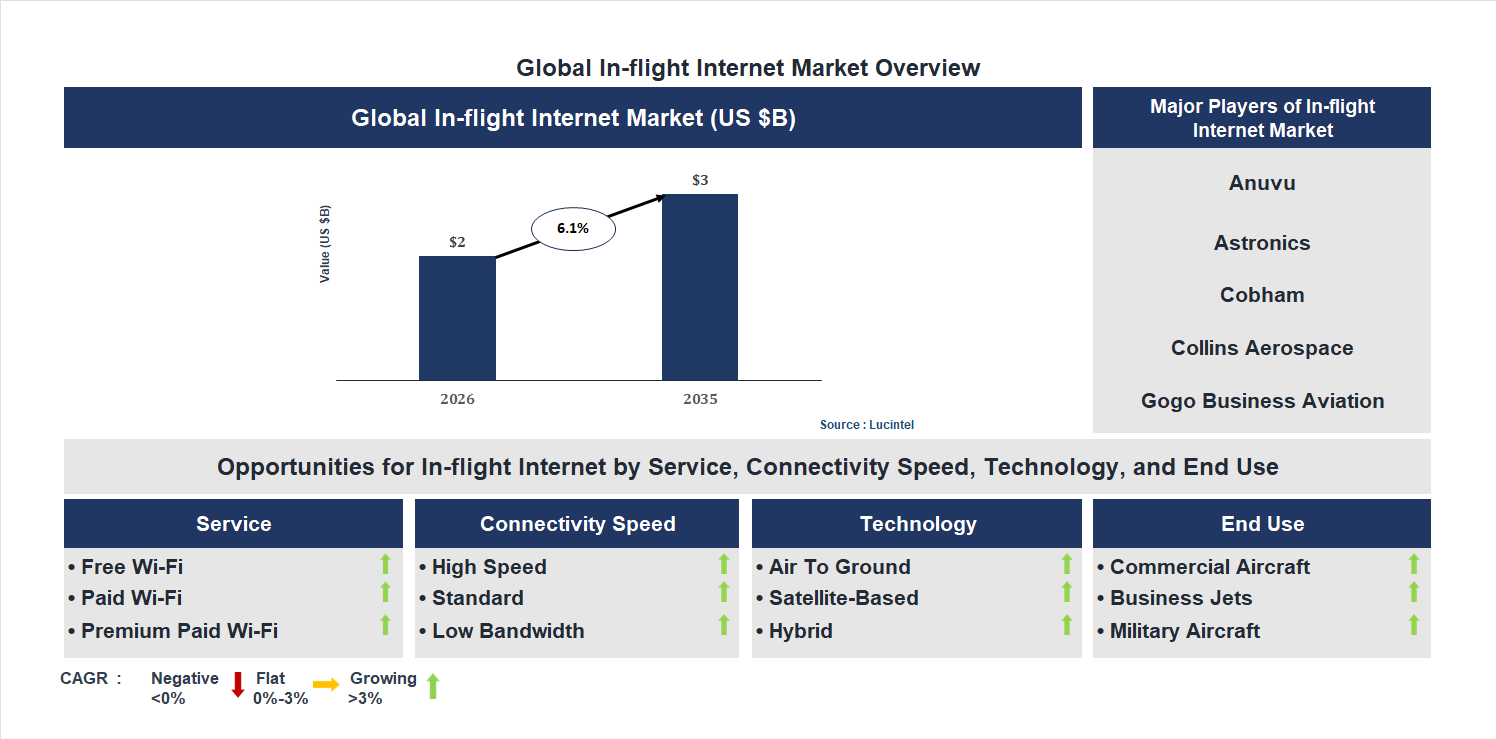
Key data points: The market size in 2035 = $3 billion, growth forecast = 6.1% annually for the next 8 years. Scroll below to get more insights. This market report covers trends, opportunities and forecasts in in-flight internet market to 2035 by service (free Wi-Fi, paid wi-fi, and premium paid wi-fi), connectivity speed (high speed, standard, and low bandwidth), technology (air to ground, satellite-based, and hybrid), end use (commercial aircraft, business jets, and military aircraft), and region (North America, Europe, Asia Pacific, and the Rest of the World)
We'll send your sample report shortly.
• Lucintel forecasts that, within the service category, paid Wi-Fi is expected to witness the highest growth over the forecast period.
• Within the end use category, commercial aircraft is expected to witness the highest growth.
• In terms of region, North America is expected to witness the highest growth over the forecast period. Gain valuable insights for your business decisions with our comprehensive 150+ page report. Sample figures with some insights are shown below.
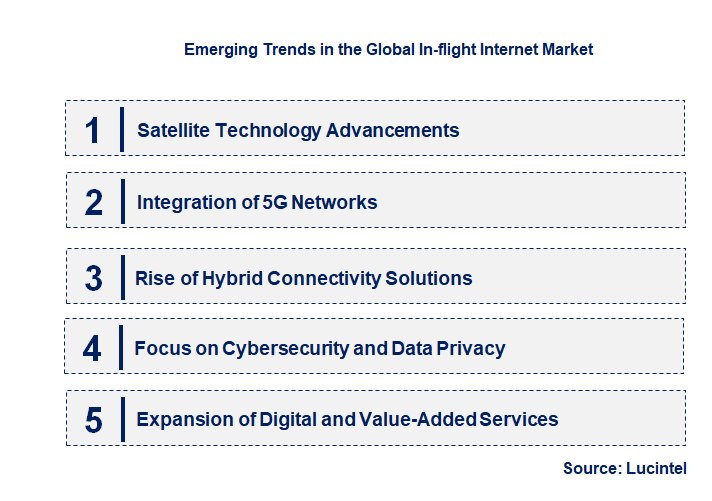
• Satellite Technology Advancements: Enhanced Coverage and Speed : The deployment of next-generation satellites, including Low Earth Orbit (LEO) constellations, is significantly improving internet coverage and speed. These satellites reduce latency and provide more reliable connections, even over remote areas. As a result, passengers experience faster, more stable internet, which boosts satisfaction and encourages higher usage. Airlines benefit from reduced operational costs and expanded service offerings, making in-flight connectivity more accessible and efficient globally.
• Integration of 5G Networks: Faster and More Reliable Connectivity : The rollout of 5G technology is set to revolutionize in-flight internet by offering ultra-fast speeds and lower latency. This integration allows for seamless streaming, real-time communication, and enhanced digital services onboard. Airlines adopting 5G-enabled systems can provide a superior passenger experience, attract tech-savvy travelers, and support innovative services like live streaming and virtual reality. The widespread adoption of 5G is expected to create a competitive edge for early adopters and reshape the market landscape.
• Rise of Hybrid Connectivity Solutions: Combining Satellite and Ground Networks : To ensure uninterrupted service, providers are increasingly adopting hybrid solutions that combine satellite links with ground-based networks such as cellular towers. This approach optimizes coverage, reduces costs, and enhances bandwidth management. Hybrid systems enable airlines to deliver consistent internet access across different flight routes and environments, improving overall reliability. This trend supports a broader range of digital services, from basic browsing to complex enterprise applications, thereby expanding market reach and customer satisfaction.
• Focus on Cybersecurity and Data Privacy: Protecting Passenger Data and Network Integrity : As in-flight internet usage grows, so does the importance of cybersecurity. Market players are investing in advanced encryption, secure access protocols, and compliance with data privacy regulations to safeguard passenger information and prevent cyber threats. Enhanced security measures build passenger trust and meet regulatory standards, which are becoming more stringent globally. This focus on cybersecurity is critical for maintaining service integrity, avoiding data breaches, and ensuring the long-term sustainability of in-flight connectivity services.
• Expansion of Digital and Value-Added Services: Personalized Content and In-Flight Commerce : Airlines are leveraging in-flight internet to offer personalized entertainment, targeted advertising, and seamless e-commerce experiences. These value-added services increase passenger engagement and generate additional revenue streams. The integration of digital platforms enables real-time content updates, interactive experiences, and contactless transactions. As a result, the market is shifting from basic connectivity to comprehensive digital ecosystems that enhance passenger satisfaction and loyalty, while also providing airlines with new monetization opportunities. These emerging trends are collectively reshaping the in-flight internet market by enhancing connectivity quality, expanding service offerings, and improving security. The adoption of advanced satellite and 5G technologies, combined with hybrid solutions, is delivering faster, more reliable internet access. Simultaneously, a focus on cybersecurity and personalized digital services is elevating passenger experiences and building trust. These developments are driving innovation, increasing competition, and enabling airlines to differentiate themselves in a rapidly evolving landscape. Ultimately, these trends are transforming in-flight internet from a luxury amenity into a vital component of modern air travel, fostering growth and new business models across the industry.
• Technological Innovations Drive Market Expansion: The adoption of satellite and 5G technologies enhances connectivity quality, enabling faster, more reliable in-flight internet. These innovations reduce latency and improve coverage, attracting more airlines and passengers. As technology advances, costs decrease, making high-speed internet accessible to a broader customer base. This growth fosters competition among providers, encouraging continuous improvement and diversification of service offerings, ultimately transforming the passenger experience and expanding market reach.
• Increasing Passenger Demand for Connectivity: Modern travelers prioritize staying connected during flights for work, entertainment, and communication. Airlines are responding by upgrading their in-flight internet services to meet these expectations. The demand is particularly high among business travelers and younger demographics, driving airlines to invest in better infrastructure. This trend boosts revenue opportunities for service providers through premium packages and data plans, while also enhancing customer satisfaction and loyalty, further fueling market growth.
• Strategic Partnerships and Collaborations: Major satellite operators, technology firms, and airlines are forming strategic alliances to expand coverage and improve service quality. These collaborations facilitate the deployment of advanced infrastructure and innovative solutions, reducing operational costs and increasing reach. Partnerships also enable shared investments in research and development, accelerating technological adoption. Such alliances are crucial for market expansion, enabling providers to offer comprehensive, reliable in-flight internet services across diverse routes and regions.
• Regulatory Support and Policy Frameworks: Governments and aviation authorities are implementing policies to promote in-flight connectivity. Regulatory frameworks facilitate spectrum allocation, licensing, and standardization, reducing barriers for service providers. Supportive policies encourage investments in satellite and ground infrastructure, ensuring wider coverage and better service quality. This regulatory environment fosters market confidence, attracts new entrants, and accelerates deployment of in-flight internet solutions, ultimately benefiting consumers with improved access and competitive pricing.
• Market Diversification and Revenue Streams: Airlines are exploring new revenue models by offering tiered internet packages, advertising, and e-commerce integrations. The diversification of services enhances profitability and customer engagement. Additionally, the rise of premium and business class internet offerings creates high-margin opportunities. Market players are also developing ancillary services such as onboard entertainment and real-time data analytics, further expanding revenue streams. This diversification is transforming the in-flight internet market into a lucrative sector with multiple growth avenues. These developments are significantly transforming the in-flight Internet Market by enhancing service quality, expanding coverage, and creating new revenue opportunities. Technological innovations, strategic partnerships, and supportive regulations are driving rapid growth and market penetration. As passenger expectations continue to rise, providers and airlines are investing heavily in infrastructure and service diversification. Overall, these trends are fostering a more connected, competitive, and profitable market landscape, promising sustained expansion and improved passenger experiences.
• Enhanced Satellite Connectivity Technologies: The adoption of high-throughput satellites (HTS) and Low Earth Orbit (LEO) satellite constellations offers faster, more reliable in-flight Internet. These advancements reduce latency and improve bandwidth, enabling seamless streaming, video conferencing, and real-time data transfer. As satellite technology continues to evolve, service providers can expand coverage to remote and underserved regions, creating new revenue streams and improving passenger satisfaction.
• Growing Demand for Premium Passenger Experience: Airlines are increasingly investing in in-flight Internet to differentiate their services and attract high-value customers. Offering high-speed connectivity enables passengers to work, stream content, and communicate effortlessly, enhancing overall travel experience. Premium cabins with dedicated Internet packages and value-added services like live TV and gaming are emerging sub-segments, driving revenue growth and customer loyalty.
• Integration of IoT and Operational Efficiency Solutions: In-flight Internet facilitates the integration of Internet of Things (IoT) devices for real-time aircraft monitoring, predictive maintenance, and operational management. Airlines can optimize fuel consumption, reduce downtime, and improve safety through connected systems. This technological integration not only reduces costs but also enhances safety standards, making it a strategic growth area for service providers and airlines alike.
• Expansion of In-Flight Entertainment and Content Streaming: The demand for on-demand entertainment and streaming services is fueling investments in in-flight Internet infrastructure. Content providers are partnering with airlines to offer tailored streaming options, live sports, and interactive media. This segment attracts more passengers and increases ancillary revenue, encouraging further technological upgrades and content licensing agreements to meet evolving consumer preferences.
• Development of Cost-Effective and Scalable Business Models: Service providers are exploring innovative pricing strategies such as tiered packages, pay-as-you-go, and bundled services to attract a broader customer base. Cost-effective hardware solutions and scalable network architectures enable rapid deployment across diverse aircraft fleets. These models facilitate market penetration, improve profitability, and support the expansion of in-flight Internet services into emerging markets with growing air travel demand. These growth opportunities are poised to significantly influence the in-flight Internet market by enhancing technological capabilities, passenger experience, operational efficiency, and revenue streams. Stakeholders who strategically leverage these trends can achieve competitive advantages, foster innovation, and accelerate market expansion, ultimately transforming the landscape of in-flight connectivity and meeting the evolving needs of global travelers.
• Technological Advancements: The rapid development of satellite and wireless communication technologies has significantly enhanced in-flight internet capabilities. Innovations like high-throughput satellites and 5G connectivity enable faster, more reliable internet services at cruising altitudes. These advancements reduce latency and improve user experience, encouraging airlines to adopt in-flight connectivity solutions. As technology continues to evolve, costs are expected to decrease, making high-quality internet more accessible across different airline segments. This ongoing innovation fosters increased demand from passengers seeking seamless digital experiences, thereby fueling market growth.
• Rising Passenger Demand for Connectivity: The increasing number of air travelers worldwide, coupled with their growing reliance on internet services for work, entertainment, and communication, is a major driver. Passengers now expect consistent, high-speed internet access during flights, influencing airlines to upgrade their onboard connectivity offerings. This demand is particularly strong among business travelers and younger demographics, who prioritize staying connected. Airlines recognize that providing reliable internet can enhance customer satisfaction and loyalty, prompting investments in advanced in-flight connectivity solutions to meet these expectations.
• Economic Growth and Airline Expansion: The expanding global economy and the consequent rise in airline operations contribute significantly to market growth. As airlines expand their fleets and routes, the need for reliable in-flight internet becomes more critical to remain competitive. Increased passenger volumes translate into higher revenue opportunities from connectivity services, encouraging airlines to invest in advanced systems. Moreover, emerging markets with growing middle classes and increased air travel are expected to further boost demand, making in-flight internet a key differentiator in a competitive industry.
• Regulatory Support and Spectrum Allocation: Governments and regulatory bodies are increasingly recognizing the importance of in-flight connectivity, leading to supportive policies and spectrum allocations. Regulatory frameworks that facilitate the deployment of satellite and wireless communication infrastructure enable faster implementation of in-flight internet services. International cooperation and standardization efforts also streamline cross-border operations, reducing deployment complexities. Such regulatory support not only accelerates market growth but also encourages investments from service providers and airlines, fostering a more connected and accessible in-flight internet ecosystem.
• Strategic Partnerships and Collaborations: Collaborations between satellite providers, technology firms, and airlines are vital for expanding in-flight internet services. Strategic partnerships facilitate the development of innovative solutions, cost-sharing, and broader network coverage. These alliances enable the integration of cutting-edge technologies like 5G and IoT into in-flight systems, enhancing service quality. Additionally, joint ventures help mitigate high infrastructure costs and accelerate deployment timelines. As these collaborations become more prevalent, they will drive market expansion by offering more comprehensive, reliable, and cost-effective connectivity options to airlines and passengers alike. The challenges facing the in-flight internet market include:
• High Infrastructure and Deployment Costs: Establishing in-flight internet infrastructure requires significant capital investment in satellite technology, ground stations, and onboard equipment. These costs can be prohibitive, especially for smaller airlines or those operating in emerging markets. The expense of upgrading existing fleets and maintaining complex systems poses financial challenges, potentially limiting market penetration. Additionally, the need for continuous technological upgrades to keep pace with advancements further escalates costs, impacting profitability and slowing adoption rates across the industry.
• Regulatory and Spectrum Limitations: Despite supportive policies in some regions, regulatory hurdles remain a significant challenge. Variations in spectrum allocation, licensing requirements, and safety standards across countries complicate deployment efforts. International coordination is often complex and time-consuming, delaying the rollout of new services. Regulatory uncertainties can also deter investment, as companies face risks related to policy changes or restrictions. These limitations hinder the rapid expansion of in-flight internet services and create barriers to achieving global coverage.
• Technological Limitations and Connectivity Reliability: While technological advancements have improved in-flight internet, issues such as signal latency, bandwidth constraints, and coverage gaps persist. Satellite-based systems can be affected by weather conditions and signal interference, leading to inconsistent service quality. Maintaining reliable connectivity at high altitudes and over remote regions remains challenging. These technological limitations can result in customer dissatisfaction and impact revenue streams for service providers, emphasizing the need for ongoing innovation and infrastructure improvements. The in-flight internet market is driven by technological progress, increasing passenger demand, economic growth, regulatory support, and strategic collaborations. However, high deployment costs, regulatory complexities, and technological limitations pose significant challenges. These factors collectively influence the pace and scope of market expansion. While opportunities for growth are substantial, addressing these challenges is crucial for sustainable development. The markets future will depend on technological innovation, regulatory harmonization, and strategic investments, shaping a more connected and seamless in-flight experience for passengers worldwide.
• Anuvu
• Astronics
• Cobham
• Collins Aerospace
• Gogo Business Aviation
• Iridium
• Panasonic Avionics
• SmartSky Networks
• Thales Group
• ViaSat
• Free Wi-Fi
• Paid Wi-Fi
• Premium Paid Wi-Fi
• High Speed
• Standard
• Low Bandwidth
• Air To Ground
• Satellite-Based
• Hybrid
• Commercial Aircraft
• Business Jets
• Military Aircraft
• North America
• Europe
• Asia Pacific
• The Rest of the World
• United States: The US market has seen significant investments in satellite-based Internet services, with companies like SpaceX and OneWeb expanding coverage. Major airlines are upgrading their in-flight Wi-Fi systems to offer faster, more reliable connections, often partnering with providers like Gogo and Viasat. Regulatory efforts aim to streamline spectrum allocation, boosting service quality. Additionally, the adoption of 5G technology is beginning to influence in-flight connectivity solutions, promising higher speeds and lower latency for passengers.
• China: China’s in-flight Internet market is rapidly expanding, driven by government support and the growth of domestic airlines. Companies such as China Telecom and China Unicom are deploying advanced satellite networks to improve coverage, especially on domestic routes. The integration of 5G technology is underway, aiming to provide seamless connectivity. Chinese airlines are increasingly offering free or subsidized Wi-Fi to attract passengers, and local tech giants are investing in innovative solutions like AI-powered customer service and personalized content delivery.
• Germany: The German market is characterized by a focus on high-quality, reliable connectivity, with Lufthansa leading the way through partnerships with providers like Inmarsat and Viasat. Recent developments include the rollout of high-speed satellite Internet on long-haul flights and the integration of 5G technology. Regulatory frameworks are evolving to facilitate the deployment of advanced connectivity solutions, and there is a growing emphasis on cybersecurity and data privacy. German airlines are also exploring hybrid solutions combining satellite and terrestrial networks to enhance coverage and performance.
• India: India’s in-flight Internet market is witnessing rapid growth, fueled by increasing domestic air travel and rising consumer demand for connectivity. Airlines like Air India and IndiGo are expanding Wi-Fi services, often partnering with local providers such as Jio and Airtel. The government’s push for digital infrastructure development supports this trend. The deployment of satellite-based Internet solutions is accelerating, with a focus on providing coverage over remote and underserved regions. Additionally, affordable pricing models and bundled services are making in-flight Wi-Fi more accessible to a broader customer base.
• Japan: Japan’s market is characterized by advanced technological adoption and high passenger expectations. Airlines such as Japan Airlines and ANA are investing in next-generation satellite Internet systems to deliver high-speed connectivity. Recent developments include the integration of 5G technology and the deployment of hybrid networks combining satellite and terrestrial systems. Japan’s regulatory environment supports innovation, and partnerships with global tech firms are enhancing service quality. The focus remains on providing seamless, high-capacity Internet to meet the demands of business and leisure travelers alike.


• Anuvu
• Astronics
• Cobham
• Collins Aerospace
• Gogo Business Aviation
• Iridium
• Panasonic Avionics
• SmartSky Networks
• Thales Group
• ViaSat Q6. Which in-flight internet market segment will be the largest in future? Answer: Lucintel forecasts that, within the service category, paid Wi-Fi is expected to witness the highest growth over the forecast period. Q7. In in-flight internet market, which region is expected to be the largest in next 8 years? Answer: In terms of region, North America is expected to witness the highest growth over the forecast period. Q8. Do we receive customization in this report? Answer: Yes, Lucintel provides 10% customization without any additional cost.


Choose a license that fits your team. Instant PDF delivery.
Prices exclude taxes. Instant delivery. Custom licensing available on request.
Market Report · July 31, 2026
Market Report · July 31, 2026
Market Report · July 31, 2026
Trusted partner for strategic intelligence and business growth


Receive a complimentary market analysis tailored to your industry. Our analysts will identify key growth opportunities and competitive dynamics specific to your business.

Market size, growth rate, and key trend analysis for your specific sector.

Top competitor positioning and market share analysis.

Strategic recommendations backed by data-driven insights.
Get curated market intelligence and competitive moves straight to your inbox.
By subscribing, you agree to receive our monthly insights. Unsubscribe anytime.
Receive a complimentary market analysis tailored to your industry. Our analysts will identify key growth opportunities and competitive dynamics specific to your business.
Market size, growth rate, and key trend analysis for your specific sector.
Top competitor positioning and market share analysis.
Strategic recommendations backed by data-driven insights.
Get curated market intelligence, emerging trends, and competitive moves straight to your inbox each month.
By subscribing, you agree to receive our monthly insights. Unsubscribe anytime.
We'll send your sample report shortly.