
Report Feature
In-Counter Barcode Scanner Market Trends and Forecast
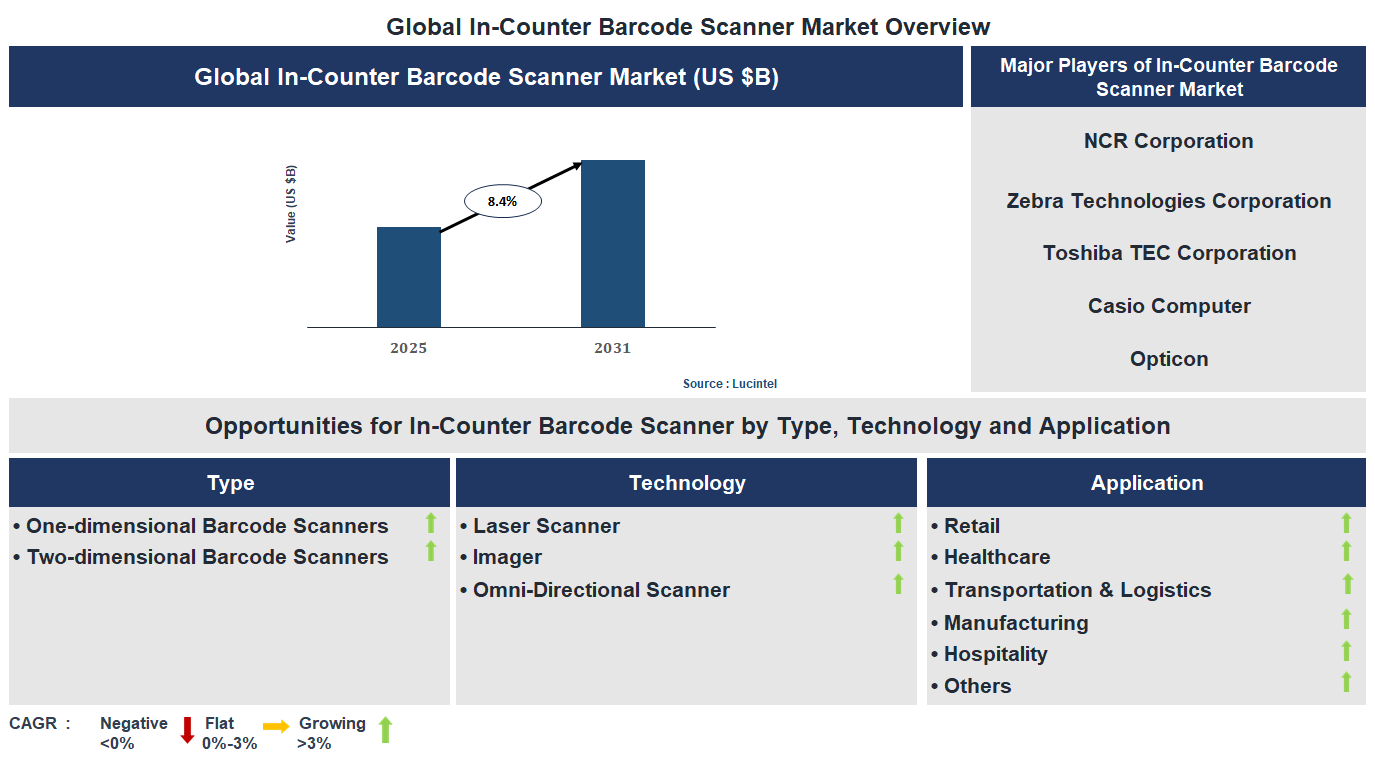
The future of the global in-counter barcode scanner market looks promising with opportunities in the retail, healthcare, transportation & logistic, manufacturing, and hospitality markets. The global in-counter barcode scanner market is expected to grow with a CAGR of 8.4% from 2025 to 2031. The major drivers for this market are the increasing demand for faster checkout operations, the rising need for high-accuracy scanning performance, and the growing adoption of automated retail systems.• Lucintel forecasts that, within the type category, two-dimensional barcode scanner is expected to witness higher growth over the forecast period.
• Within the application category, retail is expected to witness the highest growth.
• In terms of region, North America is expected to witness the highest growth over the forecast period. Gain valuable insights for your business decisions with our comprehensive 150+ page report. Sample figures with some insights are shown below.
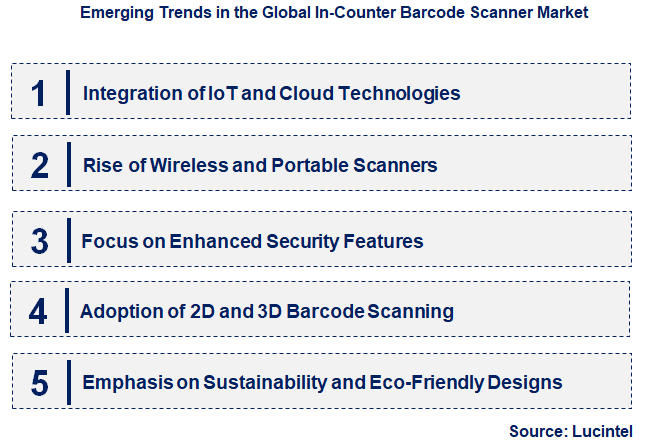
Emerging Trends in the In-Counter Barcode Scanner Market
The In-counter barcode scanner market is experiencing rapid evolution driven by technological advancements, changing consumer behaviors, and increasing demand for efficiency across retail, logistics, and healthcare sectors. As businesses seek faster, more accurate, and integrated solutions, several emerging trends are shaping the future of this market. These developments are not only enhancing operational productivity but also redefining customer experiences and supply chain management. Understanding these key trends is essential for stakeholders aiming to stay competitive and leverage new opportunities in this dynamic landscape.• Integration of IoT and Cloud Technologies: The adoption of Internet of Things (IoT) and cloud computing is transforming barcode scanners into smart devices. These integrations enable real-time data collection, remote management, and seamless connectivity with enterprise systems. Businesses benefit from improved inventory accuracy, faster data processing, and enhanced analytics capabilities. This trend supports more agile supply chains and personalized customer experiences, making barcode scanners more versatile and integral to digital transformation initiatives.
• Rise of Wireless and Portable Scanners: Wireless barcode scanners are gaining popularity due to their flexibility and ease of use. Portable devices allow staff to scan items from a distance or in hard-to-reach areas, increasing efficiency in retail and warehouse environments. The convenience of cordless operation reduces clutter and enhances workflow, leading to faster checkout processes and inventory management. As wireless technology advances, these scanners are becoming more reliable, affordable, and feature-rich, further driving their adoption across various sectors.
• Focus on Enhanced Security Features: With increasing data sensitivity, security features in barcode scanners are becoming a priority. Advanced encryption, user authentication, and secure data transmission are being integrated to prevent unauthorized access and data breaches. This trend is particularly significant in healthcare and logistics, where sensitive information must be protected. Enhanced security measures ensure compliance with regulations and build trust with customers, making secure barcode scanning a critical component of enterprise security strategies.
• Adoption of 2D and 3D Barcode Scanning: The shift from traditional 1D to 2D and 3D barcode scanning is expanding capabilities. 2D barcodes store more information and are used in mobile payments, ticketing, and inventory tracking, while 3D scanning offers improved accuracy for complex items. This trend broadens application possibilities, enabling more detailed data capture and integration with advanced systems like augmented reality. As 2D and 3D technologies become more affordable, their adoption is expected to accelerate, opening new avenues for innovation and efficiency.
• Emphasis on Sustainability and Eco-Friendly Designs: Environmental concerns are influencing product development, with manufacturers focusing on sustainable materials and energy-efficient designs. Eco-friendly barcode scanners reduce power consumption and utilize recyclable components, aligning with corporate social responsibility goals. This trend appeals to environmentally conscious consumers and organizations aiming to minimize their carbon footprint. Sustainable design not only enhances brand reputation but also complies with evolving regulations, positioning eco-friendly barcode scanners as a strategic choice for future-proofing operations. In summary, these emerging trends are significantly reshaping the In-counter barcode scanner market by enhancing technological capabilities, improving security, expanding application scope, and promoting sustainability. They are driving increased efficiency, accuracy, and security across industries, ultimately transforming how businesses manage inventory, streamline operations, and deliver customer experiences. As these trends continue to evolve, the market is poised for innovative growth and greater integration into digital ecosystems.
Recent Development in the In-Counter Barcode Scanner Market
The In-counter barcode scanner market has experienced significant growth driven by technological advancements, increasing retail automation, and the rising demand for efficient inventory management. As businesses seek faster checkout processes and improved accuracy, the market is evolving rapidly. Recent developments reflect innovations in hardware, software, and integration capabilities, shaping the future landscape of retail and logistics sectors. These changes are not only enhancing operational efficiency but also enabling better customer experiences and data analytics. The following key developments highlight the current trajectory and transformative potential within this market.• Integration of AI and Machine Learning: Advanced barcode scanners now incorporate AI and machine learning algorithms, enabling real-time data processing and predictive analytics. This development improves inventory accuracy, reduces checkout times, and enhances customer service. Retailers benefit from smarter stock management and personalized shopping experiences, leading to increased sales and operational efficiency.
• Wireless and Bluetooth Connectivity: The shift towards wireless barcode scanners with Bluetooth capabilities offers greater flexibility and ease of use. These devices facilitate seamless integration with POS systems and inventory management software, reducing clutter and improving mobility within stores. The impact includes faster deployment, enhanced staff productivity, and improved customer interactions.
• Enhanced Durability and Rugged Design: Recent models feature rugged construction with water, dust, and shock resistance, making them suitable for harsh environments like warehouses and outdoor settings. This durability extends device lifespan and reduces maintenance costs, ensuring reliable performance in demanding conditions and supporting continuous operations.
• Integration with IoT and Cloud Platforms: Barcode scanners are increasingly connected to IoT devices and cloud-based systems, enabling centralized data collection and remote management. This integration enhances real-time inventory tracking, reduces stock discrepancies, and streamlines supply chain operations. Businesses gain better visibility and control over their assets and logistics.
• Adoption of 2D and QR Code Scanning: The market has shifted towards supporting 2D barcodes and QR codes, which store more information and are widely used in marketing, ticketing, and mobile payments. This development broadens scanner applications, improves data capture capabilities, and supports contactless transactions, aligning with modern consumer preferences and security standards. In summary, these recent developments are transforming the In-counter barcode scanner market by enhancing functionality, durability, and connectivity. They enable retailers and logistics providers to operate more efficiently, improve customer experiences, and leverage data-driven insights. As technology continues to evolve, the market is poised for further innovation, supporting the growing demand for smarter, more integrated solutions in retail and supply chain management.
Strategic Growth Opportunities in the In-Counter Barcode Scanner Market
The In-counter barcode scanner market is experiencing rapid growth driven by increasing demand for efficient retail operations, inventory management, and customer experience enhancement. Technological advancements and the rising adoption of automation across various sectors are fueling this expansion. As businesses seek to optimize their supply chains and improve checkout processes, the market presents numerous opportunities for innovation and expansion. Key applications such as retail, healthcare, logistics, hospitality, and manufacturing are pivotal in shaping the future landscape of this market. Exploring these growth opportunities reveals how companies can leverage emerging trends to gain competitive advantages and meet evolving customer expectations.• Enhanced Customer Experience : In-counter barcode scanners streamline checkout processes, reduce wait times, and improve accuracy, leading to higher customer satisfaction and loyalty. Retailers can handle high transaction volumes efficiently, supporting omnichannel strategies and increasing sales.
• Inventory and Asset Management : Implementing barcode scanners in healthcare improves tracking of pharmaceuticals, medical devices, and patient records. This reduces errors, ensures compliance, and enhances operational efficiency, ultimately improving patient care quality.
• Real-Time Tracking and Automation : Barcode scanners enable real-time tracking of shipments and inventory, reducing delays and losses. Automation of warehouse operations increases throughput, minimizes manual errors, and optimizes supply chain management.
• Streamlined Check-In and Inventory Control : In hospitality, barcode scanners facilitate quick check-in processes and accurate inventory management of supplies and amenities. This enhances guest experience and operational efficiency, supporting service excellence.
• Quality Control and Asset Tracking : Barcode scanners assist in quality assurance by tracking components and finished products throughout production. They improve traceability, reduce defects, and ensure compliance with industry standards. In summary, these growth opportunities are significantly impacting the In-counter barcode scanner market by driving technological innovation, improving operational efficiencies, and enhancing customer experiences across various applications. As businesses increasingly adopt these solutions, market growth is expected to accelerate, fostering a more integrated and responsive ecosystem.
In-Counter Barcode Scanner Market Driver and Challenges
The In-counter barcode scanner market is influenced by a variety of technological, economic, and regulatory factors that shape its growth trajectory. Rapid advancements in scanning technology, increasing demand for automation in retail and logistics, and evolving regulatory standards for data security are key drivers. Conversely, challenges such as high implementation costs, technological obsolescence, and regulatory compliance issues pose significant hurdles. Understanding these drivers and challenges is essential for stakeholders to navigate market opportunities and risks effectively. As the market continues to evolve, balancing innovation with regulatory adherence will be crucial for sustained growth and competitiveness. The factors responsible for driving the In-counter barcode scanner market include:-• Technological Innovation: The rapid development of high-speed, accurate, and user-friendly barcode scanning technologies, such as 2D and 3D scanners, has significantly enhanced operational efficiency. These innovations enable faster checkout processes, inventory management, and data collection, which are critical for retail, healthcare, and logistics sectors. As technology advances, scanners become more versatile and capable of reading various barcode types, reducing errors and increasing throughput. This continuous innovation attracts new customers and encourages existing users to upgrade, fueling market growth.
• Growing Retail and E-commerce Sector: The expansion of retail chains and the booming e-commerce industry are major drivers. Barcode scanners are integral to inventory management, checkout processes, and supply chain operations. The increasing need for real-time data tracking and inventory accuracy in retail outlets and warehouses has led to higher adoption rates. E-commerce logistics, in particular, relies heavily on barcode scanning for package tracking and delivery confirmation, further propelling market demand. This sectors growth directly correlates with increased scanner deployment across various retail and logistics environments.
• Emphasis on Inventory Accuracy and Loss Prevention: Businesses are increasingly prioritizing inventory accuracy to optimize stock levels and reduce losses. Barcode scanners facilitate real-time inventory tracking, minimizing manual errors and theft. Retailers and warehouses are investing in advanced scanning solutions to improve stock management, reduce shrinkage, and enhance customer satisfaction through accurate product availability. The need for efficient inventory control systems, especially in large-scale operations, is a significant market driver, encouraging the adoption of sophisticated barcode scanning technologies.
• Integration with IoT and Automation Technologies: The integration of barcode scanners with Internet of Things (IoT) devices and automation systems is transforming operational workflows. Smart scanners connected to cloud platforms enable real-time data sharing and analytics, improving decision-making processes. Automation in checkout counters, warehouse sorting, and supply chain management is increasingly reliant on barcode scanning technology. This integration enhances efficiency, reduces manual labor, and supports Industry 4.0 initiatives, thereby expanding the market scope and encouraging technological adoption. The challenges facing In-counter barcode scanner market include:-
• High Implementation and Maintenance Costs: Despite technological advancements, the initial investment in barcode scanning systems can be substantial, especially for small and medium-sized enterprises. Costs include hardware procurement, installation, integration, and ongoing maintenance. These expenses can deter adoption, particularly in price-sensitive markets. Additionally, frequent upgrades to keep pace with technological developments further increase total costs, impacting overall market growth and accessibility for smaller players.
• Rapid Technological Obsolescence: The fast-paced evolution of scanning technologies leads to frequent product obsolescence. Companies face pressure to continually upgrade their systems to stay competitive, which can be costly and disruptive. This rapid obsolescence also results in increased electronic waste and challenges related to compatibility with existing infrastructure. Market players must balance innovation with cost-effectiveness, making strategic decisions about technology adoption and lifecycle management.
• Regulatory and Data Security Concerns: Stringent regulatory standards related to data privacy and security pose challenges for barcode scanner manufacturers and users. Compliance with regulations such as GDPR and industry-specific standards requires investments in secure hardware and software solutions. Data breaches or non-compliance can lead to legal penalties and loss of customer trust. Navigating these complex regulatory landscapes demands continuous updates and audits, adding to operational costs and complicating market expansion efforts. In summary, the In-counter barcode scanner market is driven by technological innovation, sector growth, inventory management needs, and integration with IoT, while facing challenges related to costs, rapid technological changes, and regulatory compliance. These factors collectively influence the markets growth potential, requiring stakeholders to innovate strategically and adapt swiftly. Balancing technological advancements with cost management and regulatory adherence will be key to sustaining long-term growth and competitiveness in this evolving market landscape.
List of In-Counter Barcode Scanner Companies
Companies in the market compete on the basis of product quality offered. Major players in this market focus on expanding their manufacturing facilities, R&D investments, infrastructural development, and leverage integration opportunities across the value chain. With these strategies in-counter barcode scanner companies cater increasing demand, ensure competitive effectiveness, develop innovative products & technologies, reduce production costs, and expand their customer base. Some of the in-counter barcode scanner companies profiled in this report include-• NCR Corporation
• Zebra Technologies Corporation
• Toshiba TEC Corporation
• Casio Computer
• Opticon
• SATO Holdings Corporation
• Unitech Electronics
• Datalogic
• Posiflex Technology
• TSC Auto ID Technology
In-Counter Barcode Scanner Market by Segment
The study includes a forecast for the global in-counter barcode scanner market by type, technology, application, and region.In-Counter Barcode Scanner Market by Type [Value from 2019 to 2031]:
• One-dimensional Barcode Scanners
• Two-dimensional Barcode Scanners
In-Counter Barcode Scanner Market by Technology [Value from 2019 to 2031]:
• Laser Scanner
• Imager
• Omni-Directional Scanner
In-Counter Barcode Scanner Market by Application [Value from 2019 to 2031]:
• Retail
• Healthcare
• Transportation & Logistics
• Manufacturing
• Hospitality
• Others
In-Counter Barcode Scanner Market by Region [Value from 2019 to 2031]:
• North America
• Europe
• Asia Pacific
• The Rest of the World
Country Wise Outlook for the In-Counter Barcode Scanner Market
The In-counter barcode scanner market has experienced significant growth driven by technological advancements, increasing automation in retail and logistics, and rising demand for efficient inventory management. As businesses seek faster checkout processes and improved data accuracy, key players are innovating with smarter, more integrated solutions. The market dynamics vary across regions, influenced by local technological adoption, economic factors, and industry-specific needs. Recent developments reflect a shift towards wireless, contactless, and AI-enabled barcode scanning systems, enhancing operational efficiency and customer experience. These trends are shaping the future landscape of the market in major economies worldwide.• United States: The US market has seen rapid adoption of AI-powered barcode scanners with enhanced accuracy and speed. Retail chains are integrating these systems with POS and inventory management software, boosting efficiency. The rise of contactless scanning solutions during the pandemic accelerated market growth. Major players are investing in IoT-enabled scanners for real-time data collection, and there is a growing trend toward wireless and portable devices for convenience and flexibility.
• China: Chinas market is characterized by aggressive adoption of smart barcode scanners integrated with AI and IoT technologies. The focus is on automating logistics and warehouse operations, driven by e-commerce expansion. Local manufacturers are innovating with cost-effective, high-performance scanners to meet domestic demand. Government initiatives supporting smart manufacturing and digital transformation are further propelling market growth, with a strong emphasis on contactless and mobile scanning solutions.
• Germany: The German market emphasizes high-quality, durable barcode scanners suitable for industrial environments. There is a notable shift towards rugged, industrial-grade scanners with advanced features like 2D imaging and omnidirectional scanning. The focus on automation and Industry 4.0 initiatives is driving demand for integrated solutions that enhance manufacturing and logistics efficiency. Companies are also investing in sustainable and energy-efficient scanner technologies to align with environmental standards.
• India: The Indian market is witnessing rapid growth due to expanding retail, logistics, and manufacturing sectors. Cost-effective, portable barcode scanners are in high demand, especially in small and medium enterprises. The adoption of wireless and Bluetooth-enabled scanners is increasing, facilitating mobility and ease of use. Government initiatives promoting digital payments and cashless transactions are also contributing to market expansion, with local vendors offering affordable, innovative solutions tailored to regional needs.
• Japan: Japans market focuses on high-precision, reliable barcode scanners for industrial and retail applications. There is a trend toward integrating scanners with automation systems and robotics to streamline operations. The adoption of contactless and wireless scanners is growing, driven by health and safety concerns. Japanese companies are investing in advanced imaging technologies, including 3D scanning, to improve accuracy and speed in logistics and manufacturing processes.

Features of the Global In-Counter Barcode Scanner Market
Market Size Estimates: In-counter barcode scanner market size estimation in terms of value ($B). Trend and Forecast Analysis: Market trends (2019 to 2024) and forecast (2025 to 2031) by various segments and regions. Segmentation Analysis: In-counter barcode scanner market size by type, technology, application, and region in terms of value ($B). Regional Analysis: In-counter barcode scanner market breakdown by North America, Europe, Asia Pacific, and Rest of the World. Growth Opportunities: Analysis of growth opportunities in different type, technology, application, and regions for the in-counter barcode scanner market. Strategic Analysis: This includes M&A, new product development, and competitive landscape of the in-counter barcode scanner market. Analysis of competitive intensity of the industry based on Porter’s Five Forces model.
FAQ
Q1. What is the growth forecast for in-counter barcode scanner market? Answer: The global in-counter barcode scanner market is expected to grow with a CAGR of 8.4% from 2025 to 2031. Q2. What are the major drivers influencing the growth of the in-counter barcode scanner market? Answer: The major drivers for this market are the increasing demand for faster checkout operations, the rising need for high-accuracy scanning performance, and the growing adoption of automated retail systems. Q3. What are the major segments for in-counter barcode scanner market? Answer: The future of the in-counter barcode scanner market looks promising with opportunities in the retail, healthcare, transportation & logistic, manufacturing, and hospitality markets. Q4. Who are the key in-counter barcode scanner market companies? Answer: Some of the key in-counter barcode scanner companies are as follows:• NCR Corporation
• Zebra Technologies Corporation
• Toshiba TEC Corporation
• Casio Computer
• Opticon
• SATO Holdings Corporation
• Unitech Electronics
• Datalogic
• Posiflex Technology
• TSC Auto ID Technology Q5. Which in-counter barcode scanner market segment will be the largest in future? Answer: Lucintel forecasts that, within the type category, two-dimensional barcode scanner is expected to witness higher growth over the forecast period. Q6. In in-counter barcode scanner market, which region is expected to be the largest in next 5 years? Answer: In terms of region, North America is expected to witness the highest growth over the forecast period. Q7. Do we receive customization in this report? Answer: Yes, Lucintel provides 10% customization without any additional cost.
Table of Contents
List of Figures
List of Tables
Methodology
- In-depth interviews of the major players in this market
- Detailed secondary research from competitors’ financial statements and published data
- Extensive searches of published works, market, and database information pertaining to industry news, company press releases, and customer intentions
- A compilation of the experiences, judgments, and insights of Lucintel’s professionals, who have analyzed and tracked this market over the years.


Buy Now
Choose a license that fits your team. Instant PDF delivery.
Prices exclude taxes. Instant delivery. Custom licensing available on request.
Key Questions
- • What are some of the most promising, high-growth opportunities for the in-counter barcode scanner market by type (one-dimensional barcode scanners and two-dimensional barcode scanners), technology (laser scanner, imager, and omni-directional scanner), application (retail, healthcare, transportation & logistics, manufacturing, hospitality, and others), and region (North America, Europe, Asia Pacific, and the Rest of the World)?
- • Which segments will grow at a faster pace and why?
- • Which region will grow at a faster pace and why?
- • What are the key factors affecting market dynamics? What are the key challenges and business risks in this market?
- • What are the business risks and competitive threats in this market?
- • What are the emerging trends in this market and the reasons behind them?
- • What are some of the changing demands of customers in the market?
- • What are the new developments in the market? Which companies are leading these developments?
- • Who are the major players in this market? What strategic initiatives are key players pursuing for business growth?
- • What are some of the competing products in this market and how big of a threat do they pose for loss of market share by material or product substitution?
- • What M&A activity has occurred in the last 5 years and what has its impact been on the industry? For any questions related to In-Counter Barcode Scanner Market, In-Counter Barcode Scanner Market Size, In-Counter Barcode Scanner Market Growth, In-Counter Barcode Scanner Market Analysis, In-Counter Barcode Scanner Market Report, In-Counter Barcode Scanner Market Share, In-Counter Barcode Scanner Market Trends, In-Counter Barcode Scanner Market Forecast, In-Counter Barcode Scanner Companies, write Lucintel analyst at email: helpdesk@lucintel.com. We will be glad to get back to you soon.


