
Report Feature
Immersive System Market Trends and Forecast
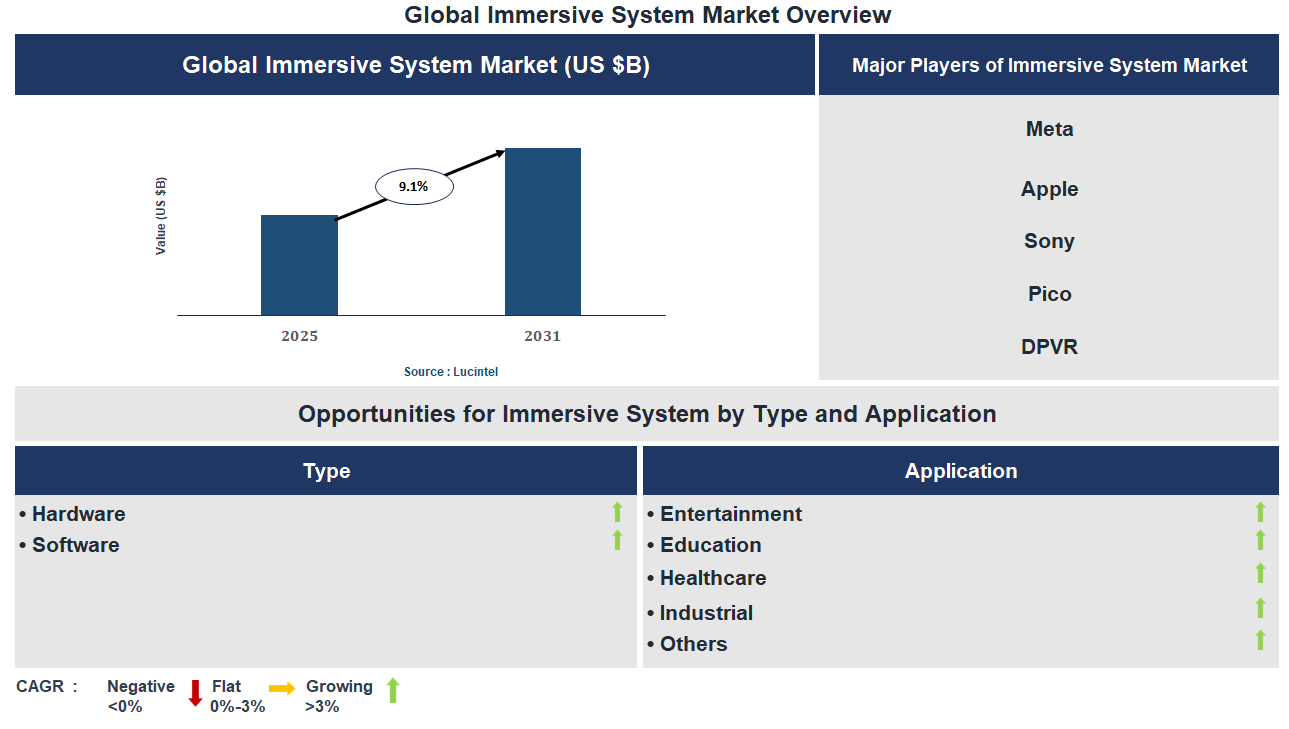
The future of the global immersive system market looks promising with opportunities in the entertainment, education, healthcare, and industrial markets. The global immersive system market is expected to grow with a CAGR of 9.1% from 2025 to 2031. The major drivers for this market are the increasing demand for interactive entertainment experiences, the rising adoption of virtual reality technologies, and the growing popularity of immersive learning applications.• Lucintel forecasts that, within the type category, hardware is expected to witness higher growth over the forecast period.
• Within the application category, entertainment is expected to witness the highest growth.
• In terms of region, APAC is expected to witness the highest growth over the forecast period. Gain valuable insights for your business decisions with our comprehensive 150+ page report. Sample figures with some insights are shown below.
Emerging Trends in the Immersive System Market
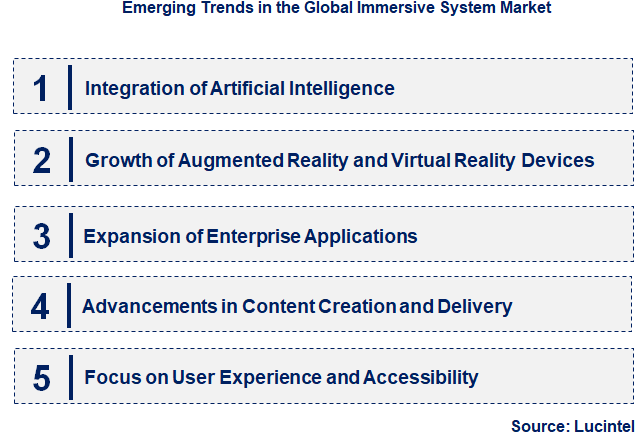
The immersive system market is experiencing rapid growth driven by technological advancements and increasing demand across various sectors such as entertainment, education, healthcare, and corporate training. As consumers and organizations seek more engaging and interactive experiences, the market is evolving with innovative solutions that enhance user engagement and operational efficiency. These developments are not only transforming how content is created and consumed but also redefining the boundaries of virtual and augmented reality applications. The following key trends highlight the major shifts shaping this dynamic market landscape, reflecting its future trajectory and potential for widespread adoption.• Integration of Artificial Intelligence: AI is increasingly embedded within immersive systems to enable smarter, more personalized experiences. AI-driven analytics improve user interaction by adapting content in real-time based on user behavior and preferences. This integration enhances the realism and responsiveness of virtual environments, making experiences more engaging and intuitive. Additionally, AI facilitates automation in content creation, reducing development time and costs. As AI continues to evolve, immersive systems will become more intelligent, capable of delivering highly customized and immersive experiences across various applications, from gaming to training simulations.
• Growth of Augmented Reality and Virtual Reality Devices: The market is witnessing a surge in the adoption of AR and VR hardware, driven by technological improvements and decreasing costs. Advanced headsets, glasses, and haptic devices are providing more immersive and comfortable experiences, encouraging wider consumer and enterprise adoption. The proliferation of standalone devices with enhanced features is expanding use cases beyond gaming to include education, healthcare, and retail. This trend is making immersive experiences more accessible, fostering innovation, and accelerating market growth as hardware becomes more affordable and user-friendly.
• Expansion of Enterprise Applications: Immersive systems are increasingly being adopted by businesses for training, simulation, product design, and marketing. Companies recognize the value of immersive experiences in reducing costs, improving safety, and enhancing learning outcomes. For example, virtual training modules allow employees to practice complex procedures in a risk-free environment. Similarly, immersive marketing campaigns create memorable brand experiences. This trend is driving the development of industry-specific solutions, expanding the market beyond entertainment and into core business functions, thereby broadening the scope and revenue potential of immersive systems.
• Advancements in Content Creation and Delivery: The evolution of content creation tools and platforms is making it easier to develop high-quality immersive experiences. Real-time rendering, 3D modeling, and cloud-based solutions enable creators to produce complex environments efficiently. Additionally, 5G connectivity enhances the delivery of high-fidelity content with minimal latency, supporting seamless user experiences. These technological advancements are democratizing content creation, allowing smaller developers and organizations to participate in the market. As content becomes more diverse and accessible, consumer engagement increases, fueling further innovation and market expansion.
• Focus on User Experience and Accessibility: Market players are prioritizing user comfort, ease of use, and accessibility to broaden adoption. Ergonomic designs, lightweight hardware, and intuitive interfaces are reducing barriers for new users. Accessibility features such as subtitles, audio descriptions, and customizable controls are making immersive systems more inclusive. This focus is crucial for expanding the user base beyond early adopters to mainstream consumers and diverse demographic groups. Enhanced user experience and accessibility are vital for sustained growth, ensuring immersive systems are appealing, comfortable, and usable by a broad audience. In summary, these emerging trends are collectively transforming the immersive system market by making experiences more intelligent, accessible, and integrated into everyday life and business operations. They are driving innovation, expanding application areas, and lowering barriers to adoption, ultimately reshaping the landscape into a more versatile and user-centric domain.
Recent Development in the Immersive System Market
The immersive system market has experienced rapid growth driven by technological advancements and increasing demand across various sectors such as entertainment, education, healthcare, and retail. As consumers and businesses seek more engaging and interactive experiences, the market is evolving with innovative solutions that enhance user engagement and operational efficiency. Recent developments reflect a shift towards more sophisticated, accessible, and versatile immersive technologies, shaping the future landscape of this industry. These advancements are not only expanding market reach but also creating new opportunities for stakeholders, fostering competitive innovation, and transforming traditional experiences into dynamic, immersive environments.• Adoption of Augmented Reality in Retail: Retailers are integrating AR to enhance customer experience by allowing virtual try-ons and interactive product displays, leading to increased engagement and sales. This development is transforming shopping into a more personalized and immersive activity, boosting customer satisfaction and loyalty.
• Growth of Virtual Reality in Healthcare: VR is increasingly used for medical training, therapy, and patient education, improving treatment outcomes and reducing costs. Its immersive nature provides realistic simulations, enhancing skill development and patient understanding, thus revolutionizing healthcare practices.
• Advancements in Hardware Technology: The development of lightweight, high-resolution headsets and haptic feedback devices has improved user comfort and realism. These innovations are making immersive systems more accessible and appealing, broadening their application scope across industries.
• Expansion of Immersive Learning Platforms: Educational institutions and corporate training programs are adopting immersive systems for more engaging learning experiences. This trend enhances knowledge retention, learner engagement, and practical skill development, transforming traditional education methods.
• Integration of Artificial Intelligence with Immersive Systems: AI-driven immersive experiences offer personalized content and adaptive interactions, increasing user engagement and effectiveness. This integration is enabling more intelligent, responsive environments that cater to individual preferences and needs. In summary, these recent developments are significantly impacting the immersive system market by enhancing technological capabilities, expanding application areas, and improving user experiences. The market is becoming more dynamic, accessible, and integrated with other advanced technologies, which is driving growth and innovation across multiple sectors.
Strategic Growth Opportunities in the Immersive System Market
The immersive system market is experiencing rapid expansion driven by technological advancements and increasing adoption across various industries. As businesses and consumers seek more engaging and interactive experiences, key applications are emerging as significant growth drivers. These applications span entertainment, education, healthcare, retail, and training sectors, each presenting unique opportunities for innovation and market penetration. Companies investing in immersive technologies are poised to capitalize on these trends, shaping the future landscape of immersive experiences. Understanding these growth opportunities is essential for stakeholders aiming to leverage the full potential of this dynamic market.• Enhanced User Engagement: Immersive systems are revolutionizing gaming, virtual concerts, and theme parks by providing highly interactive and realistic experiences, attracting larger audiences and increasing revenue streams.
• Improved Learning Outcomes: These systems enable immersive learning environments, making education more engaging and effective, which is particularly impactful in corporate training, higher education, and skill development sectors.
• Advanced Therapeutic Solutions: Immersive technologies facilitate pain management, mental health therapy, and surgical training, leading to better patient outcomes and more efficient medical procedures.
• Elevated Customer Experiences: Retailers utilize immersive systems for virtual try-ons and virtual showrooms, enhancing customer engagement, reducing return rates, and boosting sales.
• Virtual Property Tours: Immersive systems allow clients to explore properties remotely with realistic virtual walkthroughs, accelerating decision-making and reducing costs associated with physical visits. In summary, these growth opportunities are significantly transforming the immersive system market by expanding its applications and enhancing user experiences across industries. This diversification is driving increased adoption, fostering innovation, and creating new revenue streams, ultimately positioning immersive technologies as a critical component of future business strategies.
Immersive System Market Driver and Challenges
The immersive system market is influenced by a variety of technological, economic, and regulatory factors that shape its growth trajectory. Rapid advancements in hardware and software technologies, increasing adoption across diverse industries, and supportive government policies are key drivers. However, challenges such as high implementation costs, technological limitations, and regulatory concerns pose significant hurdles. Understanding these drivers and challenges is essential for stakeholders to navigate the evolving landscape effectively and capitalize on emerging opportunities. The factors responsible for driving the immersive system market include:-• Technological Innovation: The continuous development of advanced hardware like VR headsets, AR glasses, and haptic feedback devices, along with sophisticated software platforms, has significantly enhanced user experience. These innovations enable more realistic and immersive interactions, expanding applications in gaming, training, healthcare, and retail. As technology becomes more affordable and accessible, adoption rates increase, fueling market growth. Moreover, integration with AI and 5G networks further amplifies immersive capabilities, making systems more responsive and scalable. This ongoing innovation cycle ensures the market remains dynamic and poised for expansion.
• Increasing Adoption Across Industries: Immersive systems are increasingly adopted in sectors such as healthcare, education, manufacturing, and entertainment. In healthcare, they facilitate advanced surgical simulations and patient treatment plans. In education, immersive tools enhance engagement and experiential learning. Manufacturing benefits from virtual prototyping and training, reducing costs and time-to-market. The entertainment industry leverages immersive experiences for gaming, virtual concerts, and theme parks. This cross-industry adoption broadens the market scope, creating new revenue streams and driving demand for immersive solutions. As industries recognize the value of immersive technology, investments are expected to rise significantly.
• Rising Investment and Funding: The market benefits from substantial investments by technology giants, venture capitalists, and government agencies. Funding supports research and development, accelerates product launches, and fosters innovation. Major companies are acquiring startups and forming strategic alliances to strengthen their immersive offerings. Government initiatives aimed at digital transformation and smart city projects further boost funding opportunities. Increased investment not only accelerates technological advancements but also enhances market competitiveness. This financial backing ensures a steady pipeline of innovative immersive solutions, encouraging market participants to expand their portfolios and explore new applications.
• Growing Consumer Demand for Enhanced Experiences: Consumers are seeking more engaging and realistic digital interactions, driving demand for immersive systems. The proliferation of smartphones, affordable VR headsets, and AR-enabled devices has made immersive experiences more accessible. Consumers are willing to invest in immersive gaming, virtual travel, and social platforms, fueling market growth. The desire for personalized, interactive content is pushing companies to develop more sophisticated immersive solutions. This trend is particularly prominent among younger demographics, who prioritize experiential entertainment. As consumer preferences evolve, the market is expected to see sustained growth driven by increasing demand for immersive content and experiences. The challenges facing this immersive system market include:-
• High Implementation Costs: Deploying immersive systems requires significant capital investment in hardware, software, and content development. Small and medium-sized enterprises often find these costs prohibitive, limiting adoption. Additionally, ongoing expenses related to maintenance, upgrades, and training further escalate total costs. This financial barrier restricts market penetration, especially in emerging economies where budget constraints are more pronounced. Overcoming cost-related challenges is crucial for the broader adoption and scaling of immersive solutions across various sectors.
• Technological Limitations: Despite rapid advancements, current immersive technologies face limitations such as a limited field of view, resolution issues, and latency problems. These factors can cause discomfort, motion sickness, and reduced realism, impacting user experience negatively. Moreover, hardware devices often lack portability and comfort for extended use. Content creation remains complex and resource-intensive, hindering widespread deployment. Addressing these technological constraints is essential to improve system performance, user comfort, and content richness, thereby expanding market acceptance and application scope.
• Regulatory and Privacy Concerns: The immersive system market faces regulatory challenges related to data privacy, security, and content standards. As immersive experiences often involve collecting sensitive user data, ensuring compliance with data protection laws is critical. Additionally, content regulation and intellectual property rights pose hurdles, especially in virtual environments. Regulatory uncertainty can delay product launches and restrict market growth. Companies must navigate complex legal landscapes to ensure user safety and data security, which can increase operational costs and slow innovation. In summary, the immersive system market is driven by technological innovation, cross-industry adoption, increased investment, and rising consumer demand. However, high costs, technological limitations, and regulatory concerns present significant challenges. These factors collectively influence the market’s growth potential, requiring stakeholders to focus on cost reduction, technological improvements, and regulatory compliance. Successfully addressing these drivers and challenges will determine the pace and scope of market expansion, shaping the future landscape of immersive technologies.
List of Immersive System Companies
Companies in the market compete on the basis of product quality offered. Major players in this market focus on expanding their manufacturing facilities, R&D investments, infrastructural development, and leverage integration opportunities across the value chain. With these strategies immersive system companies cater increasing demand, ensure competitive effectiveness, develop innovative products & technologies, reduce production costs, and expand their customer base. Some of the immersive system companies profiled in this report include-• Meta
• Apple
• Sony
• Pico
• DPVR
• Microsoft
• HTC
• AVEVA
• Barco
Immersive System Market by Segment
The study includes a forecast for the global immersive system market by type, application, and region.Immersive System Market by Type [Value from 2019 to 2031]:
• Hardware
• Software
Immersive System Market by Application [Value from 2019 to 2031]:
• Entertainment
• Education
• Healthcare
• Industrial
• Others
Immersive System Market by Region [Value from 2019 to 2031]:
• North America
• Europe
• Asia Pacific
• The Rest of the World
Country Wise Outlook for the Immersive System Market
The immersive system market has experienced rapid growth driven by technological advancements, increasing adoption across various sectors, and a rising demand for immersive experiences in entertainment, education, and training. As countries invest in innovation and infrastructure, the landscape is evolving with new products, enhanced capabilities, and expanding applications. The United States, China, Germany, India, and Japan are leading the way, each contributing unique developments that shape the global market trajectory. These countries are leveraging their technological strengths and market strategies to foster growth, improve user experiences, and expand the reach of immersive systems worldwide.• United States: The US market has seen significant advancements in augmented reality (AR) and virtual reality (VR) hardware, with major tech companies launching innovative products. Investment in immersive training and simulation for the military and healthcare sectors has increased. The entertainment industry continues to adopt immersive systems for gaming and virtual concerts, boosting consumer adoption. Additionally, US startups are pioneering in spatial computing and mixed reality applications, driving market expansion. Government initiatives and private sector funding further support research and development, positioning the US as a leader in immersive technology innovation.
• China: China has rapidly expanded its immersive system market through substantial government support and investments in 5G infrastructure, enabling enhanced AR and VR experiences. The gaming industry remains a primary driver, with domestic companies developing immersive gaming platforms and content. The education sector is increasingly integrating immersive systems for remote learning and training, especially post-pandemic. Chinese tech giants are also focusing on enterprise applications, including virtual meetings and industrial simulations. The market benefits from a large consumer base and aggressive commercialization strategies, making China a key player in global immersive system growth.
• Germany: Germany emphasizes industrial and automotive applications of immersive systems, integrating AR and VR into manufacturing, design, and training processes. The country is advancing in medical simulation and healthcare training, improving precision and safety. German companies are investing in research collaborations to develop high-fidelity immersive experiences for engineering and product development. The government promotes digital transformation initiatives, fostering innovation in immersive technologies. Additionally, Germany’s focus on quality and engineering excellence ensures the development of sophisticated, reliable immersive solutions for various sectors, strengthening its position in the European market.
• India: India’s immersive system market is witnessing rapid growth driven by increasing smartphone penetration and digital infrastructure development. The education sector is adopting immersive learning tools to enhance engagement and remote education. The gaming and entertainment industries are expanding, with local developers creating immersive content tailored to regional preferences. Startups are exploring enterprise applications such as virtual training and product visualization. Government initiatives promoting digital literacy and smart city projects are also contributing to market expansion. As affordability improves, India is poised to become a significant consumer and innovator in immersive system adoption across multiple sectors.
• Japan: Japan continues to innovate in immersive systems, focusing on robotics, gaming, and healthcare applications. The gaming industry remains a major driver, with advanced VR headsets and immersive experiences gaining popularity. Japan’s healthcare sector is adopting immersive systems for therapy, rehabilitation, and medical training, improving patient outcomes. The country is also investing in augmented reality for industrial maintenance and logistics. Collaborations between tech firms and academic institutions foster cutting-edge research. Japan’s emphasis on quality, safety, and technological integration ensures the development of high-end immersive solutions, maintaining its competitive edge in the global market.

Features of the Global Immersive System Market
Market Size Estimates: Immersive system market size estimation in terms of value ($B). Trend and Forecast Analysis: Market trends (2019 to 2024) and forecast (2025 to 2031) by various segments and regions. Segmentation Analysis: Immersive system market size by type, application, and region in terms of value ($B). Regional Analysis: Immersive system market breakdown by North America, Europe, Asia Pacific, and Rest of the World. Growth Opportunities: Analysis of growth opportunities in different types, applications, and regions for the immersive system market. Strategic Analysis: This includes M&A, new product development, and competitive landscape of the immersive system market. Analysis of competitive intensity of the industry based on Porter’s Five Forces model.
FAQ
Q1. What is the growth forecast for immersive system market? Answer: The global immersive system market is expected to grow with a CAGR of 9.1% from 2025 to 2031. Q2. What are the major drivers influencing the growth of the immersive system market? Answer: The major drivers for this market are the increasing demand for interactive entertainment experiences, the rising adoption of virtual reality technologies, and the growing popularity of immersive learning applications. Q3. What are the major segments for immersive system market? Answer: The future of the immersive system market looks promising with opportunities in the entertainment, education, healthcare, and industrial markets. Q4. Who are the key immersive system market companies? Answer: Some of the key immersive system companies are as follows:• Meta
• Apple
• Sony
• Pico
• DPVR
• Microsoft
• HTC
• AVEVA
• Barco Q5. Which immersive system market segment will be the largest in future? Answer: Lucintel forecasts that, within the type category, hardware is expected to witness higher growth over the forecast period. Q6. In immersive system market, which region is expected to be the largest in next 5 years? Answer: In terms of region, APAC is expected to witness the highest growth over the forecast period. Q7. Do we receive customization in this report? Answer: Yes, Lucintel provides 10% customization without any additional cost.
Table of Contents
List of Figures
List of Tables
Methodology
- In-depth interviews of the major players in this market
- Detailed secondary research from competitors’ financial statements and published data
- Extensive searches of published works, market, and database information pertaining to industry news, company press releases, and customer intentions
- A compilation of the experiences, judgments, and insights of Lucintel’s professionals, who have analyzed and tracked this market over the years.


Buy Now
Choose a license that fits your team. Instant PDF delivery.
Prices exclude taxes. Instant delivery. Custom licensing available on request.
Key Questions
- • What are some of the most promising, high-growth opportunities for the immersive system market by type (hardware and software), application (entertainment, education, healthcare, industrial, and others), and region (North America, Europe, Asia Pacific, and the Rest of the World)?
- • Which segments will grow at a faster pace and why?
- • Which region will grow at a faster pace and why?
- • What are the key factors affecting market dynamics? What are the key challenges and business risks in this market?
- • What are the business risks and competitive threats in this market?
- • What are the emerging trends in this market and the reasons behind them?
- • What are some of the changing demands of customers in the market?
- • What are the new developments in the market? Which companies are leading these developments?
- • Who are the major players in this market? What strategic initiatives are key players pursuing for business growth?
- • What are some of the competing products in this market and how big of a threat do they pose for loss of market share by material or product substitution?
- • What M&A activity has occurred in the last 5 years and what has its impact been on the industry? For any questions related to Immersive System Market, Immersive System Market Size, Immersive System Market Growth, Immersive System Market Analysis, Immersive System Market Report, Immersive System Market Share, Immersive System Market Trends, Immersive System Market Forecast, Immersive System Companies, write Lucintel analyst at email: helpdesk@lucintel.com. We will be glad to get back to you soon.


