
Market Report · July 29, 2026

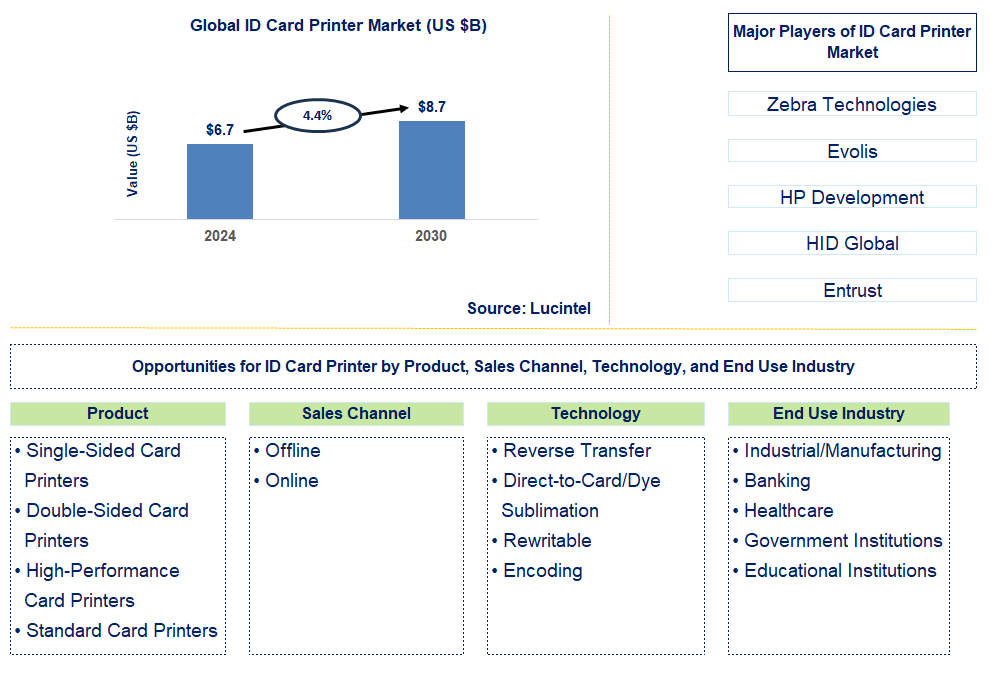
Key data points: The market size in 2030 = $8.7 billion, growth forecast = 4.4% annually for the next 6 years. Scroll below to get more insights. This market report covers trends, opportunities, and forecasts in the global ID card printer market to 2030 by product (single-sided card printers, double-sided card printers, high-performance card printers, and standard card printers), sales channel (offline and online), technology (reverse transfer, direct-to-card/dye sublimation, rewritable, and encoding), end use industry (industrial/manufacturing, banking, healthcare, government institutions, and educational institutions), and region (North America, Europe, Asia Pacific, and the Rest of the World)
We'll send your sample report shortly.
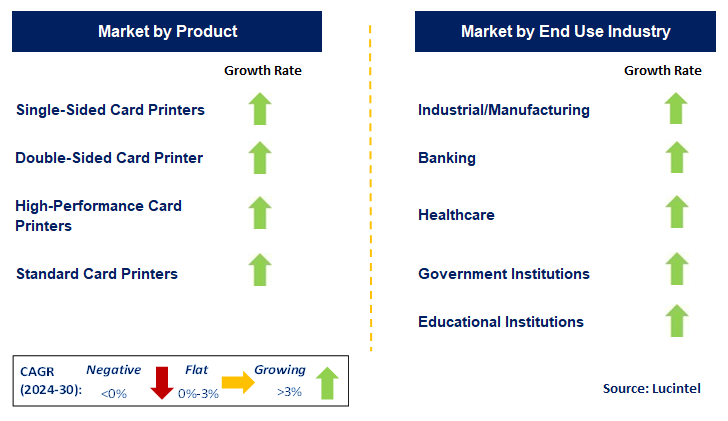
• Lucintel forecast that within the product category, double-sided card is expected to witness the highest growth over the forecast period due to rising preference for this product to rapidly generate a large number of ID cards.
• Within the end use industry category, Government is expected to witness the highest growth over the forecast period due to significant demand for reliable and secure ID cards for their citizens and employees.
• In terms of regions, North America is expected to witness the highest growth over the forecast period due to the availability of major manufacturing hubs and the increasing adoption of ID card printers by banks and educational institutes in the region. Gain valuable insights for your business decisions with our 150+ page report.
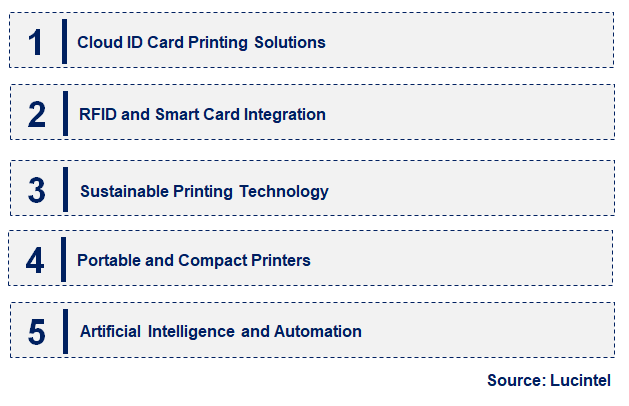
• Cloud ID card printing solutions: Cloud-based technologies allow remote management as well as scalability, which helps incorporate flexibility and cost-effectiveness in the business of ID card printing in several locations.
• RFID and smart card integration: The growing need for contactless solutions has led to increased integration of RFID and smart card technology into document authentication procedures, thus improving ID card printing for high-security applications.
• Sustainable printing technology: Manufacturers also address the growing waste management issues by developing green prints and green printing machines made from new recycled materials with reduced power requirements to meet global demand.
• Portable and compact printers: The need for users to travel for operations has increased the demand for portable and compact ID card printers that can be used anywhere, allowing for easy printing while maintaining high quality.
• Artificial intelligence and automation: Robotic devices and artificial intelligence are being incorporated into the operational procedures of ID card printing, improving time and precision and reducing the chances of human error, which enhances operational efficiency. These trends bring change to the ID card printer industry by facilitating innovations, improving security, and encouraging environmental protection, which translates to more effective and efficient printing systems.
• Integration of biometric features: New ID card printers are well-equipped with the capability of printing biometric data, thus improving the security and utility of ID cards in various implementations.
• Advancement in high-resolution printing: Printing technology is rapidly advancing toward high-resolution printing, which enhances picture quality and detailed graphics on ID cards, especially in highly secure areas.
• Adoption of cloud-based printing: There is an increasing trend toward cloud-based ID card printers, which facilitates the management of the printing process from a centralized point, especially for large institutions such as corporate companies and schools.
• Expansion of customization options: The design and production of new ID card printers introduce additional personalization features whereby cards can be designed and printed to be appealing and functional for specific organizations.
• Focus on user-friendly interfaces: Manufacturers of ID card printers are implementing user-friendly interfaces, making it easier and faster for non-IT experts to use the printers. These developments are pushing the ID card printer market toward greater efficiency, security, and appealing ID card designs for all industries.
• Government and public sector: These products are heavily consumed by the government and public sector, encompassing a host of applications from issuing national IDs to issuing driving licenses. Due to growing concerns over card security and efficiency in recovering from loss, sophisticated ID card printers with extra features like biometric and contactless capabilities will be in high demand.
• Healthcare: The market's growth also extends to the police industry, where there is a growing need for ID card printers for activities such as investigations and access management. The global push for better and technologically improved management of accurate patient data is increasing demand for ID card printers in this market.
• Education: ID card printers are increasingly used by schools and universities for issuing student IDs, faculty IDs, and access cards. The importance of ID cards in promoting campus safety, improving administrative processes, and providing resource access to students is driving their increased use in educational institutions.
• Corporate and enterprise: Marketplaces also recognize the significance of each employee's identity, visitors, and how to ensure their access to business operations via ID card printers. The need for more secure boundaries and optimized workforce management is what calls for ID card printers in corporate settings.
• Events and conferences: The events sector is also utilizing ID card printers to create badges for participants and provide secure access control and networking opportunities. The demand for ID card printers in this industry is rising with the increased popularity of conventions and trade fairs. All these growth opportunities work in concert to spur the growth of the ID card printer market. Furthermore, the factors driving these market trends include the rise of secure identity systems technology and requirements in various industries.
• Technological advancements: The production of ID card printers is highly influenced by advances in printing technology such as RFID and NFC. These technologies provide better security and allow for contactless interactions.
• Rising security concerns: Demand for ID card printers has increased due to safety issues such as identity theft, fraud, terrorism, and other related threats that require secure identification measures.
• Government regulations: An influx of government mandates and regulations regarding identification, access controls, and pertinent details has opened the door for growth in the ID card printer market.
• Economic growth: Advancements in the economy, especially in developing countries, lead to increased use of ID for business purposes and assistance from the government.
• Globalization: The rapid growth of global business and increased movement of people between countries create demand for specific and safe identification mechanisms such as passports and other travel documents. Challenges in the ID card printer market include:
• Cost: The adoption of ID cards throughout an organization can be capital intensive; for instance, the initial cost of procuring ID card printers for a certain size of organization can be a hurdle, particularly for small-scale companies and non-profit organizations.
• Complexity: Due to reliance on technology, ID card systems are not only visually implemented but also logistically administered, which requires specialists and key resources.
• Security risks: Despite the security benefits provided by ID card printers, threats of data theft and leakage of sensitive information still exist. Major factors fueling the growth of the ID card printer market include technological innovations, increasing security concerns, government initiatives, rapid economic development, and globalization. However, cost-related issues, complexity, and security risks are likely to restrain market growth. Business enterprises operating in these markets need to manage these drivers and challenges to seize the opportunities available.
• Zebra Technologies
• Evolis
• HP Development
• HID Global
• Entrust
• Kanematsu
• CIM
• Magicard NEO
• Seiko Epson
• IDP
• Single-Sided Card Printers
• Double-Sided Card Printers
• High-Performance Card Printers
• Standard Card Printers
• Offline
• Online
• Reverse Transfer
• Direct-to-Card/Dye Sublimation
• Rewritable
• Encoding
• Industrial/Manufacturing
• Banking
• Healthcare
• Government Institutions
• Educational Institutions
• North America
• Europe
• Asia Pacific
• The Rest of the World
• United States: Segments reported increased adoption of high-resolution ID card printers in the U.S. market as companies aim to improve the security of their printers and offer cloud-based deployment to facilitate remote work.
• China: AI technology integration with ID card printers has been prominent in China, with mass production of comprehensive features that involve fast printing speeds and accurate identity verification developed to support the rise of smart cities.
• Germany: The market in Germany is moving toward designs that reduce the use of plastic in producing ID card printers. The strategy for this move includes utilizing environmentally friendly materials and energy-saving devices during production.
• India: The scenario has changed rapidly with the introduction of biometrics-based identification in India. Multifunctional ID card printers with printing and biometric data functions have recently been embraced in the internal market due to the demand for portrait-based biometric ID systems in government and education.
• Japan: Japan is at the forefront of miniaturization, focusing on efficiently utilizing space constraints to provide small-scale but productive ID card printers.


• Zebra Technologies
• Evolis
• HP Development
• HID Global
• Entrust
• Kanematsu
• CIM
• Magicard NEO
• Seiko Epson
• IDP Q6. Which ID card printer market segment will be the largest in future? Answer: Lucintel forecast that double-sided card is expected to witness highest growth over the forecast period due to rising preference for this product to rapidly generate a large number of ID cards. Q7. In ID card printer market, which region is expected to be the largest in next 5 years? Answer: North America is expected to witness the highest growth over the forecast period due to the availability of major manufacturing hubs and the increasing adoption of ID card printers by banks and educational institutes in the region. Q.8 Do we receive customization in this report? Answer: Yes, Lucintel provides 10% customization without any additional cost.


Choose a license that fits your team. Instant PDF delivery.
Prices exclude taxes. Instant delivery. Custom licensing available on request.
Market Report · July 29, 2026
Market Report · July 15, 2026
Market Report · July 13, 2026
Trusted partner for strategic intelligence and business growth


Receive a complimentary market analysis tailored to your industry. Our analysts will identify key growth opportunities and competitive dynamics specific to your business.

Market size, growth rate, and key trend analysis for your specific sector.

Top competitor positioning and market share analysis.

Strategic recommendations backed by data-driven insights.
Get curated market intelligence and competitive moves straight to your inbox.
By subscribing, you agree to receive our monthly insights. Unsubscribe anytime.
Receive a complimentary market analysis tailored to your industry. Our analysts will identify key growth opportunities and competitive dynamics specific to your business.
Market size, growth rate, and key trend analysis for your specific sector.
Top competitor positioning and market share analysis.
Strategic recommendations backed by data-driven insights.
Get curated market intelligence, emerging trends, and competitive moves straight to your inbox each month.
By subscribing, you agree to receive our monthly insights. Unsubscribe anytime.
We'll send your sample report shortly.