
Report Feature
Ibuprofen API Market Trends and Forecast
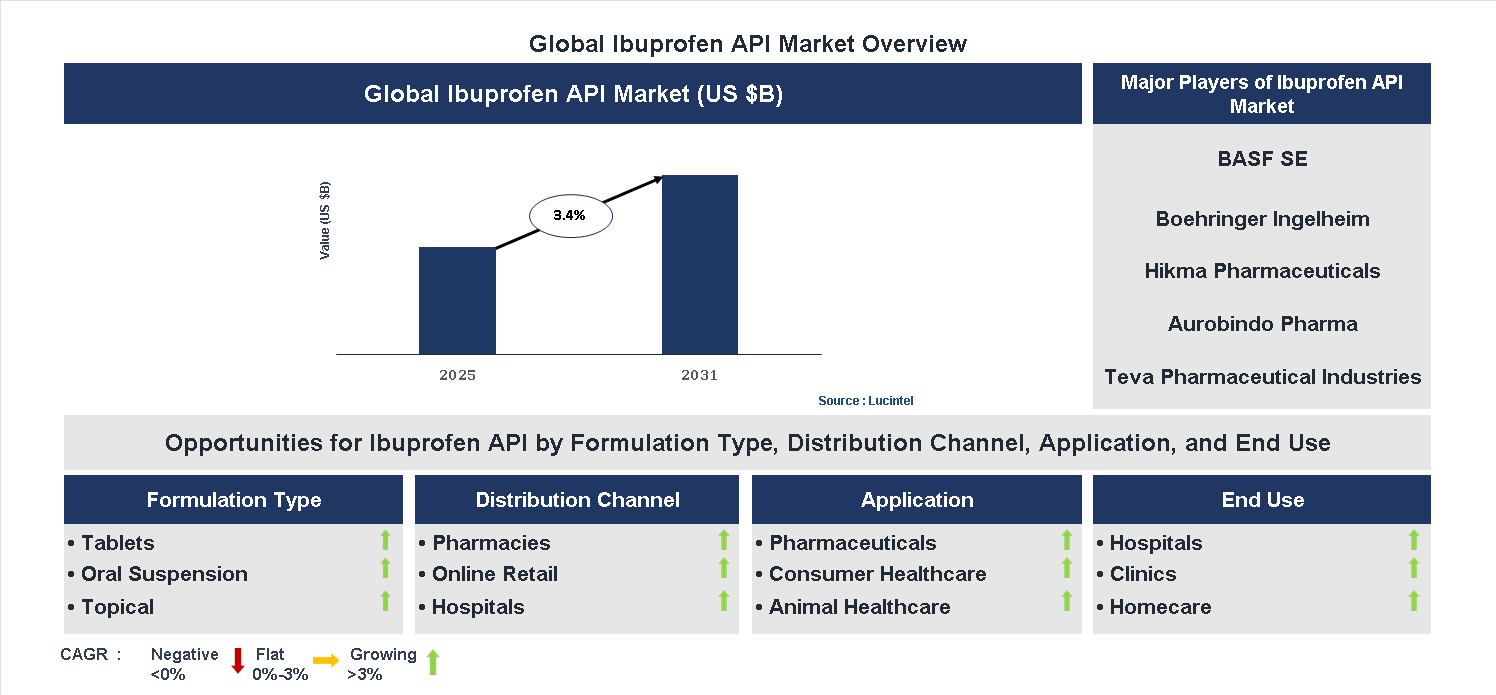
The future of the global ibuprofen API market looks promising with opportunities in the hospital, clinic, and homecare markets. The global ibuprofen API market is expected to grow with a CAGR of 3.4% from 2025 to 2031. The major drivers for this market are the increasing prevalence of pain disorders, the rising demand for over the counter analgesics, and the growing production of generic ibuprofen.• Lucintel forecasts that, within the formulation type category, tablet is expected to witness the highest growth over the forecast period.
• Within the end use category, hospital is expected to witness the highest growth.
• In terms of region, APAC is expected to witness the highest growth over the forecast period. Gain valuable insights for your business decisions with our comprehensive 150+ page report. Sample figures with some insights are shown below.
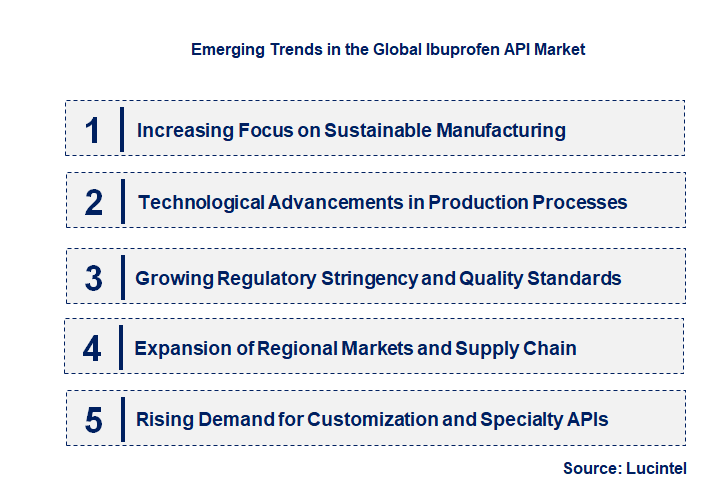
Emerging Trends in the Ibuprofen API Market
The Ibuprofen API Market is experiencing rapid evolution driven by technological advancements, changing regulatory landscapes, and shifting consumer preferences. As healthcare demands grow and innovation accelerates, key trends are shaping the future of this market. These developments are not only influencing manufacturing and distribution but also impacting pricing, quality standards, and sustainability practices. Stakeholders must adapt to these changes to remain competitive and meet global health needs effectively. Understanding these emerging trends is crucial for industry players aiming to capitalize on new opportunities and navigate potential challenges in the dynamic landscape of Ibuprofen API production and supply.• Increasing Focus on Sustainable Manufacturing: Emphasis on eco-friendly processes and green chemistry is rising, driven by environmental regulations and consumer demand for sustainable products. Manufacturers are adopting cleaner production techniques, reducing waste, and utilizing renewable resources to minimize environmental impact. This shift enhances brand reputation, ensures compliance with stricter regulations, and appeals to environmentally conscious consumers. Sustainable practices also help reduce costs in the long term and mitigate risks associated with environmental liabilities, positioning companies as responsible industry leaders in the evolving pharmaceutical landscape.
• Technological Advancements in Production Processes: Innovations such as continuous manufacturing, automation, and advanced synthesis techniques are transforming API production. These technologies improve efficiency, reduce production time, and enhance product quality. They also enable better control over manufacturing parameters, leading to higher purity and consistency of Ibuprofen APIs. The adoption of digital tools and process analytics further optimizes operations, reduces costs, and accelerates time-to-market. These advancements are crucial for meeting increasing global demand and maintaining competitive advantage in a highly regulated industry.
• Growing Regulatory Stringency and Quality Standards: Regulatory agencies worldwide are tightening standards for pharmaceutical APIs, emphasizing safety, efficacy, and quality. This trend compels manufacturers to adopt rigorous quality control measures, comply with Good Manufacturing Practices (GMP), and ensure traceability throughout the supply chain. Enhanced regulatory scrutiny increases compliance costs but ultimately ensures higher product safety and consumer trust. Companies investing in robust quality management systems and transparent documentation are better positioned to navigate complex regulatory environments and avoid costly penalties or product recalls.
• Expansion of Regional Markets and Supply Chain Diversification: Emerging markets in Asia, Africa, and Latin America are experiencing rapid growth in pharmaceutical manufacturing, including Ibuprofen API production. This expansion is driven by increasing healthcare infrastructure, local demand, and government incentives. Simultaneously, companies are diversifying supply chains to reduce dependency on specific regions, mitigate risks, and ensure a steady supply amid geopolitical or logistical disruptions. Regional market growth offers new opportunities for partnerships, investments, and market penetration, while supply chain diversification enhances resilience and responsiveness to global market fluctuations.
• Rising Demand for Customization and Specialty APIs: There is a growing trend toward developing customized and specialty Ibuprofen APIs tailored to specific therapeutic needs or formulations. This shift is driven by personalized medicine approaches and the demand for targeted therapies. Manufacturers are investing in R&D to create differentiated products with improved bioavailability, reduced side effects, or novel delivery mechanisms. This trend allows companies to command premium pricing, expand their product portfolios, and meet diverse customer requirements. It also fosters innovation and differentiation in a competitive market, opening new avenues for growth and collaboration. In summary, these emerging trends are collectively reshaping the Ibuprofen API market by promoting sustainability, technological innovation, regulatory compliance, regional expansion, and product customization. They are driving increased efficiency, quality, and resilience, enabling industry players to better serve global healthcare needs while adapting to a rapidly changing environment.
Recent Development in the Ibuprofen API Market
The ibuprofen API market has experienced significant advancements driven by increasing demand for pain relief medications and expanding pharmaceutical applications. Innovations in manufacturing processes, regulatory approvals, and global market expansion are shaping its growth trajectory. These developments are creating new opportunities for manufacturers and investors, while also addressing challenges related to quality standards and supply chain management. Understanding these key trends is essential for stakeholders aiming to capitalize on the evolving landscape of the Ibuprofen API industry.• Growth in Demand for Over-the-Counter Pain Relief: The rising prevalence of chronic pain and self-medication trends have boosted demand for OTC pain relief products containing Ibuprofen. This surge has prompted manufacturers to increase production capacity and innovate formulations to meet consumer preferences. The expanding consumer base across emerging markets further amplifies growth prospects, making Ibuprofen API a critical component in global pain management solutions. This trend is expected to sustain long-term market expansion.
• Advances in Manufacturing Technologies: Recent developments in green synthesis and continuous manufacturing processes have improved efficiency and reduced environmental impact. These innovations enable higher yields, lower costs, and enhanced quality control, which are vital for regulatory compliance. As manufacturers adopt these advanced technologies, the market benefits from increased scalability and sustainability. This progress supports the industrys goal of producing high-quality Ibuprofen API at competitive prices, fostering global supply stability.
• Regulatory Approvals and Quality Standards: Stringent regulatory frameworks and quality standards, such as GMP compliance, have driven manufacturers to upgrade their facilities and processes. Recent approvals for new manufacturing sites and formulations have expanded market access, especially in emerging regions. Enhanced regulatory oversight ensures product safety and efficacy, boosting consumer confidence. These developments facilitate smoother market entry and foster trust among healthcare providers, ultimately strengthening the global ibuprofen API market.
• Expansion into Emerging Markets: Growing healthcare infrastructure and increasing healthcare awareness in regions like Asia-Pacific and Latin America have opened new avenues for market growth. Local manufacturers are investing in capacity expansion and technology upgrades to meet rising demand. International companies are also entering these markets through partnerships and joint ventures. This regional expansion diversifies supply sources and reduces dependency on traditional markets, positioning the Ibuprofen API industry for sustained global growth.
• Focus on Sustainability and Supply Chain Resilience: The industry is increasingly adopting sustainable practices, including eco-friendly raw material sourcing and waste reduction. Additionally, efforts to diversify supply chains mitigate risks associated with geopolitical tensions and pandemics. These initiatives enhance resilience and ensure a consistent supply of Ibuprofen API. Stakeholders are also investing in digital tracking and quality assurance systems to improve transparency. Such focus on sustainability and resilience is vital for maintaining market stability amid global uncertainties. The overall impact of these developments is a more robust, efficient, and sustainable ibuprofen API market. Increased demand, technological innovations, regulatory enhancements, regional expansion, and sustainability efforts collectively drive growth, improve product quality, and ensure supply stability. These factors position the industry for long-term success, benefiting manufacturers, healthcare providers, and consumers worldwide.
Strategic Growth Opportunities in the Ibuprofen API Market
The ibuprofen API market is experiencing significant growth driven by increasing demand for over-the-counter pain relief medications, expanding pharmaceutical manufacturing capabilities, and rising awareness of pain management therapies worldwide. Innovations in synthesis processes and regulatory approvals are further fueling market expansion. Companies are exploring new applications and markets to capitalize on this trend, creating opportunities for strategic investments and partnerships. This dynamic environment offers numerous avenues for growth, innovation, and increased market share in the global pharmaceutical industry.• Expansion into emerging markets offers significant growth potential: Emerging economies present increasing demand for affordable pain relief medications, driven by rising healthcare awareness and improving healthcare infrastructure. Companies can capitalize on this by establishing local manufacturing units, forming strategic alliances, and customizing products to meet regional needs. This expansion not only broadens market reach but also reduces logistics costs and import dependencies, enabling companies to tap into a rapidly growing customer base and enhance their global footprint.
• Innovation in synthesis processes to reduce costs and improve efficiency: Developing novel, cost-effective synthesis methods for Ibuprofen API can significantly lower production costs and improve scalability. Advances such as green chemistry techniques and continuous manufacturing processes enhance sustainability and reduce environmental impact. These innovations enable manufacturers to meet increasing demand while maintaining competitive pricing, ultimately boosting profit margins and market share. Continuous R&D efforts are crucial for staying ahead in a competitive landscape.
• Strategic partnerships and collaborations to accelerate market growth: Collaborations between pharmaceutical companies, research institutions, and contract manufacturing organizations (CMOs) facilitate technology sharing, resource pooling, and faster product development. Such alliances can lead to the development of improved formulations, regulatory approvals, and expanded distribution channels. Strategic partnerships also enable access to new markets and customer segments, fostering innovation and ensuring sustained growth in the competitive ibuprofen API market.
• Regulatory approvals and quality standards to expand market access: Achieving compliance with stringent regulatory standards like FDA, EMA, and WHO certifications is vital for market expansion. Enhanced quality assurance processes and adherence to international guidelines build trust among healthcare providers and consumers. Regulatory approvals open doors to new markets, facilitate exports, and support the launch of new formulations. Maintaining high-quality standards ensures long-term sustainability and competitiveness in the global market.
• Diversification into new therapeutic applications and formulations: Exploring new therapeutic uses of Ibuprofen API, such as in combination drugs or specialized formulations like topical gels and controlled-release tablets, can open additional revenue streams. Diversification allows companies to meet specific patient needs and expand their product portfolio. Developing innovative delivery systems enhances drug efficacy and patient compliance, positioning companies to capture niche markets and stay ahead of evolving healthcare demands. The overall growth opportunities in the ibuprofen API market are poised to drive innovation, expand global reach, and enhance profitability. Strategic investments in emerging markets, process innovations, collaborations, regulatory compliance, and product diversification will shape the future landscape. These opportunities collectively support sustained market expansion, increased competitiveness, and the development of more effective pain management solutions worldwide.
Ibuprofen API Market Driver and Challenges
The ibuprofen API market is influenced by a complex interplay of technological advancements, economic conditions, and regulatory frameworks. Innovations in manufacturing processes and quality control enhance product efficacy and safety, while economic factors such as healthcare spending and demand for over-the-counter medications drive market growth. Regulatory policies, including approvals and compliance standards, shape market entry and expansion strategies. Additionally, global health trends and consumer preferences impact demand patterns. Navigating these multifaceted drivers and challenges is essential for stakeholders aiming to capitalize on opportunities and mitigate risks within this competitive landscape. The factors responsible for driving the ibuprofen API market include:-• Technological Innovations: The development of advanced synthesis methods and continuous manufacturing processes has significantly improved the efficiency, purity, and cost-effectiveness of ibuprofen production. These innovations reduce lead times and manufacturing costs, enabling companies to meet rising global demand. Enhanced quality control measures also ensure compliance with stringent regulatory standards, fostering trust among consumers and regulators. As technology evolves, the ability to produce high-quality APIs at scale becomes a critical competitive advantage, encouraging market expansion and new product development.
• Growing Healthcare Expenditure: Increasing healthcare spending worldwide, especially in emerging economies, boosts demand for affordable and effective pain relief medications like ibuprofen. Governments and the private sectors are investing heavily in healthcare infrastructure, which facilitates wider distribution and accessibility of OTC and prescription drugs. The rising prevalence of chronic pain conditions and inflammatory diseases further amplifies the need for reliable APIs. This economic trend supports sustained growth in the ibuprofen API market, encouraging manufacturers to expand production capacities and innovate to meet diverse healthcare needs.
• Regulatory Approvals and Compliance: Stringent regulatory frameworks established by agencies such as the FDA, EMA, and other global authorities influence market dynamics. Obtaining necessary approvals for manufacturing processes and product quality is crucial for market entry and expansion. Compliance with Good Manufacturing Practices (GMP) and safety standards ensures product credibility and reduces the risk of recalls or legal issues. Evolving regulations also drive innovation in manufacturing techniques to meet new standards, impacting costs and timelines but ultimately fostering a safer, more reliable market environment.
• Rising Demand for OTC Medications: The increasing consumer preference for over-the-counter pain relief options propels the demand for ibuprofen APIs. Busy lifestyles and a preference for self-medication have led to higher sales of OTC drugs globally. This trend encourages manufacturers to produce high-quality APIs that meet consumer safety expectations and regulatory standards. The convenience and affordability of OTC medications make them a preferred choice, thereby expanding the market scope for ibuprofen API producers and stimulating innovation in formulation and delivery methods.
• Strategic Collaborations and Market Expansion: Partnerships between pharmaceutical companies, API manufacturers, and research institutions facilitate technological exchange and market penetration. These collaborations enable access to new markets, enhance R&D capabilities, and optimize supply chains. Companies are also investing in capacity expansion and geographic diversification to capitalize on emerging markets. Such strategic moves help mitigate risks associated with market saturation and regulatory hurdles, ensuring sustained growth and competitiveness in the global ibuprofen API landscape. The challenges in the ibuprofen API market are:
• Stringent Regulatory Environment: Navigating complex regulatory requirements across different regions poses a significant challenge. Compliance with evolving standards for safety, efficacy, and manufacturing practices demands substantial investment in quality assurance and documentation. Delays in obtaining approvals can hinder product launches and market entry, impacting revenue streams. Additionally, regulatory changes may necessitate reformulation or process modifications, increasing costs and operational complexities for manufacturers striving to maintain compliance while remaining competitive.
• Supply Chain Disruptions: The global supply chain for raw materials and intermediates essential for ibuprofen synthesis is vulnerable to disruptions caused by geopolitical tensions, pandemics, and logistical issues. Such interruptions can lead to shortages, increased costs, and delays in production schedules. Dependence on specific suppliers or regions heightens risks, requiring manufacturers to diversify sourcing strategies. Ensuring a resilient supply chain is critical to maintaining consistent product availability and meeting market demand without compromising quality or profitability.
• Price Volatility and Competition: Intense competition among API manufacturers results in price wars, squeezing profit margins. Fluctuations in raw material costs and currency exchange rates further exacerbate pricing pressures. Market entrants face challenges in differentiating their products while maintaining cost competitiveness. Additionally, patent expirations and the emergence of generic alternatives intensify price competition, compelling companies to innovate and optimize operations to sustain profitability in a highly competitive environment. In summary, the ibuprofen API market is shaped by technological progress, economic growth, and regulatory compliance, which collectively foster expansion and innovation. However, challenges such as regulatory complexities, supply chain vulnerabilities, and pricing pressures pose significant risks. Navigating these drivers and challenges requires strategic planning, technological adaptation, and robust supply chain management. Overall, the markets future hinges on balancing innovation with regulatory adherence and operational resilience, ensuring sustainable growth amid evolving global healthcare demands.
List of Ibuprofen API Companies
Companies in the market compete on the basis of product quality offered. Major players in this market focus on expanding their manufacturing facilities, R&D investments, infrastructural development, and leverage integration opportunities across the value chain. With these strategies ibuprofen API companies cater increasing demand, ensure competitive effectiveness, develop innovative products & technologies, reduce production costs, and expand their customer base. Some of the ibuprofen API companies profiled in this report include-• BASF SE
• Boehringer Ingelheim
• Hikma Pharmaceuticals
• Aurobindo Pharma
• Teva Pharmaceutical Industries
• Mylan N.V.
• Sandoz
Ibuprofen API Market by Segment
The study includes a forecast for the global ibuprofen API market by formulation type, distribution channel, application, end use, and region.Ibuprofen API Market by Formulation Type [Value from 2019 to 2031]:
• Tablets
• Oral Suspension
• Topical
Ibuprofen API Market by Distribution Channel [Value from 2019 to 2031]:
• Pharmacies
• Online Retail
• Hospitals
Ibuprofen API Market by Application [Value from 2019 to 2031]:
• Pharmaceuticals
• Consumer Healthcare
• Animal Healthcare
Ibuprofen API Market by End Use [Value from 2019 to 2031]:
• Hospitals
• Clinics
• Homecare
Ibuprofen API Market by Region [Value from 2019 to 2031]:
• North America
• Europe
• Asia Pacific
• The Rest of the World
Country Wise Outlook for the Ibuprofen API Market
The ibuprofen API market has experienced significant shifts driven by technological advancements, regulatory changes, and evolving global demand. As healthcare systems adapt to new challenges, key players are innovating to improve production efficiency, sustainability, and quality standards. The markets growth is also influenced by increasing awareness of pain management and anti-inflammatory treatments worldwide. Countries are adopting different strategies to enhance their manufacturing capabilities and meet international standards, which impacts global supply chains. These developments reflect a dynamic landscape where innovation and regulation play crucial roles in shaping the future of the ibuprofen API market.• United States: The US market has seen increased investment in sustainable manufacturing practices and stricter regulatory standards by the FDA, ensuring higher quality and safety. Major pharmaceutical companies are expanding their API production facilities to meet rising domestic and export demands. Innovation in green chemistry has gained momentum, reducing environmental impact. Additionally, there is a growing trend toward integrating digital technologies for process optimization and quality control, enhancing overall efficiency and compliance.
• China: China remains a dominant player in the ibuprofen API market, with significant capacity expansion and technological upgrades. The government has supported the industry through favorable policies and incentives, boosting export capabilities. Chinese manufacturers are adopting advanced synthesis methods to improve yield and reduce costs. The focus on quality improvement and compliance with international standards has increased, aiming to enhance global competitiveness. Moreover, China is investing in R&D to develop more sustainable and cost-effective production processes.
• Germany: Germanys market is characterized by high-quality standards and innovation in pharmaceutical manufacturing. Leading companies are investing in advanced purification and synthesis technologies to ensure product purity and consistency. The country emphasizes regulatory compliance with EMA guidelines and sustainability initiatives. Germany is also a hub for research collaborations, focusing on developing environmentally friendly APIs and improving process efficiencies through automation and digitalization.
• India: India has emerged as a key manufacturing hub for Ibuprofen APIs, driven by cost advantages and a skilled workforce. The industry is witnessing modernization efforts, including the adoption of continuous manufacturing techniques and quality management systems. Government initiatives to promote pharmaceutical exports and ease of doing business have further supported growth. Indian companies are also investing in R&D to develop more sustainable production methods and expand their global footprint, aiming to meet increasing international demand.
• Japan: Japans market is characterized by a focus on high-quality, innovative pharmaceutical ingredients. Companies are investing in cutting-edge research to develop more effective and safer APIs. Regulatory compliance with stringent standards such as PMDA guidelines is a priority, ensuring product safety and efficacy. Japan is also emphasizing sustainability and environmental responsibility in manufacturing processes. The industry is exploring digital transformation to enhance process control, reduce waste, and improve overall operational efficiency.

Features of the Global Ibuprofen API Market
Market Size Estimates: Ibuprofen api market size estimation in terms of value ($B). Trend and Forecast Analysis: Market trends (2019 to 2024) and forecast (2025 to 2031) by various segments and regions. Segmentation Analysis: Ibuprofen api market size by various segments, such as by formulation type, distribution channel, application, end use, and region in terms of value ($B). Regional Analysis: Ibuprofen api market breakdown by North America, Europe, Asia Pacific, and Rest of the World. Growth Opportunities: Analysis of growth opportunities in different formulation types, distribution channels, applications, end uses, and regions for the ibuprofen API market. Strategic Analysis: This includes M&A, new product development, and competitive landscape of the ibuprofen API market. Analysis of competitive intensity of the industry based on Porter’s Five Forces model.
FAQ
Q1. What is the growth forecast for ibuprofen API market? Answer: The global ibuprofen API market is expected to grow with a CAGR of 3.4% from 2025 to 2031. Q2. What are the major drivers influencing the growth of the ibuprofen API market? Answer: The major drivers for this market are the increasing prevalence of pain disorders, the rising demand for over the counter analgesics, and the growing production of generic ibuprofen. Q3. What are the major segments for ibuprofen API market? Answer: The future of the ibuprofen API market looks promising with opportunities in the hospital, clinic, and homecare markets. Q4. Who are the key ibuprofen API market companies? Answer: Some of the key ibuprofen API companies are as follows:• BASF SE
• Boehringer Ingelheim
• Hikma Pharmaceuticals
• Aurobindo Pharma
• Teva Pharmaceutical Industries
• Mylan N.V.
• Sandoz Q5. Which ibuprofen API market segment will be the largest in future? Answer: Lucintel forecasts that, within the formulation type category, tablet is expected to witness the highest growth over the forecast period. Q6. In ibuprofen API market, which region is expected to be the largest in next 5 years? Answer: In terms of region, APAC is expected to witness the highest growth over the forecast period. Q7. Do we receive customization in this report? Answer: Yes, Lucintel provides 10% customization without any additional cost.
Table of Contents
List of Figures
List of Tables
Methodology
- In-depth interviews of the major players in this market
- Detailed secondary research from competitors’ financial statements and published data
- Extensive searches of published works, market, and database information pertaining to industry news, company press releases, and customer intentions
- A compilation of the experiences, judgments, and insights of Lucintel’s professionals, who have analyzed and tracked this market over the years.


Buy Now
Choose a license that fits your team. Instant PDF delivery.
Prices exclude taxes. Instant delivery. Custom licensing available on request.
Key Questions
- • What are some of the most promising, high-growth opportunities for the ibuprofen API market by formulation type (tablets, oral suspension, and topical), distribution channel (pharmacies, online retail, and hospitals), application (pharmaceuticals, consumer healthcare, and animal healthcare), end use (hospitals, clinics, and homecare), and region (North America, Europe, Asia Pacific, and the Rest of the World)?
- • Which segments will grow at a faster pace and why?
- • Which region will grow at a faster pace and why?
- • What are the key factors affecting market dynamics? What are the key challenges and business risks in this market?
- • What are the business risks and competitive threats in this market?
- • What are the emerging trends in this market and the reasons behind them?
- • What are some of the changing demands of customers in the market?
- • What are the new developments in the market? Which companies are leading these developments?
- • Who are the major players in this market? What strategic initiatives are key players pursuing for business growth?
- • What are some of the competing products in this market and how big of a threat do they pose for loss of market share by material or product substitution?
- • What M&A activity has occurred in the last 6 years and what has its impact been on the industry? For any questions related to Ibuprofen API Market, Ibuprofen API Market Size, Ibuprofen API Market Growth, Ibuprofen API Market Analysis, Ibuprofen API Market Report, Ibuprofen API Market Share, Ibuprofen API Market Trends, Ibuprofen API Market Forecast, Ibuprofen API Companies, write Lucintel analyst at email: helpdesk@lucintel.com. We will be glad to get back to you soon.


