
Market Report · July 22, 2026

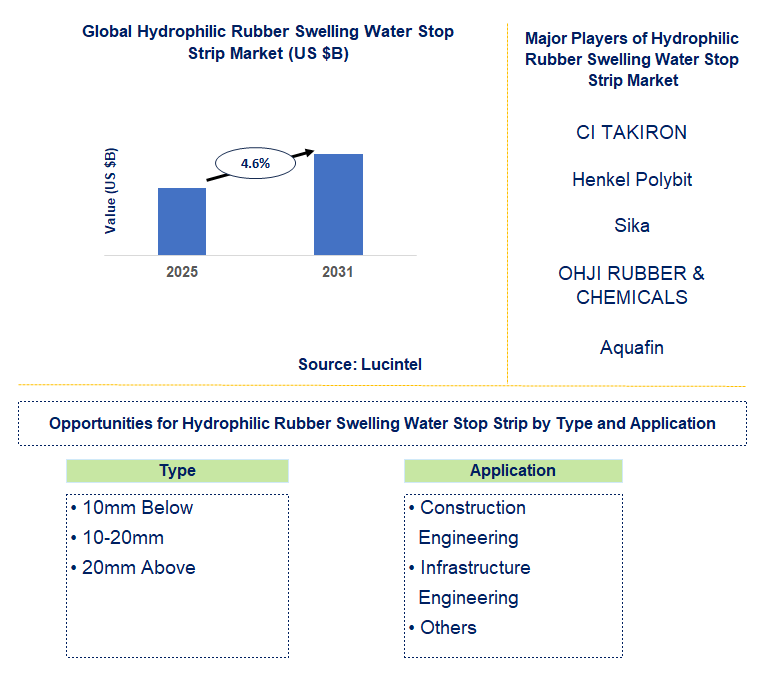
Key data points: The growth forecast = 4.6% annually for the next 7 years. Scroll below to get more insights. This market report covers Trends, opportunities and forecasts in hydrophilic rubber swelling water stop strip market to 2031 by type (10mm below, 10-20mm, and 20mm above), application (construction engineering, infrastructure engineering, and others), and region (North America, Europe, Asia Pacific, and the Rest of the World)
We'll send your sample report shortly.
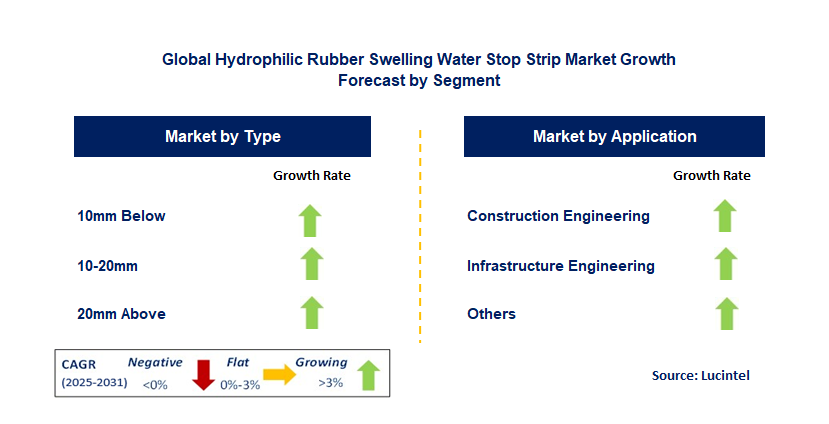
• Lucintel forecasts that, within the type category, 10–20mm is expected to witness the highest growth over the forecast period.
• Within the application category, infrastructure engineering is expected to witness higher growth.
• In terms of region, APAC is expected to witness the highest growth over the forecast period.
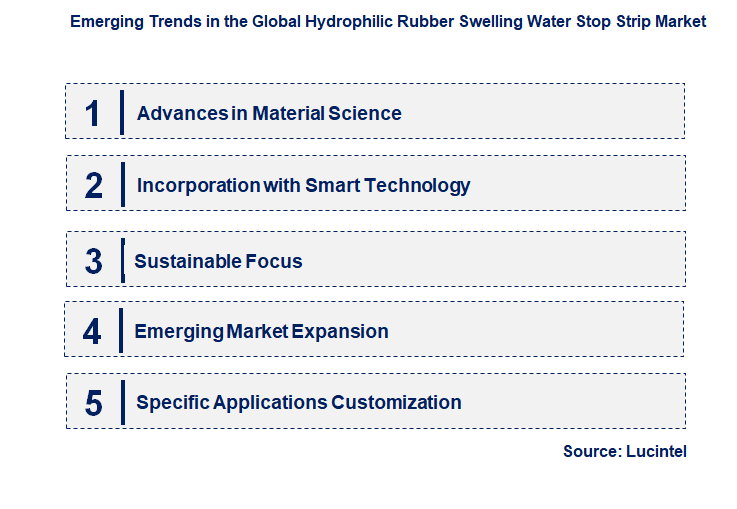
• Advances in Material Science: Continued Innovation in the hydrophilic properties of water stop strips has resulted in stronger products with higher durability like AQUAQUELL SEALER that can expand to 700%. The performance of water stop systems enhances with the ever-evolving construction projects of the modern world. Advanced sealing for concrete joints ensures water tightness and improves service life of the structures.
• Incorporation with Smart Technology: Construction materials are increasingly being integrated with smart technologies. Water Stop Strips are designed with moisture sensors that prevent water ingress as well as assess the damage level to the structure in real time. This results in improved maintenance and increased lifespan of the structure.
• Sustainable Focus: The eco-conscious construction industry is adopting sustainable building practices, which has led to the creation of hydrophilic water stop strips. Non-toxic and safe products are being manufactured to promote eco-sustainability and reduce the carbon footprint of construction activities.
• Emerging Market Expansion: These days, hydrophilic water stop strips are in greater demand due to rapid urbanization and infrastructure development in emerging markets like India and China. The construction of new green expressways, underwater tunnels, and other infrastructure projects is driving market growth. This growth enables manufacturers to meet the needs of a developing diverse marketplace.
• Specific Applications Customization: Manufacturers are now designing hydrophilic water stop strips for precise applications like shield tunneling, concrete assembly, and secondary concrete products. Tailored solutions improve the performance of water stop systems and primary constructions by addressing the specific challenges associated with various construction enactments. As previously stated, technological advancements, new marketplace centers, sustainability focuses, and innovative construction initiatives are the main reasons for the shift in focus towards the hydrophilic rubber swelling water stop strip market. Modern construction projects have driven the need for water stop solutions that are seamlessly integrated into construction projects, giving them greater efficiency, enhanced durability, and improved environmental protection. Trends are pushing the industry to develop more efficient solutions.
• Integration of Bentonite-Enhanced Rubber Composite: The addition of hydrophilic rubber composites containing bentonite is modifying the swelling and sealing capabilities of water stop strips for the better. This is because bentonite has excellent water absorption capacity which allows it to expand more quickly and evenly, even in low water pressure situations. This has added to the range of applications of these strips in intricate constructions located underground or underwater. The Set of hydrophilic rubber and bentonite also has improved resistance to chemical erosion and enduring constructional aging, making It is very appealing for critical infrastructure components like subways and dams. Therefore, manufacturers have started adding bentonite to their product lines in order to gain competitive advantage.
• Progression in Formulations that are Environmentally Friendly: With increasing concerns for the environment and stricter sustainability policies, manufacturers are focusing on the development of eco-friendly hydrophilic rubber water stop strips. These new formulations use non-toxic and recyclable materials that meet the international green construction policies such as LEED and BREEAM. The shift to these sustainable materials mitigates the regulatory issues while appealing to the clients who are conscious of sustainability. In addition, these strips still retain the required swelling behavior without loss of mechanical strength, allowing them to continue meeting the tough demands of infrastructure projects. This trend is anticipated to accelerate further as green building certifications gain prominence in bid submissions for governmental-funded projects.
• Development of Temperature-Resistant Strip: Recent innovations have created water stop strips that maintain performance across a wider range of extreme temperatures, both cold and hot. These strips are invaluable in regions with severe climatic variations or in structures where there is exposure to geothermal activity. Enhanced engineering of polymers has enabled strips to retain their elasticity and swelling behavior without cracking or degrading, thus ensuring reliable performance. This development increases the northern European, Russian, and North American markets which were previously difficult to reach geographically. It also increases the use of these products in power and industrial facilities.
• Advanced Smart Monitoring Integration: The rapid advancement of construction technologies has sparked the introduction of sensors and even IoT capabilities into some advanced hydrophilic water stop strip systems. These integrated sensors, for example, can monitor moisture levels, expansion, and even breaches of a structure and manage them in real time, improving the critical maintenance safety of the structure. Although these systems are in their early adoption phase, they signal the progress towards combining construction with digital monitoring systems that improve operational transparency and efficiency. The ability to monitor these strips remotely enhances safety in high-risk infrastructures like nuclear reactors, transport tunnels, and defense facilities, driving the demand for smarter and more flexible waterproofing systems.
• Strategic Partnership Driven Regional Expansion: Strategic partnerships with construction firms and distributors in newer regions have propelled key manufacturers to gain regional market share in the recently developed Middle Eastern and Asia Pacific territories due to escalated investments in infrastructure. Companies are leveraging joint ventures to set up localized manufacturing and distribution channels, helping to balance cost and lead time while also tailoring products to local environmental and regulatory requirements. These partnerships have greatly increased the use of hydrophilic rubber water stop strips in public infrastructure projects, urban development, and megacities, significantly increasing market acquisition. The marketplace for hydrophilic rubber swelling water stop strips is undergoing transformative and energetic change as a outcome of technology, sustainability, and infrastructure needs globally. Innovations like eco-friendly bentonite and smart technology are improving not only performance but also the region and scope of market application. Regional collaboration also enhances market acceptance. Altogether, these developments are forming a flexible and strong market ready to expand for a long time, especially with the increasing construction requirements for durability, smart monitoring systems, and environmental friendliness.
• Underground Transportation System: The construction of subways, underground tunnels, and metro stations is one of the most profitable development areas. These projects need efficient waterproofing strategies to control groundwater and prevent seepage through construction joints. These strips do not only offer good protection but are also economical as they swell upon contact with water. Their remarkable capacity to deform makes them extremely useful on joints with curved or uneven surfaces. As cities in Asia Pacific and Europe focus on urban mobility infrastructure, the demand for these strips will increase. In this region, other product manufacturers are already custom tailoring their products to fit regulatory controls and high safety standards.
• Water Treatment and Reservoir Facilities: In the treatment of water, and the construction of reservoirs, hydrophilic rubber strips are gaining popularity. They are used in the reservoirs, waste water treatment plants, and canals. These applications come with constant exposure to water and require long lasting seals that endure hydrostatic water pressure. The strips ability to self seal enhances structure reliability while lowering construction costs due to minimal alterations needed. Hydrophilic sealing is critical in both new construction and retrofit projects. Developing economies are also driving investments alongside government contracts due to their increased focus on water conservation and management. The initial trend will then lead to more long term demand. These factors will greatly aid in retrofitting existing systems.
• High-Rise Commercial and Residential Building: Vertical construction in heavily populated urban areas, ”expansion” joints, as well as waterproofing basements, requires special hydrophilic rubber strips and technologically advanced seals for high rises to control water movement and joint integrity between pre-fabricated sections. Hydrophilic rubber strips have quickly proven effective for these tasks as they are simple to install with consistent results. Because of hydrophilic rubber strips ability to swell, water tight seals can be maintained even in extremely high pressures, which is crucial multi-leveled structures. Litigation risk alongside long term structural damage caused by moisture encasement during construction is driving increased focus from contractors. North America, the Middle East and East Asia are regions seeing accelerated demand, due to vertical metropolitan construction expanding at high rates.
• Hydropower and Dam: Hydrophilic water stop strips serve an important purpose in the construction of hydropower plants and dams by sealing the joints in concrete spillways, turbines, and also in the foundation of the dam. These environments offer a unique combination of construction challenges such as constant hydrostatic load, potential seismic activity, and a high demand for incredible material durability. The product is needed due to new construction and refurbishment of aging dams in the United States and China. These strips provide performance critical in combination with adaptability and chemical resistance, which define successful outcomes in these applications. In a world straining to utilize new sources of power, hydropower infrastructure will remain as a key area of application for constant growth of these products.
• Industrial Foundations and Waste Containment: Industrial facilities usually possess strict requirements for water and chemical resistance for industrial worksites, especially concerning the foundation and storage pits because any leakage could be environmentally dangerous. These hydrophilic rubber strips are used in hazardous material containment and chemical processing plants due to their reliable seal and long-lasting performance. Their ability to swell in contaminated waters makes them highly effective in these environments. These opportunities are growing due to new environmental legislation combined with the construction of compliant industrial facilities in Germany, India, and China. Harsh and corrosive environments are driving innovations in strip formulation designed to endure. Broadening strategic growth areas for hydrophilic rubber swelling water stop strips encompass significant domains such as transport infrastructure, skyscrapers, hydropower facilities, and more. The effectiveness of these strips in providing dependable, enduring performance over time and across various environmental conditions makes them critical within these sectors. The construction of safer, more environmentally-respectful, and higher-integrity structures will continuously increase the demand for these strips. Investment in such opportunities will require innovation and tailored approaches for specific regions, which sets a strong market growth potential in both developed and developing countries.
• CI TAKIRON
• Henkel Polybit
• Sika
• OHJI RUBBER & CHEMICALS
• Aquafin
• BPA
• WFP
• PohlCon
• SealBoss
• DCA Construction Products
• 10mm Below
• 10-20mm
• 20mm Above
• Construction Engineering
• Infrastructure Engineering
• Others
• North America
• Europe
• Asia Pacific
• The Rest of the World
• United States: The growing emphasis on infrastructure resilience along with construction sustainability has further propelled the adoption of hydrophilic rubber swelling water stop strips in the US. The need to defend structures, particularly in flood Basin Regions, from water damage has increased. Furthermore, advancements in material science has made water stop solutions more efficient and durable, especially in the diverse climatic conditions of the country.
• China: Meeting the waterproofing requirements for construction in China is very easy due to the country’s rapid urbanization and infrastructure development. There is the construction of new tunnels, subways, and skyscrapers that require waterproofing construction junctions. Chinese companies are paying special attention to producing hydrophilic rubber water stop strips to guarantee quality and durability of the structures.
• Germany: Innovative waterproofing techniques synchronized with hydraulic engineering works is characteristic of Germany’s construction engineering. The underground and hydraulic structures strongly employ hydrophilic rubber swelling water stop strips. German companies still prefer to conduct research for the undetermined use of these products. This is due to their strict environmental and safety requirements.
• India: With the rapid growth of the construction industry in India due to increased urbanization, government initiatives such as the Smart Cities Mission have further enhanced the need for waterproofing. Effective water stop systems are critical in the country as its diverse climate is accompanied by heavy monsoon rains. Furthermore, the waterproofing membrane market in India is expected. This increase reflects the rising investment in new causing sustainable infrastructure projects, including the use of hydrophilic rubber swelling water stop strips, which guarantee waterproofing, durability, and safety.
• Japan: As Japan is prone to earthquakes and tsunamis, the country has prioritized disaster-resistant waterproof construction, thus attracting the adoption of advanced waterproofing materials. Additionally, Japanese enterprises have products for construction chemicals, including OHJI Rubber & Chemicals Co., Ltd., which developed AQUAQUELL SEALER, boasting exceptional durability and performance under high water pressure. These advances help maintain the nationally recognized construction quality standards.


• CI TAKIRON
• Henkel Polybit
• Sika
• OHJI RUBBER & CHEMICALS
• Aquafin
• BPA
• WFP
• PohlCon
• SealBoss
• DCA Construction Products Q5. Which hydrophilic rubber swelling water stop strip market segment will be the largest in future? Answer: Lucintel forecasts that, within the type category, 10–20mm is expected to witness the highest growth over the forecast period. Q6. In hydrophilic rubber swelling water stop strip market, which region is expected to be the largest in next 5 years? Answer: In terms of region, APAC is expected to witness the highest growth over the forecast period. Q7. Do we receive customization in this report? Answer: Yes, Lucintel provides 10% customization without any additional cost.


Choose a license that fits your team. Instant PDF delivery.
Prices exclude taxes. Instant delivery. Custom licensing available on request.
Market Report · July 22, 2026
Market Report · July 17, 2026
Market Report · July 17, 2026
Trusted partner for strategic intelligence and business growth


Receive a complimentary market analysis tailored to your industry. Our analysts will identify key growth opportunities and competitive dynamics specific to your business.

Market size, growth rate, and key trend analysis for your specific sector.

Top competitor positioning and market share analysis.

Strategic recommendations backed by data-driven insights.
Get curated market intelligence and competitive moves straight to your inbox.
By subscribing, you agree to receive our monthly insights. Unsubscribe anytime.
Receive a complimentary market analysis tailored to your industry. Our analysts will identify key growth opportunities and competitive dynamics specific to your business.
Market size, growth rate, and key trend analysis for your specific sector.
Top competitor positioning and market share analysis.
Strategic recommendations backed by data-driven insights.
Get curated market intelligence, emerging trends, and competitive moves straight to your inbox each month.
By subscribing, you agree to receive our monthly insights. Unsubscribe anytime.
We'll send your sample report shortly.