
Close Lucintel Chat
Didn't Find What You're Looking for?
Call us at +1972 636 5056 or write at helpdesk@Lucintel.com
Ask an Expert Provide Custom Requirements Download Sample Report Search Available Reports
  • helpdesk@Lucintel.com
  • |
  • Call Lucintel +1 972 636 5056
  • |
  • Login
  • |
  • Register
  • |
  • Search
  • |
'
...

The Impact of COVID-19 is included in Hydrocolloid Market Report. Buy it today to get an advantage.

Request the impact of COVID-19 on your product or industry


Hydrocolloid Market Trends and Forecast

The future of the global hydrocolloid market looks promising with opportunities in the food & beverage, pharmaceutical, and personal care & cosmetic markets. The global hydrocolloid market is expected to grow with a CAGR of 6.1% from 2025 to 2031. The major drivers for this market are the increasing demand from food industry, the rising application in personal care products, and the growing use in pharmaceutical formulations.

• Lucintel forecasts that, within the product category, gelatin is expected to witness the highest growth over the forecast period.
• Within the application category, food & beverage is expected to witness the highest growth.
• In terms of region, Europe will remain the largest region over the forecast period.
Gain valuable insights for your business decisions with our comprehensive 150+ page report. Sample figures with some insights are shown below.
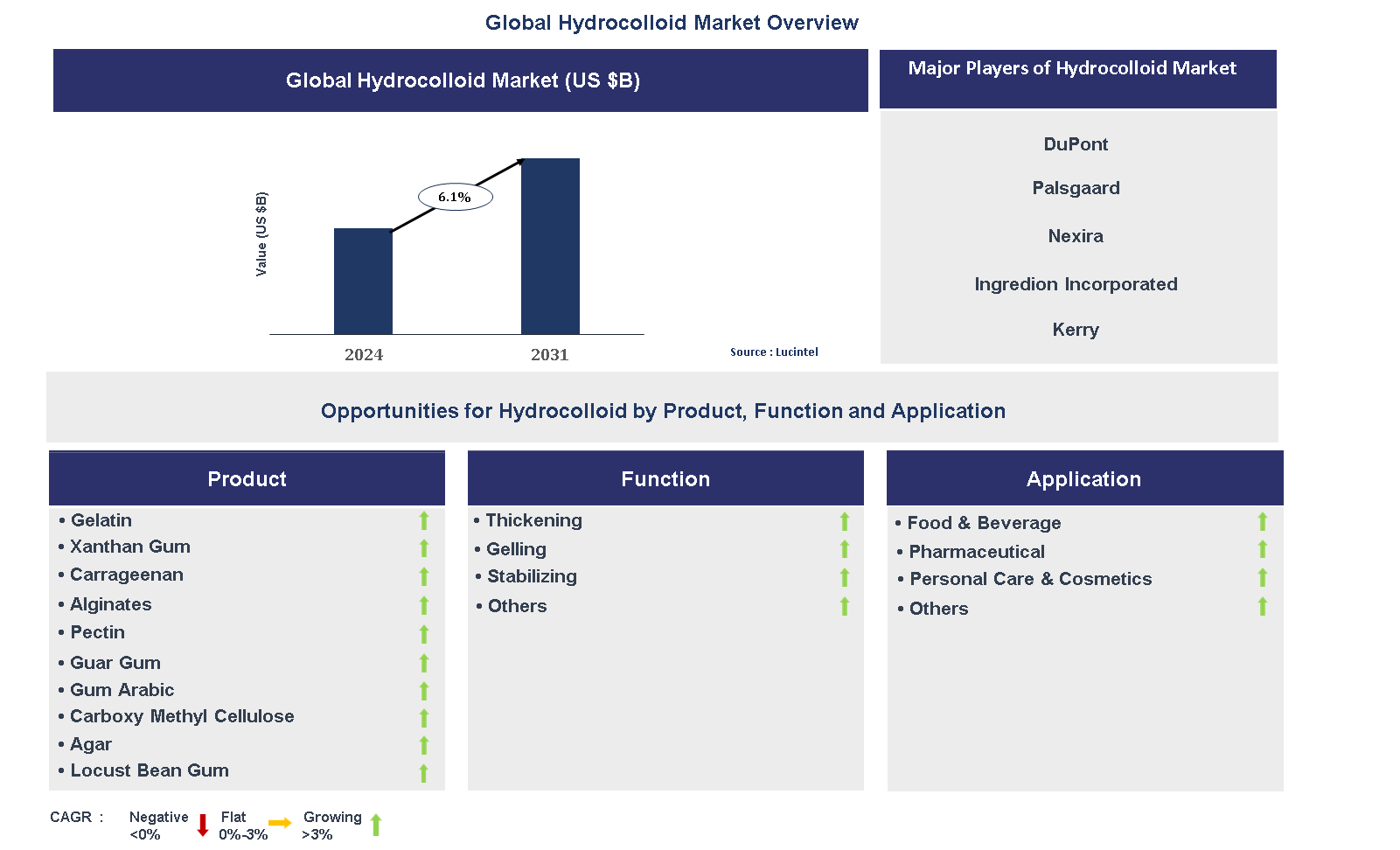
Hydrocolloid Market Trends and Forecast

Emerging Trends in the Hydrocolloid Market

The hydrocolloid market is also experiencing a dramatic shift, with a combination of consumer, technological, and regulatory trends influencing the market. These new developments are taking the industry out of its rudimentary function as a basic thickening agent and inculcating a central role in the development of functional, green, and consumer-friendly products. Value addition is what the market is presently concerned with, innovation in product formulation and sourcing being the key in addressing the changing needs of a health-orientated and environmentally conscious consumer community.
• Transition towards Natural and Clean-Label Ingredients: The trend towards applying natural, plant-based hydrocolloids such as pectin, guar gum, and agar is strong and on the increase. This is because the consumer seeks products with straightforward, familiar lists of ingredients and an increasing suspicion of synthetic additives. As consumers increasingly focus on health and examine product labeling, food and beverage manufacturers are reformulating products in line with clean-labeling principles.
• Increased Growth of Plant-Based and Vegan Food Products: The expanding popularity of plant-based diets and veganism is a main trend propelling the hydrocolloid market. Hydrocolloids play a crucial role in the formulation of plant-based meat and dairy alternatives since they are responsible for adding the required texture, stability, and mouthfeel that resembles animal-derived products. Hydrocolloids, for instance, are employed to form the gel-like texture in plant-based cheeses and enhance the texture of plant-based burgers.
• Spread to Non-Food Uses: Although the food and drinks sector continues to be the biggest user, a significant trend is the growing application of hydrocolloids in non-food industries, such as pharmaceuticals, personal care, and cosmetics. Within pharmaceuticals, they find use in controlled-release medication delivery systems and the treatment of wounds. In cosmetics, they are employed as thickeners and stabilizers in creams and lotions. This trend is affecting the market by providing diversified sources of revenue, lowering dependency on the food sector, and developing new, high-value applications that necessitate specialized, high-purity grades of hydrocolloids.
• Focus on Functional and Health-Oriented Products: There is an evident trend towards the utilization of hydrocolloids in functional foods and beverages that provide certain health benefits. Several hydrocolloids are also dietary fiber sources, which ensure gut health, among other nutritional contributions. This trend arises due to a growing older population worldwide and an increasing demand for preventive healthcare. The effect of this trend is product development changing in such a way that companies now design hydrocolloid solutions to not only enhance texture but also contribute to the nutritional value of a product.
• Technology Advances in Production and Blending: The industry is enjoying technology advances in hydrocolloid manufacturing, such as enhanced extraction techniques and the creation of tailored hydrocolloid blends. Companies can now develop personal solutions that address the unique textural and stability needs of emerging products. Such innovations are facilitating more effective production and are contributing to new hydrocolloid ingredients with improved functionalities.
All these trends are coming together to collectively transform the hydrocolloid market towards a cleaner, higher-value, more technologically sophisticated future. Clean-label and plant-based, newer uses in non-food applications, and a demand for functional ingredients are all transforming the industry from a bulk commodity operation into one of specialty, high-performance solutions.
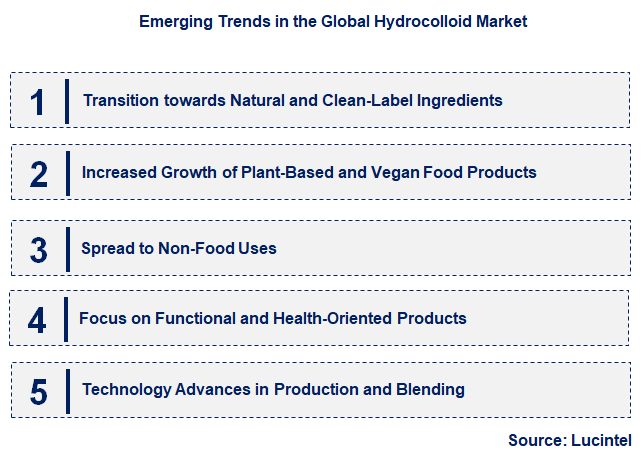
Emerging Trends in the Hydrocolloid Market

Recent Development in the Hydrocolloid Market

The hydrocolloid industry is facing dynamic changes prompted by a mixture of global economic transformations, technological advancements, and changing regulatory environments. These current trends are impacting production, supply chains, and end-use applications. The industry is experiencing a drive for capacity increase to address increasing demand while, at the same time, grappling with challenges resulting from raw material volatility and stiff competition. The market is reacting with an emphasis on efficiency, diversification of product, and a strategic shift towards sustainable and high-value uses.
• Greater Emphasis on Sourcing and Sustainability: One development is a greater emphasis on sustainable sourcing and manufacturing practices. This is especially the case for seaweed-based hydrocolloids such as carrageenan and alginates. Firms are investing in more efficient cultivation and harvesting techniques to provide a stable and sustainable supply chain. This evolution is also caused by consumer and regulatory pressure to minimize the environmental impact of food ingredients.
• Product Development in Blends and Custom Applications: The industry is experiencing a boom in product development, with companies formulating and marketing new hydrocolloid blends. Rather than marketing single-ingredient products, firms are designing customized products combining various hydrocolloids to create desired functional attributes such as improved gelling, thickening, or emulsification. Such blends are specifically designed for uses in applications like dairy-free desserts or gluten-free baked foods.
• Acquisitions and Strategic Partnerships: Recent trends involve a series of mergers, acquisitions, and strategic alliances. Large food ingredient business firms are buying small, specialty hydrocolloid manufacturers to broaden their product lines and acquire new technologies or sources of raw materials. These alliances are also being made in order to develop new products together or penetrate new markets. This is having an effect on the market as it results in consolidation, bringing on more integrated and larger players who can provide more goods and services.
• Production Capacity Expansion: In order to cater to the booming global demand, particularly from Asia, there has been a tremendous growth in the expansion of production capacity. Large producers are making investments in new plants or plant expansions. This is especially evident for hydrocolloids such as xanthan gum and guar gum. This is making the market more stable by providing a consistent supply, but it can also create potential for oversupply and price pressure downward if demand does not match up with increased capacity.
• Adoption of Modern Manufacturing Technologies: Recent trends involve the adoption of cutting-edge manufacturing technologies to enhance product quality and efficiency. This involves automation in processing, advanced drying technologies, and advanced quality control systems. These advances in technology are contributing to improved consistency in product quality and reduced cost of production. This is affecting the market by allowing manufacturers to provide more competitive pricing and still maintain the high quality and safety standards of food and pharmaceutical industries.
These are the major developments that are all having a cumulative effect on the hydrocolloid market by necessitating a shift towards a more diversified, competitive, and green industry. The pressure to build new capacities and the increase in strategic partnerships are opening up new avenues for growth, whereas the emphasis on sustainability and technology innovation is structurally redefining the market, clearing the path for an environmentally friendly and efficient future.

Strategic Growth Opportunities in the Hydrocolloid Market

The hydrocolloid industry, though mature across most applications, offers strong strategic growth prospects based on changing consumer patterns, technological development, and worldwide pressure for sustainability. These opportunities are not in the conventional uses but rather in new, niche, high-value applications across industries. To take advantage of these opportunities, industry players need to prioritize innovation, product segmentation, and strategic collaboration.
• Seizing the Plant-Based Food and Beverage Market Opportunity: The sheer growth of the plant-based food and beverage market is a substantial strategic opportunity. Hydrocolloids play an important role in this industry for mimicking the texture and functionality of dairy and meat. The firm can formulate proprietary hydrocolloid blends and formulations that are tailored for plant-based use. This can be done to produce solutions for vegan cheese, dairy-free yogurt, and meat alternatives derived from plants.
• Expanding Applications in the Pharmaceutical Industry: The pharmaceutical industry offers a substantial growth opportunity, particularly in areas like controlled-release drug delivery, oral suspensions, and tablet binding. Hydrocolloids can be used to control the release rate of active ingredients, improving drug efficacy and patient compliance. The aging global population and rising healthcare expenditure are driving this opportunity. This affects the market by having a premium, high-margin product that necessitates a high level of product purity and regulatory compliance, giving companies the ability to stand out from others.
• Targeting the Personal Care and Cosmetics Market: The personal care and cosmetics market is an emerging strategic potential market for hydrocolloids. They are utilized as thickeners, stabilizers, and emulsifiers in various products, such as creams, lotions, shampoos, and conditioners. The trend in consumers preferring natural and bio-based ingredients is driving demand for natural hydrocolloids in this market.
• Clean-Label and Functional Formulations Innovation: There is a strategic incentive to innovate through creating clean-label and functional hydrocolloid products. This includes the development of new blends that are synthetic additive-free and have added health value, for instance, as a source of dietary fiber. New hydrocolloids can also be developed from alternative materials. This provides an opportunity to the market because it enables manufacturers to position their brands with leading consumer trends, thereby enabling them to charge a premium and build a greater brand reputation.
• Focusing on Specific Niche Applications: A strategic strength is to target specific niche applications where hydrocolloids can offer a novel solution. This might involve their application in 3D food printing to produce complex food shapes, or for the production of edible films and coatings for food preservation. These niche markets, though small in size, have huge growth prospects and enable companies to showcase their expertise and innovation.
These strategic opportunities for growth are transforming the hydrocolloid market by inviting a change from a bulk commodity business to a value-driven, specialty business. By focusing on high-growth industries and embracing the trend towards sustainability, businesses can tap into new revenue channels, differentiate themselves from the competition, and establish a more secure market position for the future.

Hydrocolloid Market Driver and Challenges

The hydrocolloid market is influenced by a dynamic interplay of key drivers and challenges, ranging from different technological, economic, and regulatory considerations. The growth of the market is driven by growing demand from leading industries and a shift toward more environmentally friendly practices, which encourage innovation. This growth, however, is tempered by enormous challenges around the volatility of raw material prices, high competition, and strict environmental regulations. Understanding the interplay of these forces is vital to understanding the market’s present situation and predicting its future course.
The factors responsible for driving the hydrocolloid market include:
1. Increasing Demand for Convenience and Processed Foods: Rising world population, urbanization, and hectic lifestyles are contributing to the increased demand for convenience and processed foods. Hydrocolloids are key ingredients of these foods as thickening, stabilizing, and emulsifying agents that enhance texture, shelf life, and quality. This driver forms a stable and growing platform for the market as consumers continue to favor convenience without compromising on product consistency or attraction.
2. Growing Consumer Demand for Clean-Label and Natural Ingredients: Consumers are increasingly focusing on their health and are, in turn, demanding food products containing natural, simple, and recognizable ingredients. This has resulted in a major demand for natural hydrocolloids such as pectin, guar gum, and agar. This trend is encouraging manufacturers to shift away from synthetic additives and invest in natural, plant-based alternatives that are seen as healthier and more sustainable.
3. Plant-Based Food Industry Growth: Global trends toward plant-based diets and veganism are a strong motivator. Hydrocolloids play a critical role in developing plant-based versions of meat and dairy, lending the right texture and stability to replicate animal products. This trend has established a new, high-growth application category for hydrocolloids, with businesses competing to serve the demand for vegan dairy, yogurt, and meat alternatives.
4. Versatile Applications of Hydrocolloids: The multitude of functional attributes provided by hydrocolloids, such as gelling, thickening, emulsifying, and stabilizing, renders them invaluable to a variety of industries. This versatility enables them to be utilized across a wide range of products, ranging from dressings and sauces to pharmaceuticals and cosmetics. This multifunctionality of hydrocolloids makes them a very coveted ingredient and a major market growth driver.
5. Pharmaceutical and Personal Care Industries Growth: The rise in the application of hydrocolloids for non-food uses is one major driving factor. They find their application in drug release controlled in pharma and as thickeners as well as stabilizers in the personal care industry. With the growing population aging worldwide, coupled with increased healthcare spending, demand for these high-purity, specialized products is driving growth. This offers a secure and high-margin revenue base for the market.
Challenges in the hydrocolloid market are:
1. Fluctuating Raw Material Prices: The industry is confronted with a major challenge in the form of the price volatility of its raw materials, especially natural hydrocolloids extracted from agricultural or aquatic origins. Geopolitical conditions, crop losses, and global warming can cause supply chains to be interrupted and create steep price swings. This uncertainty renders the control of stable production costs and pricing strategies challenging for manufacturers.
2. Strict Regulatory Standards: Hydrocolloid use in food and medicine is regulated by strict standards and quality criteria that differ from nation to nation. Manufacturers have to make sure their products meet a complicated system of rules about safety, purity, and labeling. This can be enormously expensive and time-consuming and may block market entry to smaller competitors.
3. Competition from Alternative Ingredients: The hydrocolloid market is under threat of competition from other ingredients with the same functional properties. Modified starches and other artificial alternatives, for instance, can be even less expensive at times. This forces hydrocolloid producers to innovate and emphasize the special advantages of their product, like their natural origin and better functional performance in particular applications.
In summary, the hydrocolloid industry is at the crossroads, where strong drivers are pushing it along and major challenges require strategic adjustment. The growing demand from food and non-food applications, in combination with increasing emphasis on sustainability and technological advancement, is opening up new chances for expansion and profitability. But the market has to deal with the volatility of raw material prices, the perpetual risk of other ingredients, and the growing weight of environmental legislation.

List of Hydrocolloid Companies

Companies in the market compete on the basis of product quality offered. Major players in this market focus on expanding their manufacturing facilities, R&D investments, infrastructural development, and leverage integration opportunities across the value chain. With these strategies hydrocolloid companies cater increasing demand, ensure competitive effectiveness, develop innovative products & technologies, reduce production costs, and expand their customer base. Some of the hydrocolloid companies profiled in this report include-
• DuPont
• Palsgaard
• Nexira
• Ingredion Incorporated
• Kerry
• BASF
• Ashland
• CP Kelco U.S
• Glanbia Nutritionals
• Darling Ingredients

Hydrocolloid Market by Segment

The study includes a forecast for the global hydrocolloid market by product, function, application, and region.

Hydrocolloid Market by Product [Value from 2019 to 2031]:


• Gelatin
• Xanthan Gum
• Carrageenan
• Alginates
• Pectin
• Guar Gum
• Gum Arabic
• Carboxy Methyl Cellulose
• Agar
• Locust Bean Gum

Hydrocolloid Market by Function [Value from 2019 to 2031]:


• Thickening
• Gelling
• Stabilizing
• Others

Hydrocolloid Market by Application [Value from 2019 to 2031]:


• Food & Beverage
• Pharmaceutical
• Personal Care & Cosmetics
• Others

Hydrocolloid Market by Region [Value from 2019 to 2031]:


• North America
• Europe
• Asia Pacific
• The Rest of the World

Country Wise Outlook for the Hydrocolloid Market

The recent trends of the global hydrocolloid market are marked by a dynamic trend towards natural and clean-label ingredients, fueled by changing consumer attitudes and an increased emphasis on health and wellness. The billion-dollar market is experiencing a growth spurt in demand from the food and beverage sector, especially in areas such as convenience foods and plant-based alternatives. Moreover, the market is creeping into non-food uses, such as pharmaceuticals and personal care items.
• United States: The US hydrocolloid market is a trendsetter in adopting the "clean-label" movement. There is an increasing trend toward natural, plant-derived ingredients such as pectin and agar for use as replacements for synthetic additives. This is especially true in the emerging market for gluten-free and reduced-fat foods, where hydrocolloids play a critical role in mimicking the texture and mouthfeel of conventional products. Increasing applications in functional foods and beverages are also occurring, as consumers demand food products that offer enhanced health benefits.
• China: China’s hydrocolloid industry is seeing strong growth, fueled by a fast-growing food and beverage processing sector and a changing dietary pattern of consumers towards western-style processed foods. Being a leading producer and consumer, China is looking to invest heavily in large-scale plants to cater to both local and export markets. A major trend is the use of hydrocolloids in new food products, most notably in dairy and meat alternatives, to improve texture and stability.
• Germany: Germany’s hydrocolloid market leads Europe and is dominated by a premium, high-quality ingredient demand. The market is fueled by its well-developed food industry and consumer base that places importance on natural and sustainable products. More recently, there has been a greater emphasis on use in specialty foods and confectionery, where blends of hydrocolloids are employed to create specific textures. German manufacturers also lead the way in developing new functionalities for hydrocolloids to address the high standards required by the pharmaceutical and cosmetic industries.
• India: The Indian hydrocolloid market is experiencing tremendous growth, driven by a flourishing food processing industry and increasing usage of convenience foods. Being one of the largest manufacturers of natural hydrocolloids such as guar gum, India possesses a strong competitive edge. Recent trends revolve around growing usage of hydrocolloids in bakery and dairy foods to enhance shelf life and texture. The market is also increasing owing to the increasing demand for gluten-free and health-related food products, with hydrocolloids proving to be essential in their development.
• Japan: The hydrocolloid market in Japan is mature and well-developed, with a lot of focus on high-quality and functional ingredients. One of the development areas is the application of hydrocolloids in pharmaceuticals and nutraceuticals, especially in controlled-release drug delivery systems and dietary supplements. The market is also witnessing innovation in food uses, with manufacturers creating new combinations of hydrocolloids to create novel textures and enhance the sense experience of modern convenience foods and traditional Japanese cuisine.

Lucintel Analytics Dashboard

Features of the Global Hydrocolloid Market

Market Size Estimates: Hydrocolloid market size estimation in terms of value ($B).
Trend and Forecast Analysis: Market trends (2019 to 2024) and forecast (2025 to 2031) by various segments and regions.
Segmentation Analysis: Hydrocolloid market size by product, function, application, and region in terms of value ($B).
Regional Analysis: Hydrocolloid market breakdown by North America, Europe, Asia Pacific, and Rest of the World.
Growth Opportunities: Analysis of growth opportunities in different products, functions, applications, and regions for the hydrocolloid market.
Strategic Analysis: This includes M&A, new product development, and competitive landscape of the hydrocolloid market.
Analysis of competitive intensity of the industry based on Porter’s Five Forces model.

Lucintel Consulting Services

FAQ

Q1. What is the growth forecast for hydrocolloid market?
Answer: The global hydrocolloid market is expected to grow with a CAGR of 6.1% from 2025 to 2031.
Q2. What are the major drivers influencing the growth of the hydrocolloid market?
Answer: The major drivers for this market are the increasing demand from food industry, the rising application in personal care products, and the growing use in pharmaceutical formulations.
Q3. What are the major segments for hydrocolloid market?
Answer: The future of the hydrocolloid market looks promising with opportunities in the food & beverage, pharmaceutical, and personal care & cosmetic markets.
Q4. Who are the key hydrocolloid market companies?
Answer: Some of the key hydrocolloid companies are as follows:
• DuPont
• Palsgaard
• Nexira
• Ingredion Incorporated
• Kerry
• BASF
• Ashland
• CP Kelco U.S
• Glanbia Nutritionals
• Darling Ingredients
Q5. Which hydrocolloid market segment will be the largest in future?
Answer: Lucintel forecasts that, within the product category, gelatin is expected to witness the highest growth over the forecast period.
Q6. In hydrocolloid market, which region is expected to be the largest in next 5 years?
Answer: In terms of region, Europe will remain the largest region over the forecast period.
Q7. Do we receive customization in this report?
Answer: Yes, Lucintel provides 10% customization without any additional cost.

This report answers following 11 key questions:

Q.1. What are some of the most promising, high-growth opportunities for the hydrocolloid market by product (gelatin, xanthan gum, carrageenan, alginates, pectin, guar gum, gum arabic, carboxy methyl cellulose, agar, and locust bean gum), function (thickening, gelling, stabilizing, and others), application (food & beverage, pharmaceutical, personal care & cosmetics, and others), and region (North America, Europe, Asia Pacific, and the Rest of the World)?
Q.2. Which segments will grow at a faster pace and why?
Q.3. Which region will grow at a faster pace and why?
Q.4. What are the key factors affecting market dynamics? What are the key challenges and business risks in this market?
Q.5. What are the business risks and competitive threats in this market?
Q.6. What are the emerging trends in this market and the reasons behind them?
Q.7. What are some of the changing demands of customers in the market?
Q.8. What are the new developments in the market? Which companies are leading these developments?
Q.9. Who are the major players in this market? What strategic initiatives are key players pursuing for business growth?
Q.10. What are some of the competing products in this market and how big of a threat do they pose for loss of market share by material or product substitution?
Q.11. What M&A activity has occurred in the last 5 years and what has its impact been on the industry?

For any questions related to Hydrocolloid Market, Hydrocolloid Market Size, Hydrocolloid Market Growth, Hydrocolloid Market Analysis, Hydrocolloid Market Report, Hydrocolloid Market Share, Hydrocolloid Market Trends, Hydrocolloid Market Forecast, Hydrocolloid Companies, write Lucintel analyst at email: helpdesk@lucintel.com. We will be glad to get back to you soon.
                                           Table of Contents

            1. Executive Summary

            2. Market Overview

                        2.1 Background and Classifications
                        2.2 Supply Chain

            3. Market Trends & Forecast Analysis

                        3.1 Macroeconomic Trends and Forecasts
                        3.2 Industry Drivers and Challenges
                        3.3 PESTLE Analysis
                        3.4 Patent Analysis
                        3.5 Regulatory Environment
                        3.6 Global Hydrocolloid Market Trends and Forecast

            4. Global Hydrocolloid Market by Product

                        4.1 Overview
                        4.2 Attractiveness Analysis by Product
                        4.3 Gelatin : Trends and Forecast 2025 to 2031
                        4.4 Xanthan Gum : Trends and Forecast 2025 to 2031
                        4.5 Carrageenan : Trends and Forecast 2025 to 2031
                        4.6 Alginates : Trends and Forecast 2025 to 2031
                        4.7 Pectin : Trends and Forecast 2025 to 2031
                        4.8 Guar Gum : Trends and Forecast 2025 to 2031
                        4.9 Gum Arabic : Trends and Forecast 2025 to 2031
                        4.10 Carboxy Methyl Cellulose : Trends and Forecast 2025 to 2031
                        4.11 Agar : Trends and Forecast 2025 to 2031
                        4.12 Locust Bean Gum : Trends and Forecast 2025 to 2031

            5. Global Hydrocolloid Market by Function

                        5.1 Overview
                        5.2 Attractiveness Analysis by Function
                        5.3 Thickening : Trends and Forecast 2025 to 2031
                        5.4 Gelling : Trends and Forecast 2025 to 2031
                        5.5 Stabilizing : Trends and Forecast 2025 to 2031
                        5.6 Others : Trends and Forecast 2025 to 2031

            6. Global Hydrocolloid Market by Application

                        6.1 Overview
                        6.2 Attractiveness Analysis by Application
                        6.3 Food & Beverage : Trends and Forecast 2025 to 2031
                        6.4 Pharmaceutical : Trends and Forecast 2025 to 2031
                        6.5 Personal Care & Cosmetics : Trends and Forecast 2025 to 2031
                        6.6 Others : Trends and Forecast 2025 to 2031

            7. Regional Analysis

                        7.1 Overview
                        7.2 Global Hydrocolloid Market by Region

            8. North American Hydrocolloid Market

                        8.1 Overview
                        8.2 North American Hydrocolloid Market by Product
                        8.3 North American Hydrocolloid Market by Application
                        8.4 The United States Hydrocolloid Market
                        8.5 Canadian Hydrocolloid Market
                        8.6 Mexican Hydrocolloid Market

            9. European Hydrocolloid Market

                        9.1 Overview
                        9.2 European Hydrocolloid Market by Product
                        9.3 European Hydrocolloid Market by Application
                        9.4 German Hydrocolloid Market
                        9.5 French Hydrocolloid Market
                        9.6 Italian Hydrocolloid Market
                        9.7 Spanish Hydrocolloid Market
                        9.8 The United Kingdom Hydrocolloid Market

            10. APAC Hydrocolloid Market

                        10.1 Overview
                        10.2 APAC Hydrocolloid Market by Product
                        10.3 APAC Hydrocolloid Market by Application
                        10.4 Chinese Hydrocolloid Market
                        10.5 Indian Hydrocolloid Market
                        10.6 Japanese Hydrocolloid Market
                        10.7 South Korean Hydrocolloid Market
                        10.8 Indonesian Hydrocolloid Market

            11. ROW Hydrocolloid Market

                        11.1 Overview
                        11.2 ROW Hydrocolloid Market by Product
                        11.3 ROW Hydrocolloid Market by Application
                        11.4 Middle Eastern Hydrocolloid Market
                        11.5 South American Hydrocolloid Market
                        11.6 African Hydrocolloid Market

            12. Competitor Analysis

                        12.1 Product Portfolio Analysis
                        12.2 Operational Integration
                        12.3 Porter’s Five Forces Analysis
                                    • Competitive Rivalry
                                    • Bargaining Power of Buyers
                                    • Bargaining Power of Suppliers
                                    • Threat of Substitutes
                                    • Threat of New Entrants
                        12.4 Market Share Analysis

            13. Opportunities & Strategic Analysis

                        13.1 Value Chain Analysis
                        13.2 Growth Opportunity Analysis
                                    13.2.1 Growth Opportunity by Product
                                    13.2.2 Growth Opportunity by Function
                                    13.2.3 Growth Opportunity by Application
                        13.3 Emerging Trends in the Global Hydrocolloid Market
                        13.4 Strategic Analysis
                                    13.4.1 New Product Development
                                    13.4.2 Certification and Licensing
                                    13.4.3 Mergers, Acquisitions, Agreements, Collaborations, and Joint Ventures

            14. Company Profiles of the Leading Players Across the Value Chain

                        14.1 Competitive Analysis
                        14.2 DuPont
                                    • Company Overview
                                    • Hydrocolloid Market Business Overview
                                    • New Product Development
                                    • Merger, Acquisition, and Collaboration
                                    • Certification and Licensing
                        14.3 Palsgaard
                                    • Company Overview
                                    • Hydrocolloid Market Business Overview
                                    • New Product Development
                                    • Merger, Acquisition, and Collaboration
                                    • Certification and Licensing
                        14.4 Nexira
                                    • Company Overview
                                    • Hydrocolloid Market Business Overview
                                    • New Product Development
                                    • Merger, Acquisition, and Collaboration
                                    • Certification and Licensing
                        14.5 Ingredion Incorporated
                                    • Company Overview
                                    • Hydrocolloid Market Business Overview
                                    • New Product Development
                                    • Merger, Acquisition, and Collaboration
                                    • Certification and Licensing
                        14.6 Kerry
                                    • Company Overview
                                    • Hydrocolloid Market Business Overview
                                    • New Product Development
                                    • Merger, Acquisition, and Collaboration
                                    • Certification and Licensing
                        14.7 BASF
                                    • Company Overview
                                    • Hydrocolloid Market Business Overview
                                    • New Product Development
                                    • Merger, Acquisition, and Collaboration
                                    • Certification and Licensing
                        14.8 Ashland
                                    • Company Overview
                                    • Hydrocolloid Market Business Overview
                                    • New Product Development
                                    • Merger, Acquisition, and Collaboration
                                    • Certification and Licensing
                        14.9 CP Kelco U.S
                                    • Company Overview
                                    • Hydrocolloid Market Business Overview
                                    • New Product Development
                                    • Merger, Acquisition, and Collaboration
                                    • Certification and Licensing
                        14.10 Glanbia Nutritionals
                                    • Company Overview
                                    • Hydrocolloid Market Business Overview
                                    • New Product Development
                                    • Merger, Acquisition, and Collaboration
                                    • Certification and Licensing
                        14.11 Darling Ingredients
                                    • Company Overview
                                    • Hydrocolloid Market Business Overview
                                    • New Product Development
                                    • Merger, Acquisition, and Collaboration
                                    • Certification and Licensing

            15. Appendix

                        15.1 List of Figures
                        15.2 List of Tables
                        15.3 Research Methodology
                        15.4 Disclaimer
                        15.5 Copyright
                        15.6 Abbreviations and Technical Units
                        15.7 About Us
                        15.8 Contact Us

                                               List of Figures


            Chapter 1

                        Figure 1.1: Trends and Forecast for the Global Hydrocolloid Market

            Chapter 2

                        Figure 2.1: Usage of Hydrocolloid Market
                        Figure 2.2: Classification of the Global Hydrocolloid Market
                        Figure 2.3: Supply Chain of the Global Hydrocolloid Market

            Chapter 3

                        Figure 3.1: Trends of the Global GDP Growth Rate
                        Figure 3.2: Trends of the Global Population Growth Rate
                        Figure 3.3: Trends of the Global Inflation Rate
                        Figure 3.4: Trends of the Global Unemployment Rate
                        Figure 3.5: Trends of the Regional GDP Growth Rate
                        Figure 3.6: Trends of the Regional Population Growth Rate
                        Figure 3.7: Trends of the Regional Inflation Rate
                        Figure 3.8: Trends of the Regional Unemployment Rate
                        Figure 3.9: Trends of Regional Per Capita Income
                        Figure 3.10: Forecast for the Global GDP Growth Rate
                        Figure 3.11: Forecast for the Global Population Growth Rate
                        Figure 3.12: Forecast for the Global Inflation Rate
                        Figure 3.13: Forecast for the Global Unemployment Rate
                        Figure 3.14: Forecast for the Regional GDP Growth Rate
                        Figure 3.15: Forecast for the Regional Population Growth Rate
                        Figure 3.16: Forecast for the Regional Inflation Rate
                        Figure 3.17: Forecast for the Regional Unemployment Rate
                        Figure 3.18: Forecast for Regional Per Capita Income
                        Figure 3.19: Driver and Challenges of the Hydrocolloid Market

            Chapter 4

                        Figure 4.1: Global Hydrocolloid Market by Product in 2019, 2024, and 2031
                        Figure 4.2: Trends of the Global Hydrocolloid Market ($B) by Product
                        Figure 4.3: Forecast for the Global Hydrocolloid Market ($B) by Product
                        Figure 4.4: Trends and Forecast for Gelatin in the Global Hydrocolloid Market (2019-2031)
                        Figure 4.5: Trends and Forecast for Xanthan Gum in the Global Hydrocolloid Market (2019-2031)
                        Figure 4.6: Trends and Forecast for Carrageenan in the Global Hydrocolloid Market (2019-2031)
                        Figure 4.7: Trends and Forecast for Alginates in the Global Hydrocolloid Market (2019-2031)
                        Figure 4.8: Trends and Forecast for Pectin in the Global Hydrocolloid Market (2019-2031)
                        Figure 4.9: Trends and Forecast for Guar Gum in the Global Hydrocolloid Market (2019-2031)
                        Figure 4.10: Trends and Forecast for Gum Arabic in the Global Hydrocolloid Market (2019-2031)
                        Figure 4.11: Trends and Forecast for Carboxy Methyl Cellulose in the Global Hydrocolloid Market (2019-2031)
                        Figure 4.12: Trends and Forecast for Agar in the Global Hydrocolloid Market (2019-2031)
                        Figure 4.13: Trends and Forecast for Locust Bean Gum in the Global Hydrocolloid Market (2019-2031)

            Chapter 5

                        Figure 5.1: Global Hydrocolloid Market by Function in 2019, 2024, and 2031
                        Figure 5.2: Trends of the Global Hydrocolloid Market ($B) by Function
                        Figure 5.3: Forecast for the Global Hydrocolloid Market ($B) by Function
                        Figure 5.4: Trends and Forecast for Thickening in the Global Hydrocolloid Market (2019-2031)
                        Figure 5.5: Trends and Forecast for Gelling in the Global Hydrocolloid Market (2019-2031)
                        Figure 5.6: Trends and Forecast for Stabilizing in the Global Hydrocolloid Market (2019-2031)
                        Figure 5.7: Trends and Forecast for Others in the Global Hydrocolloid Market (2019-2031)

            Chapter 6

                        Figure 6.1: Global Hydrocolloid Market by Application in 2019, 2024, and 2031
                        Figure 6.2: Trends of the Global Hydrocolloid Market ($B) by Application
                        Figure 6.3: Forecast for the Global Hydrocolloid Market ($B) by Application
                        Figure 6.4: Trends and Forecast for Food & Beverage in the Global Hydrocolloid Market (2019-2031)
                        Figure 6.5: Trends and Forecast for Pharmaceutical in the Global Hydrocolloid Market (2019-2031)
                        Figure 6.6: Trends and Forecast for Personal Care & Cosmetics in the Global Hydrocolloid Market (2019-2031)
                        Figure 6.7: Trends and Forecast for Others in the Global Hydrocolloid Market (2019-2031)

            Chapter 7

                        Figure 7.1: Trends of the Global Hydrocolloid Market ($B) by Region (2019-2024)
                        Figure 7.2: Forecast for the Global Hydrocolloid Market ($B) by Region (2025-2031)

            Chapter 8

                        Figure 8.1: Trends and Forecast for the North American Hydrocolloid Market (2019-2031)
                        Figure 8.2: North American Hydrocolloid Market by Product in 2019, 2024, and 2031
                        Figure 8.3: Trends of the North American Hydrocolloid Market ($B) by Product (2019-2024)
                        Figure 8.4: Forecast for the North American Hydrocolloid Market ($B) by Product (2025-2031)
                        Figure 8.5: North American Hydrocolloid Market by Function in 2019, 2024, and 2031
                        Figure 8.6: Trends of the North American Hydrocolloid Market ($B) by Function (2019-2024)
                        Figure 8.7: Forecast for the North American Hydrocolloid Market ($B) by Function (2025-2031)
                        Figure 8.8: North American Hydrocolloid Market by Application in 2019, 2024, and 2031
                        Figure 8.9: Trends of the North American Hydrocolloid Market ($B) by Application (2019-2024)
                        Figure 8.10: Forecast for the North American Hydrocolloid Market ($B) by Application (2025-2031)
                        Figure 8.11: Trends and Forecast for the United States Hydrocolloid Market ($B) (2019-2031)
                        Figure 8.12: Trends and Forecast for the Mexican Hydrocolloid Market ($B) (2019-2031)
                        Figure 8.13: Trends and Forecast for the Canadian Hydrocolloid Market ($B) (2019-2031)

            Chapter 9

                        Figure 9.1: Trends and Forecast for the European Hydrocolloid Market (2019-2031)
                        Figure 9.2: European Hydrocolloid Market by Product in 2019, 2024, and 2031
                        Figure 9.3: Trends of the European Hydrocolloid Market ($B) by Product (2019-2024)
                        Figure 9.4: Forecast for the European Hydrocolloid Market ($B) by Product (2025-2031)
                        Figure 9.5: European Hydrocolloid Market by Function in 2019, 2024, and 2031
                        Figure 9.6: Trends of the European Hydrocolloid Market ($B) by Function (2019-2024)
                        Figure 9.7: Forecast for the European Hydrocolloid Market ($B) by Function (2025-2031)
                        Figure 9.8: European Hydrocolloid Market by Application in 2019, 2024, and 2031
                        Figure 9.9: Trends of the European Hydrocolloid Market ($B) by Application (2019-2024)
                        Figure 9.10: Forecast for the European Hydrocolloid Market ($B) by Application (2025-2031)
                        Figure 9.11: Trends and Forecast for the German Hydrocolloid Market ($B) (2019-2031)
                        Figure 9.12: Trends and Forecast for the French Hydrocolloid Market ($B) (2019-2031)
                        Figure 9.13: Trends and Forecast for the Spanish Hydrocolloid Market ($B) (2019-2031)
                        Figure 9.14: Trends and Forecast for the Italian Hydrocolloid Market ($B) (2019-2031)
                        Figure 9.15: Trends and Forecast for the United Kingdom Hydrocolloid Market ($B) (2019-2031)

            Chapter 10

                        Figure 10.1: Trends and Forecast for the APAC Hydrocolloid Market (2019-2031)
                        Figure 10.2: APAC Hydrocolloid Market by Product in 2019, 2024, and 2031
                        Figure 10.3: Trends of the APAC Hydrocolloid Market ($B) by Product (2019-2024)
                        Figure 10.4: Forecast for the APAC Hydrocolloid Market ($B) by Product (2025-2031)
                        Figure 10.5: APAC Hydrocolloid Market by Function in 2019, 2024, and 2031
                        Figure 10.6: Trends of the APAC Hydrocolloid Market ($B) by Function (2019-2024)
                        Figure 10.7: Forecast for the APAC Hydrocolloid Market ($B) by Function (2025-2031)
                        Figure 10.8: APAC Hydrocolloid Market by Application in 2019, 2024, and 2031
                        Figure 10.9: Trends of the APAC Hydrocolloid Market ($B) by Application (2019-2024)
                        Figure 10.10: Forecast for the APAC Hydrocolloid Market ($B) by Application (2025-2031)
                        Figure 10.11: Trends and Forecast for the Japanese Hydrocolloid Market ($B) (2019-2031)
                        Figure 10.12: Trends and Forecast for the Indian Hydrocolloid Market ($B) (2019-2031)
                        Figure 10.13: Trends and Forecast for the Chinese Hydrocolloid Market ($B) (2019-2031)
                        Figure 10.14: Trends and Forecast for the South Korean Hydrocolloid Market ($B) (2019-2031)
                        Figure 10.15: Trends and Forecast for the Indonesian Hydrocolloid Market ($B) (2019-2031)

            Chapter 11

                        Figure 11.1: Trends and Forecast for the ROW Hydrocolloid Market (2019-2031)
                        Figure 11.2: ROW Hydrocolloid Market by Product in 2019, 2024, and 2031
                        Figure 11.3: Trends of the ROW Hydrocolloid Market ($B) by Product (2019-2024)
                        Figure 11.4: Forecast for the ROW Hydrocolloid Market ($B) by Product (2025-2031)
                        Figure 11.5: ROW Hydrocolloid Market by Function in 2019, 2024, and 2031
                        Figure 11.6: Trends of the ROW Hydrocolloid Market ($B) by Function (2019-2024)
                        Figure 11.7: Forecast for the ROW Hydrocolloid Market ($B) by Function (2025-2031)
                        Figure 11.8: ROW Hydrocolloid Market by Application in 2019, 2024, and 2031
                        Figure 11.9: Trends of the ROW Hydrocolloid Market ($B) by Application (2019-2024)
                        Figure 11.10: Forecast for the ROW Hydrocolloid Market ($B) by Application (2025-2031)
                        Figure 11.11: Trends and Forecast for the Middle Eastern Hydrocolloid Market ($B) (2019-2031)
                        Figure 11.12: Trends and Forecast for the South American Hydrocolloid Market ($B) (2019-2031)
                        Figure 11.13: Trends and Forecast for the African Hydrocolloid Market ($B) (2019-2031)

            Chapter 12

                        Figure 12.1: Porter’s Five Forces Analysis of the Global Hydrocolloid Market
                        Figure 12.2: Market Share (%) of Top Players in the Global Hydrocolloid Market (2024)

            Chapter 13

                        Figure 13.1: Growth Opportunities for the Global Hydrocolloid Market by Product
                        Figure 13.2: Growth Opportunities for the Global Hydrocolloid Market by Function
                        Figure 13.3: Growth Opportunities for the Global Hydrocolloid Market by Application
                        Figure 13.4: Growth Opportunities for the Global Hydrocolloid Market by Region
                        Figure 13.5: Emerging Trends in the Global Hydrocolloid Market

                                               List of Tables


            Chapter 1

                        Table 1.1: Growth Rate (%, 2023-2024) and CAGR (%, 2025-2031) of the Hydrocolloid Market by Product, Function, and Application
                        Table 1.2: Attractiveness Analysis for the Hydrocolloid Market by Region
                        Table 1.3: Global Hydrocolloid Market Parameters and Attributes

            Chapter 3

                        Table 3.1: Trends of the Global Hydrocolloid Market (2019-2024)
                        Table 3.2: Forecast for the Global Hydrocolloid Market (2025-2031)

            Chapter 4

                        Table 4.1: Attractiveness Analysis for the Global Hydrocolloid Market by Product
                        Table 4.2: Market Size and CAGR of Various Product in the Global Hydrocolloid Market (2019-2024)
                        Table 4.3: Market Size and CAGR of Various Product in the Global Hydrocolloid Market (2025-2031)
                        Table 4.4: Trends of Gelatin in the Global Hydrocolloid Market (2019-2024)
                        Table 4.5: Forecast for Gelatin in the Global Hydrocolloid Market (2025-2031)
                        Table 4.6: Trends of Xanthan Gum in the Global Hydrocolloid Market (2019-2024)
                        Table 4.7: Forecast for Xanthan Gum in the Global Hydrocolloid Market (2025-2031)
                        Table 4.8: Trends of Carrageenan in the Global Hydrocolloid Market (2019-2024)
                        Table 4.9: Forecast for Carrageenan in the Global Hydrocolloid Market (2025-2031)
                        Table 4.10: Trends of Alginates in the Global Hydrocolloid Market (2019-2024)
                        Table 4.11: Forecast for Alginates in the Global Hydrocolloid Market (2025-2031)
                        Table 4.12: Trends of Pectin in the Global Hydrocolloid Market (2019-2024)
                        Table 4.13: Forecast for Pectin in the Global Hydrocolloid Market (2025-2031)
                        Table 4.14: Trends of Guar Gum in the Global Hydrocolloid Market (2019-2024)
                        Table 4.15: Forecast for Guar Gum in the Global Hydrocolloid Market (2025-2031)
                        Table 4.16: Trends of Gum Arabic in the Global Hydrocolloid Market (2019-2024)
                        Table 4.17: Forecast for Gum Arabic in the Global Hydrocolloid Market (2025-2031)
                        Table 4.18: Trends of Carboxy Methyl Cellulose in the Global Hydrocolloid Market (2019-2024)
                        Table 4.19: Forecast for Carboxy Methyl Cellulose in the Global Hydrocolloid Market (2025-2031)
                        Table 4.20: Trends of Agar in the Global Hydrocolloid Market (2019-2024)
                        Table 4.21: Forecast for Agar in the Global Hydrocolloid Market (2025-2031)
                        Table 4.22: Trends of Locust Bean Gum in the Global Hydrocolloid Market (2019-2024)
                        Table 4.23: Forecast for Locust Bean Gum in the Global Hydrocolloid Market (2025-2031)

            Chapter 5

                        Table 5.1: Attractiveness Analysis for the Global Hydrocolloid Market by Function
                        Table 5.2: Market Size and CAGR of Various Function in the Global Hydrocolloid Market (2019-2024)
                        Table 5.3: Market Size and CAGR of Various Function in the Global Hydrocolloid Market (2025-2031)
                        Table 5.4: Trends of Thickening in the Global Hydrocolloid Market (2019-2024)
                        Table 5.5: Forecast for Thickening in the Global Hydrocolloid Market (2025-2031)
                        Table 5.6: Trends of Gelling in the Global Hydrocolloid Market (2019-2024)
                        Table 5.7: Forecast for Gelling in the Global Hydrocolloid Market (2025-2031)
                        Table 5.8: Trends of Stabilizing in the Global Hydrocolloid Market (2019-2024)
                        Table 5.9: Forecast for Stabilizing in the Global Hydrocolloid Market (2025-2031)
                        Table 5.10: Trends of Others in the Global Hydrocolloid Market (2019-2024)
                        Table 5.11: Forecast for Others in the Global Hydrocolloid Market (2025-2031)

            Chapter 6

                        Table 6.1: Attractiveness Analysis for the Global Hydrocolloid Market by Application
                        Table 6.2: Market Size and CAGR of Various Application in the Global Hydrocolloid Market (2019-2024)
                        Table 6.3: Market Size and CAGR of Various Application in the Global Hydrocolloid Market (2025-2031)
                        Table 6.4: Trends of Food & Beverage in the Global Hydrocolloid Market (2019-2024)
                        Table 6.5: Forecast for Food & Beverage in the Global Hydrocolloid Market (2025-2031)
                        Table 6.6: Trends of Pharmaceutical in the Global Hydrocolloid Market (2019-2024)
                        Table 6.7: Forecast for Pharmaceutical in the Global Hydrocolloid Market (2025-2031)
                        Table 6.8: Trends of Personal Care & Cosmetics in the Global Hydrocolloid Market (2019-2024)
                        Table 6.9: Forecast for Personal Care & Cosmetics in the Global Hydrocolloid Market (2025-2031)
                        Table 6.10: Trends of Others in the Global Hydrocolloid Market (2019-2024)
                        Table 6.11: Forecast for Others in the Global Hydrocolloid Market (2025-2031)

            Chapter 7

                        Table 7.1: Market Size and CAGR of Various Regions in the Global Hydrocolloid Market (2019-2024)
                        Table 7.2: Market Size and CAGR of Various Regions in the Global Hydrocolloid Market (2025-2031)

            Chapter 8

                        Table 8.1: Trends of the North American Hydrocolloid Market (2019-2024)
                        Table 8.2: Forecast for the North American Hydrocolloid Market (2025-2031)
                        Table 8.3: Market Size and CAGR of Various Product in the North American Hydrocolloid Market (2019-2024)
                        Table 8.4: Market Size and CAGR of Various Product in the North American Hydrocolloid Market (2025-2031)
                        Table 8.5: Market Size and CAGR of Various Function in the North American Hydrocolloid Market (2019-2024)
                        Table 8.6: Market Size and CAGR of Various Function in the North American Hydrocolloid Market (2025-2031)
                        Table 8.7: Market Size and CAGR of Various Application in the North American Hydrocolloid Market (2019-2024)
                        Table 8.8: Market Size and CAGR of Various Application in the North American Hydrocolloid Market (2025-2031)
                        Table 8.9: Trends and Forecast for the United States Hydrocolloid Market (2019-2031)
                        Table 8.10: Trends and Forecast for the Mexican Hydrocolloid Market (2019-2031)
                        Table 8.11: Trends and Forecast for the Canadian Hydrocolloid Market (2019-2031)

            Chapter 9

                        Table 9.1: Trends of the European Hydrocolloid Market (2019-2024)
                        Table 9.2: Forecast for the European Hydrocolloid Market (2025-2031)
                        Table 9.3: Market Size and CAGR of Various Product in the European Hydrocolloid Market (2019-2024)
                        Table 9.4: Market Size and CAGR of Various Product in the European Hydrocolloid Market (2025-2031)
                        Table 9.5: Market Size and CAGR of Various Function in the European Hydrocolloid Market (2019-2024)
                        Table 9.6: Market Size and CAGR of Various Function in the European Hydrocolloid Market (2025-2031)
                        Table 9.7: Market Size and CAGR of Various Application in the European Hydrocolloid Market (2019-2024)
                        Table 9.8: Market Size and CAGR of Various Application in the European Hydrocolloid Market (2025-2031)
                        Table 9.9: Trends and Forecast for the German Hydrocolloid Market (2019-2031)
                        Table 9.10: Trends and Forecast for the French Hydrocolloid Market (2019-2031)
                        Table 9.11: Trends and Forecast for the Spanish Hydrocolloid Market (2019-2031)
                        Table 9.12: Trends and Forecast for the Italian Hydrocolloid Market (2019-2031)
                        Table 9.13: Trends and Forecast for the United Kingdom Hydrocolloid Market (2019-2031)

            Chapter 10

                        Table 10.1: Trends of the APAC Hydrocolloid Market (2019-2024)
                        Table 10.2: Forecast for the APAC Hydrocolloid Market (2025-2031)
                        Table 10.3: Market Size and CAGR of Various Product in the APAC Hydrocolloid Market (2019-2024)
                        Table 10.4: Market Size and CAGR of Various Product in the APAC Hydrocolloid Market (2025-2031)
                        Table 10.5: Market Size and CAGR of Various Function in the APAC Hydrocolloid Market (2019-2024)
                        Table 10.6: Market Size and CAGR of Various Function in the APAC Hydrocolloid Market (2025-2031)
                        Table 10.7: Market Size and CAGR of Various Application in the APAC Hydrocolloid Market (2019-2024)
                        Table 10.8: Market Size and CAGR of Various Application in the APAC Hydrocolloid Market (2025-2031)
                        Table 10.9: Trends and Forecast for the Japanese Hydrocolloid Market (2019-2031)
                        Table 10.10: Trends and Forecast for the Indian Hydrocolloid Market (2019-2031)
                        Table 10.11: Trends and Forecast for the Chinese Hydrocolloid Market (2019-2031)
                        Table 10.12: Trends and Forecast for the South Korean Hydrocolloid Market (2019-2031)
                        Table 10.13: Trends and Forecast for the Indonesian Hydrocolloid Market (2019-2031)

            Chapter 11

                        Table 11.1: Trends of the ROW Hydrocolloid Market (2019-2024)
                        Table 11.2: Forecast for the ROW Hydrocolloid Market (2025-2031)
                        Table 11.3: Market Size and CAGR of Various Product in the ROW Hydrocolloid Market (2019-2024)
                        Table 11.4: Market Size and CAGR of Various Product in the ROW Hydrocolloid Market (2025-2031)
                        Table 11.5: Market Size and CAGR of Various Function in the ROW Hydrocolloid Market (2019-2024)
                        Table 11.6: Market Size and CAGR of Various Function in the ROW Hydrocolloid Market (2025-2031)
                        Table 11.7: Market Size and CAGR of Various Application in the ROW Hydrocolloid Market (2019-2024)
                        Table 11.8: Market Size and CAGR of Various Application in the ROW Hydrocolloid Market (2025-2031)
                        Table 11.9: Trends and Forecast for the Middle Eastern Hydrocolloid Market (2019-2031)
                        Table 11.10: Trends and Forecast for the South American Hydrocolloid Market (2019-2031)
                        Table 11.11: Trends and Forecast for the African Hydrocolloid Market (2019-2031)

            Chapter 12

                        Table 12.1: Product Mapping of Hydrocolloid Suppliers Based on Segments
                        Table 12.2: Operational Integration of Hydrocolloid Manufacturers
                        Table 12.3: Rankings of Suppliers Based on Hydrocolloid Revenue

            Chapter 13

                        Table 13.1: New Product Launches by Major Hydrocolloid Producers (2019-2024)
                        Table 13.2: Certification Acquired by Major Competitor in the Global Hydrocolloid Market

.

Buy full report or by chapter as follows

Limited Time Offer

Price by License Type:
[-] Hide Chapter Details
[Chapter Number] [Chapter Name] [Chapter Number Of Pages] [Chapter Price]
Title/Chapter Name Pages Price
Full Report: Hydrocolloid Market Report: Trends, Forecast and Competitive Analysis to 2031 Full Report $ 2,990
A 150 Page Report
Lucintel has been in the business of market research and management consulting since 2000 and has published over 1000 market intelligence reports in various markets / applications and served over 1,000 clients worldwide. This study is a culmination of four months of full-time effort performed by Lucintel's analyst team. The analysts used the following sources for the creation and completion of this valuable report:
  • In-depth interviews of the major players in this market
  • Detailed secondary research from competitors’ financial statements and published data 
  • Extensive searches of published works, market, and database information pertaining to industry news, company press releases, and customer intentions
  • A compilation of the experiences, judgments, and insights of Lucintel’s professionals, who have analyzed and tracked this market over the years.
Extensive research and interviews are conducted across the supply chain of this market to estimate market share, market size, trends, drivers, challenges, and forecasts. Below is a brief summary of the primary interviews that were conducted by job function for this report.
 
Thus, Lucintel compiles vast amounts of data from numerous sources, validates the integrity of that data, and performs a comprehensive analysis. Lucintel then organizes the data, its findings, and insights into a concise report designed to support the strategic decision-making process. The figure below is a graphical representation of Lucintel’s research process. 
 

Please sign in below to get report brochure - Hydrocolloid Market Report.

At Lucintel, we respect your privacy and maintain the confidentiality of information / data provided by you
(Please enter your corporate email. * These fields are mandatory )

Follow us on