
Market Report · July 31, 2026

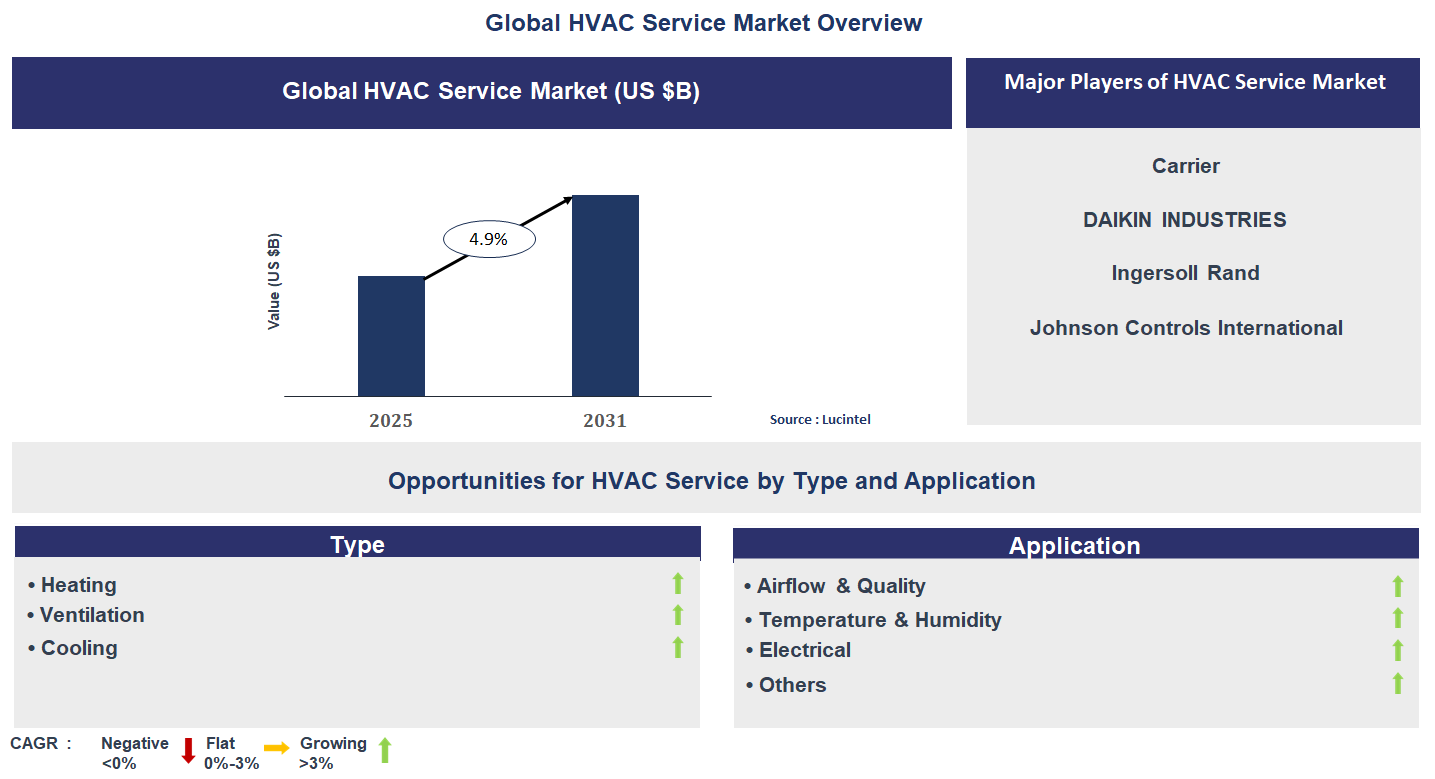
Key data points: The growth forecast = 4.9% annually for the next 7 years. Scroll below to get more insights. This market report covers trends, opportunities and forecasts in HVAC service market to 2031 by type (heating, ventilation, and cooling), application (airflow & quality, temperature & humidity, electrical, and others), and region (North America, Europe, Asia Pacific, and the Rest of the World)
We'll send your sample report shortly.
• Lucintel forecasts that, within the type category, cooling is expected to witness the highest growth over the forecast period.
• Within the application category, airflow & quality is expected to witness the highest growth.
• In terms of region, APAC is expected to witness the highest growth over the forecast period. Gain valuable insights for your business decisions with our comprehensive 150+ page report. Sample figures with some insights are shown below.
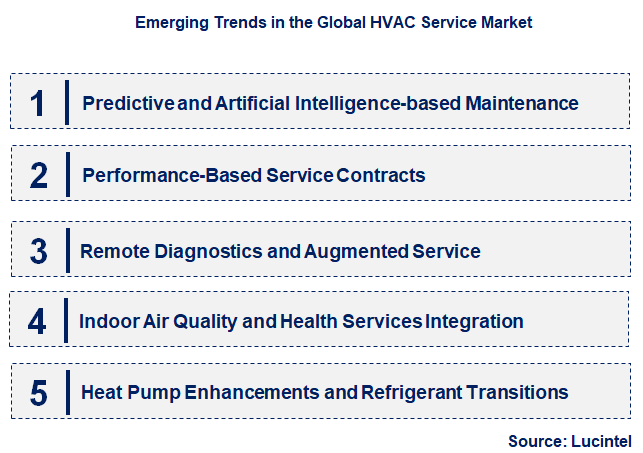
• Predictive and Artificial Intelligence‑based Maintenance: Instead of reacting to failures, service providers now use sensor-based monitoring and artificial intelligence models that actually forecast faults or performance decline. Through the measurement of temperature, vibration, current consumption, and refrigerant levels, these systems are able to identify anomalies ahead of time. This minimizes downtime, prevents emergency repairs, and allows service visits to be optimized.
• Performance-Based Service Contracts: Instead of straightforward maintenance agreements, service providers are providing result-based contracts (e.g. energy savings or certain levels of comfort). In these types of models, the provider takes a share of risk and responsibility for system function, encouraging greater system optimization and retrofit service. Provider and client interests are aligned and long-term ties are cemented. Expansion in this model is promoted by corporate ESG objectives, energy budgets, and green building requirements.
• Remote Diagnostics and Augmented Service: Service providers are launching digital platforms to enable remote diagnostics, scheduling, ordering of parts, dispatching of technicians, and virtual support. Augmented reality (AR) technologies enable technicians to superimpose instructions, diagnostics, and remote expert information. These technologies decrease mean time to repair, allow less-skilled technicians to conduct complex repairs, and enhance first-time fix rates. Digital platforms also enable customer transparency, predictive alerts, and warranty administration.
• Indoor Air Quality and Health Services Integration: In addition to temperature and humidity control, HVAC service is growing to include air filtration, UV germicidal units, carbon dioxide management, humidity control, and pathogen reduction. With increased sensitivity following COVID‑19, customers expect packages to guarantee healthier indoor spaces. HVAC service providers offering packaged IAQ services can differentiate and capture more margins, particularly in office, education, healthcare, and hospitality markets.
• Heat Pump Enhancements and Refrigerant Transitions: The worldwide trend towards decarbonization is moving HVAC towards electric heat pumps and low‑global‑warming potential (GWP) refrigerants. Service providers will need to enable retrofits, refrigerant conversions, and servicing of new system types. This will mean retraining and new equipment, but also the potential to realize value in service. As increasing numbers of householders and companies use heat pumps, there will be growing demand for specialized servicing, inspection, and performance guarantee. These trends are transforming HVAC service providers from mere maintenance providers to technology-enabled energy and health allies. The trend is towards data-driven services, more robust customer relationships through performance assurances, and service differentiation through IAQ and electrification support. Service margins, client retention, and operational efficiency are increasing in lockstep with technological complexity.
• Explosion in Mergers & Acquisitions among service companies: In the U.S., HVAC service M&A activity accelerated: in 2024, 124 deals were announced or were completed (a ~6.9 % YoY growth), with strategic buyers acquiring ~62.9 % share. This consolidation enables scaling of training, digital tools, and multi-discipline service (HVAC + plumbing + electrical). Larger companies can better absorb technician shortages, streamline processes, and invest in software and IoT platforms.
• Regulatory-driven refrigerant and efficiency transitions: In Europe and the U.S., future refrigerant phase-downs (e.g. A2L fluids from high-GWP fluids) and minimum efficiency requirements are compelling broad equipment replacement and retrofitting. HVAC service companies are spending on new technology, training, and compliance services. This regulatory drive is shortening replacement cycles and driving retrofit service demand.
• Growth of digital tools and remote monitoring by OEMs: Large HVAC equipment makers (e.g. Carrier, Daikin) are introducing cloud-based platforms to enable remote diagnosis, predictive notification, and firmware upgrades. Such OEM solutions enable service providers to get advance fault alerts and plan proactive maintenance. This trend moves some of the service operations upstream and enhances collaboration between OEMs and service operators.
• Bundled service & energy management offers emerges: Most service companies are packaging HVAC maintenance together with energy audits, control optimization, and indoor air quality services. They are framing service agreements not only as repairs, but as performance improvement packages. Bundling drives higher average order value, segmentation of offerings, and longer-term contracts.
• Deployment of AI, digital twins, and smart controls in service: There are some service providers that are implementing AI and digital twin models to model HVAC system performance under various conditions. These enable "what-if" diagnostics, system tuning, anomaly detection, and optimization recommendations. This innovation represents a step forward from rule-based diagnostics to model-based assistance, allowing deeper service insight and proactive enhancement. These trends support the evolution of HVAC service from reactive, technician-focused operations to analytics-enabled, client-focused performance businesses. M&A consolidation, regulatory requirements, OEM platform adoption, bundled energy services, and AI enablement are combining to redefine the delivery, monetization, and scale of HVAC service.
• Commercial & Office Buildings: Service providers may provide monitoring, performance tuning, IAQ upgrades, and demand response participation in commercial structures. With tenants and owners demanding ESG goals, services associated with energy performance and occupant comfort warrant premium value. Upgrading HVAC controls, providing green certification support, and ongoing optimization are appealing.
• Healthcare, Hospitals & Clean Rooms: These applications require severe temperature, humidity, and air cleanliness. HVAC service in these industries can involve validation, compliance, filter change, and emergency service. The high reliability requirement warrants high service margins and repeat contracts.
• Industrial & Process HVAC: Factories, data centers, pharmaceutical factories, and manufacturing plants require accurate thermal management and are usually 24/7 operations. System audits, performance tuning, reliability maintenance, and predictive monitoring can be provided by service providers. The cost of downtime and sensitivity to performance provide a rich source of lucrative accounts.
• Residential & Multi‑family Retrofit / Upgrade Services: Most single-family homes and apartment buildings retain old HVAC systems. Vendors can create value by replacing systems (heat pumps, high-efficiency equipment, smart controls) and providing maintenance contracts. Retrofit is a big and ongoing service opportunity, particularly where incentives exist.
• Indoor Air Quality and Healthy Buildings Services: With increasing concerns over air pollutants, allergens, and microbials, service opportunities for filtration upgrades, UV/UV-C systems, carbon dioxide / VOC control, humidity control, and air purification gain greater value. These add-on services tend to have greater margins and enhance customer loyalty. These services—commercial, healthcare, industrial, residential improvements, and IAQ services—provide solid growth drivers for HVAC service providers. By focusing on high-value verticals and combining performance, health, and energy functionality, HVAC service companies can move from commodity maintenance to strategic facility partners. Providers who make investments in domain knowledge, digital capability, and adaptive contracts will drive the next wave of HVAC service growth.
• Carrier
• DAIKIN INDUSTRIES
• Ingersoll Rand
• Johnson Controls International
• Heating
• Ventilation
• Cooling
• Airflow & Quality
• Temperature & Humidity
• Electrical
• Others
• North America
• Europe
• Asia Pacific
• The Rest of the World
• United States: The HVAC service industry in the U.S. is gaining strength with the support of increasing retrofits, policy initiatives, and regulation push towards efficiency. The U.S. HVAC service industry is expected to increase from approximately USD 28.2 billion in 2025 to USD 38.8 billion by 2030 (CAGR ~6.6 %). Upgrades to heat pumps and efficient systems are propelled by the Inflation Reduction Act and other incentives, and new refrigerant requirements (e.g. A2L transition) necessitate retraining of technicians and equipment upgrades. A significant restriction is still a lack of qualified technicians, driving up labor costs and limiting expansion in some areas
• China: Chinas HVAC service market is expanding robustly, supported by rapid urbanization, vast retrofitting demand, and the development of smart building environments. Chinas HVAC maintenance services market was USD 18,118.5 million in 2024 and is estimated to reach USD 28,054.2 million by 2030 (CAGR ~7.8 %). A key growth is the growth of HVAC rental and transient systems, especially for construction sites or large events, which is also set to increase (CAGR ~7.1 %). Furthermore, Chinas HVAC suppliers are going at digitizing client interaction in a big way—using mini‑programs, mobile platforms, cloud ERP, and self‑service ordering to enable service after-sales and spares support. Service providers are also moving towards green building and refrigerant regulations, driving more low‑GWP and energy‑efficient system servicing.
• Germany: The HVAC service market in Germany is mature and influenced by robust energy efficiency and environmental regulations. The German HVAC maintenance services market was approximately USD 5,464.3 million in 2024 and is estimated to increase to USD 7,179.9 million by 2030 (CAGR ~4.8 %) . Major developments are expansion in "performance contracting" approaches, by which service companies commit to energy savings via retro commissioning, system efficiency, and routine upkeep. Additional service companies are bundling HVAC service with building automation, intelligent control, and indoor air quality (IAQ) monitoring.
• India: Indias HVAC service industry is gaining momentum, with growth in HVAC installations in residential, commercial, and industrial categories outrunning services consumption. Indias HVAC maintenance services market was USD 4,631.7 million in 2024 and is expected to reach USD 6,857.3 million by 2030 (CAGR ~6.8 %). Recent strategic decision: Panasonic has diversified out of Indias washing machine and refrigeration businesses to concentrate on B2B solutions and HVAC, which shows optimism about growth in services and business HVAC demand in India. Indian service companies are also launching preventive contracts, remote diagnostics, and connectivity upgrades to generate recurring revenue.
• Japan: Japans HVAC service market is focusing on longevity, accuracy, and indoor air wellness. Japans HVAC maintenance services market was USD 7,858.3 million in 2024 and is expected to reach USD 11,072.4 million by 2030 (CAGR ~6.2 %). Top service trends in Japan are high penetration of predictive maintenance, indoor environmental monitoring (e.g. humidification, filtration, VOC sensing), and AI/ML integration in control systems. Service providers in Japan are also concentrating on refrigerant transitions and servicing of compact, high-efficiency equipment (e.g. VRF, heat pumps).


• Carrier
• DAIKIN INDUSTRIES
• Ingersoll Rand
• Johnson Controls International Q5. Which HVAC service market segment will be the largest in future? Answer: Lucintel forecasts that, within the type category, cooling is expected to witness the highest growth over the forecast period. Q6. In HVAC service market, which region is expected to be the largest in next 5 years? Answer: In terms of region, APAC is expected to witness the highest growth over the forecast period. Q7. Do we receive customization in this report? Answer: Yes, Lucintel provides 10% customization without any additional cost.


Choose a license that fits your team. Instant PDF delivery.
Prices exclude taxes. Instant delivery. Custom licensing available on request.
Market Report · July 31, 2026
Market Report · July 31, 2026
Market Report · July 31, 2026
Trusted partner for strategic intelligence and business growth


Receive a complimentary market analysis tailored to your industry. Our analysts will identify key growth opportunities and competitive dynamics specific to your business.

Market size, growth rate, and key trend analysis for your specific sector.

Top competitor positioning and market share analysis.

Strategic recommendations backed by data-driven insights.
Get curated market intelligence and competitive moves straight to your inbox.
By subscribing, you agree to receive our monthly insights. Unsubscribe anytime.
Receive a complimentary market analysis tailored to your industry. Our analysts will identify key growth opportunities and competitive dynamics specific to your business.
Market size, growth rate, and key trend analysis for your specific sector.
Top competitor positioning and market share analysis.
Strategic recommendations backed by data-driven insights.
Get curated market intelligence, emerging trends, and competitive moves straight to your inbox each month.
By subscribing, you agree to receive our monthly insights. Unsubscribe anytime.
We'll send your sample report shortly.