
Report Feature
Hull Cleaning Robot Market Trends and Forecast
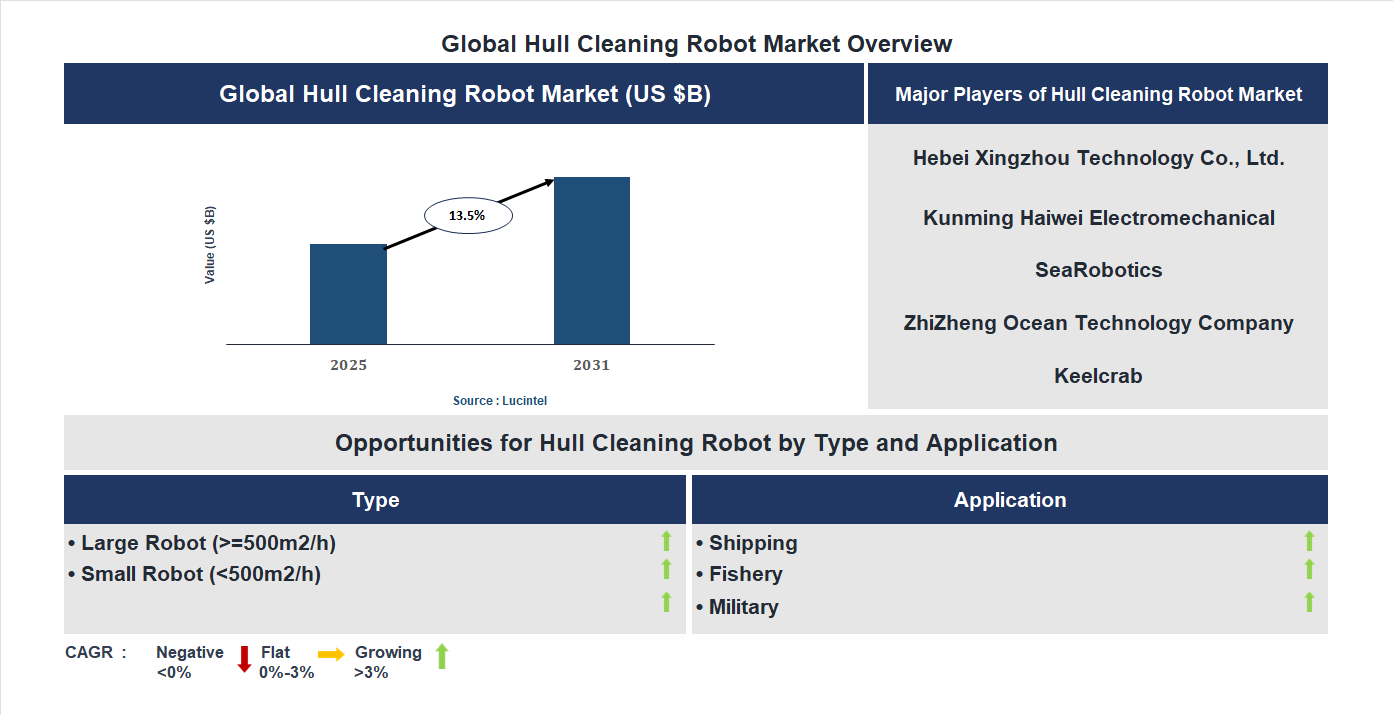
The future of the global hull cleaning robot market looks promising with opportunities in the shipping, fishery, and military markets. The global hull cleaning robot market is expected to grow with a CAGR of 13.5% from 2025 to 2031. The major drivers for this market are the increasing demand for automated ship maintenance, the rising focus on marine vessel fuel efficiency, and the growing adoption in commercial & naval fleets.• Lucintel forecasts that, within the type category, small robot (<500m2/h) is expected to witness higher growth over the forecast period.
• Within the application category, shipping is expected to witness the highest growth.
• In terms of region, APAC is expected to witness the highest growth over the forecast period. Gain valuable insights for your business decisions with our comprehensive 150+ page report. Sample figures with some insights are shown below.
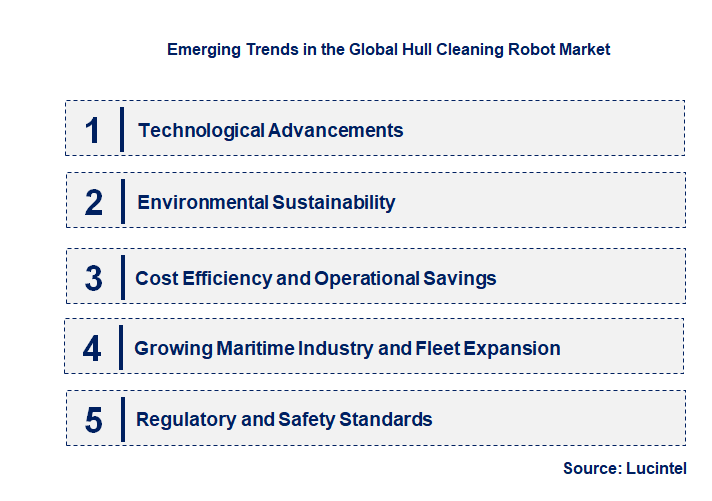
Emerging Trends in the Hull Cleaning Robot Market
The hull cleaning robot market is experiencing rapid growth driven by technological advancements, increasing demand for efficient maintenance solutions, and a focus on environmental sustainability. As ships become larger and more complex, traditional cleaning methods are becoming less feasible, prompting the adoption of automated solutions. Innovations in robotics, AI, and sensor technology are transforming how hull cleaning is performed, making it safer, faster, and more cost-effective. These developments are not only improving operational efficiency but also reducing environmental impact by minimizing the use of harmful chemicals and water. The market is poised for significant expansion as stakeholders recognize the benefits of automated hull cleaning systems.• Technological Advancements: Integration of AI and robotics is revolutionizing hull cleaning by enabling autonomous navigation and precise cleaning. These robots can operate in challenging conditions, reducing the need for human intervention and enhancing safety. Advanced sensors and machine learning algorithms improve cleaning accuracy and efficiency, leading to faster turnaround times. As technology continues to evolve, robots are becoming more adaptable to different ship types and sizes, broadening their application scope. This trend is driving market growth by offering innovative, reliable, and cost-effective cleaning solutions.
• Environmental Sustainability: Growing environmental concerns are pushing the industry toward eco-friendly cleaning methods. Hull cleaning robots reduce the reliance on chemical biocides and abrasive cleaning techniques, which can harm marine ecosystems. They use less water and generate minimal waste, aligning with global sustainability goals. Regulatory pressures are also encouraging ship owners to adopt greener practices, further boosting demand for robotic solutions. This trend not only benefits the environment but also helps companies comply with international regulations, enhancing their reputation and operational compliance.
• Cost Efficiency and Operational Savings: Automated hull cleaning robots significantly lower labor costs and reduce downtime for ships. They enable continuous, scheduled cleaning without halting operations, leading to improved fuel efficiency and reduced maintenance expenses. The quick deployment and high cleaning precision of these robots translate into substantial cost savings over traditional methods. As shipping companies seek to optimize operational costs, the adoption of robotic hull cleaning solutions is becoming increasingly attractive, driving market expansion and encouraging further technological investments.
• Growing Maritime Industry and Fleet Expansion: The global increase in maritime trade and fleet size is fueling demand for efficient maintenance solutions. Larger ships and more frequent voyages necessitate regular hull cleaning to maintain optimal performance and fuel efficiency. The rise in new vessel construction, especially in emerging markets, creates a substantial market for hull cleaning robots. This growth in maritime activity directly correlates with increased adoption of automated cleaning systems, making the market more competitive and innovative as companies strive to meet the evolving needs of the shipping industry.
• Regulatory and Safety Standards: Stricter international regulations regarding marine pollution and safety are compelling ship operators to adopt advanced cleaning technologies. Automated hull cleaning robots help ensure compliance with standards set by organizations like IMO and MARPOL by reducing the risk of invasive species transfer and chemical pollution. Additionally, robots minimize human exposure to hazardous environments, enhancing safety onboard ships. The increasing emphasis on regulatory compliance is accelerating market adoption, prompting manufacturers to develop more sophisticated, compliant solutions that meet evolving legal requirements. In summary, these trends are collectively transforming the hull cleaning robot market by fostering innovation, promoting sustainability, reducing costs, and ensuring regulatory compliance. As technological and environmental considerations become central to industry practices, the market is poised for sustained growth, reshaping how ships are maintained and operated worldwide.
Recent Development in the Hull Cleaning Robot Market
The hull cleaning robot market has experienced significant growth driven by technological advancements, increasing demand for efficient maintenance solutions, and environmental regulations. As ships become larger and more complex, the need for automated cleaning systems has surged, reducing manual labor and operational costs. Innovations in robotics, AI, and sensor technology are transforming the industry, making hull cleaning safer, faster, and more environmentally friendly. Market players are investing heavily in R&D to develop smarter, more adaptable robots. These developments are shaping the future of maritime maintenance, emphasizing sustainability, efficiency, and cost-effectiveness. The following are five key recent developments in this market.• Technological Advancements in Robotics: Integration of AI and machine learning has enhanced robot navigation and cleaning precision, enabling autonomous operation in complex hull geometries. This reduces human intervention, minimizes operational downtime, and improves cleaning efficiency, leading to cost savings and better vessel performance.
• Eco-Friendly Cleaning Solutions: Development of environmentally safe cleaning agents and waterless or low-water cleaning technologies has gained traction. These innovations help reduce water consumption and prevent pollution, aligning with stricter environmental regulations and promoting sustainable maritime practices.
• Increased Adoption of Remote Monitoring: Implementation of IoT sensors and remote control systems allows real-time monitoring of cleaning processes. This improves operational oversight, maintenance scheduling, and data collection, leading to optimized performance and reduced downtime.
• Market Expansion in Emerging Regions: Growing maritime activities in Asia-Pacific and Africa have driven demand for hull cleaning robots. Local manufacturers are entering the market, and global players are expanding their presence, resulting in increased competition and innovation.
• Strategic Collaborations and Mergers: Major companies are forming alliances with technology providers and maritime operators to develop advanced robotic solutions. These collaborations accelerate product development, expand market reach, and foster innovation in hull cleaning technologies. In summary, recent developments in the hull cleaning robot market are significantly enhancing operational efficiency, environmental sustainability, and technological innovation. These trends are driving market growth, expanding regional adoption, and fostering competitive advancements, ultimately transforming maritime maintenance practices worldwide.
Strategic Growth Opportunities in the Hull Cleaning Robot Market
The hull cleaning robot market is experiencing rapid growth driven by increasing demand for efficient, eco-friendly, and cost-effective solutions in maritime maintenance. As ships become larger and more complex, the need for automated cleaning systems that reduce downtime and environmental impact is rising. Technological advancements and regulatory pressures are further propelling this market forward. Key applications such as commercial shipping, cruise ships, offshore platforms, naval vessels, and yacht maintenance present significant opportunities for growth. These developments are transforming the industry by enhancing operational efficiency, reducing labor costs, and promoting sustainability, thereby creating a dynamic landscape for hull cleaning robot solutions.• Commercial Shipping: Enhanced fleet maintenance : The adoption of hull cleaning robots in commercial shipping improves vessel turnaround times, reduces maintenance costs, and minimizes environmental impact, making shipping operations more sustainable and profitable.
• Cruise Ships: Improved passenger safety and experience : Implementing hull cleaning robots on cruise ships ensures cleaner hulls, leading to better fuel efficiency, reduced emissions, and enhanced passenger safety and comfort.
• Offshore Platforms: Maintenance efficiency in harsh environments : Hull cleaning robots designed for offshore platforms enable safe, efficient cleaning in challenging conditions, reducing downtime and operational costs in oil and gas extraction.
• Naval Vessels: Enhanced operational readiness : The military sector benefits from hull cleaning robots by maintaining vessel performance, extending service life, and ensuring readiness for deployment with minimal maintenance disruptions.
• Yacht Maintenance: Cost-effective and eco-friendly solutions : Yacht owners increasingly adopt hull cleaning robots for regular, eco-friendly cleaning, reducing manual labor and preserving vessel aesthetics and performance. In summary, these growth opportunities are significantly impacting the hull cleaning robot market by driving technological innovation, reducing operational costs, and promoting sustainable maritime practices. The increasing adoption across diverse applications is fostering market expansion and shaping the future of automated hull maintenance solutions.
Hull Cleaning Robot Market Driver and Challenges
The hull cleaning robot market is influenced by a variety of technological, economic, and regulatory factors that shape its growth and development. Advances in robotics and automation have enabled more efficient and safer cleaning processes, reducing the need for manual labor and minimizing environmental impact. Economic factors such as increasing maritime trade and the need for vessel maintenance drive demand for innovative cleaning solutions. Regulatory standards aimed at reducing marine pollution and enhancing safety protocols further propel market expansion. However, the market also faces challenges including high initial investment costs, technological limitations, and regulatory compliance complexities. Understanding these drivers and challenges is essential for stakeholders to navigate this evolving industry landscape effectively. The factors responsible for driving the hull cleaning robot market include:• Technological Innovation: The development of advanced robotics and automation technologies has significantly improved hull cleaning efficiency. These robots can operate in challenging marine environments, reach difficult areas, and perform cleaning with minimal human intervention. Innovations such as AI integration and sensor-based navigation enhance precision and operational safety. As technology continues to evolve, the cost of deployment decreases, making these solutions more accessible to shipowners and operators. This ongoing innovation fosters market growth by providing more reliable, faster, and environmentally friendly cleaning options, ultimately reducing maintenance costs and vessel downtime.
• Increasing Maritime Trade and Fleet Expansion: The global increase in maritime trade has led to a rise in the number of ships requiring regular hull maintenance to ensure optimal performance and fuel efficiency. As fleets expand and new vessels are commissioned, the demand for efficient cleaning solutions grows. Hull fouling can significantly impact vessel speed and fuel consumption, prompting ship operators to adopt automated cleaning systems. The economic benefits of maintaining clean hulls, such as reduced fuel costs and compliance with environmental standards, further drive market demand. This trend is expected to continue as global trade volume increases, supporting sustained growth in the hull cleaning robot market.
• Environmental Regulations and Sustainability Goals: Stricter environmental regulations imposed by international bodies like IMO (International Maritime Organization) aim to reduce marine pollution and prevent invasive species transfer. Traditional cleaning methods often involve harmful chemicals and abrasive techniques, which are increasingly being replaced by eco-friendly robotic solutions. Hull cleaning robots offer a chemical-free, water-efficient alternative that minimizes environmental impact. Compliance with these regulations not only avoids penalties but also enhances a companys reputation for sustainability. As environmental concerns become more prominent, the adoption of eco-friendly hull cleaning robots is expected to accelerate, further propelling market growth.
• Cost Efficiency and Operational Benefits: Automated hull cleaning robots provide significant cost savings over manual cleaning methods by reducing labor costs, cleaning time, and vessel downtime. They enable ships to maintain optimal hull conditions, thereby improving fuel efficiency and reducing emissions. The ability to perform cleaning operations at sea or port without extensive logistical arrangements adds to their operational appeal. These benefits translate into higher return on investment for shipping companies, encouraging widespread adoption. As the technology matures and becomes more affordable, the market is likely to see increased penetration across various vessel types, including cargo ships, cruise liners, and offshore platforms.
• Growing Adoption of Autonomous and Remote-Controlled Systems: The trend toward autonomous and remotely operated hull cleaning robots enhances safety and operational efficiency. These systems can be operated from a safe distance, reducing risks to human workers in hazardous marine environments. Integration with IoT and AI allows for real-time monitoring, predictive maintenance, and optimized cleaning schedules. The adoption of such advanced systems is driven by the need to improve safety standards and reduce operational costs. As remote-control and autonomous technologies become more reliable and affordable, their adoption is expected to expand, further transforming the hull cleaning industry and supporting market growth. The challenges facing this hull cleaning robot market include:
• High Initial Investment Costs: The deployment of hull cleaning robots requires substantial capital expenditure on equipment, infrastructure, and training. Many shipping companies, especially smaller operators, may find these costs prohibitive, limiting market penetration. Additionally, the return on investment depends on the frequency of use and operational efficiency, which can vary based on vessel type and operating conditions. The high upfront costs can slow adoption rates, particularly in regions with limited access to financing or where cost savings are not immediately apparent. Overcoming this challenge requires innovative financing models and demonstrating clear long-term benefits to stakeholders.
• Technological Limitations and Reliability Issues: Despite advancements, hull cleaning robots face challenges related to navigation accuracy, obstacle detection, and operational reliability in complex marine environments. Biofouling and marine debris can impair robot sensors and movement, leading to incomplete cleaning or operational failures. Harsh sea conditions, such as high waves and strong currents, can also affect robot stability and performance. These technological limitations hinder widespread adoption and raise concerns about maintenance costs and operational downtime. Continuous research and development are necessary to enhance robustness, adaptability, and reliability of these robotic systems to ensure consistent performance.
• Regulatory and Certification Challenges: The marine industry is heavily regulated, and the deployment of autonomous robots must comply with international and local maritime safety standards. Obtaining certifications for new robotic systems can be a lengthy and complex process, delaying market entry and adoption. Variations in regulations across different jurisdictions add further complexity, requiring manufacturers to customize solutions for specific markets. Ensuring compliance with safety, environmental, and operational standards is critical but challenging, potentially hindering rapid deployment and scaling of hull cleaning robots globally. In summary, the hull cleaning robot market is driven by technological advancements, increasing maritime activity, environmental regulations, cost efficiencies, and the adoption of autonomous systems. However, high initial costs, technological reliability issues, and regulatory hurdles pose significant challenges. These factors collectively influence market growth, with ongoing innovation and regulatory adaptation likely to shape future developments. The markets evolution will depend on balancing technological progress with cost management and regulatory compliance, ultimately enabling safer, more efficient, and environmentally sustainable hull cleaning solutions worldwide.
List of Hull Cleaning Robot Companies
Companies in the market compete on the basis of product quality offered. Major players in this market focus on expanding their manufacturing facilities, R&D investments, infrastructural development, and leverage integration opportunities across the value chain. With these strategies hull cleaning robot companies cater increasing demand, ensure competitive effectiveness, develop innovative products & technologies, reduce production costs, and expand their customer base. Some of the hull cleaning robot companies profiled in this report include-• Hebei Xingzhou Technology Co., Ltd.
• Kunming Haiwei Electromechanical
• SeaRobotics
• ZhiZheng Ocean Technology Company
• Keelcrab
• CLIIN Robotics
• BRI Offshore AS
• SLM Global
• Tas Gloabal
• Seashell Robotics
Hull Cleaning Robot Market by Segment
The study includes a forecast for the global hull cleaning robot market by type, application, and region.Hull Cleaning Robot Market by Type [Value from 2019 to 2031]:
• Large Robot (>=500m2/h)
• Small Robot (<500m2/h)
Hull Cleaning Robot Market by Application [Value from 2019 to 2031]:
• Shipping
• Fishery
• Military
Hull Cleaning Robot Market by Region [Value from 2019 to 2031]:
• North America
• Europe
• Asia Pacific
• The Rest of the World
Country Wise Outlook for the Hull Cleaning Robot Market
The hull cleaning robot market has experienced significant growth driven by increasing maritime activities, technological advancements, and a focus on environmental sustainability. Countries are adopting innovative solutions to improve efficiency, reduce costs, and minimize ecological impact. The markets evolution reflects a shift towards automation and smart technologies, with key players investing in R&D to develop more effective and eco-friendly hull cleaning robots. These developments are crucial for maintaining vessel performance, preventing biofouling, and complying with international regulations. As global maritime trade expands, the demand for advanced hull cleaning solutions continues to rise, shaping the future landscape of this industry.• United States: The US market has seen rapid adoption of autonomous hull cleaning robots, driven by major shipping companies and port authorities seeking efficiency and environmental compliance. Innovations include AI-powered navigation systems and eco-friendly cleaning methods. Several startups and established firms are investing heavily in R&D to develop smarter, more durable robots capable of operating in diverse marine conditions. Regulatory pressures to reduce biofouling and emissions are also encouraging the deployment of advanced cleaning solutions. Additionally, collaborations between technology firms and maritime operators are fostering the integration of IoT and data analytics into hull cleaning processes, enhancing operational efficiency.
• China: China has emerged as a significant player in the hull cleaning robot market, with substantial government support for maritime technology development. The country is focusing on automating port operations and vessel maintenance to boost its shipping industry. Chinese companies are developing cost-effective, high-performance hull cleaning robots tailored for large vessels and busy ports. The market benefits from rapid technological advancements and a large domestic shipping fleet, which drives demand. Moreover, China is investing in eco-friendly cleaning technologies to meet international environmental standards, positioning itself as a leader in sustainable maritime solutions.
• Germany: Germanys market is characterized by a focus on high-precision, technologically advanced hull cleaning robots. The country emphasizes quality, safety, and environmental sustainability, integrating cutting-edge robotics and sensor technologies. German firms are pioneering innovations in autonomous navigation and surface detection to optimize cleaning efficiency. The strong presence of engineering expertise and a robust maritime industry support the development of customized solutions for commercial and naval vessels. Germany also collaborates with European regulatory bodies to ensure compliance with strict environmental standards, fostering a market that prioritizes eco-friendly and reliable hull cleaning technologies.
• India: The Indian hull cleaning robot market is witnessing rapid growth due to expanding maritime trade and port infrastructure development. The focus is on affordable, scalable solutions suitable for the countrys diverse fleet and port conditions. Indian companies are adopting modular designs and locally sourced components to reduce costs and improve accessibility. The government’s initiatives to modernize ports and promote maritime safety are fueling demand for automated cleaning systems. Additionally, increasing awareness of biofoulings impact on fuel efficiency and vessel performance is encouraging adoption. The market is also seeing collaborations with international firms to incorporate advanced technologies and meet global standards.
• Japan: Japans market is driven by technological innovation and stringent environmental regulations. Japanese companies are developing sophisticated hull cleaning robots equipped with advanced sensors, AI, and eco-friendly cleaning agents. The focus is on minimizing environmental impact while maximizing cleaning efficiency, especially for large commercial and naval vessels. Japans strong maritime industry and emphasis on sustainability foster continuous R&D investments. The country is also exploring the integration of IoT and data analytics to enable predictive maintenance and real-time monitoring. These developments position Japan as a leader in high-tech, environmentally conscious hull cleaning solutions within the global market.

Features of the Global Hull Cleaning Robot Market
Market Size Estimates: Hull cleaning robot market size estimation in terms of value ($B). Trend and Forecast Analysis: Market trends (2019 to 2024) and forecast (2025 to 2031) by various segments and regions. Segmentation Analysis: Hull cleaning robot market size by type, application, and region in terms of value ($B). Regional Analysis: Hull cleaning robot market breakdown by North America, Europe, Asia Pacific, and Rest of the World. Growth Opportunities: Analysis of growth opportunities in different types, applications, and regions for the hull cleaning robot market. Strategic Analysis: This includes M&A, new product development, and competitive landscape of the hull cleaning robot market. Analysis of competitive intensity of the industry based on Porter’s Five Forces model.
FAQ
Q1. What is the growth forecast for hull cleaning robot market? Answer: The global hull cleaning robot market is expected to grow with a CAGR of 13.5% from 2025 to 2031. Q2. What are the major drivers influencing the growth of the hull cleaning robot market? Answer: The major drivers for this market are the increasing demand for automated ship maintenance, the rising focus on marine vessel fuel efficiency, and the growing adoption in commercial & naval fleets. Q3. What are the major segments for hull cleaning robot market? Answer: The future of the hull cleaning robot market looks promising with opportunities in the shipping, fishery, and military markets. Q4. Who are the key hull cleaning robot market companies? Answer: Some of the key hull cleaning robot companies are as follows:• Hebei Xingzhou Technology Co., Ltd.
• Kunming Haiwei Electromechanical
• SeaRobotics
• ZhiZheng Ocean Technology Company
• Keelcrab
• CLIIN Robotics
• BRI Offshore AS
• SLM Global
• Tas Gloabal
• Seashell Robotics Q5. Which hull cleaning robot market segment will be the largest in future? Answer: Lucintel forecasts that, within the type category, small robot (<500m2/h) is expected to witness higher growth over the forecast period. Q6. In hull cleaning robot market, which region is expected to be the largest in next 5 years? Answer: In terms of region, APAC is expected to witness the highest growth over the forecast period. Q7. Do we receive customization in this report? Answer: Yes, Lucintel provides 10% customization without any additional cost.
Table of Contents
List of Figures
List of Tables
Methodology
- In-depth interviews of the major players in this market
- Detailed secondary research from competitors’ financial statements and published data
- Extensive searches of published works, market, and database information pertaining to industry news, company press releases, and customer intentions
- A compilation of the experiences, judgments, and insights of Lucintel’s professionals, who have analyzed and tracked this market over the years.


Buy Now
Choose a license that fits your team. Instant PDF delivery.
Prices exclude taxes. Instant delivery. Custom licensing available on request.
Key Questions
- • What are some of the most promising, high-growth opportunities for the hull cleaning robot market by type (large robot (>=500m2/h) and small robot (


