
Market Report · July 22, 2026

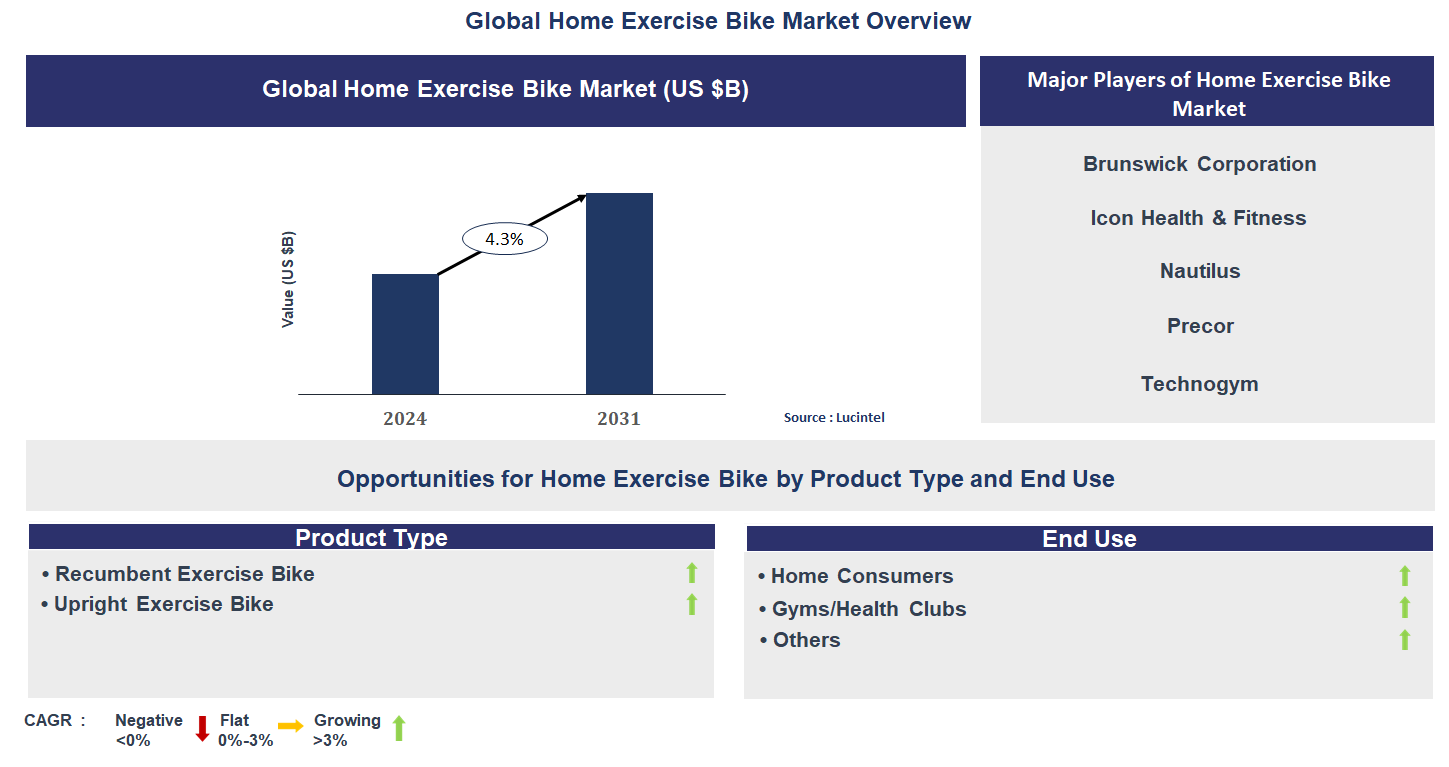
Key data points: The growth forecast = 4.3% annually for the next 7 years. Scroll below to get more insights. This market report covers trends, opportunities and forecasts in home exercise bike market to 2031 by product type (recumbent exercise bike and upright exercise bike), end use (home consumers, gyms/health clubs, and others), and region (North America, Europe, Asia Pacific, and the Rest of the World)
We'll send your sample report shortly.
• Lucintel forecasts that, within the product type category, recumbent exercise bike is expected to witness higher growth over the forecast period.
• Within the end use category, home consumer is expected to witness higher growth.
• In terms of region, APAC is expected to witness the highest growth over the forecast period. Gain valuable insights for your business decisions with our comprehensive 150+ page report. Sample figures with some insights are shown below.
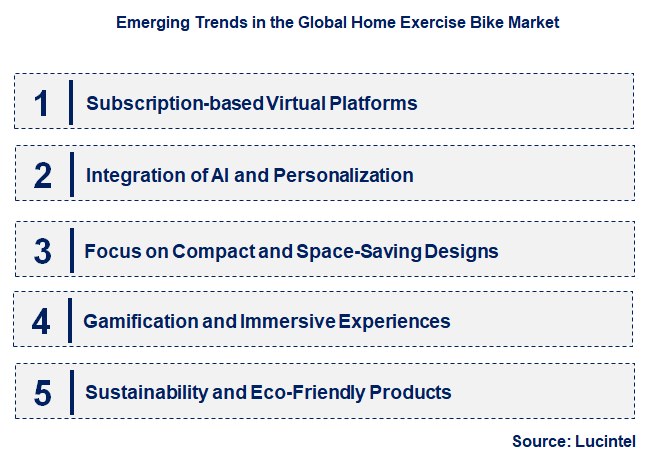
• Subscription-based Virtual Platforms: The market is witnessing a significant trend toward subscription-based platforms like Peloton. These services offer live and on-demand classes led by professional instructors, creating a sense of community and motivation. This trend is impacting the market by transforming a one-time product purchase into a continuous revenue stream and enhancing user engagement with a dynamic, social workout experience.
• Integration of AI and Personalization: There is a growing trend for home exercise bikes to integrate artificial intelligence (AI) to create personalized workout plans. These systems analyze a users performance data and automatically adjust resistance and intensity. This personalization is impacting the market by offering a more tailored and effective fitness experience, helping users achieve their goals more efficiently than with static workout programs.
• Focus on Compact and Space-Saving Designs: The market is seeing a trend toward compact and aesthetically pleasing designs that fit into urban living spaces. This includes foldable bikes and those with sleek, minimalist profiles that blend into home decor. This is impacting the market by addressing the key challenge of space constraints, making home fitness accessible to a larger demographic, particularly in densely populated cities.
• Gamification and Immersive Experiences: Manufacturers are incorporating elements of gaming into the workout experience, using virtual reality (VR) and augmented reality (AR) to simulate outdoor cycling routes. This gamification is impacting the market by making exercise more engaging and fun, reducing the monotony of indoor cycling and motivating users to stick with their fitness routines by turning workouts into an entertaining experience.
• Sustainability and Eco-Friendly Products: There is a growing consumer demand for environmentally conscious products. This trend involves using recycled materials, energy-efficient components, and sustainable manufacturing processes. Adopting sustainable practices not only appeals to a new generation of eco-aware consumers but also positions brands as responsible leaders, enhancing their reputation and marketability in a competitive market. The combination of these trends is fundamentally reshaping the home exercise bike market. The introduction of smart technology and AI is elevating the user experience, while a focus on compact design and sustainability is catering to modern consumer values. The shift to a subscription-based, gamified model is changing how products are sold and used, creating a more responsive and consumer-friendly market.
• Smart Technology and Connectivity: A key development is the integration of high-resolution touchscreens and internet connectivity into home exercise bikes. This feature provides a portal to live and on-demand fitness classes and a vast library of workout content. This technology is revolutionizing the user experience by offering a studio-quality workout from home, increasing engagement and motivation.
• Personalized Workout Programs: The development of AI-driven software that creates personalized workout plans is a major recent development. These programs analyze a users performance and biometrics to adjust resistance and difficulty in real time. This is impacting the market by offering a tailored training experience, which helps users achieve their fitness goals more effectively and efficiently than with static, pre-set programs.
• Shift to Subscription Models: The emergence of a subscription-based business model, where the bike is a gateway to a monthly content service, is a significant development. This model, pioneered by companies like Peloton, has changed how consumers purchase and use fitness equipment. This is impacting the market by creating a continuous revenue stream for brands and fostering a strong sense of community among users.
• Ergonomic and Low-Impact Designs: There is a strong focus on developing bikes with enhanced ergonomics and low-impact designs. This includes recumbent bikes for rehabilitation and those with adjustable seats and handlebars to accommodate a wide range of body types. This is impacting the market by broadening its appeal to an older demographic and individuals with joint or mobility issues.
• Compact and Foldable Solutions: A notable recent development is the growing trend toward compact and foldable exercise bikes. These designs are specifically created for consumers living in small urban apartments who have limited space for bulky fitness equipment. This is impacting the market by making home fitness accessible to a larger audience, particularly in densely populated areas. These recent developments are collectively transforming the home exercise bike market. The integration of smart technology and AI is elevating the user experience, while a focus on ergonomic design and personalization is broadening the user base. The shift to a subscription-based, direct-to-consumer model is changing how products are sold and used, making the market more dynamic and responsive to a wider range of consumer needs.
• Interactive and Connected Fitness: The interactive and connected fitness segment presents a key growth opportunity by providing a comprehensive digital ecosystem. This includes bikes with touchscreens that offer live and on-demand classes, leaderboards, and social features. The impact is significant as this model commands premium prices and fosters strong customer loyalty through an engaging and community-driven experience.
• Rehabilitation and Senior Applications: A significant growth opportunity lies in designing bikes specifically for rehabilitation and the senior population. This includes low-impact recumbent bikes with easy-to-use interfaces and ergonomic designs. The impact is a new revenue stream from a specialized market segment, positioning bikes as a tool for physical therapy and maintaining mobility for an aging population.
• Corporate Wellness Programs: The market for corporate wellness is a promising area for growth. Opportunities involve partnering with companies to provide home exercise bikes and wellness platforms to employees. The impact is a steady, large-scale revenue stream from business-to-business sales, as companies invest in employee health to boost morale and productivity.
• Entry-Level and Budget-Friendly Market: The entry-level market offers a substantial growth opportunity by providing basic, high-quality, and affordable bikes. This segment is crucial for attracting new users who are not ready to invest in premium, high-tech models. The impact is widespread, as this market segment drives high-volume sales and introduces new consumers to the benefits of home cycling.
• Compact and Urban Living Applications: A new growth opportunity lies in marketing bikes specifically for urban dwellers with limited space. This includes compact, foldable, and aesthetically pleasing designs. The impact is a broader market reach beyond suburban homes, attracting consumers who previously couldnt accommodate a full-size exercise bike, thus expanding the total addressable market. These strategic growth opportunities are reshaping the home exercise bike market by encouraging companies to diversify their product portfolios and target specific applications. By catering to the distinct needs of fitness enthusiasts, seniors, corporate clients, budget-conscious consumers, and urban dwellers, the industry can achieve sustainable growth, innovate new products, and foster a more inclusive and dynamic fitness community.
• Brunswick Corporation
• Icon Health & Fitness
• Nautilus
• Precor
• Technogym
• Recumbent Exercise Bike
• Upright Exercise Bike
• Home Consumers
• Gyms/Health Clubs
• Others
• North America
• Europe
• Asia Pacific
• The Rest of the World
• United States: The U.S. market is a leader in high-tech, connected fitness. Recent developments include the widespread adoption of smart bikes with interactive touchscreens and subscription-based virtual fitness platforms. The market is also seeing a rise in AI-driven personalized workout programs and a strong focus on eco-friendly, sustainable equipment to meet consumer demand.
• China: China’s market is experiencing explosive growth, fueled by rising disposable incomes and a growing interest in at-home wellness. Developments are centered on mass-produced, affordable smart bikes with integrated apps and social features. The market is also seeing a rise in high-end, aesthetically pleasing equipment that blends into modern home decor, appealing to a young, tech-savvy urban population.
• Germany: Germanys market is characterized by a strong emphasis on quality, durability, and a focus on wellness. Developments involve the use of high-quality, long-lasting materials and a focus on ergonomic design for comfort and safety. The market is seeing a steady demand for reliable bikes, with a growing interest in integrated digital features that provide personalized and data-driven workouts.
• India: The home exercise bike market in India is emerging, driven by increasing health consciousness and a young, digitally savvy population. Developments are centered on providing accessible, entry-level products. The market is heavily reliant on online retail, which is making a wide variety of domestic and international brands available to a large, young, and geographically dispersed consumer base, often at competitive prices.
• Japan: Japan’s market is mature and highly specialized, with developments focused on innovative, space-saving designs. Recent trends include the rise of compact, foldable bikes that can be easily stored in urban living spaces. The market is also seeing a strong demand for low-impact recumbent bikes, catering to a growing aging population seeking convenient and joint-friendly exercise options.


• Brunswick Corporation
• Icon Health & Fitness
• Nautilus
• Precor
• Technogym Q5. Which home exercise bike market segment will be the largest in future? Answer: Lucintel forecasts that, within the product type category, recumbent exercise bike is expected to witness higher growth over the forecast period. Q6. In home exercise bike market, which region is expected to be the largest in next 5 years? Answer: In terms of region, APAC is expected to witness the highest growth over the forecast period. Q7. Do we receive customization in this report? Answer: Yes, Lucintel provides 10% customization without any additional cost.


Choose a license that fits your team. Instant PDF delivery.
Prices exclude taxes. Instant delivery. Custom licensing available on request.
Market Report · July 22, 2026
Market Report · July 16, 2026
Market Report · May 18, 2026
Trusted partner for strategic intelligence and business growth


Receive a complimentary market analysis tailored to your industry. Our analysts will identify key growth opportunities and competitive dynamics specific to your business.

Market size, growth rate, and key trend analysis for your specific sector.

Top competitor positioning and market share analysis.

Strategic recommendations backed by data-driven insights.
Get curated market intelligence and competitive moves straight to your inbox.
By subscribing, you agree to receive our monthly insights. Unsubscribe anytime.
Receive a complimentary market analysis tailored to your industry. Our analysts will identify key growth opportunities and competitive dynamics specific to your business.
Market size, growth rate, and key trend analysis for your specific sector.
Top competitor positioning and market share analysis.
Strategic recommendations backed by data-driven insights.
Get curated market intelligence, emerging trends, and competitive moves straight to your inbox each month.
By subscribing, you agree to receive our monthly insights. Unsubscribe anytime.
We'll send your sample report shortly.