
Market Report · May 16, 2026

Key data points: The growth forecast = 6.2% annually for the next 7 years. Scroll below to get more insights. This market report covers Trends, opportunities and forecasts in home accident insurance market to 2031 by type (children's accident insurance and adult accident insurance), application (insurance direct sales and insurance agency), and region (North America, Europe, Asia Pacific, and the Rest of the World)
We'll send your sample report shortly.
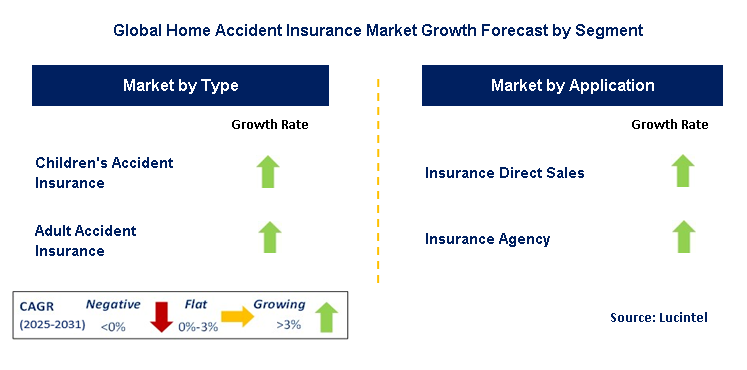
• Lucintel forecasts that, within the type category, adult accident insurance is expected to witness higher growth over the forecast period.
• Within the application category, insurance direct sale is expected to witness higher growth.
• In terms of region, North America is expected to witness the highest growth over the forecast period.

• Modular and Tailored Policy Options: Insurers are shifting away from standard policy options to more tailored and modular ones. This enables consumers to choose particular coverages according to their unique situations, for example, occupants' age, children or elderly residents, and the nature of the house. Riders for particular threats such as home DIY accidents or smart home device accidents are also increasingly available, which allows for individualized protection and even lower-priced premiums for lower-risk families.
• Integration with Smart Home Safety Devices: The widespread use of smart home safety products, including fall detection devices, smoke and carbon monoxide alarm systems with alert emergency messages, and smart door locks, is impacting the market for home accident insurance. Insurers are discussing collaborations with tech providers to promote bundled solutions or premium discounts to policyholders using these devices. This integration serves to improve safety while also allowing insurers to access real-time information for risk evaluation and probable claims reduction.
• Preventative Focus and Risk Education: Insurers are shifting emphasis toward preventative measures and educating policyholders on typical home accident hazards. This entails offering safety advice, home risk assessment kits, and incentives to implement safety practices. By giving consumers the ability to minimize the potential for accidents, insurers seek to decrease the frequency of claims and, in turn, be able to quote more competitive premiums. This preventative focus works to the benefit of both insurers and policyholders by making homes safer places.
• Policy Management and Claims Processing Digitalization: Home accident insurance is being influenced profoundly by the digital revolution. Web-based platforms and mobile applications are fast becoming the standard for policy buying, management, and claims filing. Digital claims processing, such as the use of AI for preliminary evaluation and virtual inspections, makes the process faster, efficient, and easier to interact with. This movement towards digital channels is also enabling insurers to engage a broader audience and provide more accessible services.
• Bundling with Homeowners or Renters Insurance: Insurance companies are more and more often providing home accident insurance as a rider or a built-in element of more general homeowners or renters insurance policies. This makes the buying process easier for consumers and provides more full-coverage protection for a wider range of risks related to the home environment. Bundling may also result in potential cost reductions and a more integrated approach to safeguarding one's residence and its occupants against unexpected occurrences. These new trends are transforming the home accident insurance market into one where policies are more personalized, technology is utilized to manage risks as well as service delivery, preventative care is encouraged, and the insurance experience is streamlined for consumers. Personalization, interoperability with smart devices, digital innovation, and bundling are creating a more dynamic and consumer-led market.

• Expansion of Coverage Scope: Recent trends involve the enlargement of policy cover to cover a broader scope of home-related accidents, including those injuries caused by doing things yourself at home, accidents with pets, and accidents that might be caused by using household appliances and smart home gadgets. Broader cover is a consequence of improved knowledge about the numerous risks that exist in today's home environment.
• Standalone Home Accident Policies: Although frequently bundled, there is a trend towards providing standalone home accident insurance policies. These policies offer specialized coverage specifically for home-based injuries, providing an alternative to those who might not need or have comprehensive homeowners or renters insurance. This makes accident coverage more accessible to a broader population.
• Teleconsultation and Home Healthcare Benefits: Certain insurers have included teleconsultation services as well as compensation for home health care costs as a result of home accidents. This ensures convenient access to expert medical advice as well as quality care without involving immediate hospital attendance, thus making claims more expensive and enhancing recovery.
• IoT and Wearable Technology Use in Risk Assessment: Insurers are investigating the use of Internet of Things (IoT) sensors and wearable technology to evaluate and possibly reduce home accident risks. For example, fall sensors for older policyholders can send alerts and enable timely support. Though still in its infancy, this integration can lead to personalized premiums based on true risk profiles and encourage safer homes.
• Increased Focus on Affordability and Accessibility: There is increasing focus on making home accident insurance more affordable and accessible to more consumers. This involves the creation of microinsurance products with reduced premiums and streamlined coverage, and leveraging digital channels to lower distribution expenses and reach underserved consumers. These are the major developments that are influencing the home accident insurance market by offering more extensive and customized coverage solutions, using technology for enhanced risk assessment and service provision, and emphasizing greater accessibility and affordability. These developments are intended to make home accident insurance a more relevant and valuable protection for a wider section of the population.
• Specialty Policies for Aging in Place and Senior Living: As the aging population grows, there is immense growth potential in creating niche home accident policies to meet the specific needs of older adults who prefer to live at home. The policies should provide coverage for falls, mobility accidents, and accidents related to the use of assistive devices. Combining it with telehealth and home care services can make the value proposition even stronger for this group.
• Coverage for Home-Based Businesses and Remote Workers: The growth of remote work and home-based businesses has created a new niche with distinct accident risks. Providing policies that address injuries incurred while working in the home environment, such as ergonomic concerns and accidents with office equipment, is an opportunity for growth. Package sales with business insurance or providing special riders for home office environments can be appealing.
• Home Improvement and DIY Accident Coverage: The growing popularity of home improvements and DIY projects makes such accidents more likely. Specialized policies or riders to cover accidents during these activities may appeal to a substantial portion of homeowners. Supplying educational materials on safe DIY practices in addition to insurance products can provide even greater customer value.
• Family Policies with Young Children: Families with young children have particular home accident hazards, including falls, burns, and poisoning. Creating customized policies with coverage for these typical childhood accidents, as well as access to child safety information and guidance, can be a worthwhile offering. Bundling with child-related products or services may also generate synergistic opportunities.
• Integration with Smart Home Ecosystems: Collaboration with smart home device makers and service providers to provide integrated insurance offerings is a large growth opportunity. This may include providing premium reductions for homes that are outfitted with safety devices or providing instant claims settlement through connected devices. As smart homes gain traction, insurance products aligned with this ecosystem will gain competitive advantage. These strategic growth prospects emphasize the potential for the home accident insurance market to grow by targeting particular demographics, lifestyle patterns, and technological integrations. By offering products and services that address the specific requirements of these applications, insurers can access new customer bases and increase the relevance and value of home accident insurance.
• Allianz
• Assicurazioni Generali
• China Life Insurance
• MetLife
• Ping An
• Axa Life Insurance
• Aegon
• Dai-ichi Life Insurance
• China Pacific Insurance
• Aviva
• Children's Accident Insurance
• Adult Accident Insurance
• Insurance Direct Sales
• Insurance Agency
• North America
• Europe
• Asia Pacific
• The Rest of the World
• United States: The American market is witnessing a trend of increasing comprehensive home accident insurance policies that protect against a greater variety of incidents, such as falls, burns, and accidents with household appliances and tools. Insurers are increasingly providing personalized plans and riders to address unique needs and the particular risks inherent in various kinds of homes and lifestyles. Increasing focus is also being placed on digital distribution channels and online claims handling for greater convenience. Home safety device manufacturers are also forming partnerships as a means to provide bundled solutions and encourage preventative care.
• China: The Chinese home accident insurance market is in an embryonic phase but is growing with the rising trend of urbanization and a greater sense of concern regarding safety inside the home. The recent development is the launching of more budget-friendly and lower-tier home accident policies aimed at middle-income households. Online platforms are taking center stage in the distribution of such policies and creating consumer awareness. As the market evolves, opportunities arise for more comprehensive and specialized products to emerge along with tighter regulation on coverage and claims handling.
• Germany: Germany has a fairly mature market, and household accident insurance tends to be built into larger household or personal liability policies. New developments concentrate on defining the boundaries of home-based accident coverage and improving consumer familiarity with policy provisions. There is also movement towards combining data analytics and smart home technologies in risk assessment as well as the possibility of future premium adjustments. Insurers are focusing on preventatives and issuing home safety tips to minimize chances of accidents occurring.
• India: India's market for home accident insurance is steadily picking up speed, especially among urban populations, with rising disposable incomes and higher awareness of financial consequences of accidents at home fueling the drive. Recent trends have seen the launch of stand-alone home accident policies with differentiated coverage for typical household accidents. Microinsurance models and digital platforms are being tested to extend reach to a large population. As affordability and awareness grow, product innovation and uptake are likely to increase further in the market.
• Japan: Japan's highly dense population and aged society make it highly focused on home security and prevention of accidents. The home accident insurance industry is quite well developed, usually bundled with fire and earthquake insurance coverage. New innovations include the availability of policies designed specifically to cater to the risk factors of older home residents staying at home, for example, falls and injury due to aging. Insurers are also making use of technology in remote monitoring and emergency services to improve policyholders' safety and security.


• Allianz
• Assicurazioni Generali
• China Life Insurance
• MetLife
• Ping An
• Axa Life Insurance
• Aegon
• Dai-ichi Life Insurance
• China Pacific Insurance
• Aviva Q5. Which home accident insurance market segment will be the largest in future? Answer: Lucintel forecasts that, within the type category, adult accident insurance is expected to witness higher growth over the forecast period. Q6. In home accident insurance market, which region is expected to be the largest in next 5 years? Answer: In terms of region, North America is expected to witness the highest growth over the forecast period. Q7. Do we receive customization in this report? Answer: Yes, Lucintel provides 10% customization without any additional cost.


Choose a license that fits your team. Instant PDF delivery.
Prices exclude taxes. Instant delivery. Custom licensing available on request.
Market Report · May 16, 2026
Market Report · May 16, 2026
Market Report · May 16, 2026
Trusted partner for strategic intelligence and business growth


Receive a complimentary market analysis tailored to your industry. Our analysts will identify key growth opportunities and competitive dynamics specific to your business.

Market size, growth rate, and key trend analysis for your specific sector.

Top competitor positioning and market share analysis.

Strategic recommendations backed by data-driven insights.
Get curated market intelligence and competitive moves straight to your inbox.
By subscribing, you agree to receive our monthly insights. Unsubscribe anytime.
Receive a complimentary market analysis tailored to your industry. Our analysts will identify key growth opportunities and competitive dynamics specific to your business.
Market size, growth rate, and key trend analysis for your specific sector.
Top competitor positioning and market share analysis.
Strategic recommendations backed by data-driven insights.
Get curated market intelligence, emerging trends, and competitive moves straight to your inbox each month.
By subscribing, you agree to receive our monthly insights. Unsubscribe anytime.
We'll send your sample report shortly.