
Report Feature
Hologram Market Trends and Forecast
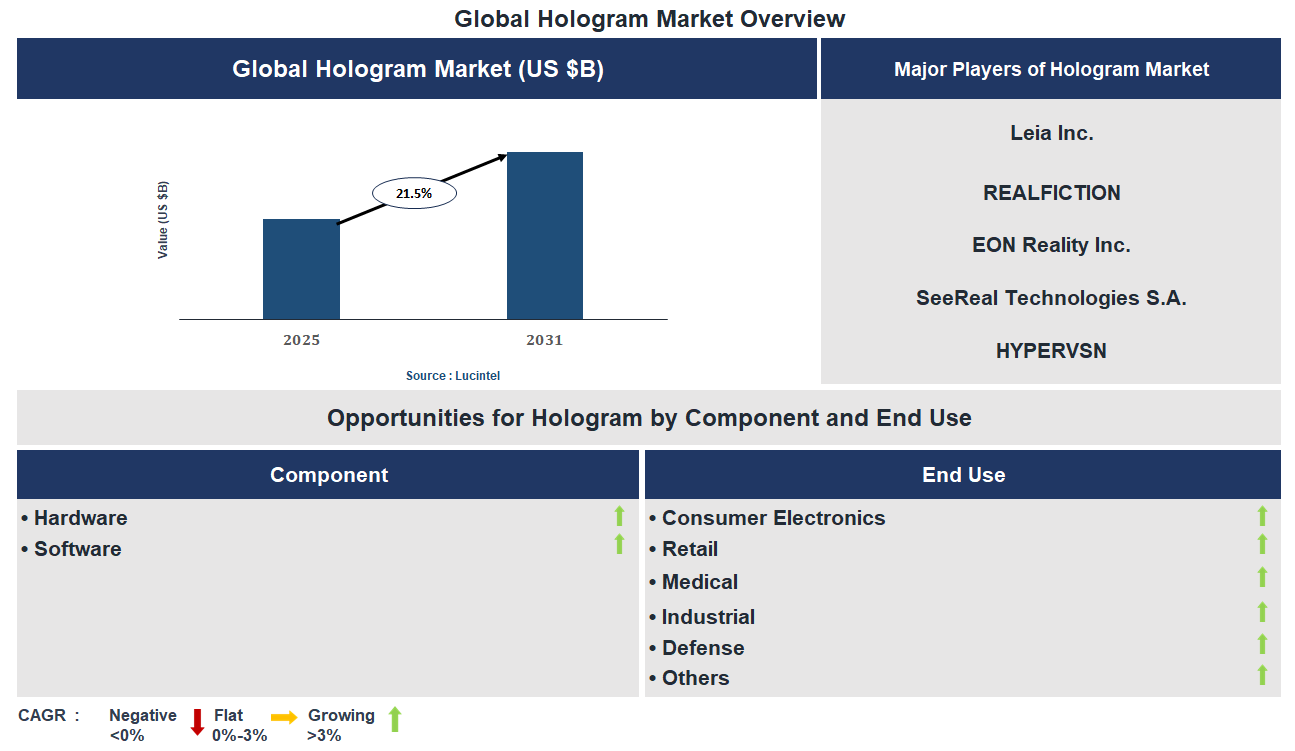
The future of the global hologram market looks promising with opportunities in the consumer electronic, retail, medical, industrial, and defense markets. The global hologram market is expected to grow with a CAGR of 21.5% from 2025 to 2031. The major drivers for this market are the increasing demand for immersive visual displays, the rising use of holographic security features, and the growing adoption of interactive hologram applications.• Lucintel forecasts that, within the component category, software is expected to witness higher growth over the forecast period.
• Within the end use category, medical is expected to witness the highest growth.
• In terms of region, North America is expected to witness the highest growth over the forecast period. Gain valuable insights for your business decisions with our comprehensive 150+ page report. Sample figures with some insights are shown below.
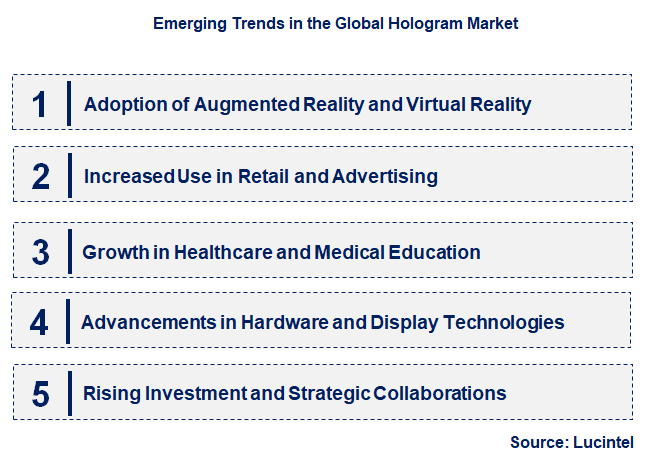
Emerging Trends in the Hologram Market
The hologram market is experiencing rapid growth driven by technological advancements, increasing demand across various industries, and evolving consumer preferences. As businesses seek innovative ways to engage audiences, the integration of holographic technology is becoming more prevalent. This market is characterized by a shift towards more immersive, realistic, and accessible hologram solutions, which are transforming sectors such as entertainment, retail, healthcare, and education. The following key trends highlight the major developments shaping the future of the hologram industry, reflecting its expanding scope and potential for disruptive innovation.• Adoption of Augmented Reality and Virtual Reality: The integration of AR and VR with holographic technology is creating more immersive experiences. These combined technologies enable users to interact with 3D holograms in real-time, enhancing applications in gaming, training, and virtual meetings. This trend is driving demand for more sophisticated hologram displays and content, making holography more accessible and engaging for consumers and businesses alike.
• Increased Use in Retail and Advertising: Retailers and advertisers are leveraging holograms to create captivating product displays and immersive marketing campaigns. Holographic displays attract customer attention, improve brand engagement, and enable virtual try-ons or product demonstrations without physical contact. This trend is transforming traditional advertising methods, offering innovative ways to connect with consumers and boost sales through memorable visual experiences.
• Growth in Healthcare and Medical Education: Holograms are increasingly used for medical visualization, surgical planning, and training. They provide detailed 3D representations of anatomy, enabling healthcare professionals to better understand complex structures and improve surgical outcomes. In education, holograms facilitate interactive learning, making complex medical concepts more comprehensible. This trend enhances precision, reduces training costs, and improves patient care.
• Advancements in Hardware and Display Technologies: The development of lightweight, high-resolution holographic displays and projectors is making holograms more practical and portable. Innovations such as laser plasma, light field displays, and transparent screens are improving image quality and user experience. These technological improvements are expanding the applications of holography, reducing costs, and increasing adoption across various sectors.
• Rising Investment and Strategic Collaborations: Major tech companies and startups are investing heavily in hologram research and development. Strategic partnerships are forming to accelerate innovation, develop new applications, and commercialize holographic solutions. Increased funding and collaboration are fueling market growth, driving the creation of more advanced, affordable, and scalable hologram products, and positioning holography as a key component of future digital ecosystems. In summary, these emerging trends are significantly reshaping the hologram market by making holographic technology more immersive, versatile, and accessible. They are fostering innovation across industries, enhancing user engagement, and opening new revenue streams. As these developments continue, the market is poised for rapid expansion, with holography becoming an integral part of digital transformation strategies worldwide.
Recent Development in the Hologram Market
The hologram market has experienced significant growth driven by technological advancements, increasing adoption across various industries, and rising consumer demand for immersive experiences. As businesses seek innovative ways to engage audiences and enhance product offerings, hologram technology is becoming more accessible and versatile. Recent developments reflect a shift towards more realistic, cost-effective, and scalable hologram solutions, expanding their application scope. These innovations are transforming sectors such as entertainment, retail, healthcare, and education, creating new opportunities and competitive advantages. The markets evolution is also influenced by increased investments and strategic collaborations, positioning hologram technology as a key driver of future digital experiences.• Advancements in Display Technology: Improved resolution and brightness have enhanced hologram realism, making displays more vivid and lifelike. This development boosts consumer engagement and broadens application possibilities, especially in entertainment and advertising, by providing more immersive visual experiences.
• Integration with Augmented Reality and Virtual Reality: Combining holograms with AR and VR creates seamless mixed-reality environments. This integration enhances training, gaming, and remote communication, leading to more interactive and engaging user experiences, and expanding market reach.
• Cost Reduction and Scalability: Innovations in manufacturing and materials have lowered production costs, making hologram solutions more affordable for small and medium-sized enterprises. This democratization accelerates adoption across diverse sectors, fostering market growth and diversification.
• Real-Time Holography and Interactivity: Development of real-time, interactive holograms enables dynamic content manipulation and user interaction. This advancement is particularly impactful in live events, retail displays, and medical visualization, increasing engagement and functionality.
• Strategic Collaborations and Investments: Major tech firms and startups are forming partnerships and investing heavily in hologram technology. These collaborations accelerate innovation, expand market applications, and enhance commercialization efforts, positioning holograms as mainstream solutions. In summary, these recent developments are significantly transforming the hologram market by improving visual quality, reducing costs, and expanding application areas. The integration with AR/VR and real-time interactivity are creating more immersive and engaging experiences, while strategic investments are fueling innovation and market expansion. Overall, these trends are driving rapid growth and establishing hologram technology as a vital component of future digital ecosystems.
Strategic Growth Opportunities in the Hologram Market
The hologram market is experiencing rapid expansion driven by technological advancements and increasing demand across various industries. As businesses seek innovative ways to enhance customer engagement, training, and data visualization, hologram technology is becoming a pivotal tool. Key applications such as entertainment, retail, healthcare, education, and defense are witnessing significant growth opportunities. These developments are shaping the future landscape of the hologram industry, offering new revenue streams and competitive advantages. Companies investing in these areas are poised to capitalize on emerging trends, ensuring sustained market growth and technological leadership.• Immersive experiences : The entertainment industry is leveraging holograms for concerts, movies, and gaming, creating highly engaging and realistic experiences that attract larger audiences and generate new revenue streams.
• Enhanced customer engagement : Retailers are adopting holograms for virtual try-ons and product displays, improving customer interaction, reducing return rates, and increasing sales through innovative shopping experiences.
• Medical visualization : Holograms are transforming healthcare by enabling detailed 3D visualization of anatomy for surgical planning, training, and diagnostics, leading to improved patient outcomes and more effective medical procedures.
• Interactive learning tools : Educational institutions are integrating holograms to provide interactive, engaging lessons that enhance understanding of complex concepts, fostering better student engagement and learning retention.
• Advanced training and simulation : The defense sector is utilizing holograms for realistic training simulations and strategic planning, reducing costs and risks while improving preparedness and operational efficiency. In summary, these growth opportunities across key applications are significantly impacting the hologram market by expanding its use cases, increasing adoption, and driving innovation. This diversification is fostering market resilience and positioning hologram technology as a vital component across multiple sectors, ultimately accelerating industry growth and technological progress.
Hologram Market Driver and Challenges
The hologram market is influenced by a variety of technological, economic, and regulatory factors that shape its growth trajectory. Advances in display technology, increased demand for immersive experiences, and the proliferation of digital content are key drivers. Simultaneously, regulatory challenges related to intellectual property and data security, along with economic fluctuations, impact market expansion. The integration of holography into various sectors such as entertainment, healthcare, and retail further propels growth, while technological limitations and high implementation costs pose significant hurdles. Understanding these drivers and challenges is essential for stakeholders aiming to capitalize on emerging opportunities and navigate potential risks within this dynamic industry. The factors responsible for driving the hologram market include:• Technological Advancements: The rapid development of holographic display technologies, such as volumetric displays and augmented reality, has significantly enhanced the quality, affordability, and accessibility of holograms. These innovations enable more realistic and interactive experiences, fueling adoption across entertainment, advertising, and education sectors. As technology continues to evolve, the market benefits from improved performance and reduced costs, encouraging broader deployment and integration into various applications.
• Increasing Demand for Immersive Experiences: Consumers and businesses are seeking more engaging and immersive content, driven by the rise of virtual events, gaming, and experiential marketing. Holograms offer a unique way to captivate audiences, providing three-dimensional visuals that enhance storytelling and brand engagement. This demand is particularly prominent in retail, entertainment, and corporate presentations, creating a robust growth environment for hologram solutions.
• Growing Adoption in Healthcare and Education: The healthcare sector leverages holography for medical imaging, surgical planning, and training, improving precision and outcomes. Similarly, educational institutions utilize holograms for interactive learning, making complex concepts more understandable. The expanding use cases in these sectors are expanding market reach and driving technological innovation, ultimately contributing to increased market size and diversification.
• Rising Investment and Strategic Collaborations: Increased funding from venture capitalists, government initiatives, and corporate investments are accelerating research and development in holography. Strategic collaborations between technology providers and end-user industries facilitate the deployment of advanced hologram solutions. These investments support product innovation, market expansion, and the development of scalable, cost-effective holographic systems. The challenges facing this hologram market include:
• High Implementation Costs: The deployment of holographic technology often requires significant capital investment in hardware, software, and infrastructure. These costs can be prohibitive for small and medium-sized enterprises, limiting widespread adoption. Additionally, ongoing maintenance and updates add to the financial burden, slowing market penetration and scalability.
• Technological Limitations: Despite rapid advancements, hologram technology still faces challenges such as limited resolution, viewing angles, and brightness. These technical constraints hinder the creation of fully realistic and seamless holographic displays, affecting user experience and acceptance. Overcoming these limitations requires substantial research and development, which can be time-consuming and costly.
• Regulatory and Intellectual Property Concerns: The evolving regulatory landscape around data security, privacy, and intellectual property rights poses hurdles for hologram market growth. Issues related to content ownership, licensing, and compliance can delay product launches and restrict deployment in certain regions. Navigating these legal complexities is essential to ensure market stability and protect innovations. In summary, the hologram market is driven by technological progress, increasing demand for immersive content, and expanding applications in healthcare and education. However, high costs, technological limitations, and regulatory challenges present significant obstacles. These factors collectively influence the pace and scope of market growth, requiring stakeholders to innovate strategically and address barriers proactively. The overall impact suggests a promising yet cautious outlook, with ongoing developments poised to unlock new opportunities while navigating existing challenges.
List of Hologram Companies
Companies in the market compete on the basis of product quality offered. Major players in this market focus on expanding their manufacturing facilities, R&D investments, infrastructural development, and leverage integration opportunities across the value chain. With these strategies hologram companies cater increasing demand, ensure competitive effectiveness, develop innovative products & technologies, reduce production costs, and expand their customer base. Some of the hologram companies profiled in this report include-• Leia Inc.
• REALFICTION
• EON Reality Inc.
• SeeReal Technologies S.A.
• HYPERVSN
• Looking Glass
• Real View Imaging
• Holoxica Limited
• Qualcomm Technologies
• Holotech Switzerland AG
Hologram Market by Segment
The study includes a forecast for the global hologram market by component, end use, and region.Hologram Market by Component [Value from 2019 to 2031]:
• Hardware
• Software
Hologram Market by End Use [Value from 2019 to 2031]:
• Consumer Electronics
• Retail
• Medical
• Industrial
• Defense
• Others
Hologram Market by Region [Value from 2019 to 2031]:
• North America
• Europe
• Asia Pacific
• The Rest of the World
Country Wise Outlook for the Hologram Market
The hologram market has experienced significant growth driven by technological advancements, increased adoption across various industries, and rising consumer demand for immersive experiences. As digital transformation accelerates globally, countries are investing heavily in holographic technology to enhance communication, entertainment, education, and retail sectors. Innovations in display quality, cost reduction, and integration with augmented reality are further propelling market expansion. Governments and private enterprises are collaborating to develop cutting-edge hologram solutions, positioning themselves as leaders in this emerging industry. The following summaries highlight recent developments in the hologram market across the United States, China, Germany, India, and Japan.• United States: The US has seen rapid adoption of holographic displays in entertainment, advertising, and corporate communications. Major tech companies are investing in hologram-based virtual meetings and product showcases, with advancements in 3D projection and augmented reality integration. Universities and research institutions are pioneering new holographic imaging techniques, while startups are developing affordable hologram devices for consumer use. The government is also supporting innovation through grants and partnerships, fostering a vibrant hologram ecosystem.
• China: China is rapidly expanding its hologram industry, focusing on commercial applications such as retail, tourism, and education. The country has launched several large-scale holographic exhibitions and immersive experiences, leveraging government support to promote technological innovation. Chinese firms are developing high-resolution holographic displays and integrating AI to enhance interactivity. The market is also witnessing increased investment in hologram-based smart city projects and entertainment venues, positioning China as a global leader in holographic technology.
• Germany: Germany emphasizes industrial and automotive applications of holograms, particularly for design visualization and training simulations. The country’s strong engineering and manufacturing sectors are adopting holographic solutions to improve product development processes. Research institutions are collaborating with industry to refine hologram projection techniques and develop standards for quality and interoperability. Additionally, Germany is exploring holographic applications in healthcare, such as medical imaging and surgical planning, supported by government-funded research initiatives.
• India: India’s hologram market is experiencing growth driven by the entertainment, advertising, and retail sectors. Local startups are creating affordable hologram displays for marketing campaigns and live events. The government’s Digital India initiative is encouraging the adoption of holographic technology to enhance digital communication and education. Universities are incorporating holography into their curricula, and collaborations with international firms are fostering innovation. The market is also seeing increased interest in hologram-based security features for currency and identification documents.
• Japan: Japan continues to lead in holographic research and development, with a focus on consumer electronics, gaming, and entertainment. Major corporations are developing holographic displays for smartphones, tablets, and gaming consoles. The country’s advanced technological infrastructure supports high-quality hologram production and deployment. Japan is also exploring hologram applications in healthcare, such as telemedicine and medical training. Government and private sector collaborations aim to push the boundaries of holographic technology, making it more accessible and integrated into daily life.

Features of the Global Hologram Market
Market Size Estimates: Hologram market size estimation in terms of value ($B). Trend and Forecast Analysis: Market trends (2019 to 2024) and forecast (2025 to 2031) by various segments and regions. Segmentation Analysis: Hologram market size by component, end use, and region in terms of value ($B). Regional Analysis: Hologram market breakdown by North America, Europe, Asia Pacific, and Rest of the World. Growth Opportunities: Analysis of growth opportunities in different components, end uses, and regions for the hologram market. Strategic Analysis: This includes M&A, new product development, and competitive landscape of the hologram market. Analysis of competitive intensity of the industry based on Porter’s Five Forces model.
FAQ
Q1. What is the growth forecast for hologram market? Answer: The global hologram market is expected to grow with a CAGR of 21.5% from 2025 to 2031. Q2. What are the major drivers influencing the growth of the hologram market? Answer: The major drivers for this market are the increasing demand for immersive visual displays, the rising use of holographic security features, and the growing adoption of interactive hologram applications. Q3. What are the major segments for hologram market? Answer: The future of the hologram market looks promising with opportunities in the consumer electronic, retail, medical, industrial, and defense markets. Q4. Who are the key hologram market companies? Answer: Some of the key hologram companies are as follows:• Leia Inc.
• REALFICTION
• EON Reality Inc.
• SeeReal Technologies S.A.
• HYPERVSN
• Looking Glass
• Real View Imaging
• Holoxica Limited
• Qualcomm Technologies
• Holotech Switzerland AG Q5. Which hologram market segment will be the largest in future? Answer: Lucintel forecasts that, within the component category, software is expected to witness higher growth over the forecast period. Q6. In hologram market, which region is expected to be the largest in next 5 years? Answer: In terms of region, North America is expected to witness the highest growth over the forecast period. Q7. Do we receive customization in this report? Answer: Yes, Lucintel provides 10% customization without any additional cost.
Table of Contents
List of Figures
List of Tables
Methodology
- In-depth interviews of the major players in this market
- Detailed secondary research from competitors’ financial statements and published data
- Extensive searches of published works, market, and database information pertaining to industry news, company press releases, and customer intentions
- A compilation of the experiences, judgments, and insights of Lucintel’s professionals, who have analyzed and tracked this market over the years.


Buy Now
Choose a license that fits your team. Instant PDF delivery.
Prices exclude taxes. Instant delivery. Custom licensing available on request.
Key Questions
- • What are some of the most promising, high-growth opportunities for the hologram market by component (hardware and software), end use (consumer electronics, retail, medical, industrial, defense, and others), and region (North America, Europe, Asia Pacific, and the Rest of the World)?
- • Which segments will grow at a faster pace and why?
- • Which region will grow at a faster pace and why?
- • What are the key factors affecting market dynamics? What are the key challenges and business risks in this market?
- • What are the business risks and competitive threats in this market?
- • What are the emerging trends in this market and the reasons behind them?
- • What are some of the changing demands of customers in the market?
- • What are the new developments in the market? Which companies are leading these developments?
- • Who are the major players in this market? What strategic initiatives are key players pursuing for business growth?
- • What are some of the competing products in this market and how big of a threat do they pose for loss of market share by material or product substitution?
- • What M&A activity has occurred in the last 5 years and what has its impact been on the industry? For any questions related to Hologram Market, Hologram Market Size, Hologram Market Growth, Hologram Market Analysis, Hologram Market Report, Hologram Market Share, Hologram Market Trends, Hologram Market Forecast, Hologram Companies, write Lucintel analyst at email: helpdesk@lucintel.com. We will be glad to get back to you soon.


