
Report Feature
High Temperature Resistant Phytase Trends and Forecast
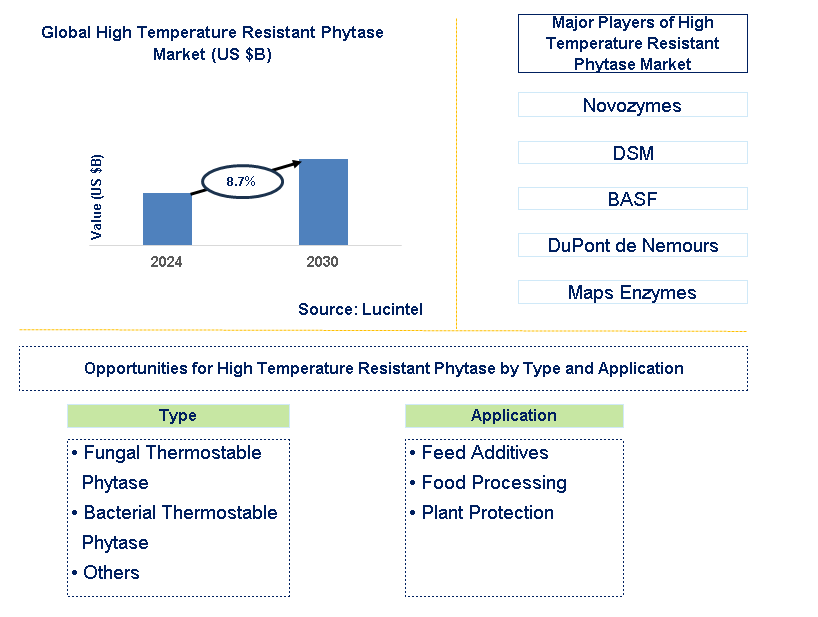
The future of the global high temperature resistant phytase market looks promising with opportunities in the feed additive, food processing, and plant protection markets. The global high temperature resistant phytase market is expected to grow with a CAGR of 8.7% from 2024 to 2030. The major drivers for this market are increasing emphasis on sustainable agriculture practices, rising demand for high-quality animal feed, and growing awareness about the environmental benefits of phytases.• Lucintel forecasts that, within the type category, fungal thermostable phytase is expected to witness higher growth over the forecast period as it delivers higher thermal stability for feed processing.
• Within application category, food processing is expected to witness highest growth due to rising demand for cleaner and more sustainable food production processes.
• In terms of region, APAC will remain the largest region over the forecast period due to expansion of livestock industry and growing feed production in the region. Gain valuable insights for your business decisions with our comprehensive 150+ page report.
Emerging Trends in the High Temperature Resistant Phytase Market
Several transformative trends are driving the market for high temperature resistant phytase market, supported by technological development and changing demands across industries.• Increased Focus on Genetic Engineering: Genetic engineering has transformed phytase production, leading to higher levels of thermal stability and effectiveness. Genetic manipulation by companies enables the production of phytase variants with increased activity at higher temperatures, thus improving feed efficiency and savings for producers.
• Emerging Sustainable Feed Solutions: There is increasing demand for sustainable feed solutions that minimize environmental impact. High-temperature-resistant phytase helps reduce phosphorus waste in animal feed, contributing to greener livestock farming. This trend aligns with global efforts to reduce ecological footprints and enhance resource efficiency.
• Integration of Phytase in Precision Agriculture: Precision agriculture is driving the use of high-temperature-resistant phytase in value-added feed formulation. Producers tailor phytase usage to specific agricultural conditions to ensure better nutrient utilization and improve overall feed performance, thereby promoting more efficient farming at reduced costs.
• Aquaculture Expanding Applications of Phytase: The enzyme’s applications are expanding to aquaculture in addition to conventional livestock. It is effective in high-temperature aquatic conditions, enhancing feed efficiency in fish and shrimp.
• Introduction of Novel Delivery Systems: Innovations in delivery systems have enhanced stability and effectiveness by making phytase resistant to high temperatures in feed. These systems, including encapsulation technologies, protect enzymes from degradation during processing and storage, ensuring consistent performance and maximizing benefits. These emerging trends broaden opportunities for innovation, sustainability, and the application range of high temperature resistant phytase. The growing convergence of these trends fosters an environment rich in collaboration, influencing the development of high-performance enzyme solutions to meet evolving needs in agriculture and animal nutrition.

Recent Developments in the High Temperature Resistant Phytase Market
Recent developments in the high temperature resistant phytase market reflect growth in biotechnology and rising demand for the enzyme across industries. These advances further enhance enzyme performance, applications, and market growth.• Development of Enzyme Variants: Genetic modification and protein engineering are being used to develop new phytase variants with improved stability and activity at high temperatures. This development facilitates cost reduction and efficiency enhancement in animal feed, especially for poultry and swine.
• Improved Stability through Encapsulation: New encapsulation technologies are being introduced to enhance stability and efficacy at high temperatures. Encapsulation protects enzymes against environmental factors during processing and storage, ensuring consistent performance and maximizing enzyme benefits in feed applications.
• Increased Investment in R&D: Significant investments in research and development are driving innovation in high-temperature-resistant phytase. New biotechnological methods and partnerships are advancing enzyme technology, leading to more effective and versatile phytase solutions.
• Entry into New Markets: High-temperature-resistant phytase is entering emerging markets, especially in Asia and Latin America. The demand for efficient animal feed solutions and the adoption of advanced enzyme technologies are the main drivers of growth in these regions. Recent developments in high temperature resistant phytase have improved enzyme performance, expanded market reach, and promoted sustainability. The market continues to evolve to meet the demands of modern agriculture and animal nutrition.
Strategic Growth Opportunities in the High Temperature Resistant Phytase Market
Strategic growth opportunities are emerging in the high temperature resistant phytase market across various applications. Rising demand for effective and resource-efficient feed solutions is driving these opportunities.• Optimization of Poultry Feed: High temperature resistant phytase presents significant growth potential in the poultry industry. The enzyme enhances phosphorus utilization and reduces feed costs, supporting the demand for optimized feed solutions in commercial poultry production.
• Swine Feed Efficiency: There is increasing use of high temperature resistant phytase in swine feed to enhance nutrient absorption and feeding efficiency. This demand reflects the need for cost-effective feed solutions, contributing to improved growth performance and reduced environmental impact.
• Aquaculture Nutrition: High temperature resistant phytase is gaining traction in aquaculture due to its performance in aquatic environments. The enzyme improves feed efficiency and nutrient utilization in fish and shrimp farming.
• Applications in Ruminant Feed: Interest in using high temperature resistant phytase in ruminant feed, particularly for dairy and beef cattle, is growing. The enzyme improves phosphorus availability and feed efficiency, contributing to better performance and sustainability in livestock production.
• Emerging Markets: Expanding into emerging markets offers growth opportunities for high-temperature-resistant phytase. The demand for advanced feed solutions in Asian, Latin American, and African regions is opening new avenues for development. These growth opportunities drive innovation and market expansion in the high temperature resistant phytase sector. Addressing specific regional needs allows companies to capitalize on emerging trends and improve their market position.
High Temperature Resistant Phytase Market Driver and Challenges
The high temperature resistant phytase market is influenced by various drivers and challenges, including technological, economic, and regulatory factors. Understanding these elements is crucial in navigating shifting market dynamics. The factors driving the high temperature resistant phytase market include:• Technological Advances: Biotechnology and genetic engineering are improving high-temperature-resistant phytase, resulting in more stable and efficient enzymes that enhance feed efficiency and reduce costs.
• Growing Demand for Sustainable Solutions: The focus on sustainability in agriculture drives demand for enzymes that reduce phosphorus waste and improve feed efficiency, aligning with global environmental goals.
• Increased Animal Feed Expenses: Rising feed costs are prompting the use of high-temperature-resistant phytase to optimize feed utilization and reduce expenses. Nutritional enzymes that enhance absorption and performance offer cost-effective solutions for animal producers.
• Expansion of Livestock and Aquaculture Industries: The growth of livestock and aquaculture industries increases the demand for heat resistant phytase, pushing the need for practical and stable feed solutions.
• Regulatory Support for Phytase Use: Favorable regulations encourage phytase application in animal feed, promoting the adoption of high temperature resistant enzymes across industries. Challenges in the high temperature resistant phytase market include:
• High Manufacturing Costs: The production of high temperature resistant phytase is costly due to sophisticated biotechnology, potentially making the product unaffordable in some markets.
• Regulatory Compliance: Companies must meet complex regulatory standards, requiring time and resources to ensure compliance with all requirements.
• Market Competition: Intense competition among enzyme manufacturers can pressure prices and margins, necessitating continuous innovation to remain competitive. Drivers and challenges shape the growth and evolution of the high temperature resistant phytase market. While technological advancements and sustainability trends offer opportunities, production costs and regulatory hurdles pose challenges. Understanding these dynamics helps navigate the market effectively.
List of High Temperature Resistant Phytase Companies
Companies in the market compete on the basis of product quality offered. Major players in this market focus on expanding their manufacturing facilities, R&D investments, infrastructural development, and leverage integration opportunities across the value chain. Through these strategies high temperature resistant phytase companies cater increasing demand, ensure competitive effectiveness, develop innovative products & technologies, reduce production costs, and expand their customer base. Some of the high temperature resistant phytase companies profiled in this report include-• Novozymes
• DSM
• BASF
• DuPont de Nemours
• Maps Enzymes
High Temperature Resistant Phytase by Segment
The study includes a forecast for the global high temperature resistant phytase by type, application, and region.High Temperature Resistant Phytase Market by Type [Analysis by Value from 2018 to 2030]:
• Fungal Thermostable Phytase
• Bacterial Thermostable Phytase
• Others
High Temperature Resistant Phytase Market by Application [Analysis by Value from 2018 to 2030]:
• Feed Additives
• Food Processing
• Plant Protection
High Temperature Resistant Phytase Market by Region [Analysis by Value from 2018 to 2030]:
• North America
• Europe
• Asia Pacific
• The Rest of the World
Country Wise Outlook for the High Temperature Resistant Phytase Market
The high temperature resistant phytase market has gained significant momentum with advances in biotechnology and the rising demand for efficient solutions in animal feed. Marked by new enzyme formulations, their application has been extended to agriculture and animal nutrition. Further development across industries in the US, China, Germany, India, and Japan has created demand for robust, temperature-stable enzymes that reflect changing priorities toward greener and more economically viable alternatives.• United States: The boosting of research and development activities for the improvement of the thermal stability of the phytase enzymes observed in the region. Key players have employed the use of genetic engineering to produce new variants of phytase, which in turn have provided economical productivity at a very high temperature. These resultant developments were the release of new products, custom-made to the requirements of the poultry and swine industries for maximum utilization of phosphorus.
• China has emerged as a center for high temperature resistant phytase development, with increasing investments in the agriculture biotechnology sector of the country. Local companies are developing their phytase formulations, which enhance feed efficiency under unfriendly weather conditions. This is in conjunction with the holistic goals of the country to improve the productivity of livestock and reduce environmental impacts as compared to conventional feed.
• Germany: In return, Germany looks to integrate high temperature resistant phytase into its precision farming approach. Be it is research institutions or companies, both are attempting to come up with phytase enzymes that resist high temperatures and increase nutrient availability in diverse feed matrices. This approach will support the German commitments of sustainability and innovation in Animal Nutrition.
• India: With an increasing awareness of its potential benefits, there is unmistakably higher consumption of high temperature-resistant phytase in poultry and aqua feed in India. With the help of advanced biotechnological production techniques, Indian producers are looking at offering cost-efficient phytase solutions that help increase feed efficiency for boosting the fast-growing livestock sector in the country.
• Japan: The development of high temperature resistant phytase in Japan is focused on increasing the stability and performance of the enzyme by advanced biotechnological methods. In this regard, Japanese companies are targeting the production of phytase variants required to meet the specific demands for high-temperature feed processing in tune with Japan's concerns for precision and quality in agriculture.

Features of the Global High Temperature Resistant Phytase Market
Market Size Estimates: High temperature resistant phytase market size estimation in terms of value ($B). Trend and Forecast Analysis: Market trends (2018 to 2023) and forecast (2024 to 2030) by various segments and regions. Segmentation Analysis: High temperature resistant phytase market size by type, application, and region in terms of value ($B). Regional Analysis: High temperature resistant phytase market breakdown by North America, Europe, Asia Pacific, and Rest of the World. Growth Opportunities: Analysis of growth opportunities in different types, applications, and regions for the high temperature resistant phytase market. Strategic Analysis: This includes M&A, new product development, and competitive landscape of the high temperature resistant phytase market. Analysis of competitive intensity of the industry based on Porter’s Five Forces model.If you are looking to expand your business in this market or adjacent markets, then contact us. We have done hundreds of strategic consulting projects in market entry, opportunity screening, due diligence, supply chain analysis, M & A, and more.

FAQ
Q1. What is the growth forecast for high temperature resistant phytase market? Answer: The global high temperature resistant phytase market is expected to grow with a CAGR of 8.7% from 2024 to 2030. Q2. What are the major drivers influencing the growth of the high temperature resistant phytase market? Answer: The major drivers for this market are increasing emphasis on sustainable agriculture practises, rising demand for high-quality animal feed and growing awareness about the environmental benefits of phytases. Q3. What are the major segments for high temperature resistant phytase market? Answer: The future of the high temperature resistant phytase market looks promising with opportunities in the feed additive, food processing, and plant protection markets. Q4. Who are the key high temperature resistant phytase market companies? Answer: Some of the key high temperature resistant phytase companies are as follows:• Novozymes
• DSM
• BASF
• DuPont de Nemours
• Maps Enzymes Q5. Which high temperature resistant phytase market segment will be the largest in future? Answer: Lucintel forecasts that fungal thermostable phytase is expected to witness higher growth over the forecast period as it delivers higher thermal stability for feed processing. Q6. In high temperature resistant phytase market, which region is expected to be the largest in next 5 years? Answer: APAC will remain the largest region over the forecast period due to expansion of livestock industry and growing feed production in the region. Q7. Do we receive customization in this report? Answer: Yes, Lucintel provides 10% customization without any additional cost.
Table of Contents
Methodology
- In-depth interviews of the major players in this market
- Detailed secondary research from competitors’ financial statements and published data
- Extensive searches of published works, market, and database information pertaining to industry news, company press releases, and customer intentions
- A compilation of the experiences, judgments, and insights of Lucintel’s professionals, who have analyzed and tracked this market over the years.


Buy Now
Choose a license that fits your team. Instant PDF delivery.
Prices exclude taxes. Instant delivery. Custom licensing available on request.
Key Questions
- • What are some of the most promising, high-growth opportunities for the high temperature resistant phytase market by type (fungal thermostable phytase, bacterial thermostable phytase, and others), application (feed additives, food processing, and plant protection), and region (North America, Europe, Asia Pacific, and the Rest of the World)?
- • Which segments will grow at a faster pace and why?
- • Which region will grow at a faster pace and why?
- • What are the key factors affecting market dynamics? What are the key challenges and business risks in this market?
- • What are the business risks and competitive threats in this market?
- • What are the emerging trends in this market and the reasons behind them?
- • What are some of the changing demands of customers in the market?
- • What are the new developments in the market? Which companies are leading these developments?
- • Who are the major players in this market? What strategic initiatives are key players pursuing for business growth?
- • What are some of the competing products in this market and how big of a threat do they pose for loss of market share by material or product substitution?
- • What M&A activity has occurred in the last 5 years and what has its impact been on the industry? For any questions related to High Temperature Resistant Phytase Market, High Temperature Resistant Phytase Market Size, High Temperature Resistant Phytase Market Growth, High Temperature Resistant Phytase Market Analysis, High Temperature Resistant Phytase Market Report, High Temperature Resistant Phytase Market Share, High Temperature Resistant Phytase Market Trends, High Temperature Resistant Phytase Market Forecast, High Temperature Resistant Phytase Companies, write Lucintel analyst at email: helpdesk@lucintel.com. We will be glad to get back to you soon.


