
Report Feature
High Speed Motor Market Trends and Forecast
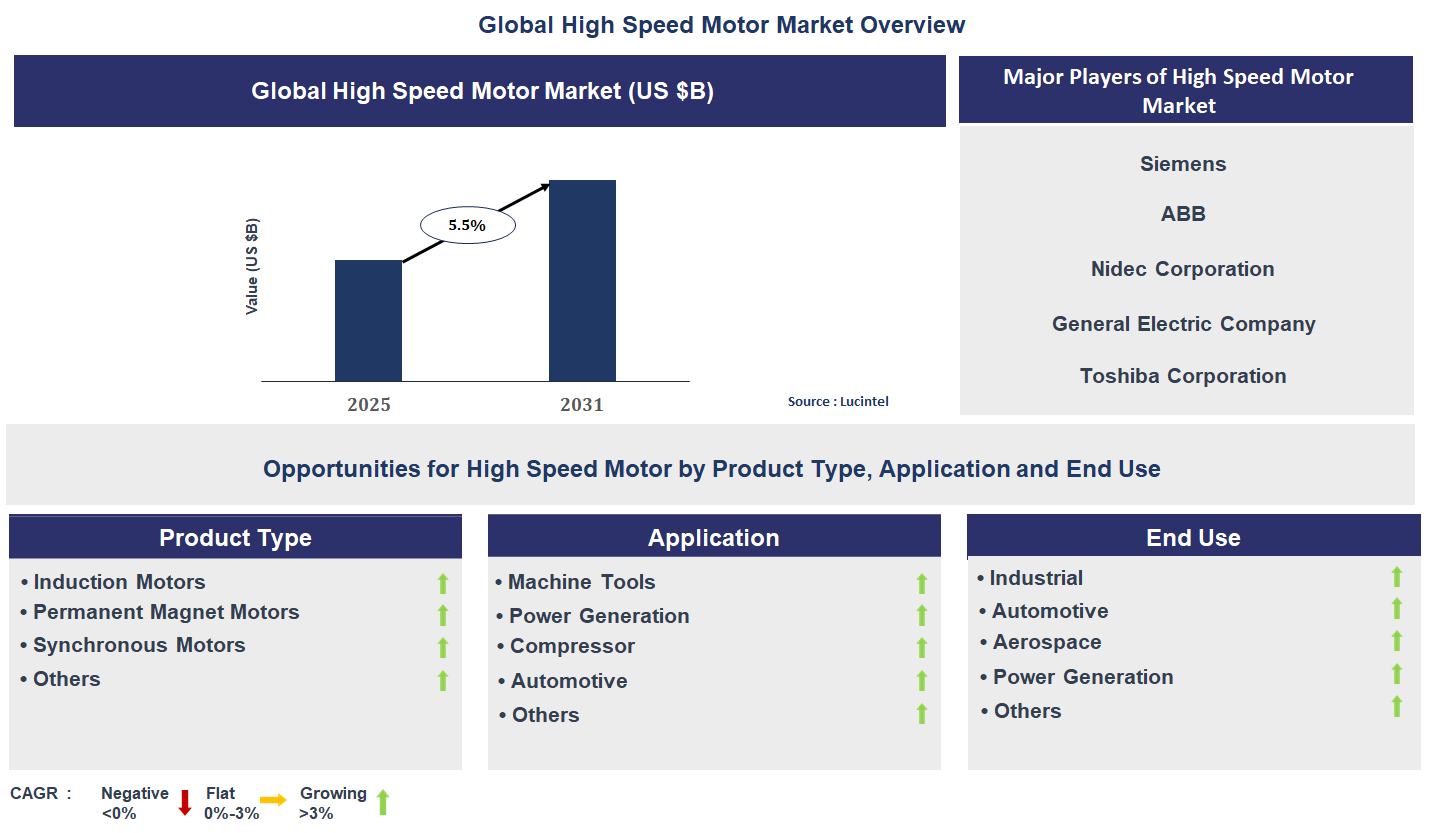
The future of the global high speed motor market looks promising with opportunities in the industrial, automotive, aerospace, and power generation markets. The global high speed motor market is expected to grow with a CAGR of 5.5% from 2025 to 2031. The major drivers for this market are the increasing use in industrial applications, the rising demand for energy efficiency, and the growing adoption in electric vehicles.• Lucintel forecasts that, within the product type category, induction motor is expected to witness the highest growth over the forecast period.
• Within the end use category, industrial is expected to witness the highest growth.
• In terms of region, APAC is expected to witness the highest growth over the forecast period. Gain valuable insights for your business decisions with our comprehensive 150+ page report. Sample figures with some insights are shown below.
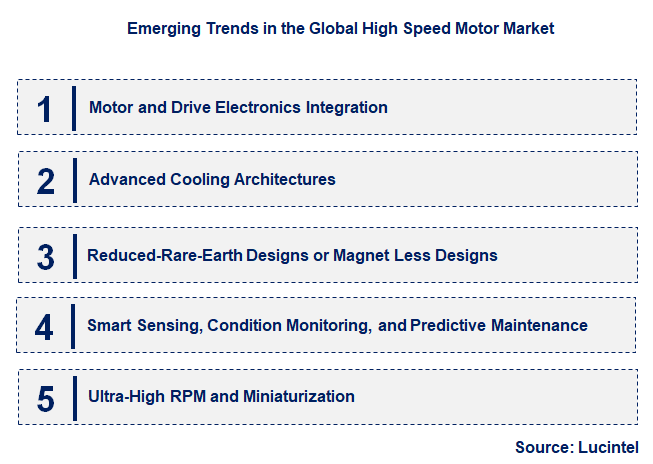
Emerging Trends in the High Speed Motor Market
The high speed motor market is changing fast under the impact of developments in materials, electronics, control systems, and emerging demand from new applications. As increasing numbers of systems need compact, high-power density actuation (drone propulsion, HVAC compressors, machine tools, EV subsystems), motors that can withstand reliable operation at high rotational speeds are becoming core.• Motor and Drive Electronics Integration: There is increasing adoption of embedding inverter and control electronics in or near the motor assembly. This minimizes wiring, losses, and footprint, enables faster dynamic response and tighter control loops, and enhances efficiency, minimizes latency, and streamlines system architecture. Motor-drive packages are more efficient with reduced latency and simplified system architecture. In high-speed motors particularly, compact integration minimizes parasitic inductance and allows for improved thermal management.
• Advanced Cooling Architectures: With higher speeds, heat management is the limiting factor. New cooling methods—such as hybrid air-oil, liquid cooling, internal channels, spray cooling, or heat pipes—are also used to provide thermal integrity without compromising compactness. The architectures enable motors to hold high torque and power densities even at very high speeds. Increased cooling also supports longer life, higher reliability, and larger operating envelopes (higher ambient temperature or duty cycles).
• Reduced-Rare-Earth Designs or Magnet Less Designs: With rare-earth material supply limitations, there is high R&D interest in motor topologies that minimize or eliminate rare-earth magnets, such as switched reluctance motors (SRMs), flux-switching motors, or hybrid-assisted machines. These magnet less or low-magnet machines seek to offer high-speed performance with lower material cost and increased supply independence.
• Smart Sensing, Condition Monitoring, and Predictive Maintenance: Incorporating sensors (temperature, vibration, strain) and integrating motors with IoT or industrial monitoring systems is becoming norm. Such systems facilitate real-time diagnosis, incipient fault detection, and predictive maintenance, which minimize downtime and enhance reliability. For high-speed motors, where mechanical stress and wear are likely to be high, such monitoring is especially beneficial. The feedback information also makes adaptive control approaches feasible to adjust performance in different situations.
• Ultra-High RPM and Miniaturization: A trend towards increasingly high rotational velocities (e.g. > 30,000 rpm or higher) and miniaturization is opening up new aerospace, medical, and micro-robotics applications. Improvements in rotor dynamics, materials (lightweight high strength alloys or composites), precision bearings, and balancing permit safe operation at extreme rotational speeds. This trend allows for more power-dense actuation in limited space, creating new applications (e.g. high-speed spindles, micro-turbines, medical devices) and increasing performance limits for traditional machinery. All these trends—integration of electronics, high-end cooling, magnet less designs, smart sensing, and ultra-high RPM miniaturization—are all together changing the way high-speed motors are designed, constructed, and applied. They shift towards more compact, efficient, reliable, and smart motor systems that can be employed for ever-more demanding applications in industries.
Recent Development in the High Speed Motor Market
Over the past decade, the high speed motor market has seen some transformative advancements that are pushing performance limits, enhancing integration, and minimizing use of limited materials. These advancements are fueled by the industrial needs for compactness, efficiency, and reliability in applications such as aerospace, EVs, automation, and medical devices.• Release of ultra-high RPM brushless motor line: Manufacturers have released brushless servo motors with very high RPMs (e.g., 60,000 rpm) aimed at robotics and precision machinery applications. These motors set a new pace in speed and dynamic response, allowing for finer control, higher-speed machining, and space-saving without gear reduction. They demonstrate faith in heat and mechanical design, and they set the standard for competing products.
• Purchase and consolidation of motor division assets: Major industry players are consolidating their portfolios by purchasing complementary high-speed motor companies. For example, Nidec purchased a high-speed motor unit from another company to expand its robotics and servo business. This consolidation enables OEMs to expand their production, consolidate technology roadmaps, and save costs in manufacturing and R&D.
• Strategic alliances among electric and automation companies: Collaborations among motor manufacturers and automation or controls companies are on the rise. For instance, an alliance between Siemens and Schneider is focused on co‑developing high-speed motor-drive systems with improved digital twin and control features. The collaborations bring together control, simulation, and motor hardware to provide turnkey solutions for the industrial customer.
• Material and cooling innovation for performance enhancement: Development in rotor and stator materials (e.g. new magnetic steels, composites) and enhanced cooling systems (liquid, hybrid, internal channels) are enabling motors to operate at higher speeds with reduced losses. Such developments minimize heat generation, enable greater power density, and make them more reliable. They are essential for guaranteeing high-speed motors to withstand severe duty cycles and a long lifespan.
• Inclusion of smart monitoring and predictive maintenance capabilities: Most modern high-speed motors have in-built sensors and digital connectivity, allowing for real-time monitoring of vibration, temperature, and performance. These functions enable predictive maintenance, fault detection, and adaptive control. This advancement reduces downtime, increases service life, and increases the attractiveness of motors to critical mission applications. These innovations—ultra‑high RPM motors, aggregation of technology assets, partnerships, materials and cooling advances, and smart monitoring integration—are collectively driving the transformation of the high-speed motor industry. They drive towards more efficient, reliable, and integrated motor systems and increase barriers to entry while preferring companies with deep technology and scale.
Strategic Growth Opportunities in the High Speed Motor Market
High speed motor industry is full of opportunities for growth in various application fields. Owing to the fact that these motors have high power density, small size, and high-speed operation, they can create new system designs in applications like aerospace, medical, robotics, EV subsystems, and industrial automation. Following are five areas where high-speed motors offer strategic growth opportunities.• Robotics and Automation Systems: Compact motors provide higher-speed, more accurate motion with less inertia and without the necessity of massive gear reduction systems. In robotics, pick‑and‑place, high-speed manipulators, collaborative robots, and micro‑robots find applications in compact, responsive motors. Demand from the trend for automation in manufacturing, warehousing, and logistics leads to such motors providing premium margins and differentiation.
• Electric Vehicle Subsystems and Auxiliaries: Aside from traction motors, high-speed motors find application in vehicle auxiliaries like turbochargers, superchargers, heating, ventilation, and air conditioning compressors, pumps, and power electronics cooling. Due to their high RPM capabilities, they are able to deliver high efficiency and compact packaging. As electric vehicles become more mainstream, their market for these subsystems is increasing, making high-speed motor application in this segment a promising business opportunity.
• Aerospace and Unmanned Systems: In aerospace, efficiency and weight are the most important factors. Turbomachinery, actuators, and propulsion in drones, electric aircraft, and satellite mechanisms can be powered by high-speed motors. Their light weight and high-speed operation give them an advantage for applications with tight restrictions. Expansion in UAVs, urban air mobility, and electrified aerospace propulsion will drive demand for ultra-efficient high-speed motor technology.
• Medical and Laboratory Instrumentation: Devices like centrifuges, surgical instruments, analytical instruments, and high-speed microfluidic or pump motors are applications for high-speed, compact motors. These industries require high reliability, low noise, and fine speed control. High-speed motors that can satisfy strict performance specifications will increase adoption as medical technology keeps improving and shrinking.
• Industrial Machine Tools, Compressors, and Turbo Machinery: High-speed motors are a natural fit for machine tools in high-precision machining, high-speed spindles, micro milling, and high-speed compressors or blowers. They have the ability to eliminate bulky gearboxes and enhance dynamic performance. As industries seek higher throughput, tighter tolerances, and smaller footprint, high-speed motors in these markets offer a sustainable growth trajectory. These growth prospects in robotics, EV subsystems, aerospace, medical, and industrial machinery are broadening the addressable market for high-speed motors. Companies that design to order and create ecosystems around these application spaces can create value as demand for high-performance motorization in small packages grows across industries.
High Speed Motor Market Driver and Challenges
The high speed motor industry is fueled by a combination of technological, economic, and regulatory drivers. While breakthroughs in materials, electronics, cooling, and automation are freeing up new abilities on the one side, problems such as cost, material sustainability, and integration complexity create hurdles. Knowing the principal drivers and challenges is important for companies to address this changing landscape. The factors responsible for driving the high speed motor market include: 1. Need for High Power Density and Small Systems: Numerous applications call for motors with high torque or power in small space and weight, eliminating or reducing mechanical transmissions. High-speed operation makes this possible, thus making high-speed motors appealing. This driver supports demand in robotics, aerospace, EV subsystems, and precision machining. 2. Increase in Automation, Robotics, and Industry: With factories, warehouses, and processes making investment in automation, demand for rapid, responsive actuation is increasing. High-speed motors provide low inertia and quick acceleration and allow for more throughput. The growth of robotics, particularly in developing economies, spurs volume. 3. Electrification of transportation and subsystems: As EVs, drones, and electrified mobility platforms become widespread, you observe growth in motors for non-traction but high-speed auxiliaries. This trend opens up the market beyond traction motors to compressors, pumps, and so on. 4. Advances in Electronics, Sensors, and Control Systems: The presence of high-frequency drives, sophisticated control algorithms, IoT integration, and on-board sensing makes high-speed motor control more practical. Improved motor control allows stable operation at extremely high RPMs with minimal vibration and high reliability. 5. Pressure to Minimize Dependence on Gearboxes and Mechanical Complexity: In most systems, gearboxes add losses, maintenance, size, and vibration. Many high-speed motors have the ability to eliminate or minimize gearing, enhancing system efficiency and reliability. This move toward simplification and reliability is a powerful driver. Challenges in the high speed motor market are: 1. Cost of Materials and Supply Limitations: High-speed motors usually depend on high-performance materials (rare-earth magnets, advanced alloys, precision bearings). Rare-earth supply volatility, magnet costs, and bearing material volatility presents cost and supply chain risk. 2. Heat Management and Cooling Constraints: At high RPMs, losses and heat generation rise. Good cooling in small form factors is technologically difficult. Thermal restrictions define how much power and torque a high-speed motor can withstand in the long term. 3. System-level and Integration Challenges: It is difficult to integrate high-speed motors with control electronics, mechanical supports, vibration dampening, and system dynamics. Design and validation are increased by issues such as rotor balancing, resonance, coupling, and lifecycle reliability. The compact, high-performance actuation demand in most modern applications is driving the high-speed motor market. Technological enablers such as advanced control, materials, and sensing are accelerating that potential. But cost, thermal limitations, and systems integration continue to be the main challenges. Mastering those will be more beneficial to firms with high engineering capabilities, good supply chains, and cross-disciplinary system-level design skills. In the years ahead, those able to balance reliability, performance, and cost will shape the competitive landscape as the high-speed motor business grows and expands into new areas.List of High Speed Motor Companies
Companies in the market compete on the basis of product quality offered. Major players in this market focus on expanding their manufacturing facilities, R&D investments, infrastructural development, and leverage integration opportunities across the value chain. With these strategies high speed motor companies cater increasing demand, ensure competitive effectiveness, develop innovative products & technologies, reduce production costs, and expand their customer base. Some of the high speed motor companies profiled in this report include-• Siemens
• ABB
• Nidec Corporation
• General Electric Company
• Toshiba Corporation
• Mitsubishi Electric Corporation
• Emerson Electric
• Hitachi
• Bosch Rexroth
• WEG
High Speed Motor Market by Segment
The study includes a forecast for the global high speed motor market by product type, application, end use, and region.High Speed Motor Market by Product Type [Value from 2019 to 2031]:
• Induction Motors
• Permanent Magnet Motors
• Synchronous Motors
• Others
High Speed Motor Market by Application [Value from 2019 to 2031]:
• Machine Tools
• Power Generation
• Compressor
• Automotive
• Others
High Speed Motor Market by End Use [Value from 2019 to 2031]:
• Industrial
• Automotive
• Aerospace
• Power Generation
• Others
High Speed Motor Market by Region [Value from 2019 to 2031]:
• North America
• Europe
• Asia Pacific
• The Rest of the World
Country Wise Outlook for the High Speed Motor Market
The high speed motor industry is increasingly important in fields like aerospace, automation, electric vehicles, and precision machinery. Such motors run at high RPMs (frequently above standard motor speeds), supporting compact, gearless, and high‑power density designs. Emerging trends in materials, cooling, control electronics, and interconnection with smart systems are driving performance limits and broadening the base of applications. Various national markets are embracing or developing high-speed motors in customized manners based on industrial objectives, home manufacturing capabilities, and strategic focus on electrification and automation.• United States: In the United States, high‑speed motor development is closely linked with aerospace, defense, robotics, and advanced manufacturing industries. U.S. companies and research centers are investing in ultra‑high RPM motor structures, enhanced cooling (air, oil, hybrid) and better control electronics (high‑frequency drives, predictive control). Convergence of IoT and condition monitoring is turning into the norm for mission-critical applications with high reliability. Additionally, American companies are driving modular motor-controller packages to minimize the requirement for external converters.
• China: Chinas high-speed motor industry is growing fast, driven by Chinas dominance in electric vehicles, automation, and electronics production. Chinese companies are increasing production of high RPM permanent magnet motors and synchronous motors with high cooling and light weight. They are also localizing supply chains of magnets, rare-earth elements, and precision bearings. China is applying high-speed motors in drones, electric propulsion, high-frequency compressors, and high-speed tools.
• Germany: Industrial and engineering powerhouse Germany is driving high-speed motor innovation through integration with Industry 4.0, automation, and high-precision machine tool industries. German development centers on very efficient motors with low losses, advanced cooling, vibration reduction, and intelligent control. The focus of German industry on energy efficiency and sustainability is leading to growth in the use of high-speed motors within electric compressors, turbo-machinery, and advanced production lines.
• India: In India, the high-speed motor industry is in an early but rapidly expanding phase of development. With expansion in the electric vehicle market, automation, and industrialization, there is growing demand for compact, high-performance motors. Indian companies and research centers are developing motors using local material and tropical climate-friendly designs (durable cooling, dust resistance). India is also looking for alternatives to rare-earth magnets due to supply vulnerabilities.
• Japan: Japan has been a pioneer in high-speed motors traditionally and continues to innovate in high-speed motor design, especially in electronics, robotics, medical, and aerospace applications. Japanese companies are developing ultra-high RPM brushless motors, sophisticated magnetic designs, and highly integrated motor‑drive systems. Cooling, balance of the rotor, and reduction of vibration are the important areas of development. Japans efforts in electrification of mobility, robotics, and micro‑electromechanical systems keep their high-speed motor technology at the forefront worldwide.

Features of the Global High Speed Motor Market
Market Size Estimates: High speed motor market size estimation in terms of value ($B). Trend and Forecast Analysis: Market trends (2019 to 2024) and forecast (2025 to 2031) by various segments and regions. Segmentation Analysis: High speed motor market size by product type, application, end use, and region in terms of value ($B). Regional Analysis: High speed motor market breakdown by North America, Europe, Asia Pacific, and Rest of the World. Growth Opportunities: Analysis of growth opportunities in different product types, applications, end uses, and regions for the high speed motor market. Strategic Analysis: This includes M&A, new product development, and competitive landscape of the high speed motor market. Analysis of competitive intensity of the industry based on Porter’s Five Forces model.
FAQ
Q1. What is the growth forecast for high speed motor market? Answer: The global high speed motor market is expected to grow with a CAGR of 5.5% from 2025 to 2031. Q2. What are the major drivers influencing the growth of the high speed motor market? Answer: The major drivers for this market are the increasing use in industrial applications, the rising demand for energy efficiency, and the growing adoption in electric vehicles. Q3. What are the major segments for high speed motor market? Answer: The future of the high speed motor market looks promising with opportunities in the industrial, automotive, aerospace, and power generation markets. Q4. Who are the key high speed motor market companies? Answer: Some of the key high speed motor companies are as follows:• Siemens
• ABB
• Nidec Corporation
• General Electric Company
• Toshiba Corporation
• Mitsubishi Electric Corporation
• Emerson Electric
• Hitachi
• Bosch Rexroth
• WEG Q5. Which high speed motor market segment will be the largest in future? Answer: Lucintel forecasts that, within the product type category, induction motor is expected to witness the highest growth over the forecast period. Q6. In high speed motor market, which region is expected to be the largest in next 5 years? Answer: In terms of region, APAC is expected to witness the highest growth over the forecast period. Q7. Do we receive customization in this report? Answer: Yes, Lucintel provides 10% customization without any additional cost.
Table of Contents
List of Figures
List of Tables
Methodology
- In-depth interviews of the major players in this market
- Detailed secondary research from competitors’ financial statements and published data
- Extensive searches of published works, market, and database information pertaining to industry news, company press releases, and customer intentions
- A compilation of the experiences, judgments, and insights of Lucintel’s professionals, who have analyzed and tracked this market over the years.


Buy Now
Choose a license that fits your team. Instant PDF delivery.
Prices exclude taxes. Instant delivery. Custom licensing available on request.
Key Questions
- • What are some of the most promising, high-growth opportunities for the high speed motor market by product type (induction motors, permanent magnet motors, synchronous motors, and others), application (machine tools, power generation, compressor, automotive, and others), end use (industrial, automotive, aerospace, power generation, and others), and region (North America, Europe, Asia Pacific, and the Rest of the World)?
- • Which segments will grow at a faster pace and why?
- • Which region will grow at a faster pace and why?
- • What are the key factors affecting market dynamics? What are the key challenges and business risks in this market?
- • What are the business risks and competitive threats in this market?
- • What are the emerging trends in this market and the reasons behind them?
- • What are some of the changing demands of customers in the market?
- • What are the new developments in the market? Which companies are leading these developments?
- • Who are the major players in this market? What strategic initiatives are key players pursuing for business growth?
- • What are some of the competing products in this market and how big of a threat do they pose for loss of market share by material or product substitution?
- • What M&A activity has occurred in the last 5 years and what has its impact been on the industry? For any questions related to High Speed Motor Market, High Speed Motor Market Size, High Speed Motor Market Growth, High Speed Motor Market Analysis, High Speed Motor Market Report, High Speed Motor Market Share, High Speed Motor Market Trends, High Speed Motor Market Forecast, High Speed Motor Companies, write Lucintel analyst at email: helpdesk@lucintel.com. We will be glad to get back to you soon.


