
Close Lucintel Chat
Didn't Find What You're Looking for?
Call us at +1972 636 5056 or write at helpdesk@Lucintel.com
Ask an Expert Provide Custom Requirements Download Sample Report Search Available Reports
  • helpdesk@Lucintel.com
  • |
  • Call Lucintel +1 972 636 5056
  • |
  • Login
  • |
  • Register
  • |
  • Search
  • |
'
...

The Impact of COVID-19 is included in Hemocytometer Market Report. Buy it today to get an advantage.

Request the impact of COVID-19 on your product or industry


Hemocytometer Market Trends and Forecast

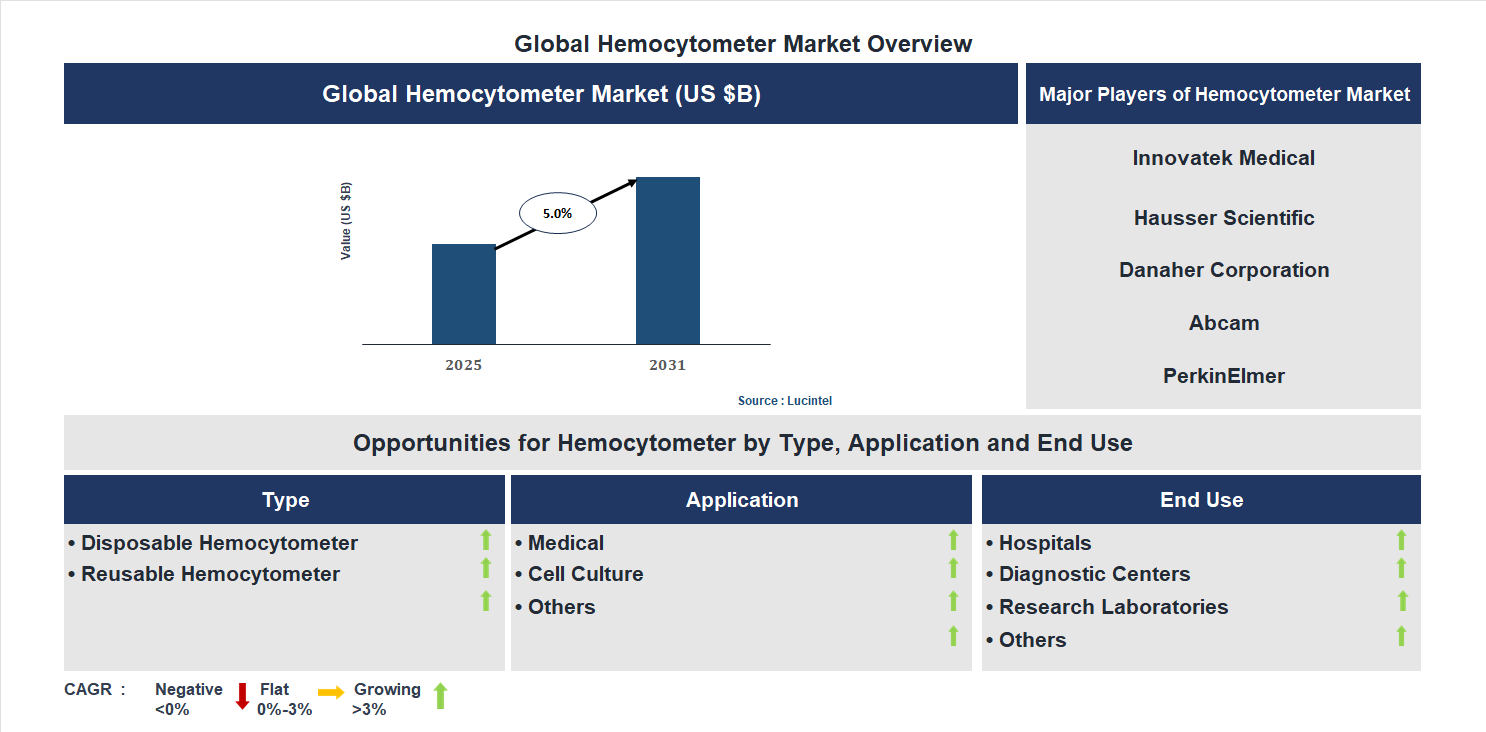
The future of the global hemocytometer market looks promising with opportunities in the hospital, diagnostic center, and research laboratory markets. The global hemocytometer market is expected to grow with a CAGR of 5% from 2025 to 2031. The major drivers for this market are the increasing demand for accurate cell counting, the rising adoption of automated laboratory tools, and the growing focus on diagnostic & research applications.

• Lucintel forecasts that, within the type category, disposable hemocytometer is expected to witness higher growth over the forecast period.
• Within the end use category, diagnostic center is expected to witness the highest growth.
• In terms of region, APAC is expected to witness the highest growth over the forecast period.
Gain valuable insights for your business decisions with our comprehensive 150+ page report. Sample figures with some insights are shown below.
Hemocytometer Market Trends and Forecast

Emerging Trends in the Hemocytometer Market

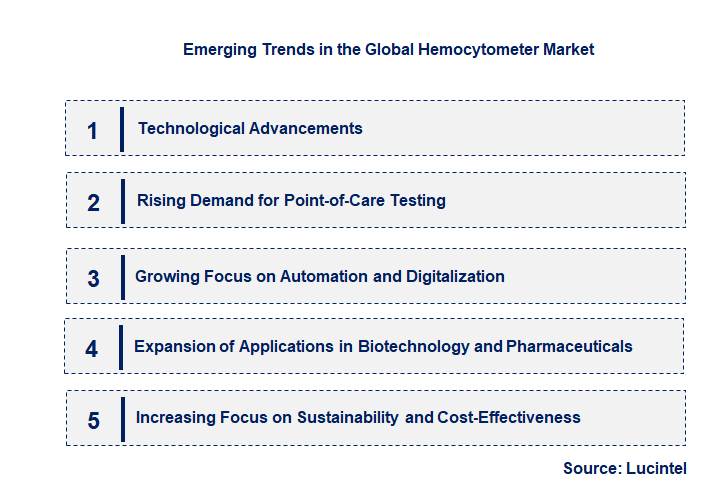
The hemocytometer market is experiencing rapid evolution driven by technological advancements, increasing demand for accurate cell counting in medical and research settings, and a growing focus on automation and precision. As laboratories and healthcare providers seek more efficient, reliable, and user-friendly tools, the market is witnessing significant innovations. These developments are not only improving the accuracy of cell analysis but also expanding the applications across clinical diagnostics, biotechnology, and pharmaceutical research. The integration of digital technologies and automation is transforming traditional methods, making cell counting faster, more precise, and accessible to a broader range of users. These trends are fundamentally reshaping the landscape of cell analysis tools.

• Technological Advancements: The market is witnessing the integration of digital imaging, automation, and AI-driven analysis in hemocytometers. These innovations enhance accuracy, reduce human error, and streamline workflows. Automated systems allow for high-throughput analysis, saving time and increasing productivity in research and clinical labs. Digital imaging enables detailed visualization and precise counting, which is crucial for diagnostic accuracy. As technology continues to evolve, the adoption of smart hemocytometers is expected to grow, making cell counting more reliable and accessible.
• Rising Demand for Point-of-Care Testing: The increasing need for rapid diagnostics in hospitals and clinics is driving the demand for portable, easy-to-use hemocytometers. These devices facilitate quick cell counts without the need for complex laboratory setups, enabling timely decision-making in critical care and outpatient settings. The trend toward decentralized testing is supported by innovations in miniaturization and user-friendly interfaces, making hemocytometers more adaptable for bedside and field use. This shift is expanding the market beyond traditional laboratories, improving patient outcomes through faster diagnostics.
• Growing Focus on Automation and Digitalization: Automation is transforming traditional manual cell counting methods into efficient, high-throughput processes. Digitalization allows for seamless data management, integration with laboratory information systems, and real-time analysis. Automated hemocytometers reduce variability and improve reproducibility, which is vital for research and clinical diagnostics. The adoption of these technologies is driven by the need for accuracy, efficiency, and scalability, especially in large-scale studies and clinical trials. This trend is making cell counting more standardized and less labor-intensive.
• Expansion of Applications in Biotechnology and Pharmaceuticals: Hemocytometers are increasingly used in cell culture monitoring, drug development, and bioprocessing. Precise cell counting is essential for optimizing production processes and ensuring quality control. The rise of regenerative medicine and personalized therapies further boosts demand for accurate cell analysis tools. As these industries grow, the need for reliable, efficient hemocytometers becomes more critical, leading to innovations tailored for specific applications such as stem cell research and biomanufacturing, thereby broadening the market scope.
• Increasing Focus on Sustainability and Cost-Effectiveness: Market players are emphasizing eco-friendly materials and reusable components to reduce environmental impact. Cost-effective designs are making hemocytometers more accessible to smaller labs and developing regions. Innovations include durable materials, simplified manufacturing, and maintenance-friendly features. This focus on sustainability and affordability is expanding market reach, enabling wider adoption across diverse settings. It also aligns with global efforts toward environmentally responsible practices, ensuring that advanced cell counting tools are both effective and sustainable.

In summary, these emerging trends are significantly reshaping the hemocytometer market by enhancing accuracy, efficiency, and accessibility. Technological innovations, the shift toward point-of-care testing, automation, expanding applications, and sustainability efforts are collectively driving growth and transforming traditional cell analysis methods. These developments are making cell counting more precise, faster, and more adaptable to the evolving needs of healthcare, research, and industrial sectors.
Emerging Trends in the Hemocytometer Market

Recent Development in the Hemocytometer Market

The hemocytometer market has experienced significant growth driven by advancements in diagnostic technologies, increasing prevalence of blood disorders, and rising demand for accurate cell counting methods. As laboratories and healthcare providers seek more efficient and precise tools, recent developments are shaping the future of this market. Innovations in automation, material enhancements, and expanding applications are contributing to its evolution. These developments are not only improving the accuracy and speed of cell counting but also broadening the scope of use across various medical and research fields. The following key developments highlight the current trajectory and future potential of the hemocytometer market.

• Automation Integration: The incorporation of automated systems into traditional hemocytometers has enhanced efficiency and accuracy. Automated cell counters reduce manual errors, save time, and enable high-throughput analysis, making them ideal for clinical laboratories and research institutions. This shift towards automation is expected to increase adoption rates and improve overall workflow efficiency.
• Material Innovations: New materials such as durable plastics and anti-fouling coatings are being used to manufacture hemocytometers. These materials improve durability, ease of cleaning, and reduce contamination risks. Enhanced material properties extend the lifespan of devices and ensure more reliable results, thereby increasing user confidence and market demand.
• Digital Imaging and Software: The integration of digital imaging technology with advanced software algorithms allows for real-time cell analysis and data management. This development facilitates precise counting, reduces human error, and enables data sharing and storage. It is particularly impactful in research settings where detailed data analysis is crucial.
• Expanded Application Scope: Hemocytometers are increasingly used beyond traditional blood cell counting, including in stem cell research, cancer diagnostics, and microbiology. This broadening of applications is driven by the need for versatile tools capable of handling diverse cell types, thereby expanding market opportunities and driving growth.
• Portable and Point-of-Care Devices: The development of portable hemocytometers and point-of-care testing devices has made cell counting accessible outside traditional laboratory settings. These devices are crucial for remote diagnostics, emergency care, and field research, significantly expanding the market reach and enabling rapid decision-making.

In summary, recent developments in automation, material innovation, digital integration, application expansion, and portability are transforming the hemocytometer market. These advancements are improving accuracy, efficiency, and accessibility, thereby driving market growth and broadening its application scope across healthcare and research sectors.

Strategic Growth Opportunities in the Hemocytometer Market

The hemocytometer market is experiencing significant growth driven by advancements in medical diagnostics, research, and clinical applications. As laboratories and healthcare providers seek more accurate and efficient cell counting methods, the demand for hemocytometers is increasing globally. Key applications such as hematology, cell biology research, and clinical diagnostics are fueling this expansion. Innovations in design and automation are further enhancing market potential. This evolving landscape presents numerous opportunities for industry players to innovate and expand their reach, ultimately improving diagnostic accuracy and research outcomes. The following are five key growth opportunities across different applications in this market.

• Hematology Diagnostics: Improving Disease Detection and Monitoring : The rising prevalence of blood disorders like anemia and leukemia is driving demand for precise cell counting. Hemocytometers enable accurate blood cell analysis, supporting early diagnosis and treatment monitoring. Enhanced sensitivity and ease of use are making them indispensable in clinical labs, boosting market growth.
• Cell Biology Research: Facilitating Advanced Cellular Studies : Researchers require reliable tools for cell counting in experiments involving cell proliferation, viability, and drug testing. Hemocytometers provide cost-effective, manual counting solutions that support detailed cellular analysis, fostering innovation in biomedical research and accelerating discoveries.
• IVF and Reproductive Medicine: Supporting Fertility Assessments : Accurate sperm and egg cell counts are critical in fertility treatments. Hemocytometers are widely used for semen analysis and embryo assessment, improving success rates. Growing fertility clinics worldwide are expanding the application of hemocytometers in reproductive health.
• Pharmaceutical Development: Enhancing Drug Testing and Quality Control : The pharmaceutical industry relies on precise cell counts for drug efficacy and safety testing. Hemocytometers assist in cell culture viability assessments, ensuring consistent product quality. This application is expected to grow with increased investment in biopharmaceuticals.
• Clinical Laboratory Automation: Integrating with Automated Systems for Efficiency : The trend toward automation in laboratories offers opportunities to integrate hemocytometers with digital and automated systems. This enhances throughput, reduces human error, and improves data accuracy, making hemocytometers more adaptable to modern clinical workflows.

In summary, these growth opportunities are significantly impacting the hemocytometer market by expanding its applications, improving diagnostic and research capabilities, and fostering technological innovations. As demand for precise cell analysis continues to rise across healthcare and research sectors, the market is poised for sustained growth and development.

Hemocytometer Market Driver and Challenges

The hemocytometer market is influenced by a variety of technological, economic, and regulatory factors that shape its growth and development. Advances in microscopy and cell counting technologies have enhanced accuracy and efficiency, driving demand among research institutions and clinical laboratories. Economic factors such as increasing healthcare expenditure and the rising prevalence of blood disorders further propel market expansion. Regulatory frameworks ensure quality standards and safety, impacting product development and adoption. However, the market also faces challenges including high costs, regulatory hurdles, and technological limitations that could hinder growth. Understanding these drivers and challenges is essential for stakeholders aiming to capitalize on market opportunities and address potential barriers effectively.

The factors responsible for driving the hemocytometer market include:
• Technological Advancements: The development of automated and digital hemocytometers has significantly improved counting accuracy, speed, and ease of use. These innovations reduce human error and enable high-throughput analysis, which is crucial for research and clinical diagnostics. As technology continues to evolve, the demand for sophisticated hemocytometers increases, fostering market growth. Additionally, integration with software for data management enhances usability, making these devices more attractive to end-users. The ongoing R&D efforts to improve device precision and automation are expected to further accelerate market expansion.
• Rising Prevalence of Blood Disorders: The increasing incidence of blood-related diseases such as anemia, leukemia, and thrombocytopenia is a major driver. These conditions require frequent blood cell analysis for diagnosis, monitoring, and treatment planning. As global populations age and lifestyle-related health issues rise, the demand for reliable cell counting tools like hemocytometers grows. This trend boosts sales across hospitals, diagnostic labs, and research centers. Moreover, the growing awareness about early diagnosis and personalized medicine fuels the need for accurate blood analysis, thereby expanding the market.
• Growing Research and Development Activities: The expanding scope of biomedical research, including cell biology, immunology, and drug development, necessitates precise cell counting tools. Hemocytometers are fundamental in laboratory experiments, cell culture, and clinical trials. Increased funding from government agencies and private organizations supports R&D initiatives, leading to innovations in hemocytometer design and functionality. The rise in research activities globally, especially in emerging economies, contributes to higher demand. This trend not only sustains current market growth but also opens avenues for new applications and product development.
• Increasing Healthcare Expenditure: Rising healthcare spending worldwide enhances access to advanced diagnostic tools, including hemocytometers. Governments and private healthcare providers are investing more in laboratory infrastructure and diagnostic services, which boosts demand for reliable cell counting devices. This financial support facilitates the adoption of high-quality hemocytometers in hospitals and clinics, improving diagnostic accuracy and patient outcomes. Additionally, the expansion of healthcare facilities in developing regions creates new markets, further propelling growth. The overall increase in healthcare expenditure underscores the importance of efficient diagnostic tools in modern medicine.
• Regulatory Approvals and Standards: Stringent regulatory frameworks ensure the safety, efficacy, and quality of hemocytometers. Compliance with standards set by agencies such as the FDA and CE marking is essential for market entry and acceptance. These regulations encourage manufacturers to innovate and improve product quality, which benefits end-users through reliable and standardized devices. However, navigating regulatory processes can be time-consuming and costly, potentially delaying product launches. Nonetheless, adherence to these standards ultimately fosters market trust and facilitates international trade, supporting sustained growth in the hemocytometer market.

The challenges facing this Market include:
• High Cost of Advanced Hemocytometers: While technological innovations improve performance, they often come with increased costs. Automated and digital hemocytometers are expensive, limiting accessibility for small clinics and laboratories with budget constraints. This high price hampers widespread adoption, especially in developing regions where cost sensitivity is critical. Additionally, ongoing maintenance and calibration expenses add to the total cost of ownership. Consequently, the market faces a challenge in balancing technological sophistication with affordability to ensure broader market penetration.
• Regulatory Hurdles and Compliance: The complex regulatory landscape poses significant barriers for market players. Obtaining approvals involves extensive testing, documentation, and compliance with diverse regional standards, which can delay product launches and increase costs. Small and medium-sized companies may struggle to meet these requirements, limiting innovation and market entry. Moreover, evolving regulations necessitate continuous updates and re-certifications, adding to operational challenges. Navigating these hurdles is essential for sustained growth but remains a significant obstacle for many manufacturers.
• Technological Limitations and Competition: Despite advancements, current hemocytometers still face limitations such as manual operation, susceptibility to human error, and limited automation. Emerging competitors offering alternative cell counting technologies, like flow cytometry and image-based analyzers, threaten traditional hemocytometer markets. These alternatives often provide higher throughput and automation, challenging the relevance of conventional devices. Continuous innovation is required to maintain competitiveness, but technological gaps and rapid industry evolution pose ongoing challenges for market players.

In summary, the hemocytometer market is driven by technological progress, rising disease prevalence, increased research activities, healthcare expenditure, and regulatory standards. However, high costs, regulatory complexities, and technological limitations present notable challenges. These factors collectively influence market dynamics, requiring stakeholders to innovate, adapt, and strategize effectively. The overall impact suggests a promising yet competitive landscape, where technological advancements and regulatory compliance will be key to sustained growth amid economic and operational hurdles.

List of Hemocytometer Companies

Companies in the market compete on the basis of product quality offered. Major players in this market focus on expanding their manufacturing facilities, R&D investments, infrastructural development, and leverage integration opportunities across the value chain. With these strategies hemocytometer companies cater increasing demand, ensure competitive effectiveness, develop innovative products & technologies, reduce production costs, and expand their customer base. Some of the hemocytometer companies profiled in this report include-
• Innovatek Medical
• Hausser Scientific
• Danaher Corporation
• Abcam
• PerkinElmer
• Paul Marienfeld
• PHYWE Systems
• Merck Millipore
• Thomas Scientific
• BRAND

Hemocytometer Market by Segment

The study includes a forecast for the global hemocytometer market by type, application, end use, and region.

Hemocytometer Market by Type [Value from 2019 to 2031]:


• Disposable Hemocytometer
• Reusable Hemocytometer

Hemocytometer Market by Application [Value from 2019 to 2031]:


• Medical
• Cell Culture
• Others

Hemocytometer Market by End Use [Value from 2019 to 2031]:


• Hospitals
• Diagnostic Centers
• Research Laboratories
• Others

Hemocytometer Market by Region [Value from 2019 to 2031]:


• North America
• Europe
• Asia Pacific
• The Rest of the World

Country Wise Outlook for the Hemocytometer Market

The hemocytometer market has experienced significant advancements driven by increasing demand for accurate cell counting in medical research, diagnostics, and biotechnological applications. Technological innovations, regulatory changes, and expanding healthcare infrastructure have shaped recent trends across major economies. These developments reflect a focus on improving precision, automation, and ease of use, catering to the growing needs of laboratories and healthcare providers worldwide. As the market evolves, key players are investing in R&D to introduce more sophisticated and user-friendly products, aligning with the global emphasis on personalized medicine and advanced diagnostics.

• United States: The U.S. market for hemocytometers has seen rapid growth due to increased adoption in clinical laboratories and research institutions. Innovations include automated hemocytometers that enhance accuracy and reduce manual errors. Regulatory approvals for new diagnostic tools have further boosted market expansion. Additionally, rising investments in biotech startups and research facilities have driven demand for high-precision cell counting devices. The focus on cancer research and stem cell therapy has also contributed to market growth, with key players expanding their product portfolios to meet these needs.
• China: Chinas hemocytometer market is expanding swiftly, fueled by government initiatives to improve healthcare infrastructure and research capabilities. The country is witnessing increased adoption of automated and digital hemocytometers, which offer faster and more reliable results. The rise in biotech and pharmaceutical industries has created a substantial demand for cell counting solutions. Moreover, collaborations between domestic and international companies are fostering innovation and product development. The growing number of research laboratories and hospitals in urban areas further propels market growth, with a focus on cost-effective and efficient cell analysis tools.
• Germany: Germanys market is characterized by a strong emphasis on quality, precision, and regulatory compliance. The country is a hub for medical device innovation, with several companies developing advanced hemocytometers integrated with digital imaging and automation features. The increasing prevalence of chronic diseases and cancer has heightened the need for accurate cell analysis in diagnostics. Germanys robust healthcare system and strict regulatory standards have driven the adoption of high-quality, reliable products. Additionally, collaborations between academia and industry are fostering technological advancements, positioning Germany as a leader in the European hemocytometer market.
• India: The Indian hemocytometer market is witnessing rapid growth due to expanding healthcare infrastructure and rising awareness of diagnostic testing. The affordability of manual hemocytometers remains a key factor, although there is a growing shift towards automated solutions. The increasing prevalence of infectious diseases and blood disorders has increased demand for cell counting devices in hospitals and diagnostic labs. Government initiatives to improve healthcare access and investments in biotech research are further supporting market expansion. Local manufacturers are also emerging, offering cost-effective products to meet the needs of a large and diverse population.
• Japan: Japans market for hemocytometers is driven by technological innovation and a focus on precision medicine. The country has a well-established healthcare system that emphasizes advanced diagnostics and research. The adoption of automated and digital hemocytometers is increasing, especially in cancer and stem cell research. Japans aging population has heightened the demand for diagnostic tools that support early disease detection and treatment monitoring. Regulatory standards are stringent, ensuring high-quality product adoption. Collaborations between biotech firms and research institutions are fostering innovation, positioning Japan as a key player in the global hemocytometer market.

Lucintel Analytics Dashboard

Features of the Global Hemocytometer Market

Market Size Estimates: Hemocytometer market size estimation in terms of value ($B).
Trend and Forecast Analysis: Market trends (2019 to 2024) and forecast (2025 to 2031) by various segments and regions.
Segmentation Analysis: Hemocytometer market size by type, application, end use, and region in terms of value ($B).
Regional Analysis: Hemocytometer market breakdown by North America, Europe, Asia Pacific, and Rest of the World.
Growth Opportunities: Analysis of growth opportunities in different types, applications, end uses, and regions for the hemocytometer market.
Strategic Analysis: This includes M&A, new product development, and competitive landscape of the hemocytometer market.
Analysis of competitive intensity of the industry based on Porter’s Five Forces model.

Lucintel Consulting Services

FAQ

Q1. What is the growth forecast for hemocytometer market?
Answer: The global hemocytometer market is expected to grow with a CAGR of 5% from 2025 to 2031.
Q2. What are the major drivers influencing the growth of the hemocytometer market?
Answer: The major drivers for this market are the increasing demand for accurate cell counting, the rising adoption of automated laboratory tools, and the growing focus on diagnostic & research applications.
Q3. What are the major segments for hemocytometer market?
Answer: The future of the hemocytometer market looks promising with opportunities in the hospital, diagnostic center, and research laboratory markets.
Q4. Who are the key hemocytometer market companies?
Answer: Some of the key hemocytometer companies are as follows:
• Innovatek Medical
• Hausser Scientific
• Danaher Corporation
• Abcam
• PerkinElmer
• Paul Marienfeld
• PHYWE Systems
• Merck Millipore
• Thomas Scientific
• BRAND
Q5. Which hemocytometer market segment will be the largest in future?
Answer: Lucintel forecasts that, within the type category, disposable hemocytometer is expected to witness higher growth over the forecast period.
Q6. In hemocytometer market, which region is expected to be the largest in next 5 years?
Answer: In terms of region, APAC is expected to witness the highest growth over the forecast period.
Q7. Do we receive customization in this report?
Answer: Yes, Lucintel provides 10% customization without any additional cost.

This report answers following 11 key questions:

Q.1. What are some of the most promising, high-growth opportunities for the hemocytometer market by type (disposable hemocytometer and reusable hemocytometer), application (medical, cell culture, and others), end use (hospitals, diagnostic centers, research laboratories, and others), and region (North America, Europe, Asia Pacific, and the Rest of the World)?
Q.2. Which segments will grow at a faster pace and why?
Q.3. Which region will grow at a faster pace and why?
Q.4. What are the key factors affecting market dynamics? What are the key challenges and business risks in this market?
Q.5. What are the business risks and competitive threats in this market?
Q.6. What are the emerging trends in this market and the reasons behind them?
Q.7. What are some of the changing demands of customers in the market?
Q.8. What are the new developments in the market? Which companies are leading these developments?
Q.9. Who are the major players in this market? What strategic initiatives are key players pursuing for business growth?
Q.10. What are some of the competing products in this market and how big of a threat do they pose for loss of market share by material or product substitution?
Q.11. What M&A activity has occurred in the last 5 years and what has its impact been on the industry?

For any questions related to Hemocytometer Market, Hemocytometer Market Size, Hemocytometer Market Growth, Hemocytometer Market Analysis, Hemocytometer Market Report, Hemocytometer Market Share, Hemocytometer Market Trends, Hemocytometer Market Forecast, Hemocytometer Companies, write Lucintel analyst at email: helpdesk@lucintel.com. We will be glad to get back to you soon.
                                           Table of Contents

            1. Executive Summary

            2. Market Overview

                        2.1 Background and Classifications
                        2.2 Supply Chain

            3. Market Trends & Forecast Analysis

                        3.1 Macroeconomic Trends and Forecasts
                        3.2 Industry Drivers and Challenges
                        3.3 PESTLE Analysis
                        3.4 Patent Analysis
                        3.5 Regulatory Environment
                        3.6 Global Hemocytometer Market Trends and Forecast

            4. Global Hemocytometer Market by Type

                        4.1 Overview
                        4.2 Attractiveness Analysis by Type
                        4.3 Disposable Hemocytometer : Trends and Forecast 2025 to 2031
                        4.4 Reusable Hemocytometer : Trends and Forecast 2025 to 2031

            5. Global Hemocytometer Market by Application

                        5.1 Overview
                        5.2 Attractiveness Analysis by Application
                        5.3 Medical : Trends and Forecast 2025 to 2031
                        5.4 Cell Culture : Trends and Forecast 2025 to 2031
                        5.5 Others : Trends and Forecast 2025 to 2031

            6. Global Hemocytometer Market by End Use

                        6.1 Overview
                        6.2 Attractiveness Analysis by End Use
                        6.3 Hospitals : Trends and Forecast 2025 to 2031
                        6.4 Diagnostic Centers : Trends and Forecast 2025 to 2031
                        6.5 Research Laboratories : Trends and Forecast 2025 to 2031
                        6.6 Others : Trends and Forecast 2025 to 2031

            7. Regional Analysis

                        7.1 Overview
                        7.2 Global Hemocytometer Market by Region

            8. North American Hemocytometer Market

                        8.1 Overview
                        8.2 North American Hemocytometer Market by Type
                        8.3 North American Hemocytometer Market by End Use
                        8.4 The United States Hemocytometer Market
                        8.5 Canadian Hemocytometer Market
                        8.6 Mexican Hemocytometer Market

            9. European Hemocytometer Market

                        9.1 Overview
                        9.2 European Hemocytometer Market by Type
                        9.3 European Hemocytometer Market by End Use
                        9.4 German Hemocytometer Market
                        9.5 French Hemocytometer Market
                        9.6 Italian Hemocytometer Market
                        9.7 Spanish Hemocytometer Market
                        9.8 The United Kingdom Hemocytometer Market

            10. APAC Hemocytometer Market

                        10.1 Overview
                        10.2 APAC Hemocytometer Market by Type
                        10.3 APAC Hemocytometer Market by End Use
                        10.4 Chinese Hemocytometer Market
                        10.5 Indian Hemocytometer Market
                        10.6 Japanese Hemocytometer Market
                        10.7 South Korean Hemocytometer Market
                        10.8 Indonesian Hemocytometer Market

            11. ROW Hemocytometer Market

                        11.1 Overview
                        11.2 ROW Hemocytometer Market by Type
                        11.3 ROW Hemocytometer Market by End Use
                        11.4 Middle Eastern Hemocytometer Market
                        11.5 South American Hemocytometer Market
                        11.6 African Hemocytometer Market

            12. Competitor Analysis

                        12.1 Product Portfolio Analysis
                        12.2 Operational Integration
                        12.3 Porter’s Five Forces Analysis
                                    • Competitive Rivalry
                                    • Bargaining Power of Buyers
                                    • Bargaining Power of Suppliers
                                    • Threat of Substitutes
                                    • Threat of New Entrants
                        12.4 Market Share Analysis

            13. Opportunities & Strategic Analysis

                        13.1 Value Chain Analysis
                        13.2 Growth Opportunity Analysis
                                    13.2.1 Growth Opportunity by Type
                                    13.2.2 Growth Opportunity by Application
                                    13.2.3 Growth Opportunity by End Use
                        13.3 Emerging Trends in the Global Hemocytometer Market
                        13.4 Strategic Analysis
                                    13.4.1 New Product Development
                                    13.4.2 Certification and Licensing
                                    13.4.3 Mergers, Acquisitions, Agreements, Collaborations, and Joint Ventures

            14. Company Profiles of the Leading Players Across the Value Chain

                        14.1 Competitive Analysis Overview
                        14.2 Innovatek Medical
                                    • Company Overview
                                    • Hemocytometer Market Business Overview
                                    • New Product Development
                                    • Merger, Acquisition, and Collaboration
                                    • Certification and Licensing
                        14.3 Hausser Scientific
                                    • Company Overview
                                    • Hemocytometer Market Business Overview
                                    • New Product Development
                                    • Merger, Acquisition, and Collaboration
                                    • Certification and Licensing
                        14.4 Danaher Corporation
                                    • Company Overview
                                    • Hemocytometer Market Business Overview
                                    • New Product Development
                                    • Merger, Acquisition, and Collaboration
                                    • Certification and Licensing
                        14.5 Abcam
                                    • Company Overview
                                    • Hemocytometer Market Business Overview
                                    • New Product Development
                                    • Merger, Acquisition, and Collaboration
                                    • Certification and Licensing
                        14.6 PerkinElmer
                                    • Company Overview
                                    • Hemocytometer Market Business Overview
                                    • New Product Development
                                    • Merger, Acquisition, and Collaboration
                                    • Certification and Licensing
                        14.7 Paul Marienfeld
                                    • Company Overview
                                    • Hemocytometer Market Business Overview
                                    • New Product Development
                                    • Merger, Acquisition, and Collaboration
                                    • Certification and Licensing
                        14.8 PHYWE Systems
                                    • Company Overview
                                    • Hemocytometer Market Business Overview
                                    • New Product Development
                                    • Merger, Acquisition, and Collaboration
                                    • Certification and Licensing
                        14.9 Merck Millipore
                                    • Company Overview
                                    • Hemocytometer Market Business Overview
                                    • New Product Development
                                    • Merger, Acquisition, and Collaboration
                                    • Certification and Licensing
                        14.10 Thomas Scientific
                                    • Company Overview
                                    • Hemocytometer Market Business Overview
                                    • New Product Development
                                    • Merger, Acquisition, and Collaboration
                                    • Certification and Licensing
                        14.11 BRAND
                                    • Company Overview
                                    • Hemocytometer Market Business Overview
                                    • New Product Development
                                    • Merger, Acquisition, and Collaboration
                                    • Certification and Licensing

            15. Appendix

                        15.1 List of Figures
                        15.2 List of Tables
                        15.3 Research Methodology
                        15.4 Disclaimer
                        15.5 Copyright
                        15.6 Abbreviations and Technical Units
                        15.7 About Us
                        15.8 Contact Us

                                               List of Figures


            Chapter 1

                        Figure 1.1: Trends and Forecast for the Global Hemocytometer Market

            Chapter 2

                        Figure 2.1: Usage of Hemocytometer Market
                        Figure 2.2: Classification of the Global Hemocytometer Market
                        Figure 2.3: Supply Chain of the Global Hemocytometer Market

            Chapter 3

                        Figure 3.1: Trends of the Global GDP Growth Rate
                        Figure 3.2: Trends of the Global Population Growth Rate
                        Figure 3.3: Trends of the Global Inflation Rate
                        Figure 3.4: Trends of the Global Unemployment Rate
                        Figure 3.5: Trends of the Regional GDP Growth Rate
                        Figure 3.6: Trends of the Regional Population Growth Rate
                        Figure 3.7: Trends of the Regional Inflation Rate
                        Figure 3.8: Trends of the Regional Unemployment Rate
                        Figure 3.9: Trends of Regional Per Capita Income
                        Figure 3.10: Forecast for the Global GDP Growth Rate
                        Figure 3.11: Forecast for the Global Population Growth Rate
                        Figure 3.12: Forecast for the Global Inflation Rate
                        Figure 3.13: Forecast for the Global Unemployment Rate
                        Figure 3.14: Forecast for the Regional GDP Growth Rate
                        Figure 3.15: Forecast for the Regional Population Growth Rate
                        Figure 3.16: Forecast for the Regional Inflation Rate
                        Figure 3.17: Forecast for the Regional Unemployment Rate
                        Figure 3.18: Forecast for Regional Per Capita Income
                        Figure 3.19: Driver and Challenges of the Hemocytometer Market

            Chapter 4

                        Figure 4.1: Global Hemocytometer Market by Type in 2019, 2024, and 2031
                        Figure 4.2: Trends of the Global Hemocytometer Market ($B) by Type
                        Figure 4.3: Forecast for the Global Hemocytometer Market ($B) by Type
                        Figure 4.4: Trends and Forecast for Disposable Hemocytometer in the Global Hemocytometer Market (2019-2031)
                        Figure 4.5: Trends and Forecast for Reusable Hemocytometer in the Global Hemocytometer Market (2019-2031)

            Chapter 5

                        Figure 5.1: Global Hemocytometer Market by Application in 2019, 2024, and 2031
                        Figure 5.2: Trends of the Global Hemocytometer Market ($B) by Application
                        Figure 5.3: Forecast for the Global Hemocytometer Market ($B) by Application
                        Figure 5.4: Trends and Forecast for Medical in the Global Hemocytometer Market (2019-2031)
                        Figure 5.5: Trends and Forecast for Cell Culture in the Global Hemocytometer Market (2019-2031)
                        Figure 5.6: Trends and Forecast for Others in the Global Hemocytometer Market (2019-2031)

            Chapter 6

                        Figure 6.1: Global Hemocytometer Market by End Use in 2019, 2024, and 2031
                        Figure 6.2: Trends of the Global Hemocytometer Market ($B) by End Use
                        Figure 6.3: Forecast for the Global Hemocytometer Market ($B) by End Use
                        Figure 6.4: Trends and Forecast for Hospitals in the Global Hemocytometer Market (2019-2031)
                        Figure 6.5: Trends and Forecast for Diagnostic Centers in the Global Hemocytometer Market (2019-2031)
                        Figure 6.6: Trends and Forecast for Research Laboratories in the Global Hemocytometer Market (2019-2031)
                        Figure 6.7: Trends and Forecast for Others in the Global Hemocytometer Market (2019-2031)

            Chapter 7

                        Figure 7.1: Trends of the Global Hemocytometer Market ($B) by Region (2019-2024)
                        Figure 7.2: Forecast for the Global Hemocytometer Market ($B) by Region (2025-2031)

            Chapter 8

                        Figure 8.1: Trends and Forecast for the North American Hemocytometer Market (2019-2031)
                        Figure 8.2: North American Hemocytometer Market by Type in 2019, 2024, and 2031
                        Figure 8.3: Trends of the North American Hemocytometer Market ($B) by Type (2019-2024)
                        Figure 8.4: Forecast for the North American Hemocytometer Market ($B) by Type (2025-2031)
                        Figure 8.5: North American Hemocytometer Market by Application in 2019, 2024, and 2031
                        Figure 8.6: Trends of the North American Hemocytometer Market ($B) by Application (2019-2024)
                        Figure 8.7: Forecast for the North American Hemocytometer Market ($B) by Application (2025-2031)
                        Figure 8.8: North American Hemocytometer Market by End Use in 2019, 2024, and 2031
                        Figure 8.9: Trends of the North American Hemocytometer Market ($B) by End Use (2019-2024)
                        Figure 8.10: Forecast for the North American Hemocytometer Market ($B) by End Use (2025-2031)
                        Figure 8.11: Trends and Forecast for the United States Hemocytometer Market ($B) (2019-2031)
                        Figure 8.12: Trends and Forecast for the Mexican Hemocytometer Market ($B) (2019-2031)
                        Figure 8.13: Trends and Forecast for the Canadian Hemocytometer Market ($B) (2019-2031)

            Chapter 9

                        Figure 9.1: Trends and Forecast for the European Hemocytometer Market (2019-2031)
                        Figure 9.2: European Hemocytometer Market by Type in 2019, 2024, and 2031
                        Figure 9.3: Trends of the European Hemocytometer Market ($B) by Type (2019-2024)
                        Figure 9.4: Forecast for the European Hemocytometer Market ($B) by Type (2025-2031)
                        Figure 9.5: European Hemocytometer Market by Application in 2019, 2024, and 2031
                        Figure 9.6: Trends of the European Hemocytometer Market ($B) by Application (2019-2024)
                        Figure 9.7: Forecast for the European Hemocytometer Market ($B) by Application (2025-2031)
                        Figure 9.8: European Hemocytometer Market by End Use in 2019, 2024, and 2031
                        Figure 9.9: Trends of the European Hemocytometer Market ($B) by End Use (2019-2024)
                        Figure 9.10: Forecast for the European Hemocytometer Market ($B) by End Use (2025-2031)
                        Figure 9.11: Trends and Forecast for the German Hemocytometer Market ($B) (2019-2031)
                        Figure 9.12: Trends and Forecast for the French Hemocytometer Market ($B) (2019-2031)
                        Figure 9.13: Trends and Forecast for the Spanish Hemocytometer Market ($B) (2019-2031)
                        Figure 9.14: Trends and Forecast for the Italian Hemocytometer Market ($B) (2019-2031)
                        Figure 9.15: Trends and Forecast for the United Kingdom Hemocytometer Market ($B) (2019-2031)

            Chapter 10

                        Figure 10.1: Trends and Forecast for the APAC Hemocytometer Market (2019-2031)
                        Figure 10.2: APAC Hemocytometer Market by Type in 2019, 2024, and 2031
                        Figure 10.3: Trends of the APAC Hemocytometer Market ($B) by Type (2019-2024)
                        Figure 10.4: Forecast for the APAC Hemocytometer Market ($B) by Type (2025-2031)
                        Figure 10.5: APAC Hemocytometer Market by Application in 2019, 2024, and 2031
                        Figure 10.6: Trends of the APAC Hemocytometer Market ($B) by Application (2019-2024)
                        Figure 10.7: Forecast for the APAC Hemocytometer Market ($B) by Application (2025-2031)
                        Figure 10.8: APAC Hemocytometer Market by End Use in 2019, 2024, and 2031
                        Figure 10.9: Trends of the APAC Hemocytometer Market ($B) by End Use (2019-2024)
                        Figure 10.10: Forecast for the APAC Hemocytometer Market ($B) by End Use (2025-2031)
                        Figure 10.11: Trends and Forecast for the Japanese Hemocytometer Market ($B) (2019-2031)
                        Figure 10.12: Trends and Forecast for the Indian Hemocytometer Market ($B) (2019-2031)
                        Figure 10.13: Trends and Forecast for the Chinese Hemocytometer Market ($B) (2019-2031)
                        Figure 10.14: Trends and Forecast for the South Korean Hemocytometer Market ($B) (2019-2031)
                        Figure 10.15: Trends and Forecast for the Indonesian Hemocytometer Market ($B) (2019-2031)

            Chapter 11

                        Figure 11.1: Trends and Forecast for the ROW Hemocytometer Market (2019-2031)
                        Figure 11.2: ROW Hemocytometer Market by Type in 2019, 2024, and 2031
                        Figure 11.3: Trends of the ROW Hemocytometer Market ($B) by Type (2019-2024)
                        Figure 11.4: Forecast for the ROW Hemocytometer Market ($B) by Type (2025-2031)
                        Figure 11.5: ROW Hemocytometer Market by Application in 2019, 2024, and 2031
                        Figure 11.6: Trends of the ROW Hemocytometer Market ($B) by Application (2019-2024)
                        Figure 11.7: Forecast for the ROW Hemocytometer Market ($B) by Application (2025-2031)
                        Figure 11.8: ROW Hemocytometer Market by End Use in 2019, 2024, and 2031
                        Figure 11.9: Trends of the ROW Hemocytometer Market ($B) by End Use (2019-2024)
                        Figure 11.10: Forecast for the ROW Hemocytometer Market ($B) by End Use (2025-2031)
                        Figure 11.11: Trends and Forecast for the Middle Eastern Hemocytometer Market ($B) (2019-2031)
                        Figure 11.12: Trends and Forecast for the South American Hemocytometer Market ($B) (2019-2031)
                        Figure 11.13: Trends and Forecast for the African Hemocytometer Market ($B) (2019-2031)

            Chapter 12

                        Figure 12.1: Porter’s Five Forces Analysis of the Global Hemocytometer Market
                        Figure 12.2: Market Share (%) of Top Players in the Global Hemocytometer Market (2024)

            Chapter 13

                        Figure 13.1: Growth Opportunities for the Global Hemocytometer Market by Type
                        Figure 13.2: Growth Opportunities for the Global Hemocytometer Market by Application
                        Figure 13.3: Growth Opportunities for the Global Hemocytometer Market by End Use
                        Figure 13.4: Growth Opportunities for the Global Hemocytometer Market by Region
                        Figure 13.5: Emerging Trends in the Global Hemocytometer Market

                                               List of Tables


            Chapter 1

                        Table 1.1: Growth Rate (%, 2023-2024) and CAGR (%, 2025-2031) of the Hemocytometer Market by Type, Application, and End Use
                        Table 1.2: Attractiveness Analysis for the Hemocytometer Market by Region
                        Table 1.3: Global Hemocytometer Market Parameters and Attributes

            Chapter 3

                        Table 3.1: Trends of the Global Hemocytometer Market (2019-2024)
                        Table 3.2: Forecast for the Global Hemocytometer Market (2025-2031)

            Chapter 4

                        Table 4.1: Attractiveness Analysis for the Global Hemocytometer Market by Type
                        Table 4.2: Market Size and CAGR of Various Type in the Global Hemocytometer Market (2019-2024)
                        Table 4.3: Market Size and CAGR of Various Type in the Global Hemocytometer Market (2025-2031)
                        Table 4.4: Trends of Disposable Hemocytometer in the Global Hemocytometer Market (2019-2024)
                        Table 4.5: Forecast for Disposable Hemocytometer in the Global Hemocytometer Market (2025-2031)
                        Table 4.6: Trends of Reusable Hemocytometer in the Global Hemocytometer Market (2019-2024)
                        Table 4.7: Forecast for Reusable Hemocytometer in the Global Hemocytometer Market (2025-2031)

            Chapter 5

                        Table 5.1: Attractiveness Analysis for the Global Hemocytometer Market by Application
                        Table 5.2: Market Size and CAGR of Various Application in the Global Hemocytometer Market (2019-2024)
                        Table 5.3: Market Size and CAGR of Various Application in the Global Hemocytometer Market (2025-2031)
                        Table 5.4: Trends of Medical in the Global Hemocytometer Market (2019-2024)
                        Table 5.5: Forecast for Medical in the Global Hemocytometer Market (2025-2031)
                        Table 5.6: Trends of Cell Culture in the Global Hemocytometer Market (2019-2024)
                        Table 5.7: Forecast for Cell Culture in the Global Hemocytometer Market (2025-2031)
                        Table 5.8: Trends of Others in the Global Hemocytometer Market (2019-2024)
                        Table 5.9: Forecast for Others in the Global Hemocytometer Market (2025-2031)

            Chapter 6

                        Table 6.1: Attractiveness Analysis for the Global Hemocytometer Market by End Use
                        Table 6.2: Market Size and CAGR of Various End Use in the Global Hemocytometer Market (2019-2024)
                        Table 6.3: Market Size and CAGR of Various End Use in the Global Hemocytometer Market (2025-2031)
                        Table 6.4: Trends of Hospitals in the Global Hemocytometer Market (2019-2024)
                        Table 6.5: Forecast for Hospitals in the Global Hemocytometer Market (2025-2031)
                        Table 6.6: Trends of Diagnostic Centers in the Global Hemocytometer Market (2019-2024)
                        Table 6.7: Forecast for Diagnostic Centers in the Global Hemocytometer Market (2025-2031)
                        Table 6.8: Trends of Research Laboratories in the Global Hemocytometer Market (2019-2024)
                        Table 6.9: Forecast for Research Laboratories in the Global Hemocytometer Market (2025-2031)
                        Table 6.10: Trends of Others in the Global Hemocytometer Market (2019-2024)
                        Table 6.11: Forecast for Others in the Global Hemocytometer Market (2025-2031)

            Chapter 7

                        Table 7.1: Market Size and CAGR of Various Regions in the Global Hemocytometer Market (2019-2024)
                        Table 7.2: Market Size and CAGR of Various Regions in the Global Hemocytometer Market (2025-2031)

            Chapter 8

                        Table 8.1: Trends of the North American Hemocytometer Market (2019-2024)
                        Table 8.2: Forecast for the North American Hemocytometer Market (2025-2031)
                        Table 8.3: Market Size and CAGR of Various Type in the North American Hemocytometer Market (2019-2024)
                        Table 8.4: Market Size and CAGR of Various Type in the North American Hemocytometer Market (2025-2031)
                        Table 8.5: Market Size and CAGR of Various Application in the North American Hemocytometer Market (2019-2024)
                        Table 8.6: Market Size and CAGR of Various Application in the North American Hemocytometer Market (2025-2031)
                        Table 8.7: Market Size and CAGR of Various End Use in the North American Hemocytometer Market (2019-2024)
                        Table 8.8: Market Size and CAGR of Various End Use in the North American Hemocytometer Market (2025-2031)
                        Table 8.9: Trends and Forecast for the United States Hemocytometer Market (2019-2031)
                        Table 8.10: Trends and Forecast for the Mexican Hemocytometer Market (2019-2031)
                        Table 8.11: Trends and Forecast for the Canadian Hemocytometer Market (2019-2031)

            Chapter 9

                        Table 9.1: Trends of the European Hemocytometer Market (2019-2024)
                        Table 9.2: Forecast for the European Hemocytometer Market (2025-2031)
                        Table 9.3: Market Size and CAGR of Various Type in the European Hemocytometer Market (2019-2024)
                        Table 9.4: Market Size and CAGR of Various Type in the European Hemocytometer Market (2025-2031)
                        Table 9.5: Market Size and CAGR of Various Application in the European Hemocytometer Market (2019-2024)
                        Table 9.6: Market Size and CAGR of Various Application in the European Hemocytometer Market (2025-2031)
                        Table 9.7: Market Size and CAGR of Various End Use in the European Hemocytometer Market (2019-2024)
                        Table 9.8: Market Size and CAGR of Various End Use in the European Hemocytometer Market (2025-2031)
                        Table 9.9: Trends and Forecast for the German Hemocytometer Market (2019-2031)
                        Table 9.10: Trends and Forecast for the French Hemocytometer Market (2019-2031)
                        Table 9.11: Trends and Forecast for the Spanish Hemocytometer Market (2019-2031)
                        Table 9.12: Trends and Forecast for the Italian Hemocytometer Market (2019-2031)
                        Table 9.13: Trends and Forecast for the United Kingdom Hemocytometer Market (2019-2031)

            Chapter 10

                        Table 10.1: Trends of the APAC Hemocytometer Market (2019-2024)
                        Table 10.2: Forecast for the APAC Hemocytometer Market (2025-2031)
                        Table 10.3: Market Size and CAGR of Various Type in the APAC Hemocytometer Market (2019-2024)
                        Table 10.4: Market Size and CAGR of Various Type in the APAC Hemocytometer Market (2025-2031)
                        Table 10.5: Market Size and CAGR of Various Application in the APAC Hemocytometer Market (2019-2024)
                        Table 10.6: Market Size and CAGR of Various Application in the APAC Hemocytometer Market (2025-2031)
                        Table 10.7: Market Size and CAGR of Various End Use in the APAC Hemocytometer Market (2019-2024)
                        Table 10.8: Market Size and CAGR of Various End Use in the APAC Hemocytometer Market (2025-2031)
                        Table 10.9: Trends and Forecast for the Japanese Hemocytometer Market (2019-2031)
                        Table 10.10: Trends and Forecast for the Indian Hemocytometer Market (2019-2031)
                        Table 10.11: Trends and Forecast for the Chinese Hemocytometer Market (2019-2031)
                        Table 10.12: Trends and Forecast for the South Korean Hemocytometer Market (2019-2031)
                        Table 10.13: Trends and Forecast for the Indonesian Hemocytometer Market (2019-2031)

            Chapter 11

                        Table 11.1: Trends of the ROW Hemocytometer Market (2019-2024)
                        Table 11.2: Forecast for the ROW Hemocytometer Market (2025-2031)
                        Table 11.3: Market Size and CAGR of Various Type in the ROW Hemocytometer Market (2019-2024)
                        Table 11.4: Market Size and CAGR of Various Type in the ROW Hemocytometer Market (2025-2031)
                        Table 11.5: Market Size and CAGR of Various Application in the ROW Hemocytometer Market (2019-2024)
                        Table 11.6: Market Size and CAGR of Various Application in the ROW Hemocytometer Market (2025-2031)
                        Table 11.7: Market Size and CAGR of Various End Use in the ROW Hemocytometer Market (2019-2024)
                        Table 11.8: Market Size and CAGR of Various End Use in the ROW Hemocytometer Market (2025-2031)
                        Table 11.9: Trends and Forecast for the Middle Eastern Hemocytometer Market (2019-2031)
                        Table 11.10: Trends and Forecast for the South American Hemocytometer Market (2019-2031)
                        Table 11.11: Trends and Forecast for the African Hemocytometer Market (2019-2031)

            Chapter 12

                        Table 12.1: Product Mapping of Hemocytometer Suppliers Based on Segments
                        Table 12.2: Operational Integration of Hemocytometer Manufacturers
                        Table 12.3: Rankings of Suppliers Based on Hemocytometer Revenue

            Chapter 13

                        Table 13.1: New Product Launches by Major Hemocytometer Producers (2019-2024)
                        Table 13.2: Certification Acquired by Major Competitor in the Global Hemocytometer Market

.

Buy full report or by chapter as follows

Limited Time Offer

Price by License Type:
[-] Hide Chapter Details
[Chapter Number] [Chapter Name] [Chapter Number Of Pages] [Chapter Price]
Title/Chapter Name Pages Price
Full Report: Hemocytometer Market Report: Trends, Forecast and Competitive Analysis to 2031 Full Report $ 2,990
A 150 Page Report
Lucintel has been in the business of market research and management consulting since 2000 and has published over 1000 market intelligence reports in various markets / applications and served over 1,000 clients worldwide. This study is a culmination of four months of full-time effort performed by Lucintel's analyst team. The analysts used the following sources for the creation and completion of this valuable report:
  • In-depth interviews of the major players in this market
  • Detailed secondary research from competitors’ financial statements and published data 
  • Extensive searches of published works, market, and database information pertaining to industry news, company press releases, and customer intentions
  • A compilation of the experiences, judgments, and insights of Lucintel’s professionals, who have analyzed and tracked this market over the years.
Extensive research and interviews are conducted across the supply chain of this market to estimate market share, market size, trends, drivers, challenges, and forecasts. Below is a brief summary of the primary interviews that were conducted by job function for this report.
 
Thus, Lucintel compiles vast amounts of data from numerous sources, validates the integrity of that data, and performs a comprehensive analysis. Lucintel then organizes the data, its findings, and insights into a concise report designed to support the strategic decision-making process. The figure below is a graphical representation of Lucintel’s research process. 
 

Please sign in below to get report brochure - Hemocytometer Market Report.

At Lucintel, we respect your privacy and maintain the confidentiality of information / data provided by you
(Please enter your corporate email. * These fields are mandatory )

Follow us on