
Report Feature
Heat Sink Market Trends and Forecast
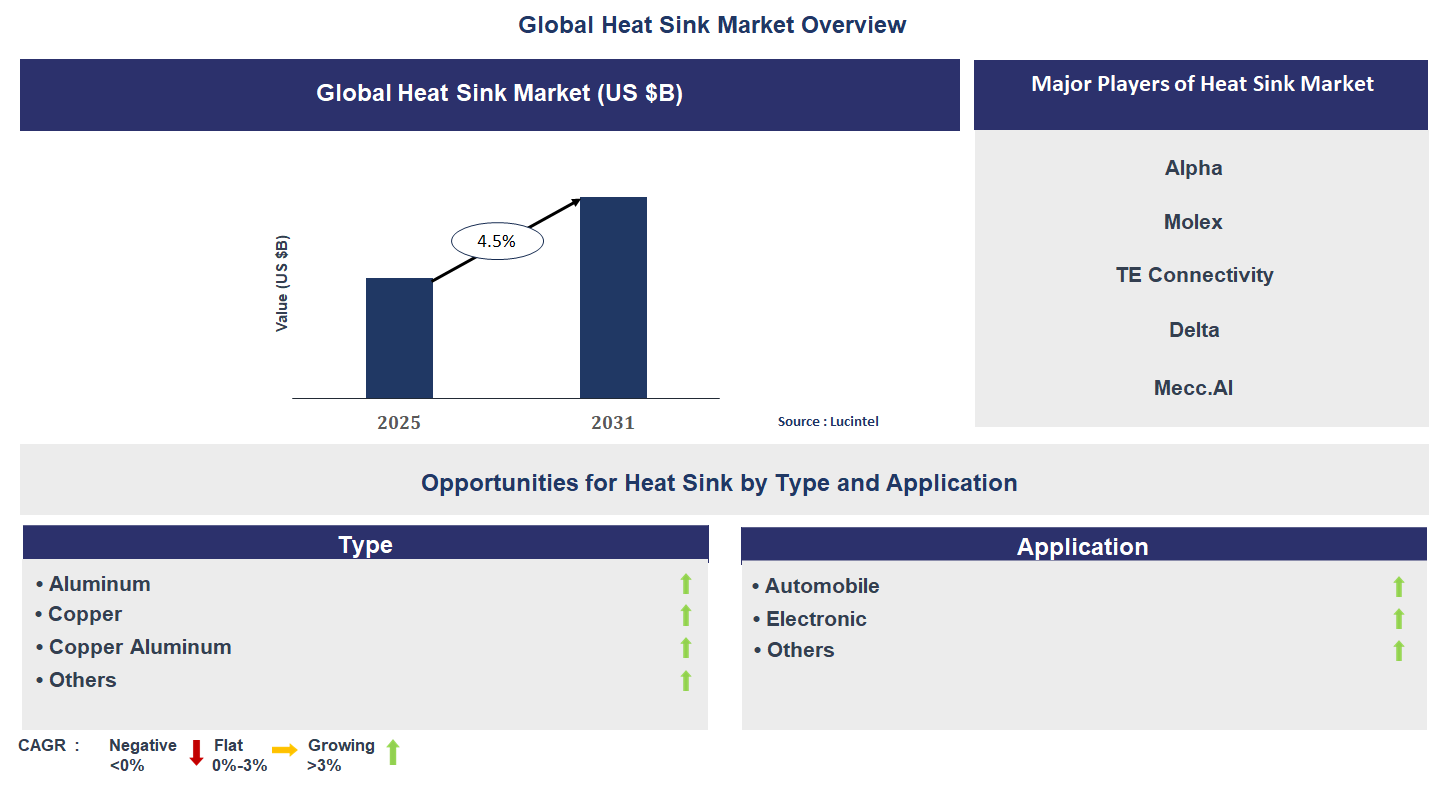
The future of the global heat sink market looks promising with opportunities in the automobile and electronic markets. The global heat sink market is expected to grow with a CAGR of 4.5% from 2025 to 2031. The major drivers for this market are the increasing demand for thermal management in electronics, the rising adoption of renewable energy systems, and the growing need for efficient cooling in data centers.• Lucintel forecasts that, within the type category, aluminum is expected to witness the highest growth over the forecast period.
• Within the application category, automobile is expected to witness higher growth.
• In terms of region, APAC is expected to witness the highest growth over the forecast period. Gain valuable insights for your business decisions with our comprehensive 150+ page report. Sample figures with some insights are shown below.
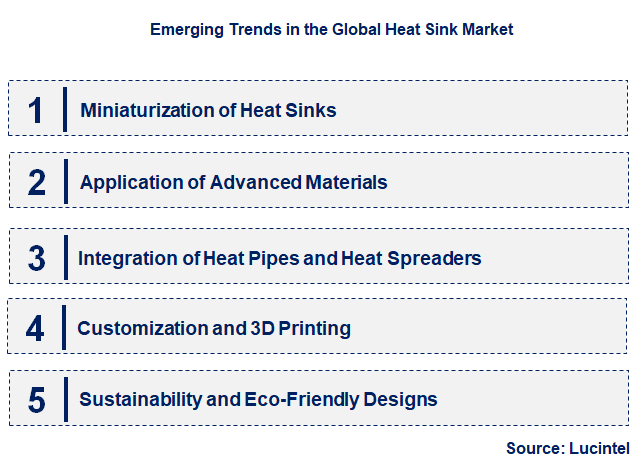
Emerging Trends in the Heat Sink Market
The heat sink industry is being revolutionized by new trends that are propelling innovation, efficiency, and sustainability across industries. The trends are being fueled by material science breakthroughs, the need for high-performance electronic devices, and the growing emphasis on energy efficiency. Below are five important trends redefining the future of the heat sink industry.• Miniaturization of Heat Sinks: When electronic devices are miniaturized to become smaller and more compact, heat sinks too are being minimized to be contained in these devices without sacrificing thermal performance. Miniaturization is most apparent in consumer electronics, including smartphones, wearables, and laptops, where space is limited and there needs to be efficient yet compact heat dissipation solutions.
• Application of Advanced Materials: The trend towards advanced materials is among the most prominent trends in the market for heat sinks. Conventional materials such as aluminum are being substituted by high-conductivity materials such as copper alloys, graphene, and advanced ceramics. Such materials provide improved thermal conductivity and higher durability in harsh conditions. As an example, graphene with good thermal properties is being used more and more in heat sink designs to enhance performance in high-power electronic devices, automotive uses, and data centers.
• Integration of Heat Pipes and Heat Spreaders: The use of heat pipes and heat spreaders in heat sink designs is becoming increasingly popular. Heat pipes that employ the mechanism of phase change to transfer heat in an efficient manner are being used in heat sinks to improve their cooling efficiencies. This is especially significant in applications with high power densities and limited space, such as electronics and automotive industries. Heat spreaders, too, that spread the heat more uniformly over the surface are being incorporated into heat sink designs to enhance overall dissipation of heat and thermal management effectiveness.
• Customization and 3D Printing: Customization of heat sinks to suit particular application needs is yet another trend on the rise. Heat sink manufacturers are making greater use of 3D printing technologies to design custom-made heat sinks that are suited to specific products and systems. This is especially useful for applications such as aerospace and medical devices, where special shapes and sizes are required. 3D printing allows for quicker prototyping, lower costs, and the possibility to produce intricate geometries which cannot be achieved with conventional manufacturing techniques.
• Sustainability and Eco-Friendly Designs: Sustainability is starting to become an important factor within the heat sink industry. As environmental awareness increases, companies are concentrating on producing heat sinks that are not only effective but also sustainable. This is done through the application of recyclable materials, minimizing energy usage in production processes, as well as the design of heat sinks that can be readily reused or repurposed. Moreover, energy-efficient heat sinks help decrease power usage in electronic products and systems, following the worldwide push for reduced environmental footprint. The new trends in the heat sink industry are changing how thermal solutions are developed, produced, and applied across industries. The demand for miniaturization, the use of high-tech materials, and the inclusion of heat pipes and spreaders are all boosting the efficiency and performance of heat sinks. Simultaneously, 3D printing technologies and customization are enabling manufacturers to fulfill precise application requirements, and sustainability initiatives are making sure that heat sink solutions are bringing about eco-friendly operations.
Recent Development in the Heat Sink Market
The heat sink industry is dynamic, with new technologies continuously emerging to respond to increasing demands for efficient and effective thermal management solutions. The drivers for these developments include technological advancements, material development, and shifting requirements of principal industries. Following are five major developments within the heat sink market that are influencing different sectors.• Evolution of High-Performance Heat Sink Materials: One of the most notable trends in the heat sink industry is the improvement in the materials employed for heat dissipation. Scientists are seeking to develop new materials with improved thermal conductivity, including graphene, carbon nanotubes, and high-end copper alloys. These new materials allow heat sinks to be able to carry more heat loads while keeping their compact size. For instance, graphene-based heat sinks are turning out to be especially useful in high-performance electronics, where effective heat management is vital to system reliability and performance.
• Improvements in Passive Cooling Technologies: Passive cooling technologies such as finned heat sinks, heat pipes, and natural convection-based solutions have made great strides. Such technologies make use of the natural flow of air or liquid to dissipate heat without any external power source. Advancements in passive cooling systems with high efficiency are crucial for minimizing energy use and increasing the sustainability of electronic equipment and industrial systems.
• Growing Use of Heat Sink Solutions in EVs: As electric vehicle (EV) adoption increases, heat sink solutions are increasingly important for the thermal management of power electronics such as battery management systems (BMS), inverters, and charging systems. Technology advancements in heat sink materials and design are enabling increased efficiency and lifespan for EV components. The emphasis is on manufacturing lightweight heat sinks with high performance that are capable of working efficiently even at elevated temperatures, ensuring that the EV operates at its best and in a safe manner.
• Automation in Heat Sink Production: Automation of heat sink production is another major innovation transforming the market. With the development of robotic technologies and accurate manufacturing methods, production of heat sinks is becoming quicker, less expensive, and more capable of achieving increased precision. Production lines also allow manufacturers to increase production to cope with increasing demand in markets like electronics, automotive, and telecommunications. Furthermore, automation facilitates greater product quality consistency and the capability to manufacture more sophisticated heat sink designs using less human resource.
• IoT Integration into Thermal Management: The integration of the Internet of Things (IoT) with thermal management systems is opening up new avenues for real-time monitoring and control of heat sink performance. IoT-integrated sensors and systems can feed information related to temperature fluctuations, airflow, and cooling performance, enabling more accurate adjustments and optimization. This technology is particularly important in applications such as data centers and industrial automation, where optimal thermal conditions are key to efficient operations. Predictive maintenance through the application of IoT technology in heat sinks can avert overheating and downtime. These five major developments are defining the future of the heat sink industry by propelling innovation, enhancing performance, and increasing sustainability. The use of advanced materials, the move toward passive cooling technologies, and the adoption of IoT technology are revolutionizing the application of heat sinks in industries. In addition, increasing the significance of thermal management for electric vehicles and the development of automation in manufacturing processes are opening up new prospects for manufacturers.
Strategic Growth Opportunities in the Heat Sink Market
The heat sink market is growing as a result of the growing demand for thermal management solutions in various industries, including electronics, automotive, and renewable energy. With devices becoming increasingly powerful and smaller, efficient cooling solutions have become a necessity. The growing demand for efficient thermal management in consumer electronics, electric vehicles, and renewable energy systems is fueling heat sink technology innovation. The following are five strategic growth opportunities in the heat sink industry, highlighted by major applications.• Consumer Electronics: There is a need for heat sinks to control heat dissipation in high-performance products in consumer electronics such as smartphones, laptops, and gaming consoles. With processors and graphics cards getting more powerful, efficient cooling systems are becoming more necessary. Aluminum and copper heat sinks are becoming standard for achieving optimal performance, avoiding overheating, and prolonging the lifespan of electronic devices. Miniaturization and reduced device size are also driving innovations in smaller, more efficient heat sink designs, offering a substantial growth prospect in this market.
• Electric Vehicles: One of the most notable growth prospects in the heat sink market is the emergence of electric vehicles. As EVs shift from conventional internal combustion engines to electric motors, effective thermal management is crucial for battery packs and power electronics. Heat sinks are imperative in ensuring ideal temperatures for high-capacity lithium-ion batteries, power inverters, and electric motors. As the adoption of EVs increases, the need for high-performance, lightweight heat sinks will rise, giving way to manufacturers that create innovative, cost-efficient thermal solutions for the automotive market.
• Telecommunications and Data Centers: Telecommunications equipment and data centers need sophisticated heat sinks to handle the growing heat output from high-performance processors and networking gear. The increasing demand for cloud computing, big data, and 5G infrastructure is fueling the demand for more energy-efficient thermal solutions. As the trend is towards hyper-scale data centers, there will be a greater need for bigger, more energy-efficient heat sinks that can handle high-density components.
• Renewable Energy Systems: The transition towards renewable energy systems, such as solar and wind power, presents an expanding market for heat sinks. In these systems, heat sinks are employed to manage power electronics, inverters, and battery heat. As renewable energy generation scales further, effective thermal management solutions must be put in place to guarantee the reliability and longevity of energy systems. Outdoor-mounted heat sinks like those employed in solar inverters present opportunities for product innovation, enabling a sustainable growth opportunity for thermal management companies.
• Industrial and Aerospace Applications: The aerospace and industrial industries are progressively dependent on heat sinks for controlling the heat generated by high-powered machinery and equipment. Heat sinks play a vital role in the operation and safety of electronic components and systems in various manufacturing, robotics, and aerospace industries. With the evolution in 3D printing technology and the growing need for precision-engineered parts, manufacturers can now design more efficient, light-weight, and resilient heat sinks specific to the requirements of industrial and aerospace sectors. These industries hold good growth opportunities for high-performance thermal management companies. The growth opportunities in consumer electronics, electric vehicles, data centers, renewable energy systems, and industrial/aerospace applications are all adding to the growth of the heat sink market. Each of these market segments offers distinct challenges and opportunities for thermal management solution improvement and innovation from manufacturers. As the technology advances and the industries move towards greater efficiency and sustainability, heat sinks will be the key factors to ensure performance and reliability, hence transforming the thermal management market landscape.
Heat Sink Market Driver and Challenges
The heat sink industry is shaped by numerous technological, economic, and regulatory forces that propel its development as well as pose challenges to it. Some of these include the need for energy-efficient systems, improvements in materials science, and the changing needs of such major industries as electronics, automotive, and renewable energy. In this section, we discuss the key drivers and challenges affecting the heat sink market and their implications on manufacturers and users. The factors responsible for driving the heat sink market include: 1. Energy-Efficient Devices Demand: Demand for energy-efficient devices in different sectors is one of the main drivers for the heat sink market. As industries like consumer electronics, automotive, and industrial machinery aim for reduced energy utilization and increased performance, demand for good thermal management solutions increases. Heat sinks play a vital role in achieving optimal operating temperatures and energy efficiency. With energy-conserving regulations becoming more stringent around the world, producers are pursuing improvements to create high-performance heat sinks that minimize the use of energy without sacrificing the efficiency and lifespan of their products. 2. Materials Technology Improvements: Improvements in materials technology are helping create more effective heat sinks. Utilization of materials like copper, graphite, and emerging alloys combined with nanotechnology breakthroughs has ensured improvements in the performance of heat sinks. These materials provide increased thermal conductivity, enabling improved dissipation of heat in smaller systems. Moreover, light materials are assisting manufacturers in creating more efficient and readily integrable heat sinks into contemporary electronics and car systems. 3. Expansion of Electric Vehicles: The fast development of the electric vehicle market is driving unprecedented demand for heat sinks. EVs need effective thermal management solutions to manage battery pack temperatures, power inverters, and other high-power components. As EV uptake increases worldwide, demand for high-performance heat sinks will keep increasing. Manufacturers are meeting this demand by creating lighter, yet more efficient heat sinks that will be capable of handling the thermal demands of electric powertrains without driving up costs. The growing EV market is a primary growth driver for the heat sink market. 4. Renewable Energy Sector Growth: Growing investment in renewable energy systems such as wind and solar power is another primary growth driver for the heat sink market. Power electronics like inverters and battery systems for renewable energy systems need thermal management to be efficient and reliable. With the increasing use of renewable energy, their associated heat sinks will similarly increase in demand. The call for heat sinks that are outdoor-rated and rugged for solar inverters and energy storage systems is a huge growth area for manufacturers of this kind. 5. Increasing Demand for Sophisticated Cooling Solutions in Data Centers: Data centers, with the mounting demand for high-performance servers and networking hardware, present a significant growth opportunity for the heat sink market. With growing demand for cloud computing, big data, and 5G technology, so does the demand for efficient thermal management solutions to cool high-density servers. Heat sinks are essential to making these systems run effectively and never overheat. The ongoing expansion of the data center sector will fuel the need for more sophisticated, effective heat sinks that can keep pace with the progressively higher processing capacity of contemporary servers. Challenges in the heat sink market are: 1. Increasing Cost of Materials: The price of materials employed in the production of heat sinks, including copper and aluminum, has been escalating due to global supply chain dynamics and rising demand from other sectors. This is a threat to manufacturers of heat sinks to ensure they are profitable despite the competitiveness in prices. With raw material prices on the rise, producers will have to seek how to improve their process to maximum output or come up with new, inexpensive materials that achieve the same thermal management capacity. 2. Challenges in Miniaturization: As components are reduced in size but increase in power, the demand for minimized heat sink solutions grows. Miniaturization of heat sinks without compromising on their thermal performance is, however, a major challenge. Industry players have to find a balance between requiring smaller size and requiring cool functionality. Materials and design innovations are addressing these issues, but miniaturization still represents an obstacle to meeting the same performance as bigger heat sinks. 3. Environmental Laws and Sustainability: Environmental laws and the increasing emphasis on sustainability are posing challenges to heat sink makers. There is mounting pressure to minimize the carbon footprint of production steps and produce more sustainable heat sinks. This involves utilizing recycled materials, minimizing waste, and making products easily recyclable. Adherence to these regulations and the implementation of green manufacturing processes will be crucial for organizations aiming to remain competitive in the market. The drivers and challenges outlined above are transforming the heat sink market. The demand for energy-efficient devices, advances in materials science, growth in electric vehicles and renewable energy are fueling expansion. Meanwhile, material cost increases, miniaturization, and environmental laws make manufacturers innovate and respond. The capacity to overcome these challenges will dictate the success of companies within the heat sink industry and fuel opportunities for future growth.List of Heat Sink Companies
Companies in the market compete on the basis of product quality offered. Major players in this market focus on expanding their manufacturing facilities, R&D investments, infrastructural development, and leverage integration opportunities across the value chain. With these strategies heat sink companies cater increasing demand, ensure competitive effectiveness, develop innovative products & technologies, reduce production costs, and expand their customer base. Some of the heat sink companies profiled in this report include-• Alpha
• Molex
• TE Connectivity
• Delta
• Mecc.Al
• Ohmite
• Aavid Thermalloy
• Sunon
• Advanced Thermal Solutions
• DAU
Heat Sink Market by Segment
The study includes a forecast for the global heat sink market by type, application, and region.Heat Sink Market by Type [Value from 2019 to 2031]:
• Aluminum
• Copper
• Copper Aluminum
• Others
Heat Sink Market by Application [Value from 2019 to 2031]:
• Automobile
• Electronic
• Others
Heat Sink Market by Region [Value from 2019 to 2031]:
• North America
• Europe
• Asia Pacific
• The Rest of the World
Country Wise Outlook for the Heat Sink Market
The heat sink industry has been developing very fast, led by the progress made in the field of materials, technology, and application in many sectors. Major regions like the United States, China, Germany, India, and Japan are witnessing major developments as demand increases for effective solutions of heat dissipation. These regions are managing issues related to higher performance electronics, higher energy requirements, and ecological issues. Recent technological advancements in the material utilized for heat sinks, and the introduction of new manufacturing methods, are playing a pivotal role in determining the market. Following is an analysis of the major developments across these nations.• United States: The market for heat sinks in the United States is growing because of rising demand from sectors like electronics, automotive, and telecommunications. The U.S. is concentrating on designing high-performance heat sinks that incorporate advanced materials such as graphite, copper alloys, and aluminum composites to enhance thermal conductivity. Moreover, the transition of the automobile industry towards electric vehicles (EVs) is also generating new requirements for heat dissipation technologies in power electronics.
• China: China has become a dominant force in the heat sink market due to its leadership in manufacturing and production of electronics. The country is heavily investing in research and development (R&D) to improve heat sink efficiency and meet the demands of its expanding semiconductor, telecommunications, and consumer electronics industries. China is also focusing on automating production lines to reduce costs and improve production speed.
• Germany: Germany is at the forefront in the uptake of new thermal management technologies across different industries, especially automotive and industry sectors. With the trend towards EVs, heat sinks are gaining importance in their role of handling thermal loads of high-power devices like inverters and electric motors. The German automotive sector is increasingly adopting sophisticated heat sinks in its EV models. Moreover, the industrial sector is concentrating on heat sink designs that can handle high operating temperatures and harsh environments.
• India: Indias heat sink market is expanding with growing electronics, telecommunication, and manufacturing industries. The emphasis of the country on infrastructure growth, particularly in smart cities and telecommunications networks, is fueling the demand for thermal management solutions. Also, Indias growing use of renewable energy technologies like solar power and electric cars is generating new areas of growth in heat sinks for power electronics and battery management systems.
• Japan: Japan is still a dominant player in the international heat sink market, with emphasis on high-precision manufacturing, electronics, and robotics. Demand for heat sinks is rising, especially in high-performance applications like semiconductors, telecommunications, and automotive electronics. Japans emphasis on technological advancements in energy-efficient products has created substantial innovation in the development of heat sink materials, including the utilization of new composites and alloys that enhance thermal performance with less size and weight.

Features of the Global Heat Sink Market
Market Size Estimates: Heat sink market size estimation in terms of value ($B). Trend and Forecast Analysis: Market trends (2019 to 2024) and forecast (2025 to 2031) by various segments and regions. Segmentation Analysis: Heat sink market size by type, application, and region in terms of value ($B). Regional Analysis: Heat sink market breakdown by North America, Europe, Asia Pacific, and Rest of the World. Growth Opportunities: Analysis of growth opportunities in different types, applications, and regions for the heat sink market. Strategic Analysis: This includes M&A, new product development, and competitive landscape of the heat sink market. Analysis of competitive intensity of the industry based on Porter’s Five Forces model.
FAQ
Q1. What is the growth forecast for heat sink market? Answer: The global heat sink market is expected to grow with a CAGR of 4.5% from 2025 to 2031. Q2. What are the major drivers influencing the growth of the heat sink market? Answer: The major drivers for this market are the increasing demand for thermal management in electronics, the rising adoption of renewable energy systems, and the growing need for efficient cooling in data centers. Q3. What are the major segments for heat sink market? Answer: The future of the heat sink market looks promising with opportunities in the automobile and electronic markets. Q4. Who are the key heat sink market companies? Answer: Some of the key heat sink companies are as follows:• Alpha
• Molex
• TE Connectivity
• Delta
• Mecc.Al
• Ohmite
• Aavid Thermalloy
• Sunon
• Advanced Thermal Solutions
• DAU Q5. Which heat sink market segment will be the largest in future? Answer: Lucintel forecasts that, within the type category, aluminum is expected to witness the highest growth over the forecast period. Q6. In heat sink market, which region is expected to be the largest in next 5 years? Answer: In terms of region, APAC is expected to witness the highest growth over the forecast period. Q7. Do we receive customization in this report? Answer: Yes, Lucintel provides 10% customization without any additional cost.
Table of Contents
List of Figures
List of Tables
Methodology
- In-depth interviews of the major players in this market
- Detailed secondary research from competitors’ financial statements and published data
- Extensive searches of published works, market, and database information pertaining to industry news, company press releases, and customer intentions
- A compilation of the experiences, judgments, and insights of Lucintel’s professionals, who have analyzed and tracked this market over the years.


Buy Now
Choose a license that fits your team. Instant PDF delivery.
Prices exclude taxes. Instant delivery. Custom licensing available on request.
Key Questions
- • What are some of the most promising, high-growth opportunities for the heat sink market by type (aluminum, copper, copper aluminum, and others), application (automobile, electronic, and others), and region (North America, Europe, Asia Pacific, and the Rest of the World)?
- • Which segments will grow at a faster pace and why?
- • Which region will grow at a faster pace and why?
- • What are the key factors affecting market dynamics? What are the key challenges and business risks in this market?
- • What are the business risks and competitive threats in this market?
- • What are the emerging trends in this market and the reasons behind them?
- • What are some of the changing demands of customers in the market?
- • What are the new developments in the market? Which companies are leading these developments?
- • Who are the major players in this market? What strategic initiatives are key players pursuing for business growth?
- • What are some of the competing products in this market and how big of a threat do they pose for loss of market share by material or product substitution?
- • What M&A activity has occurred in the last 5 years and what has its impact been on the industry? For any questions related to Heat Sink Market, Heat Sink Market Size, Heat Sink Market Growth, Heat Sink Market Analysis, Heat Sink Market Report, Heat Sink Market Share, Heat Sink Market Trends, Heat Sink Market Forecast, Heat Sink Companies, write Lucintel analyst at email: helpdesk@lucintel.com. We will be glad to get back to you soon.


