
Report Feature
Hardware Load Balancer Market Trends and Forecast
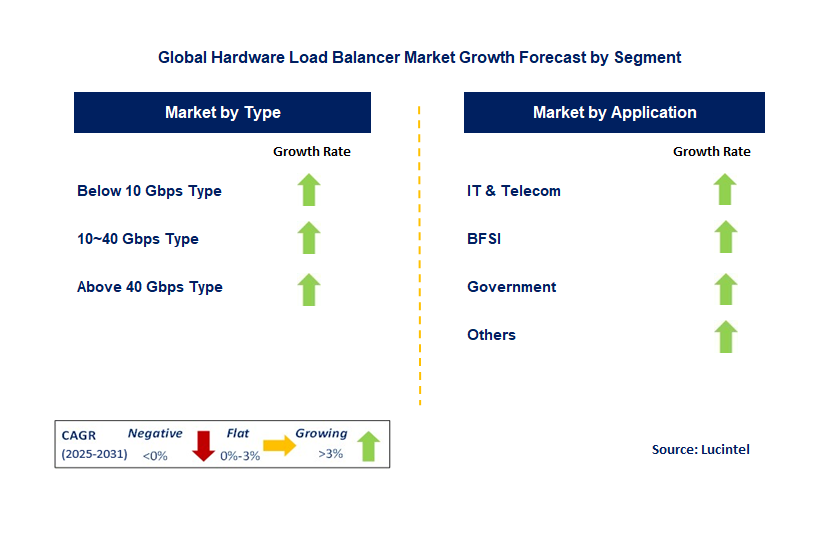
The future of the global hardware load balancer market looks promising with opportunities in the IT & Telecom, bfsi, and government markets. The global hardware load balancer market is expected to grow with a CAGR of 11.5% from 2025 to 2031. The major drivers for this market are rising cybersecurity threats push organizations to adopt hardware load balancers for enhanced security and protection, the increasing demand for high availability and reliability in data centers, and the growing trend of hybrid and multi-cloud environments requires advanced load balancing solutions to manage traffic. Lucintel forecasts that, within the type category, below 10 Gbps type is expected to witness the highest growth over the forecast period due to these solutions are suitable for less resource-intensive applications and are commonly deployed. Within the application category, IT & Telecom is expected to witness the highest growth due to the growing demand for data processing, cloud services, and communication networks. In terms of region, North America is expected to witness the highest growth over the forecast period due to a well-established tech infrastructure and a high concentration of companies in industries. Gain valuable insights for your business decisions with our comprehensive 150+ page report. Sample figures with some insights are shown below.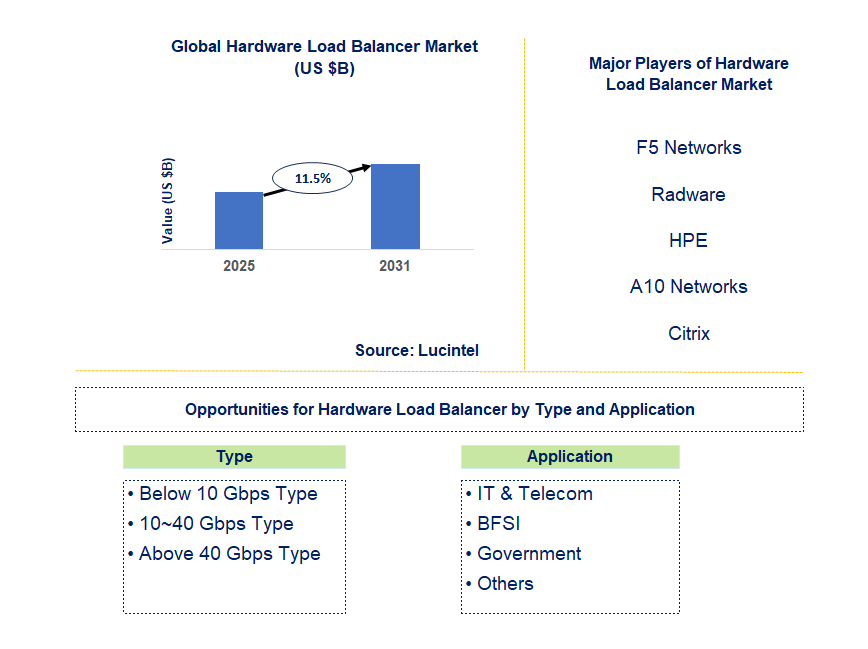
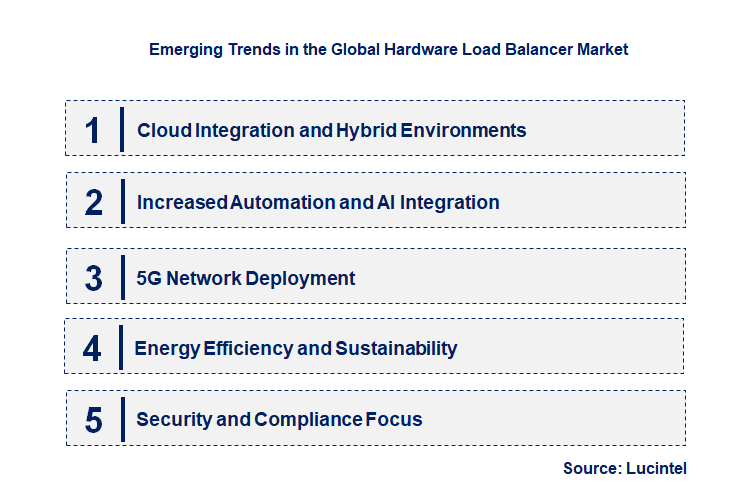
Emerging Trends in the Hardware Load Balancer Market
Emerging technologies, evolving customer requirements, and regional economic changes have led to immense transformations in the hardware load balancers market. These trends are fueled by increased automation, the adoption of clouds, rollouts of 5G, and a demand for better security solutions. The trends below shape the future of hardware load balancing systems:• Cloud Integration and Hybrid Environments: Cloud computing has shifted much of the IT infrastructure to hybrid environments, requiring hardware load balancers that can efficiently manage both on-premise and cloud-based resources. Cloud integration allows companies to maintain flexibility while ensuring optimized load distribution across hybrid environments. This trend enables businesses to scale and manage workloads effectively, ensuring seamless application performance and high availability.
• Increased Automation and AI Integration: Automation and artificial intelligence (AI) are upgrading the capabilities of hardware load balancers. AI-based systems can predict traffic patterns and adjust load distribution dynamically, making them efficient. Automation reduces the manual management required, thereby enhancing performance and minimizing downtime. AI-driven load balancing systems are increasingly being integrated into enterprise networks to predict and respond to varying demands in real-time.
• 5G Network Deployment: With the wide implementation of 5G networks, the demand for hardware load balancers that could manage high-volume, low-latency traffic has emerged. 5G introduces higher bandwidths and a more complex traffic profile, challenging the need for advanced load balancing solutions. These demands will therefore require a load balancer specifically designed for the task with minimal latency, preferably in hardware, to ensure the streamlined operation of 5G-integrated devices and services.
• Energy Efficiency and Sustainability: Sustainability has emerged as a prominent trend in the hardware load balancer market. The growing consumption of energy in the data centers and network infrastructure drives the need to develop energy-efficient load balancing solutions. Companies are now focusing on reducing carbon footprints for their IT operations. There is a push for hardware designs that do not only have high performance but also environmental responsibility and energy efficiency.
• Security and Compliance Focus: In the wake of tightening data privacy and security regulations worldwide, hardware load balancers are becoming increasingly secure. Solutions including encryption, access controls, and compliance with local regulations such as GDPR or CCPA are more in demand today. The adoption of hardware-based solutions over software-based alternatives is also driven by security focus, as it is perceived as more secure and less vulnerable to cyber threats. Emerging trends in the hardware load balancers market, such as cloud integration, AI-driven optimization, 5G, energy efficiency, and increased security concerns, are changing the approach to IT infrastructure management by businesses. All these innovations are driving the industry toward more intelligent, flexible, and scalable solutions that could handle the growing demands of modern networks. As these trends keep unfolding, hardware load balancers will be critical in ensuring that enterprises can move to increasingly complex IT environments without losing performance and security.
Recent Development in the Hardware Load Balancer Market
In recent times, the hardware load balancers market has undergone a series of key developments marked by rising demand for scalable solutions and increased security concerns, coupled with technological advances. These trends influence the way businesses approach load balancing in increasingly complex IT environments.• Software-Defined Load Balancing: One of the more key developments has actually been the evolution of software-defined load balancers. It allows for more flexible and agile management of workloads over multiple servers or across several data centers. With it, businesses can respond in real time to shifting demands without the requisite disruption of hardware upgrades, which makes them quite cost-effective for many enterprises.
• Intelligent Load Balancing Algorithms: There are recent improvements in load balancing algorithms, especially with machine learning and AI-based techniques. This gives more intelligent and predictive traffic distribution, anticipating spiky traffic with lower latency to improve system performance by dynamic adjustments of loads based on the analysis of real-time data.
• Network Function Convergence: Another important trend is the convergence of different network functions, such as traffic monitoring, security, and performance analytics, into hardware load balancing appliances. This all-in-one approach enhances the overall efficiency and simplifies network management for businesses, reducing operational complexity and improving service uptime.
• Edge Computing and Local Load Balancing: With the rapid emergence of edge computing, there is a huge need for local load balancing solutions. These can minimize latency since they process the data closer to its source. In this sense, real-time performance will improve as edge computing advances. As this progresses, so will the requirement for robust hardware load balancers to manage local traffic and integration with centralized systems.
• Customization and Integration with Legacy Systems: This is an increasing demand on customizable load balancing solutions that fit perfectly in established infrastructures. Most enterprises want to have load balancing solutions that implement support for legacy systems and work with newer technologies. The same has made providers produce more adaptable solutions that cater to the varied needs of a broad range of customers. The developments in the hardware load balancer market include software-defined load balancing, integration with intelligent algorithms, and concepts of edge computing. These developments represent the maturation and growth of this industry by really creating more dynamic, efficient, and secure IT infrastructures. As organizations increasingly demand scalable, high-performance solutions to manage complex workloads, hardware load balancers will continue to be a crucial component in ensuring optimal system operation and reliability across industries.
Strategic Growth Opportunites in the Hardware Load Balancer Market
The hardware load balancers market offers multiple growth opportunities across different applications ranging from cloud services to data centers. Every industry vertical offers challenges and demands that are different, which contributes to the adoption of appropriate load balancing solutions.• Data Centers and Cloud Services: As more and more enterprises migrate to the cloud, the requirements for and adoption of hardware load balancing solutions to manage data center operations efficiently are increasing. The focus, therefore, is on developing solutions that can handle massive, dynamic workloads and not just across the cloud but also hybrid infrastructures while still maintaining uptime and operational continuity.
• Telecommunications and 5G Networks: The adoption of hardware load balancers is a rapidly growing trend among telecommunications companies, especially those deploying 5G networks. These systems play a critical role in managing high-scale, low-latency traffic demands to ensure service levels are maintained across millions of devices and services, making it a critical growth area.
• Financial Services: High-performance load balancing solutions are being heavily invested in by financial institutions to deal with transaction volumes and meet security standards. Hardware load balancers are being adopted to ensure uptime and the seamless operation of online banking platforms, payment systems, and trading systems.
• Retail and E-commerce: The retail and e-commerce sector depends on the hardware load balancer for guaranteeing their site‘s capability of handling huge amounts of traffic. This especially takes place during periods of heavy sales. Scalability, security, and high availability are very essential aspects for such business houses. The load balancing systems are a necessary requirement for such firms.
• Healthcare and Compliance: Healthcare organizations have special regulations and performance demands, thus increasing demand for secure, reliable load balancing solutions that ensure high availability and confidentiality of sensitive patient data against HIPAA-related compliance. Strategic growth opportunities in the hardware load balancers market are vast within various applications, including data centers, telecommunications, finance, retail, and healthcare. As industries rely more on cloud computing, 5G networks, and digital services, demand for high-performance load balancing solutions that will optimize traffic, ensure uptime, and support scalability is growing. This makes hardware load balancers remain essential components of the IT infrastructure that will assist an organization in tackling challenges both currently and in the future as digitization continues.
Hardware Load Balancer Market Driver and Challenges
The hardware load balancer market is influenced by a number of drivers and challenges, from technology advancement to regulatory requirements. Understanding the factors helps assess the current and future potential of the market. The factors responsible for driving the hardware load balancer market include: 1. Explosive Adoption of Cloud Computing Solutions: The increasing adoption rates of cloud computing solutions are one of the key factors driving hardware load balancers. Businesses going to the cloud require scalable load balancers that can manage the rising complexity in distributed workloads. 2. High Availability and Scalability: With the current trend of having 24/7 business operations, it has become highly demanding to require systems that offer high availability and scalability. When companies expand their infrastructure, they need hardware load balancers in order to maintain uptime and performance. 3. Technological Advancements in Networking: SDN and AI-driven solutions for networking technologies drive the growth of the hardware load balancer market. These technological advancements provide for more flexible and efficient management of network traffic and improve system reliability. 4. Cybersecurity Concerns: As cyber threats continue to rise, businesses are focusing on securing their IT infrastructure. Hardware load balancers offer enhanced security features, such as encryption and traffic filtering, making them a key component in protecting critical systems. 5. Regulatory Compliance: The need for regulatory compliance, especially with data privacy laws such as GDPR and CCPA, is driving the adoption of secure and reliable hardware load balancing solutions. These solutions help businesses ensure that they are meeting legal requirements while optimizing performance. Challenges in the hardware load balancer market are: 1. High Upfront Investment: A big disadvantage for firms adopting hardware load balancers is the significant investment that goes into it. These systems might eventually benefit organizations but, at least in the initial stages, this can be an impediment to smaller companies. 2. Complexity in Deployment and Maintenance: Setting up and maintaining hardware load balancing systems can be complex, especially in large-scale environments. The need for specialized skills and ongoing maintenance can increase operational costs and hinder adoption for some businesses. 3. Legacy Systems Integration: Integration of hardware load balancers with legacy systems and other existing IT infrastructure can be difficult. Compatibility and smooth operation across different technologies require careful planning and often custom solutions. The hardware load balancer market is evolving with the rise of cloud computing, automation, and increased demand for scalability. While new technologies and market shifts present significant growth opportunities, businesses must also navigate challenges such as high costs and integration complexities. These developments and trends are reshaping the market, offering new solutions and driving growth across sectors.List of Hardware Load Balancer Companies
Companies in the market compete on the basis of product quality offered. Major players in this market focus on expanding their manufacturing facilities, R&D investments, infrastructural development, and leverage integration opportunities across the value chain. With these strategies hardware load balancer companies cater increasing demand, ensure competitive effectiveness, develop innovative products & technologies, reduce production costs, and expand their customer base. Some of the hardware load balancer companies profiled in this report include-• F5 Networks
• Radware
• HPE
• A10 Networks
• Citrix
• Peplink
• Zevenet
Hardware Load Balancer Market by Segment
The study includes a forecast for the global hardware load balancer market by type, application, and region.Hardware Load Balancer Market by Type [Value from 2019 to 2031]:
• Below 10 Gbps Type
• 10~40 Gbps Type
• Above 40 Gbps Type
Hardware Load Balancer Market by Application [Value from 2019 to 2031]:
• IT & Telecom
• BFSI
• Government
• Others
Hardware Load Balancer Market by Region [Value from 2019 to 2031]:
• North America
• Europe
• Asia Pacific
• The Rest of the World
Country Wise Outlook for the Hardware Load Balancer Market
Hardware load balancers are undergoing dynamic development because of the ever-increasing demand for seamless web applications, enhanced scalability, and increased network complexity. For the most part, load balancers are significant in ensuring that traffic is distributed efficiently across multiple servers for maintaining the high availability and optimal performance of enterprises. The global hardware load balancers landscape is seeing tremendous changes on account of developments in technology, regional regulatory and market requirements. Major countries such as the United States, China, Germany, India, and Japan demand more reliable systems that are highly scalable. This calls for innovation in this sector.• United States: The U.S. is the leader in hardware load balancer innovation, with companies heavily investing in next-generation technologies, such as software-defined networking (SDN) and automation. Companies are focusing on highly scalable, high-performance solutions that integrate with cloud services. Moreover, data center expansions and 5G implementation drive the need for more advanced load balancing solutions. Security concerns, especially in the wake of cyber threats, also contribute to the growth of hardware-based solutions in critical infrastructure.
• China: China has experienced a rapid increase in the deployment of hardware load balancers as its tech industry continues to expand. The demand for hardware solutions in data centers, particularly driven by e-commerce and cloud computing growth, has increased. Local manufacturers have started to develop competitive, cost-effective solutions, making China a significant player in the global market. Chinese companies also face growing challenges regarding data security and compliance with local regulations, pushing for innovations that meet stringent government requirements.
• Germany: Germany, a leader in manufacturing and industrial sectors, has seen an uptick in the demand for hardware load balancing in its enterprises, driven by the digitalization of industries. The strong emphasis on privacy laws, especially with GDPR, is pushing companies to adopt hardware solutions that ensure data protection. German companies are keen on high-performance systems that can support mass automation and enterprise-level applications, which drives the market growth. Local vendors are also innovating in the energy-efficient hardware load balancers space.
• India: India‘s rapidly growing tech industry and digital transformation initiatives are the primary drivers for hardware load balancer demand. As companies are shifting towards cloud-based services and modernizing data infrastructure, India‘s market for load balancing solutions is witnessing growth. There is also a huge demand for cost-effective and scalable hardware solutions that can serve the varied requirements of industries like e-commerce and finance. The push from the government for a Digital India has only increased the urgency for robust load balancing solutions that ensure optimal performance in online applications.
• Japan: Japan‘s market for hardware load balancers is also growing because of the country‘s strong focus on high-tech manufacturing and enterprise-grade IT infrastructure. Japanese firms are now adopting advanced load balancing technologies to support cloud-native applications and IoT systems. The growing adoption of 5G networks and digital services is increasing the demand for more complex load balancing solutions. Additionally, the cybersecurity focus of Japan, along with the concerns regarding aging infrastructure, has increased the demand for secure, resilient hardware-based load balancing systems to maintain operational continuity.

Features of the Global Hardware Load Balancer Market
Market Size Estimates: Hardware load balancer market size estimation in terms of value ($B). Trend and Forecast Analysis: Market trends (2019 to 2024) and forecast (2025 to 2031) by various segments and regions. Segmentation Analysis: Hardware load balancer market size by type, application, and region in terms of value ($B). Regional Analysis: Hardware load balancer market breakdown by North America, Europe, Asia Pacific, and Rest of the World. Growth Opportunities: Analysis of growth opportunities in different type, application, and regions for the hardware load balancer market. Strategic Analysis: This includes M&A, new product development, and competitive landscape of the hardware load balancer market. Analysis of competitive intensity of the industry based on Porter’s Five Forces model.
FAQ
Q1. What is the growth forecast for hardware load balancer market? Answer: The global hardware load balancer market is expected to grow with a CAGR of 11.5% from 2025 to 2031. Q2. What are the major drivers influencing the growth of the hardware load balancer market? Answer: The major drivers for this market are rising cybersecurity threats push organizations to adopt hardware load balancers for enhanced security and protection, the increasing demand for high availability and reliability in data centers, and the growing trend of hybrid and multi-cloud environments requires advanced load balancing solutions to manage traffic. Q3. What are the major segments for hardware load balancer market? Answer: The future of the hardware load balancer market looks promising with opportunities in the IT & Telecom, bfsi, and government markets. Q4. Who are the key hardware load balancer market companies? Answer: Some of the key hardware load balancer companies are as follows:• F5 Networks
• Radware
• HPE
• A10 Networks
• Citrix
• Peplink
• Zevenet Q5. Which hardware load balancer market segment will be the largest in future? Answer: Lucintel forecasts that below 10 Gbps type is expected to witness the highest growth over the forecast period due to these solutions are suitable for less resource-intensive applications and are commonly deployed. Q6. In hardware load balancer market, which region is expected to be the largest in next 5 years? Answer: North America is expected to witness the highest growth over the forecast period due to a well-established tech infrastructure and a high concentration of companies in industries. Q7. Do we receive customization in this report? Answer: Yes, Lucintel provides 10% customization without any additional cost.
Table of Contents
Methodology
- In-depth interviews of the major players in this market
- Detailed secondary research from competitors’ financial statements and published data
- Extensive searches of published works, market, and database information pertaining to industry news, company press releases, and customer intentions
- A compilation of the experiences, judgments, and insights of Lucintel’s professionals, who have analyzed and tracked this market over the years.


Buy Now
Choose a license that fits your team. Instant PDF delivery.
Prices exclude taxes. Instant delivery. Custom licensing available on request.
Key Questions
- • What are some of the most promising, high-growth opportunities for the hardware load balancer market by type (below 10 Gbps type, 10~40 Gbps type, and above 40 Gbps type), application (IT & Telecom, bfsi, government, and others), and region (North America, Europe, Asia Pacific, and the Rest of the World)?
- • Which segments will grow at a faster pace and why?
- • Which region will grow at a faster pace and why?
- • What are the key factors affecting market dynamics? What are the key challenges and business risks in this market?
- • What are the business risks and competitive threats in this market?
- • What are the emerging trends in this market and the reasons behind them?
- • What are some of the changing demands of customers in the market?
- • What are the new developments in the market? Which companies are leading these developments?
- • Who are the major players in this market? What strategic initiatives are key players pursuing for business growth?
- • What are some of the competing products in this market and how big of a threat do they pose for loss of market share by material or product substitution?
- • What M&A activity has occurred in the last 5 years and what has its impact been on the industry? For any questions related to Hardware Load Balancer Market, Hardware Load Balancer Market Size, Hardware Load Balancer Market Growth, Hardware Load Balancer Market Analysis, Hardware Load Balancer Market Report, Hardware Load Balancer Market Share, Hardware Load Balancer Market Trends, Hardware Load Balancer Market Forecast, Hardware Load Balancer Companies, write Lucintel analyst at email: helpdesk@lucintel.com. We will be glad to get back to you soon.


