
Market Report · July 31, 2026

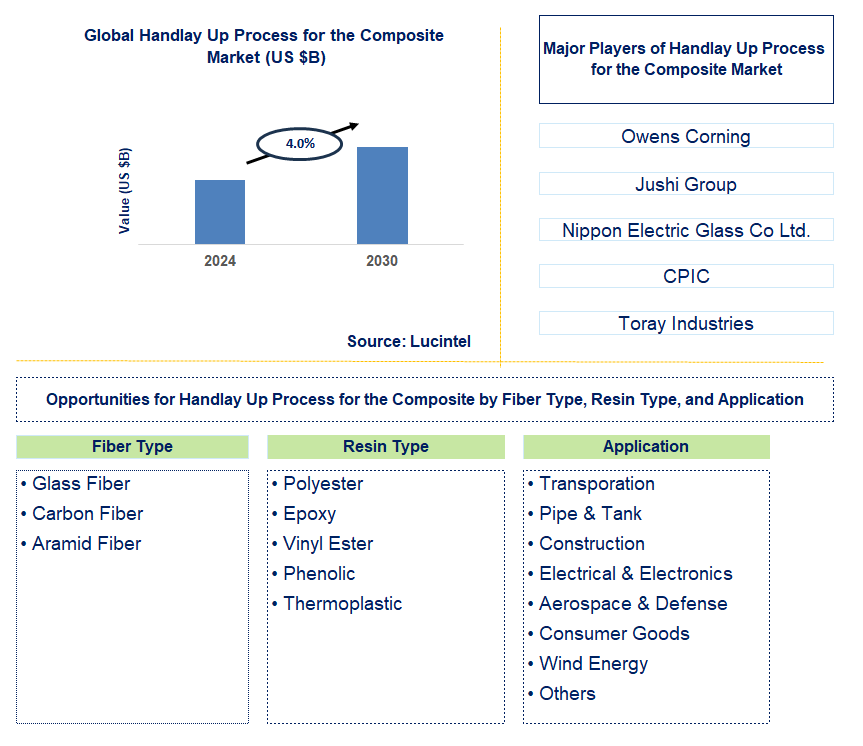
Key data points: The growth forecast = 4.0% annually for the next 6 years. Scroll below to get more insights. This market report covers trends, opportunities, and forecasts in the global handlay up process for the composite market to 2030 by fiber type (glass fiber, carbon fiber, aramid fiber, and), resin type (polyester, epoxy, vinyl ester, phenolic, and thermoplastic), application (transporation, pipe & tank, construction, electrical & electronics, aerospace & defense, consumer goods, wind energy, and others), and region (North America, Europe, Asia Pacific, and the Rest of the World)
We'll send your sample report shortly.
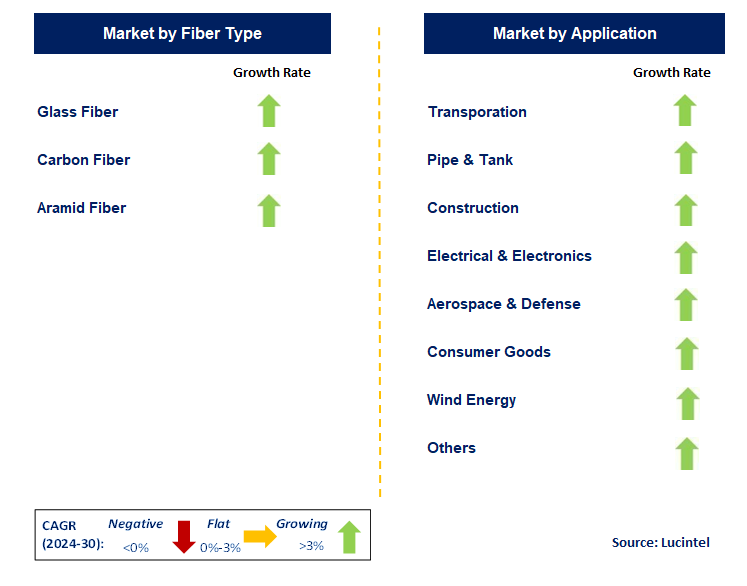
• Lucintel forecasts that, within the fiber type category, glass fiber is expected to witness the higher growth over the forecast period.
• Within the application category, transporation is expected to witness the highest growth.
• In terms of regions, APAC is expected to witness highest growth over the forecast period. A more than 150-page report is developed to help in your business decisions.
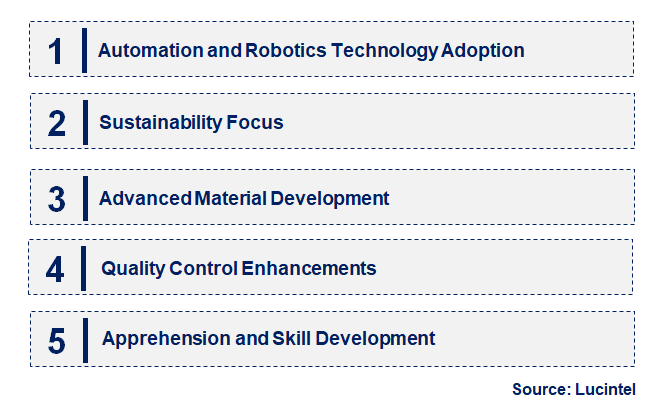
• Automation and Robotics Technology Adoption: More automation is being adopted in the Handlay Up, making the process more efficient and accurate. Material movement and resin application can now be carried out using robotics, saving labor and minimizing mistakes.
• Sustainability Focus: The structural composite market has registered a notable shift toward the usage of greener options, such as bio-based resins and recycled fibers. This also aligns with international trends toward sustainability, requiring manufacturers to adapt to the market.
• Advanced Material Development: The market has seen the emergence of new composite materials with improved mechanical properties. Advancements in resin chemistry and fiber technology have produced better products.
• Quality Control Enhancements: Advances in the control of the Handlay Up process in terms of monitoring and verification have enhanced the uniformity of the process. These improvements include the use of computer-aided image data capturing at various stages of the production cycle.
• Apprehension and Skill Development: As times have changed, more focus has been placed on training programs for workers involved in the Handlay Up process. This enhances the skills of the workforce, enabling manufacturers to adopt new technologies and become quality compliant. These emerging trends have fundamentally altered the Handlay Up process, triggering a leap in the industry that emphasizes enhanced efficiency, quality, and sustainability, positioning the composite industry for growth in the future.
• Advancement of Automation Systems: The introduction of automation systems in the Handlay Up process, such as placing unidirectional fibers, optimizes quality and enhances efficiency. Automated systems for resin application and fiber placement techniques minimize hands-on work and quickly increase production rates, which is essential to service the rising market.
• Use of Environmentally Friendly Materials: Manufacturers are increasingly improving the use of bio-based resins and recycled raw materials, reducing the carbon footprint of businesses. This transition not only reduces the environmental impact but also aligns with international objectives of sustainability, which appeals to consumers and industries.
• Improved Quality Control Measures: The use of improved quality control measures ensures that every Handlay Up procedure is well optimized and performance-controlled. In real time, information is gathered, which allows quick adjustments, reducing defects and enhancing product performance.
• Training and Skill Advancement Programs: With the introduction of advanced technologies in this field, there is an increased need for training programs aimed at workers. Making the workforce more competent ensures that employees can effectively use new techniques and tools, improving the quality of Handlay Up applications.
• Improvement of Material Properties: Advances in composite material technologies have made it possible to design high-performance resins that cure faster. These improvements expand the application of Handlay Up composites, especially in the critical safety areas of aerospace and automotive industries. These changes highlight the growing dynamics of the Handlay Up process, improving processes, quality, and addressing environmental concerns, preparing the composite industry for growth in the years to come.
• Aerospace Applications: The aerospace industry presents tremendous growth potential for the Handlay Up process, with a need for lightweight, high-strength materials. As the emphasis shifts toward better fuel and performance efficiency in aircraft components, the market for advanced composites grows.
• Automotive Industry: The automotive sector also sees a similar trend, where lightweight materials are crucial for reducing fuel consumption and improving performance. The Handlay Up process can meet specific needs in applications such as electric and hybrid vehicles.
• Wind Energy: The wind energy segment offers good prospects for the Handlay Up process, particularly in the fabrication of turbine blades. The increasing demand for powerful turbines necessitates advanced composites that can endure extreme weather conditions.
• Marine Applications: The use of composites for boats and other structural constructions has gained traction in the marine industry. Focused on weight and durability, the Handlay Up process is used for both smaller crafts and larger ships.
• Consumer Goods: A new market for Handlay Up composites is emerging in high-performance outdoor equipment. The process is used to produce lightweight, high-performance products without compromising efficacy. The Handlay Up process is flexible and has potential for further development, allowing manufacturers to create new solutions that meet the needs of changing markets.
• Increasing Demand for Lightweight Composites: There is an increasing need for lighter materials, especially in aerospace engineering and automotive manufacturing. This demand drives the extrusion of high-strength, low-weight composites using the Handlay Up process.
• Technological Advancements: Changes in materials and production methods are improving the Handlay Up process, enabling the creation of more complex shapes, which increases the customer base.
• Focus on Sustainability: The value of sustainability has spurred businesses to move toward the use of non-toxic materials and processes, making the Handlay Up method suitable for green industries.
• Growing Investment in R&D: Increased funding in research and development has enabled the development of new materials and technological modifications that improve the Handlay Up market, broadening its scope of operation.
• Synergy of Industry and Universities: Collaborative initiatives between industries and universities have led to improvements in composite technologies, enhancing the quality of Handlay Up applications. Challenges in the Handlay Up process for the composite market are:
• A Work-Intensive Process: The Handlay Up process is largely manual, making it costly to produce and prone to inconsistencies in quality. Addressing these labor challenges is critical for maintaining competitiveness.
• Material Costs: The cost of high-quality composite materials can deter smaller manufacturers from entering the market, while fluctuating prices may affect profit margins.
• Restriction of Knowledge: While the benefits of composites are clear, some industries still face challenges in understanding the limitations and advantages of the Handlay Up process, preventing its full adoption. These drivers and challenges significantly impact the Handlay Up process in determining strategic options and prospective changes. Stakeholders must navigate these challenges to improve operations and leverage new opportunities.
• Owens Corning
• Jushi Group
• Nippon Electric Glass Co Ltd.
• CPIC
• Toray Industries
• Hexcel Composites
• Mitsubishi Rayon
• Glass Fiber
• Carbon Fiber
• Aramid Fiber
• Polyester
• Epoxy
• Vinyl Ester
• Phenolic
• Thermoplastic
• Transporation
• Pipe & Tank
• Construction
• Electrical & Electronics
• Aerospace & Defense
• Consumer Goods
• Others
• North America
• Europe
• Asia Pacific
• The Rest of the World
• USA: In the US, efforts in the development of the Handlay Up process focus on automating production. Companies are adopting automation in production without compromising quality, and new training policies are being introduced to minimize variation in application methods. There is also a shift toward incorporating innovations, such as bio-resins and recycled content.
• China: China is in a strong position with increasing capabilities in the Handlay Up process, supported by substantial government funding. More composite-dedicated facilities have been constructed, and new resin systems that reduce curing time and improve mechanical properties have been launched. Chinese companies are also focusing on worker safety and skill development to enhance quality in Handlay Up applications.
• Germany: Germany is perfecting Handlay Up technologies, introducing new methodologies that provide high precision and rigorous quality control. Germany’s market is embracing the use of performance-based, lighter materials for the aerospace and automotive industries, and there are efforts to rationalize processes to reduce waste.
• India: India’s Handlay Up process shows rising prospects, particularly in the automotive and aerospace sectors. New training centers are being established to develop advanced composite expertise. Indian manufacturers are also seeking cost-effective materials sourced locally, replacing expensive imported materials. There is a growing trend to replace traditional polymers with innovative resins that offer superior performance.
• Japan: Japan’s advancements in the Handlay Up process focus on high precision and quality, particularly for aerospace and electronics applications where high performance in extreme conditions is required. Studies show a gradual adoption of automation and robotics to improve fiber placement and resin application accuracy, reducing human errors. There is also a trend toward using biodegradable resins and bio-derived materials to reduce weight.


• Owens Corning
• Jushi Group
• Nippon Electric Glass Co Ltd.
• CPIC
• Toray Industries
• Hexcel Composites
• Mitsubishi Rayon Q5. Which handlay up process for the composite market segment will be the largest in future? Answer: Lucintel forecasts that glass fiber is expected to witness the highest growth over the forecast period. Q6. In handlay up process for the composite market, which region is expected to be the largest in next 6 years? Answer: APAC is expected to witness highest growth over the forecast period. Q.7 Do we receive customization in this report? Answer: Yes, Lucintel provides 10% customization without any additional cost.


Choose a license that fits your team. Instant PDF delivery.
Prices exclude taxes. Instant delivery. Custom licensing available on request.
Market Report · July 31, 2026
Market Report · May 18, 2026
Market Report · May 16, 2026
Trusted partner for strategic intelligence and business growth


Receive a complimentary market analysis tailored to your industry. Our analysts will identify key growth opportunities and competitive dynamics specific to your business.

Market size, growth rate, and key trend analysis for your specific sector.

Top competitor positioning and market share analysis.

Strategic recommendations backed by data-driven insights.
Get curated market intelligence and competitive moves straight to your inbox.
By subscribing, you agree to receive our monthly insights. Unsubscribe anytime.
Receive a complimentary market analysis tailored to your industry. Our analysts will identify key growth opportunities and competitive dynamics specific to your business.
Market size, growth rate, and key trend analysis for your specific sector.
Top competitor positioning and market share analysis.
Strategic recommendations backed by data-driven insights.
Get curated market intelligence, emerging trends, and competitive moves straight to your inbox each month.
By subscribing, you agree to receive our monthly insights. Unsubscribe anytime.
We'll send your sample report shortly.