
Market Report · July 29, 2026

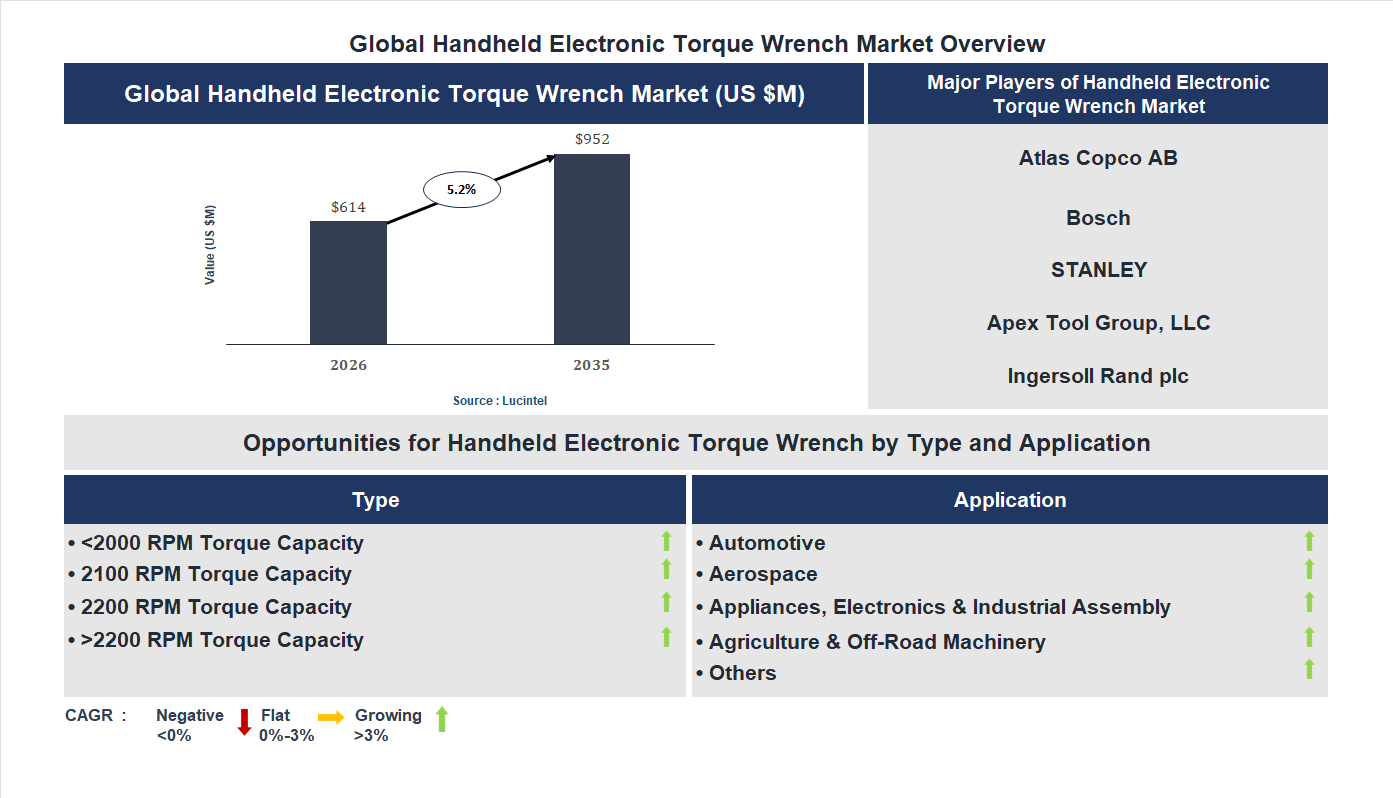
Key data points: The market size in 2035 = $952 million, growth forecast = 5.2% annually for the next 8 years. Scroll below to get more insights. This market report covers trends, opportunities and forecasts in handheld electronic torque wrench market to 2035 by type (<2000 RPM torque capacity, 2100 RPM torque capacity, 2200 RPM torque capacity, and >2200 RPM torque capacity), application (automotive, aerospace, appliances, electronics & industrial assembly, agriculture & off-road machinery, and others), and region (North America, Europe, Asia Pacific, and the Rest of the World)
We'll send your sample report shortly.
• Lucintel forecasts that, within the type category, 2200 rpm torque capacity is expected to witness the highest growth over the forecast period.
• Within the application category, automotive is expected to witness the highest growth.
• In terms of region, APAC is expected to witness the highest growth over the forecast period. Gain valuable insights for your business decisions with our comprehensive 150+ page report. Sample figures with some insights are shown below.
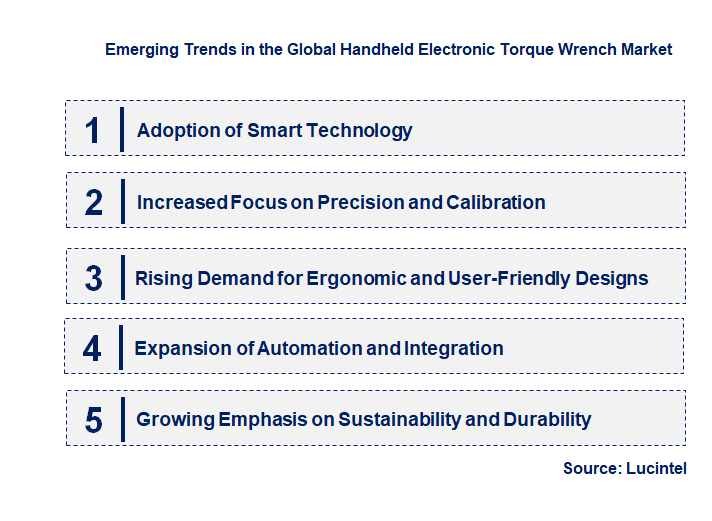
• Adoption of Smart Technology: The integration of digital sensors and IoT connectivity is making torque wrenches smarter. These devices can record torque data, provide real-time feedback, and connect to mobile apps or cloud platforms. This trend enhances accuracy, traceability, and ease of use, especially in quality control and compliance processes. It also allows for predictive maintenance and data analysis, reducing downtime and improving operational efficiency.
• Increased Focus on Precision and Calibration: As industries demand higher safety and quality standards, the emphasis on precise torque application has grown. Advanced electronic torque wrenches offer better calibration, digital readouts, and error reduction features. This trend ensures consistent performance, minimizes over-tightening or under-tightening, and helps meet stringent regulatory requirements, thereby boosting confidence among users and clients.
• Rising Demand for Ergonomic and User-Friendly Designs: Manufacturers are prioritizing ergonomic features such as lightweight construction, comfortable grips, and intuitive interfaces. These improvements reduce user fatigue and enhance productivity, especially during prolonged use. User-friendly designs also facilitate easier calibration and operation, making these tools accessible to a broader range of users, including those with limited technical expertise.
• Expansion of Automation and Integration: The market is witnessing increased automation capabilities, including programmable torque settings and integration with robotic systems. Automated torque wrenches improve consistency and speed in assembly lines, reducing human error. This trend is particularly significant in high-volume manufacturing sectors, where efficiency and precision are critical, and is driving the development of fully integrated, automated assembly solutions.
• Growing Emphasis on Sustainability and Durability: Environmental concerns are prompting manufacturers to develop more durable, energy-efficient, and eco-friendly products. Features such as rechargeable batteries, recyclable materials, and energy-saving modes are becoming standard. This trend not only reduces the environmental footprint but also lowers long-term operational costs, appealing to eco-conscious consumers and companies committed to sustainable practices. These trends are fundamentally reshaping the handheld electronic torque wrench market by enhancing device intelligence, precision, usability, automation, and sustainability. These developments are enabling industries to achieve higher safety standards, operational efficiency, and product quality, thereby driving market growth and innovation.
• Growing Adoption in Automotive Industry: The automotive sector is increasingly adopting electronic torque wrenches for precise assembly and safety compliance. This shift improves productivity, reduces errors, and ensures consistent torque application, which is critical for vehicle safety standards. The demand for lightweight, durable, and high-accuracy tools is rising, leading to innovations tailored for automotive manufacturing lines. As automakers focus on quality control, the market for advanced handheld torque wrenches is expected to expand significantly, creating new growth avenues.
• Technological Innovations in Digital Features: Recent developments include integration of Bluetooth connectivity, digital displays, and data logging capabilities. These features enable real-time monitoring, enhanced accuracy, and better record-keeping, which are vital for quality assurance. Such innovations improve user experience and operational efficiency, making tools more attractive to professional users. The integration of IoT technology is also enabling predictive maintenance and remote diagnostics, further boosting market growth and expanding the scope of applications.
• Increasing Focus on Safety and Compliance Standards: Stringent safety regulations and quality standards across industries are driving the adoption of electronic torque wrenches. These tools help ensure proper torque application, reducing the risk of equipment failure and accidents. Manufacturers are developing compliant devices with features like overload protection and calibration alerts. This focus on safety enhances product credibility and market demand, especially in aerospace, automotive, and heavy machinery sectors, fostering market expansion and encouraging innovation.
• Expansion of Sub-segments and Application Areas: The market is witnessing diversification with specialized torque wrenches for specific applications such as aerospace, electronics, and construction. Sub-segments like cordless, digital, and programmable torque wrenches are gaining popularity due to their versatility and ease of use. This expansion allows manufacturers to target niche markets and meet unique industry requirements. The growing adoption of these tools in maintenance, assembly, and repair operations is further propelling market growth and broadening the overall market landscape.
• Rising Investment in R&D and Market Penetration Strategies: Companies are investing heavily in research and development to enhance product features and durability. Strategic partnerships, acquisitions, and regional expansion are also key drivers. These efforts aim to improve product performance, reduce costs, and increase market reach. As a result, the market is witnessing a surge in innovative product launches and increased competition, which benefits consumers through better options and drives overall market growth. The overall impact of these developments is a dynamic, expanding market characterized by technological innovation, increased safety standards, and diversified application areas. These factors are collectively enhancing product quality, operational efficiency, and market competitiveness, leading to sustained growth and new opportunities for industry players.
• Automotive Industry Expansion: The automotive sector is increasingly adopting handheld electronic torque wrenches for assembly and maintenance, driven by the need for precise tightening to ensure safety and performance. The rise in electric vehicles and advanced manufacturing processes further boost demand. Sub-segments like passenger cars, commercial vehicles, and electric vehicles benefit from specialized torque tools, improving efficiency and reducing warranty costs. This growth is supported by stringent safety regulations and quality standards across global markets.
• Aerospace Sectors Need for Precision: The aerospace industry requires highly accurate torque applications to ensure safety and compliance with strict standards. Handheld electronic torque wrenches are essential for assembling aircraft components, engines, and structural parts. The demand is driven by increasing aircraft production, maintenance, and repair activities worldwide. Innovations in lightweight, durable, and user-friendly tools are making them indispensable for aerospace manufacturers and maintenance crews, fostering market growth in this high-precision application.
• Manufacturing Sectors Automation and Efficiency: Manufacturing industries are integrating handheld electronic torque wrenches to improve assembly line efficiency and product quality. These tools enable consistent torque application, reducing errors and rework costs. The rise of automation and Industry 4.0 initiatives further enhance their adoption, with smart torque wrenches offering data logging and connectivity features. Sub-segments like electronics, machinery, and appliances are leveraging these tools to meet high-quality standards and streamline production processes, fueling market expansion.
• Construction and Infrastructure Development: The construction industry increasingly relies on electronic torque wrenches for assembling structural components, steel frameworks, and machinery. The demand is driven by infrastructure projects, commercial building developments, and the need for safety compliance. Portable, rugged, and easy-to-use torque tools are preferred for on-site applications, ensuring proper tightening and safety. Growing urbanization and infrastructure investments globally are expected to sustain demand, with sub-segments like residential, commercial, and industrial construction benefiting significantly.
• Technological Innovations and Smart Features: The integration of digital, Bluetooth, and IoT capabilities into handheld electronic torque wrenches is transforming the market. These smart tools enable real-time data monitoring, remote control, and maintenance alerts, improving accuracy and operational efficiency. The adoption of AI and machine learning further enhances predictive maintenance and quality control. As industries seek smarter, connected solutions, the market for technologically advanced torque wrenches is poised for substantial growth, catering to high-precision and data-driven applications. The overall market outlook indicates that these growth opportunities will significantly enhance the adoption of handheld electronic torque wrenches across diverse sectors. Innovations, industry-specific needs, and technological integration are expected to drive sustained growth, making these tools indispensable for ensuring safety, quality, and efficiency. As industries evolve, the market will likely see increased competition, product diversification, and global expansion, shaping a promising future for stakeholders.
• Technological Innovation: The development of advanced digital torque measurement systems has significantly improved accuracy, ease of use, and data logging capabilities. These innovations enable users to perform precise tightening, reduce errors, and ensure compliance with stringent safety standards. As technology continues to evolve, manufacturers are integrating features like Bluetooth connectivity and real-time monitoring, which enhance productivity and quality control. This ongoing innovation attracts industries such as automotive, aerospace, and manufacturing, fueling market growth by meeting increasing demand for precision tools.
• Growing Manufacturing Sector: The expansion of manufacturing industries worldwide, especially in automotive, aerospace, and heavy machinery, is a major driver. These sectors require reliable, accurate torque tools to ensure safety, durability, and compliance with industry standards. As production volumes increase and quality assurance becomes more critical, the demand for handheld electronic torque wrenches rises. Economic growth in emerging markets further amplifies this trend, creating a robust market environment driven by the need for efficient and precise assembly processes.
• Regulatory and Safety Standards: Stringent safety regulations and quality standards imposed by governments and industry bodies are compelling manufacturers to adopt more accurate torque tools. Electronic torque wrenches help ensure compliance with specifications, reduce the risk of over-tightening or under-tightening, and improve safety outcomes. This regulatory landscape encourages investment in advanced tools that can provide documented proof of proper torque application, thereby boosting market demand. Companies that align with these standards gain competitive advantages and reduce liability risks.
• Increasing Adoption of Automation: The shift towards automation and Industry 4.0 initiatives is a significant driver. Electronic torque wrenches are integral to automated assembly lines, providing precise torque control and data collection for quality management. Their integration with other digital systems enhances process efficiency, reduces labor costs, and minimizes errors. As industries move towards smart manufacturing, the demand for connected, intelligent torque tools is expected to grow, further propelling market expansion and technological development.
• Rising Focus on Quality Control: The emphasis on maintaining high-quality standards across manufacturing processes is fueling demand for reliable torque measurement tools. Handheld electronic torque wrenches offer consistent performance, real-time data logging, and traceability, which are vital for quality assurance. Industries are increasingly adopting these tools to meet customer expectations, reduce warranty claims, and comply with international standards. This focus on quality control not only sustains current market growth but also encourages innovation in torque measurement technology. The challenges facing the handheld electronic torque wrench market include:
• High Initial Investment: The adoption of electronic torque wrenches involves significant upfront costs for purchasing advanced equipment and training personnel. Small and medium-sized enterprises may find these expenses prohibitive, limiting market penetration in certain regions. Additionally, the cost of maintenance and calibration can add to the financial burden, potentially slowing down adoption rates. This financial barrier can restrict market growth, especially in price-sensitive markets, despite the long-term benefits of improved accuracy and efficiency.
• Technological Complexity: The sophisticated nature of electronic torque wrenches requires specialized knowledge for operation, calibration, and maintenance. This complexity can lead to a steep learning curve for users, increasing the risk of misuse or incorrect calibration. It also necessitates ongoing technical support and training, which can be resource-intensive. Such challenges may hinder widespread adoption, particularly in industries or regions lacking technical expertise, thereby impacting overall market expansion.
• Regulatory Compliance and Standardization: Navigating diverse regulatory requirements across different countries can be challenging. Ensuring compliance with international standards such as ISO and ANSI involves rigorous testing, certification, and documentation processes, which can be time-consuming and costly. Variations in standards may also lead to compatibility issues, complicating global market expansion. These regulatory hurdles can delay product launches and increase operational costs, posing significant challenges for manufacturers aiming for international growth. The handheld electronic torque wrench market is driven by technological advancements, expanding manufacturing sectors, regulatory standards, automation, and quality focus. However, high costs, technological complexity, and regulatory challenges present notable barriers. These factors collectively shape the market landscape, requiring stakeholders to innovate and adapt strategically. While growth prospects remain promising, addressing these challenges is crucial for sustained development and competitive advantage in this evolving industry.
• Atlas Copco AB
• Bosch
• STANLEY
• Apex Tool Group, LLC
• Ingersoll Rand plc
• Hilti Corporation
• Makita Corporation
• Techtronic Industries Company Limited
• Uryu Seisaku, Ltd.
• Gedore Torque Solutions GmbH
• <2000 RPM Torque Capacity
• 2100 RPM Torque Capacity
• 2200 RPM Torque Capacity
• >2200 RPM Torque Capacity
• Automotive
• Aerospace
• Appliances, Electronics & Industrial Assembly
• Agriculture & Off-Road Machinery
• Others
• North America
• Europe
• Asia Pacific
• The Rest of the World
• United States: The US market has seen rapid adoption of smart torque wrenches with IoT integration, driven by automotive and aerospace industries. Major players are investing in R&D to develop wireless and app-enabled tools, enhancing precision and data tracking. Regulatory standards for safety and quality are also influencing market growth, with increased demand for durable, high-performance devices. The rise of automation in manufacturing has further accelerated the adoption of electronic torque wrenches, making the US a leader in technological innovation within this sector.
• China: China’s market is expanding due to rapid industrialization and infrastructure development. The focus is on cost-effective, durable electronic torque wrenches suitable for large-scale manufacturing and construction projects. Local manufacturers are increasingly adopting digital technologies to improve product quality and competitiveness. Government initiatives supporting industrial upgrades and automation are boosting demand. Additionally, China is witnessing a surge in exports of electronic torque wrenches, with companies investing in R&D to develop advanced, user-friendly products tailored to global markets.
• Germany: Germany’s market is characterized by high-quality, precision-engineered electronic torque wrenches, primarily serving the automotive, machinery, and aerospace sectors. The emphasis on safety standards and compliance with European regulations drives innovation in accuracy and durability. German companies are integrating advanced features such as digital calibration and data logging. The focus on sustainable manufacturing practices and energy-efficient tools is also prominent. Collaborations with research institutions are fostering technological advancements, positioning Germany as a key player in the premium segment of the handheld electronic torque wrench market.
• India: The Indian market is witnessing rapid growth due to expanding manufacturing, automotive, and infrastructure sectors. Cost-effective, reliable electronic torque wrenches are in high demand, with a focus on local manufacturing to reduce import dependence. Increasing awareness of safety standards and quality control is driving adoption. The government’s Make in India initiative and push for industrial automation are further fueling market expansion. Small and medium enterprises are adopting digital tools to improve efficiency, and local startups are innovating with affordable, feature-rich torque wrenches to cater to domestic and export markets.
• Japan: Japan’s market is driven by advanced technological integration and a strong focus on quality and precision. The automotive and electronics industries are primary consumers of high-end electronic torque wrenches. Japanese companies are investing in IoT-enabled tools with real-time data analysis and wireless connectivity. The emphasis on safety, reliability, and compliance with strict standards influences product development. Additionally, Japan’s focus on sustainability and energy efficiency is reflected in the design of eco-friendly, durable torque wrenches. The market benefits from a well-established industrial base and continuous innovation in digital and smart tool technologies.


• Atlas Copco AB
• Bosch
• STANLEY
• Apex Tool Group, LLC
• Ingersoll Rand plc
• Hilti Corporation
• Makita Corporation
• Techtronic Industries Company Limited
• Uryu Seisaku, Ltd.
• Gedore Torque Solutions GmbH Q6. Which handheld electronic torque wrench market segment will be the largest in future? Answer: Lucintel forecasts that, within the type category, 2200 rpm torque capacity is expected to witness the highest growth over the forecast period. Q7. In handheld electronic torque wrench market, which region is expected to be the largest in next 5 years? Answer: In terms of region, APAC is expected to witness the highest growth over the forecast period. Q8. Do we receive customization in this report? Answer: Yes, Lucintel provides 10% customization without any additional cost.


Choose a license that fits your team. Instant PDF delivery.
Prices exclude taxes. Instant delivery. Custom licensing available on request.
Market Report · July 29, 2026
Market Report · July 15, 2026
Market Report · July 13, 2026
Trusted partner for strategic intelligence and business growth


Receive a complimentary market analysis tailored to your industry. Our analysts will identify key growth opportunities and competitive dynamics specific to your business.

Market size, growth rate, and key trend analysis for your specific sector.

Top competitor positioning and market share analysis.

Strategic recommendations backed by data-driven insights.
Get curated market intelligence and competitive moves straight to your inbox.
By subscribing, you agree to receive our monthly insights. Unsubscribe anytime.
Receive a complimentary market analysis tailored to your industry. Our analysts will identify key growth opportunities and competitive dynamics specific to your business.
Market size, growth rate, and key trend analysis for your specific sector.
Top competitor positioning and market share analysis.
Strategic recommendations backed by data-driven insights.
Get curated market intelligence, emerging trends, and competitive moves straight to your inbox each month.
By subscribing, you agree to receive our monthly insights. Unsubscribe anytime.
We'll send your sample report shortly.