
Report Feature
Hair Oil Market Trends and Forecast
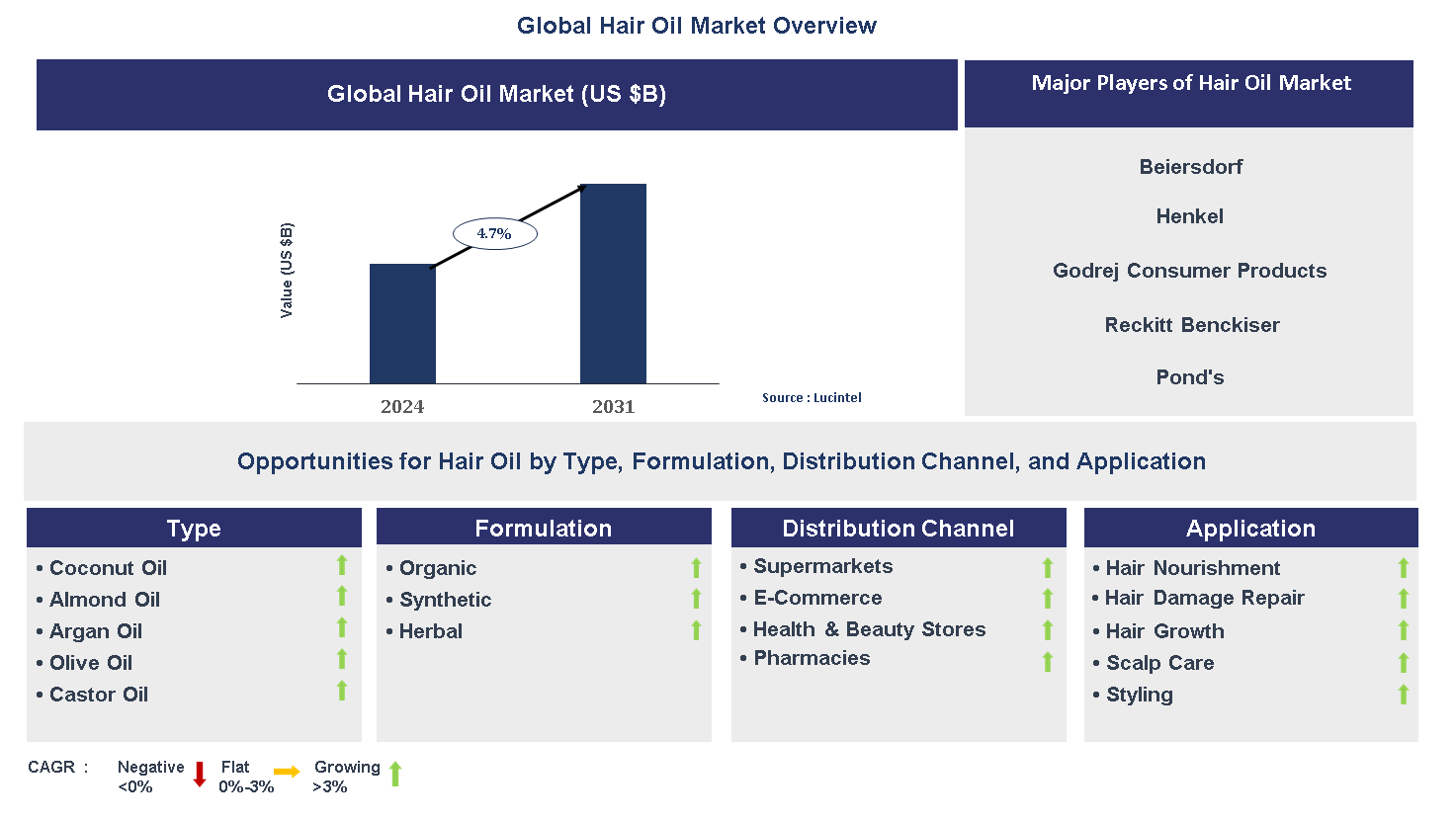
The future of the global hair oil market looks promising with opportunities in the hair nourishment, hair damage repair, hair growth, scalp care, and styling markets. The global hair oil market is expected to grow with a CAGR of 4.7% from 2025 to 2031. The major drivers for this market are the increasing awareness of hair care benefits, the rising demand for natural hair oils, and the growing focus on healthy hair growth.• Lucintel forecasts that, within the type category, coconut oil is expected to witness the highest growth over the forecast period.
• Within the application category, hair growth is expected to witness the highest growth.
• In terms of region, APAC is expected to witness the highest growth over the forecast period. Gain valuable insights for your business decisions with our comprehensive 150+ page report. Sample figures with some insights are shown below.
Emerging Trends in the Hair Oil Market
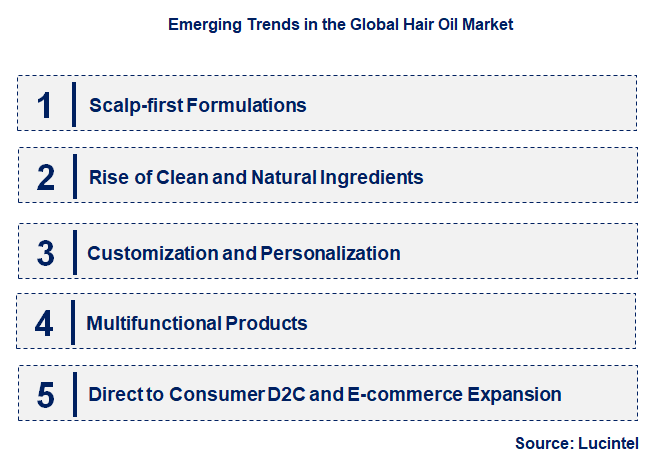
The hair oil market is emerging into a new paradigm from its more simplistic role as just a hair nourishment. It’s fueled by the junction of consumer demand for increasingly sophisticated and targeted solutions, ingredient science advancement, and the pervasive influence of digital platforms. Consumers are no longer satisfied with generic products; they are actively seeking hair oils that not only provide essential moisture but also offer specific benefits such as scalp treatment, hair growth stimulation, and protection against environmental damage.• Scalp-first Formulations: This trend marks a significant departure from hair-centric products. Instead of just focusing on the hair strands, brands are creating hair oils that prioritize scalp health. These formulations often contain active ingredients like tea tree oil, salicylic acid, or probiotics to address issues such as dandruff, inflammation, and excess sebum. By treating the root of the problem, these oils aim to create a healthy environment for hair growth.
• Rise of Clean and Natural Ingredients: Consumers are becoming more conscious of what they apply to their bodies, leading to a strong demand for products with clean, transparent, and natural ingredient lists. Hair oils featuring cold-pressed, organic, and plant-based ingredients like argan, jojoba, and coconut oil are gaining popularity. This trend is also tied to sustainability, with brands emphasizing ethically sourced and eco-friendly practices.
• Customization and Personalization: This trend is about creating a bespoke hair care experience. Brands are offering quiz-based platforms or personalized consultations to recommend hair oils tailored to an individual’s specific hair type, concerns, and lifestyle. This could involve blends of different oils to address multiple issues or a personalized oil serum for specific hair needs. This high level of personalization builds consumer loyalty and trust by offering solutions that are perceived as more effective than mass-produced products.
• Multifunctional Products: In a fast-paced world, consumers are seeking convenience. Multifunctional hair oils are gaining traction as they provide multiple benefits in a single product. These oils can be used as a pre-shampoo treatment, a leave-in conditioner, or a styling serum to tame frizz and add shine. This trend is particularly popular with consumers who have busy lifestyles and prefer simplified beauty routines. Brands are innovating to create lightweight, non-greasy formulations that can perform a variety of functions without weighing down the hair.
• Direct to Consumer D2C and E-commerce Expansion: The online world has transformed the way hair oils are marketed and sold. D2C brands are using social media and e-commerce sites to eliminate traditional retail channels, providing a direct communication channel with consumers. The model provides more transparency and storytelling, allowing brands to establish a strong community. This trend provides opportunities for niche and indie brands to compete with large corporations, offering unique products and personalized experiences that appeal to modern consumers. These five trends are collectively reshaping the hair oil market by pushing it towards a more consumer-centric, specialized, and sustainable future. The focus has moved from general nourishment to targeted, solution-oriented products. The growth of digital channels has made personalization and transparency at the brand level possible, giving power to both consumers and smaller brands. With trends growing, the market is becoming increasingly competitive and dynamic, with innovation playing a major role in differentiation.
Recent Development in the Hair Oil Market
The hair oil market is witnessing a period of significant change, shaped by evolving consumer behavior, technological advancement, and a heightened demand for efficiency of products as well as sustainability. These trends are shifting the market away from the traditional, one-size-fits-all model toward more specialized and consumer-centric approaches. This shift is not only altering the kinds of products that exist but also redirecting the way they are marketed, distributed, and perceived.• Premiumization of Hair Oils: This development reflects a shift in consumer mindset from viewing hair oil as a basic commodity to a premium hair care treatment. Brands are launching high-end hair oils with luxurious packaging, sophisticated fragrances, and potent, often exotic, ingredients like Moroccan argan oil, Japanese camellia oil, or unique botanical blends. The focus is on providing a salon-quality experience at home. This trend is driving up the average price point of products and creating new market segments, appealing to consumers with higher disposable incomes who are willing to invest in superior hair health solutions.
• Focus on Scalp Health and Treatment: A key development is the market’s pivot towards scalp care. Brands have actually launched hair oils targeted at specific scalp conditions, considering that a healthy scalp is the foundation of healthy hair. Ingredients range from dandruff-fighting and irritation-calming properties to helping regulate sebum production, ensuring the scalp doesn’t overproduce sebum. This has driven the incorporation of hair oil into a much more holistic hair care.
• Integration of Science and Traditional Medicine: This development involves the fusion of modern cosmetic science with age-old herbal and Ayurvedic practices. Brands are combining traditional botanical ingredients like amla, barangay, and rosemary with advanced scientific compounds like peptides and vitamins. This hybrid approach allows for the creation of potent formulations that are rooted in tradition but validated by science.
• Sustainable and Eco-friendly Packaging: Sustainability is no longer just a trend; it is a core business development. Hair oil brands are increasingly adopting eco-friendly practices, particularly in their packaging. This includes using recyclable glass bottles, post-consumer recycled plastic, and minimalist, non-toxic packaging. Some brands are also exploring refillable options to reduce waste. This development is a direct response to consumer demand for sustainable products and demonstrates a brand’s commitment to environmental responsibility, which can significantly influence purchasing decisions.
• Rise of Waterless Formulations and Concentrates: To reduce their carbon footprint and appeal to eco-conscious consumers, some brands are developing waterless hair oil formulations or highly concentrated serums. These products are more potent and require smaller amounts for each application, which reduces both the amount of product used and the overall packaging. This development also caters to the minimalist consumer who values efficacy and reduced clutter in their beauty routine. These five developments are collectively shaping the hair oil market by driving innovation and a renewed focus on consumer needs. The market is increasingly segmented, with products tailored to specific issues and more focus on quality than quantity. Merging science and tradition, coupled with increasing pressure to sustain, is reshaping the product universe. These shifts are fostering a more competitive and dynamic market where transparent, innovative, and values-driven brands can thrive.
Strategic Growth Opportunities in the Hair Oil Market
The hair oil market is evolving, presenting strategic growth opportunities across various applications. The traditional use of hair oils for simple nourishment is expanding to encompass more specialized and targeted solutions. This shift is driven by a more informed consumer base seeking products that deliver multiple benefits and address specific hair and scalp concerns. By focusing on these emerging applications, brands can unlock new market segments and drive significant growth.• Scalp Treatment and Wellness: A significant growth opportunity lies in positioning hair oils as a primary product for scalp health. The market for such innovation is ripe, as more and more consumers are seeking solutions for scalp issues like dandruff and dryness; it’s also linked to inflammation. Brands can develop scalp-specific oils with tea tree, rosemary, and peppermint oil, which have proven antibacterial and anti-inflammatory properties. Such products can be marketed as a pre-shampoo treatment or a nightly serum, transforming the simple act of oiling into a therapeutic scalp ritual.
• Hair Growth and Density Enhancement: Hair loss and thinning are major concerns for consumers across all age groups. Hair oils are well-positioned to address this, offering a natural and less-invasive alternative to chemical treatments. Opportunities lie in creating hair oils using ingredients that are known to stimulate blood flow and grow hair roots, like castor oil, amla, and fenugreek. Such products are sold with an open assurance of hair growth and enhanced density.
• Anti-Pollution and Environmental Protection: As environmental concerns grow, so does the demand for products that protect hair from damage caused by pollution, UV rays, and other external aggressors. Hair oils can be formulated as a protective barrier, rich in antioxidants like Vitamin E and green tea extract. This application is particularly relevant in urban areas with high pollution levels. Brands can market these oils as a daily defense shield, creating a new usage occasion.
• Color Protection and Post-Treatment Care: The hair color and chemical treatment market is booming, creating a need for specialized post-treatment care. Hair oils can serve as a vital part of this routine, helping to lock in color, repair damage, and restore moisture. Strategic growth lies in developing oils with ingredients that are specifically beneficial for color-treated hair, such as macadamia nut oil or argan oil, which help to seal the hair cuticle. These products can be sold through salons and directly to consumers who color their hair on a regular basis, providing a high-end solution to hair health and vibrancy.
• Finishing and Styling Products: In addition to nourishment, hair oils can be formulated as light finishing and styling products. The value here is to formulate products that are not greasy but still offer shine, frizz control, and texture definition. This application appeals to consumers seeking a natural alternative to synthetic styling products. Brands can innovate with dry oils and oil-serum hybrids that offer a smooth, non-oily finish. This provides a versatile application that integrates hair oils into the daily styling routine, expanding their usage beyond a pre-wash treatment. By strategically focusing on these five application areas, the hair oil market can move beyond its traditional confines and cater to the specific, evolving needs of modern consumers. These opportunities are not about creating new products but about repositioning and reformulating existing ones to address high-demand concerns. This strategic approach will drive market growth and establish hair oils as a versatile and essential component of any comprehensive hair care routine.
Hair Oil Market Driver and Challenges
The hair oil market is a complex ecosystem influenced by a dynamic interplay of technological, economic, and regulatory factors. Major drivers are propelling the market forward, including a growing consumer inclination towards natural products, the influence of digital media, and increasing disposable incomes. However, the market also faces significant challenges, such as stiff competition from synthetic alternatives and a fragmented consumer base with diverse needs. The factors responsible for driving the hair oil market include: 1. Increasing Demand for Natural and Organic Products: This is a key factor changing the hair oil industry. There is a growing awareness of the potential danger from man-made chemicals, and people are actively looking for products that contain natural, plant-based ingredients. Hair oils, being natural in nature, are well-placed to benefit from this trend. The movement is not transient but a fundamental consumer value, fueling the demand for paraben-free, sulfate-free, and silicone-free products. 2. Social Media and Digital Marketing Influence: Beauty influencers and social media platforms play a central role in driving consumer trends. The visual and educational nature of platforms like Instagram and YouTube makes them ideal for showcasing the benefits of hair oiling rituals and product results. This digital influence has democratized the market, allowing niche brands to gain visibility and reach a global audience. Influencers often provide testimonials and tutorials, which build consumer trust and significantly impact purchasing decisions, particularly among younger demographics. 3. Rising Consumer Awareness of Hair and Scalp Health: There is a heightened awareness among consumers that hair health begins at the scalp. This has shifted the focus from purely cosmetic benefits to functional and therapeutic ones. Consumers are now seeking hair oils that address specific concerns such as hair fall, dandruff, and scalp dryness. This driver is pushing brands to innovate with specialized formulations that offer targeted solutions, transforming hair oil from a traditional conditioning product into a wellness and treatment staple. 4. Growing Disposable Incomes: In emerging economies, growing disposable incomes are allowing consumers to spend more on personal care and beauty products. This economic force is driving premiumization of the hair oil market. Consumers who previously used simple, low-priced oils are now in the mood to pay more for more expensive, benefit-driven products. This trend is generating a profitable market for premium and luxury hair oil brands that provide complex formulations, exotic ingredients, and richer sensory experiences. 5. Rising E-commerce and D2C: E-commerce has made it possible to reach consumers anywhere in the world with a plethora of hair oils. D2C brands are using these channels as a way to ensure better, direct contact with the final consumers and offer suitable recommendations specific to their needs, thus offering tailor-made products for consumers. In any given market, this development has reduced the entry barriers of new contenders into the mix. E-commerce platforms also provide valuable consumer data that brands can use to tailor their product offerings and marketing strategies. Challenges in the hair oil market are: 1. Competition from Synthetic and Chemical-based Alternatives: The hair oil market faces strong competition from a vast array of synthetic products such as serums, creams, and leave-in conditioners. These alternatives often promise quick, visible results, which can be appealing to consumers seeking immediate gratification. The challenge for hair oil brands is to effectively communicate the long-term, holistic benefits of natural oiling, which may not be as instantly noticeable as a silicone-based product. 2. Perceived Greasiness and Stickiness: One of the biggest and longest-standing issues for hair oil brands is the perceived greasiness and stickiness of hair oil, which tends to be especially repellent for new users. This is often enough to deter from using hair oil as a regular styling product or in warmer climates. Brands need to get over this barrier by creating light, fast-absorbing, and non-greasy formulas. 3. Highly Fragmented Consumer Base and Multiple Requirements: The hair oil market is a highly fragmented consumer base with diversified hair types, needs, and cultural practices. A product that works for one consumer may not work for another. The diversity makes it difficult for brands to develop a single product that would appeal to a broad group of consumers. Brands need to invest in R&D in order to develop a large number of specialized products, which needs huge investments and in-depth knowledge of various market segments. The intersection of these drivers and challenges is radically transforming the hair oil industry. The drivers are nudging the market towards more innovation, specialization, and consumerization. Brands are responding with premium, natural, and multi-functional products for specific hair and scalp worries. The critical issues, especially the competition with synthetic products and the stigma associated with being greasy, require that brands become more innovative in their formulations and marketing efforts.List of Hair Oil Companies
Companies in the market compete on the basis of product quality offered. Major players in this market focus on expanding their manufacturing facilities, R&D investments, infrastructural development, and leverage integration opportunities across the value chain. With these strategies hair oil companies cater increasing demand, ensure competitive effectiveness, develop innovative products & technologies, reduce production costs, and expand their customer base. Some of the hair oil companies profiled in this report include-• Beiersdorf
• Henkel
• Godrej Consumer Products
• Reckitt Benckiser
• Pond’s
• L’Oreal
• Unilever
• Procter and Gamble
• Marico
• PepsiCo
Hair Oil Market by Segment
The study includes a forecast for the global hair oil market by type, formulation, distribution channel, application, and region.Hair Oil Market by Type [Value from 2019 to 2031]:
• Coconut Oil
• Almond Oil
• Argan Oil
• Olive Oil
• Castor Oil
Hair Oil Market by Formulation [Value from 2019 to 2031]:
• Organic
• Synthetic
• Herbal
Hair Oil Market by Distribution Channel [Value from 2019 to 2031]:
• Supermarkets
• E-Commerce
• Health & Beauty Stores
• Pharmacies
Hair Oil Market by Application [Value from 2019 to 2031]:
• Hair Nourishment
• Hair Damage Repair
• Hair Growth
• Scalp Care
• Styling
Hair Oil Market by Region [Value from 2019 to 2031]:
• North America
• Europe
• Asia Pacific
• The Rest of the World
Country Wise Outlook for the Hair Oil Market
The hair oil industry is experiencing a paradigm shift fueled by a worldwide shift towards holistic well-being, natural elements, and customized hair care regimens. This change is remodeling consumer tastes and product development in various parts of the world. Companies are placing more emphasis on niche formulations for specific issues like hair loss, scalp care, and environmental stress, going beyond the classical nourishment-based products. The growth of digital marketing and e-commerce has also democratized the market, making it easier for niche and direct-to-consumer brands to take hold and compete with industry giants.• United States: The US market for hair oil is characterized by a high emphasis on premiumization and niches. Consumers are increasingly seeking products with therapeutic benefits and transparent, natural ingredients, moving away from a one-size-fits-all approach. There is a growing demand for hair oils that address specific issues like scalp health, anti-aging, and hair loss, particularly among an aging population and younger consumers experiencing premature hair concerns. The market is also witnessing the emergence of "clean beauty" and eco-friendly practices, as companies introduce green and sustainably sourced products.
• China: The hair oil market in China is marked by the sudden trend towards premium and professional products. Scalp and hair care are high among consumer priorities, driven by pollution and stress concerns. This has resulted in a high demand for products with sophisticated formulations and ingredients derived from traditional Chinese medicine. The e-commerce and social media platforms such as Xiaohan’s also dominate the market, playing a significant role in creating consumer trends and propelling sales.
• Germany: Germany’s hair oil market is characterized by high demand from consumers for organic, natural, chemical-free products. German consumers are extremely health-oriented and value product safety as well as ingredient openness. This has led to a significant demand for hair oils that are free from parabens, sulfates, and silicones. The market is also seeing a rise in specialized products that cater to specific hair and scalp issues.
• India: Indian hair oil industry is a highly traditional but fast-changing market. Heritage oils such as coconut and amla remain dominant, but with increasing demand for special, multi-functional, and non-sticky products. Urban and youth consumers are fueling the growth for premium hair oils that cater to certain problems such as hair fall and dandruff. The market is also seeing a strong surge towards Ayurvedic and natural products, a sign of a rekindled interest in old wellness practices.
• Japan: Japan’s hair oil market is upscale and propelled by its aging population and focus on scalp health. Consumers are very product-savvy in terms of ingredients and are looking for solutions that address concerns such as hair loss and hair-related changes due to aging. Natural and organic product formulations are in high demand, along with goods that comply with the country’s stringent cosmetic standards. "J-beauty" innovations are also being welcomed within the market, as technology-driven solutions and unique forms of products have become the focus of brands.

Features of the Global Hair Oil Market
Market Size Estimates: Hair oil market size estimation in terms of value ($B). Trend and Forecast Analysis: Market trends (2019 to 2024) and forecast (2025 to 2031) by various segments and regions. Segmentation Analysis: Hair oil market size by various segments, such as by type, formulation, distribution channel, application, and region in terms of value ($B). Regional Analysis: Hair oil market breakdown by North America, Europe, Asia Pacific, and Rest of the World. Growth Opportunities: Analysis of growth opportunities in different types, formulations, distribution channel, applications, and regions for the hair oil market. Strategic Analysis: This includes M&A, new product development, and competitive landscape of the hair oil market. Analysis of competitive intensity of the industry based on Porter’s Five Forces model.
FAQ
Q1. What is the growth forecast for hair oil market? Answer: The global hair oil market is expected to grow with a CAGR of 4.7% from 2025 to 2031. Q2. What are the major drivers influencing the growth of the hair oil market? Answer: The major drivers for this market are the increasing awareness of hair care benefits, the rising demand for natural hair oils, and the growing focus on healthy hair growth. Q3. What are the major segments for hair oil market? Answer: The future of the hair oil market looks promising with opportunities in the hair nourishment, hair damage repair, hair growth, scalp care, and styling markets. Q4. Who are the key hair oil market companies? Answer: Some of the key hair oil companies are as follows:• Beiersdorf
• Henkel
• Godrej Consumer Products
• Reckitt Benckiser
• Pond’s
• L’Oreal
• Unilever
• Procter and Gamble
• Marico
• PepsiCo Q5. Which hair oil market segment will be the largest in future? Answer: Lucintel forecasts that, within the type category, coconut oil is expected to witness the highest growth over the forecast period. Q6. In hair oil market, which region is expected to be the largest in next 5 years? Answer: In terms of region, APAC is expected to witness the highest growth over the forecast period. Q7. Do we receive customization in this report? Answer: Yes, Lucintel provides 10% customization without any additional cost.
Table of Contents
List of Figures
List of Tables
Methodology
- In-depth interviews of the major players in this market
- Detailed secondary research from competitors’ financial statements and published data
- Extensive searches of published works, market, and database information pertaining to industry news, company press releases, and customer intentions
- A compilation of the experiences, judgments, and insights of Lucintel’s professionals, who have analyzed and tracked this market over the years.


Buy Now
Choose a license that fits your team. Instant PDF delivery.
Prices exclude taxes. Instant delivery. Custom licensing available on request.
Key Questions
- • What are some of the most promising, high-growth opportunities for the hair oil market by type (coconut oil, almond oil, argan oil, olive oil, and castor oil), formulation (organic, synthetic, and herbal), distribution channel (supermarkets, e-commerce, health & beauty stores, and pharmacies), application (hair nourishment, hair damage repair, hair growth, scalp care, and styling), and region (North America, Europe, Asia Pacific, and the Rest of the World)?
- • Which segments will grow at a faster pace and why?
- • Which region will grow at a faster pace and why?
- • What are the key factors affecting market dynamics? What are the key challenges and business risks in this market?
- • What are the business risks and competitive threats in this market?
- • What are the emerging trends in this market and the reasons behind them?
- • What are some of the changing demands of customers in the market?
- • What are the new developments in the market? Which companies are leading these developments?
- • Who are the major players in this market? What strategic initiatives are key players pursuing for business growth?
- • What are some of the competing products in this market and how big of a threat do they pose for loss of market share by material or product substitution?
- • What M&A activity has occurred in the last 5 years and what has its impact been on the industry? For any questions related to Hair Oil Market, Hair Oil Market Size, Hair Oil Market Growth, Hair Oil Market Analysis, Hair Oil Market Report, Hair Oil Market Share, Hair Oil Market Trends, Hair Oil Market Forecast, Hair Oil Companies, write Lucintel analyst at email: helpdesk@lucintel.com. We will be glad to get back to you soon.


