
Report Feature
Hair Growth Product Market Trends and Forecast
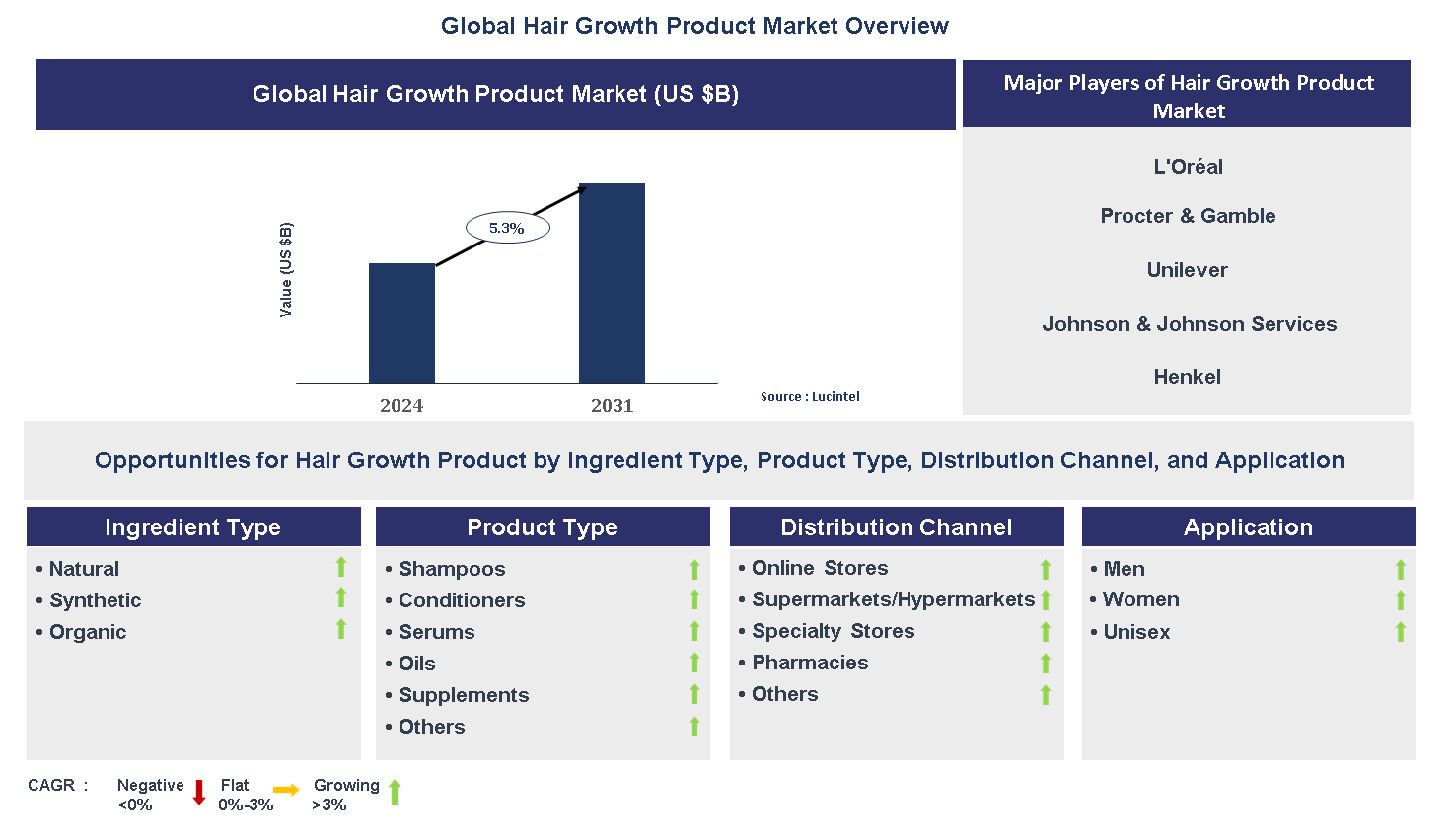
The future of the global hair growth product market looks promising with opportunities in the shampoo, conditioner, serum, oil, and supplement markets. The global hair growth product market is expected to grow with a CAGR of 5.3% from 2025 to 2031. The major drivers for this market are the increasing prevalence of hair loss issues, the rising demand for natural hair treatments, and the growing focus on personal grooming products.• Lucintel forecasts that, within the ingredient type category, natural is expected to witness the highest growth over the forecast period.
• Within the product type category, shampoo is expected to witness the highest growth.
• In terms of region, APAC is expected to witness the highest growth over the forecast period. Gain valuable insights for your business decisions with our comprehensive 150+ page report. Sample figures with some insights are shown below.
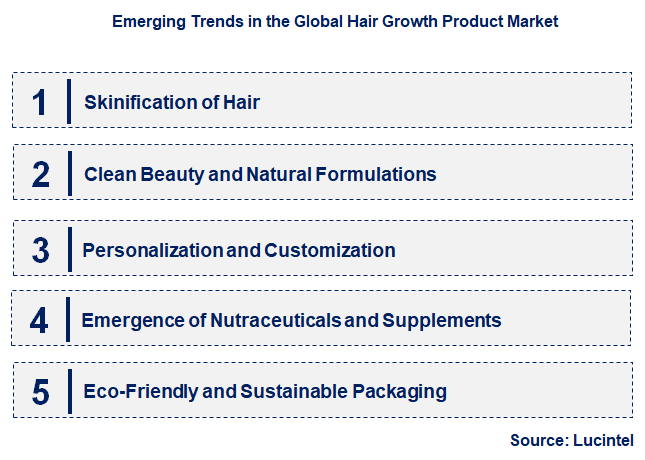
Emerging Trends in the Hair Growth Product Market
The market for hair growth product is experiencing a profound shift, spurred by changing consumer trends and advances in product technology. These emerging trends indicate a more extensive societal trend toward holistic wellness, sustainability, and customization. Consumers are not anymore merely searching for a functional solution to hair loss; they are seeking products that fit into their lifestyle and values.• Skinification of Hair: The skinification of hair involves using skincare principles and ingredients for hair and scalp care. There are products being formulated with scalp health in mind, utilizing ingredients such as hyaluronic acid, niacinamide, and prebiotics to treat the scalp as part of the facial skin. The result is a more comprehensive treatment of hair growth because brands now appreciate that healthy scalp is the key to healthy hair.
• Clean Beauty and Natural Formulations: Buyers are reading product labels more closely and expecting products without sulfates, parabens, and other artificial chemicals. This trend is pushing the creation of hair growth products using natural, plant-based, and organic ingredients. Brands are calling out ingredients such as rosemary oil, caffeine, and different herbal extracts. The effect is a shift in the market away from purely chemical solutions to those which are seen as safer and more wholesome.
• Personalization and Customization: The market is shifting from the one-size-fits-all model. Brands are leveraging AI-driven diagnostics and quizzes to build bespoke product regimens based on an individual’s hair type, lifestyle, and personal concerns. There are companies that supply custom-blended shampoos, conditioners, and serums. The effect is a highly dissected but very interactive marketplace in which consumers have the experience of being attended to by their unique requirements.
• Emergence of Nutraceuticals and Supplements: Oral supplements are increasingly popular as a means of treating hair loss from the inside out. This trend utilizes vitamins, minerals, and herbal supplements such as biotin, collagen, and saw palmetto. The consumer is looking for a total solution to hair care, both topically and nutritionally. The result is a huge opportunity for brands to effectively market and deliver supplements with clinically validated ingredients.
• Eco-Friendly and Sustainable Packaging: Fueled by concerns for the environment, this trend sees brands shift from plastic bottles to more sustainable packaging materials. Brands are launching products in recyclable formats, leading to glass jars, and even solid packaging such as shampoo bars that obviate the use of plastic. The effect is that brands are able to target green consumers, driving brand awareness and a good reputation. These trends are transforming the hair growth product industry by diverting attention away from traditional solutions toward a more holistic, natural, and personalized strategy. Companies are reacting to consumers’ calls for increased transparency, personalization, and environmental sustainability, resulting in a fresh generation of product development and marketing initiatives. The industry is becoming increasingly diverse, with products that address particular needs and values, ultimately generating a more fragmented but extremely dynamic business.
Recent Development in the Hair Growth Product Market
The hair growth product market is rapidly changing, fueled by an increasingly informed and sophisticated consumer base opting for their personal care products. New trends are a response of strategic intent by both new-age corporations and nimble startups to tap into this rising segment. Trends include product innovation, takeovers, and increased emphasis on sustainable and ethical practices. These trends collectively represent an emerging market that is becoming a major player in the wider personal care industry, disrupting traditional one-size-fits-all solutions’ dominance.• Strategic Acquisitions and Partnerships: Bigger companies are buying up successful smaller brands to gain rapid traction in the fast-growing market. For instance, a large player in the beauty space can take over a trendy direct-to-consumer company that is a specialist in hair growth serums to combine its innovative product suite and a loyal customer base. These deals enable established firms to combine innovative products and a loyal customer base with their current operations.
• Merging of Sophisticated Technologies: Companies are advancing beyond fundamental topical application to encompass sophisticated, science-driven technologies. For instance, applying nanotechnology for the targeted delivery of active ingredients into hair follicles is becoming mainstream. In the same way, device innovation such as low-level laser therapy (LLLT) combs and helmets has presented consumers with non-invasive, home-based treatments.
• Product Format Diversification: The market is experiencing an uptick in new and innovative product forms other than the classic shampoo and conditioner. Firms are launching hair growth gummies, scalp serums, and topical foams that resonate with a broader audience. These forms tend to be convenient and user-friendly. The effect is a wider choice for consumers and a trend towards a more convenient and user-friendly hair care regimen.
• Increased Male Grooming Focus: There is a significant jump in the number of hair growth products that are specially designed for men. Increased consciousness about personal grooming and aesthetics among men has opened a profitable market for such products. Manufacturers are reacting by developing products in various fragrances, formulations, and pack sizes that attract a male customer base. The result is a thriving male grooming segment that is a key growth driver of the hair growth market.
• Growing Digital Marketing and E-commerce Presence: Digital marketing and influencer alliances are being hugely invested in by brands to reach the target audience. They are using social media platforms to inform consumers of their product benefits and to showcase their company values, including sustainability and clean ingredients. The end result is a more direct, personal link with consumers, enabling brands to create a community and influence sales through online means. These advancements are having a tremendous influence on the hair growth product industry by increasing its popularity and establishing itself as an effective and credible option compared to traditional options. The industry is no longer a niche market but is emerging as a mainstream option for an increasing number of consumers. This is influencing innovation, leading to investments, and redefining the strategies of new as well as existing players in the oral care market.
Strategic Growth Opportunities in the Hair Growth Product Market
The hair growth product market is full of strategic growth opportunities, especially across numerous applications that address specific consumer needs. As the market matures, firms are no longer able to depend on one product but need to diversify their product offerings to cover different segments of the consumer base. These are fueled by consumer need for products that, in addition to stimulating hair growth, deliver added benefits, match particular lifestyles, and correct specific hair health concerns.• Postpartum Hair Loss Solutions: The postpartum hair loss category is a major growth opportunity. New mothers commonly suffer from hair loss caused by hormonal shifts, and they are searching actively for safe and effective solutions. This segment can be addressed by creating products with soothing, natural ingredients that are safe for breastfeeding women. The effect of targeting this application is the potential to create a loyal consumer base at a young age and earn consumer trust by offering a safe, effective solution
• Hair Growth for Certain Hair Types: The ethnic and diverse hair care market is a prime growth area. Many consumers with coil, curly, or textured hair have special needs and might not be able to find products that meet their needs in mainstream lines. This application presents an opportunity to create products that are specially formulated to meet these needs. The effect of such a focus is to gain a large market share by offering focused solutions that are specific to the individual requirements of various communities.
• Anti-Aging Hair Care: The need for a more youthful look is one of the key drivers in the personal care industry. Businesses can take advantage of this through hair growth products with anti-aging functions, like ingredients that shield the hair from environmental stressors and oxidative damage. These products attract customers who desire to keep their hair dense and vibrant despite the advancement of age. The effect of this growth potential is that it opens up the market beyond strictly hair loss victims to those who are interested in preventative anti-aging treatments, thus expanding total market size and revenue.
• Wellness and Holistic Products: There exists a developing customer base that considers hair care as part of an overall holistic wellness regimen. This opens the door to creating hair growth products with ingredients with a secondary benefit, i.e., adaptogens for stress relief or probiotics for scalp microbiome health. These may be sold in conjunction with other wellness and personal care products.
• Subscription-Based Models for Hair Growth: The repeat nature of hair growth treatment makes subscription-based models a compelling growth opportunity. Brands are able to provide customized regimens sent to the consumer on a regular timetable, ensuring steady use and improved results. This model can also involve customized consultations and guidance. The effect of this strategic model is to establish a stable revenue stream and acquire loyal customers. These growth possibilities are affecting the hair growth product market by spurring product innovation and diversification. They are inducing brands to develop specialist, value-added products that are more than a single function. By targeting these uses, companies can successfully address niche consumer groups, expand their market share, and contribute to the ongoing expansion and development of the market.
Hair Growth Product Market Driver and Challenges
The market for hair growth product is witnessing rapid growth, driven by a mix of strong drivers and slowed down by certain challenges. The key drivers are several technological, economic, and social drivers that are making it conducive to market growth. At the same time, the market is also being confronted with critical challenges like consumer distrust, the high cost of production, and the heavy presence of imitation products. Ascertaining these forces is key to any business in this arena, as they outline the future direction of the market and competitive environment. The factors responsible for driving the hair growth product market include: 1. Increasing Incidence of Hair Loss: One of the key stimuli is the growing prevalence of hair loss among both females and males as a result of causes such as stress, pollution, and inadequate diet. This phenomenon is on the rise at early ages. The effect is a big and growing consumer base consciously in pursuit of solutions. This induces a strong, regular demand for hair growth products. 2. Enhancing Aesthetic and Grooming Consciousness: The worldwide trend of valuing personal looks and grooming is a major driver. Celebrity culture and social media have increased the need for healthy, thick hair, which has made a younger age group want preventative and restorative measures. The effect is increasingly shifting the market from a "problem-fix" orientation to a "proactive maintenance" one. 3. Product Formulation Technological Developments: Innovation in hair care science is a key driver. New ingredients such as peptides, plant stem cells, and new delivery systems like nanotechnology are improving product effectiveness. All this is making it easier to counter the disbelief that non-pharmaceutical products are not effective. The result is that brands are now able to launch products with clinically-supported claims, promoting greater consumer confidence and readiness to spend on premium solutions. 4. Growth of E-commerce and Digital Marketing: The expansion of online shopping has brought numerous hair growth products into the hands of consumers across the world. The e-commerce platforms, combined with niche marketing via digital channels, enable brands to connect directly and effectively with consumers. The result is a more level playing field where niche brands and established players are on par with one another. 5. Increasing Demand for Natural and Ayurvedic Products: There is also increasing demand for products containing natural, organic, and traditional ingredients. This is particularly so in nations such as India, where Ayurvedic belief systems are deeply established in society. Demand is fueled by people’s worries about the side effects of chemical-based solutions. The effect is a successful segment of the market that deals with herbal and plant-based formulations, serving as a unique selling point for brands and appealing to a health-oriented consumer base. Challenges in the hair growth product market are: 1. Widespread of Ineffective and Counterfeit Products: The market is saturated with fake and poor-quality products that claim exaggerated or unsubstantiated benefits. These products can not only be ineffective but also unsafe, leading to consumer dissatisfaction and distrust. The result is a major challenge to brand image and consumer trust. This leads to the need for genuine companies to spend more on consumer education and brand defense in order to distinguish themselves from these fake options. 2. Excessive Cost of Sophisticated Treatments: Most of the best and most innovative hair growth products, particularly those with cutting-edge technology or high-end ingredients, are very expensive. This can be prohibitively expensive for price-conscious consumers, especially in emerging economies. The effect is to constrain the market for high-end products to a niche. 3. Regulatory Barriers and Approval Delays: The regulatory environment for hair growth products can be complicated, particularly for drug-grade products. Draconian controls and time-consuming approval processes can slow the launch of products and drive up research and development expenses. The consequence is slowing the release of new, very effective treatments onto the marketplace. This can be a challenge for small to medium-sized enterprises that might lack the resources to decipher complex regulatory environments. The drivers and challenges are converging to redefine the hair growth market into a more dynamic and segmented marketplace. The drivers are driving the market towards high growth and innovation, especially in the natural, personalized, and technology-driven categories. This is causing a more diverse product landscape and an increasingly informed consumer base. On the other hand, the difficulties are acting as a brake on rapid widespread adoption, leaving the marketplace relatively niche and competitive.List of Hair Growth Product Companies
Companies in the market compete on the basis of product quality offered. Major players in this market focus on expanding their manufacturing facilities, R&D investments, infrastructural development, and leverage integration opportunities across the value chain. With these strategies hair growth product companies cater increasing demand, ensure competitive effectiveness, develop innovative products & technologies, reduce production costs, and expand their customer base. Some of the hair growth product companies profiled in this report include-• L’Oréal
• Procter & Gamble
• Unilever
• Johnson & Johnson Services
• Henkel
• Shiseido Company
• Kao Corporation
• Beiersdorf
• Coty
• Amorepacific Corporation
Hair Growth Product Market by Segment
The study includes a forecast for the global hair growth product market by ingredient type, product type, distribution channel, application, and region.Hair Growth Product Market by Ingredient Type [Value from 2019 to 2031]:
• Natural
• Synthetic
• Organic
Hair Growth Product Market by Product Type [Value from 2019 to 2031]:
• Shampoos
• Conditioners
• Serums
• Oils
• Supplements
• Others
Hair Growth Product Market by Distribution Channel [Value from 2019 to 2031]:
• Online Stores
• Supermarkets/Hypermarkets
• Specialty Stores
• Pharmacies
• Others
Hair Growth Product Market by Application [Value from 2019 to 2031]:
• Men
• Women
• Unisex
Hair Growth Product Market by Region [Value from 2019 to 2031]:
• North America
• Europe
• Asia Pacific
• The Rest of the World
Country Wise Outlook for the Hair Growth Product Market
The market for hair growth product is undergoing swift growth, driven by worldwide increases in the issue of hair loss due to causes such as stress, pollution, and aging. Customers are becoming increasingly aware of effective, affordable, and secure solutions, going beyond conventional treatments to adopt a broad range of products. The movement is stimulated by increased personal awareness of grooming and beauty, enabled by social media and online shopping.• United States: The US hair growth products market is characterized by a high level of focus on scientific substantiation and technological advancement. The nation has experienced an explosion of FDA-approved therapies and an increase in direct-to-consumer brands with customized solutions. Consumers increasingly crave products that merge pharmaceuticals with cosmeceuticals, including minoxidil-formulations incorporating additional vitamins and plant extracts.
• China: China’s market for hair growth products is growing exponentially, led by the increase in disposable incomes and growing stress-induced hair loss among the youth. The market has a high demand for herbal and traditional Chinese medicine (TCM) derived formulas, where the consumer demands natural and holistic products. Online and social media are indispensable tools for reaching the market, with companies employing channels such as Douyin and WeChat to reach out to consumers and establish credibility.
• Germany: In Germany, the market has a strong demand for clean-label, natural, and very effective products. German consumers are quality-conscious and prefer product safety and transparency in ingredients. A significant trend is towards botanical-based products and those with certified organic ingredients. The market is backed by a robust retailing presence in pharmacies and health food stores. Businesses are developing products that are not only efficient but also in sync with the German consumer’s desire for sustainability as well as low chemical exposure.
• India: India’s hair growth market is thriving, powered by the huge popularity of herbal and Ayurvedic treatments. Customers are exhibiting deep-rooted faith in classic ingredients such as amla, barangay, and neem. The market is taken over by local brands that have managed to incorporate these time-tested practices into new product forms. E-commerce has greatly broadened the market’s penetration to tier-2 and tier-3 towns. The emphasis is on delivering value-for-money and efficacious offerings that tap India’s abundant cultural heritage of natural health practices.
• Japan: Japan’s market is a hotbed for technological and ingredient innovation. The nation is at the forefront of research and development in hair products. Examples include the application of nanotechnology for enhancing ingredient delivery, as well as the incorporation of ingredients such as peptides and stem cell extracts. Consumers in Japan are strongly interested in preventative and anti-aging oral care, considering hair an integral part of global wellness and beauty.

Features of the Global Hair Growth Product Market
Market Size Estimates: Hair growth product market size estimation in terms of value ($B). Trend and Forecast Analysis: Market trends (2019 to 2024) and forecast (2025 to 2031) by various segments and regions. Segmentation Analysis: Hair growth product market size by various segments, such as by ingredient type, product type, distribution channel, application, and region in terms of value ($B). Regional Analysis: Hair growth product market breakdown by North America, Europe, Asia Pacific, and Rest of the World. Growth Opportunities: Analysis of growth opportunities in different ingredient types, product types, distribution channels, applications, and regions for the hair growth product market. Strategic Analysis: This includes M&A, new product development, and competitive landscape of the hair growth product market. Analysis of competitive intensity of the industry based on Porter’s Five Forces model.
FAQ
Q1. What is the growth forecast for hair growth product market? Answer: The global hair growth product market is expected to grow with a CAGR of 5.3% from 2025 to 2031. Q2. What are the major drivers influencing the growth of the hair growth product market? Answer: The major drivers for this market are the increasing prevalence of hair loss issues, the rising demand for natural hair treatments, and the growing focus on personal grooming products. Q3. What are the major segments for hair growth product market? Answer: The future of the hair growth product market looks promising with opportunities in the shampoo, conditioner, serum, oil, and supplement markets. Q4. Who are the key hair growth product market companies? Answer: Some of the key hair growth product companies are as follows:• L’Oréal
• Procter & Gamble
• Unilever
• Johnson & Johnson Services
• Henkel
• Shiseido Company
• Kao Corporation
• Beiersdorf
• Coty
• Amorepacific Corporation Q5. Which hair growth product market segment will be the largest in future? Answer: Lucintel forecasts that, within the ingredient type category, natural is expected to witness the highest growth over the forecast period. Q6. In hair growth product market, which region is expected to be the largest in next 5 years? Answer: In terms of region, APAC is expected to witness the highest growth over the forecast period. Q7. Do we receive customization in this report? Answer: Yes, Lucintel provides 10% customization without any additional cost.
Table of Contents
List of Figures
List of Tables
Methodology
- In-depth interviews of the major players in this market
- Detailed secondary research from competitors’ financial statements and published data
- Extensive searches of published works, market, and database information pertaining to industry news, company press releases, and customer intentions
- A compilation of the experiences, judgments, and insights of Lucintel’s professionals, who have analyzed and tracked this market over the years.


Buy Now
Choose a license that fits your team. Instant PDF delivery.
Prices exclude taxes. Instant delivery. Custom licensing available on request.
Key Questions
- • What are some of the most promising, high-growth opportunities for the hair growth product market by ingredient type (natural, synthetic, and organic), product type (shampoos, conditioners, serums, oils, supplements, and others), distribution channel (online stores, supermarkets/hypermarkets, specialty stores, pharmacies, and others), application (men, women, and unisex), and region (North America, Europe, Asia Pacific, and the Rest of the World)?
- • Which segments will grow at a faster pace and why?
- • Which region will grow at a faster pace and why?
- • What are the key factors affecting market dynamics? What are the key challenges and business risks in this market?
- • What are the business risks and competitive threats in this market?
- • What are the emerging trends in this market and the reasons behind them?
- • What are some of the changing demands of customers in the market?
- • What are the new developments in the market? Which companies are leading these developments?
- • Who are the major players in this market? What strategic initiatives are key players pursuing for business growth?
- • What are some of the competing products in this market and how big of a threat do they pose for loss of market share by material or product substitution?
- • What M&A activity has occurred in the last 5 years and what has its impact been on the industry? For any questions related to Hair Growth Product Market, Hair Growth Product Market Size, Hair Growth Product Market Growth, Hair Growth Product Market Analysis, Hair Growth Product Market Report, Hair Growth Product Market Share, Hair Growth Product Market Trends, Hair Growth Product Market Forecast, Hair Growth Product Companies, write Lucintel analyst at email: helpdesk@lucintel.com. We will be glad to get back to you soon.


