
Market Report · July 20, 2026

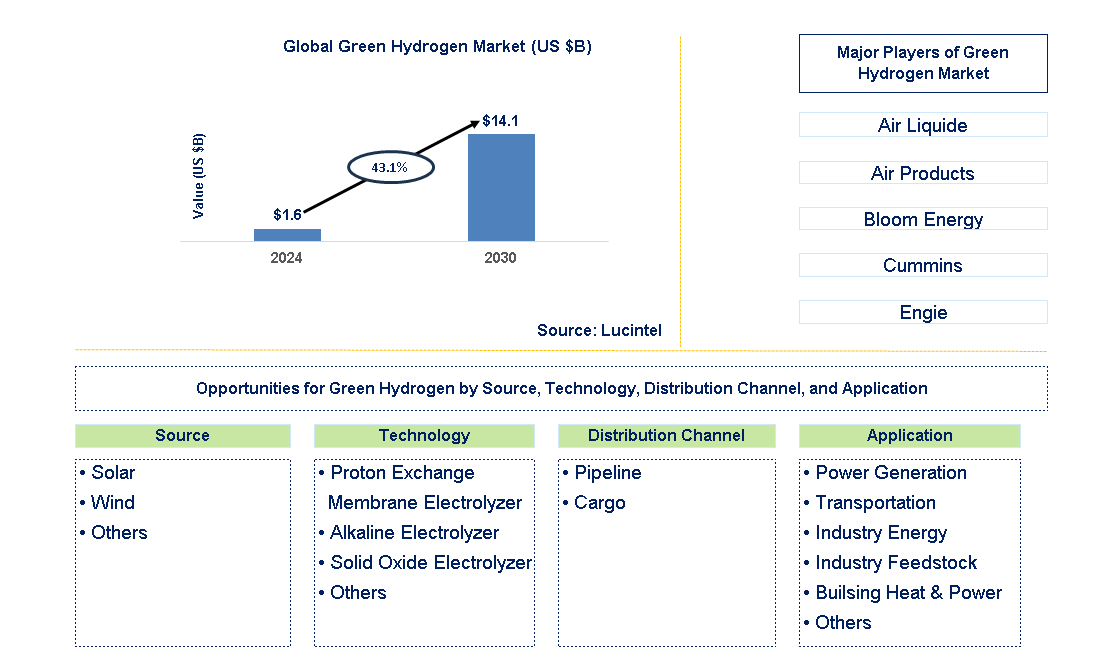
Key data points: The market size in 2030 = $14.1 billion, growth forecast = 43.1% annually for the next 6 years. Scroll below to get more insights. This market report covers trends, opportunities, and forecasts in the global green hydrogen market to 2030 by source (solar, wind, and others), technology (proton exchange membrane electrolyzer, alkaline electrolyzer, solid oxide electrolyzer, and others), distribution channel (pipeline and cargo), application (power generation, transportation, industry energy, industry feedstock, building heat & power, and others), and region (North America, Europe, Asia Pacific, and the Rest of the World)
We'll send your sample report shortly.
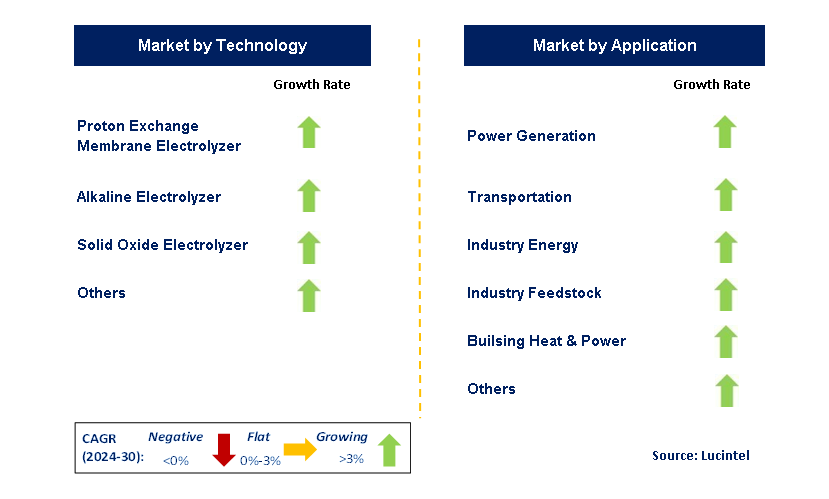
• Lucintel forecasts that, within the technology category, alkaline electrolyzer will remain the largest segment due to its significant use in green hydrogen projects given to its longer operating hours, easy availability, and affordability.
• Within the application category, transportation will remain the largest segment due to considerable usage of hydrogen fuel cell in this sector given to its energy efficiency.
• In terms of regions, Europe will remain the largest region due to growing demand for clean hydrogen-based economy and presence of key manufacturer in the region. Gain valuable insights for your business decisions with our comprehensive 150+ page report.
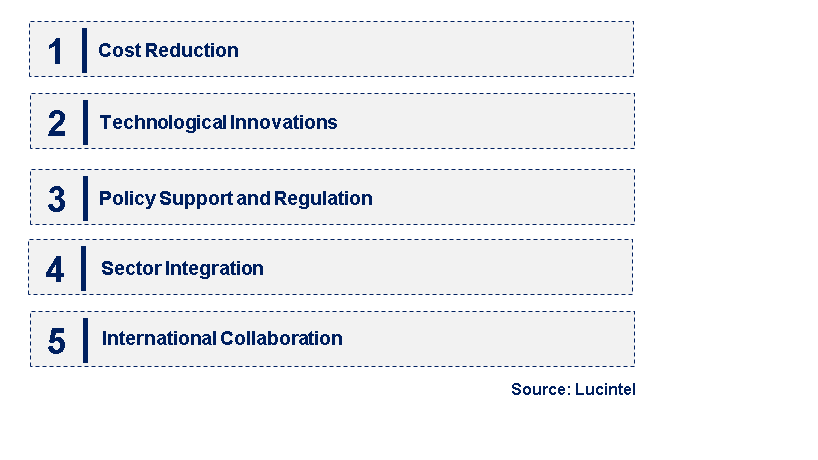
• Cost Reduction: Cost reduction regarding the production of green hydrogen is a noteworthy trend. Positive changes in electrolyzing equipment and the reduction of costs through mass production are putting green hydrogen on par with other primary energy sources. This is an important trend for the commercialization of green hydrogen and its adoption in various applications.
• Technological Innovations: There has been an increase in the market for green hydrogen due to technological innovations. Improvements in electrolyzer systems, hydrogen storage, and advancements in fuel cell technologies are increasing the feasibility and effectiveness of green hydrogen technologies. These advancements are crucial in reinforcing the effectiveness of hydrogen production and fuel utilization.
• Policy Support and Regulation: The existence of policy support and regulation is another important trend in the green hydrogen market. Governments are providing policies and regulations that support green hydrogen industry activities. These include subsidies, tax relief, and regulatory policies that promote investment opportunities and asset development for the hydrogen industry.
• Sector Integration: Agriculture has recently emerged as an area for green hydrogen production. Today, green hydrogen is being integrated into transportation, power generation, and industrial processes. This trend shows how hydrogen can be used as a clean energy source to encourage emissions reduction in different sectors.
• International Collaboration: International collaboration has been growing with the development of the green hydrogen market. Money received by countries and companies is used to develop hydrogen technology, share knowledge, and build hydrogen value chains around the world. To speed up technology development and increase hydrogen production and distribution, such collaboration is key for market players. These emerging trends are transforming the green hydrogen market through technological innovation, cost containment, and global trust. Gradual changes in these trends will shape the development of the green hydrogen sector and address its importance in the sustainable energy future.
• Expansion of Production Facilities: The expansion of green hydrogen production facilities is a notable development. Major investments are being made in electrolyzer manufacturing and renewable energy-powered hydrogen plants. These expansions are increasing production capacity and driving down costs, making green hydrogen more accessible and competitive in the energy market.
• Government Policy Initiatives: Government policy initiatives are significantly influencing the green hydrogen market. National strategies and funding programs are supporting research, development, and deployment of hydrogen technologies. These policies are creating a favorable environment for investment and accelerating the growth of hydrogen infrastructure and applications.
• Technological Advancements: Technological advancements in green hydrogen production and storage are driving market growth. Innovations such as more efficient electrolyzers, advanced hydrogen storage solutions, and improved fuel cell technologies are enhancing the performance and scalability of green hydrogen systems. These advancements are crucial for making green hydrogen a viable energy solution.
• International Partnerships: International partnerships are expanding in the green hydrogen market. Countries and companies are collaborating on joint projects, research, and development efforts to advance hydrogen technology and create global supply chains. These partnerships are facilitating knowledge exchange, technology transfer, and market expansion.
• Increased Investment: Increased investment in green hydrogen projects is a significant development. Both public and private sectors are channeling funds into hydrogen research, infrastructure development, and commercialization efforts. This influx of investment is driving innovation, scaling up production, and accelerating the deployment of green hydrogen solutions. These recent developments are enhancing the green hydrogen market by extending production capacities, accelerating technological development, and promoting collaboration across countries and regions. The advancements will, as they have in the past, aid in the development of green hydrogen and its integration into the global energy system.
• Transportation: The transportation sector holds the greatest potential for growth related to green hydrogen. Hydrogen fuel cells could replace conventional fuels used in vehicles such as buses, trucks, and trains. This growth is being supported by the development of hydrogen refueling stations and vehicle technologies, making the integration of green hydrogen into the transportation sector as an emissions reduction measure achievable.
• Industrial Applications: The focus on industrial applications of green hydrogen is crucial due to the increasing demand. For production and chemical processes, hydrogen is used as a feedstock or fuel in industries such as steelmaking and chemicals. The use of green hydrogen in these sectors will positively impact the reduction of greenhouse gases and align with industrial decarbonization efforts.
• Power Generation: Another segment with high growth potential is power generation with hydrogen-powered plants. Hydrogen may be used for electricity generation in gas turbines or fuel cells while maintaining environmental standards. Integrating green hydrogen into power generation systems further stabilizes the grid and contributes to achieving renewable energy targets.
• Energy Storage: Within the framework of renewable hydrogen, there are developments in energy storage. Excess renewable energy can be converted into hydrogen and stored for use during times of low renewable energy generation. Hydrogen, as a stored energy source, has great prospects, with new developments in storage mechanisms enhancing its versatility.
• Export Markets: Export markets for green hydrogen are expanding rapidly. Countries rich in green energy are turning to hydrogen production for export to nations with larger energy markets. To meet the growing demand for hydrogen in the international market, the development of hydrogen export facilities and international trading policies is essential. Expansion strategies clearly indicate areas where further development is needed in the green hydrogen market. Focusing on transportation, industrial applications, power generation, energy storage, and export markets enables stakeholders to harness changing trends and meet the growing demand for green hydrogen solutions.
• Technological Advancements: Technological innovations are a major driver of growth in the green hydrogen market. Improvements in the efficiency of electrolyzer systems, hydrogen storage solutions, and fuel cell technologies are making green hydrogen cheaper and more effective. These advancements are increasing competition in the market and expanding the range of applications for green hydrogen.
• Government Policies: Government policies are crucial for the growth of the green hydrogen market. National policies, grants, and regulatory frameworks support the implementation and use of hydrogen technologies. These policies make it easier for investors and accelerate the proliferation of green hydrogen technology.
• Greater Investment: Investment in green hydrogen projects is growing. Both public and private sectors are funding research and development, as well as the commercialization of hydrogen technologies. This financial backing is fostering innovation, increasing production capacity, and expanding the green hydrogen market.
• Environmental Impact: Concerns about climate change are driving the green hydrogen market. Countries and corporations are focusing on reducing CO2 emissions for effective energy usage and addressing greenhouse gases, with hydrogen offering a solution. As environmental awareness grows, so does the demand for hydrogen. Energy Security: Energy security concerns are central to the green hydrogen market. Hydrogen allows for a shift in energy supply, reducing dependence on carbon-based resources. With countries looking for greater energy stability and resilience, green hydrogen is rapidly becoming an integral part of energy strategies. Challenges in the green hydrogen market include:
• High Production Costs: High production costs pose a significant barrier to the development of green hydrogen. Electrolyzers, renewable power, and hydrogen infrastructure all incur substantial costs, limiting the economic feasibility of such projects. Reducing production costs is essential for green hydrogen to compete with other traditional energy sources.
• Infrastructure Development: Building hydrogen infrastructure is a major challenge. Constructing refueling stations, storage units, and transport links requires significant investment and cooperation. Expanding hydrogen infrastructure is critical to keeping pace with new hydrogen technologies.
• Regulatory Uncertainty: Regulatory uncertainty hinders the green hydrogen market. Conflicting legal acts and volatile policies make it difficult for market players. To stimulate investment and encourage further development, it is essential to provide stable and supportive policies for investors. The driving forces and barriers in the green hydrogen market are explained here, showing how they influence market development. Technological advancements, government intervention, and new funding are driving growth, while high production costs, infrastructure challenges, and regulatory risks pose obstacles. Addressing these challenges is crucial for the success of green hydrogen in the energy market.
• Air Liquide
• Air Products
• Bloom Energy
• Cummins
• Engie
• Linde
• Nel
• Siemens Energy
• Toshiba Energy Systems & Solutions
• Uniper
• Solar
• Wind
• Others
• Proton Exchange Membrane Electrolyzer
• Alkaline Electrolyzer
• Solid Oxide Electrolyzer
• Others
• Pipeline
• Cargo
• Power Generation
• Transportation
• Industry Energy
• Industry Feedstock
• Building Heat & Power
• Others
• North America
• Europe
• Asia Pacific
• The Rest of the World
• United States: In the US, the federal government and private investors are promoting the growth of the green hydrogen industry. Recent developments include the establishment of more extensive green hydrogen production plants and improvements in electrolyzer technology. The US Department of Energy (DOE) has also launched programs aimed at reducing green hydrogen production costs and applying it in industries such as transportation and manufacturing. State-level incentives and collaborations are fostering innovation and expanding hydrogen infrastructure.
• China: China is focused on reducing carbon emissions and increasing green hydrogen production. The country has announced significant investments in hydrogen production, as well as the development of related infrastructure such as large electrolyzer plants and hydrogen refueling stations. Heavy industries and the transportation sector in China are also targeting green hydrogen projects, with the goal of becoming a global leader in hydrogen technology. Government policies and subsidies are supporting this growth, with a focus on both domestic and international markets.
• India: India is positioning itself as a key player in the energy transition, with a focus on green hydrogen. New initiatives include the National Hydrogen Mission, which aims to increase green hydrogen production and system support. India is leveraging its renewable energy potential and forming partnerships with international companies. The country is also exploring the use of green hydrogen for transportation and industrial purposes.
• Japan: Japan is pursuing green hydrogen projects, focusing on technology development and international collaboration. Recent developments include increased investment in hydrogen production systems such as electrolyzers and fuel cells. Japan is also working on hydrogen supply chains and associated infrastructure, including hydrogen refueling stations and depots. Government strategies are driving innovation and positioning Japan at the forefront of the global hydrogen market.


• Air Liquide
• Air Products
• Bloom Energy
• Cummins
• Engie
• Linde
• Nel
• Siemens Energy
• Toshiba Energy Systems & Solutions
• Uniper Q6. Which green hydrogen market segment will be the largest in future? Answer: Lucintel forecasts that alkaline electrolyzer will remain the largest segment due to its significant use in green hydrogen projects given to its longer operating hours, easy availability, and affordability. Q7. In green hydrogen market, which region is expected to be the largest in next 5 years? Answer: Europe will remain the largest region due to growing demand for clean hydrogen-based economy and presence of key manufacturer in the region. Q.8 Do we receive customization in this report? Answer: Yes, Lucintel provides 10% customization without any additional cost.


Choose a license that fits your team. Instant PDF delivery.
Prices exclude taxes. Instant delivery. Custom licensing available on request.
Market Report · July 20, 2026
Market Report · July 20, 2026
Market Report · July 20, 2026
Trusted partner for strategic intelligence and business growth


Receive a complimentary market analysis tailored to your industry. Our analysts will identify key growth opportunities and competitive dynamics specific to your business.

Market size, growth rate, and key trend analysis for your specific sector.

Top competitor positioning and market share analysis.

Strategic recommendations backed by data-driven insights.
Get curated market intelligence and competitive moves straight to your inbox.
By subscribing, you agree to receive our monthly insights. Unsubscribe anytime.
Receive a complimentary market analysis tailored to your industry. Our analysts will identify key growth opportunities and competitive dynamics specific to your business.
Market size, growth rate, and key trend analysis for your specific sector.
Top competitor positioning and market share analysis.
Strategic recommendations backed by data-driven insights.
Get curated market intelligence, emerging trends, and competitive moves straight to your inbox each month.
By subscribing, you agree to receive our monthly insights. Unsubscribe anytime.
We'll send your sample report shortly.