
Market Report · July 31, 2026

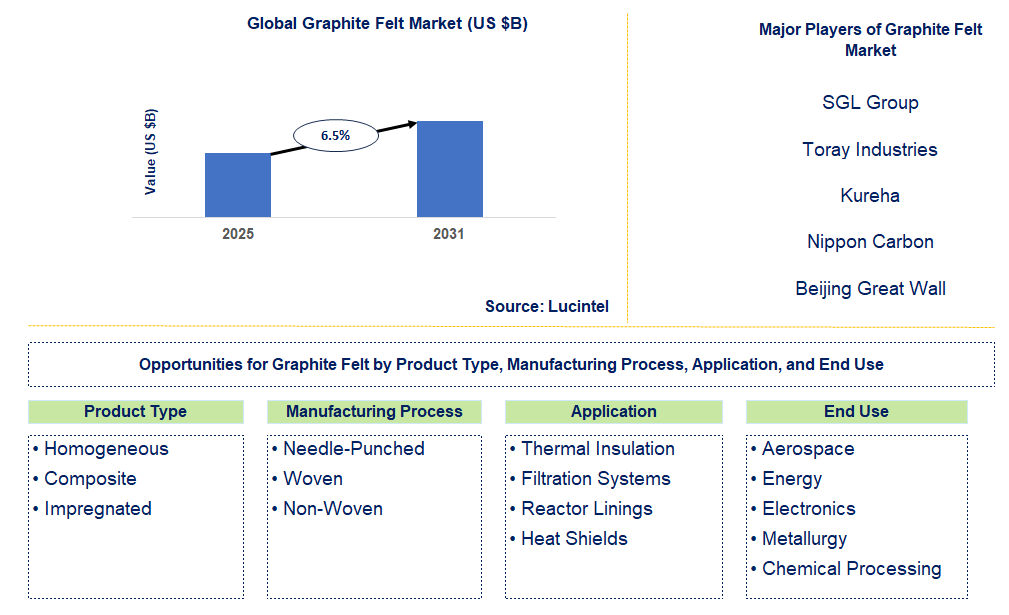
Key data points: The growth forecast = 6.5% annually for the next 7 years. Scroll below to get more insights. This market report covers trends, opportunities and forecasts in graphite felt market to 2031 by product type (homogeneous, composite, and impregnated), manufacturing process (needle-punched, woven, and non-woven), application (thermal insulation, filtration systems, reactor linings, and heat shields), end use (aerospace, energy, electronics, metallurgy, and chemical processing), and region (North America, Europe, Asia Pacific, and the Rest of the World)
We'll send your sample report shortly.
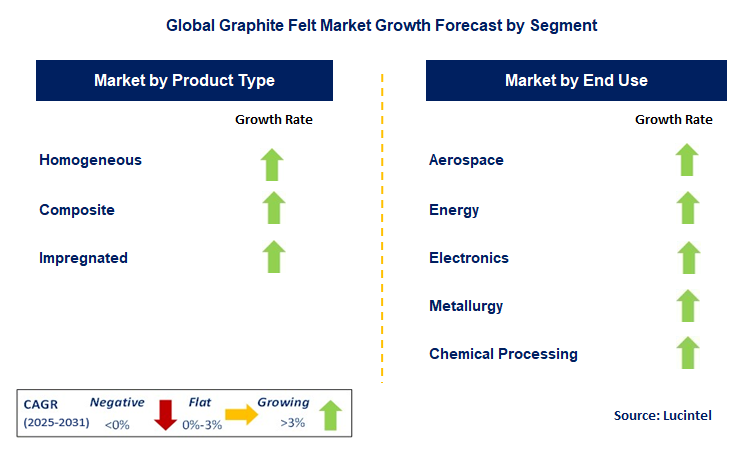
• Lucintel forecasts that, within the product type category, composite is expected to witness the highest growth over the forecast period.
• Within the end use category, aerospace is expected to witness the highest growth.
• In terms of region, APAC is expected to witness the highest growth over the forecast period. Gain valuable insights for your business decisions with our comprehensive 150+ page report. Sample figures with some insights are shown below.
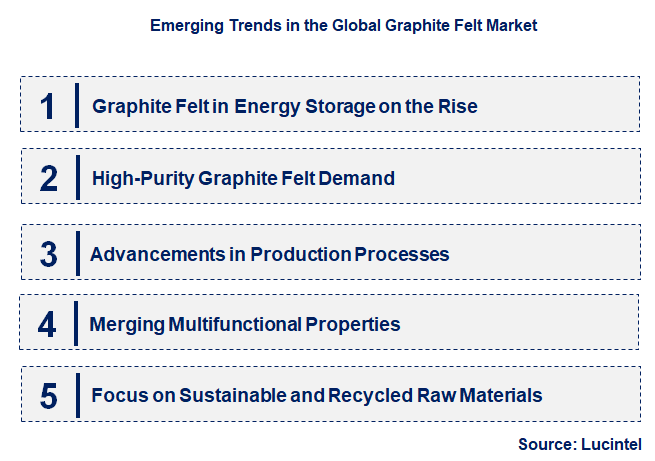
• Graphite Felt in Energy Storage on the Rise: A prominent trend is the growing application of graphite felt as an electrode material in next-generation energy storage devices, especially vanadium redox flow batteries. It is being fueled by the worldwide need for dependable and scalable grid-scale energy storage to complement renewable energy sources such as wind and solar. Graphite felt's high surface area, chemical stability, and conductivity make it well-suited for this application. The market impact is a major growth of the market outside of its historic application in high-temperature furnaces, developing a new high-growth application segment that is pivotal to the clean energy shift.
• High-Purity Graphite Felt Demand: The market is seeing a trend toward increasingly high-purity graphite felt. This is being prompted by the high-quality demands of high-technology applications, including semiconductors, aerospace parts, and specialty batteries. Graphite felt impurities can have a detrimental effect on the performance and longevity of such delicate systems. Manufacturers are reacting by designing enhanced purification technology in order to manufacture felts containing very low levels of impurities. The effect is a shift towards a higher end and specialized market, where high purity is a major discriminator, allowing it to find applications in high-value, performance-critical uses.
• Advancements in Production Processes: One of the main trends is the advancement in production processes, such as new carbonization and graphitization methods, in order to enhance the final product's quality and consistency. Producers are investigating technologies such as plasma purification to increase purity in felts and advanced needling techniques to manage porosity and density. This is in response to the necessity of maximizing product performance for particular applications. The result is better product uniformity, greater efficiency, and lower cost of manufacture, making graphite felt a more competitive and dependable substance for an increasing number of applications.
• Merging Multifunctional Properties: The trend is toward creating multifunctional graphite felts that merge thermal and electrical properties with others, like catalytic activity or improved corrosion resistance. This is fueled by the need for materials with multiple capabilities in one system, reducing complexity and enhancing efficiency. For instance, a felt may serve as an insulator against heat as well as a catalyst in chemical processing. The effect is the production of value-added products that are applicable in more sophisticated and niche purposes, like chemical processing and fuel cells.
• Focus on Sustainable and Recycled Raw Materials: The industry is witnessing a growing trend towards sustainability and the use of recycled or bio-based precursors for producing graphite felt. The driving force behind this is the rise in environmental legislation and corporate sustainability strategies. Enterprises are trying to recycle waste carbon material and make production more energy-efficient to lower their eco-footprint. The effect is a greener market more supportive of global decarbonization, which allows businesses to fulfill regulatory demands and win over an increasing number of customers focused on environmentally friendly materials. All in all, the trends are collectively transforming the graphite felt market by pushing it towards increased innovation, specialization, and sustainability. The emphasis on energy storage, purity, and multi-functionality is broadening the market's area of applications. Technologies in manufacturing and shifting towards sustainable materials are enhancing manufacturing efficiency and environmental friendliness. These trends are pushing the graphite felt industry from a commodity to a high-technology, value-added sector that is a leading facilitator of advanced technologies and clean energy solutions.
• Production Capacity Expansion: One of the most significant developments in recent times is the strategic increase in production capacity, especially in significant markets such as China and Germany. This is fueled by the rising demand from the high-temperature furnace and energy storage industries. New facilities are being invested in and old ones refurbished to address the shortfall in global demand. The effect is a stronger and more geographically dispersed supply chain that stabilizes prices and provides a steady supply of graphite felt for essential uses, decreasing dependence on sole-source providers and geopolitics.
• Precursor Material Improvements: Important improvements have been achieved in the application of precursor materials, with an especially pronounced movement toward high-quality polyacrylonitrile (PAN) fibers. This progress is spurred by demand for graphite felt with improved mechanical characteristics, purity, and electrochemical performance. Felts based on PAN provide an improved carbon yield in processing, thus reducing costs and increasing efficiency in manufacture. The result is a more consistent and dependable product that satisfies the stringent requirements of new battery technology and high-technology applications.
• Strategic Alliances and Acquisitions: Strategic alliances, mergers, and acquisitions have been a recent trend in the market. Large firms are buying smaller, niche companies to enrich their product offerings and gain access to new technology. For instance, one of the industry leaders recently took over a US-based company to increase its capability for specialty felts. The effect is a market consolidation, resulting in fewer and larger players who have more to spend on research and development. It drives innovation, enhances economies of scale, and enables firms to provide a wider array of solutions to their customers.
• Energy Storage Applications Focus: A significant recent trend is the expanded R&D and commercial interest in the application of graphite felt in energy storage, especially vanadium redox flow batteries and fuel cells, spurred by the world effort toward renewable energy and the requirements for cost-effective grid-scale storage. Firms are creating bespoke graphite felts with higher surface area and better chemical resistance to maximize performance in these systems. The effect is the establishment of a new, high-growth market segment which is vital to the future of clean energy and is generating high levels of investment and innovation.
• Customized Felt Module Development: There has been an evolution of customized graphite felt modules developed for certain applications, e.g., gas purification systems or heat management in certain furnaces. This is a shift from a one-size-fits-all strategy to a more application-specific approach. The effect is enhanced performance and efficiency for the end-user, as the felt has been adapted to their precise requirements. This evolution enables service providers to provide a greater value proposition and establish more successful, long-term relationships with their clients. Overall, all these advances are together changing the graphite felt market. The increase in production capacity, development in precursor materials, and strategic mergers are strengthening and making the market more competitive. The emphasis on energy storage applications and tailor-made solutions is increasing the value and significance of the market. These developments are making the market more innovative, specialized, and efficient and are set to fuel the growth of high-tech and clean energy sectors.
• Potential in the Energy Storage Industry: The key strategic growth potential exists in the energy storage industry, especially in vanadium redox flow battery manufacturing and other next-generation battery systems. Graphite felt is a key electrode material in such batteries because of its excellent electrical conductivity and chemical stability. The potential is to create and provide high-performance, low-cost graphite felts specifically designed to maximize battery efficiency and lifespan. The result is being able to access a fast-expanding industry that is at the forefront of the world's shift to renewable energy.
• Growth into Aerospace and Defense: The defense and aerospace industry offers a significant strategic growth opportunity. Graphite felt is employed as high-temperature insulation in rocket nozzles, furnaces, and similar other critical applications where lightweight, heat-resistant materials are required. The opportunity lies in designing specialized, lightweight felts that can operate at extreme temperatures and satisfy the high quality requirements of this industry. The effect is access to a high-value, high-margin market needing custom-engineered solutions and providing long-term contracts.
• Concentration on the High-Temperature Furnace Market: The high-temperature furnace market is still a principal growth opportunity for graphite felt, especially in vacuum furnaces and crystal growth furnaces. Graphite felt is a better thermal insulator in such environments. The potential is to deliver high-purity and long-lasting graphite felt products that enhance the efficiency of furnaces and minimize energy usage. The effect is being able to sustain a significant presence in a conservative but stable market that is constantly on the lookout for enhanced performance and minimized operating expenses.
• Expansion in the Semiconductor and Electronics Industry: The semiconductor and electronics sector presents a huge strategic growth potential. Graphite felt has applications in thermal management, heat dissipation, and as a material in the production of high-performance electronics. The challenge is to create ultra-high-purity graphite felts that satisfy the strict requirements of semiconductor production and maintain the stability of electronic components. The effect is the potential to supply a critical material to an industry that is leading in technological advancement and is in constant need of high-performing, dependable materials.
• Penetration of the Chemical Processing Industry: The chemical processing industry is an emerging growth market for graphite felt. It may be employed in filters, catalysts, and as a chemical reactor component because it is chemically inert and has a high surface area. The challenge is to create selective, corrosion-stable graphite felts which can be exposed to aggressive chemical milieus. The effect is the potential to expand the field of application of graphite felt and solve the particular requirements of a highly technical and niche industry, generating new streams of revenue and driving innovation in material science. Overall, such strategic growth opportunities are transforming the graphite felt market by emphasizing the significance of application-specific innovation. With a focus on energy storage, aerospace, high-temperature furnaces, semiconductors, and chemical processing, companies are departing from a one-size-fits-all approach. Such a transformation is resulting in a more advanced, niche, and high-value market where product performance and technical competency are the determining factors for success.
• SGL Group
• Toray Industries
• Kureha
• Nippon Carbon
• Beijing Great Wall
• Chemshine Carbon
• CM Carbon
• Gansu Haoshi Carbon Fiber
• CFC Carbon
• Ceramaterials
• Homogeneous
• Composite
• Impregnated
• Needle-Punched
• Woven
• Non-Woven
• Thermal Insulation
• Filtration Systems
• Reactor Linings
• Heat Shields
• Aerospace
• Energy
• Electronics
• Metallurgy
• Chemical Processing
• North America
• Europe
• Asia Pacific
• The Rest of the World
• United States: The graphite felt market in the United States is experiencing robust growth fueled by investment in renewable energy and advanced manufacturing. Recent trends involve more emphasis on the application of graphite felts in flow batteries for grid-scale energy storage as well as in fuel cells, consistent with national energy modernization plans. There is also an emphasis on high-performance, low-weight felts to be applied in the aerospace and semiconductor sectors. The US market is dominated by a focus on technical excellence and compliance with high-quality standards, which is underpinned by strategic acquisitions by firms to increase their capacity for specialty materials.
• China: China is the global leader in the consumption and production of graphite felt, with its market led by enormous industrial growth, especially in the battery and furnace industries. Recent advancements have involved large investments in research and development to enhance the quality and performance of graphite felt so that it is good enough for high-end uses such as electric vehicle batteries. The industry is also driven substantially by government policies promoting the electric vehicle and clean energy industries. Yet, China's overbearing dominance of the global graphite supply chain is also generating geopolitical tensions and export controls, which are affecting world markets.
• Germany: Germany's graphite felt market is characterized by its particular focus on high-quality engineering and leadership in the automobile and industrial segments. Recent advancements are centered on working toward the creation of high-temperature insulation felts for industrial furnace application as well as for hydrogen energy applications, such as fuel cells. The market is also experiencing a strategic shift to decrease its dependence on outside graphite sources, as indicated by a new graphite processing facility being supported by international investors. German firms are a frontrunner in product development, emphasizing the production of high-purity felts in accordance with the stringent requirements of sophisticated technologies.
• India: India's graphite market for felts is growing at a fast rate, driven by its growing industrial economy and policies backing electric vehicles and clean energy. Trends involve an increasing domestic demand for the steel, automotive, and energy storage industries. The Indian market is also experiencing growth in domestic graphite mining and processing operations, which seeks to minimize its reliance on imports and secure its position in the global supply chain. The market is significantly interested in low-cost solutions for addressing the demand of a price-conscious market while identifying opportunities in high-purity, battery-grade graphite.
• Japan: The Japanese graphite felt market is technologically sophisticated and quality- and precision-oriented. The main developments revolve around research on new felts for high-performance batteries, fuel cells, and semiconductors. The market is fueled by high-quality standards and a culture of careful manufacturing, which translates into high-purity material development with improved performance attributes. Japan's major players also have global partnerships and strategic alliances aimed at increasing their raw material access and presence in the global clean energy market.


• SGL Group
• Toray Industries
• Kureha
• Nippon Carbon
• Beijing Great Wall
• Chemshine Carbon
• CM Carbon
• Gansu Haoshi Carbon Fiber
• CFC Carbon
• Ceramaterials Q5. Which graphite felt market segment will be the largest in future? Answer: Lucintel forecasts that, within the product type category, composite is expected to witness the highest growth over the forecast period. Q6. In graphite felt market, which region is expected to be the largest in next 5 years? Answer: In terms of region, APAC is expected to witness the highest growth over the forecast period. Q7. Do we receive customization in this report? Answer: Yes, Lucintel provides 10% customization without any additional cost.


Choose a license that fits your team. Instant PDF delivery.
Prices exclude taxes. Instant delivery. Custom licensing available on request.
Market Report · July 31, 2026
Market Report · July 31, 2026
Market Report · July 31, 2026
Trusted partner for strategic intelligence and business growth


Receive a complimentary market analysis tailored to your industry. Our analysts will identify key growth opportunities and competitive dynamics specific to your business.

Market size, growth rate, and key trend analysis for your specific sector.

Top competitor positioning and market share analysis.

Strategic recommendations backed by data-driven insights.
Get curated market intelligence and competitive moves straight to your inbox.
By subscribing, you agree to receive our monthly insights. Unsubscribe anytime.
Receive a complimentary market analysis tailored to your industry. Our analysts will identify key growth opportunities and competitive dynamics specific to your business.
Market size, growth rate, and key trend analysis for your specific sector.
Top competitor positioning and market share analysis.
Strategic recommendations backed by data-driven insights.
Get curated market intelligence, emerging trends, and competitive moves straight to your inbox each month.
By subscribing, you agree to receive our monthly insights. Unsubscribe anytime.
We'll send your sample report shortly.