
Close Lucintel Chat
Didn't Find What You're Looking for?
Call us at +1972 636 5056 or write at helpdesk@Lucintel.com
Ask an Expert Provide Custom Requirements Download Sample Report Search Available Reports
  • helpdesk@Lucintel.com
  • |
  • Call Lucintel +1 972 636 5056
  • |
  • Login
  • |
  • Register
  • |
  • Search
  • |
'
...

The Impact of COVID-19 is included in Goods-to-Person AMRs Market Report. Buy it today to get an advantage.

Request the impact of COVID-19 on your product or industry


Goods-to-Person AMRs Market Trends and Forecast

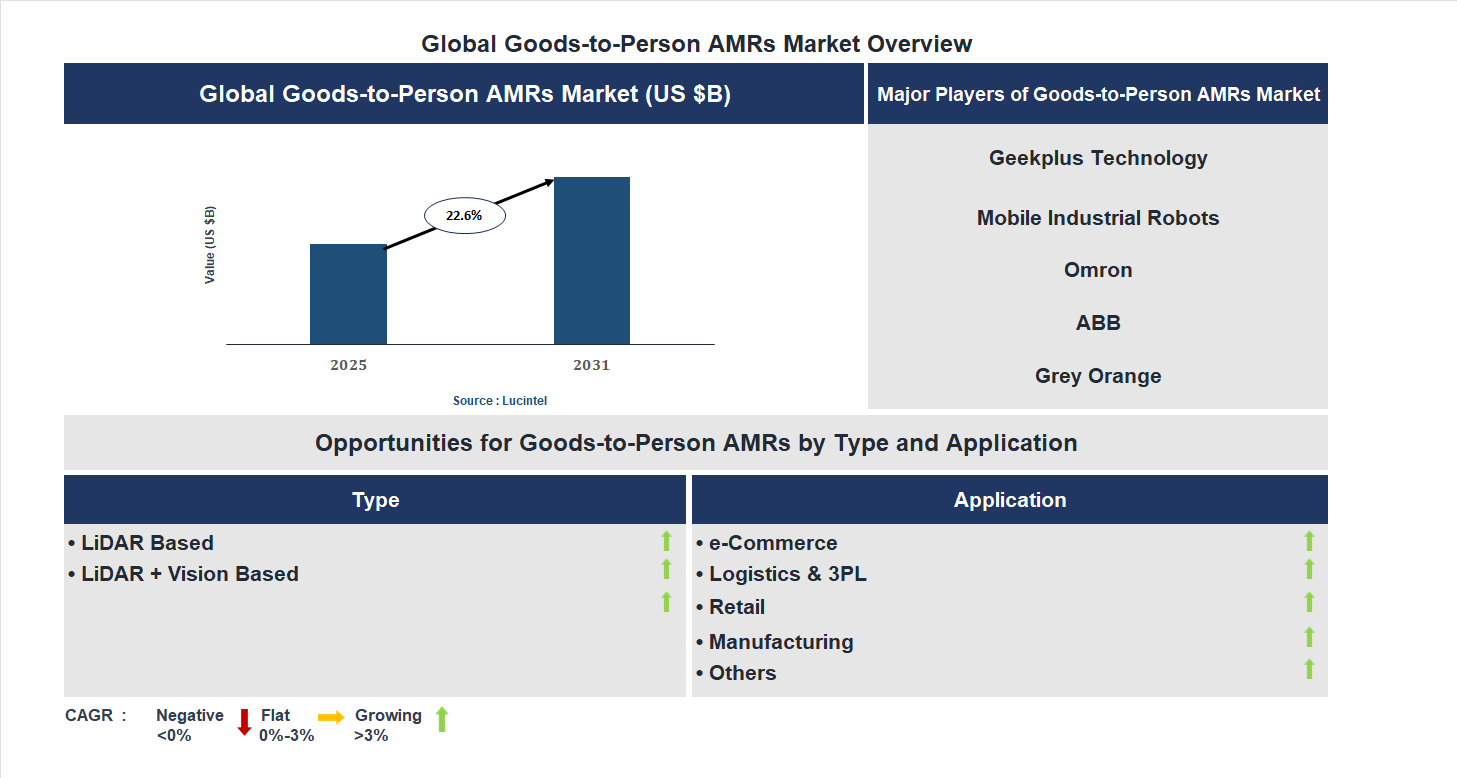
The future of the global goods-to-person AMRs market looks promising with opportunities in the e-commerce, logistics & 3PL, retail, and manufacturing markets. The global goods-to-person AMRs market is expected to grow with a CAGR of 22.6% from 2025 to 2031. The major drivers for this market are the increasing demand for automated warehouse operations, the rising pressure to enhance order fulfillment speed, and the growing adoption of robotics in logistics.

• Lucintel forecasts that, within the type category, LiDAR + vision based is expected to witness higher growth over the forecast period.
• Within the application category, logistics & 3PL is expected to witness the highest growth.
• In terms of region, APAC is expected to witness the highest growth over the forecast period.
Gain valuable insights for your business decisions with our comprehensive 150+ page report. Sample figures with some insights are shown below.
Goods-to-Person AMRs Market Trends and Forecast

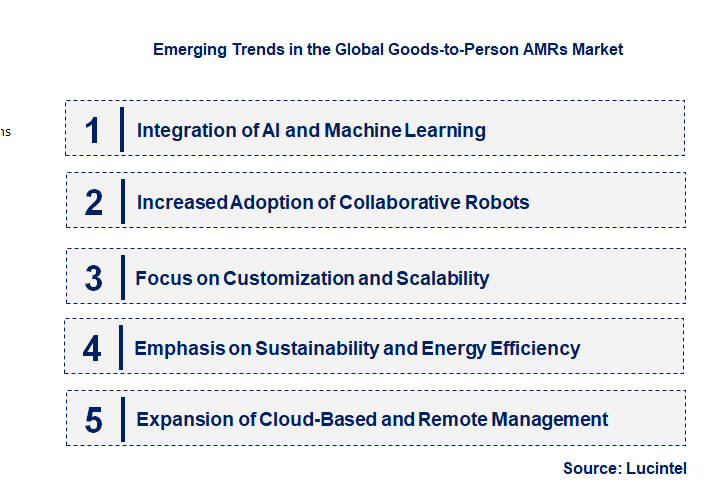
Emerging Trends in the Goods-to-Person AMRs Market

The goods-to-person AMRs market is experiencing rapid growth driven by advancements in robotics, increasing demand for warehouse automation, and the need for efficient supply chain management. As e-commerce expands and consumer expectations for faster delivery rise, companies are investing heavily in automation solutions to stay competitive. Emerging trends are shaping the future of this market, influencing how goods are stored, retrieved, and transported within warehouses and distribution centers. These developments are not only improving operational efficiency but also reducing labor costs and enhancing safety standards. Understanding these trends is crucial for stakeholders aiming to capitalize on the evolving landscape of goods-to-person AMRs.

• Integration of AI and Machine Learning: The incorporation of AI and machine learning algorithms into AMRs enhances their ability to navigate complex environments, optimize routes, and adapt to dynamic warehouse conditions. This trend improves operational efficiency by enabling real-time decision-making and predictive maintenance, reducing downtime. AI-driven AMRs can learn from their environment, leading to smarter task execution and better inventory management. As these technologies become more affordable, their adoption is expected to accelerate, transforming warehouse automation into a more intelligent and autonomous system.
• Increased Adoption of Collaborative Robots: Collaborative AMRs are designed to work safely alongside human workers, facilitating a hybrid workforce model. This trend allows companies to maximize productivity without replacing human labor entirely. Collaborative robots are equipped with advanced sensors and safety features that prevent accidents, making them suitable for diverse warehouse tasks. Their flexibility and ease of deployment are driving widespread adoption, especially in small to medium-sized enterprises. This shift enhances operational agility, reduces labor shortages, and improves overall workplace safety.
• Focus on Customization and Scalability: Market players are offering highly customizable AMR solutions tailored to specific industry needs, such as pharmaceuticals, retail, or electronics. Scalability is also a key focus, enabling businesses to expand their automation infrastructure gradually. This trend allows companies to optimize workflows and adapt quickly to changing market demands. Customizable and scalable AMRs provide a competitive edge by improving efficiency, reducing costs, and supporting growth strategies. As a result, the market is witnessing a surge in flexible automation solutions that cater to diverse operational requirements.
• Emphasis on Sustainability and Energy Efficiency: Environmental concerns are prompting manufacturers to develop energy-efficient AMRs with reduced carbon footprints. Innovations include the use of sustainable materials, energy recovery systems, and optimized power consumption. This trend aligns with corporate sustainability goals and regulatory requirements, making eco-friendly automation solutions more attractive. Energy-efficient AMRs not only lower operational costs but also enhance brand reputation. As sustainability becomes a priority across industries, the market is likely to see increased innovation focused on green automation technologies.
• Expansion of Cloud-Based and Remote Management Solutions: The adoption of cloud technology enables remote monitoring, control, and maintenance of AMRs, offering greater flexibility and operational oversight. Cloud-based platforms facilitate data analytics, predictive maintenance, and seamless integration with other enterprise systems. This trend reduces the need for on-site management, lowers infrastructure costs, and enhances scalability. It also allows for real-time performance tracking and rapid deployment of updates. As digital transformation accelerates, cloud-enabled AMRs are becoming essential for efficient, scalable, and connected warehouse operations.

In summary, these emerging trends are fundamentally reshaping the Goods-to-Person AMRs market by making automation smarter, safer, more adaptable, and environmentally sustainable. They are driving increased adoption across industries, reducing operational costs, and enabling companies to meet the evolving demands of modern supply chains. As these developments continue, the market is poised for significant growth and innovation, setting new standards for warehouse automation worldwide.
Emerging Trends in the Goods-to-Person AMRs Market

Recent Development in the Goods-to-Person AMRs Market

The goods-to-person AMRs market has experienced significant growth driven by advancements in automation, increasing e-commerce demand, and the need for efficient warehouse operations. Companies are adopting innovative technologies to enhance productivity, reduce labor costs, and improve accuracy. The markets evolution is marked by technological breakthroughs, strategic partnerships, and expanding applications across various industries. These developments are shaping a more dynamic and competitive landscape, influencing supply chain management and logistics strategies worldwide. As businesses seek smarter solutions, the market is poised for continued expansion and innovation, reflecting the critical role of AMRs in modern warehouse and distribution center operations.
• Technological Advancements: Integration of AI and machine learning has improved AMR navigation, obstacle avoidance, and task efficiency, leading to higher productivity and reduced operational costs.
• Strategic Partnerships: Major players are forming alliances with technology providers and logistics companies to develop customized solutions, expanding market reach and accelerating adoption.
• Industry Diversification: The adoption of Goods-to-Person AMRs is spreading beyond retail and e-commerce to manufacturing, healthcare, and food industries, broadening market scope and applications.
• Increased Investment: Venture capital and corporate investments are fueling innovation, enabling startups and established firms to develop advanced AMR systems and expand production capacities.
• Regulatory and Safety Standards: Governments and industry bodies are establishing safety protocols and standards, ensuring safe deployment of AMRs and boosting stakeholder confidence.

These developments are collectively driving market growth by enhancing technological capabilities, expanding application areas, and fostering a more secure and efficient operational environment. The market is becoming more competitive and innovative, with a focus on delivering smarter, safer, and more adaptable goods-to-person solutions.

Strategic Growth Opportunities in the Goods-to-Person AMRs Market

The goods-to-person AMRs market is experiencing rapid growth driven by the increasing demand for automation in logistics, warehousing, and manufacturing sectors. As companies seek to improve efficiency, reduce labor costs, and enhance safety, the adoption of AMRs is becoming a strategic priority. Key applications such as e-commerce fulfillment, retail, pharmaceuticals, food & beverage, and electronics are witnessing significant technological advancements and deployment. These developments are creating new opportunities for market players to innovate and expand their presence. Understanding these growth opportunities is essential for stakeholders aiming to capitalize on the evolving landscape of goods-to-person AMRs.

• E-commerce Fulfillment: Expansion of online shopping drives demand for faster, more efficient order processing. AMRs enable rapid picking and packing, reducing delivery times and increasing customer satisfaction, thus boosting market growth in logistics hubs and distribution centers.
• Retail Sector: Retailers are adopting AMRs for inventory management and shelf replenishment. This reduces labor costs and minimizes stock discrepancies, leading to improved store operations and enhanced customer experience, which accelerates market penetration.
• Pharmaceuticals: Strict regulatory standards and the need for precision in pharmaceutical logistics create opportunities for AMRs to handle sensitive products securely. Their ability to ensure accurate, contamination-free delivery enhances supply chain reliability in this sector.
• Food & Beverage: The demand for hygienic, contactless handling of perishable goods is rising. AMRs facilitate efficient, safe movement of food products within warehouses and production facilities, supporting compliance and reducing waste.
• Electronics Manufacturing: The high value and delicate nature of electronic components require precise handling. AMRs improve assembly line efficiency, reduce damage, and enable flexible manufacturing setups, fostering growth in this application.

In summary, these growth opportunities are significantly impacting the Goods-to-Person AMRs market by expanding its application scope, increasing adoption rates, and driving technological innovation. As industries recognize the benefits of automation, the market is poised for sustained growth, transforming traditional supply chain and logistics operations into more efficient, cost-effective systems.

Goods-to-Person AMRs Market Driver and Challenges

The goods-to-person AMRs market is influenced by a variety of technological, economic, and regulatory factors. Rapid advancements in robotics and AI are transforming warehouse automation, reducing labor costs, and increasing efficiency. Economic factors such as rising e-commerce demand and supply chain disruptions are further propelling market growth. However, regulatory challenges related to safety standards and data security pose significant hurdles. Additionally, high initial investment costs and integration complexities can hinder adoption. Understanding these drivers and challenges is essential for stakeholders to navigate the evolving landscape and capitalize on emerging opportunities effectively.

The factors responsible for driving the goods-to-person AMRs market include:
• Technological Innovation: The continuous development of advanced sensors, AI, and machine learning algorithms enhances AMR capabilities, enabling more precise navigation, obstacle avoidance, and task execution. These innovations improve operational efficiency and reduce errors, making AMRs more attractive for warehouse automation. As technology becomes more affordable and scalable, adoption accelerates across various industries, including retail, manufacturing, and logistics. The integration of IoT connectivity further optimizes fleet management and real-time data analytics, fostering smarter, more responsive systems that meet the increasing demands of modern supply chains.
• Rising E-commerce and Retail Demand: The exponential growth of e-commerce has significantly increased the need for efficient warehouse operations. Companies seek to handle higher order volumes with faster turnaround times, which traditional manual labor cannot sustain efficiently. Goods-to-Person AMRs facilitate rapid picking, packing, and inventory management, reducing labor costs and improving throughput. This demand is further amplified by consumer expectations for quick delivery, prompting warehouses to adopt automation solutions. As online shopping continues to expand globally, the market for AMRs is expected to grow correspondingly, driven by the need for scalable, flexible, and cost-effective logistics solutions.
• Supply Chain Disruptions and Labor Shortages: The COVID-19 pandemic exposed vulnerabilities in global supply chains and highlighted the importance of automation. Labor shortages, especially in warehouse and logistics sectors, have driven companies to seek autonomous solutions to maintain operational continuity. Goods-to-Person AMRs help mitigate these challenges by reducing dependence on human labor, increasing safety, and ensuring consistent productivity. Additionally, these robots can operate 24/7, addressing labor availability issues and enabling companies to meet rising customer expectations for rapid delivery. This trend underscores the strategic importance of automation in building resilient supply chains.
• Cost Reduction and ROI Benefits: The decreasing costs of robotics components and advancements in AI have made AMRs more economically viable. Companies recognize the long-term savings associated with reduced labor costs, minimized errors, and increased throughput. The quick return on investment (ROI) from deploying Goods-to-Person AMRs encourages widespread adoption, especially among large-scale warehouses and distribution centers. Furthermore, automation allows for better space utilization and inventory accuracy, leading to operational efficiencies. As the technology matures and costs decline, smaller enterprises are also increasingly able to implement AMRs, broadening the market scope.
• Regulatory and Standardization Developments: Evolving safety standards, data security regulations, and industry-specific compliance requirements influence AMR deployment. Governments and industry bodies are establishing guidelines to ensure safe operation within shared spaces and protect sensitive data. These regulations can impact design, testing, and certification processes, potentially increasing time-to-market and costs. However, clear standards also promote trust and interoperability among different systems and vendors. Companies investing in compliant solutions can gain competitive advantages, while those lagging behind may face delays or legal challenges. Regulatory developments are thus shaping the pace and nature of market growth.

The challenges facing this goods-to-person AMRs market include:
• High Initial Investment Costs: Despite decreasing component prices, the upfront costs of acquiring, integrating, and maintaining Goods-to-Person AMRs remain substantial. Small and medium-sized enterprises may find these investments prohibitive, limiting market penetration. Additionally, costs associated with infrastructure modifications, staff training, and system integration can further escalate expenses. This financial barrier slows adoption rates, especially in regions with limited capital availability. Overcoming this challenge requires innovative financing models, leasing options, or government incentives to make automation more accessible and attractive to a broader customer base.
• Integration and Compatibility Issues: Implementing AMRs within existing warehouse management systems and infrastructure can be complex. Compatibility issues between different vendors’ hardware and software may lead to operational inefficiencies or require extensive customization. Integration challenges include ensuring seamless communication, data sharing, and coordination with other automation systems. These complexities can cause delays, increase costs, and hinder scalability. Moreover, staff training and change management are critical to successful deployment. Addressing these issues necessitates standardized protocols, open architectures, and comprehensive support services to facilitate smooth integration and maximize ROI.
• Safety and Regulatory Compliance: Ensuring the safe operation of AMRs in dynamic environments is a significant concern. Regulatory frameworks are still evolving, and compliance requirements can vary across regions, adding complexity to deployment. Safety standards related to collision avoidance, emergency shutdowns, and human-robot interaction must be rigorously met to prevent accidents and liability issues. Data security and privacy concerns also pose challenges, especially with connected systems vulnerable to cyber threats. Navigating these regulatory landscapes requires substantial effort, expertise, and investment, which can slow down market growth and innovation.

In summary, the Goods-to-Person AMRs Market is driven by technological advancements, rising e-commerce demand, supply chain resilience needs, cost efficiencies, and evolving regulations. However, high initial costs, integration complexities, and safety compliance challenges pose significant hurdles. The interplay of these factors will shape the market’s trajectory, with technological progress and supportive policies likely to foster growth, while financial and operational barriers may temper expansion. Overall, the market’s future depends on how effectively stakeholders address these challenges and leverage emerging opportunities to enhance automation capabilities.

List of Goods-to-Person AMRs Companies

Companies in the market compete on the basis of product quality offered. Major players in this market focus on expanding their manufacturing facilities, R&D investments, infrastructural development, and leverage integration opportunities across the value chain. With these strategies goods-to-person AMRs companies cater increasing demand, ensure competitive effectiveness, develop innovative products & technologies, reduce production costs, and expand their customer base. Some of the goods-to-person AMRs companies profiled in this report include-
• Geekplus Technology
• Mobile Industrial Robots
• Omron
• ABB
• Grey Orange
• 6 River Systems
• Fetch Robotics
• Dematic
• Yujin Robot
• ForwardX Robotics

Goods-to-Person AMRs Market by Segment

The study includes a forecast for the global goods-to-person AMRs market by type, application, and region.

Goods-to-Person AMRs Market by Type [Value from 2019 to 2031]:


• LiDAR Based
• LiDAR + Vision Based

Goods-to-Person AMRs Market by Application [Value from 2019 to 2031]:


• e-Commerce
• Logistics & 3PL
• Retail
• Manufacturing
• Others

Goods-to-Person AMRs Market by Region [Value from 2019 to 2031]:


• North America
• Europe
• Asia Pacific
• The Rest of the World

Country Wise Outlook for the Goods-to-Person AMRs Market

The goods-to-person AMRs market has experienced rapid growth driven by the increasing demand for automation in logistics and warehousing sectors worldwide. Technological advancements, cost reductions, and the need for efficient supply chain management have accelerated adoption across various regions. Countries are investing heavily in developing smarter, more adaptable AMRs to meet evolving industry needs. The markets evolution reflects a shift towards more autonomous, flexible, and scalable solutions that enhance productivity and reduce labor costs. This global trend is particularly prominent in major economies with significant manufacturing and logistics sectors, including the United States, China, Germany, India, and Japan.

• United States: The US market has seen significant investments in smart AMRs, with major players focusing on integrating AI and machine learning for improved navigation and task efficiency. E-commerce growth has driven demand for warehouse automation, leading to increased adoption of goods-to-person AMRs. Companies are also exploring collaborative robots to work alongside human operators, enhancing safety and productivity.
• China: China continues to lead in AMR deployment, driven by rapid industrialization and a focus on smart manufacturing. The government’s support for Industry 4.0 initiatives has accelerated the adoption of goods-to-person AMRs in logistics hubs and factories. Local manufacturers are innovating with cost-effective solutions, expanding the market reach across various sectors.
• Germany: Germany’s emphasis on Industry 4.0 and precision engineering has fostered the development of highly sophisticated AMRs. The focus is on integrating AMRs into existing manufacturing lines to improve efficiency and reduce downtime. German companies are also investing in R&D to enhance the adaptability and safety features of these robots.
• India: The Indian market is witnessing rapid growth due to rising e-commerce and manufacturing sectors. Cost-effective AMRs are gaining popularity among small and medium enterprises seeking automation solutions. Government initiatives promoting Make in India and digital transformation are further boosting market expansion.
• Japan: Japan remains a leader in robotics innovation, with a focus on developing highly reliable and advanced AMRs for logistics and manufacturing. The country’s aging workforce has driven the adoption of automation solutions, including goods-to-person AMRs, to address labor shortages and improve operational efficiency.

Lucintel Analytics Dashboard

Features of the Global Goods-to-Person AMRs Market

Market Size Estimates: Goods-to-person AMRs market size estimation in terms of value ($B).
Trend and Forecast Analysis: Market trends (2019 to 2024) and forecast (2025 to 2031) by various segments and regions.
Segmentation Analysis: Goods-to-person AMRs market size by type, application, and region in terms of value ($B).
Regional Analysis: Goods-to-person AMRs market breakdown by North America, Europe, Asia Pacific, and Rest of the World.
Growth Opportunities: Analysis of growth opportunities in different types, applications, and regions for the goods-to-person AMRs market.
Strategic Analysis: This includes M&A, new product development, and competitive landscape of the goods-to-person AMRs market.
Analysis of competitive intensity of the industry based on Porter’s Five Forces model.

Lucintel Consulting Services

FAQ

Q1. What is the growth forecast for goods-to-person AMRs market?
Answer: The global goods-to-person AMRs market is expected to grow with a CAGR of 22.6% from 2025 to 2031.
Q2. What are the major drivers influencing the growth of the goods-to-person AMRs market?
Answer: The major drivers for this market are the increasing demand for automated warehouse operations, the rising pressure to enhance order fulfillment speed, and the growing adoption of robotics in logistics.
Q3. What are the major segments for goods-to-person AMRs market?
Answer: The future of the goods-to-person AMRs market looks promising with opportunities in the e-commerce, logistics & 3PL, retail, and manufacturing markets.
Q4. Who are the key goods-to-person AMRs market companies?
Answer: Some of the key goods-to-person AMRs companies are as follows:
• Geekplus Technology
• Mobile Industrial Robots
• Omron
• ABB
• Grey Orange
• 6 River Systems
• Fetch Robotics
• Dematic
• Yujin Robot
• ForwardX Robotics
Q5. Which goods-to-person AMRs market segment will be the largest in future?
Answer: Lucintel forecasts that, within the type category, LiDAR + vision based is expected to witness higher growth over the forecast period.
Q6. In goods-to-person AMRs market, which region is expected to be the largest in next 5 years?
Answer: In terms of region, APAC is expected to witness the highest growth over the forecast period.
Q7. Do we receive customization in this report?
Answer: Yes, Lucintel provides 10% customization without any additional cost.

This report answers following 11 key questions:

Q.1. What are some of the most promising, high-growth opportunities for the goods-to-person AMRs market by type (LiDAR based and LiDAR + vision based), application (e-commerce, logistics & 3PL, retail, manufacturing, and others), and region (North America, Europe, Asia Pacific, and the Rest of the World)?
Q.2. Which segments will grow at a faster pace and why?
Q.3. Which region will grow at a faster pace and why?
Q.4. What are the key factors affecting market dynamics? What are the key challenges and business risks in this market?
Q.5. What are the business risks and competitive threats in this market?
Q.6. What are the emerging trends in this market and the reasons behind them?
Q.7. What are some of the changing demands of customers in the market?
Q.8. What are the new developments in the market? Which companies are leading these developments?
Q.9. Who are the major players in this market? What strategic initiatives are key players pursuing for business growth?
Q.10. What are some of the competing products in this market and how big of a threat do they pose for loss of market share by material or product substitution?
Q.11. What M&A activity has occurred in the last 5 years and what has its impact been on the industry?

For any questions related to Goods-to-Person AMRs Market, Goods-to-Person AMRs Market Size, Goods-to-Person AMRs Market Growth, Goods-to-Person AMRs Market Analysis, Goods-to-Person AMRs Market Report, Goods-to-Person AMRs Market Share, Goods-to-Person AMRs Market Trends, Goods-to-Person AMRs Market Forecast, Goods-to-Person AMRs Companies, write Lucintel analyst at email: helpdesk@lucintel.com. We will be glad to get back to you soon.
                                           Table of Contents

            1. Executive Summary

            2. Market Overview

                        2.1 Background and Classifications
                        2.2 Supply Chain

            3. Market Trends & Forecast Analysis

                        3.1 Macroeconomic Trends and Forecasts
                        3.2 Industry Drivers and Challenges
                        3.3 PESTLE Analysis
                        3.4 Patent Analysis
                        3.5 Regulatory Environment
                        3.6 Global Goods-to-Person AMRs Market Trends and Forecast

            4. Global Goods-to-Person AMRs Market by Type

                        4.1 Overview
                        4.2 Attractiveness Analysis by Type
                        4.3 LiDAR Based : Trends and Forecast 2019 to 2031
                        4.4 LiDAR + Vision Based : Trends and Forecast 2019 to 2031

            5. Global Goods-to-Person AMRs Market by Application

                        5.1 Overview
                        5.2 Attractiveness Analysis by Application
                        5.3 e-Commerce : Trends and Forecast 2019 to 2031
                        5.4 Logistics & 3PL : Trends and Forecast 2019 to 2031
                        5.5 Retail : Trends and Forecast 2019 to 2031
                        5.6 Manufacturing : Trends and Forecast 2019 to 2031
                        5.7 Others : Trends and Forecast 2019 to 2031

            6. Regional Analysis

                        6.1 Overview
                        6.2 Global Goods-to-Person AMRs Market by Region

            7. North American Goods-to-Person AMRs Market

                        7.1 Overview
                        7.2 North American Goods-to-Person AMRs Market by Type
                        7.3 North American Goods-to-Person AMRs Market by Application
                        7.4 The United States Goods-to-Person AMRs Market
                        7.5 Canadian Goods-to-Person AMRs Market
                        7.6 Mexican Goods-to-Person AMRs Market

            8. European Goods-to-Person AMRs Market

                        8.1 Overview
                        8.2 European Goods-to-Person AMRs Market by Type
                        8.3 European Goods-to-Person AMRs Market by Application
                        8.4 German Goods-to-Person AMRs Market
                        8.5 French Goods-to-Person AMRs Market
                        8.6 Italian Goods-to-Person AMRs Market
                        8.7 Spanish Goods-to-Person AMRs Market
                        8.8 The United Kingdom Goods-to-Person AMRs Market

            9. APAC Goods-to-Person AMRs Market

                        9.1 Overview
                        9.2 APAC Goods-to-Person AMRs Market by Type
                        9.3 APAC Goods-to-Person AMRs Market by Application
                        9.4 Chinese Goods-to-Person AMRs Market
                        9.5 Indian Goods-to-Person AMRs Market
                        9.6 Japanese Goods-to-Person AMRs Market
                        9.7 South Korean Goods-to-Person AMRs Market
                        9.8 Indonesian Goods-to-Person AMRs Market

            10. ROW Goods-to-Person AMRs Market

                        10.1 Overview
                        10.2 ROW Goods-to-Person AMRs Market by Type
                        10.3 ROW Goods-to-Person AMRs Market by Application
                        10.4 Middle Eastern Goods-to-Person AMRs Market
                        10.5 South American Goods-to-Person AMRs Market
                        10.6 African Goods-to-Person AMRs Market

            11. Competitor Analysis

                        11.1 Product Portfolio Analysis
                        11.2 Operational Integration
                        11.3 Porter’s Five Forces Analysis
                                    • Competitive Rivalry
                                    • Bargaining Power of Buyers
                                    • Bargaining Power of Suppliers
                                    • Threat of Substitutes
                                    • Threat of New Entrants
                        11.4 Market Share Analysis

            12. Opportunities & Strategic Analysis

                        12.1 Value Chain Analysis
                        12.2 Growth Opportunity Analysis
                                    12.2.1 Growth Opportunity by Type
                                    12.2.2 Growth Opportunity by Application
                        12.3 Emerging Trends in the Global Goods-to-Person AMRs Market
                        12.4 Strategic Analysis
                                    12.4.1 New Product Development
                                    12.4.2 Certification and Licensing
                                    12.4.3 Mergers, Acquisitions, Agreements, Collaborations, and Joint Ventures

            13. Company Profiles of the Leading Players Across the Value Chain

                        13.1 Competitive Analysis Overview
                        13.2 Geekplus Technology
                                    • Company Overview
                                    • Goods-to-Person AMRs Market Business Overview
                                    • New Product Development
                                    • Merger, Acquisition, and Collaboration
                                    • Certification and Licensing
                        13.3 Mobile Industrial Robots
                                    • Company Overview
                                    • Goods-to-Person AMRs Market Business Overview
                                    • New Product Development
                                    • Merger, Acquisition, and Collaboration
                                    • Certification and Licensing
                        13.4 Omron
                                    • Company Overview
                                    • Goods-to-Person AMRs Market Business Overview
                                    • New Product Development
                                    • Merger, Acquisition, and Collaboration
                                    • Certification and Licensing
                        13.5 ABB
                                    • Company Overview
                                    • Goods-to-Person AMRs Market Business Overview
                                    • New Product Development
                                    • Merger, Acquisition, and Collaboration
                                    • Certification and Licensing
                        13.6 Grey Orange
                                    • Company Overview
                                    • Goods-to-Person AMRs Market Business Overview
                                    • New Product Development
                                    • Merger, Acquisition, and Collaboration
                                    • Certification and Licensing
                        13.7 6 River Systems
                                    • Company Overview
                                    • Goods-to-Person AMRs Market Business Overview
                                    • New Product Development
                                    • Merger, Acquisition, and Collaboration
                                    • Certification and Licensing
                        13.8 Fetch Robotics
                                    • Company Overview
                                    • Goods-to-Person AMRs Market Business Overview
                                    • New Product Development
                                    • Merger, Acquisition, and Collaboration
                                    • Certification and Licensing
                        13.9 Dematic
                                    • Company Overview
                                    • Goods-to-Person AMRs Market Business Overview
                                    • New Product Development
                                    • Merger, Acquisition, and Collaboration
                                    • Certification and Licensing
                        13.10 Yujin Robot
                                    • Company Overview
                                    • Goods-to-Person AMRs Market Business Overview
                                    • New Product Development
                                    • Merger, Acquisition, and Collaboration
                                    • Certification and Licensing
                        13.11 ForwardX Robotics
                                    • Company Overview
                                    • Goods-to-Person AMRs Market Business Overview
                                    • New Product Development
                                    • Merger, Acquisition, and Collaboration
                                    • Certification and Licensing

            14. Appendix

                        14.1 List of Figures
                        14.2 List of Tables
                        14.3 Research Methodology
                        14.4 Disclaimer
                        14.5 Copyright
                        14.6 Abbreviations and Technical Units
                        14.7 About Us
                        14.8 Contact Us

                                               List of Figures


            Chapter 1

                        Figure 1.1: Trends and Forecast for the Global Goods-to-Person AMRs Market

            Chapter 2

                        Figure 2.1: Usage of Goods-to-Person AMRs Market
                        Figure 2.2: Classification of the Global Goods-to-Person AMRs Market
                        Figure 2.3: Supply Chain of the Global Goods-to-Person AMRs Market

            Chapter 3

                        Figure 3.1: Trends of the Global GDP Growth Rate
                        Figure 3.2: Trends of the Global Population Growth Rate
                        Figure 3.3: Trends of the Global Inflation Rate
                        Figure 3.4: Trends of the Global Unemployment Rate
                        Figure 3.5: Trends of the Regional GDP Growth Rate
                        Figure 3.6: Trends of the Regional Population Growth Rate
                        Figure 3.7: Trends of the Regional Inflation Rate
                        Figure 3.8: Trends of the Regional Unemployment Rate
                        Figure 3.9: Trends of Regional Per Capita Income
                        Figure 3.10: Forecast for the Global GDP Growth Rate
                        Figure 3.11: Forecast for the Global Population Growth Rate
                        Figure 3.12: Forecast for the Global Inflation Rate
                        Figure 3.13: Forecast for the Global Unemployment Rate
                        Figure 3.14: Forecast for the Regional GDP Growth Rate
                        Figure 3.15: Forecast for the Regional Population Growth Rate
                        Figure 3.16: Forecast for the Regional Inflation Rate
                        Figure 3.17: Forecast for the Regional Unemployment Rate
                        Figure 3.18: Forecast for Regional Per Capita Income
                        Figure 3.19: Driver and Challenges of the Goods-to-Person AMRs Market

            Chapter 4

                        Figure 4.1: Global Goods-to-Person AMRs Market by Type in 2019, 2024, and 2031
                        Figure 4.2: Trends of the Global Goods-to-Person AMRs Market ($B) by Type
                        Figure 4.3: Forecast for the Global Goods-to-Person AMRs Market ($B) by Type
                        Figure 4.4: Trends and Forecast for LiDAR Based in the Global Goods-to-Person AMRs Market (2019-2031)
                        Figure 4.5: Trends and Forecast for LiDAR + Vision Based in the Global Goods-to-Person AMRs Market (2019-2031)

            Chapter 5

                        Figure 5.1: Global Goods-to-Person AMRs Market by Application in 2019, 2024, and 2031
                        Figure 5.2: Trends of the Global Goods-to-Person AMRs Market ($B) by Application
                        Figure 5.3: Forecast for the Global Goods-to-Person AMRs Market ($B) by Application
                        Figure 5.4: Trends and Forecast for e-Commerce in the Global Goods-to-Person AMRs Market (2019-2031)
                        Figure 5.5: Trends and Forecast for Logistics & 3PL in the Global Goods-to-Person AMRs Market (2019-2031)
                        Figure 5.6: Trends and Forecast for Retail in the Global Goods-to-Person AMRs Market (2019-2031)
                        Figure 5.7: Trends and Forecast for Manufacturing in the Global Goods-to-Person AMRs Market (2019-2031)
                        Figure 5.8: Trends and Forecast for Others in the Global Goods-to-Person AMRs Market (2019-2031)

            Chapter 6

                        Figure 6.1: Trends of the Global Goods-to-Person AMRs Market ($B) by Region (2019-2024)
                        Figure 6.2: Forecast for the Global Goods-to-Person AMRs Market ($B) by Region (2025-2031)

            Chapter 7

                        Figure 7.1: Trends and Forecast for the North American Goods-to-Person AMRs Market (2019-2031)
                        Figure 7.2: North American Goods-to-Person AMRs Market by Type in 2019, 2024, and 2031
                        Figure 7.3: Trends of the North American Goods-to-Person AMRs Market ($B) by Type (2019-2024)
                        Figure 7.4: Forecast for the North American Goods-to-Person AMRs Market ($B) by Type (2025-2031)
                        Figure 7.5: North American Goods-to-Person AMRs Market by Application in 2019, 2024, and 2031
                        Figure 7.6: Trends of the North American Goods-to-Person AMRs Market ($B) by Application (2019-2024)
                        Figure 7.7: Forecast for the North American Goods-to-Person AMRs Market ($B) by Application (2025-2031)
                        Figure 7.8: Trends and Forecast for the United States Goods-to-Person AMRs Market ($B) (2019-2031)
                        Figure 7.9: Trends and Forecast for the Mexican Goods-to-Person AMRs Market ($B) (2019-2031)
                        Figure 7.10: Trends and Forecast for the Canadian Goods-to-Person AMRs Market ($B) (2019-2031)

            Chapter 8

                        Figure 8.1: Trends and Forecast for the European Goods-to-Person AMRs Market (2019-2031)
                        Figure 8.2: European Goods-to-Person AMRs Market by Type in 2019, 2024, and 2031
                        Figure 8.3: Trends of the European Goods-to-Person AMRs Market ($B) by Type (2019-2024)
                        Figure 8.4: Forecast for the European Goods-to-Person AMRs Market ($B) by Type (2025-2031)
                        Figure 8.5: European Goods-to-Person AMRs Market by Application in 2019, 2024, and 2031
                        Figure 8.6: Trends of the European Goods-to-Person AMRs Market ($B) by Application (2019-2024)
                        Figure 8.7: Forecast for the European Goods-to-Person AMRs Market ($B) by Application (2025-2031)
                        Figure 8.8: Trends and Forecast for the German Goods-to-Person AMRs Market ($B) (2019-2031)
                        Figure 8.9: Trends and Forecast for the French Goods-to-Person AMRs Market ($B) (2019-2031)
                        Figure 8.10: Trends and Forecast for the Spanish Goods-to-Person AMRs Market ($B) (2019-2031)
                        Figure 8.11: Trends and Forecast for the Italian Goods-to-Person AMRs Market ($B) (2019-2031)
                        Figure 8.12: Trends and Forecast for the United Kingdom Goods-to-Person AMRs Market ($B) (2019-2031)

            Chapter 9

                        Figure 9.1: Trends and Forecast for the APAC Goods-to-Person AMRs Market (2019-2031)
                        Figure 9.2: APAC Goods-to-Person AMRs Market by Type in 2019, 2024, and 2031
                        Figure 9.3: Trends of the APAC Goods-to-Person AMRs Market ($B) by Type (2019-2024)
                        Figure 9.4: Forecast for the APAC Goods-to-Person AMRs Market ($B) by Type (2025-2031)
                        Figure 9.5: APAC Goods-to-Person AMRs Market by Application in 2019, 2024, and 2031
                        Figure 9.6: Trends of the APAC Goods-to-Person AMRs Market ($B) by Application (2019-2024)
                        Figure 9.7: Forecast for the APAC Goods-to-Person AMRs Market ($B) by Application (2025-2031)
                        Figure 9.8: Trends and Forecast for the Japanese Goods-to-Person AMRs Market ($B) (2019-2031)
                        Figure 9.9: Trends and Forecast for the Indian Goods-to-Person AMRs Market ($B) (2019-2031)
                        Figure 9.10: Trends and Forecast for the Chinese Goods-to-Person AMRs Market ($B) (2019-2031)
                        Figure 9.11: Trends and Forecast for the South Korean Goods-to-Person AMRs Market ($B) (2019-2031)
                        Figure 9.12: Trends and Forecast for the Indonesian Goods-to-Person AMRs Market ($B) (2019-2031)

            Chapter 10

                        Figure 10.1: Trends and Forecast for the ROW Goods-to-Person AMRs Market (2019-2031)
                        Figure 10.2: ROW Goods-to-Person AMRs Market by Type in 2019, 2024, and 2031
                        Figure 10.3: Trends of the ROW Goods-to-Person AMRs Market ($B) by Type (2019-2024)
                        Figure 10.4: Forecast for the ROW Goods-to-Person AMRs Market ($B) by Type (2025-2031)
                        Figure 10.5: ROW Goods-to-Person AMRs Market by Application in 2019, 2024, and 2031
                        Figure 10.6: Trends of the ROW Goods-to-Person AMRs Market ($B) by Application (2019-2024)
                        Figure 10.7: Forecast for the ROW Goods-to-Person AMRs Market ($B) by Application (2025-2031)
                        Figure 10.8: Trends and Forecast for the Middle Eastern Goods-to-Person AMRs Market ($B) (2019-2031)
                        Figure 10.9: Trends and Forecast for the South American Goods-to-Person AMRs Market ($B) (2019-2031)
                        Figure 10.10: Trends and Forecast for the African Goods-to-Person AMRs Market ($B) (2019-2031)

            Chapter 11

                        Figure 11.1: Porter’s Five Forces Analysis of the Global Goods-to-Person AMRs Market
                        Figure 11.2: Market Share (%) of Top Players in the Global Goods-to-Person AMRs Market (2024)

            Chapter 12

                        Figure 12.1: Growth Opportunities for the Global Goods-to-Person AMRs Market by Type
                        Figure 12.2: Growth Opportunities for the Global Goods-to-Person AMRs Market by Application
                        Figure 12.3: Growth Opportunities for the Global Goods-to-Person AMRs Market by Region
                        Figure 12.4: Emerging Trends in the Global Goods-to-Person AMRs Market

                                               List of Tables


            Chapter 1

                        Table 1.1: Growth Rate (%, 2023-2024) and CAGR (%, 2025-2031) of the Goods-to-Person AMRs Market by Type and Application
                        Table 1.2: Attractiveness Analysis for the Goods-to-Person AMRs Market by Region
                        Table 1.3: Global Goods-to-Person AMRs Market Parameters and Attributes

            Chapter 3

                        Table 3.1: Trends of the Global Goods-to-Person AMRs Market (2019-2024)
                        Table 3.2: Forecast for the Global Goods-to-Person AMRs Market (2025-2031)

            Chapter 4

                        Table 4.1: Attractiveness Analysis for the Global Goods-to-Person AMRs Market by Type
                        Table 4.2: Market Size and CAGR of Various Type in the Global Goods-to-Person AMRs Market (2019-2024)
                        Table 4.3: Market Size and CAGR of Various Type in the Global Goods-to-Person AMRs Market (2025-2031)
                        Table 4.4: Trends of LiDAR Based in the Global Goods-to-Person AMRs Market (2019-2024)
                        Table 4.5: Forecast for LiDAR Based in the Global Goods-to-Person AMRs Market (2025-2031)
                        Table 4.6: Trends of LiDAR + Vision Based in the Global Goods-to-Person AMRs Market (2019-2024)
                        Table 4.7: Forecast for LiDAR + Vision Based in the Global Goods-to-Person AMRs Market (2025-2031)

            Chapter 5

                        Table 5.1: Attractiveness Analysis for the Global Goods-to-Person AMRs Market by Application
                        Table 5.2: Market Size and CAGR of Various Application in the Global Goods-to-Person AMRs Market (2019-2024)
                        Table 5.3: Market Size and CAGR of Various Application in the Global Goods-to-Person AMRs Market (2025-2031)
                        Table 5.4: Trends of e-Commerce in the Global Goods-to-Person AMRs Market (2019-2024)
                        Table 5.5: Forecast for e-Commerce in the Global Goods-to-Person AMRs Market (2025-2031)
                        Table 5.6: Trends of Logistics & 3PL in the Global Goods-to-Person AMRs Market (2019-2024)
                        Table 5.7: Forecast for Logistics & 3PL in the Global Goods-to-Person AMRs Market (2025-2031)
                        Table 5.8: Trends of Retail in the Global Goods-to-Person AMRs Market (2019-2024)
                        Table 5.9: Forecast for Retail in the Global Goods-to-Person AMRs Market (2025-2031)
                        Table 5.10: Trends of Manufacturing in the Global Goods-to-Person AMRs Market (2019-2024)
                        Table 5.11: Forecast for Manufacturing in the Global Goods-to-Person AMRs Market (2025-2031)
                        Table 5.12: Trends of Others in the Global Goods-to-Person AMRs Market (2019-2024)
                        Table 5.13: Forecast for Others in the Global Goods-to-Person AMRs Market (2025-2031)

            Chapter 6

                        Table 6.1: Market Size and CAGR of Various Regions in the Global Goods-to-Person AMRs Market (2019-2024)
                        Table 6.2: Market Size and CAGR of Various Regions in the Global Goods-to-Person AMRs Market (2025-2031)

            Chapter 7

                        Table 7.1: Trends of the North American Goods-to-Person AMRs Market (2019-2024)
                        Table 7.2: Forecast for the North American Goods-to-Person AMRs Market (2025-2031)
                        Table 7.3: Market Size and CAGR of Various Type in the North American Goods-to-Person AMRs Market (2019-2024)
                        Table 7.4: Market Size and CAGR of Various Type in the North American Goods-to-Person AMRs Market (2025-2031)
                        Table 7.5: Market Size and CAGR of Various Application in the North American Goods-to-Person AMRs Market (2019-2024)
                        Table 7.6: Market Size and CAGR of Various Application in the North American Goods-to-Person AMRs Market (2025-2031)
                        Table 7.7: Trends and Forecast for the United States Goods-to-Person AMRs Market (2019-2031)
                        Table 7.8: Trends and Forecast for the Mexican Goods-to-Person AMRs Market (2019-2031)
                        Table 7.9: Trends and Forecast for the Canadian Goods-to-Person AMRs Market (2019-2031)

            Chapter 8

                        Table 8.1: Trends of the European Goods-to-Person AMRs Market (2019-2024)
                        Table 8.2: Forecast for the European Goods-to-Person AMRs Market (2025-2031)
                        Table 8.3: Market Size and CAGR of Various Type in the European Goods-to-Person AMRs Market (2019-2024)
                        Table 8.4: Market Size and CAGR of Various Type in the European Goods-to-Person AMRs Market (2025-2031)
                        Table 8.5: Market Size and CAGR of Various Application in the European Goods-to-Person AMRs Market (2019-2024)
                        Table 8.6: Market Size and CAGR of Various Application in the European Goods-to-Person AMRs Market (2025-2031)
                        Table 8.7: Trends and Forecast for the German Goods-to-Person AMRs Market (2019-2031)
                        Table 8.8: Trends and Forecast for the French Goods-to-Person AMRs Market (2019-2031)
                        Table 8.9: Trends and Forecast for the Spanish Goods-to-Person AMRs Market (2019-2031)
                        Table 8.10: Trends and Forecast for the Italian Goods-to-Person AMRs Market (2019-2031)
                        Table 8.11: Trends and Forecast for the United Kingdom Goods-to-Person AMRs Market (2019-2031)

            Chapter 9

                        Table 9.1: Trends of the APAC Goods-to-Person AMRs Market (2019-2024)
                        Table 9.2: Forecast for the APAC Goods-to-Person AMRs Market (2025-2031)
                        Table 9.3: Market Size and CAGR of Various Type in the APAC Goods-to-Person AMRs Market (2019-2024)
                        Table 9.4: Market Size and CAGR of Various Type in the APAC Goods-to-Person AMRs Market (2025-2031)
                        Table 9.5: Market Size and CAGR of Various Application in the APAC Goods-to-Person AMRs Market (2019-2024)
                        Table 9.6: Market Size and CAGR of Various Application in the APAC Goods-to-Person AMRs Market (2025-2031)
                        Table 9.7: Trends and Forecast for the Japanese Goods-to-Person AMRs Market (2019-2031)
                        Table 9.8: Trends and Forecast for the Indian Goods-to-Person AMRs Market (2019-2031)
                        Table 9.9: Trends and Forecast for the Chinese Goods-to-Person AMRs Market (2019-2031)
                        Table 9.10: Trends and Forecast for the South Korean Goods-to-Person AMRs Market (2019-2031)
                        Table 9.11: Trends and Forecast for the Indonesian Goods-to-Person AMRs Market (2019-2031)

            Chapter 10

                        Table 10.1: Trends of the ROW Goods-to-Person AMRs Market (2019-2024)
                        Table 10.2: Forecast for the ROW Goods-to-Person AMRs Market (2025-2031)
                        Table 10.3: Market Size and CAGR of Various Type in the ROW Goods-to-Person AMRs Market (2019-2024)
                        Table 10.4: Market Size and CAGR of Various Type in the ROW Goods-to-Person AMRs Market (2025-2031)
                        Table 10.5: Market Size and CAGR of Various Application in the ROW Goods-to-Person AMRs Market (2019-2024)
                        Table 10.6: Market Size and CAGR of Various Application in the ROW Goods-to-Person AMRs Market (2025-2031)
                        Table 10.7: Trends and Forecast for the Middle Eastern Goods-to-Person AMRs Market (2019-2031)
                        Table 10.8: Trends and Forecast for the South American Goods-to-Person AMRs Market (2019-2031)
                        Table 10.9: Trends and Forecast for the African Goods-to-Person AMRs Market (2019-2031)

            Chapter 11

                        Table 11.1: Product Mapping of Goods-to-Person AMRs Suppliers Based on Segments
                        Table 11.2: Operational Integration of Goods-to-Person AMRs Manufacturers
                        Table 11.3: Rankings of Suppliers Based on Goods-to-Person AMRs Revenue

            Chapter 12

                        Table 12.1: New Product Launches by Major Goods-to-Person AMRs Producers (2019-2024)
                        Table 12.2: Certification Acquired by Major Competitor in the Global Goods-to-Person AMRs Market

.

Buy full report or by chapter as follows

Limited Time Offer

Price by License Type:
[-] Hide Chapter Details
[Chapter Number] [Chapter Name] [Chapter Number Of Pages] [Chapter Price]
Title/Chapter Name Pages Price
Full Report: Goods-to-Person AMRs Market Report: Trends, Forecast and Competitive Analysis to 2031 Full Report $ 2,990
A 150 Page Report
Lucintel has been in the business of market research and management consulting since 2000 and has published over 1000 market intelligence reports in various markets / applications and served over 1,000 clients worldwide. This study is a culmination of four months of full-time effort performed by Lucintel's analyst team. The analysts used the following sources for the creation and completion of this valuable report:
  • In-depth interviews of the major players in this market
  • Detailed secondary research from competitors’ financial statements and published data 
  • Extensive searches of published works, market, and database information pertaining to industry news, company press releases, and customer intentions
  • A compilation of the experiences, judgments, and insights of Lucintel’s professionals, who have analyzed and tracked this market over the years.
Extensive research and interviews are conducted across the supply chain of this market to estimate market share, market size, trends, drivers, challenges, and forecasts. Below is a brief summary of the primary interviews that were conducted by job function for this report.
 
Thus, Lucintel compiles vast amounts of data from numerous sources, validates the integrity of that data, and performs a comprehensive analysis. Lucintel then organizes the data, its findings, and insights into a concise report designed to support the strategic decision-making process. The figure below is a graphical representation of Lucintel’s research process. 
 

Please sign in below to get report brochure - Goods-to-Person AMRs Market Report.

At Lucintel, we respect your privacy and maintain the confidentiality of information / data provided by you
(Please enter your corporate email. * These fields are mandatory )

Follow us on