
Market Report · July 16, 2026

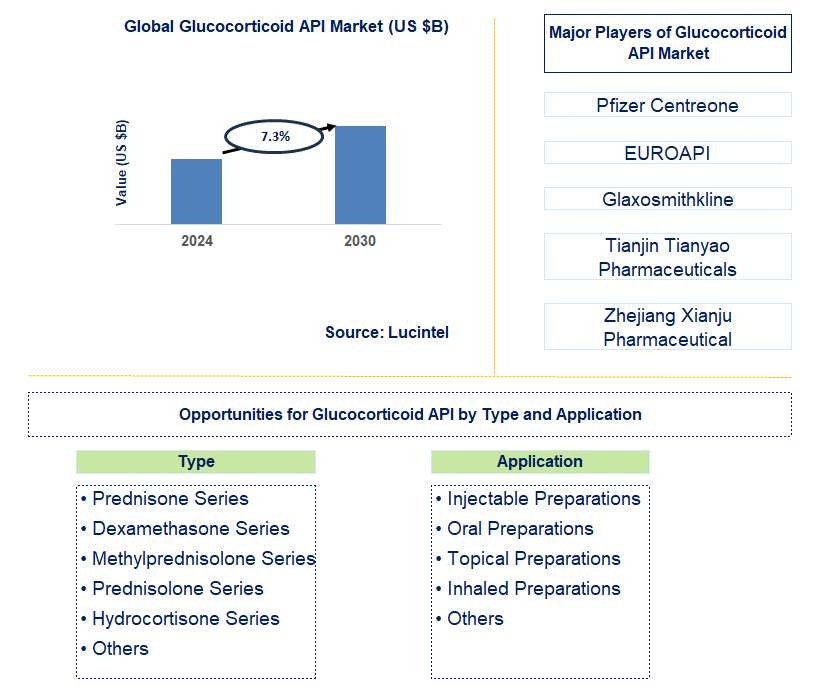
Key data points: The growth forecast = 7.3% annually for the next 6 years. Scroll below to get more insights. This market report covers trends, opportunities, and forecasts in the global glucocorticoid api market to 2030 by type (prednisone series, dexamethasone series, methylprednisolone series, prednisolone series, hydrocortisone series, and others), application (injectable preparations, oral preparations, topical preparations, inhaled preparations, and others), and region (North America, Europe, Asia Pacific, and the Rest of the World)
We'll send your sample report shortly.
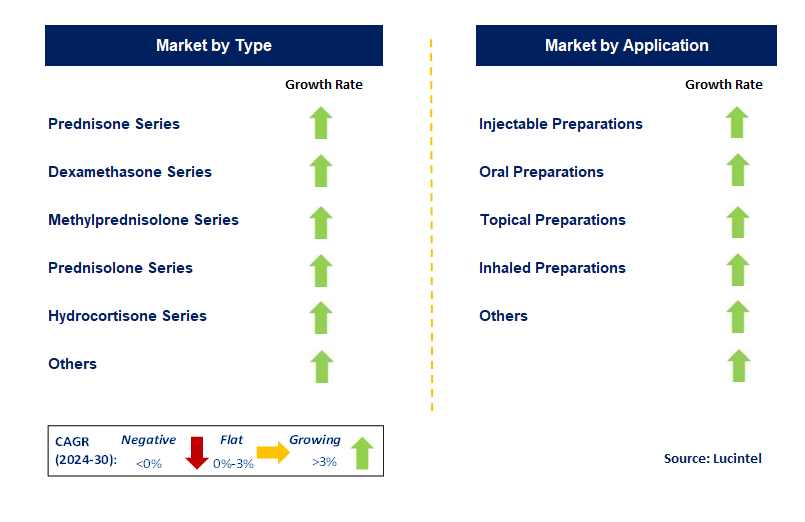
• Lucintel forecasts that, within the type category, the prednisone series is expected to witness the highest growth.
• Within the application category, injectable preparation is expected to witness the highest growth.
• In terms of regions, APAC is expected to witness the highest growth. Gain valuable insights for your business decisions with our comprehensive 150+ page report.
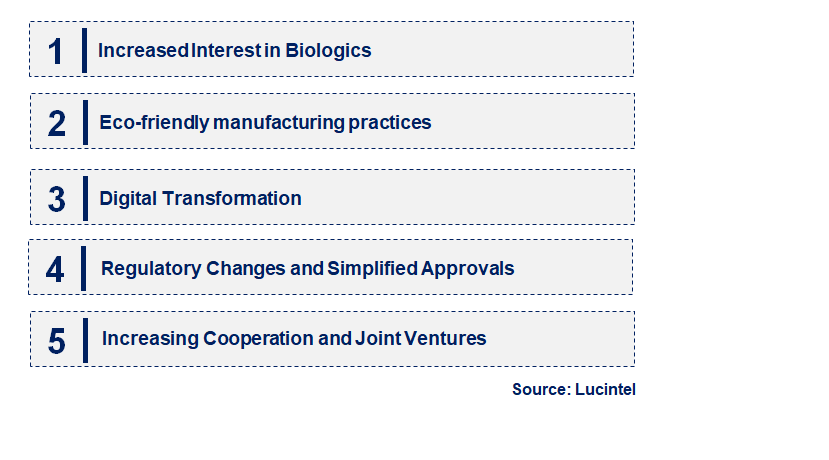
• Increased Interest in Biologics: Biologics and biosimilars are now becoming the emerging face of the treatment option for inflammatory diseases. Companies are exploring investment in R&D through glucocorticoid biologics, which in turn promises better efficacy and safety profiles. As a result, patients will find increased options for therapy, while their dependence on small-molecule traditional glucocorticoids gets minimized and thereby the scope of their treatment possibility is also increasing.
• Eco-friendly manufacturing practices: Sustainability is fast becoming an issue that cannot be ignored within the glucocorticoid API production chain. Companies are moving toward greener processes and sustainable sourcing of raw materials to attain considerable environmental benefits. The shift affects the sentiments of eco-conscious consumers, complies with international regulatory requirements, and may subsequently save compliance costs while enhancing brand reputation in the market.
• Digital Transformation: Advanced analytics, artificial intelligence, and automation are quite profoundly changing the Glucocorticoid API market. They have made it easier to produce; streamlined the management of the supply chain and reduced timelines for the development of drugs. The use of digital tools enables easy cutting back on costs and streamlined operations, which will favor the manufacturers and the patients.
• Regulatory Changes and Simplified Approvals: Some global regulatory authorities are relaxing their guidelines to streamline the approval process of new glucocorticoid APIs. In this regard, innovation is always encouraged, and the introduction of new treatments occurs much faster, hence efficiently meeting unmet medical needs. Moreover, in a continuously more favorable regulatory environment, companies can overcome such challenges and gain a competitive advantage.
• Increasing Cooperation and Joint Ventures: The number of collaborations between research institutions and pharmaceutical firms to develop novel formulations of glucocorticoids is increasing day by day. Collaborations between such institutions ensure knowledge sharing, resource pooling, and finally develop better glucocorticoid therapies. Advancements in such fields are essential to overcoming complex medical challenges and accelerating product development that will eventually benefit patients and healthcare systems. These emerging trends are highly transforming the Glucocorticoid API market with innovation, sustainability, and collaboration among the glaucoma product manufacturers and suppliers. The participants in the market will see improved competition, and the evolving needs of patients will increasingly be reflected in new treatments.
• New Formulation Technologies: New formulation technologies have opened up new delivery systems of glucocorticoids. Better bioavailability and reduced side effects enhance compliance for patients. For example, inhalable glucocorticoids show how technology influences the type of therapy that is required for respiratory disorders, opening up mostly explosive growth in this market as patients become exposed to better treatments.
• Simplification of Regulations: Regulatory agencies have standardized the approval process of glucocorticoid APIs in key markets, thus making it more convenient for companies to launch new products. This, therefore opens opportunities for a company to address unmet medical needs at a rate faster than before. Not only do faster approvals accelerate response to newly arising health issues, but they also reduce competition in the market great incentive for further innovation and development.
• Personalized Medicine: Continuous growth in the area of personalized medicine is profoundly influencing the Glucocorticoid API market, which is going to be approached by companies with the best-designed, tailored therapy approaches for patient populations, thereby achieving an optimum effect of treatment with minimal side effects. This will eventually make glucocorticoids a better solution for chronic inflammation disorders, thus establishing further market potential and appeal.
• Strategic Acquisition and Merger: Many pharmaceutical firms have undertaken significant merger and acquisition activities to strengthen their portfolios of glucocorticoid APIs. This strategic maneuver provides firms with access to new technologies and markets, further driving innovation and competitiveness. The consolidation of the market may lead to efficiency, increased resource deployment, and stronger products.
• Penetration into Emerging Markets: As economic growth strengthens and healthcare needs increase, companies are paying more attention to sharpening their focus as they look forward to expanding the presence of glucocorticoid API into emerging markets. This will further diversify the revenue streams and improve the global market share, because companies are investing in facilities locally placed to provide the maximum support to a region's healthcare needs in a more precise and economical manner. Such major shifts in the Glucocorticoid API market are indicative of a rapidly evolving environment. As far as innovation is concerned, regulatory change and strategic initiatives will drive the shift in this market in the right direction, lead to more effective treatment options, and improve patient outcomes by taking into account the different needs of healthcare systems across the globe.
• Treatment of Chronic Inflammatory Diseases: Rising Chronic Inflammatory Diseases: The increasing rates of chronic inflammatory diseases have increased the demand for glucocorticoid APIs. Companies can capture this opportunity by manufacturing targeted therapies that offer improved efficacy and safety profiles, thus catering to the augmented number of patients and increasing market share with a focus on revenue growth.
• Pediatric Application: Pediatric formulation of glucocorticoids finds more demand as with the call for effective treatments of childhood illness. Suitable formulations and delivery systems targeting an underserved market will provide children with efficacious treatments with fewer potential side effects. Brand loyalty will be encouraged along with a boost in market penetration within a critical demographic.
• Biosimilar Growth: With the patents of the innovator products expiring one after another, the glucocorticoid biosimilar market is growing rapidly. By investing in the development of such biosimilars, companies can provide cost-effective alternatives and therefore increase access to glucocorticoid therapies. This growth opportunity not only enhances the access to personalized glucocorticoid medicines but also strengthens the competitive position in a dynamic landscape.
• Personalized Medicine Initiatives: With the increasing trend towards personalized medicine, there lies an opportunity to develop glucocorticoids to cater to patient needs. Companies may leverage advances in genetic and biomarker research to create targeted therapies that improve treatment results and enrich compliance, thus positioning themselves at the top of this emerging space.
• Digital Health Integration: The inclusion of digital health technologies in glucocorticoid therapies is a great opportunity for growth. Companies could, for example, offer apps and platforms applied in monitoring the impact of patient adherence and outcomes. It will result in an more involved population, and therefore, better overall effectiveness of treatment. This is integrating well with the major trends of current healthcare dynamics that can dramatically alter the patient experience. Many of these strategic growth opportunities are somewhat significantly shaping the Glucocorticoid API market, which enables companies to innovate and respond to changing healthcare demands. Focus on these areas could help strengthen the position of the stakeholders in the market while improving the patient's outcome and sustainable growth in a competitive landscape.
• Pfizer Centreone
• EUROAPI
• GlaxoSmithKline
• Tianjin Tianyao Pharmaceuticals
• Zhejiang Xianju Pharmaceutical
• Henan Lihua Pharmaceutical
• Symbiotec Pharmalab
• Sun Pharmaceutical
• Cipla
• Hovione
• Prednisone Series
• Dexamethasone Series
• Methylprednisolone Series
• Prednisolone Series
• Hydrocortisone Series
• Others
• Injectable Preparations
• Oral Preparations
• Topical Preparations
• Inhaled Preparations
• Others
• North America
• Europe
• Asia Pacific
• The Rest of the World
• United States: Glucocorticoid API Market in the U.S. Market is witnessing a rise following a strong demand for respiratory drugs, specially during the post-COVID-19 period. The leading pharmaceutical companies not only increase the production capacity but also spend much on research to give new profiles of safety and efficacy to existing glucocorticoids. Innovation focus is increasingly creating a more competitive market environment, which stimulates the development of new formulations and delivery methods that meet the patient's needs.
• China: Germany is perceived to be a hotbed for original equipment manufacturing and is manifesting considerable growth. Growing healthcare expenditure along with government policies that are focused on encouraging local manufacturing capabilities, will drive the rapid growth of Glucocorticoid APIs in China. New APIs will experience faster inclusions in the market as a result of recent regulatory reforms and the deregulation of entry processes. This positive aspect of the regulatory environment is inviting investment in the pharmaceutical sector from both domestic and international players. In the global glucocorticoid API market, China is currently a potential player.
• Germany: It is found that Germany has substantial developments in the Glucocorticoid API market due to its strong R&D capabilities and high-quality standards. The country is now heading toward sustainable production practices and improvements in bioavailability, which places it at the forefront of Europe to produce high-quality glucocorticoids. Moreover, the institutes and industry's collaboration have been anticipated to deliver more innovative programs in the development of novel glucocorticoid therapies to meet the needs of the growing patient needs.
• India: Growth in the Glucocorticoid API market in India is impressive, given the growing prevalence of chronic diseases, and local manufacturers are increasing their production capacities and investing in advanced technology to fulfill demand in the country and internationally. Government support to the pharmaceutical industry improves competitiveness, and innovation in glucocorticoid formulations, and enhances the access of essential medicines to patients.
• Japan: Japan's Glucocorticoid API market is very concentrated around advanced therapeutic applications and personalized medicine approaches. Therefore, Japanese firms are concentrating their innovation efforts on the development of new glucocorticoids that more specifically target diseases, especially within the treatment of autoimmune conditions. So, partnership with global pharmaceutical companies helps Japan to plant itself firmly within its market space and make innovations in the global space.


• Pfizer Centreone
• EUROAPI
• GlaxoSmithKline
• Tianjin Tianyao Pharmaceuticals
• Zhejiang Xianju Pharmaceutical
• Henan Lihua Pharmaceutical
• Symbiotec Pharmalab
• Sun Pharmaceutical
• Cipla
• Hovione Q5. Which glucocorticoid API market segment will be the largest in future? Answer: Lucintel forecasts that prednisone series is expected to witness the highest growth. Q6. In glucocorticoid API market, which region is expected to be the largest in next 5 years? Answer: APAC is expected to witness the highest growth. Q.7 Do we receive customization in this report? Answer: Yes, Lucintel provides 10% customization without any additional cost.


Choose a license that fits your team. Instant PDF delivery.
Prices exclude taxes. Instant delivery. Custom licensing available on request.
Market Report · July 16, 2026
Market Report · July 15, 2026
Market Report · July 15, 2026
Trusted partner for strategic intelligence and business growth


Receive a complimentary market analysis tailored to your industry. Our analysts will identify key growth opportunities and competitive dynamics specific to your business.

Market size, growth rate, and key trend analysis for your specific sector.

Top competitor positioning and market share analysis.

Strategic recommendations backed by data-driven insights.
Get curated market intelligence and competitive moves straight to your inbox.
By subscribing, you agree to receive our monthly insights. Unsubscribe anytime.
Receive a complimentary market analysis tailored to your industry. Our analysts will identify key growth opportunities and competitive dynamics specific to your business.
Market size, growth rate, and key trend analysis for your specific sector.
Top competitor positioning and market share analysis.
Strategic recommendations backed by data-driven insights.
Get curated market intelligence, emerging trends, and competitive moves straight to your inbox each month.
By subscribing, you agree to receive our monthly insights. Unsubscribe anytime.
We'll send your sample report shortly.