
Germanium Market Trends and Forecast
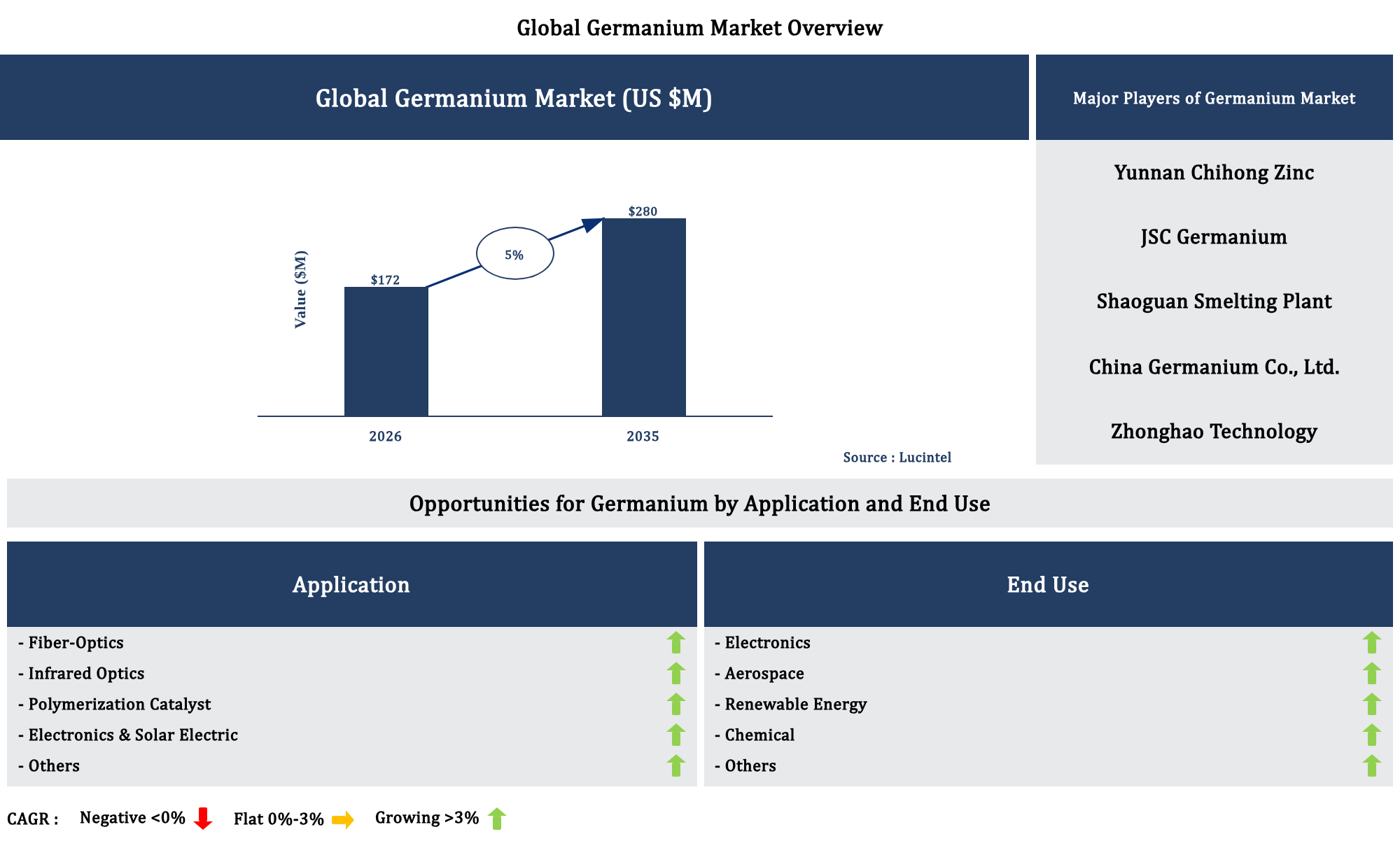
The future of the global germanium market looks promising with opportunities in the electronic, aerospace, renewable energy, and chemical markets. The global germanium market is expected to reach an estimated $280 million by 2035 with a CAGR of 5.0% from 2026 to 2035. The major drivers for this market are the rising demand for fiber optic communication network, the growing demand for high-speed communication systems, and the increasing adoption in semiconductor & electronic chip production.
• Lucintel forecasts that, within the application category, fiber-optic is expected to witness the highest growth over the forecast period.
• Within the end use category, electronic is expected to witness the highest growth.
• In terms of region, APAC is expected to witness the highest growth over the forecast period.
Gain valuable insights for your business decisions with our comprehensive 150+ page report. Sample figures with some insights are shown below.
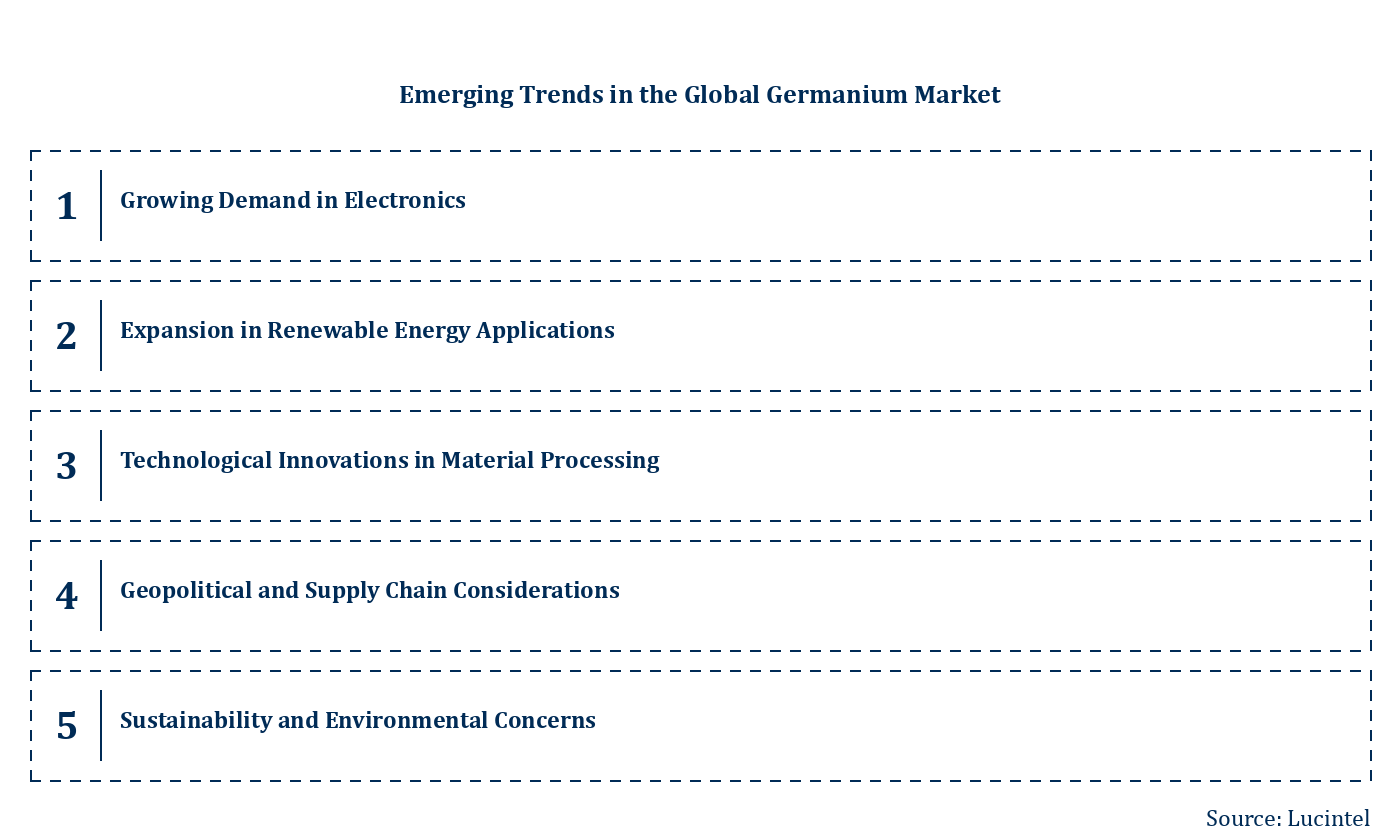
Emerging Trends in the Germanium Market
The germanium market is experiencing significant transformation driven by technological advancements, increasing demand in various industries, and evolving supply chain dynamics. As applications expand in sectors such as electronics, renewable energy, and aerospace, market players are adapting to new challenges and opportunities. Innovations in material processing, sustainability initiatives, and geopolitical factors are also influencing market trends. These developments are shaping the future landscape of Germanium, making it more competitive and diversified. Understanding these key trends is essential for stakeholders to navigate the market effectively and capitalize on emerging opportunities.
• Growing Demand in Electronics: The proliferation of high-performance electronic devices, including semiconductors and infrared optics, is driving increased Germanium consumption. As technology advances, the need for high-purity Germanium in manufacturing sensitive components grows, boosting market growth. This trend is particularly evident in consumer electronics, military applications, and telecommunications, where Germanium‘s unique properties are highly valued. The expanding electronics sector is expected to sustain demand, encouraging investments in refining and extraction processes to meet quality standards.
• Expansion in Renewable Energy Applications: Germanium‘s role in photovoltaic cells and other renewable energy technologies is gaining prominence. Its use in thin-film solar panels and other energy-efficient devices enhances performance and durability. As the global shift toward sustainable energy accelerates, the demand for Germanium in these applications is expected to rise significantly. This trend not only supports the growth of the renewable energy sector but also encourages innovation in material efficiency and recycling methods, reducing environmental impact and ensuring supply stability.
• Technological Innovations in Material Processing: Advances in extraction, purification, and recycling techniques are making Germanium more accessible and cost-effective. New methods such as solvent extraction and electrochemical refining improve yield and purity, reducing reliance on traditional sources. These innovations help stabilize prices and ensure a more sustainable supply chain, which is crucial given the limited availability of natural Germanium deposits. Enhanced processing technologies also enable the development of specialized applications, broadening market potential and encouraging research and development investments.
• Geopolitical and Supply Chain Considerations: The concentration of Germanium production in a few countries, primarily China, poses supply risks and influences market dynamics. Trade policies, export restrictions, and geopolitical tensions can disrupt supply chains, leading to price volatility and supply shortages. As a result, market players are exploring alternative sources and investing in recycling initiatives to mitigate risks. Diversifying supply sources and establishing strategic reserves are becoming critical strategies to ensure market stability and meet growing demand.
• Sustainability and Environmental Concerns: Increasing awareness of environmental impacts associated with Germanium extraction and processing is prompting industry shifts toward greener practices. Efforts include improving recycling techniques, reducing waste, and adopting eco-friendly extraction methods. Regulatory pressures and consumer preferences for sustainable products are driving companies to innovate in environmentally responsible ways. These initiatives aim to minimize ecological footprints, ensure compliance with regulations, and promote long-term market viability, aligning the Germanium industry with global sustainability goals.
These emerging trends are reshaping the germanium market by enhancing technological capabilities, diversifying applications, and addressing supply and sustainability challenges. The market is becoming more resilient, innovative, and aligned with global economic and environmental priorities, paving the way for sustained growth and new opportunities.
Recent Development in the Germanium Market
The germanium market has experienced significant shifts driven by technological advancements, increasing demand in electronics, and strategic supply chain developments. As industries evolve, the focus on high-purity materials and innovative applications has created new growth avenues. Market players are investing in research and expanding production capacities to meet rising global needs. These developments are shaping the future landscape of the Germanium industry, influencing pricing, supply stability, and technological integration across sectors.
• Growth in Electronics and Semiconductor Industries: The demand for Germanium in high-performance transistors and photodetectors is rising due to the expansion of electronics and semiconductor sectors. This growth is driven by the need for faster, more efficient devices, especially in telecommunications and consumer electronics. As a result, manufacturers are investing in advanced purification techniques and expanding production capacities to meet the increasing demand, which boosts market revenue and innovation.
• Strategic Supply Chain Diversification: Countries and companies are diversifying their sources of Germanium to reduce dependency on traditional suppliers. This includes developing domestic extraction and recycling methods, as well as establishing new supply partnerships. Such diversification enhances supply stability, reduces geopolitical risks, and encourages investment in sustainable extraction technologies, ultimately strengthening the overall market resilience and ensuring consistent availability for end-users.
• Rising Use in Infrared Optics and Sensors: Germanium’s unique optical properties make it essential in infrared optics, thermal imaging, and sensor applications. The growing adoption in defense, medical imaging, and industrial inspection is fueling demand. Companies are focusing on developing high-purity Germanium for these specialized applications, which commands premium pricing and opens new revenue streams, thereby expanding the market scope and technological capabilities.
• Innovation in Renewable Energy Technologies: Germanium is increasingly used in photovoltaic cells and other renewable energy applications due to its efficiency in solar energy conversion. The push for sustainable energy solutions is driving research into Germanium-based materials, leading to improved solar panel performance. This trend is attracting investments and fostering technological breakthroughs, which are expected to boost market growth and position Germanium as a critical component in the green energy transition.
• Advances in Recycling and Sustainable Production: The industry is emphasizing recycling of end-of-life electronic devices and waste materials to recover Germanium, reducing environmental impact and raw material costs. Innovations in recycling technologies are making this process more efficient and economically viable. These developments promote sustainability, lower production costs, and ensure a more stable supply chain, positively impacting market growth and aligning with global environmental goals.
The overall impact of these developments is a more resilient, innovative, and expanding germanium market. Increased demand across multiple sectors, supply chain diversification, and technological advancements are driving growth, improving sustainability, and positioning Germanium as a vital material in future technological and energy solutions.
Strategic Growth Opportunities in the Germanium Market
The germanium market is experiencing significant growth driven by technological advancements and increasing demand across various industries. As a critical component in electronics, optics, and renewable energy, Germanium‘s unique properties position it as a strategic material. Market players are exploring new applications and expanding production capacities to meet rising global needs. This dynamic environment offers numerous opportunities for growth, innovation, and market expansion, making it essential for stakeholders to identify key areas for strategic investment and development.
• Expansion in Semiconductor and Electronics Applications: The increasing demand for high-performance semiconductors and electronic devices is driving growth in the germanium market. Germanium‘s excellent electrical properties make it ideal for use in transistors, diodes, and photodetectors. As consumer electronics, telecommunications, and computing devices become more advanced, the need for Germanium-based components rises. Manufacturers are investing in refining extraction and processing techniques to meet the quality standards required for these high-tech applications, fueling market expansion.
• Growing Use in Infrared Optics and Photonics: Germanium‘s transparency in the infrared spectrum makes it essential for infrared optics, sensors, and imaging systems. The expanding defense, aerospace, and medical sectors are increasing their reliance on Germanium for thermal imaging, night vision, and spectroscopy. Advances in manufacturing processes are reducing costs and improving quality, enabling broader adoption. The rising demand for precise infrared components is expected to significantly boost Germanium‘s role in photonics and optical applications.
• Increasing Demand in Renewable Energy Technologies: Germanium is increasingly used in solar cell technology, particularly in high-efficiency photovoltaic devices. Its ability to enhance the performance of multi-junction solar cells makes it valuable for renewable energy projects. As governments and industries push for sustainable energy solutions, investments in Germanium-based solar technologies are rising. This trend is expected to expand the market, driven by innovations in material efficiency and cost reduction strategies.
• Rising Adoption in Fiber Optic and Communication Networks: The global expansion of fiber optic communication networks is creating new opportunities for Germanium. It is used as a dopant in optical fibers to improve signal quality and transmission distance. The demand for faster, more reliable internet connectivity is fueling investments in optical infrastructure. As 5G and next-generation communication systems develop, the need for high-quality Germanium components in fiber optics will continue to grow, supporting market expansion.
• Development of Recycling and Sustainable Supply Chains: The increasing focus on sustainability is encouraging the development of recycling methods for Germanium from electronic waste and scrap materials. This approach reduces reliance on primary mining and supports environmentally friendly supply chains. Advances in recycling technology are making it more cost-effective and efficient, ensuring a steady supply of Germanium. This sustainable approach is expected to enhance market stability, reduce costs, and attract environmentally conscious investors.
The germanium market‘s growth opportunities are poised to significantly influence its global landscape, driven by technological innovation and sustainability initiatives. These opportunities will foster increased investment, research, and development, ultimately expanding applications and strengthening supply chains. As industries continue to evolve, Germanium‘s strategic importance will grow, making it a vital material for future technological advancements and sustainable development.
Germanium Market Driver and Challenges
The germanium market is influenced by a variety of technological, economic, and regulatory factors that shape its growth trajectory. Technological advancements drive demand for high-purity germanium in electronics and photonics, while economic conditions impact investment and production levels. Regulatory policies concerning environmental standards and trade also play a significant role in market dynamics. Additionally, supply chain stability and geopolitical considerations influence market expansion and challenges. Understanding these drivers and challenges is essential for stakeholders to navigate the complexities of the germanium market effectively and capitalize on emerging opportunities while mitigating risks.
The factors responsible for driving the germanium market include:-
• Technological Innovation: The increasing adoption of germanium in fiber optics, infrared optics, and semiconductor devices propels market growth. As industries demand higher performance and miniaturization, high-purity germanium becomes essential. Advances in manufacturing processes improve yield and quality, further boosting demand. The integration of germanium in emerging technologies like quantum computing and advanced sensors also contributes significantly. These innovations create a robust pipeline for future growth, making germanium a critical material in cutting-edge applications. The continuous evolution of technology ensures sustained demand, positioning germanium as a vital component in high-tech industries.
• Growing Electronics and Semiconductor Industry: The expanding electronics sector, including smartphones, tablets, and wearable devices, relies heavily on germanium for its semiconductor properties. The increasing need for faster, more efficient electronic components drives demand for germanium-based transistors and diodes. Semiconductor manufacturers are investing in germanium to improve device performance and energy efficiency. The rise of 5G technology and IoT devices further amplifies this trend, as germanium enhances signal processing and device miniaturization. This growth in electronics manufacturing directly correlates with increased germanium consumption, supporting market expansion.
• Rising Demand for Infrared and Optical Applications: Germanium‘s unique optical properties make it indispensable in infrared optics, thermal imaging, and spectroscopy. The expanding defense, aerospace, and healthcare sectors utilize germanium for sensors, imaging systems, and diagnostic equipment. The increasing adoption of infrared technology in security and surveillance systems also boosts demand. Moreover, the growth of remote sensing and environmental monitoring relies on germanium-based optical components. As these applications become more prevalent, the market for high-quality germanium continues to grow, driven by the need for precision and reliability in optical systems.
• Environmental and Regulatory Factors: Stringent environmental regulations regarding the mining and processing of germanium influence market operations. Governments are implementing policies to reduce environmental impact, which can increase production costs and limit supply. Additionally, trade policies and tariffs affect international trade flows, impacting pricing and availability. Companies are also investing in sustainable extraction and recycling methods to comply with regulations, which may initially raise costs but promote long-term stability. These regulatory factors shape the supply chain and influence market competitiveness, requiring stakeholders to adapt to evolving legal frameworks.
The challenges in the germanium market are:
• Supply Chain Constraints: The limited availability of germanium, primarily as a byproduct of zinc ore processing, constrains supply. Fluctuations in zinc production directly impact germanium availability, leading to market volatility. The complex extraction and refining processes are costly and time-consuming, which can hinder supply chain efficiency. Additionally, geopolitical tensions and trade restrictions may disrupt supply routes, causing shortages and price fluctuations. These constraints challenge manufacturers to secure a stable supply of high-purity germanium, impacting production schedules and market growth.
• High Production Costs: The manufacturing of high-purity germanium involves sophisticated and expensive processes, including zone refining and crystal growth techniques. These costs are further amplified by stringent quality standards required for electronic and optical applications. As a result, the overall cost of germanium remains high, limiting its adoption in cost-sensitive markets. The need for continuous technological improvements to reduce costs adds to the financial burden. High production costs can restrict market expansion and reduce profit margins for producers, posing a significant challenge to industry growth.
• Environmental and Regulatory Challenges: The extraction and processing of germanium pose environmental concerns, including habitat disruption and waste management issues. Stricter environmental regulations increase compliance costs and may restrict mining activities. Additionally, international trade policies and tariffs can create barriers to market entry and increase prices. The need for sustainable practices and regulatory compliance requires significant investment, which can be a barrier for smaller players. These challenges necessitate ongoing adaptation and innovation to ensure sustainable and compliant operations within the market.
The germanium market is driven by technological advancements, expanding electronics and optical applications, and regulatory influences that promote sustainable practices. However, supply chain limitations, high production costs, and environmental regulations pose significant challenges. These factors collectively influence market stability, pricing, and growth potential. Stakeholders must navigate these dynamics carefully, leveraging opportunities created by technological innovation while addressing supply and regulatory hurdles. The overall impact is a market poised for growth but requiring strategic management to mitigate risks and capitalize on emerging trends.
List of Germanium Companies
Companies in the market compete on the basis of product quality offered. Major players in this market focus on expanding their manufacturing facilities, R&D investments, infrastructural development, and leverage integration opportunities across the value chain. With these strategies germanium companies cater increasing demand, ensure competitive effectiveness, develop innovative products & technologies, reduce production costs, and expand their customer base. Some of the germanium companies profiled in this report include-
• Yunnan Chihong Zinc
• JSC Germanium
• Shaoguan Smelting Plant
• China Germanium Co., Ltd.
• Zhonghao Technology
Germanium Market by Segment
The study includes a forecast for the global germanium market by application, end use, and region.
Germanium Market by Application [Value from 2019 to 2035]:
• Fiber-Optics
• Infrared Optics
• Polymerization Catalyst
• Electronics & Solar Electric
• Others
Germanium Market by End Use [Value from 2019 to 2035]:
• Electronics
• Aerospace
• Renewable Energy
• Chemical
• Others
Germanium Market by Region [Value from 2019 to 2035]:
• North America
• Europe
• Asia Pacific
• The Rest of the World
Country Wise Outlook for the Germanium Market
The germanium market has experienced notable shifts driven by technological advancements, geopolitical factors, and evolving demand in various sectors. As industries such as electronics, telecommunications, and renewable energy expand, the need for high-purity germanium has increased. Countries are investing in domestic production and supply chain resilience to meet rising demands and reduce reliance on imports. Innovations in material processing and recycling are also shaping the market landscape. These developments reflect broader trends toward sustainable and secure supply chains, influencing global trade dynamics and investment strategies in the Germanium sector.
• United States: The US has seen increased investment in domestic germanium production, driven by national security concerns and supply chain diversification. Technological advancements in semiconductor manufacturing have boosted demand for high-purity germanium, especially in fiber optics and infrared sensors. The government’s focus on reducing reliance on foreign sources has led to funding for research and development projects. Additionally, recycling initiatives are gaining traction to recover germanium from electronic waste, contributing to a more sustainable supply chain. Overall, the US market is positioning itself as a key player in high-tech applications and supply security.
• China: China continues to dominate the global germanium market, expanding its production capacity and refining processing techniques. The country’s strategic focus on electronics, solar energy, and military applications has driven demand growth. Chinese firms are investing heavily in upgrading refining facilities to produce higher purity germanium, essential for advanced semiconductor devices. The government’s support through policies and subsidies has further strengthened China’s market position. Additionally, China is actively working on recycling programs to recover germanium from scrap electronics, aiming to reduce import dependency and enhance self-sufficiency.
• Germany: Germany remains a significant player in the germanium market, primarily through its advanced electronics and semiconductor industries. The country is investing in research to improve germanium processing and develop innovative applications such as infrared technology and fiber optics. German companies are also focusing on sustainable sourcing and recycling to meet environmental standards. Collaborations with research institutions are fostering technological breakthroughs. The German government’s emphasis on Industry 4.0 and digital transformation is expected to increase demand for germanium-based components, positioning Germany as a key hub for high-tech germanium applications in Europe.
• India: India’s germanium market is emerging, with increased interest in semiconductor and optoelectronic applications. The government’s initiatives to boost electronics manufacturing under the Make in India campaign are encouraging domestic production and R&D. Investments are being made in refining capacities and recycling technologies to reduce import dependence. The growing demand for infrared sensors and fiber optic components in defense and telecommunications sectors is driving market growth. India’s focus on developing a self-reliant supply chain is expected to foster innovation and expand the domestic germanium industry in the coming years.
• Japan: Japan continues to advance in high-purity germanium production, leveraging its expertise in semiconductor and electronic component manufacturing. The country is investing in next-generation technologies such as quantum computing and advanced sensors, which require high-quality germanium. Japanese firms are also exploring recycling methods to recover germanium from electronic waste, aligning with sustainability goals. The government supports innovation through funding and collaboration with academia. Japan’s strategic focus on maintaining technological leadership ensures ongoing demand for germanium in cutting-edge applications, reinforcing its position as a key player in the global market.
Features of the Global Germanium Market
Market Size Estimates: Germanium market size estimation in terms of value ($M).
Trend and Forecast Analysis: Market trends (2019 to 2025) and forecast (2026 to 2035) by various segments and regions.
Segmentation Analysis: Germanium market size by application, end use, and region in terms of value ($M).
Regional Analysis: Germanium market breakdown by North America, Europe, Asia Pacific, and Rest of the World.
Growth Opportunities: Analysis of growth opportunities in different application, end use, and regions for the germanium market.
Strategic Analysis: This includes M&A, new product development, and competitive landscape of the germanium market.
Analysis of competitive intensity of the industry based on Porter’s Five Forces model.
FAQ
Q1. What is the germanium market size?
Answer: The global germanium market is expected to reach an estimated $280 million by 2035.
Q2. What is the growth forecast for germanium market?
Answer: The global germanium market is expected to grow with a CAGR of 5.0% from 2026 to 2035.
Q3. What are the major drivers influencing the growth of the germanium market?
Answer: The major drivers for this market are the rising demand for fiber optic communication network, the growing demand for high-speed communication systems, and the increasing adoption in semiconductor & electronic chip production.
Q4. What are the major segments for germanium market?
Answer: The future of the germanium market looks promising with opportunities in the electronic, aerospace, renewable energy, and chemical markets.
Q5. Who are the key germanium market companies?
Answer: Some of the key germanium companies are as follows:
• Yunnan Chihong Zinc
• JSC Germanium
• Shaoguan Smelting Plant
• China Germanium Co., Ltd.
• Zhonghao Technology
Q6. Which germanium market segment will be the largest in future?
Answer: Lucintel forecasts that, within the application category, fiber-optic is expected to witness the highest growth over the forecast period.
Q7. In germanium market, which region is expected to be the largest in next 8 years?
Answer: In terms of region, APAC is expected to witness the highest growth over the forecast period.
Q8. Do we receive customization in this report?
Answer: Yes, Lucintel provides 10% customization without any additional cost.
This report answers following 11 key questions:
Q.1. What are some of the most promising, high-growth opportunities for the germanium market by application (fiber-optics, infrared optics, polymerization catalyst, electronics & solar electric, and others), end use (electronics, aerospace, renewable energy, chemical, and others), and region (North America, Europe, Asia Pacific, and the Rest of the World)?
Q.2. Which segments will grow at a faster pace and why?
Q.3. Which region will grow at a faster pace and why?
Q.4. What are the key factors affecting market dynamics? What are the key challenges and business risks in this market?
Q.5. What are the business risks and competitive threats in this market?
Q.6. What are the emerging trends in this market and the reasons behind them?
Q.7. What are some of the changing demands of customers in the market?
Q.8. What are the new developments in the market? Which companies are leading these developments?
Q.9. Who are the major players in this market? What strategic initiatives are key players pursuing for business growth?
Q.10. What are some of the competing products in this market and how big of a threat do they pose for loss of market share by material or product substitution?
Q.11. What M&A activity has occurred in the last 7 years and what has its impact been on the industry?
For any questions related to Germanium Market, Germanium Market Size, Germanium Market Growth, Germanium Market Analysis, Germanium Market Report, Germanium Market Share, Germanium Market Trends, Germanium Market Forecast, Germanium Companies, write Lucintel analyst at email: helpdesk@lucintel.com. We will be glad to get back to you soon.