
Report Feature
General Purpose Chip Resistor Market Trends and Forecast
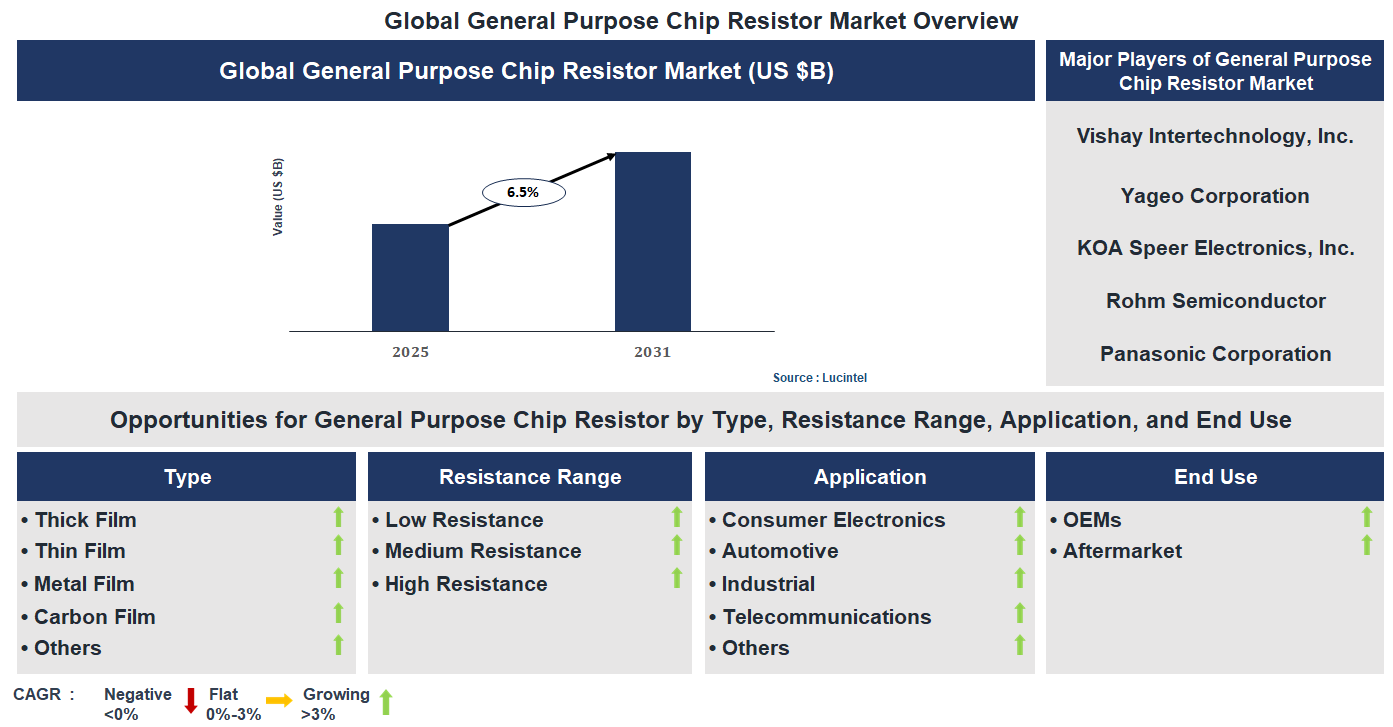
The future of the global general purpose chip resistor market looks promising with opportunities in the consumer electronics, automotive, industrial, and telecommunication markets. The global general purpose chip resistor market is expected to grow with a CAGR of 6.5% from 2025 to 2031. The major drivers for this market are the increasing demand for consumer electronics, the rising adoption of electric vehicles, and the growing need for power management systems.• Lucintel forecasts that, within the type category, thick film is expected to witness the highest growth over the forecast period.
• Within the application category, consumer electronics is expected to witness the highest growth.
• In terms of region, APAC is expected to witness the highest growth over the forecast period. Gain valuable insights for your business decisions with our comprehensive 150+ page report. Sample figures with some insights are shown below.
Emerging Trends in the General Purpose Chip Resistor Market
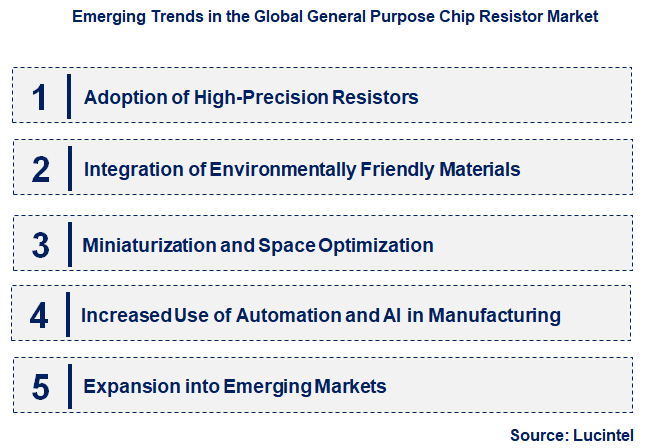
The general purpose chip resistor market is experiencing rapid evolution driven by technological advancements, increasing demand for electronic devices, and shifts in manufacturing practices. As consumer electronics, automotive, and industrial sectors expand, the market is adapting through innovative materials, manufacturing processes, and integration techniques. These developments are not only enhancing performance and reliability but also influencing supply chains and competitive dynamics. Understanding these emerging trends is crucial for stakeholders aiming to capitalize on new opportunities and navigate potential challenges in this dynamic landscape.• Adoption of High-Precision Resistors: The demand for high-precision chip resistors is rising due to the need for accurate and stable performance in sensitive electronic applications. These resistors offer low tolerance and temperature coefficient, making them ideal for medical devices, aerospace, and advanced communication systems. This trend is driving manufacturers to develop more reliable and finely tuned products, which enhances overall device performance and ensures compliance with stringent industry standards.
• Integration of Environmentally Friendly Materials: Sustainability is becoming a key focus, prompting the use of eco-friendly materials in resistor manufacturing. Companies are shifting towards lead-free, RoHS-compliant components that reduce hazardous waste and environmental impact. This trend not only aligns with global regulations but also appeals to environmentally conscious consumers and OEMs, fostering innovation in material science and manufacturing processes to produce greener products.
• Miniaturization and Space Optimization: The push for smaller, more efficient electronic devices is fueling the miniaturization of chip resistors. Smaller form factors enable more compact device designs, especially in smartphones, wearables, and IoT devices. This trend encourages advancements in manufacturing techniques such as thin-film technology and surface-mount innovations, which improve performance while conserving space, ultimately leading to more versatile and portable electronic products.
• Increased Use of Automation and AI in Manufacturing: Automation and artificial intelligence are transforming resistor production by enhancing precision, reducing defects, and increasing throughput. Automated inspection, robotic assembly, and AI-driven quality control streamline manufacturing processes, lower costs, and improve product consistency. This trend allows manufacturers to meet rising demand efficiently while maintaining high quality standards, thus strengthening their competitive edge in the market.
• Expansion into Emerging Markets: Growing electronics adoption in emerging economies is opening new opportunities for chip resistor suppliers. Increased investments in infrastructure, consumer electronics, and automotive sectors in regions like Asia-Pacific and Latin America are driving demand. Companies are establishing local manufacturing facilities and distribution channels to capitalize on these markets, which are expected to experience significant growth, thereby diversifying revenue streams and reducing dependency on mature markets. In summary, these trends are collectively reshaping the general purpose chip resistor market by fostering innovation, promoting sustainability, enabling miniaturization, and expanding global reach. They are driving the industry toward more precise, eco-friendly, and compact solutions, ensuring it remains responsive to technological and market demands.
Recent Development in the General Purpose Chip Resistor Market
The general purpose chip resistor market is experiencing rapid growth driven by technological advancements and increasing demand across various industries. Innovations in manufacturing processes, material improvements, and expanding applications are fueling market expansion. As electronic devices become more sophisticated, the need for reliable, cost-effective resistors grows. Market players are focusing on product diversification and strategic collaborations to capture emerging opportunities. These developments are shaping a dynamic landscape, offering significant potential for growth and innovation in the coming years.• Technological Advancements in Manufacturing: Enhanced production techniques are enabling higher precision and reliability in chip resistors, reducing costs and improving performance. This progress allows manufacturers to meet the increasing demand for miniaturized and high-performance electronic components across consumer electronics, automotive, and industrial sectors. The improved manufacturing processes also facilitate faster production cycles, boosting overall market capacity. As a result, companies can offer more competitive products, expanding their market share and driving industry growth.
• Material Innovation for Better Durability: New materials are being developed to improve the thermal stability, resistance to environmental factors, and lifespan of chip resistors. These innovations enhance product durability, making resistors suitable for harsh environments such as automotive and aerospace applications. The increased reliability reduces maintenance costs and enhances device performance, encouraging adoption in critical sectors. This focus on material science is fostering a more resilient product portfolio, opening new avenues for market expansion and customer trust.
• Growing Demand in Consumer Electronics: The proliferation of smartphones, tablets, wearables, and smart home devices is significantly increasing the need for compact, efficient resistors. Consumer electronics manufacturers seek reliable components that support miniaturization and energy efficiency. This demand is driving innovation in resistor design and material use, leading to a broader product range tailored for various applications. The expanding consumer market is a key driver, contributing to sustained growth and diversification within the chip resistor industry.
• Expansion in Automotive and Industrial Applications: The automotive sectors shift towards electric vehicles and advanced driver-assistance systems (ADAS) is boosting demand for high-quality chip resistors. Similarly, industrial automation and robotics require resistors capable of withstanding extreme conditions. These sectors demand resistors with high precision, stability, and durability, prompting manufacturers to develop specialized products. The growth in these applications is creating new market segments, fostering innovation, and increasing overall industry revenue.
• Strategic Collaborations and Market Consolidation: Companies are forming alliances to enhance technological capabilities and expand product offerings. Mergers and acquisitions are consolidating market share, enabling access to new markets and resources. These collaborations facilitate the development of innovative resistor solutions tailored to emerging needs, such as IoT and 5G infrastructure. The strategic moves are fostering a competitive environment that accelerates product development, reduces costs, and broadens market reach, ultimately driving industry growth. The recent developments in manufacturing, materials, application sectors, and strategic collaborations are significantly transforming the general purpose chip resistor market. These advancements are enhancing product quality, expanding application areas, and fostering innovation, which collectively boost market growth. As industries continue to evolve technologically, the market is poised for sustained expansion, driven by increased demand for reliable, efficient, and miniaturized resistors across diverse sectors.
Strategic Growth Opportunities in the General Purpose Chip Resistor Market
The general purpose chip resistor market is experiencing significant growth driven by increasing demand across various industries such as consumer electronics, automotive, and industrial automation. Technological advancements and the need for miniaturization are fueling innovation in resistor design and manufacturing. Market players are focusing on expanding their product portfolios and geographical reach to capitalize on emerging opportunities. The integration of resistors into IoT devices and smart systems further enhances market potential. Strategic collaborations and investments in R&D are crucial for maintaining competitive advantage and addressing evolving customer needs.• Expansion into Emerging Markets: Growing electronics manufacturing in regions like Asia-Pacific and Latin America presents substantial opportunities for market expansion. Local demand for consumer gadgets, automotive electronics, and industrial equipment is rising, prompting companies to establish manufacturing bases and distribution channels. Tailoring products to regional specifications and forging strategic partnerships will enable market players to capture new customer segments and increase market share in these high-growth areas.
• Development of High-Precision and Low-Resistance Resistors: As electronic devices become more sophisticated, there is an increasing need for high-precision and low-resistance resistors to ensure optimal performance. Innovations in materials and manufacturing processes are enabling the production of resistors with tighter tolerances and better stability. This growth opportunity caters to applications in medical devices, aerospace, and high-frequency communication systems, where accuracy and reliability are critical, driving demand for advanced resistor solutions.
• Integration of Resistors into IoT and Smart Devices: The proliferation of IoT and smart devices is creating a demand for compact, reliable, and energy-efficient resistors. These components are essential for sensor calibration, power management, and signal processing in connected systems. Developing resistors that meet the specific requirements of IoT applications, such as low power consumption and miniaturization, offers significant growth potential. Companies investing in specialized resistor designs will benefit from the expanding smart device ecosystem.
• Focus on Sustainable and Eco-Friendly Resistor Manufacturing: Increasing environmental regulations and consumer awareness are pushing manufacturers to adopt sustainable practices. Developing eco-friendly resistor materials, reducing hazardous substances, and improving energy efficiency in production processes are key growth areas. Offering environmentally sustainable products not only aligns with regulatory standards but also enhances brand reputation. This opportunity supports the transition toward greener electronics and appeals to environmentally conscious customers and industries.
• Strategic Collaborations and Mergers for Innovation: Collaborations between resistor manufacturers, material suppliers, and technology firms are vital for accelerating innovation. Mergers and acquisitions enable access to advanced technologies, expand product portfolios, and enhance R&D capabilities. Such strategic moves facilitate the development of next-generation resistors with improved performance characteristics. These partnerships are crucial for staying competitive, addressing complex customer requirements, and capturing a larger share of the evolving market landscape. These growth opportunities are poised to significantly influence the general purpose chip resistor market by fostering innovation, expanding geographical reach, and aligning with technological and environmental trends. Companies that strategically leverage these opportunities will be better positioned to meet the increasing demands of diverse applications and sustain long-term growth in a competitive landscape.
General Purpose Chip Resistor Market Driver and Challenges
The general purpose chip resistor market is influenced by a variety of technological, economic, and regulatory factors that shape its growth and development. Technological advancements drive innovation, enabling the production of more efficient and reliable resistors, while economic conditions impact demand across various industries such as consumer electronics, automotive, and telecommunications. Regulatory standards concerning safety, environmental impact, and quality control also play a crucial role in shaping market dynamics. Additionally, supply chain stability and raw material availability influence production costs and pricing strategies. Understanding these drivers and challenges is essential for stakeholders to navigate the evolving landscape of the market effectively. The factors responsible for driving the general purpose chip resistor market include:• Technological Innovation: The continuous development of advanced manufacturing processes and materials enhances resistor performance, miniaturization, and reliability. Innovations such as surface-mount technology (SMT) and improved power ratings enable resistors to meet the demands of modern electronic devices. This technological progress fosters increased adoption across sectors like consumer electronics, automotive, and industrial automation, fueling market growth. Companies investing in R&D are able to introduce products that offer better thermal stability, lower noise, and higher precision, which are critical for high-performance applications. As technology evolves, the market benefits from a broader range of resistor options tailored to specific needs, thus expanding its scope and applications.
• Growing Electronics Industry: The expanding electronics sector, driven by rising consumer demand for smartphones, tablets, and wearable devices, significantly propels the market. The proliferation of IoT devices and smart appliances further amplifies the need for reliable, cost-effective resistors. Automotive electronics, especially with the rise of electric vehicles, require robust resistors for various control systems. Industrial automation and healthcare equipment also contribute to increased demand. This growth in electronics manufacturing directly correlates with higher consumption of general purpose chip resistors, creating a positive feedback loop that sustains market expansion. The increasing integration of electronic components in everyday products ensures a steady demand trajectory.
• Cost-Effectiveness and Standardization: The market benefits from the availability of cost-effective, standardized resistor products that cater to mass production needs. Manufacturers focus on producing resistors that meet industry standards while maintaining affordability, which is crucial for high-volume applications. Standardization facilitates easier procurement, inventory management, and compatibility across different devices and systems. As global supply chains become more efficient, economies of scale reduce costs further, making these resistors accessible to a broader customer base. This affordability and standardization support the growth of electronics manufacturing worldwide, especially in emerging markets where cost sensitivity is paramount.
• Regulatory and Environmental Standards: Stringent regulations concerning environmental impact, such as RoHS (Restriction of Hazardous Substances) and WEEE (Waste Electrical and Electronic Equipment), influence resistor manufacturing processes. Compliance ensures market access and enhances product credibility. Manufacturers are adopting eco-friendly materials and sustainable production practices to meet these standards, which can initially increase costs but ultimately lead to a more sustainable market. Regulatory frameworks also promote innovation in materials and design to reduce hazardous substances, fostering the development of greener resistors. These standards shape product development, quality assurance, and supply chain practices, impacting overall market dynamics.
• Increasing Adoption of Automation and Industry 4.0: The shift towards automation and Industry 4.0 initiatives accelerates demand for reliable electronic components, including general purpose chip resistors. Automated manufacturing processes require resistors that can withstand high-speed assembly and operational stresses. The integration of smart manufacturing systems demands resistors with enhanced performance characteristics such as stability, low noise, and high precision. This trend encourages manufacturers to innovate and improve resistor quality, thereby expanding market opportunities. As industries adopt more automated solutions, the need for consistent, high-quality resistors becomes critical, further driving market growth. The challenges facing this general purpose chip resistor market include:
• Supply Chain Disruptions: The global supply chain for raw materials and electronic components has faced significant disruptions due to geopolitical tensions, pandemics, and logistical issues. These disruptions lead to delays in production, increased costs, and shortages of key materials like metal oxides and ceramics used in resistor manufacturing. Such instability hampers the ability of manufacturers to meet rising demand and can result in price volatility. Companies must navigate these challenges by diversifying suppliers and optimizing inventory management, which can increase operational complexity and costs. Persistent supply chain issues threaten to slow down market growth and innovation.
• Price Volatility of Raw Materials: Fluctuations in the prices of raw materials such as metal oxides, ceramics, and other components directly impact manufacturing costs. Price volatility can be driven by geopolitical factors, environmental regulations, and market speculation. Increased costs may be passed on to consumers, affecting competitiveness and profit margins. Manufacturers may also face challenges in maintaining consistent pricing strategies, which can influence customer loyalty and market share. Managing raw material costs requires strategic sourcing and inventory planning, but persistent volatility remains a significant challenge that could hinder market expansion.
• Rapid Technological Changes and Obsolescence: The fast pace of technological innovation in electronics demands continuous product development and adaptation. Resistors that are suitable today may become obsolete as new materials and designs emerge. This rapid evolution can lead to increased R&D expenses and inventory obsolescence, impacting profitability. Companies must invest heavily in innovation to stay competitive, which can strain resources, especially for smaller players. Additionally, frequent updates to standards and specifications require ongoing compliance efforts. Navigating technological obsolescence is a key challenge that influences long-term planning and market stability. In summary, the general purpose chip resistor market is driven by technological advancements, expanding electronics industries, cost efficiencies, regulatory compliance, and automation trends. However, it faces challenges such as supply chain disruptions, raw material price volatility, and rapid technological changes. These factors collectively shape the markets growth trajectory, requiring stakeholders to adapt strategically. While opportunities for innovation and expansion are substantial, addressing supply and cost challenges is crucial for sustained development. Overall, the markets future depends on balancing technological progress with effective management of supply and regulatory risks, ensuring resilience and continued growth.
List of General Purpose Chip Resistor Companies
Companies in the market compete on the basis of product quality offered. Major players in this market focus on expanding their manufacturing facilities, R&D investments, infrastructural development, and leverage integration opportunities across the value chain. With these strategies general purpose chip resistor companies cater increasing demand, ensure competitive effectiveness, develop innovative products & technologies, reduce production costs, and expand their customer base. Some of the general purpose chip resistor companies profiled in this report include-• Vishay Intertechnology, Inc.
• Yageo Corporation
• KOA Speer Electronics, Inc.
• Rohm Semiconductor
• Panasonic Corporation
• TE Connectivity Ltd.
• TT Electronics plc
• Bourns, Inc.
• Samsung Electro-Mechanics Co., Ltd.
• Walsin Technology Corporation
General Purpose Chip Resistor Market by Segment
The study includes a forecast for the global general purpose chip resistor market by type, resistance range, application, end use, and region.General Purpose Chip Resistor Market by Type [Value from 2019 to 2031]:
• Thick Film
• Thin Film
• Metal Film
• Carbon Film
• Others
General Purpose Chip Resistor Market by Resistance Range [Value from 2019 to 2031]:
• Low Resistance
• Medium Resistance
• High Resistance
General Purpose Chip Resistor Market by Application [Value from 2019 to 2031]:
• Consumer Electronics
• Automotive
• Industrial
• Telecommunications
• Others
General Purpose Chip Resistor Market by End Use [Value from 2019 to 2031]:
• OEMs
• Aftermarket
General Purpose Chip Resistor Market by Region [Value from 2019 to 2031]:
• North America
• Europe
• Asia Pacific
• The Rest of the World
Country Wise Outlook for the General Purpose Chip Resistor Market
The general purpose chip resistor market has experienced significant shifts driven by technological advancements, supply chain adjustments, and increasing demand across various sectors. Countries are adopting innovative manufacturing techniques, expanding production capacities, and implementing policies to enhance competitiveness. These developments reflect the evolving landscape of electronic components essential for consumer electronics, automotive, industrial, and telecommunications industries. As the market adapts to new challenges and opportunities, each country’s strategic initiatives and technological progress play a crucial role in shaping the future of the general purpose chip resistor industry.• United States: The U.S. market has seen increased investment in advanced manufacturing facilities and R&D activities, focusing on high-precision resistors to meet the demands of emerging technologies like 5G and electric vehicles. Major players are expanding their product portfolios and forming strategic partnerships to enhance supply chain resilience. Government initiatives supporting innovation and domestic production have further boosted market growth, alongside rising demand from consumer electronics and aerospace sectors.
• China: China continues to dominate the market with rapid expansion in production capacity and technological innovation. The country is investing heavily in automation and smart manufacturing to improve quality and reduce costs. Domestic companies are developing high-performance resistors tailored for automotive and industrial applications, while government policies favor local industry growth through subsidies and infrastructure development. The Chinese market remains highly competitive, with a focus on export expansion and technological self-sufficiency.
• Germany: Germany’s market is characterized by a focus on high-quality, reliable resistors for automotive and industrial applications. The country emphasizes sustainable manufacturing practices and innovation in materials to improve resistor performance and longevity. Leading firms are integrating Industry 4.0 technologies to optimize production processes. The German market benefits from strong engineering expertise and a robust supply chain network, supporting the development of customized resistor solutions for complex applications.
• India: India is witnessing rapid growth driven by increasing electronics manufacturing and government initiatives like Make in India. The market is expanding its capabilities in producing cost-effective resistors for consumer electronics, automotive, and telecom sectors. Local companies are adopting new technologies to improve product quality and meet international standards. The government’s focus on infrastructure development and ease of doing business is attracting investments, fostering innovation, and boosting overall market growth.
• Japan: Japan maintains its reputation for high-quality electronic components, with a focus on advanced resistor technologies for automotive and industrial sectors. The country is investing in research to develop resistors with enhanced thermal stability and durability. Japanese firms are integrating IoT and automation into manufacturing processes to improve efficiency. The market benefits from a strong tradition of innovation, with a focus on miniaturization and energy efficiency, supporting the global demand for reliable, high-performance chip resistors.

Features of the Global General Purpose Chip Resistor Market
Market Size Estimates: General purpose chip resistor market size estimation in terms of value ($B). Trend and Forecast Analysis: Market trends (2019 to 2024) and forecast (2025 to 2031) by various segments and regions. Segmentation Analysis: General purpose chip resistor market size by various segments, such as by type, resistance range, application, end use, and region in terms of value ($B). Regional Analysis: General purpose chip resistor market breakdown by North America, Europe, Asia Pacific, and Rest of the World. Growth Opportunities: Analysis of growth opportunities in different types, resistance ranges, applications, end uses, and regions for the general purpose chip resistor market. Strategic Analysis: This includes M&A, new product development, and competitive landscape of the general purpose chip resistor market. Analysis of competitive intensity of the industry based on Porter’s Five Forces model.
FAQ
Q1. What is the growth forecast for general purpose chip resistor market? Answer: The global general purpose chip resistor market is expected to grow with a CAGR of 6.5% from 2025 to 2031. Q2. What are the major drivers influencing the growth of the general purpose chip resistor market? Answer: The major drivers for this market are the increasing demand for consumer electronics, the rising adoption of electric vehicles, and the growing need for power management systems. Q3. What are the major segments for general purpose chip resistor market? Answer: The future of the general purpose chip resistor market looks promising with opportunities in the consumer electronics, automotive, industrial, and telecommunication markets. Q4. Who are the key general purpose chip resistor market companies? Answer: Some of the key general purpose chip resistor companies are as follows:• Vishay Intertechnology, Inc.
• Yageo Corporation
• KOA Speer Electronics, Inc.
• Rohm Semiconductor
• Panasonic Corporation
• TE Connectivity Ltd.
• TT Electronics plc
• Bourns, Inc.
• Samsung Electro-Mechanics Co., Ltd.
• Walsin Technology Corporation Q5. Which general purpose chip resistor market segment will be the largest in future? Answer: Lucintel forecasts that, within the type category, thick film is expected to witness the highest growth over the forecast period. Q6. In general purpose chip resistor market, which region is expected to be the largest in next 5 years? Answer: In terms of region, APAC is expected to witness the highest growth over the forecast period. Q7. Do we receive customization in this report? Answer: Yes, Lucintel provides 10% customization without any additional cost.
Table of Contents
List of Figures
List of Tables
Methodology
- In-depth interviews of the major players in this market
- Detailed secondary research from competitors’ financial statements and published data
- Extensive searches of published works, market, and database information pertaining to industry news, company press releases, and customer intentions
- A compilation of the experiences, judgments, and insights of Lucintel’s professionals, who have analyzed and tracked this market over the years.


Buy Now
Choose a license that fits your team. Instant PDF delivery.
Prices exclude taxes. Instant delivery. Custom licensing available on request.
Key Questions
- • What are some of the most promising, high-growth opportunities for the general purpose chip resistor market by type (thick film, thin film, metal film, carbon film, and others), resistance range (low resistance, medium resistance, and high resistance), application (consumer electronics, automotive, industrial, telecommunications, and others), end use (OEMs and aftermarket), and region (North America, Europe, Asia Pacific, and the Rest of the World)?
- • Which segments will grow at a faster pace and why?
- • Which region will grow at a faster pace and why?
- • What are the key factors affecting market dynamics? What are the key challenges and business risks in this market?
- • What are the business risks and competitive threats in this market?
- • What are the emerging trends in this market and the reasons behind them?
- • What are some of the changing demands of customers in the market?
- • What are the new developments in the market? Which companies are leading these developments?
- • Who are the major players in this market? What strategic initiatives are key players pursuing for business growth?
- • What are some of the competing products in this market and how big of a threat do they pose for loss of market share by material or product substitution?
- • What M&A activity has occurred in the last 6 years and what has its impact been on the industry? For any questions related to General Purpose Chip Resistor Market, General Purpose Chip Resistor Market Size, General Purpose Chip Resistor Market Growth, General Purpose Chip Resistor Market Analysis, General Purpose Chip Resistor Market Report, General Purpose Chip Resistor Market Share, General Purpose Chip Resistor Market Trends, General Purpose Chip Resistor Market Forecast, General Purpose Chip Resistor Companies, write Lucintel analyst at email: helpdesk@lucintel.com. We will be glad to get back to you soon.


