
Report Feature
Gated Recurrent Unit Market Trends and Forecast
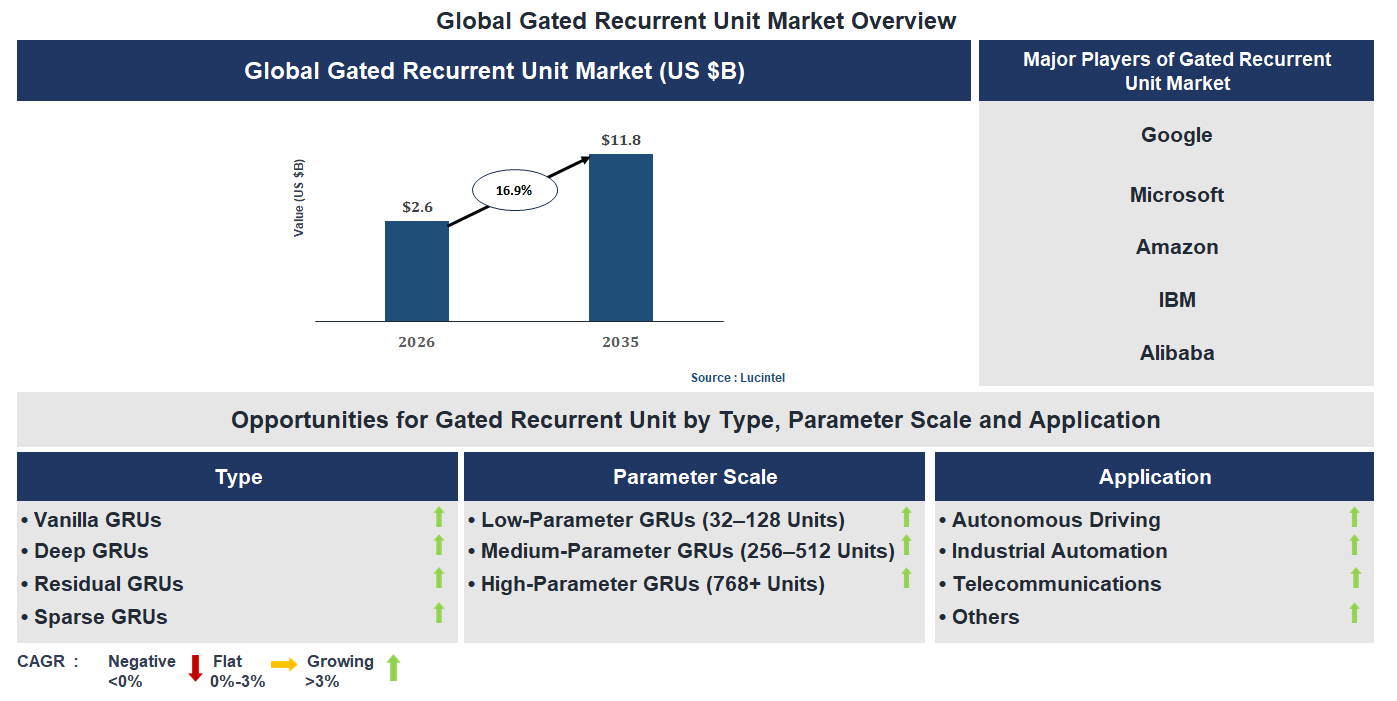
The future of the global gated recurrent unit market looks promising with opportunities in the autonomous driving, industrial automation, and telecommunication markets. The global gated recurrent unit market is expected to reach an estimated $11.8 billion by 2035 with a CAGR of 16.9% from 2026 to 2035. The major drivers for this market are the increasing adoption of deep learning techniques, the rising demand for natural language processing applications, and the growing use in speech recognition & translation.• Lucintel forecasts that, within the type category, deep GRU is expected to witness the highest growth over the forecast period.
• Within the application category, autonomous driving is expected to witness the highest growth.
• In terms of region, APAC is expected to witness the highest growth over the forecast period. Gain valuable insights for your business decisions with our comprehensive 150+ page report. Sample figures with some insights are shown below.
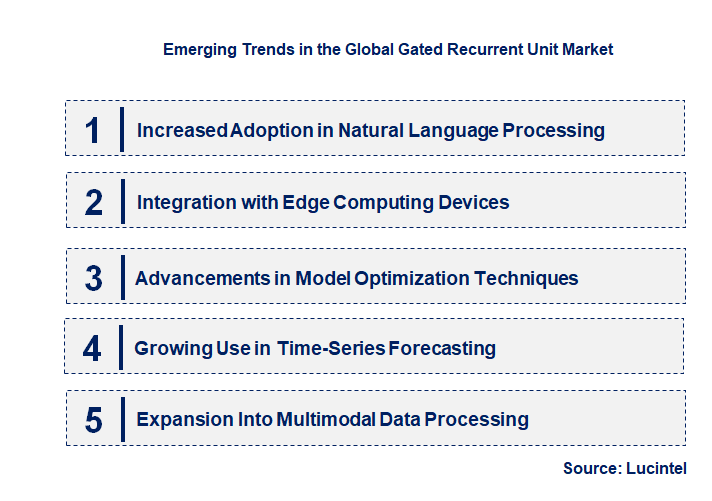
Emerging Trends in the Gated Recurrent Unit Market
The gated recurrent unit market is experiencing rapid growth driven by advancements in artificial intelligence, machine learning, and deep learning applications. As industries increasingly adopt sophisticated models for natural language processing, speech recognition, and time-series analysis, the demand for efficient and scalable recurrent neural network architectures like GRUs is surging. These models offer a balance between performance and computational efficiency, making them attractive for real-time applications and resource-constrained environments. The evolving landscape is marked by innovation, integration, and expanding use cases, which are collectively reshaping the future of the GRU market and its role in AI-driven solutions.• Increased Adoption in Natural Language Processing: GRUs are widely adopted in NLP tasks such as language translation, sentiment analysis, and chatbots due to their ability to handle sequential data efficiently. Their simplified architecture compared to LSTMs results in faster training times and lower computational costs, making them suitable for deployment in real-time applications. As NLP continues to grow, the demand for GRUs is expected to rise, especially in industries like customer service, healthcare, and finance, where understanding and generating human language is critical.
• Integration with Edge Computing Devices: The lightweight nature of GRUs makes them ideal for deployment on edge devices such as smartphones, IoT sensors, and embedded systems. This trend is driven by the need for real-time data processing without relying on cloud infrastructure, which can introduce latency and security concerns. As edge computing gains momentum, GRUs are increasingly integrated into applications requiring on-device intelligence, such as predictive maintenance, smart home devices, and wearable health monitors, expanding their market reach.
• Advancements in Model Optimization Techniques: Innovations in model compression, pruning, and quantization are enhancing the efficiency of GRUs, enabling their deployment in resource-constrained environments. These techniques reduce model size and improve inference speed without significantly sacrificing accuracy. The ongoing research in this area is making GRUs more accessible for applications with limited computational power, such as mobile apps and embedded systems, thereby broadening their applicability and market penetration.
• Growing Use in Time-Series Forecasting: GRUs are increasingly employed in time-series analysis for applications like stock market prediction, weather forecasting, and anomaly detection. Their ability to capture temporal dependencies with fewer parameters than traditional RNNs makes them suitable for complex, real-world data. This trend is driven by the need for accurate, real-time forecasting models in finance, energy management, and industrial automation, positioning GRUs as a preferred choice for predictive analytics in various sectors.
• Expansion into Multimodal Data Processing: The market is witnessing a shift towards using GRUs for processing multimodal data, combining text, audio, and visual inputs. This capability enhances applications like multimedia analysis, video captioning, and cross-modal retrieval. The integration of GRUs into multimodal frameworks allows for a more comprehensive understanding and interaction with complex data types, opening new avenues for research and commercial applications. This trend is expected to significantly expand the scope and versatility of GRU-based solutions across industries. In summary, these emerging trends are collectively transforming the Gated Recurrent Unit market by enhancing model efficiency, expanding application domains, and enabling deployment across diverse environments. As innovation continues, the market is poised for sustained growth, driven by the increasing demand for intelligent, real-time, and resource-efficient AI solutions.
Recent Development in the Gated Recurrent Unit Market
The gated recurrent unit market is experiencing rapid growth driven by advancements in artificial intelligence, machine learning, and data processing capabilities. As industries increasingly adopt deep learning models for various applications, the demand for efficient and scalable recurrent neural networks like GRUs has surged. Innovations in hardware, software, and algorithm optimization are further propelling this market forward. These developments are transforming how businesses analyze sequential data, improve predictive accuracy, and enhance real-time decision-making processes across sectors.• Growing Adoption in Natural Language Processing: The increasing use of GRUs in NLP applications such as chatbots, translation, and sentiment analysis is expanding market reach. Their ability to handle sequential data efficiently with fewer parameters than LSTMs makes them attractive for real-time language understanding. This trend is driving demand in tech, healthcare, and customer service industries, leading to more sophisticated AI-driven communication tools and improved user experiences.
• Advancements in Hardware Accelerators: The development of specialized hardware like GPUs, TPUs, and edge devices optimized for neural network computations is significantly impacting the GRU market. These accelerators enable faster training and inference, reducing latency and energy consumption. As a result, GRUs are increasingly deployed in embedded systems, IoT devices, and mobile applications, broadening their applicability and fostering innovation in real-time data processing and autonomous systems.
• Integration with Edge Computing Solutions: The shift towards edge computing is creating new opportunities for GRUs to operate efficiently on decentralized devices. Their lightweight architecture makes them suitable for deployment in resource-constrained environments, enabling real-time analytics and decision-making at the edge. This development is particularly influential in sectors like healthcare, manufacturing, and smart cities, where immediate data processing is critical for operational efficiency and security.
• Algorithm Optimization and Model Compression: Recent research focuses on enhancing GRU efficiency through pruning, quantization, and knowledge distillation. These techniques reduce model size and computational requirements without sacrificing accuracy, facilitating deployment on low-power devices. This progress is expanding the market by making GRUs more accessible for applications with limited hardware resources, such as wearable devices and remote sensors, thus broadening their industrial and consumer use cases.
• Increased Focus on Multimodal Data Processing: The ability of GRUs to handle multimodal data—combining text, audio, and visual inputs—is opening new avenues for complex AI applications. This capability enhances performance in areas like multimedia analysis, autonomous vehicles, and augmented reality. The market benefits from this trend as it enables more integrated and intelligent systems, fostering innovation and creating new revenue streams across diverse sectors. These recent developments are significantly transforming the Gated Recurrent Unit market by enhancing efficiency, expanding application scope, and enabling deployment in diverse environments. The integration of hardware advancements, algorithm improvements, and edge computing solutions is driving growth and innovation. As a result, the market is poised for sustained expansion, with GRUs playing a crucial role in advancing AI capabilities across industries, ultimately leading to smarter, faster, and more efficient data processing solutions.
Strategic Growth Opportunities in the Gated Recurrent Unit Market
The gated recurrent unit market is experiencing rapid expansion driven by advancements in artificial intelligence, machine learning, and deep learning applications. As industries seek more efficient and scalable models for sequential data processing, GRUs offer a compelling alternative to traditional RNNs and LSTMs. Growing adoption across sectors such as healthcare, finance, and automotive is creating new opportunities for innovation, deployment, and integration of GRU-based solutions, ultimately fueling market growth and technological progress.• Increasing Adoption of GRUs in Natural Language Processing: The rising demand for real-time language translation, sentiment analysis, and chatbots is propelling GRU utilization in NLP applications. GRUs ability to handle long-term dependencies with fewer parameters than LSTMs makes them ideal for scalable, efficient language models. This trend is further supported by advancements in voice assistants and automated customer service, expanding the market for GRU-based NLP solutions.
• Growing Use of GRUs in Healthcare Data Analysis: The healthcare industry is leveraging GRUs for predictive analytics, patient monitoring, and medical imaging interpretation. Their proficiency in processing sequential health data enhances diagnostic accuracy and treatment planning. As healthcare data volume increases, the need for efficient, real-time analysis tools like GRUs is expected to grow, driving market expansion and fostering innovation in medical AI applications.
• Expansion of GRU Applications in Financial Forecasting: Financial institutions are adopting GRUs for stock price prediction, risk assessment, and fraud detection due to their ability to model complex temporal patterns. The demand for accurate, fast, and adaptive models in volatile markets makes GRUs a preferred choice. This trend is expected to accelerate as AI-driven financial analytics become integral to investment strategies and risk management.
• Integration of GRUs in Autonomous Vehicles and IoT Devices: The automotive and IoT sectors are utilizing GRUs for sensor data analysis, navigation, and decision-making processes. Their capacity to process sequential data in real-time enhances the safety and efficiency of autonomous systems. As connected devices and smart vehicles proliferate, the deployment of GRU-based algorithms will expand, creating new growth avenues in intelligent transportation and smart infrastructure.
• Increasing Investment in AI Research and Development for GRUs: Substantial funding from tech giants and research institutions is fueling innovation in GRU architectures and training techniques. This investment accelerates the development of more robust, energy-efficient, and scalable models, broadening their applicability. Enhanced research efforts are expected to lead to breakthroughs that will further entrench GRUs as a core component of advanced AI systems across multiple industries. In conclusion, these growth opportunities are poised to significantly influence the evolution of the Gated Recurrent Unit market, fostering technological innovation and expanding its application landscape. As industries increasingly rely on sequential data processing, the markets trajectory will be shaped by advancements in model efficiency, integration, and deployment, ultimately driving sustained growth and competitive advantage.
Gated Recurrent Unit Market Driver and Challenges
The gated recurrent unit market is influenced by a variety of technological, economic, and regulatory factors that shape its growth trajectory. Advances in deep learning and artificial intelligence have significantly increased the adoption of GRUs in various applications such as natural language processing, speech recognition, and time-series forecasting. Economic factors like increasing investments in AI-driven solutions and the proliferation of data centers further propel market expansion. Regulatory frameworks around data privacy and AI ethics also impact development and deployment strategies. Navigating these complex drivers and challenges is essential for stakeholders aiming to capitalize on the markets potential while addressing associated risks. The factors responsible for driving the gated recurrent unit market include:• Technological Advancements: The continuous evolution of neural network architectures, especially the development of GRUs, offers efficient alternatives to traditional RNNs and LSTMs. GRUs require fewer parameters, leading to faster training times and reduced computational costs, which makes them highly attractive for real-time applications. As AI research progresses, the integration of GRUs into various platforms enhances their performance and versatility, encouraging widespread adoption across industries such as healthcare, finance, and automotive. This technological momentum is expected to sustain market growth by enabling more sophisticated and scalable AI solutions.
• Increasing Adoption in Natural Language Processing (NLP): The surge in demand for intelligent language models has driven the adoption of GRUs due to their ability to handle sequential data effectively. Applications like chatbots, translation services, and sentiment analysis rely heavily on recurrent neural networks. GRUs capability to capture long-term dependencies with fewer parameters than LSTMs makes them suitable for deployment in resource-constrained environments. As businesses seek more efficient NLP solutions, the market for GRUs is poised to expand, supported by the proliferation of digital communication channels and the need for real-time language understanding.
• Rising Investments in AI and Machine Learning: Governments, private enterprises, and venture capitalists are increasing investments in AI technologies, fueling the development and deployment of GRU-based models. These investments facilitate research, innovation, and the scaling of AI solutions across sectors such as healthcare diagnostics, autonomous vehicles, and financial forecasting. The influx of funding accelerates the creation of more advanced, efficient, and accessible GRU architectures, thereby expanding market opportunities. This financial backing underscores the strategic importance of GRUs in the broader AI ecosystem and ensures sustained market momentum.
• Growing Data Generation and Cloud Computing: The exponential increase in data generated by IoT devices, social media, and enterprise systems necessitates efficient models like GRUs for processing and analysis. Cloud computing platforms provide the infrastructure for deploying large-scale GRU models, enabling real-time analytics and decision-making. The scalability and flexibility of cloud services reduce barriers to entry for organizations adopting AI solutions. As data volumes continue to grow, the demand for robust, scalable, and efficient recurrent neural network models like GRUs is expected to rise, further propelling market growth.
• Expansion of Edge Computing: The shift towards edge computing to enable real-time data processing closer to data sources is a significant driver for the GRU market. GRUs lightweight architecture makes them suitable for deployment on edge devices with limited computational resources, such as IoT sensors and mobile devices. This enables applications like predictive maintenance, smart surveillance, and personalized healthcare to operate efficiently without relying solely on cloud infrastructure. The increasing adoption of edge computing solutions is expected to boost demand for optimized GRU models, fostering innovation in decentralized AI applications. The challenges facing this gated recurrent unit market include:
• Data Privacy and Regulatory Constraints: Stringent data privacy laws such as GDPR and CCPA impose restrictions on data collection, storage, and processing, complicating the training of GRU models. Organizations must implement compliance measures, which can increase costs and limit data availability. These regulations may slow down innovation and deployment of AI solutions, especially in sensitive sectors like healthcare and finance. Navigating complex legal frameworks requires significant effort and resources, potentially hindering market growth and the rapid adoption of GRU-based applications.
• Computational Resource Limitations: Despite their efficiency, training and deploying GRUs still demand substantial computational power, especially for large-scale models. Organizations with limited access to high-performance hardware face challenges in implementing these models effectively. This constraint can lead to increased costs and longer development cycles, restricting adoption among small and medium-sized enterprises. As the demand for more complex models grows, balancing performance with resource availability remains a critical challenge for market expansion.
• Model Interpretability and Trust Issues: The "black box" nature of neural networks, including GRUs, raises concerns about transparency and explainability. Stakeholders in regulated industries require clear insights into model decision-making processes, which are often opaque in deep learning models. Lack of interpretability can hinder trust and acceptance, delaying deployment in critical applications like healthcare diagnostics or financial risk assessment. Addressing these issues through explainable AI techniques is essential, but remains a significant hurdle for widespread market adoption. In summary, the gated recurrent unit market is driven by technological innovations, increasing NLP applications, substantial investments, data proliferation, and the rise of edge computing. However, regulatory constraints, resource limitations, and interpretability concerns pose notable challenges. These factors collectively influence the pace and scope of market growth. While expansion opportunities are substantial, addressing these challenges is crucial for sustainable development. The markets future will depend on how effectively stakeholders can leverage technological advancements while navigating regulatory and operational hurdles, ensuring robust and trustworthy AI solutions.
List of Gated Recurrent Unit Companies
Companies in the market compete on the basis of product quality offered. Major players in this market focus on expanding their manufacturing facilities, R&D investments, infrastructural development, and leverage integration opportunities across the value chain. With these strategies gated recurrent unit companies cater increasing demand, ensure competitive effectiveness, develop innovative products & technologies, reduce production costs, and expand their customer base. Some of the gated recurrent unit companies profiled in this report include-• Microsoft
• Amazon
• IBM
• Alibaba
• Tencent
• Baidu
• Meta
• NVIDIA
• OpenAI
Gated Recurrent Unit Market by Segment
The study includes a forecast for the global gated recurrent unit market by type, parameter scale, application, and region.Gated Recurrent Unit Market by Type [Value from 2019 to 2035]:
• Vanilla GRUs
• Deep GRUs
• Residual GRUs
• Sparse GRUs
Gated Recurrent Unit Market by Parameter Scale [Value from 2019 to 2035]:
• Low-Parameter GRUs (32–128 Units)
• Medium-Parameter GRUs (256–512 Units)
• High-Parameter GRUs (768+ Units)
Gated Recurrent Unit Market by Application [Value from 2019 to 2035]:
• Autonomous Driving
• Industrial Automation
• Telecommunications
• Others
Gated Recurrent Unit Market by Region [Value from 2019 to 2035]:
• North America
• Europe
• Asia Pacific
• The Rest of the World
Country Wise Outlook for the Gated Recurrent Unit Market
The gated recurrent unit market has experienced significant growth driven by advancements in artificial intelligence, machine learning, and natural language processing. As industries increasingly adopt deep learning models for applications such as speech recognition, translation, and predictive analytics, the demand for efficient and scalable recurrent neural network architectures like GRUs has surged. Countries are investing heavily in AI research and development, fostering innovation and competition. This global trend reflects a shift towards more sophisticated, resource-efficient models that can handle complex sequential data, shaping the future landscape of AI-driven solutions across various sectors.• United States: The United States remains a leader in GRU technology development, with major tech companies and research institutions investing heavily in AI innovation. Recent advancements include improved model efficiency and integration into commercial applications such as virtual assistants, autonomous vehicles, and healthcare diagnostics. The U.S. government has also increased funding for AI research, emphasizing ethical AI deployment and industry collaboration. Startups and established firms alike are exploring novel architectures that enhance the performance of GRUs, making them more adaptable for real-time processing and large-scale data analysis.
• China: China has made remarkable progress in the GRU market, driven by government initiatives to become a global AI powerhouse. Chinese tech giants like Baidu, Alibaba, and Tencent are actively developing and deploying GRU-based models for applications in speech recognition, language translation, and customer service automation. Recent developments include the integration of GRUs into smart city infrastructure and AI-powered healthcare solutions. The country’s focus on large-scale data collection and processing has accelerated the adoption of efficient recurrent neural networks, positioning China as a key player in this domain.
• Germany: Germany’s focus on industrial automation and automotive innovation has propelled the adoption of GRU models. Recent developments include the use of GRUs in predictive maintenance, robotics, and autonomous driving systems. German research institutions are also contributing to the development of more energy-efficient and robust GRU architectures, emphasizing sustainability and reliability. Collaborations between academia and industry have led to breakthroughs in applying GRUs to real-time data analysis, enhancing manufacturing processes and smart infrastructure.
• India: India’s rapidly growing AI ecosystem has seen increased adoption of GRU models across sectors such as finance, healthcare, and e-commerce. Recent advancements include the deployment of GRU-based chatbots and voice assistants to improve customer engagement and service delivery. The government’s push for digital transformation and startup ecosystem growth has fostered innovation in AI applications. Indian research institutions are also working on optimizing GRU architectures for low-resource environments, making AI more accessible and scalable across diverse regions.
• Japan: Japan continues to innovate in robotics and automation, with recent developments involving the integration of GRUs into intelligent control systems and language processing applications. Japanese companies are leveraging GRUs for advanced speech recognition and machine translation, particularly in multilingual contexts. The focus on energy-efficient AI models aligns with Japan’s sustainability goals, leading to the development of lightweight GRU architectures suitable for embedded systems. Collaborations between industry and academia are driving forward the application of GRUs in autonomous robots and smart manufacturing solutions.

Features of the Global Gated Recurrent Unit Market
Market Size Estimates: Gated recurrent unit market size estimation in terms of value ($B). Trend and Forecast Analysis: Market trends (2019 to 2025) and forecast (2026 to 2035) by various segments and regions. Segmentation Analysis: Gated recurrent unit market size by type, parameter scale, application, and region in terms of value ($B). Regional Analysis: Gated recurrent unit market breakdown by North America, Europe, Asia Pacific, and Rest of the World. Growth Opportunities: Analysis of growth opportunities in different types, parameter scale, applications, and regions for the gated recurrent unit market. Strategic Analysis: This includes M&A, new product development, and competitive landscape of the gated recurrent unit market. Analysis of competitive intensity of the industry based on Porter’s Five Forces model.
FAQ
Q1. What is the market size and growth forecast for gated recurrent unit market? Answer: The global gated recurrent unit market is expected to reach an estimated $11.8 billion by 2035 and grow with a CAGR of 16.9% from 2026 to 2035. Q2. What are the major drivers influencing the growth of the gated recurrent unit market? Answer: The major drivers for this market are the increasing adoption of deep learning techniques, the rising demand for natural language processing applications, and the growing use in speech recognition & translation. Q3. What are the major segments for gated recurrent unit market? Answer: The future of the gated recurrent unit market looks promising with opportunities in the autonomous driving, industrial automation, and telecommunication markets. Q4. Who are the key gated recurrent unit market companies? Answer: Some of the key gated recurrent unit companies are as follows:• Microsoft
• Amazon
• IBM
• Alibaba
• Tencent
• Baidu
• Meta
• NVIDIA
• OpenAI Q5. Which gated recurrent unit market segment will be the largest in future? Answer: Lucintel forecasts that, within the type category, deep GRU is expected to witness the highest growth over the forecast period. Q6. In gated recurrent unit market, which region is expected to be the largest in next 5 years? Answer: In terms of region, APAC is expected to witness the highest growth over the forecast period. Q7. Do we receive customization in this report? Answer: Yes, Lucintel provides 10% customization without any additional cost.
Table of Contents
List of Figures
List of Tables
Methodology
- In-depth interviews of the major players in this market
- Detailed secondary research from competitors’ financial statements and published data
- Extensive searches of published works, market, and database information pertaining to industry news, company press releases, and customer intentions
- A compilation of the experiences, judgments, and insights of Lucintel’s professionals, who have analyzed and tracked this market over the years.


Buy Now
Choose a license that fits your team. Instant PDF delivery.
Prices exclude taxes. Instant delivery. Custom licensing available on request.
Key Questions
- • What are some of the most promising, high-growth opportunities for the gated recurrent unit market by type (vanilla GRUs, deep GRUs, residual GRUs, and sparse GRUs), parameter scale (low-parameter GRUs (32–128 units), medium-parameter GRUs (256–512 units), and high-parameter GRUs (768+ units)), application (autonomous driving, industrial automation, telecommunications, and others), and region (North America, Europe, Asia Pacific, and the Rest of the World)?
- • Which segments will grow at a faster pace and why?
- • Which region will grow at a faster pace and why?
- • What are the key factors affecting market dynamics? What are the key challenges and business risks in this market?
- • What are the business risks and competitive threats in this market?
- • What are the emerging trends in this market and the reasons behind them?
- • What are some of the changing demands of customers in the market?
- • What are the new developments in the market? Which companies are leading these developments?
- • Who are the major players in this market? What strategic initiatives are key players pursuing for business growth?
- • What are some of the competing products in this market and how big of a threat do they pose for loss of market share by material or product substitution?
- • What M&A activity has occurred in the last 7 years and what has its impact been on the industry? For any questions related to Gated Recurrent Unit Market, Gated Recurrent Unit Market Size, Gated Recurrent Unit Market Growth, Gated Recurrent Unit Market Analysis, Gated Recurrent Unit Market Report, Gated Recurrent Unit Market Share, Gated Recurrent Unit Market Trends, Gated Recurrent Unit Market Forecast, Gated Recurrent Unit Companies, write Lucintel analyst at email: helpdesk@lucintel.com. We will be glad to get back to you soon.


