
Report Feature
Full Service CRO Market Trends and Forecast
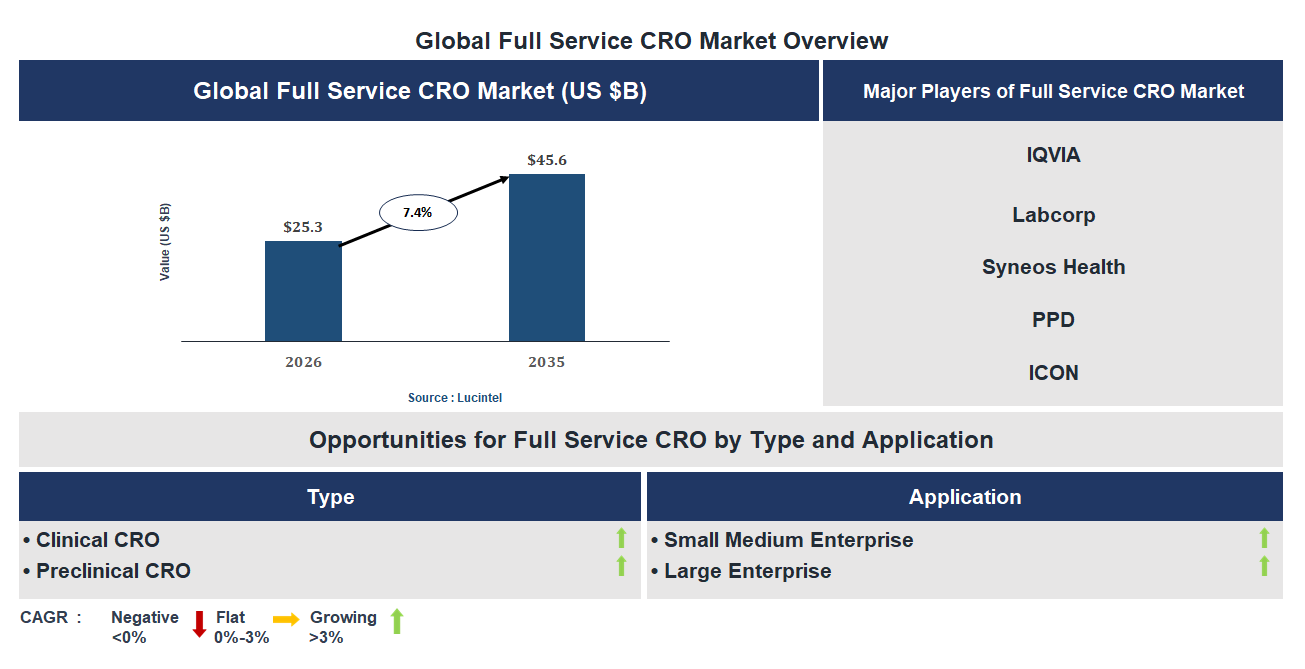
The future of the global full service CRO market looks promising with opportunities in the small medium enterprise and large enterprise markets. The global full service CRO market is expected to reach an estimated $45.6 billion by 2035 with a CAGR of 7.4% from 2026 to 2035. The major drivers for this market are the rising strategic collaborations between sponsors & CRO providers, the increasing adoption of clinical trial complexity, and the growing demand for cost efficient drug development solutions.• Lucintel forecasts that, within the type category, clinical CRO is expected to witness higher growth over the forecast period.
• Within the application category, large enterprise is expected to witness higher growth.
• In terms of region, APAC is expected to witness the highest growth over the forecast period. Gain valuable insights for your business decisions with our comprehensive 150+ page report. Sample figures with some insights are shown below.
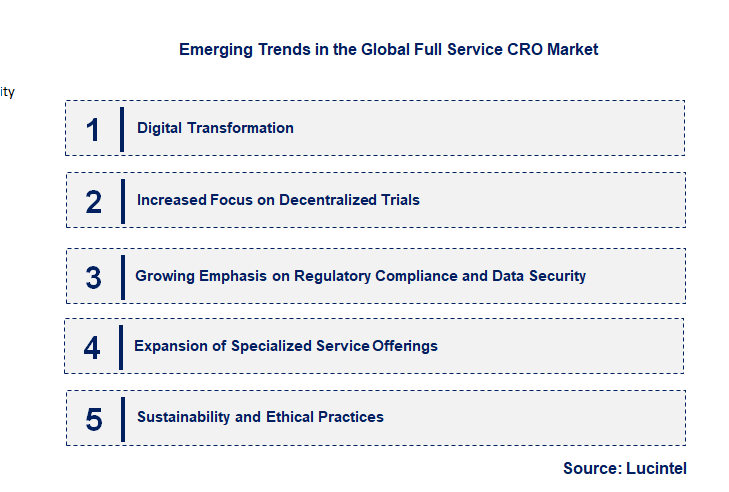
Emerging Trends in the Full Service CRO Market
The full service CRO market is experiencing rapid transformation driven by technological advancements, evolving client needs, and regulatory changes. As the pharmaceutical, biotech, and healthcare sectors seek more efficient, cost-effective, and innovative solutions, CROs are adapting to meet these demands. Emerging trends are shaping the competitive landscape, influencing service offerings, and redefining industry standards. These developments are not only enhancing operational efficiencies but also enabling faster drug development and approval processes. Understanding these key trends is essential for stakeholders aiming to stay ahead in this dynamic market environment.• Digital Transformation: The adoption of artificial intelligence, machine learning, and big data analytics is revolutionizing how CROs conduct research, manage data, and optimize trial processes. These technologies enable faster patient recruitment, real-time data analysis, and predictive modeling, reducing costs and timelines. Digital tools improve accuracy, compliance, and decision-making, making clinical trials more efficient and adaptable to complex research needs. This trend is expected to continue expanding, further streamlining drug development workflows and enhancing data-driven insights.
• Increased Focus on Decentralized Trials: The shift towards decentralized or virtual clinical trials is driven by the need for greater patient convenience, broader geographic reach, and cost savings. Technologies such as telemedicine, wearable devices, and mobile health apps facilitate remote monitoring and data collection. This approach reduces site visits, accelerates recruitment, and improves patient retention. As regulatory bodies adapt to these models, CROs are investing in infrastructure and expertise to support decentralized trials, making clinical research more accessible and patient-centric.
• Growing Emphasis on Regulatory Compliance and Data Security: With increasing regulatory scrutiny and data privacy concerns, CROs are prioritizing compliance with global standards such as GDPR, HIPAA, and ICH-GCP. Implementing robust data security protocols and audit trails is critical to protect sensitive patient information and ensure trial integrity. This trend drives innovation in secure data management systems and fosters trust among sponsors, regulators, and patients. Staying ahead in compliance is vital for CROs to avoid penalties and maintain market credibility.
• Expansion of Specialized Service Offerings: CROs are diversifying their service portfolios to include specialized areas such as rare diseases, biologics, and personalized medicine. They are also offering integrated solutions that cover end-to-end drug development, from preclinical to post-marketing. This expansion allows CROs to cater to complex research needs, provide tailored solutions, and foster long-term partnerships. The trend reflects a move towards more comprehensive, flexible, and expert-driven services that meet the evolving landscape of pharmaceutical innovation.
• Sustainability and Ethical Practices: The market is witnessing a growing emphasis on sustainable practices, including eco-friendly trial operations and reduced carbon footprints. CROs are adopting green logistics, digital documentation, and energy-efficient facilities. Additionally, there is a focus on patient-centric approaches, ensuring trials are accessible, inclusive, and ethically conducted. These initiatives enhance corporate responsibility, improve stakeholder trust, and align with global sustainability goals, positioning CROs as responsible partners in the drug development ecosystem. These emerging trends are fundamentally reshaping the full service CRO market by fostering innovation, enhancing efficiency, and emphasizing compliance and sustainability. They are enabling faster, more patient-friendly, and ethically responsible clinical trials, ultimately accelerating the development of new therapies and improving healthcare outcomes worldwide.
Recent Development in the Full Service CRO Market
The full service CRO market is experiencing rapid evolution driven by technological advancements, increasing demand for efficient clinical trials, and a shift towards integrated healthcare solutions. These developments are reshaping the landscape, offering new opportunities for growth and innovation. Stakeholders are focusing on expanding capabilities, adopting digital tools, and enhancing patient engagement to stay competitive. The following key developments highlight the current trajectory and future potential of this dynamic industry.• Expansion of Digital Technologies: Integration of AI and data analytics is transforming clinical trial processes, enabling faster data collection, improved accuracy, and predictive insights. This technological shift reduces trial timelines and costs, attracting more sponsors. Digital tools also facilitate remote monitoring and virtual trials, broadening participant reach. Overall, this enhances efficiency, accelerates drug development, and increases market competitiveness.
• Growing Focus on Patient-Centric Approaches: Emphasizing patient engagement and experience is becoming central to clinical research. CROs are adopting mobile apps, telemedicine, and personalized communication to improve recruitment, retention, and compliance. This approach leads to higher quality data and faster trial completion. It also aligns with regulatory trends favoring patient-focused methodologies, ultimately expanding market opportunities and fostering trust among stakeholders.
• Strategic Mergers and Acquisitions: The industry is witnessing increased consolidation through mergers and acquisitions, aimed at expanding service portfolios and geographic reach. Larger CROs acquire specialized firms to offer comprehensive solutions, enhance technological capabilities, and improve operational efficiencies. This trend results in a more competitive landscape, better resource allocation, and increased capacity to handle complex trials, thereby driving overall market growth and innovation.
• Emphasis on Regulatory Compliance and Quality Standards: Stringent regulatory requirements are prompting CROs to enhance quality assurance processes. Investments in compliance infrastructure, staff training, and quality management systems are rising. This focus ensures trial integrity, reduces delays, and mitigates risks of non-compliance penalties. Strengthening regulatory adherence boosts client confidence, attracts global sponsors, and sustains market credibility, fostering long-term growth in the CRO sector.
• Adoption of Sustainable and Ethical Practices: Environmental and ethical considerations are gaining prominence, with CROs implementing eco-friendly operations and transparent practices. This includes reducing carbon footprints, ethical data handling, and promoting diversity in trials. Such initiatives improve corporate reputation, meet stakeholder expectations, and align with global sustainability goals. Embracing sustainability not only enhances brand value but also opens new avenues for market differentiation and investor interest. These developments are significantly transforming the full service CRO market by enhancing operational efficiency, expanding service offerings, and aligning with evolving regulatory and societal expectations. The integration of digital tools, patient-centric strategies, strategic consolidations, compliance focus, and sustainability initiatives collectively drives growth, competitiveness, and innovation. As a result, the market is poised for sustained expansion, attracting new investments and fostering a more dynamic, efficient, and responsible clinical research ecosystem.
Strategic Growth Opportunities in the Full Service CRO Market
The full service CRO market is experiencing rapid expansion driven by increasing demand for outsourced research services across pharmaceuticals, biotechnology, and medical device industries. Technological advancements, regulatory complexities, and the need for cost-effective solutions are fueling growth opportunities. CROs are evolving to offer comprehensive, integrated services that streamline drug development processes, reduce time-to-market, and enhance research quality. This dynamic environment presents numerous strategic opportunities for market players to innovate, expand, and capture new customer segments.• Expansion into Emerging Markets: The growth of healthcare infrastructure and increasing R&D investments in regions like Asia-Pacific and Latin America create significant opportunities for CROs to establish local operations. These markets offer cost advantages, access to diverse patient populations, and less saturated competition, enabling CROs to expand their global footprint. Tailoring services to regional regulatory requirements and building local partnerships will be crucial for success in these emerging markets.
• Adoption of Digital Technologies for Enhanced Service Offerings: Integrating AI, machine learning, and data analytics into clinical trial processes can improve efficiency, accuracy, and decision-making. Digital tools enable real-time monitoring, predictive analytics, and automation, reducing trial durations and costs. CROs adopting these technologies can differentiate themselves by offering faster, more reliable services, attracting clients seeking innovative solutions. Embracing digital transformation is essential for staying competitive in a rapidly evolving market landscape.
• Increasing Demand for Specialized Clinical Trial Services: As therapies become more complex, there is a rising need for specialized services such as rare disease trials, gene therapy, and personalized medicine. CROs that develop expertise in these niche areas can command premium pricing and establish long-term client relationships. Investing in specialized staff, infrastructure, and regulatory knowledge will position CROs as leaders in high-growth, high-margin segments of the market.
• Strategic Collaborations and Partnerships: Forming alliances with pharmaceutical companies, biotech firms, and technology providers can enhance service offerings and market reach. Collaborations facilitate access to novel compounds, innovative technologies, and new markets. Strategic partnerships also enable resource sharing, risk mitigation, and accelerated development timelines. Building a robust network of alliances will be vital for CROs aiming to expand their capabilities and maintain a competitive advantage.
• Focus on Sustainability and Regulatory Compliance: Increasing emphasis on environmental, social, and governance (ESG) factors influences CRO operations. Implementing sustainable practices, reducing carbon footprints, and ensuring compliance with evolving regulations can attract clients prioritizing corporate responsibility. Demonstrating commitment to sustainability and compliance enhances reputation, builds trust, and opens doors to new business opportunities in a competitive landscape. The overall impact of these growth opportunities will significantly shape the future of the full-service CRO market, fostering innovation, expanding global reach, and improving service quality. Companies that strategically leverage these opportunities can achieve sustained growth, strengthen their market position, and better meet the evolving needs of the healthcare and life sciences industries.
Full Service CRO Market Driver and Challenges
The full service CRO market is influenced by a complex interplay of technological advancements, economic conditions, and regulatory frameworks. As the pharmaceutical and biotech industries evolve, the demand for comprehensive research services grows, driven by the need for efficient drug development and regulatory compliance. Technological innovations such as AI and data analytics are transforming research methodologies, while economic factors like rising R&D costs and global market expansion influence growth trajectories. Additionally, stringent regulatory requirements across different regions shape operational strategies. Navigating these multifaceted drivers and overcoming associated challenges is crucial for market players aiming to sustain competitive advantage and meet industry demands effectively. The factors responsible for driving the full service CRO market include:• Technological Innovation: The integration of advanced technologies such as artificial intelligence, machine learning, and data analytics enhances research efficiency, accuracy, and speed. These innovations enable CROs to deliver more precise results, streamline trial processes, and reduce costs, making them more attractive to pharmaceutical companies. As technology continues to evolve, CROs that adopt these tools can offer differentiated services, improve patient recruitment, and optimize trial management, thereby fueling market growth.
• Increasing R&D Expenditure: The rising costs associated with drug discovery and development compel pharmaceutical companies to outsource research activities to CROs. This trend is driven by the need to reduce time-to-market and manage complex clinical trials efficiently. As R&D budgets expand globally, especially in emerging markets, the demand for comprehensive CRO services increases, supporting market expansion and diversification of service offerings.
• Regulatory Complexity and Compliance: The evolving regulatory landscape, with stringent guidelines from agencies like the FDA, EMA, and other regional authorities, necessitates specialized expertise. CROs that can navigate these complex regulatory environments provide valuable support to sponsors, ensuring compliance and smooth approval processes. This demand for regulatory expertise drives the growth of full-service CROs capable of managing multi-regional trials and compliance requirements.
• Growing Biotech and Pharmaceutical Sectors: The rapid growth of biotech firms and pharmaceutical companies, especially in emerging markets, fuels demand for outsourced research services. These companies often lack in-house capabilities for extensive clinical trials, making CROs essential partners. The expanding pipeline of innovative therapies and personalized medicine further boosts the need for specialized research services, contributing significantly to market growth.
• Strategic Collaborations and Mergers: The increasing trend of partnerships, alliances, and mergers among CROs and pharmaceutical companies enhances service capabilities and market reach. These collaborations facilitate access to new markets, advanced technologies, and broader expertise, enabling CROs to offer comprehensive solutions. Such strategic moves strengthen market positioning and accelerate growth, especially in competitive landscapes. The challenges facing the market include:
• Regulatory Uncertainty: The constantly changing regulatory environment across different regions poses significant challenges for CROs. Navigating diverse compliance standards, documentation requirements, and approval processes can delay trials and increase costs. Uncertainty regarding future regulations also complicates planning and resource allocation, potentially impacting project timelines and profitability.
• High Operational Costs: Running full-service CRO operations involves substantial investments in infrastructure, technology, and skilled personnel. Maintaining compliance with evolving standards and managing complex clinical trials require significant financial resources. These high operational costs can limit profitability, especially for smaller CROs, and may hinder market entry or expansion efforts.
• Data Security and Privacy Concerns: With increasing reliance on digital data collection and management, CROs face heightened risks related to data breaches and privacy violations. Ensuring compliance with data protection regulations like GDPR and HIPAA demands robust cybersecurity measures. Data security issues can lead to legal liabilities, loss of client trust, and reputational damage, posing ongoing challenges for market participants. The full service CRO market is driven by technological advancements, rising R&D investments, regulatory complexities, sector growth, and strategic collaborations. However, it faces challenges such as regulatory uncertainty, high operational costs, and data security concerns. These factors collectively shape the market landscape, influencing growth opportunities and operational strategies. While technological and industry growth prospects remain strong, addressing regulatory and security challenges is essential for sustained success and competitive advantage in this dynamic market environment.
List of Full Service CRO Companies
Companies in the market compete on the basis of product quality offered. Major players in this market focus on expanding their manufacturing facilities, R&D investments, infrastructural development, and leverage integration opportunities across the value chain. With these strategies full service CRO companies cater increasing demand, ensure competitive effectiveness, develop innovative products & technologies, reduce production costs, and expand their customer base. Some of the full service CRO companies profiled in this report include-• IQVIA
• Labcorp
• Syneos Health
• PPD
• ICON
• PRA
• Parexel
• Medpace
• Wuxi Apptec
• EPS International
Full Service CRO Market by Segment
The study includes a forecast for the global full service CRO market by type, application, and region.Full Service CRO Market by Type [Value from 2019 to 2035]:
• Clinical CRO
• Preclinical CRO
Full Service CRO Market by Application [Value from 2019 to 2035]:
• Small Medium Enterprise
• Large Enterprise
Full Service CRO Market by Region [Value from 2019 to 2035]:
• North America
• Europe
• Asia Pacific
• The Rest of the World
Country Wise Outlook for the Full Service CRO Market
The full service CRO market has experienced significant growth driven by increasing demand for outsourced clinical trials, technological advancements, and evolving regulatory landscapes. Countries are adopting innovative strategies to enhance research efficiency, reduce costs, and accelerate drug development timelines. The competitive landscape is also shifting with new entrants and collaborations, reflecting a dynamic global environment. These developments are shaping the future of clinical research, with each country leveraging its unique strengths to influence the market trajectory.• United States: The US remains a leader in the CRO market, with increased investments in digital health and AI-driven data analytics. Major CROs are expanding their service portfolios to include personalized medicine and real-world evidence studies. Regulatory agencies are streamlining approval processes, encouraging faster clinical trial approvals. The adoption of decentralized trials is gaining momentum, improving patient recruitment and retention. Additionally, collaborations between biotech firms and CROs are on the rise, fostering innovation and expanding market reach.
• China: China’s CRO market is rapidly expanding, driven by government initiatives to boost biotech innovation and clinical research capabilities. The country is witnessing a surge in domestic CROs offering comprehensive services, supported by investments in infrastructure and technology. Regulatory reforms have simplified trial approval processes, attracting international pharmaceutical companies. The integration of AI and big data analytics is enhancing trial efficiency. China is also focusing on developing expertise in rare diseases and personalized medicine, positioning itself as a key player in the global CRO landscape.
• Germany: Germany’s CRO market benefits from its strong pharmaceutical and biotech sectors, with a focus on high-quality, compliant research services. Recent developments include increased adoption of digital tools and e-clinical solutions to streamline trials. The country is emphasizing sustainable and patient-centric research models, aligning with EU regulations. Collaborations between academia and industry are fostering innovation in clinical methodologies. Germany is also investing in training and workforce development to meet the growing demand for specialized clinical research professionals.
• India: India’s CRO market is experiencing rapid growth, fueled by a large patient pool and cost advantages. Recent developments include the establishment of new clinical research centers and increased regulatory clarity. The government’s initiatives to promote clinical research and the entry of global CROs are expanding service offerings. India is also focusing on building expertise in complex therapeutic areas like oncology and neurology. The adoption of electronic data capture and other digital tools is improving trial efficiency. The country aims to become a preferred destination for global clinical trials.
• Japan: Japan’s CRO market is evolving with a focus on advanced technology integration and personalized medicine. Recent developments include increased use of AI and machine learning to optimize trial design and data analysis. Regulatory agencies are adopting more flexible approval pathways to accelerate drug development. Japan is also emphasizing patient-centric approaches and real-world evidence to support clinical decisions. Collaborations between Japanese CROs and international partners are growing, enhancing global competitiveness. Investments in workforce training and digital infrastructure are further strengthening Japan’s position in the global CRO market.

Features of the Global Full Service CRO Market
Market Size Estimates: Full service CRO market size estimation in terms of value ($B). Trend and Forecast Analysis: Market trends (2019 to 2025) and forecast (2026 to 2035) by various segments and regions. Segmentation Analysis: Full service CRO market size by type, application, and region in terms of value ($B). Regional Analysis: Full service CRO market breakdown by North America, Europe, Asia Pacific, and Rest of the World. Growth Opportunities: Analysis of growth opportunities in different types, applications, and regions for the full service CRO market. Strategic Analysis: This includes M&A, new product development, and competitive landscape of the full service CRO market. Analysis of competitive intensity of the industry based on Porter’s Five Forces model.
FAQ
Q1. What is the market size and growth forecast for full service CRO market? Answer: The global full service CRO market is expected to reach an estimated $45.6 billion by 2035 and grow with a CAGR of 7.4% from 2026 to 2035. Q2. What are the major drivers influencing the growth of the full service CRO market? Answer: The major drivers for this market are the rising strategic collaborations between sponsors & CRO providers, the increasing adoption of clinical trial complexity, and the growing demand for cost efficient drug development solutions. Q3. What are the major segments for full service CRO market? Answer: The future of the full service CRO market looks promising with opportunities in the small medium enterprise and large enterprise markets. Q4. Who are the key full service CRO market companies? Answer: Some of the key full service CRO companies are as follows:• IQVIA
• Labcorp
• Syneos Health
• PPD
• ICON
• PRA
• Parexel
• Medpace
• Wuxi Apptec
• EPS International Q5. Which full service CRO market segment will be the largest in future? Answer: Lucintel forecasts that, within the type category, clinical CRO is expected to witness higher growth over the forecast period. Q6. In full service CRO market, which region is expected to be the largest in next 5 years? Answer: In terms of region, APAC is expected to witness the highest growth over the forecast period. Q7. Do we receive customization in this report? Answer: Yes, Lucintel provides 10% customization without any additional cost.
Table of Contents
List of Figures
List of Tables
Methodology
- In-depth interviews of the major players in this market
- Detailed secondary research from competitors’ financial statements and published data
- Extensive searches of published works, market, and database information pertaining to industry news, company press releases, and customer intentions
- A compilation of the experiences, judgments, and insights of Lucintel’s professionals, who have analyzed and tracked this market over the years.


Buy Now
Choose a license that fits your team. Instant PDF delivery.
Prices exclude taxes. Instant delivery. Custom licensing available on request.
Key Questions
- • What are some of the most promising, high-growth opportunities for the full service CRO market by type (Clinical CRO and Preclinical CRO), application (small medium enterprise and large enterprise), and region (North America, Europe, Asia Pacific, and the Rest of the World)?
- • Which segments will grow at a faster pace and why?
- • Which region will grow at a faster pace and why?
- • What are the key factors affecting market dynamics? What are the key challenges and business risks in this market?
- • What are the business risks and competitive threats in this market?
- • What are the emerging trends in this market and the reasons behind them?
- • What are some of the changing demands of customers in the market?
- • What are the new developments in the market? Which companies are leading these developments?
- • Who are the major players in this market? What strategic initiatives are key players pursuing for business growth?
- • What are some of the competing products in this market and how big of a threat do they pose for loss of market share by material or product substitution?
- • What M&A activity has occurred in the last 7 years and what has its impact been on the industry? For any questions related to Full Service CRO Market, Full Service CRO Market Size, Full Service CRO Market Growth, Full Service CRO Market Analysis, Full Service CRO Market Report, Full Service CRO Market Share, Full Service CRO Market Trends, Full Service CRO Market Forecast, Full Service CRO Companies, write Lucintel analyst at email: helpdesk@lucintel.com. We will be glad to get back to you soon.


