
Market Report · July 22, 2026

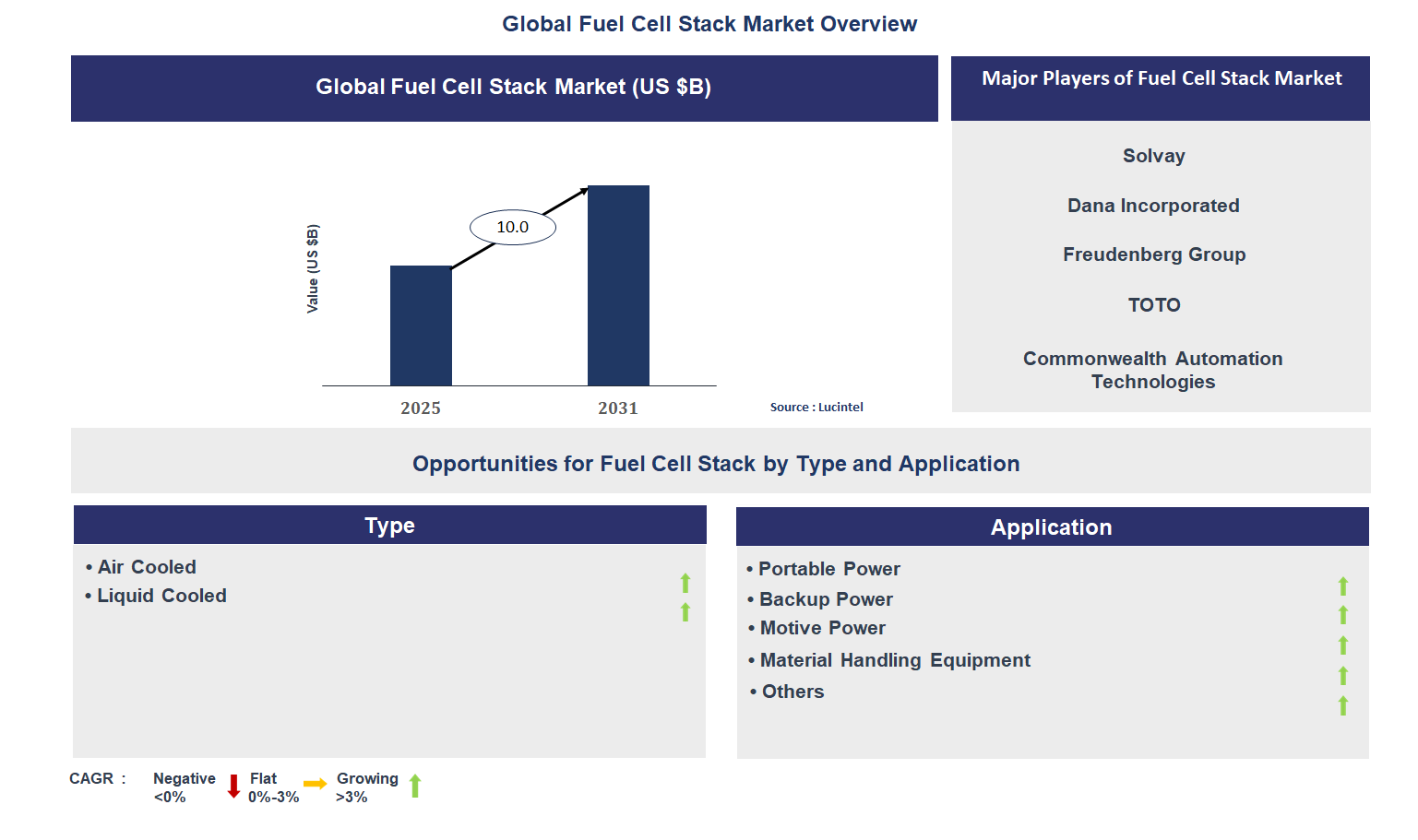
Key data points: The growth forecast = 10% annually for the next 7 years. Scroll below to get more insights. This market report covers trends, opportunities and forecasts in fuel cell stack market to 2031 by type (air cooled and liquid cooled), application (portable power, backup power, motive power, material handling equipment, and others), and region (North America, Europe, Asia Pacific, and the Rest of the World)
We'll send your sample report shortly.
• Lucintel forecasts that, within the type category, liquid cooled is expected to witness higher growth over the forecast period.
• Within the application category, motive power is expected to witness the highest growth.
• In terms of region, APAC is expected to witness the highest growth over the forecast period. Gain valuable insights for your business decisions with our comprehensive 150+ page report. Sample figures with some insights are shown below.
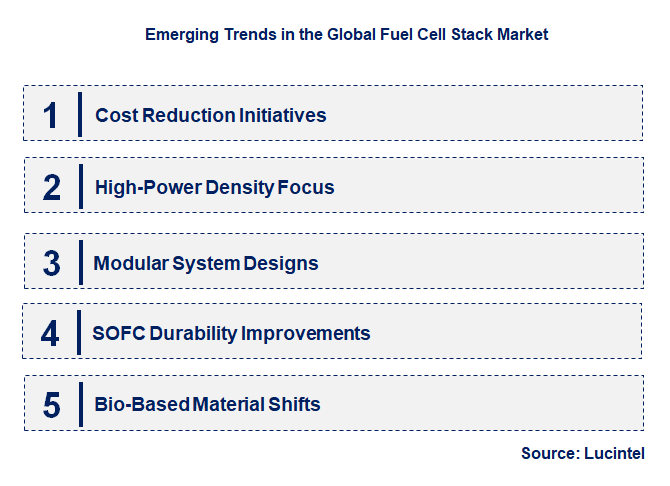
• Cost Reduction Initiatives: Platinum alternatives and scalable manufacturing lower stack prices, targeting competitiveness with batteries. Economies of scale in Asia drive localization. Impact democratizes access, accelerates FCEV adoption, and unlocks industrial uses, easing financial barriers for global transitions.
• High-Power Density Focus: Enhanced catalysts and bipolar plates boost output per volume, suiting heavy-duty vehicles. Trials show twenty percent gains in efficiency. This trend elevates range, reduces system size, and supports maritime apps, transforming long-haul logistics.
• Modular System Designs: Plug-and-play stacks enable flexible integrations in microgrids and fleets. Partnerships like Hyundai-Gore optimize PEMs. Impact speeds deployments, cuts customization costs, and fosters hybrids with renewables, broadening off-grid viability.
• SOFC Durability Improvements: High-temperature operations extend life for stationary power, using biogas feeds. Italian cogeneration pilots validate reliability. This expands backup roles, integrates waste heat, and aligns with circular economies for sustained outputs.
• Bio-Based Material Shifts: Renewable composites replace metals, improving recyclability and reducing toxicity. EU standards promote adoption in aviation. Impact lowers environmental impacts, meets ESG criteria, and attracts investments, reshaping supply chains sustainably. These trends reshape the fuel cell stack market by prioritizing affordability and versatility, evolving from niche to mainstream power sources. They bridge infrastructure gaps, amplify automotive dominance, and embed hydrogen in diverse sectors, driving equitable clean energy proliferation.
• Hyzon MEA Facility Launch: Largest U.S. production site enables components for twelve thousand trucks annually, scaling PEM tech. Impact boosts heavy-duty zero-emission fleets, cuts imports, and exemplifies domestic manufacturing synergies.
• Sino-Synergy High-Power Stack: World‘s top output module for commercial vehicles surpasses rivals in efficiency. Rolled out for heavy transport. This elevates China‘s ecosystem, reduces foreign dependencies, and accelerates regional decarbonization.
• EKPO Aircraft Supply: Stacks power inaugural non-stop hydrogen flight, covering vast distances emission-free. Integrated in aviation trials. Impact pioneers aerial sustainability, spurs R&D, and sets benchmarks for green propulsion.
• Thermax-Ceres SOEC Pact: India scales electrolysis stacks for green hydrogen, licensing global tech locally. Targets industrial production. This fosters self-sufficiency, supports missions, and integrates renewables into power grids.
• Nimbus-Toshiba Pure Hydrogen: Next-gen stack development enhances efficiency for diverse apps. Focuses on modular scalability. Impact strengthens Japan‘s hydrogen strategy, optimizes CHP systems, and expands functional integrations. These developments impact the fuel cell stack market by scaling capacities and innovating apps. They drive efficiencies, compliance, and partnerships, transforming hydrogen into viable, widespread clean energy.
• Automotive FCEV Propulsion: High-density stacks suit passenger and commercial vehicles, backed by refueling expansions. OEM pilots accelerate. Impact extends ranges, complies with ZEV rules, and captures premium mobility markets.
• Heavy-Duty Trucking Fleets: Durable modules power long-haul logistics, reducing diesel reliance. Corridor developments aid. This boosts freight efficiencies, lowers emissions, and taps subsidies for industrial shifts.
• Stationary Backup Power: SOFC integrations ensure grid resilience for data centers and utilities. Biogas compatibility fits. Impact minimizes outages, supports microgrids, and attracts ESG funding for reliable operations.
• Marine Propulsion Systems: Compact stacks decarbonize shipping, meeting IMO norms via bunkering. Trials in ports expand. This creates blue corridors, enhances trade sustainability, and diversifies naval applications.
• Portable Energy Solutions: Lightweight designs power telecom and events, with quick refuels. Emerging mobile units grow. Impact enables off-grid access, fosters rural electrification, and integrates with renewables. These opportunities impact the fuel cell stack market by embedding versatility across sectors. They spur investments, tech synergies, and policy alignments, propelling scalable, low-carbon advancements globally.
• Solvay
• Dana Incorporated
• Freudenberg Group
• TOTO
• Commonwealth Automation Technologies
• Robert Bosch
• Horizon Fuel Cell Technologies
• Ballard Power Systems
• Nedstack
• ElringKlinger
• Air Cooled
• Liquid Cooled
• Portable Power
• Backup Power
• Motive Power
• Material Handling Equipment
• Others
• North America
• Europe
• Asia Pacific
• The Rest of the World
• United States: Honda‘s CR-V e:FCEV production launch in Ohio integrates advanced stacks for zero-emission driving, while Hyzon Motors established a major membrane electrode assembly facility for heavy-duty trucks. Pennsylvania research cuts platinum costs via chip-like methods. These advancements boost FCEV affordability, support data center backups, and align with Inflation Reduction Act incentives for resilient energy.
• China: Sino-Synergy unveiled the world‘s highest-power stack, surpassing competitors in output for commercial vehicles, while Bosch acquired IP rights for localized adaptations. Fuel system prices dropped significantly, enabling heavy-duty transport pilots. This fosters self-reliance, scales manufacturing, and integrates with dual-carbon goals, enhancing regional hydrogen ecosystems.
• Germany: Schaeffler‘s LOI with Lhyfe deploys PEM electrolyzers in a major green hydrogen plant, while EKPO supplies stacks for the first non-stop hydrogen aircraft. Symbio‘s H2Motive roadmap targets mass production of versatile modules. These efforts comply with EU directives, advance aviation decarbonization, and optimize industrial power for net-zero transitions.
• India: Thermax-Ceres partnership scales SOEC stack manufacturing for green hydrogen, while DST pilots fuel cells for telecom towers. Log9 and h2e develop grid-independent SOFC solutions for distributed power. This addresses diesel dependency, supports rural electrification, and leverages national hydrogen missions for economic and clean energy growth.
• Japan: Nimbus-Toshiba joint development creates next-gen pure hydrogen stacks, while Toyota‘s 50kW module suits diverse machinery. Maruha Nichiro enriches capsules for aging support, aligning with FCV targets. These innovations ensure seismic resilience, expand functional foods, and bolster hydrogen society goals through efficient, modular designs.


• Solvay
• Dana Incorporated
• Freudenberg Group
• TOTO
• Commonwealth Automation Technologies
• Robert Bosch
• Horizon Fuel Cell Technologies
• Ballard Power Systems
• Nedstack
• ElringKlinger Q5. Which fuel cell stack market segment will be the largest in future? Answer: Lucintel forecasts that, within the type category, liquid cooled is expected to witness higher growth over the forecast period. Q6. In fuel cell stack market, which region is expected to be the largest in next 5 years? Answer: In terms of region, APAC is expected to witness the highest growth over the forecast period. Q7. Do we receive customization in this report? Answer: Yes, Lucintel provides 10% customization without any additional cost.


Choose a license that fits your team. Instant PDF delivery.
Prices exclude taxes. Instant delivery. Custom licensing available on request.
Market Report · July 22, 2026
Market Report · July 22, 2026
Market Report · July 17, 2026
Trusted partner for strategic intelligence and business growth


Receive a complimentary market analysis tailored to your industry. Our analysts will identify key growth opportunities and competitive dynamics specific to your business.

Market size, growth rate, and key trend analysis for your specific sector.

Top competitor positioning and market share analysis.

Strategic recommendations backed by data-driven insights.
Get curated market intelligence and competitive moves straight to your inbox.
By subscribing, you agree to receive our monthly insights. Unsubscribe anytime.
Receive a complimentary market analysis tailored to your industry. Our analysts will identify key growth opportunities and competitive dynamics specific to your business.
Market size, growth rate, and key trend analysis for your specific sector.
Top competitor positioning and market share analysis.
Strategic recommendations backed by data-driven insights.
Get curated market intelligence, emerging trends, and competitive moves straight to your inbox each month.
By subscribing, you agree to receive our monthly insights. Unsubscribe anytime.
We'll send your sample report shortly.