
Report Feature
Friction Modifier Market Trends and Forecast
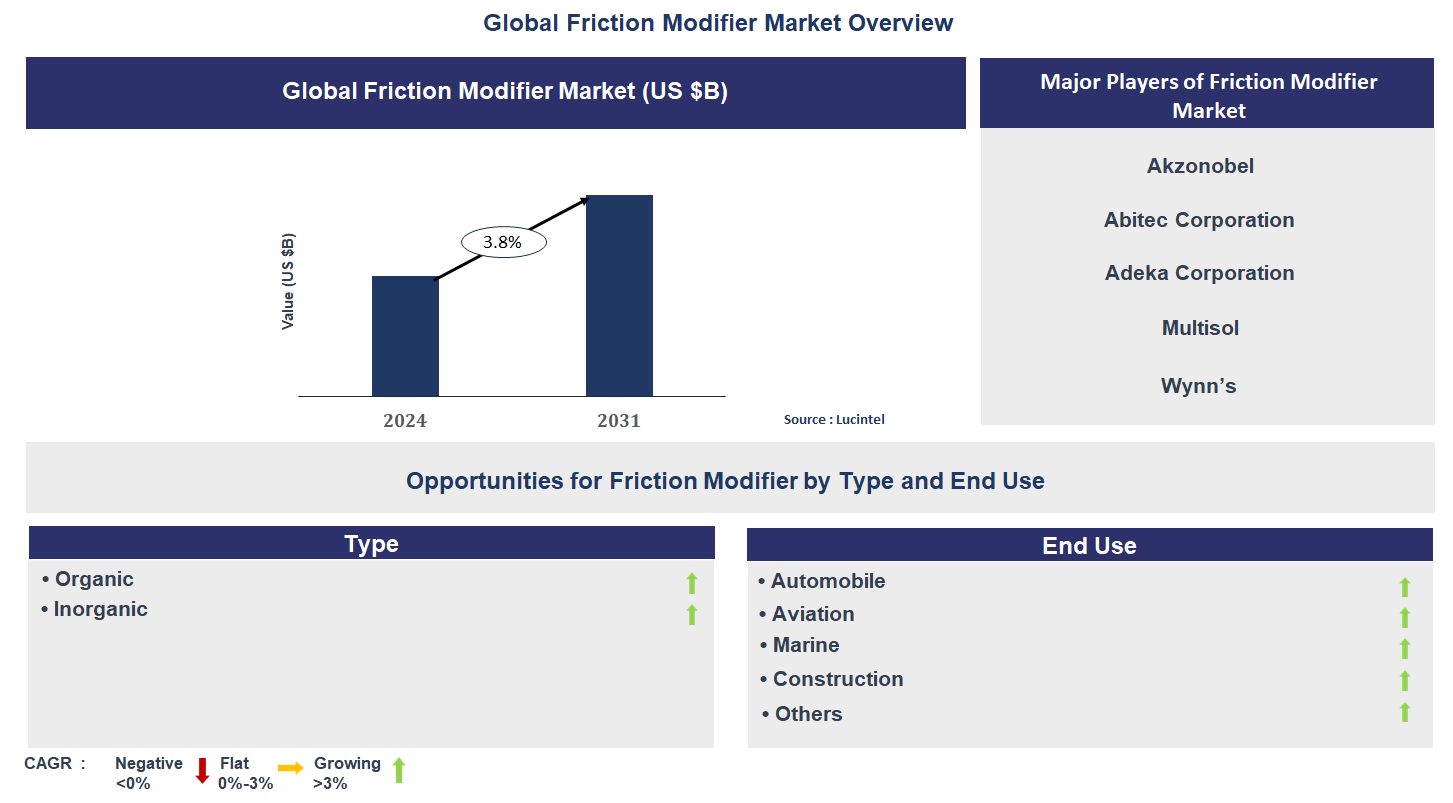
The future of the global friction modifier market looks promising with opportunities in the automobile, aviation, marine, and construction markets. The global friction modifier market is expected to grow with a CAGR of 3.8% from 2025 to 2031. The major drivers for this market are the increasing demand for automotive lubricants, the rising need for fuel efficiency standards, and the growing adoption in industrial applications.• Lucintel forecasts that, within the type category, organic is expected to witness higher growth over the forecast period.
• Within the end use category, automobile is expected to witness the highest growth.
• In terms of region, APAC is expected to witness the highest growth over the forecast period. Gain valuable insights for your business decisions with our comprehensive 150+ page report. Sample figures with some insights are shown below.
Emerging Trends in the Friction Modifier Market
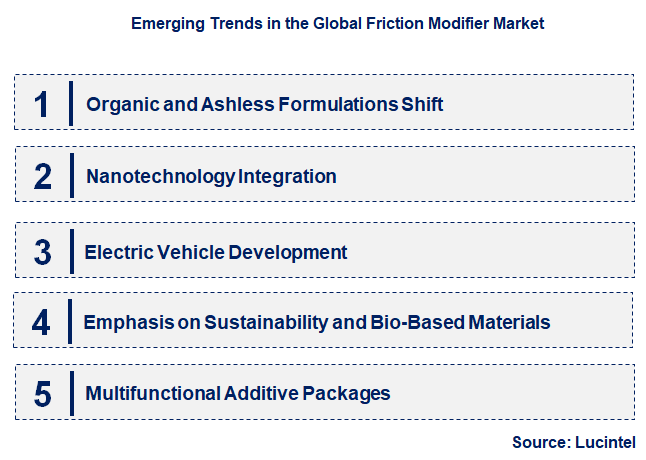
The friction modifier market is undergoing a steady process of innovation, responding to the needs of an era requiring more energy efficiency and sustainability. These emerging trends are remodeling the industry by transcending traditional additive chemistries to adopt new materials, formulations, and applications. The market is propelled by a requirement to not only minimize friction but also increase equipment life, lower emissions, and comply with increasingly stringent environmental legislation.• Organic and Ashless Formulations Shift: Usage of organic and ashless friction modifiers over conventional inorganic compounds is a strong trend. This is largely due to tighter environmental legislation, especially in the automobile sector, where ash poses damage to emission control components such as diesel particulate filters. Organic friction modifiers, usually sourced from fatty acids and esters, are regarded as a greener and cleaner option. This is driving manufacturers to create high-performance organic chemicals with similar, if not superior, anti-friction qualities to their inorganic equivalents.
• Nanotechnology Integration: The integration of nanotechnology is a new trend in the friction modifier industry. Nanoparticles of material such as graphene, molybdenum disulfide, and boron nitride are being integrated into lubricants to deliver improved friction reduction and wear protection. Such small particles can seal microscopic gaps and create a protective coating on metal surfaces, drastically minimizing contact friction. This trend is creating new markets for high-performance lubricants in challenging applications such as aerospace and premium automotive engines.
• Electric Vehicle Development: The electric vehicle movement is driving a new and significant trend in the market. Although EVs lack a traditional internal combustion engine, they do need specialized transmission, bearing, and electric motor system lubricants. These e-fluids must offer not only friction modification but also electrical insulation and thermal management. This is leading to a new generation of research and development of friction modifiers designed to deliver the special needs of EV powertrains.
• Emphasis on Sustainability and Bio-Based Materials: Sustainability is a prominent trend in the market. Purchasers and industries are now seeking products with reduced environmental footprint. This has generated interest in creating bio-based friction modifiers from renewable feedstocks such as vegetable oils. These bio-based modifiers are biodegradable and less toxic than those based on petroleum. This trend is forcing producers to reformulate products to green standards, which also falls in line with larger corporate social responsibility objectives.
• Multifunctional Additive Packages: There is a move in the market towards creating multifunctional additive packages. Rather than introducing a single friction modifier, manufacturers are formulating complex products containing a variety of additives to deliver a set of benefits. The packages can have the capability to deliver friction reduction, anti-wear, corrosion protection, and thermal stability at the same time. These trends are inherently transforming the friction modifier market into a more technologically driven, eco-friendly, and application-focused industry. The attention is no longer merely on friction reduction but on developing comprehensive solutions that cater to intricate issues such as fuel efficiency, environmental regulations, and the specific requirements of next-generation automobiles. Players that manage to adapt to these trends will be strongly poised to dominate the market in the years to come.
Recent Development in the Friction Modifier Market
The friction modifier market is in a process of dynamic evolution, fueled by an international drive towards more energy-efficient products and reduced emissions. These trends are as much about new products as they are about a complete revolution in the way additives are designed, manufactured, and used. The industry is adapting to a world that expects more from its lubricants—more performance, less environmental footprint, and compatibility with emerging technologies.• Breakthroughs in Nanotechnology-Based Formulations: One such development is the employment of nanotechnology in the formulation of next-generation friction modifiers. Manufacturers are adding nanoparticles of substances such as graphene, molybdenum disulfide, and boron nitride to lubricant formulations. The particles are exceptionally good at minimizing friction and wear at the microscopic level. The innovation is enabling the production of lubricants with better performance properties, especially in high-stress uses such as car engines and industrial equipment, where conventional additives do not perform as well.
• Trend Towards Organic and Biodegradable Products: There has been a major move towards organic and biodegradable friction modifiers. Compelled by stringent environmental laws and consumer pressure for "green" products, manufacturers are now employing plant-derived or synthetic organic chemicals such as fatty acids and esters. This trend is most significant for lubricants utilized in environmentally sensitive applications, like marine and agricultural uses.
• e-Fluids for Electric Vehicles: One of the biggest recent innovations is the development of electric vehicle specific lubricants, also referred to as e-fluids. Friction modifiers are important in these fluids but are also required to be compatible with emerging demands, including electrical conductivity, thermal management, and material compatibility with electric motors. This evolution is creating a new and highly profitable market segment and is compelling lubricant and additive companies to invest substantially in research and development to produce products that satisfy these demanding and complex performance requirements.
• Multifunctional Additive Packages with Integration of Additives: The industry is witnessing a trend towards multifunctional additive packages. Rather than providing separate additives, firms are presently providing one package that contains a friction modifier in addition to other elements such as anti-wear, antioxidant, and corrosion inhibitors. This trend streamlines the formulation process of lubricant blenders and provides a balanced final product.
• Strategic Partnerships Among OEMs and Additives: There has been a significant shift in strategic partnerships among car OEMs and additive producers. It is caused by the demand for creating bespoke lubricant solutions for emerging vehicle platforms, especially those having new engine technologies and novel transmission systems. These partnerships enable a more efficient development process and make sure that the lubricants and additives are completely optimized for the hardware of the vehicle. These advancements are significantly altering the friction modifier market by changing its focus from being a commodity-driven business to a value-added business. The focus now is on innovation, specialization, and sustainability. By embracing these advancements, firms are not only serving existing market needs but also preparing for long-term growth in a world that increasingly appreciates efficiency and environmental stewardship.
Strategic Growth Opportunities in the Friction Modifier Market
The market for friction modifier is full of strategic development possibilities, spurred by a worldwide need for greater efficiency, lower emissions, and the development of new technologies. These possibilities center on breaking out of conventional applications to high-margin, specialist niches in which specialized performance is paramount. By strategically approaching these applications, businesses can differentiate products, boost their margins, and create a more sustainable business model.• Use in Electric Vehicle e-Fluids: The biggest growth opportunity is the use of friction modifiers in electric vehicle e-fluids. Although EVs lack a traditional engine, they do need specialized lubricants for their gearboxes and bearings. These fluids not only need friction reduction but also thermal management and electrical insulation. By creating and selling friction modifiers for this application, businesses can access a fast-expanding market that is less price-sensitive and more concerned with performance and safety.
• High-Performance Automotive Lubricant Application: The high-performance automotive market, comprising luxury vehicles, sports vehicles, and racing, presents a prime growth opportunity. These cars have engines and transmissions that are used under extreme conditions, necessitating lubricants that possess outstanding anti-wear and anti-friction properties. Through the development of high-load and high-temperature stable friction modifiers, manufacturers are able to address this high-margin, high-revenue market.
• Industrial and Manufacturing Lubricant Use: The industrial and manufacturing industries present a substantial growth prospect for friction modifiers. Heavy-duty machinery, for instance, utilized in construction, mining, and manufacturing, is subjected to high-pressure conditions in which wear and friction are serious issues. Utilization of friction modifiers in industrial gear oil, grease, and hydraulic fluids can really increase equipment lifespan, lower maintenance costs, and enhance energy efficiency.
• Use in Sustainable and Bio-Based Formulations: There is a huge growth opportunity in demand for sustainable products. By working from bio-based, renewable raw materials to create friction modifiers, companies can attract consumers that are environmentally aware and cope with stringent regulations. This application can be a market differentiator of great strength, especially for those industries that are environmentally focused, like agriculture and shipping. It also offers a forward-thinking strategy that supports global sustainability objectives.
• Application in Metalworking Fluids: The metalworking market offers a strategic opportunity for growth by friction modifiers. These fluids serve to cool and lubricate the tools and workpiece during cutting, grinding, and forming operations. Addition of friction modifiers in these fluids has a profound impact, decreasing tool wear, surface finish, and lowering the overall operation cost of machining processes. This possibility has come about due to the demand from the industry for increased precision, productivity, and lowered operational expense. These strategic opportunities are affecting the friction modifier market by driving specialization and diversification. The market is transforming from a generic commodity-based business to one where a host of value-added, application-specific solutions are being offered. By concentrating on these opportunities, companies are not only ensuring future growth but becoming key partners in creating more efficient and sustainable technologies in a range of industries.
Friction Modifier Market Driver and Challenges
The friction modifier market is a highly complex market with various sets of major drivers and challenges that affect it. These range from technological, economic, and regulatory drivers to various other factors. These drivers are shaping a dynamic market situation where firms have to balance growth opportunities with operational as well as environmental risks. On the one side, the rising demand from major industrial applications and a move towards increased efficiency are accelerating market growth. The factors responsible for driving the friction modifier market include: 1. Stringent Fuel Economy and Emission Regulations: The biggest driver for the friction modifier market is increasingly stringent fuel economy and emission regulations globally. Governments are setting demanding fuel efficiency and CO2 emission targets, which is compelling automobile and industrial producers to look for means of enhancing the performance of their motors and machinery. Through friction reduction, these modifiers enable vehicles to comply with the targets, and they are thus an indispensable part of contemporary lubricants. 2. Motorists: Expansion of the Automotive and Industrial Markets: The consistent expansion of the global automotive and industrial markets represents an invigorating driver. With rising vehicle manufacturing and usage of heavy machinery, demand for lubricants and consequently friction modifiers also rises. The driver is especially robust in fast-industrializing emerging economies like China and India, where a rising middle class and infrastructure activities are driving demand. The market is closely linked to the well-being of these key end-use industries. 3. Technological Improvements in Lubricant Composition: Ongoing technological improvement in lubricant and additive composition is a key driver. This involves the creation of novel, high-performance friction modifiers that can sustain severe temperatures, pressures, and shear. Advances in nanotechnology and application of novel organic compounds are extending the functionality of lubricants, thus generating demand for these sophisticated additives. This driver enables manufacturers to formulate value-added products and distinguish themselves from rivals. 4. Growing Demand for Increased Drain Intervals: The increasing demand for lubricants with increased drain intervals is one of the major drivers. Customers and plant operators desire to minimize maintenance expense and downtime, necessitating lubricants to be longer-lasting and more effective. Friction modifiers are also important in keeping the lubricant in operation for an extended duration by suppressing wear and tear. This driver is compelling companies to create more robust and stable formulations that are able to sustain performance over a period of time. 5. Energy Efficiency and Cost Reduction: A key driver is the international emphasis on energy efficiency and cost saving. Friction is responsible for a significant proportion of energy dissipation in mechanical systems. Reducing friction serves to conserve energy, which equates to less fuel consumption for vehicles and lower running costs for industrial equipment. This economic advantage is a strong incentive for industries to embrace lubricants with such additives. Challenges in the friction modifier market are: 1. High Raw Material Cost: One of the major challenges for the market is the high and volatile cost of raw materials. The manufacture of friction modifiers, especially those derived from complex organic or inorganic compounds, can be costly and vulnerable to commodity price movements. This has implications for manufacturer profitability and may prevent manufacturers from offering competitive pricing. This challenge requires companies to have robust supply chain management strategies and to continuously seek out more cost-effective production methods. 2. Competition from Electric Vehicles: Increased demand for electric vehicles poses a long-term threat to the industry. Although EVs also need lubricants in some components, their absence of the conventional internal combustion engine results in a drastic decrease in the total amount of lubricants and consequently friction modifiers consumed per car. This challenge is pushing manufacturers to differentiate their product lines and to design proprietary friction modifiers to meet the specific needs of EVs. 3. Complexity of Formulation: Complexity in developing new lubricants is one of the biggest challenges. Friction modifiers have to be compatible with a broad range of base oils as well as other additives in a lubricant package. Incompatibility results in poor performance or even equipment damage in extreme cases. This challenge demands a lot of investment in research and development and can pose a high entry barrier for new entrants in the market. To summarize, the market for friction modifiers is being driven by strong drivers in the form of a global drive for fuel efficiency and industrial sector expansion. It has to ride over huge challenges like a changing technology scenario and fluctuating raw material costs. How effectively the companies are able to overcome these challenges while leveraging opportunities in emerging spaces like electric vehicles and green formulations will determine long-term growth and success.List of Friction Modifier Companies
Companies in the market compete on the basis of product quality offered. Major players in this market focus on expanding their manufacturing facilities, R&D investments, infrastructural development, and leverage integration opportunities across the value chain. With these strategies friction modifier companies cater increasing demand, ensure competitive effectiveness, develop innovative products & technologies, reduce production costs, and expand their customer base. Some of the friction modifier companies profiled in this report include-• Akzonobel
• Abitec Corporation
• Adeka Corporation
• Multisol
• Wynn’s
• Archoil
• Nyco
Friction Modifier Market by Segment
The study includes a forecast for the global friction modifier market by type, end use, and region.Friction Modifier Market by Type [Value from 2019 to 2031]:
• Organic
• Inorganic
Friction Modifier Market by End Use [Value from 2019 to 2031]:
• Automobile
• Aviation
• Marine
• Construction
• Others
Friction Modifier Market by Region [Value from 2019 to 2031]:
• North America
• Europe
• Asia Pacific
• The Rest of the World
Country Wise Outlook for the Friction Modifier Market
The world friction modifier market is experiencing a dramatic shift, prompted by the acute necessity of increased energy efficiency and lower environmental footprint in industries worldwide. New trends revolve around the development of more advanced additives capable of responding to stringent standards while improving the performance of lubricants in new and emerging markets. The market is moving towards ashless and organic formulations and is witnessing an increase in nanotechnology-based products.• United States: In the United States, recent trends are primarily influenced by stringent environmental laws and the pressure for higher fuel economy in the automotive industry. The marketplace is witnessing growing demand for high-performance and low-viscosity friction modifiers that are compatible with new-generation engine and transmission fluids. There is also a strong emphasis on research and development of new additive chemistries that can deliver high performance under severe operating conditions.
• China: China’s market for friction modifiers is growing at a fast pace, driven by its status as the world’s top auto producer and increasing industrial base. Recent trends revolve around compliance with new emission regulations and staying aligned with the nation’s accelerating move towards electric vehicles (EVs). There is very strong emphasis on local production and supply chains, with considerable investment by Chinese firms in state-of-the-art additive manufacturing capacity.
• Germany: Germany’s market for friction modifiers is dominated by a very strong emphasis on precision engineering and high-quality solutions to the automotive and industrial machinery industries. Current advancement is spurred by tough European Union fuel economy and emission regulations. The market is witnessing growth of biodegradable and sustainable friction modifiers, with suppliers working on bio-based formulations to cater to environmental regulations.
• India: The market for Indian friction modifiers is being revolutionized by a fast-expanding automotive sector as well as rising industrialization. Recent trends have seen increased awareness and use of high-performance lubricants and a shift away from traditional ones. The market has experienced a rising demand for efficient yet affordable friction modifiers that cut down maintenance costs and enhance the lifespan of machines. Electronic commerce websites and increases in organized retailing are making sophisticated lubricant products available to an expanded consumer base, fueling the use of friction modifiers in transportation and industrial uses.
• Japan: Japan’s friction modifier industry is a fusion of technological advancement and high regard for quality. The recent trends are led by advanced automotive and electronics industries in the country. There is a strong trend towards very specialty, low-viscosity friction modifiers for hybrid and future vehicle transmissions. Nanotechnology application leaders are the Japanese companies, developing nanoparticles to make lubricants that possess enhanced anti-friction and anti-wear characteristics.

Features of the Global Friction Modifier Market
Market Size Estimates: Friction modifier market size estimation in terms of value ($B). Trend and Forecast Analysis: Market trends (2019 to 2024) and forecast (2025 to 2031) by various segments and regions. Segmentation Analysis: Friction modifier market size by type, end use, and region in terms of value ($B). Regional Analysis: Friction modifier market breakdown by North America, Europe, Asia Pacific, and Rest of the World. Growth Opportunities: Analysis of growth opportunities in different types, end uses, and regions for the friction modifier market. Strategic Analysis: This includes M&A, new product development, and competitive landscape of the friction modifier market. Analysis of competitive intensity of the industry based on Porter’s Five Forces model.
FAQ
Q1. What is the growth forecast for friction modifier market? Answer: The global friction modifier market is expected to grow with a CAGR of 3.8% from 2025 to 2031. Q2. What are the major drivers influencing the growth of the friction modifier market? Answer: The major drivers for this market are the increasing demand for automotive lubricants, the rising need for fuel efficiency standards, and the growing adoption in industrial applications. Q3. What are the major segments for friction modifier market? Answer: The future of the friction modifier market looks promising with opportunities in the automobile, aviation, marine, and construction markets. Q4. Who are the key friction modifier market companies? Answer: Some of the key friction modifier companies are as follows:• Akzonobel
• Abitec Corporation
• Adeka Corporation
• Multisol
• Wynn’s
• Archoil
• Nyco Q5. Which friction modifier market segment will be the largest in future? Answer: Lucintel forecasts that, within the type category, organic is expected to witness higher growth over the forecast period. Q6. In friction modifier market, which region is expected to be the largest in next 5 years? Answer: In terms of region, APAC is expected to witness the highest growth over the forecast period. Q7. Do we receive customization in this report? Answer: Yes, Lucintel provides 10% customization without any additional cost.
Table of Contents
List of Figures
List of Tables
Methodology
- In-depth interviews of the major players in this market
- Detailed secondary research from competitors’ financial statements and published data
- Extensive searches of published works, market, and database information pertaining to industry news, company press releases, and customer intentions
- A compilation of the experiences, judgments, and insights of Lucintel’s professionals, who have analyzed and tracked this market over the years.


Buy Now
Choose a license that fits your team. Instant PDF delivery.
Prices exclude taxes. Instant delivery. Custom licensing available on request.
Key Questions
- • What are some of the most promising, high-growth opportunities for the friction modifier market by type (organic and inorganic), end use (automobile, aviation, marine, construction, and others), and region (North America, Europe, Asia Pacific, and the Rest of the World)?
- • Which segments will grow at a faster pace and why?
- • Which region will grow at a faster pace and why?
- • What are the key factors affecting market dynamics? What are the key challenges and business risks in this market?
- • What are the business risks and competitive threats in this market?
- • What are the emerging trends in this market and the reasons behind them?
- • What are some of the changing demands of customers in the market?
- • What are the new developments in the market? Which companies are leading these developments?
- • Who are the major players in this market? What strategic initiatives are key players pursuing for business growth?
- • What are some of the competing products in this market and how big of a threat do they pose for loss of market share by material or product substitution?
- • What M&A activity has occurred in the last 5 years and what has its impact been on the industry? For any questions related to Friction Modifier Market, Friction Modifier Market Size, Friction Modifier Market Growth, Friction Modifier Market Analysis, Friction Modifier Market Report, Friction Modifier Market Share, Friction Modifier Market Trends, Friction Modifier Market Forecast, Friction Modifier Companies, write Lucintel analyst at email: helpdesk@lucintel.com. We will be glad to get back to you soon.


