
Close Lucintel Chat
Didn't Find What You're Looking for?
Call us at +1972 636 5056 or write at helpdesk@Lucintel.com
Ask an Expert Provide Custom Requirements Download Sample Report Search Available Reports
  • helpdesk@Lucintel.com
  • |
  • Call Lucintel +1 972 636 5056
  • |
  • Login
  • |
  • Register
  • |
  • Search
  • |
'
...

The Impact of COVID-19 is included in Football Market Report. Buy it today to get an advantage.

Request the impact of COVID-19 on your product or industry


Football Market Trends and Forecast

The future of the global football market looks promising with opportunities in the football, training equipment, protective gear, and accessory markets. The global football market is expected to grow with a CAGR of 3.7% from 2025 to 2031. The major drivers for this market are the increasing popularity of football tournaments, the rising interest in youth football participation, and the growing investment in football infrastructure.

• Lucintel forecasts that, within the end use category, amateur player is expected to witness the highest growth over the forecast period.
• Within the product type category, training equipment is expected to witness the highest growth.
• In terms of region, APAC is expected to witness the highest growth over the forecast period.
Gain valuable insights for your business decisions with our comprehensive 150+ page report. Sample figures with some insights are shown below.
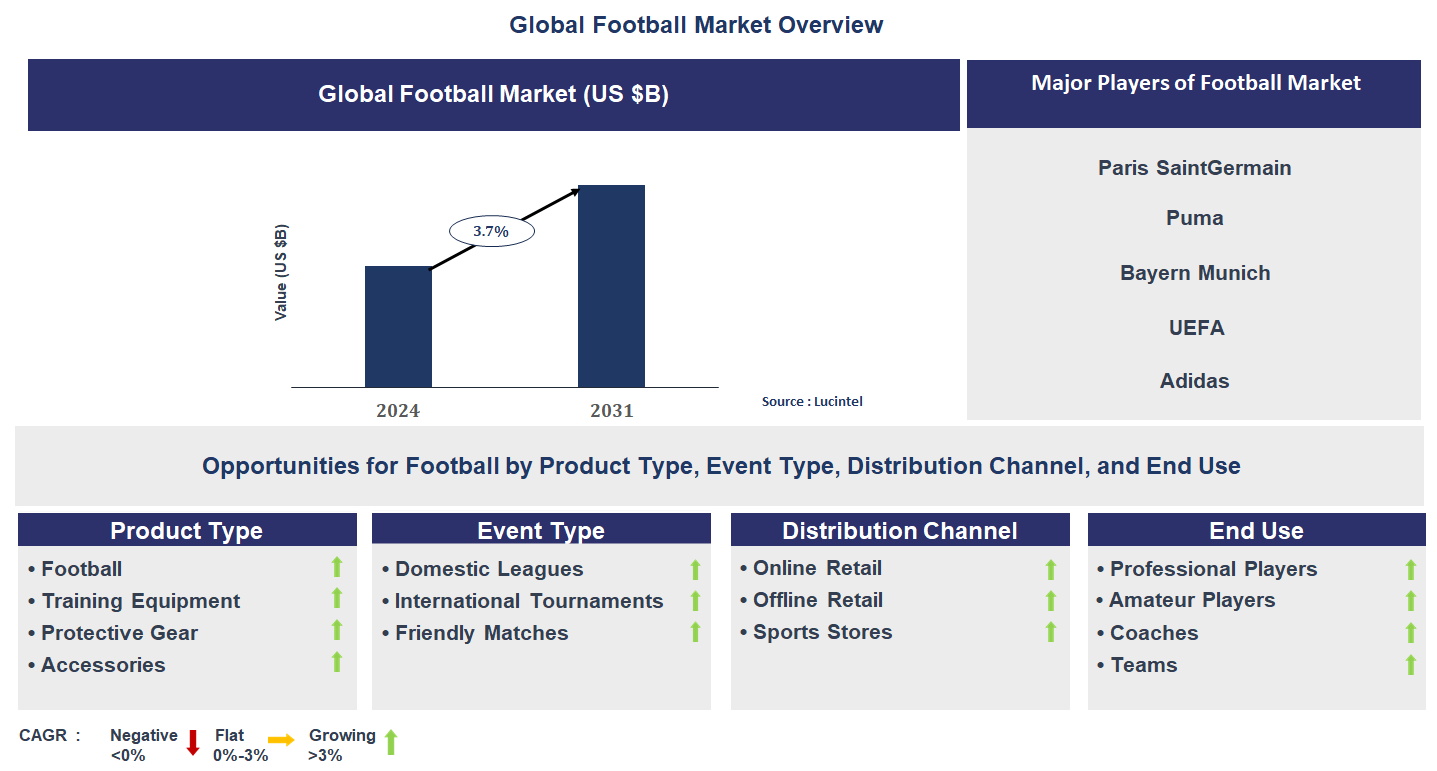
Football Market Trends and Forecast

Emerging Trends in the Football Market

The football marketplace is being revolutionized by a number of emerging trends that are reshaping consumption and commercialization of the sport. These trends are taking the business out of 90 minutes on the pitch and into an ongoing loop of fan interaction, performance-informed by data, and new business models. The conventional broadcasting-centric approach is broadening to capture a more fragmented and digital environment, presenting new opportunities and challenges for leagues, clubs, and companies in general.
• Immersive Fan Experience and Digitalization: One of the key trends is the mass digitalization of the fan relationship. Leagues and clubs are employing mobile apps, social media, and live-streaming sites to engage their supporters in a more immersive and interactive manner. This is augmented with the use of virtual reality (VR) and augmented reality (AR) to offer virtual tours of the stadium and exclusive behind-the-scenes material. The effect is a more personal and globalized support base.
• Data Analytics and Performance Optimization: The industry is witnessing a growing tendency to leverage big data and artificial intelligence (AI) for performance analysis. With this, clubs are now gathering and analyzing huge amounts of data on everything from player conditioning to tactical effectiveness. All this data is employed to advise training, scouting, and match-day decisions. The influence is a more scientific style of the sport, and it is having implications from player transfer to in-game tactics. The trend is opening up a new segment of the marketplace for sports tech firms and data analysts.
• Advancement of Women’s Football: Another major and fast-growing trend is the advancement of women’s football. Top leagues and global tournaments are seeing record levels of viewership and investment. This is resulting in more visibility for women’s sports and a new, multicultural fan base. The effect is a new source of revenue for the sport of football through broadcasting rights, sponsorships, and merchandise sales. It is also breaking down traditional gender roles within sports and offering a tremendous platform for equality.
• Localization in a Global Market: The market is experiencing an increasing trend toward localization. Though major clubs enjoy international reach, these clubs are increasingly customizing their content and marketing to appeal to particular local cultures and fan bases. They are doing this by producing content in the local language, collaborating with local brands, and staging local events. The result is greater affinity with fans in growth markets. This strategy assists clubs in creating loyalty and in monetizing their international brand more effectively by rendering their content more local, relevant, and engaging.
• Sustainability and Social Responsibility: One trend caused by a new wave of fans is the emphasis on sustainability and social responsibility. Clubs and leagues are under pressure to minimize their carbon footprint and to leverage their platform for social causes. This encompasses recycling materials to use in kits, encouraging green travel, and backing community projects. The effect is a more ethical, mission-focused industry. Brands that transparently report on their social and environmental commitments are establishing a more robust reputation and appealing to an emerging segment of socially responsible consumers.
All these new trends combined are collectively redefining the football market by pushing it towards a more data-based, consumer-focused, and purpose-led model. The emphasis on digital interaction and localization is enabling clubs to engage with supporters at a more intimate, personal level. Concurrently, the rise of women’s football as well as the focus on social responsibility are making the industry relevant and interesting to a new generation of socially responsible consumers.
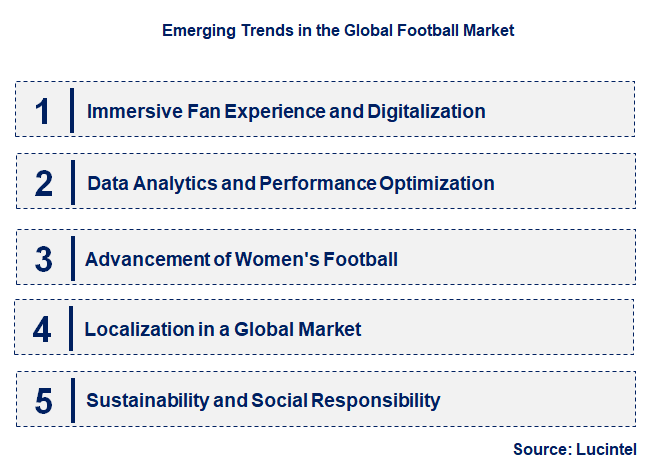
Emerging Trends in the Football Market

Recent Development in the Football Market

The football market is today guided by several important recent trends that are decisively driving its direction and competitive dynamics. These trends are not in themselves disconnected but are intertwined and represent a wider movement in technology, media, and consumer trends. The market is increasingly maturing, fueled by emerging business models, fan-centricity, and globalized strategies to build brands.
• Over-the-Top Streaming Services Proliferation: One of the most significant developments is the proliferation of over-the-top (OTT) streaming services for the transmission of football. Traditional television transmission is increasingly being challenged by services such as Amazon Prime, DAZN, and ESPN+, which are signing up exclusive rights to top leagues and competitions. The effect is a more dispersed media environment.
• Sovereign Wealth Fund and Private Equity Strategic Investment: One of the biggest developments is the rise in investment within football clubs by sovereign wealth funds and private equity groups. This is giving way to a new era of ownership that is approaching clubs not only as sporting institutions but as global brands and business assets. The result is a large boost in transfer fees and salaries for players. This is also resulting in more emphasis on commercialization, brand building, and internationalization, which is changing the financial landscape of the sport.
• Grassroots and Youth Football Development: One of the recent developments is the renewed interest in grassroots and youth football development. Leagues and administrations are making investments in academy-building and more extensive training for youth players. This growth is a long-term plan to have a sustainable pipeline of local talent. The effect is a healthier and autonomous football ecosystem. This also assists in developing a closer bond with local communities, which can be converted to a more loyal supporter base and a more stable club in the long run.
• Application of AI and Data Analytics for Scouting and Transfers of Players: The market is witnessing a significant growth in the application of artificial intelligence and data analytics for player scouting and transfers. Clubs are now employing advanced algorithms to find promising players, forecast their performance, and estimate their value in the market. This trend is shifting the transfer market from conventional scouting techniques to a data-driven system. The effect is an efficient and less risky transfer mechanism. This also opens up a new niche for firms that offer these analytical services.
• Growth of Women’s Football Leagues: One major development is the rapid growth and professionalization of women’s football leagues. The sport is becoming more visible and commercially supported, resulting in improved wages for female players and greater media attention. The growth is pulling in new sponsors and an expanding fan base. The result is a more balanced and more inclusive football business. It also offers a fresh opportunity for development and investment, with women’s leagues and teams increasingly lucrative assets for brands and investors.
These latest trends are all cumulatively affecting the football industry by nudging it towards a more data-centric, globally networked, and commercially advanced paradigm. The emphasis on new media rights and investment-for-growth strategies is transforming the sport’s financial ecosystem. Meanwhile, the growth of grassroots football as well as the women’s leagues are keeping the industry’s expansion sustainable and inclusive.

Strategic Growth Opportunities in the Football Market

The football market offers a number of strategic growth opportunities in its major uses. With the sport further globalization and advances in technology, businesses and entities are able to capitalize on these opportunities and increase their market share and generate new revenue streams. The opportunities are not limited to conventional match-day income and encompass innovation in digital media, content, and fan interaction. Recognition and leveraging these strategic growth areas will be imperative for any organization seeking to find long-term success within this fast-paced market.
• Opportunity in Digital Fan Engagement Platforms: There is a huge opportunity in creating and monetizing digital fan engagement platforms. This encompasses the development of club-specific mobile applications that provide private content, customized experiences, and e-commerce capabilities. It also involves collaborations with social network sites and gaming operators to produce interactive content such as fantasy leagues and games of prediction. It is tapping into the wish for ongoing and personalized engagement by today’s fan.
• Sports Technology and Data Analytics Opportunity: The other primary growth opportunity lies in using data analytics and sports technology. This involves creating software that can analyze a player’s performance, monitor players’ health, and deliver real-time tactical feedback to coaches. It also involves using AI to forecast talent and market value of players. This strategy responds to an increasing demand for using science to drive football. It provides clubs with a competitive advantage in scouting, training, and strategic planning, thus creating value for their teams.
• Global Media Rights Market Opportunity: A significant growth opportunity exists in the global media rights market. With more countries connecting to the high-speed internet, demand for football content is increasing. Businesses can take advantage of this by purchasing broadcasting rights for large leagues and selling them to emerging markets, specifically in Asia and North America. This allows for a means to earn money from the international popularity of the sport. It also necessitates creating new business models, like subscription-based streaming options, which can service an international market.
• Youth and Grassroots Development Programs Opportunity: The market offers a significant growth prospect in youth and grassroots development. This entails developing and selling football academies, training camps, and youth leagues. This strategy responds to the increasing need for structured training and development for promising young players. It also assists in developing a sustainable pipeline of talent for professional leagues. This method not only earns money through membership fees but also assists in building a new generation of supporters and players.
• Potential in Branded Merchandise and Retail: The sector presents a massive growth potential within the branded merchandise and retail segment. This involves developing and merchandising club jerseys, clothing, and accessories, especially in developing nations. Businesses can use e-commerce sites and strategic alliances to increase their retail presence. This approach enables clubs to commercialize their international brand and to engage fans on a more concrete level. Limited-edition products and collaborations with fashion brands also have the potential to stimulate demand and generate revenue.
These strategic growth opportunities are set to propel the football market forward. With a concentration on digital engagement, data analytics, and international media rights, businesses can build higher-value and consumer-focused products. The creation of grassroots initiatives and branded items likewise corresponds to the fundamental values of the sport. Ultimately, these prospects point to a future where the market is not merely larger but also more innovative, specialized, and responsive to the changing demands of its heterogeneous consumer base.

Football Market Driver and Challenges

The football market is driven by a dynamic mix of drivers and challenges shaping its course. The major drivers are largely focused on the sport’s worldwide popularity, economic realities, and technological developments. The market, however, has serious challenges it needs to deal with, such as stiff competition, financial fair play rules, and the looming specter of over-commercialization. Knowledge of these forces will help any company or organization to prosper in this fast-changing market.
The factors responsible for driving the football market include:
1. Huge Global Popularity and Fan Following: The main driver is the huge global popularity of football, which draws a huge fan following and creates vast commercial prospects. The sport is enjoyed by billions of fans across the world. This phenomenal popular appeal generates huge demand for football merchandise and services, ranging from tickets and merchandise to broadcasting rights. This driver is a core driver of the market’s persistent growth and profitability.
2. Increasing Corporate Sponsorships and Investments: The key driver is growing investment by corporations and private investors. Large brands are sensing the international appeal of the sport and are engaging in high-paying sponsorship and endorsement contracts with clubs, leagues, and players. This investment is assisting the professionalization of the sport in emerging markets, upgrading infrastructure, and adding to the overall value of the market.
3. Technological Development in Broadcasting and Fan Engagement: The industry is led by ongoing technological developments. The growth of high-definition broadcasting, live-streaming, and interactivity digital platforms has improved the viewer experience and facilitated the sport to reach a wider global audience. Technologies such as VAR, artificial intelligence-based analytics, and augmented reality are also opening up new ways of fan engagement and performance analysis.
4. Football Club and League Globalization: Globalization of the world’s leading football clubs and leagues is a major driver. Clubs are global brands with international followings. They are going out of their way to engage with supporters in new markets through international tours, online content, and targeted partnerships. This driver is extending the reach of the market beyond its historic heartlands, generating new revenues from merchandise and broadcasting rights in markets such as Asia and North America.
5. Increased Participation and Grassroots Development: Another driver is the growing participation in football, notably at grass-roots level. Governments and governing bodies are backing this with physical activity promotion and investment in youth academies and local leagues. This driver is developing a bigger consumer market for football equipment and kit. It is also developing a sustainable talent pipeline for the professional game.
Challenges in the football market are:
1. Financial Imbalance and Over-Commercialization: One challenge is the increasing financial imbalance between wealthy top clubs and lower clubs. The concentration of wealth among a small group of top clubs has the potential to result in an uncompetitive and one-sided league. This is a serious challenge for the market because it can lower fan interest in certain leagues and impose financial instability upon many clubs. It also poses a threat to the integrity of the sport.
2. Exorbitant Broadcasting Rights and Ticket Price: There are challenges in the market concerning the exorbitant broadcasting rights and ticket price. While clubs and leagues charge a premium, these amounts tend to be transferred to the consumers, a situation that may render the sport unaffordable for some of them. This presents a challenge that may cause fan fatigue and decreased viewership, especially in markets where incomes are fixed.
3. Financial Fair Play and Regulatory Matters: The sector is challenged by regulatory matters, especially financial fair play (FFP) regulations. The regulations aim to provide for the financial sustainability of clubs but also constrain a club from competing with state-owned clubs. The challenge has caused continuous disputes and court cases, which may cause uncertainty and affect a club’s long-term planning.
The market for football is at a crossroads, driven by great accelerators such as its popularity across the world and high investment. They are building a good foundation for innovation and growth. However, the development of the market is being threatened by financial imbalances, high cost of access to fans, and regulatory complexity. The future of success will depend on clubs and governing bodies using the drivers to make a more open and high-tech experience, while strategically tackling the challenges to secure the long-term sustainability and competitiveness of the sport.

List of Football Companies

Companies in the market compete on the basis of product quality offered. Major players in this market focus on expanding their manufacturing facilities, R&D investments, infrastructural development, and leverage integration opportunities across the value chain. With these strategies football companies cater increasing demand, ensure competitive effectiveness, develop innovative products & technologies, reduce production costs, and expand their customer base. Some of the football companies profiled in this report include-
• Paris SaintGermain
• Puma
• Bayern Munich
• UEFA
• Adidas
• ESPN
• FIFA
• Nike
• Juventus
• Real Madrid

Football Market by Segment

The study includes a forecast for the global football market by product type, event type, distribution channel, end use, and region.

Football Market by Product Type [Value from 2019 to 2031]:


• Football
• Training Equipment
• Protective Gear
• Accessories

Football Market by Event Type [Value from 2019 to 2031]:


• Domestic Leagues
• International Tournaments
• Friendly Matches

Football Market by Distribution Channel [Value from 2019 to 2031]:


• Online Retail
• Offline Retail
• Sports Stores

Football Market by End Use [Value from 2019 to 2031]:


• Professional Players
• Amateur Players
• Coaches
• Teams

Football Market by Region [Value from 2019 to 2031]:


• North America
• Europe
• Asia Pacific
• The Rest of the World

Country Wise Outlook for the Football Market

The international football market is experiencing a profound and dynamic transformation, fueled by intersecting forces of technological innovation, changing fan culture, and venture capitalist investment. Although the sport has historically been a cultural staple, especially across much of Europe, its growth into new markets such as the United States and Asia is shaping a more integrated and commodified environment. This is driven by online engagement, emerging rights models for new media, and renewed emphasis on grassroots development. The market is growing more data-intensive and consumer-oriented, with increasing focus on developing rich, immersive, and personalized fan experiences.
• United States: In the United States, one of the most important developments is the growing popularity of football, especially among the younger population. Major League Soccer (MLS) is increasing its presence and signing top-tier players. This is propelling the rise in stadium attendance, TV viewership, and retail sales. The US market also ranks high with leading European clubs, who are actively targeting American fans via summer tours, strategic partnerships, and localized digital content. The coming FIFA World Cup in 2026 is poised to be a key driver of continued expansion and investment.
• China: China’s football market is a key growth region, fueled by a sustained government vision to establish China as a football superpower. Recent trends have seen major investments in grassroots football, including the construction of new academies and facilities. The market is equally digitalized, with overseas clubs utilizing social media platforms and live-streaming to reach a huge digitally-educated fan base. Whereas financial fair play rules have influenced expenditure on foreign players, the emphasis is now on nurturing local talent and making the local league stronger.
• Germany: Germany’s football market is a poster child of financial solidity and robust supporter culture. One notable trend is the ongoing success of the Bundesliga, which boasts high attendance and low ticket prices, creating a fervent local following. The market is also a technological and data analytics leader, with clubs applying sophisticated systems to maximize players’ performance and tactics. The focus today is on sustaining a viable business model while competing against financially dominant leagues abroad.
• India: India’s football market is growing steadily, fueled by an increasing youth population and an interest in the game. One of the most important developments is the popularity and growth of the Indian Super League (ISL), which is gaining more investors and players. The market is also being supported by the growing television audience for top European leagues, which is encouraging more youngsters to play the game. Government and corporate support for youth academies and grassroots development is essential in creating a sustainable system for the future.
• Japan: Japan’s football market is mature and organized, with recent trends centered on financial health and youth development. The J-League has its well-organized clubs and emphasis on developing home-grown players, with numerous Japanese players now playing in leading European leagues. One area of development is the continued push to improve the financial well-being of clubs, with a recent study pointing to a danger of bankruptcy facing some. The market is also developing new approaches to connecting with fans via digital channels and global partnerships.

Lucintel Analytics Dashboard

Features of the Global Football Market

Market Size Estimates: Football market size estimation in terms of value ($B).
Trend and Forecast Analysis: Market trends (2019 to 2024) and forecast (2025 to 2031) by various segments and regions.
Segmentation Analysis: Football market size by various segments, such as by product type, event type, distribution channel, end use, and region in terms of value ($B).
Regional Analysis: Football market breakdown by North America, Europe, Asia Pacific, and Rest of the World.
Growth Opportunities: Analysis of growth opportunities in different product type, event type, distribution channel, end use, and regions for the football market.
Strategic Analysis: This includes M&A, new product development, and competitive landscape of the football market.
Analysis of competitive intensity of the industry based on Porter’s Five Forces model.

Lucintel Consulting Services

FAQ

Q1. What is the growth forecast for football market?
Answer: The global football market is expected to grow with a CAGR of 3.7% from 2025 to 2031.
Q2. What are the major drivers influencing the growth of the football market?
Answer: The major drivers for this market are the increasing popularity of football tournaments, the rising interest in youth football participation, and the growing investment in football infrastructure.
Q3. What are the major segments for football market?
Answer: The future of the football market looks promising with opportunities in the football, training equipment, protective gear, and accessory markets.
Q4. Who are the key football market companies?
Answer: Some of the key football companies are as follows:
• Paris SaintGermain
• Puma
• Bayern Munich
• UEFA
• Adidas
• ESPN
• FIFA
• Nike
• Juventus
• Real Madrid
Q5. Which football market segment will be the largest in future?
Answer: Lucintel forecasts that, within the end use category, amateur player is expected to witness the highest growth over the forecast period.
Q6. In football market, which region is expected to be the largest in next 5 years?
Answer: In terms of region, APAC is expected to witness the highest growth over the forecast period.
Q7. Do we receive customization in this report?
Answer: Yes, Lucintel provides 10% customization without any additional cost.

This report answers following 11 key questions:

Q.1. What are some of the most promising, high-growth opportunities for the football market by product type (football, training equipment, protective gear, and accessories), event type (domestic leagues, international tournaments, and friendly matches), distribution channel (online retail, offline retail, and sports stores), end use (professional players, amateur players, coaches, and teams), and region (North America, Europe, Asia Pacific, and the Rest of the World)?
Q.2. Which segments will grow at a faster pace and why?
Q.3. Which region will grow at a faster pace and why?
Q.4. What are the key factors affecting market dynamics? What are the key challenges and business risks in this market?
Q.5. What are the business risks and competitive threats in this market?
Q.6. What are the emerging trends in this market and the reasons behind them?
Q.7. What are some of the changing demands of customers in the market?
Q.8. What are the new developments in the market? Which companies are leading these developments?
Q.9. Who are the major players in this market? What strategic initiatives are key players pursuing for business growth?
Q.10. What are some of the competing products in this market and how big of a threat do they pose for loss of market share by material or product substitution?
Q.11. What M&A activity has occurred in the last 5 years and what has its impact been on the industry?

For any questions related to Football Market, Football Market Size, Football Market Growth, Football Market Analysis, Football Market Report, Football Market Share, Football Market Trends, Football Market Forecast, Football Companies, write Lucintel analyst at email: helpdesk@lucintel.com. We will be glad to get back to you soon.
                                           Table of Contents

            1. Executive Summary

            2. Market Overview

                        2.1 Background and Classifications
                        2.2 Supply Chain

            3. Market Trends & Forecast Analysis

                        3.1 Macroeconomic Trends and Forecasts
                        3.2 Industry Drivers and Challenges
                        3.3 PESTLE Analysis
                        3.4 Patent Analysis
                        3.5 Regulatory Environment
                        3.6 Global Football Market Trends and Forecast

            4. Global Football Market by Product Type

                        4.1 Overview
                        4.2 Attractiveness Analysis by Product Type
                        4.3 Football : Trends and Forecast 2025 to 2031
                        4.4 Training Equipment : Trends and Forecast 2025 to 2031
                        4.5 Protective Gear : Trends and Forecast 2025 to 2031
                        4.6 Accessories : Trends and Forecast 2025 to 2031

            5. Global Football Market by Event Type

                        5.1 Overview
                        5.2 Attractiveness Analysis by Event Type
                        5.3 Domestic Leagues : Trends and Forecast 2025 to 2031
                        5.4 International Tournaments : Trends and Forecast 2025 to 2031
                        5.5 Friendly Matches : Trends and Forecast 2025 to 2031

            6. Global Football Market by Distribution Channel

                        6.1 Overview
                        6.2 Attractiveness Analysis by Distribution Channel
                        6.3 Online Retail : Trends and Forecast 2025 to 2031
                        6.4 Offline Retail : Trends and Forecast 2025 to 2031
                        6.5 Sports Stores : Trends and Forecast 2025 to 2031

            7. Global Football Market by End Use

                        7.1 Overview
                        7.2 Attractiveness Analysis by End Use
                        7.3 Professional Players : Trends and Forecast 2025 to 2031
                        7.4 Amateur Players : Trends and Forecast 2025 to 2031
                        7.5 Coaches : Trends and Forecast 2025 to 2031
                        7.6 Teams : Trends and Forecast 2025 to 2031

            8. Regional Analysis

                        8.1 Overview
                        8.2 Global Football Market by Region

            9. North American Football Market

                        9.1 Overview
                        9.2 North American Football Market by End Use
                        9.3 North American Football Market by Product Type
                        9.4 The United States Football Market
                        9.5 Canadian Football Market
                        9.6 Mexican Football Market

            10. European Football Market

                        10.1 Overview
                        10.2 European Football Market by End Use
                        10.3 European Football Market by Product Type
                        10.4 German Football Market
                        10.5 French Football Market
                        10.6 Italian Football Market
                        10.7 Spanish Football Market
                        10.8 The United Kingdom Football Market

            11. APAC Football Market

                        11.1 Overview
                        11.2 APAC Football Market by End Use
                        11.3 APAC Football Market by Product Type
                        11.4 Chinese Football Market
                        11.5 Indian Football Market
                        11.6 Japanese Football Market
                        11.7 South Korean Football Market
                        11.8 Indonesian Football Market

            12. ROW Football Market

                        12.1 Overview
                        12.2 ROW Football Market by End Use
                        12.3 ROW Football Market by Product Type
                        12.4 Middle Eastern Football Market
                        12.5 South American Football Market
                        12.6 African Football Market

            13. Competitor Analysis

                        13.1 Product Portfolio Analysis
                        13.2 Operational Integration
                        13.3 Porter’s Five Forces Analysis
                                    • Competitive Rivalry
                                    • Bargaining Power of Buyers
                                    • Bargaining Power of Suppliers
                                    • Threat of Substitutes
                                    • Threat of New Entrants
                        13.4 Market Share Analysis

            14. Opportunities & Strategic Analysis

                        14.1 Value Chain Analysis
                        14.2 Growth Opportunity Analysis
                                    14.2.1 Growth Opportunity by Product Type
                                    14.2.2 Growth Opportunity by Event Type
                                    14.2.3 Growth Opportunity by Distribution Channel
                                    14.2.4 Growth Opportunity by End Use
                        14.3 Emerging Trends in the Global Football Market
                        14.4 Strategic Analysis
                                    14.4.1 New Product Development
                                    14.4.2 Certification and Licensing
                                    14.4.3 Mergers, Acquisitions, Agreements, Collaborations, and Joint Ventures

            15. Company Profiles of the Leading Players Across the Value Chain

                        15.1 Competitive Analysis
                        15.2 Paris SaintGermain
                                    • Company Overview
                                    • Football Market Business Overview
                                    • New Product Development
                                    • Merger, Acquisition, and Collaboration
                                    • Certification and Licensing
                        15.3 Puma
                                    • Company Overview
                                    • Football Market Business Overview
                                    • New Product Development
                                    • Merger, Acquisition, and Collaboration
                                    • Certification and Licensing
                        15.4 Bayern Munich
                                    • Company Overview
                                    • Football Market Business Overview
                                    • New Product Development
                                    • Merger, Acquisition, and Collaboration
                                    • Certification and Licensing
                        15.5 UEFA
                                    • Company Overview
                                    • Football Market Business Overview
                                    • New Product Development
                                    • Merger, Acquisition, and Collaboration
                                    • Certification and Licensing
                        15.6 Adidas
                                    • Company Overview
                                    • Football Market Business Overview
                                    • New Product Development
                                    • Merger, Acquisition, and Collaboration
                                    • Certification and Licensing
                        15.7 ESPN
                                    • Company Overview
                                    • Football Market Business Overview
                                    • New Product Development
                                    • Merger, Acquisition, and Collaboration
                                    • Certification and Licensing
                        15.8 FIFA
                                    • Company Overview
                                    • Football Market Business Overview
                                    • New Product Development
                                    • Merger, Acquisition, and Collaboration
                                    • Certification and Licensing
                        15.9 Nike
                                    • Company Overview
                                    • Football Market Business Overview
                                    • New Product Development
                                    • Merger, Acquisition, and Collaboration
                                    • Certification and Licensing
                        15.10 Juventus
                                    • Company Overview
                                    • Football Market Business Overview
                                    • New Product Development
                                    • Merger, Acquisition, and Collaboration
                                    • Certification and Licensing
                        15.11 Real Madrid
                                    • Company Overview
                                    • Football Market Business Overview
                                    • New Product Development
                                    • Merger, Acquisition, and Collaboration
                                    • Certification and Licensing

            16. Appendix

                        16.1 List of Figures
                        16.2 List of Tables
                        16.3 Research Methodology
                        16.4 Disclaimer
                        16.5 Copyright
                        16.6 Abbreviations and Technical Units
                        16.7 About Us
                        16.8 Contact Us

                                               List of Figures


            Chapter 1

                        Figure 1.1: Trends and Forecast for the Global Football Market

            Chapter 2

                        Figure 2.1: Usage of Football Market
                        Figure 2.2: Classification of the Global Football Market
                        Figure 2.3: Supply Chain of the Global Football Market

            Chapter 3

                        Figure 3.1: Trends of the Global GDP Growth Rate
                        Figure 3.2: Trends of the Global Population Growth Rate
                        Figure 3.3: Trends of the Global Inflation Rate
                        Figure 3.4: Trends of the Global Unemployment Rate
                        Figure 3.5: Trends of the Regional GDP Growth Rate
                        Figure 3.6: Trends of the Regional Population Growth Rate
                        Figure 3.7: Trends of the Regional Inflation Rate
                        Figure 3.8: Trends of the Regional Unemployment Rate
                        Figure 3.9: Trends of Regional Per Capita Income
                        Figure 3.10: Forecast for the Global GDP Growth Rate
                        Figure 3.11: Forecast for the Global Population Growth Rate
                        Figure 3.12: Forecast for the Global Inflation Rate
                        Figure 3.13: Forecast for the Global Unemployment Rate
                        Figure 3.14: Forecast for the Regional GDP Growth Rate
                        Figure 3.15: Forecast for the Regional Population Growth Rate
                        Figure 3.16: Forecast for the Regional Inflation Rate
                        Figure 3.17: Forecast for the Regional Unemployment Rate
                        Figure 3.18: Forecast for Regional Per Capita Income
                        Figure 3.19: Driver and Challenges of the Football Market

            Chapter 4

                        Figure 4.1: Global Football Market by Product Type in 2019, 2024, and 2031
                        Figure 4.2: Trends of the Global Football Market ($B) by Product Type
                        Figure 4.3: Forecast for the Global Football Market ($B) by Product Type
                        Figure 4.4: Trends and Forecast for Football in the Global Football Market (2019-2031)
                        Figure 4.5: Trends and Forecast for Training Equipment in the Global Football Market (2019-2031)
                        Figure 4.6: Trends and Forecast for Protective Gear in the Global Football Market (2019-2031)
                        Figure 4.7: Trends and Forecast for Accessories in the Global Football Market (2019-2031)

            Chapter 5

                        Figure 5.1: Global Football Market by Event Type in 2019, 2024, and 2031
                        Figure 5.2: Trends of the Global Football Market ($B) by Event Type
                        Figure 5.3: Forecast for the Global Football Market ($B) by Event Type
                        Figure 5.4: Trends and Forecast for Domestic Leagues in the Global Football Market (2019-2031)
                        Figure 5.5: Trends and Forecast for International Tournaments in the Global Football Market (2019-2031)
                        Figure 5.6: Trends and Forecast for Friendly Matches in the Global Football Market (2019-2031)

            Chapter 6

                        Figure 6.1: Global Football Market by Distribution Channel in 2019, 2024, and 2031
                        Figure 6.2: Trends of the Global Football Market ($B) by Distribution Channel
                        Figure 6.3: Forecast for the Global Football Market ($B) by Distribution Channel
                        Figure 6.4: Trends and Forecast for Online Retail in the Global Football Market (2019-2031)
                        Figure 6.5: Trends and Forecast for Offline Retail in the Global Football Market (2019-2031)
                        Figure 6.6: Trends and Forecast for Sports Stores in the Global Football Market (2019-2031)

            Chapter 7

                        Figure 7.1: Global Football Market by End Use in 2019, 2024, and 2031
                        Figure 7.2: Trends of the Global Football Market ($B) by End Use
                        Figure 7.3: Forecast for the Global Football Market ($B) by End Use
                        Figure 7.4: Trends and Forecast for Professional Players in the Global Football Market (2019-2031)
                        Figure 7.5: Trends and Forecast for Amateur Players in the Global Football Market (2019-2031)
                        Figure 7.6: Trends and Forecast for Coaches in the Global Football Market (2019-2031)
                        Figure 7.7: Trends and Forecast for Teams in the Global Football Market (2019-2031)

            Chapter 8

                        Figure 8.1: Trends of the Global Football Market ($B) by Region (2019-2024)
                        Figure 8.2: Forecast for the Global Football Market ($B) by Region (2025-2031)

            Chapter 9

                        Figure 9.1: Trends and Forecast for the North American Football Market (2019-2031)
                        Figure 9.2: North American Football Market by Product Type in 2019, 2024, and 2031
                        Figure 9.3: Trends of the North American Football Market ($B) by Product Type (2019-2024)
                        Figure 9.4: Forecast for the North American Football Market ($B) by Product Type (2025-2031)
                        Figure 9.5: North American Football Market by Event Type in 2019, 2024, and 2031
                        Figure 9.6: Trends of the North American Football Market ($B) by Event Type (2019-2024)
                        Figure 9.7: Forecast for the North American Football Market ($B) by Event Type (2025-2031)
                        Figure 9.8: North American Football Market by Distribution Channel in 2019, 2024, and 2031
                        Figure 9.9: Trends of the North American Football Market ($B) by Distribution Channel (2019-2024)
                        Figure 9.10: Forecast for the North American Football Market ($B) by Distribution Channel (2025-2031)
                        Figure 9.11: North American Football Market by End Use in 2019, 2024, and 2031
                        Figure 9.12: Trends of the North American Football Market ($B) by End Use (2019-2024)
                        Figure 9.13: Forecast for the North American Football Market ($B) by End Use (2025-2031)
                        Figure 9.14: Trends and Forecast for the United States Football Market ($B) (2019-2031)
                        Figure 9.15: Trends and Forecast for the Mexican Football Market ($B) (2019-2031)
                        Figure 9.16: Trends and Forecast for the Canadian Football Market ($B) (2019-2031)

            Chapter 10

                        Figure 10.1: Trends and Forecast for the European Football Market (2019-2031)
                        Figure 10.2: European Football Market by Product Type in 2019, 2024, and 2031
                        Figure 10.3: Trends of the European Football Market ($B) by Product Type (2019-2024)
                        Figure 10.4: Forecast for the European Football Market ($B) by Product Type (2025-2031)
                        Figure 10.5: European Football Market by Event Type in 2019, 2024, and 2031
                        Figure 10.6: Trends of the European Football Market ($B) by Event Type (2019-2024)
                        Figure 10.7: Forecast for the European Football Market ($B) by Event Type (2025-2031)
                        Figure 10.8: European Football Market by Distribution Channel in 2019, 2024, and 2031
                        Figure 10.9: Trends of the European Football Market ($B) by Distribution Channel (2019-2024)
                        Figure 10.10: Forecast for the European Football Market ($B) by Distribution Channel (2025-2031)
                        Figure 10.11: European Football Market by End Use in 2019, 2024, and 2031
                        Figure 10.12: Trends of the European Football Market ($B) by End Use (2019-2024)
                        Figure 10.13: Forecast for the European Football Market ($B) by End Use (2025-2031)
                        Figure 10.14: Trends and Forecast for the German Football Market ($B) (2019-2031)
                        Figure 10.15: Trends and Forecast for the French Football Market ($B) (2019-2031)
                        Figure 10.16: Trends and Forecast for the Spanish Football Market ($B) (2019-2031)
                        Figure 10.17: Trends and Forecast for the Italian Football Market ($B) (2019-2031)
                        Figure 10.18: Trends and Forecast for the United Kingdom Football Market ($B) (2019-2031)

            Chapter 11

                        Figure 11.1: Trends and Forecast for the APAC Football Market (2019-2031)
                        Figure 11.2: APAC Football Market by Product Type in 2019, 2024, and 2031
                        Figure 11.3: Trends of the APAC Football Market ($B) by Product Type (2019-2024)
                        Figure 11.4: Forecast for the APAC Football Market ($B) by Product Type (2025-2031)
                        Figure 11.5: APAC Football Market by Event Type in 2019, 2024, and 2031
                        Figure 11.6: Trends of the APAC Football Market ($B) by Event Type (2019-2024)
                        Figure 11.7: Forecast for the APAC Football Market ($B) by Event Type (2025-2031)
                        Figure 11.8: APAC Football Market by Distribution Channel in 2019, 2024, and 2031
                        Figure 11.9: Trends of the APAC Football Market ($B) by Distribution Channel (2019-2024)
                        Figure 11.10: Forecast for the APAC Football Market ($B) by Distribution Channel (2025-2031)
                        Figure 11.11: APAC Football Market by End Use in 2019, 2024, and 2031
                        Figure 11.12: Trends of the APAC Football Market ($B) by End Use (2019-2024)
                        Figure 11.13: Forecast for the APAC Football Market ($B) by End Use (2025-2031)
                        Figure 11.14: Trends and Forecast for the Japanese Football Market ($B) (2019-2031)
                        Figure 11.15: Trends and Forecast for the Indian Football Market ($B) (2019-2031)
                        Figure 11.16: Trends and Forecast for the Chinese Football Market ($B) (2019-2031)
                        Figure 11.17: Trends and Forecast for the South Korean Football Market ($B) (2019-2031)
                        Figure 11.18: Trends and Forecast for the Indonesian Football Market ($B) (2019-2031)

            Chapter 12

                        Figure 12.1: Trends and Forecast for the ROW Football Market (2019-2031)
                        Figure 12.2: ROW Football Market by Product Type in 2019, 2024, and 2031
                        Figure 12.3: Trends of the ROW Football Market ($B) by Product Type (2019-2024)
                        Figure 12.4: Forecast for the ROW Football Market ($B) by Product Type (2025-2031)
                        Figure 12.5: ROW Football Market by Event Type in 2019, 2024, and 2031
                        Figure 12.6: Trends of the ROW Football Market ($B) by Event Type (2019-2024)
                        Figure 12.7: Forecast for the ROW Football Market ($B) by Event Type (2025-2031)
                        Figure 12.8: ROW Football Market by Distribution Channel in 2019, 2024, and 2031
                        Figure 12.9: Trends of the ROW Football Market ($B) by Distribution Channel (2019-2024)
                        Figure 12.10: Forecast for the ROW Football Market ($B) by Distribution Channel (2025-2031)
                        Figure 12.11: ROW Football Market by End Use in 2019, 2024, and 2031
                        Figure 12.12: Trends of the ROW Football Market ($B) by End Use (2019-2024)
                        Figure 12.13: Forecast for the ROW Football Market ($B) by End Use (2025-2031)
                        Figure 12.14: Trends and Forecast for the Middle Eastern Football Market ($B) (2019-2031)
                        Figure 12.15: Trends and Forecast for the South American Football Market ($B) (2019-2031)
                        Figure 12.16: Trends and Forecast for the African Football Market ($B) (2019-2031)

            Chapter 13

                        Figure 13.1: Porter’s Five Forces Analysis of the Global Football Market
                        Figure 13.2: Market Share (%) of Top Players in the Global Football Market (2024)

            Chapter 14

                        Figure 14.1: Growth Opportunities for the Global Football Market by Product Type
                        Figure 14.2: Growth Opportunities for the Global Football Market by Event Type
                        Figure 14.3: Growth Opportunities for the Global Football Market by Distribution Channel
                        Figure 14.4: Growth Opportunities for the Global Football Market by End Use
                        Figure 14.5: Growth Opportunities for the Global Football Market by Region
                        Figure 14.6: Emerging Trends in the Global Football Market

                                               List of Tables


            Chapter 1

                        Table 1.1: Growth Rate (%, 2023-2024) and CAGR (%, 2025-2031) of the Football Market by Product Type, Event Type, Distribution Channel, and End Use
                        Table 1.2: Attractiveness Analysis for the Football Market by Region
                        Table 1.3: Global Football Market Parameters and Attributes

            Chapter 3

                        Table 3.1: Trends of the Global Football Market (2019-2024)
                        Table 3.2: Forecast for the Global Football Market (2025-2031)

            Chapter 4

                        Table 4.1: Attractiveness Analysis for the Global Football Market by Product Type
                        Table 4.2: Market Size and CAGR of Various Product Type in the Global Football Market (2019-2024)
                        Table 4.3: Market Size and CAGR of Various Product Type in the Global Football Market (2025-2031)
                        Table 4.4: Trends of Football in the Global Football Market (2019-2024)
                        Table 4.5: Forecast for Football in the Global Football Market (2025-2031)
                        Table 4.6: Trends of Training Equipment in the Global Football Market (2019-2024)
                        Table 4.7: Forecast for Training Equipment in the Global Football Market (2025-2031)
                        Table 4.8: Trends of Protective Gear in the Global Football Market (2019-2024)
                        Table 4.9: Forecast for Protective Gear in the Global Football Market (2025-2031)
                        Table 4.10: Trends of Accessories in the Global Football Market (2019-2024)
                        Table 4.11: Forecast for Accessories in the Global Football Market (2025-2031)

            Chapter 5

                        Table 5.1: Attractiveness Analysis for the Global Football Market by Event Type
                        Table 5.2: Market Size and CAGR of Various Event Type in the Global Football Market (2019-2024)
                        Table 5.3: Market Size and CAGR of Various Event Type in the Global Football Market (2025-2031)
                        Table 5.4: Trends of Domestic Leagues in the Global Football Market (2019-2024)
                        Table 5.5: Forecast for Domestic Leagues in the Global Football Market (2025-2031)
                        Table 5.6: Trends of International Tournaments in the Global Football Market (2019-2024)
                        Table 5.7: Forecast for International Tournaments in the Global Football Market (2025-2031)
                        Table 5.8: Trends of Friendly Matches in the Global Football Market (2019-2024)
                        Table 5.9: Forecast for Friendly Matches in the Global Football Market (2025-2031)

            Chapter 6

                        Table 6.1: Attractiveness Analysis for the Global Football Market by Distribution Channel
                        Table 6.2: Market Size and CAGR of Various Distribution Channel in the Global Football Market (2019-2024)
                        Table 6.3: Market Size and CAGR of Various Distribution Channel in the Global Football Market (2025-2031)
                        Table 6.4: Trends of Online Retail in the Global Football Market (2019-2024)
                        Table 6.5: Forecast for Online Retail in the Global Football Market (2025-2031)
                        Table 6.6: Trends of Offline Retail in the Global Football Market (2019-2024)
                        Table 6.7: Forecast for Offline Retail in the Global Football Market (2025-2031)
                        Table 6.8: Trends of Sports Stores in the Global Football Market (2019-2024)
                        Table 6.9: Forecast for Sports Stores in the Global Football Market (2025-2031)

            Chapter 7

                        Table 7.1: Attractiveness Analysis for the Global Football Market by End Use
                        Table 7.2: Market Size and CAGR of Various End Use in the Global Football Market (2019-2024)
                        Table 7.3: Market Size and CAGR of Various End Use in the Global Football Market (2025-2031)
                        Table 7.4: Trends of Professional Players in the Global Football Market (2019-2024)
                        Table 7.5: Forecast for Professional Players in the Global Football Market (2025-2031)
                        Table 7.6: Trends of Amateur Players in the Global Football Market (2019-2024)
                        Table 7.7: Forecast for Amateur Players in the Global Football Market (2025-2031)
                        Table 7.8: Trends of Coaches in the Global Football Market (2019-2024)
                        Table 7.9: Forecast for Coaches in the Global Football Market (2025-2031)
                        Table 7.10: Trends of Teams in the Global Football Market (2019-2024)
                        Table 7.11: Forecast for Teams in the Global Football Market (2025-2031)

            Chapter 8

                        Table 8.1: Market Size and CAGR of Various Regions in the Global Football Market (2019-2024)
                        Table 8.2: Market Size and CAGR of Various Regions in the Global Football Market (2025-2031)

            Chapter 9

                        Table 9.1: Trends of the North American Football Market (2019-2024)
                        Table 9.2: Forecast for the North American Football Market (2025-2031)
                        Table 9.3: Market Size and CAGR of Various Product Type in the North American Football Market (2019-2024)
                        Table 9.4: Market Size and CAGR of Various Product Type in the North American Football Market (2025-2031)
                        Table 9.5: Market Size and CAGR of Various Event Type in the North American Football Market (2019-2024)
                        Table 9.6: Market Size and CAGR of Various Event Type in the North American Football Market (2025-2031)
                        Table 9.7: Market Size and CAGR of Various Distribution Channel in the North American Football Market (2019-2024)
                        Table 9.8: Market Size and CAGR of Various Distribution Channel in the North American Football Market (2025-2031)
                        Table 9.9: Market Size and CAGR of Various End Use in the North American Football Market (2019-2024)
                        Table 9.10: Market Size and CAGR of Various End Use in the North American Football Market (2025-2031)
                        Table 9.11: Trends and Forecast for the United States Football Market (2019-2031)
                        Table 9.12: Trends and Forecast for the Mexican Football Market (2019-2031)
                        Table 9.13: Trends and Forecast for the Canadian Football Market (2019-2031)

            Chapter 10

                        Table 10.1: Trends of the European Football Market (2019-2024)
                        Table 10.2: Forecast for the European Football Market (2025-2031)
                        Table 10.3: Market Size and CAGR of Various Product Type in the European Football Market (2019-2024)
                        Table 10.4: Market Size and CAGR of Various Product Type in the European Football Market (2025-2031)
                        Table 10.5: Market Size and CAGR of Various Event Type in the European Football Market (2019-2024)
                        Table 10.6: Market Size and CAGR of Various Event Type in the European Football Market (2025-2031)
                        Table 10.7: Market Size and CAGR of Various Distribution Channel in the European Football Market (2019-2024)
                        Table 10.8: Market Size and CAGR of Various Distribution Channel in the European Football Market (2025-2031)
                        Table 10.9: Market Size and CAGR of Various End Use in the European Football Market (2019-2024)
                        Table 10.10: Market Size and CAGR of Various End Use in the European Football Market (2025-2031,)
                        Table 10.11: Trends and Forecast for the German Football Market (2019-2031)
                        Table 10.12: Trends and Forecast for the French Football Market (2019-2031)
                        Table 10.13: Trends and Forecast for the Spanish Football Market (2019-2031)
                        Table 10.14: Trends and Forecast for the Italian Football Market (2019-2031)
                        Table 10.15: Trends and Forecast for the United Kingdom Football Market (2019-2031)

            Chapter 11

                        Table 11.1: Trends of the APAC Football Market (2019-2024)
                        Table 11.2: Forecast for the APAC Football Market (2025-2031)
                        Table 11.3: Market Size and CAGR of Various Product Type in the APAC Football Market (2019-2024)
                        Table 11.4: Market Size and CAGR of Various Product Type in the APAC Football Market (2025-2031)
                        Table 11.5: Market Size and CAGR of Various Event Type in the APAC Football Market (2019-2024)
                        Table 11.6: Market Size and CAGR of Various Event Type in the APAC Football Market (2025-2031)
                        Table 11.7: Market Size and CAGR of Various Distribution Channel in the APAC Football Market (2019-2024)
                        Table 11.8: Market Size and CAGR of Various Distribution Channel in the APAC Football Market (2025-2031)
                        Table 11.9: Market Size and CAGR of Various End Use in the APAC Football Market (2019-2024)
                        Table 11.10: Market Size and CAGR of Various End Use in the APAC Football Market (2025-2031)
                        Table 11.11: Trends and Forecast for the Japanese Football Market (2019-2031)
                        Table 11.12: Trends and Forecast for the Indian Football Market (2019-2031)
                        Table 11.13: Trends and Forecast for the Chinese Football Market (2019-2031)
                        Table 11.14: Trends and Forecast for the South Korean Football Market (2019-2031)
                        Table 11.15: Trends and Forecast for the Indonesian Football Market (2019-2031)

            Chapter 12

                        Table 12.1: Trends of the ROW Football Market (2019-2024)
                        Table 12.2: Forecast for the ROW Football Market (2025-2031)
                        Table 12.3: Market Size and CAGR of Various Product Type in the ROW Football Market (2019-2024)
                        Table 12.4: Market Size and CAGR of Various Product Type in the ROW Football Market (2025-2031)
                        Table 12.5: Market Size and CAGR of Various Event Type in the ROW Football Market (2019-2024)
                        Table 12.6: Market Size and CAGR of Various Event Type in the ROW Football Market (2025-2031)
                        Table 12.7: Market Size and CAGR of Various Distribution Channel in the ROW Football Market (2019-2024)
                        Table 12.8: Market Size and CAGR of Various Distribution Channel in the ROW Football Market (2025-2031)
                        Table 12.9: Market Size and CAGR of Various End Use in the ROW Football Market (2019-2024)
                        Table 12.10: Market Size and CAGR of Various End Use in the ROW Football Market (2025-2031)
                        Table 12.11: Trends and Forecast for the Middle Eastern Football Market (2019-2031)
                        Table 12.12: Trends and Forecast for the South American Football Market (2019-2031)
                        Table 12.13: Trends and Forecast for the African Football Market (2019-2031)

            Chapter 13

                        Table 13.1: Product Mapping of Football Suppliers Based on Segments
                        Table 13.2: Operational Integration of Football Manufacturers
                        Table 13.3: Rankings of Suppliers Based on Football Revenue

            Chapter 14

                        Table 14.1: New Product Launches by Major Football Producers (2019-2024)
                        Table 14.2: Certification Acquired by Major Competitor in the Global Football Market

.

Buy full report or by chapter as follows

Limited Time Offer

Price by License Type:
[-] Hide Chapter Details
[Chapter Number] [Chapter Name] [Chapter Number Of Pages] [Chapter Price]
Title/Chapter Name Pages Price
Full Report: Football Market Report: Trends, Forecast and Competitive Analysis to 2031 Full Report $ 2,990
A 150 Page Report
Lucintel has been in the business of market research and management consulting since 2000 and has published over 1000 market intelligence reports in various markets / applications and served over 1,000 clients worldwide. This study is a culmination of four months of full-time effort performed by Lucintel's analyst team. The analysts used the following sources for the creation and completion of this valuable report:
  • In-depth interviews of the major players in this market
  • Detailed secondary research from competitors’ financial statements and published data 
  • Extensive searches of published works, market, and database information pertaining to industry news, company press releases, and customer intentions
  • A compilation of the experiences, judgments, and insights of Lucintel’s professionals, who have analyzed and tracked this market over the years.
Extensive research and interviews are conducted across the supply chain of this market to estimate market share, market size, trends, drivers, challenges, and forecasts. Below is a brief summary of the primary interviews that were conducted by job function for this report.
 
Thus, Lucintel compiles vast amounts of data from numerous sources, validates the integrity of that data, and performs a comprehensive analysis. Lucintel then organizes the data, its findings, and insights into a concise report designed to support the strategic decision-making process. The figure below is a graphical representation of Lucintel’s research process. 
 

Please sign in below to get report brochure - Football Market Report.

At Lucintel, we respect your privacy and maintain the confidentiality of information / data provided by you
(Please enter your corporate email. * These fields are mandatory )

Follow us on