
Report Feature
Food Processing Equipment Market Trends and Forecast
The future of the global food processing equipment market looks promising with opportunities in the food processing plant and restaurant markets. The global food processing equipment market is expected to reach an estimated $115 billion by 2035 with a CAGR of 5.3% from 2026 to 2035. The major drivers for this market are the increasing demand for processed food, the rising adoption of automation technology, and the growing focus on food safety.• Lucintel forecasts that, within the type category, meat processing machinery is expected to witness the highest growth over the forecast period.
• Within the application category, food processing plant is expected to witness higher growth.
• In terms of region, APAC is expected to witness the highest growth over the forecast period. Gain valuable insights for your business decisions with our comprehensive 150+ page report. Sample figures with some insights are shown below.
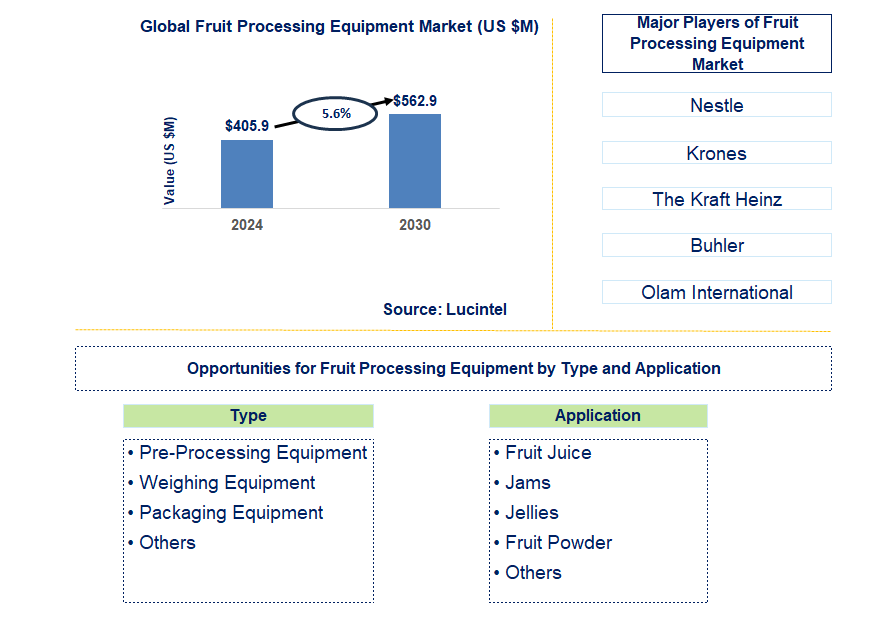
Emerging Trends in the Food Processing Equipment Market
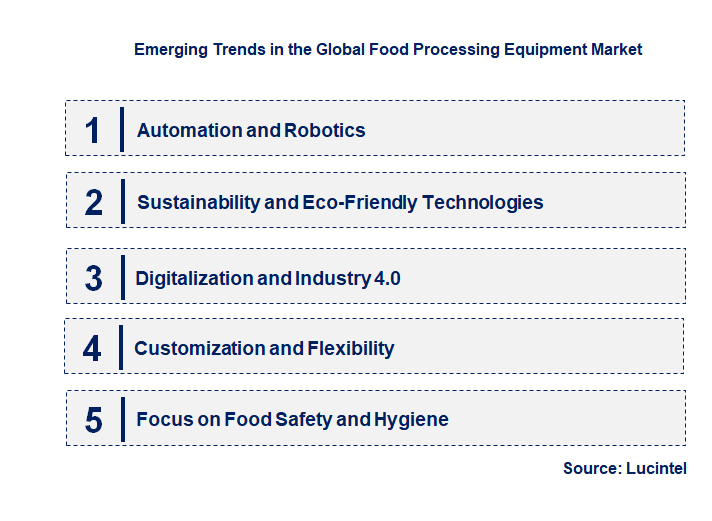
The food processing equipment market is experiencing rapid evolution driven by technological advancements, changing consumer preferences, and increasing demand for efficiency and sustainability. As food safety standards tighten and innovation accelerates, manufacturers are adopting new strategies to stay competitive. These developments are transforming how food is processed, packaged, and distributed, ultimately impacting the entire supply chain. The following key trends highlight the major shifts shaping this dynamic market, reflecting a move towards smarter, more sustainable, and consumer-centric solutions that are redefining industry standards and growth prospects.• Automation and Robotics: Enhanced efficiency and precision are achieved through increased integration of automation and robotics in food processing. These technologies reduce labor costs, improve product consistency, and increase throughput. Automated systems enable continuous operation, minimize human error, and enhance safety by handling hazardous tasks. As a result, manufacturers can meet rising demand while maintaining high quality standards. The adoption of robotics is also facilitating customization and flexibility in processing lines, allowing for rapid product changes and reducing time-to-market, which is crucial in a competitive landscape.
• Sustainability and Eco-Friendly Technologies: Growing environmental concerns are prompting the industry to adopt sustainable practices. This includes energy-efficient machinery, water conservation systems, and waste reduction technologies. Companies are investing in eco-friendly packaging solutions and renewable energy sources to minimize their carbon footprint. These initiatives not only comply with stricter regulations but also appeal to environmentally conscious consumers. The shift towards sustainability is driving innovation in equipment design, encouraging the development of greener processing methods that reduce resource consumption and promote circular economy principles.
• Digitalization and Industry 4.0: The integration of digital technologies such as IoT, AI, and data analytics is revolutionizing food processing equipment. Real-time monitoring and predictive maintenance improve operational efficiency and reduce downtime. Digitalization enables better traceability, quality control, and compliance with safety standards. Industry 4.0 concepts facilitate smart factories where equipment communicates seamlessly, optimizing production workflows. This trend enhances decision-making, reduces costs, and accelerates product development cycles, positioning companies to respond swiftly to market changes and consumer demands.
• Customization and Flexibility: Consumer preferences are shifting towards personalized and diverse food products. Processing equipment is increasingly designed for flexibility, allowing quick adjustments for different recipes, portion sizes, and packaging formats. Modular machinery and adaptable processing lines enable manufacturers to diversify their offerings without significant capital investment. This trend supports small-batch production and rapid innovation, helping companies meet niche market demands and reduce waste. The ability to customize processing solutions is becoming a key differentiator in a competitive market, fostering innovation and customer satisfaction.
• Focus on Food Safety and Hygiene: Stringent safety regulations and consumer awareness are emphasizing the importance of hygiene in food processing. Equipment is being designed with easy-to-clean surfaces, minimal crevices, and advanced sterilization features. Automation reduces human contact, lowering contamination risks. Technologies such as UV sterilization and antimicrobial coatings are increasingly incorporated. Ensuring food safety not only prevents costly recalls but also builds consumer trust. The emphasis on hygiene standards is driving innovation in equipment design, making safety a central aspect of processing technology development. These emerging trends—automation, sustainability, digitalization, customization, and safety—are collectively reshaping the food processing equipment market. They are fostering a more efficient, flexible, and environmentally responsible industry that can better meet evolving consumer expectations and regulatory requirements. As these trends continue to develop, they will drive innovation, improve competitiveness, and ensure sustainable growth in the global food processing sector.
Recent Development in the Food Processing Equipment Market
The food processing equipment market is experiencing rapid growth driven by technological advancements, increasing demand for processed foods, and expanding global food industries. Innovations in automation, sustainability initiatives, and rising consumer preferences for convenience foods are shaping the landscape. Market players are investing heavily in R&D to develop efficient, eco-friendly equipment. These developments are creating new opportunities for manufacturers and suppliers, ultimately transforming the industry and influencing global food production and consumption patterns.• Automation and Smart Technologies: Revolutionizing Food Processing Efficiency: The integration of automation and smart technologies in food processing equipment enhances productivity, reduces labor costs, and improves product consistency. IoT-enabled machinery allows real-time monitoring and predictive maintenance, minimizing downtime. This shift increases operational efficiency, reduces waste, and ensures high-quality output, making food processing more sustainable and cost-effective. As a result, manufacturers can meet rising demand while maintaining competitive pricing and quality standards.
• Sustainability and Eco-Friendly Equipment: Promoting Green Practices in Food Processing: Growing environmental concerns are prompting the adoption of sustainable equipment that minimizes energy consumption, water usage, and waste generation. Innovations include energy-efficient motors, biodegradable packaging machinery, and water recycling systems. These eco-friendly solutions help companies reduce their carbon footprint and comply with stringent regulations. The focus on sustainability is also appealing to environmentally conscious consumers, boosting brand reputation and market share for companies investing in green technologies.
• Technological Innovations in Equipment Design: Enhancing Food Safety and Quality: Advances in equipment design focus on improving food safety, hygiene, and product quality. Features like automated cleaning systems, sealed environments, and advanced filtration reduce contamination risks. Innovative designs also enable the processing of a wider variety of food products with minimal cross-contamination. These improvements help meet strict safety standards, extend shelf life, and ensure consumer trust. Consequently, companies can access new markets and satisfy regulatory requirements more effectively.
• Growing Demand for Processed and Convenience Foods: Expanding Market Opportunities: The rising consumer preference for ready-to-eat and convenience foods is fueling demand for specialized processing equipment. Equipment capable of handling diverse ingredients, packaging, and preservation techniques is in high demand. This trend supports the development of innovative products with longer shelf life and better nutritional value. Manufacturers investing in versatile, scalable equipment can capitalize on this growth, expanding their market share and catering to evolving consumer lifestyles across regions.
• Global Expansion and Market Penetration: Increasing Reach in Emerging Economies: Emerging economies present significant growth opportunities due to rising disposable incomes and urbanization. Companies are expanding their distribution networks and customizing equipment to meet local needs. This expansion facilitates access to new customer bases and diversifies revenue streams. Additionally, regional adaptations in equipment design accommodate local food preferences and regulatory standards, strengthening market presence. Such global penetration accelerates industry growth and fosters innovation tailored to diverse markets. These developments are significantly transforming the food processing equipment market by enhancing efficiency, sustainability, safety, and adaptability. The integration of smart technologies and eco-friendly solutions is driving operational improvements and environmental responsibility. Growing demand for processed foods and global expansion are opening new avenues for growth. Collectively, these trends are fostering innovation, increasing competitiveness, and shaping the future landscape of the industry, ultimately benefiting manufacturers, consumers, and the environment.
Strategic Growth Opportunities in the Food Processing Equipment Market
The food processing equipment market is experiencing rapid expansion driven by increasing consumer demand for processed foods, technological advancements, and rising food safety standards. Manufacturers are focusing on innovation, automation, and sustainable solutions to meet evolving industry needs. Emerging markets present significant growth potential, while regulatory pressures encourage modernization. This dynamic environment offers numerous opportunities for companies to expand their product portfolios, improve efficiency, and capture new customer segments, ultimately shaping the future landscape of food processing technology worldwide.• Growing Demand for Automation in Food Processing Equipment: Automation enhances efficiency, consistency, and safety in food production. As food companies aim to meet high-volume demands and reduce labor costs, the adoption of automated machinery increases. Advanced robotics, AI-driven systems, and IoT integration enable real-time monitoring and predictive maintenance, minimizing downtime. This trend is particularly prominent in large-scale manufacturing, driving innovation and investment in automated solutions to improve productivity and product quality.
• Expansion of Sustainable and Eco-Friendly Equipment Solutions: Sustainability is a key focus in the food processing industry, prompting demand for eco-friendly equipment. Companies are investing in energy-efficient machines, water-saving technologies, and recyclable materials to reduce environmental impact. Green certifications and consumer preferences for sustainable products further accelerate this shift. Developing environmentally conscious equipment not only helps companies comply with regulations but also enhances brand reputation, creating a competitive advantage in a market increasingly driven by eco-awareness.
• Increasing Adoption of Advanced Food Preservation Technologies: Innovations in preservation methods, such as high-pressure processing, freeze-drying, and modified atmosphere packaging, extend shelf life and maintain nutritional quality. These technologies meet consumer demand for fresh, minimally processed foods with longer shelf lives. Food processors are adopting these advanced solutions to reduce waste, improve safety, and access new markets. The integration of preservation technologies into equipment design is a significant growth driver, enabling manufacturers to offer versatile, high-performance machinery.
• Rising Investment in Customization and Modular Equipment: Customizable and modular food processing equipment allows manufacturers to adapt to diverse product requirements and production scales. This flexibility reduces downtime and enhances operational efficiency. As food companies diversify their product lines, demand for tailored solutions increases. Modular systems facilitate easy upgrades and maintenance, supporting rapid innovation cycles. Investment in such adaptable equipment helps companies optimize space, reduce costs, and respond swiftly to market trends, fostering growth in the sector.
• Increasing Focus on Food Safety and Hygiene Standards: Stringent safety regulations and consumer awareness drive demand for hygienic, easy-to-clean processing equipment. Technologies such as antimicrobial surfaces, automated cleaning systems, and sealed designs minimize contamination risks. Equipment that complies with international safety standards ensures product integrity and reduces recall risks. The emphasis on hygiene standards encourages manufacturers to develop innovative, safety-compliant machinery, which is crucial for gaining customer trust and expanding market share in a highly regulated environment. The overall market growth is significantly influenced by these opportunities, as companies leverage technological advancements, sustainability initiatives, and safety standards to innovate and expand. Embracing these trends will enable industry players to meet evolving consumer demands, improve operational efficiencies, and secure a competitive edge in the expanding food processing equipment landscape.
Food Processing Equipment Market Driver and Challenges
The food processing equipment market is influenced by a variety of technological, economic, and regulatory factors that shape its growth trajectory. Advances in automation and smart technology are driving efficiency and product quality, while economic shifts such as rising disposable incomes and urbanization increase demand for processed foods. Regulatory standards concerning safety and sustainability are also impacting equipment design and manufacturing. Additionally, global supply chain dynamics and environmental concerns influence market strategies. These multifaceted drivers and challenges collectively determine the market’s evolution, presenting opportunities for innovation and expansion, but also posing hurdles that require strategic navigation to sustain growth and competitiveness. The factors responsible for driving the food processing equipment market include:-• Technological Innovation: The rapid development of automation, robotics, and IoT integration enhances processing efficiency, reduces labor costs, and improves product consistency. Manufacturers are investing heavily in smart equipment that offers real-time monitoring and predictive maintenance, which minimizes downtime and enhances productivity. These technological advancements enable processors to meet increasing consumer demands for quality and safety, fostering market growth. As technology continues to evolve, the market is expected to see further innovations that streamline operations and reduce operational costs, making food processing more efficient and sustainable.
• Rising Demand for Processed Foods: Increasing urbanization, busy lifestyles, and changing consumer preferences are fueling the demand for convenient, ready-to-eat, and packaged foods. This surge in demand encourages food manufacturers to invest in advanced processing equipment to meet volume requirements and ensure product safety. The growth of emerging markets with expanding middle classes further amplifies this trend. As consumers seek diverse and innovative food products, the need for sophisticated processing machinery becomes critical, driving market expansion and technological upgrades in equipment.
• Regulatory and Safety Standards: Stringent food safety regulations and quality standards imposed by governments and international bodies compel manufacturers to adopt advanced processing equipment that complies with these norms. Equipment must meet criteria related to hygiene, contamination prevention, and environmental impact. Compliance often requires upgrading existing machinery or investing in new, compliant systems, which can be costly but necessary for market access. These regulations also promote innovation in equipment design, focusing on sustainability and safety, thereby shaping the competitive landscape of the market.
• Environmental Sustainability and Energy Efficiency: Growing environmental concerns and the push for sustainable practices influence equipment design and operational strategies. Manufacturers are developing energy-efficient machinery that reduces water and energy consumption, minimizes waste, and utilizes eco-friendly materials. Regulatory pressures and consumer preferences for sustainable products further incentivize this shift. Adoption of green technologies not only helps companies meet compliance but also reduces operational costs in the long term, making sustainability a key driver for innovation and market differentiation.
• Global Supply Chain Dynamics: The complexity of global supply chains impacts the availability and cost of raw materials and components used in manufacturing food processing equipment. Disruptions caused by geopolitical tensions, pandemics, or trade policies can lead to delays and increased costs. Companies are increasingly focusing on local sourcing and flexible manufacturing strategies to mitigate risks. Efficient supply chain management is crucial for maintaining production schedules and meeting market demand, influencing overall market stability and growth prospects. The challenges facing the food processing equipment market include:-
• High Capital Investment: The adoption of advanced food processing equipment requires significant capital expenditure, which can be a barrier for small and medium-sized enterprises. The costs associated with purchasing, installing, and maintaining sophisticated machinery can limit market entry and expansion. Additionally, rapid technological changes necessitate frequent upgrades, further increasing financial burdens. This challenge can slow down adoption rates, especially in developing regions, impacting overall market growth and innovation.
• Rapid Technological Changes: The fast pace of technological advancements can render existing equipment obsolete quickly, forcing companies to continuously invest in upgrades or new machinery. This creates a cycle of high capital expenditure and operational disruption. Smaller firms may struggle to keep pace, leading to market consolidation. Moreover, integrating new technologies with existing systems can pose compatibility issues, complicating implementation and training, which can hinder overall market development.
• Regulatory Compliance Costs: While regulations ensure safety and quality, they also impose significant compliance costs on manufacturers. Developing equipment that meets diverse international standards involves extensive R&D, testing, and certification processes, which can be time-consuming and expensive. These costs may deter innovation or limit the entry of new players into the market. Additionally, frequent regulatory updates require ongoing adjustments, adding to operational complexities and financial burdens, potentially slowing market growth. The food processing equipment market is shaped by technological advancements, rising consumer demand, regulatory standards, sustainability initiatives, and supply chain factors. While these drivers promote growth through innovation and efficiency, challenges such as high capital costs, rapid technological changes, and compliance expenses pose hurdles. Navigating these dynamics requires strategic investments and adaptability. Overall, the market’s future hinges on balancing innovation with cost management and regulatory compliance, ensuring sustainable growth and competitiveness in a rapidly evolving landscape.
List of Food Processing Equipment Companies
Companies in the market compete on the basis of product quality offered. Major players in this market focus on expanding their manufacturing facilities, R&D investments, infrastructural development, and leverage integration opportunities across the value chain. With these strategies food processing equipment companies cater increasing demand, ensure competitive effectiveness, develop innovative products & technologies, reduce production costs, and expand their customer base. Some of the food processing equipment companies profiled in this report include-• GEA Group
• Bühler
• JBT
• Ali Group
• Marel
• Satake Corporation
• Heat and Control
• Baader Group
• Rheon
• Haarslev Industries
Food Processing Equipment Market by Segment
The study includes a forecast for the global food processing equipment market by type, application, and region.Food Processing Equipment Market by Type [Value from 2019 to 2035]:
• Frozen Food Processing Machinery
• Bread & Pasta Processing Machinery
• Meat Processing Machinery
• Others
Food Processing Equipment Market by Application [Value from 2019 to 2035]:
• Food Processing Plants
• Restaurants
• Others
Food Processing Equipment Market by Region [Value from 2019 to 2035]:
• North America
• Europe
• Asia Pacific
• The Rest of the World
Country Wise Outlook for the Food Processing Equipment Market
The food processing equipment market has experienced significant growth driven by technological innovations, increasing demand for processed foods, and evolving consumer preferences worldwide. Countries are investing in advanced machinery to enhance efficiency, safety, and sustainability. The United States, China, Germany, India, and Japan are key players, each contributing unique developments to this dynamic industry. These nations are adopting automation, integrating smart technologies, and focusing on eco-friendly solutions to meet rising food safety standards and consumer expectations. The following summaries highlight recent advancements and strategic shifts within each country's food processing equipment sector.• United States: The US market has seen a surge in automation and robotics integration, improving production efficiency and safety standards. Companies are investing in smart equipment with IoT connectivity for real-time monitoring and maintenance. There is also a focus on sustainable practices, such as energy-efficient machinery and waste reduction technologies. The adoption of advanced packaging and preservation equipment is increasing to extend shelf life and meet consumer demand for convenience foods. Regulatory compliance and food safety innovations remain priorities for industry players.
• China: China continues to expand its food processing equipment sector through technological upgrades and increased domestic manufacturing. The country emphasizes automation and high-capacity machinery to support its large-scale food production. Innovations include intelligent sorting systems, advanced sterilization equipment, and automated filling lines. The government promotes modernization to improve food safety standards and reduce reliance on imports. Additionally, there is a growing focus on eco-friendly equipment that minimizes energy consumption and waste, aligning with sustainability goals.
• Germany: Germany remains a leader in high-quality, precision food processing equipment, emphasizing innovation and sustainability. Recent developments include the integration of Industry 4.0 technologies, such as IoT and data analytics, to optimize manufacturing processes. The country is also advancing in hygienic design and automation to meet strict European safety standards. German firms are investing in energy-efficient machinery and environmentally friendly materials. The focus on research and development fosters innovations in packaging, preservation, and processing techniques, maintaining Germany’s reputation for technological excellence.
• India: The Indian food processing equipment market is rapidly growing, driven by government initiatives and increasing consumer demand for processed foods. Recent developments include the adoption of semi-automatic and fully automatic machinery to improve productivity. There is a rising trend toward modular and compact equipment suitable for small and medium-sized enterprises. Innovations focus on energy efficiency, ease of maintenance, and cost-effectiveness. The sector is also witnessing increased investment in cold storage and packaging equipment to reduce food wastage and improve supply chain efficiency.
• Japan: Japan’s food processing equipment sector emphasizes precision, automation, and safety. Recent advancements include the integration of robotics and AI to enhance production accuracy and reduce labor costs. The country is investing in hygienic and energy-efficient machinery to meet stringent safety and environmental standards. Innovations in packaging technology, such as vacuum and modified atmosphere packaging, are prominent. Japan also focuses on developing equipment that supports the aging population by improving ergonomics and ease of use. Sustainability and resource conservation remain key themes in ongoing technological developments.

Features of the Global Food Processing Equipment Market
Market Size Estimates: Food processing equipment market size estimation in terms of value ($B). Trend and Forecast Analysis: Market trends (2019 to 2025) and forecast (2026 to 2035) by various segments and regions. Segmentation Analysis: Food processing equipment market size by type, application, and region in terms of value ($B). Regional Analysis: Food processing equipment market breakdown by North America, Europe, Asia Pacific, and Rest of the World. Growth Opportunities: Analysis of growth opportunities in different types, applications, and regions for the food processing equipment market. Strategic Analysis: This includes M&A, new product development, and competitive landscape of the food processing equipment market. Analysis of competitive intensity of the industry based on Porter’s Five Forces model.
FAQ
Q1. What is the food processing equipment market size? Answer: The global food processing equipment market is expected to reach an estimated $115 billion by 2035. Q2. What is the growth forecast for food processing equipment market? Answer: The global food processing equipment market is expected to grow with a CAGR of 5.3% from 2026 to 2035. Q3. What are the major drivers influencing the growth of the food processing equipment market? Answer: The major drivers for this market are the increasing demand for processed food, the rising adoption of automation technology, and the growing focus on food safety. Q4. What are the major segments for food processing equipment market? Answer: The future of the food processing equipment market looks promising with opportunities in the food processing plant and restaurant markets. Q5. Who are the key food processing equipment market companies? Answer: Some of the key food processing equipment companies are as follows:• GEA Group
• Bühler
• JBT
• Ali Group
• Marel
• Satake Corporation
• Heat and Control
• Baader Group
• Rheon
• Haarslev Industries Q6. Which food processing equipment market segment will be the largest in future? Answer: Lucintel forecasts that, within the type category, meat processing machinery is expected to witness the highest growth over the forecast period. Q7. In food processing equipment market, which region is expected to be the largest in next 5 years? Answer: In terms of region, APAC is expected to witness the highest growth over the forecast period. Q8. Do we receive customization in this report? Answer: Yes, Lucintel provides 10% customization without any additional cost.
Table of Contents
List of Figures
List of Tables
Methodology
- In-depth interviews of the major players in this market
- Detailed secondary research from competitors’ financial statements and published data
- Extensive searches of published works, market, and database information pertaining to industry news, company press releases, and customer intentions
- A compilation of the experiences, judgments, and insights of Lucintel’s professionals, who have analyzed and tracked this market over the years.


Buy Now
Choose a license that fits your team. Instant PDF delivery.
Prices exclude taxes. Instant delivery. Custom licensing available on request.
Key Questions
- • What are some of the most promising, high-growth opportunities for the food processing equipment market by type (frozen food processing machinery, bread & pasta processing machinery, meat processing machinery, and others), application (food processing plants, restaurants, and others), and region (North America, Europe, Asia Pacific, and the Rest of the World)?
- • Which segments will grow at a faster pace and why?
- • Which region will grow at a faster pace and why?
- • What are the key factors affecting market dynamics? What are the key challenges and business risks in this market?
- • What are the business risks and competitive threats in this market?
- • What are the emerging trends in this market and the reasons behind them?
- • What are some of the changing demands of customers in the market?
- • What are the new developments in the market? Which companies are leading these developments?
- • Who are the major players in this market? What strategic initiatives are key players pursuing for business growth?
- • What are some of the competing products in this market and how big of a threat do they pose for loss of market share by material or product substitution?
- • What M&A activity has occurred in the last 7 years and what has its impact been on the industry? For any questions related to Food Processing Equipment Market, Food Processing Equipment Market Size, Food Processing Equipment Market Growth, Food Processing Equipment Market Analysis, Food Processing Equipment Market Report, Food Processing Equipment Market Share, Food Processing Equipment Market Trends, Food Processing Equipment Market Forecast, Food Processing Equipment Companies, write Lucintel analyst at email: helpdesk@lucintel.com. We will be glad to get back to you soon.


