
Report Feature
Food Industry Pulsed Electric Field System Market Trends and Forecast
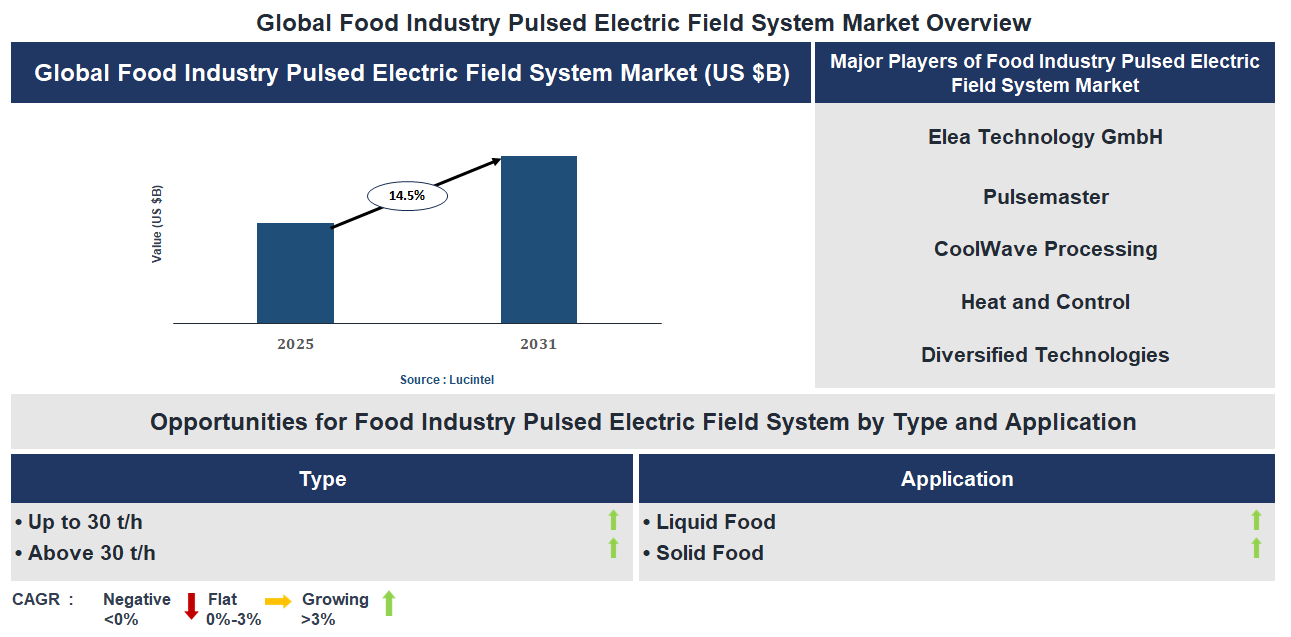
The future of the global food industry pulsed electric field system market looks promising with opportunities in the liquid food and solid food markets. The global food industry pulsed electric field system market is expected to grow with a CAGR of 14.5% from 2025 to 2031. The major drivers for this market are the increasing demand for food preservation methods, the rising preference for non-thermal processing technologies, and the growing focus on sustainability in food production.• Lucintel forecasts that, within the type category, above 30 t/h is expected to witness higher growth over the forecast period.
• Within the application category, liquid food is expected to witness higher growth.
• In terms of region, APAC is expected to witness the highest growth over the forecast period. Gain valuable insights for your business decisions with our comprehensive 150+ page report. Sample figures with some insights are shown below.
Emerging Trends in the Food Industry Pulsed Electric Field System Market
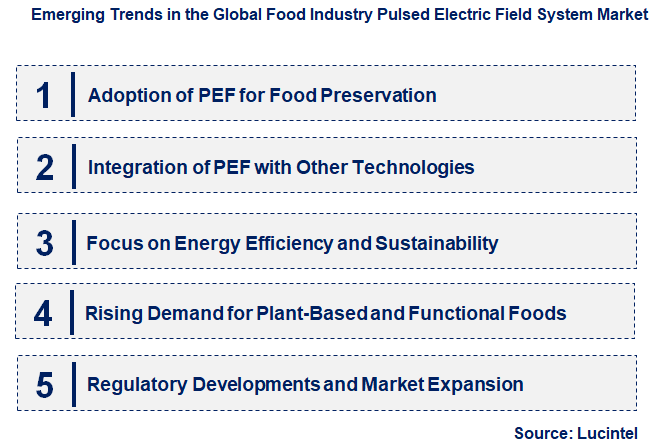
The food industry pulsed electric field system market is experiencing rapid growth driven by technological advancements, increasing consumer demand for minimally processed foods, and a focus on sustainable and energy-efficient processing methods. As food safety standards tighten and innovation accelerates, companies are adopting PEF technology to improve product quality, extend shelf life, and reduce processing costs. These developments are transforming traditional food processing paradigms, making the market highly dynamic and competitive. Understanding the key emerging trends is essential for stakeholders aiming to capitalize on this evolving landscape and stay ahead in the industry.• Adoption of PEF for Food Preservation: The use of Pulsed Electric Field technology for food preservation is expanding rapidly. PEF offers a non-thermal method to inactivate bacteria and enzymes, thereby extending shelf life without compromising nutritional quality. This trend is driven by consumer preferences for fresh, minimally processed foods and regulatory pressures for safer, preservative-free products. The technologys ability to reduce energy consumption and processing time further enhances its appeal. As a result, food manufacturers are increasingly integrating PEF into their preservation processes, leading to improved product safety, longer shelf life, and reduced reliance on chemical preservatives.
• Integration of PEF with Other Technologies: Combining PEF with other innovative processing methods such as high-pressure processing (HPP), ultrasound, and cold plasma is gaining traction. This integrated approach enhances overall efficiency, product quality, and safety. For example, PEF combined with HPP can achieve better microbial inactivation while preserving sensory attributes. This synergy allows for more versatile applications across different food categories, including juices, dairy, and meats. The integration also helps optimize processing parameters, reduce costs, and improve scalability, making advanced food processing more accessible to manufacturers.
• Focus on Energy Efficiency and Sustainability: The market is witnessing a shift towards more energy-efficient PEF systems that align with sustainability goals. Manufacturers are investing in systems that consume less power and generate minimal waste, reducing the environmental footprint of food processing. Innovations include improved electrode designs, better energy management software, and modular systems that adapt to various production scales. This trend not only appeals to environmentally conscious consumers but also helps companies meet regulatory standards and reduce operational costs. As sustainability becomes a core business objective, energy-efficient PEF systems are poised to dominate the market.
• Rising Demand for Plant-Based and Functional Foods: The surge in plant-based diets and functional foods is influencing PEF system adoption. PEF technology helps preserve the nutritional integrity and bioactive compounds in plant-based products, making them more appealing to health-conscious consumers. Additionally, PEF can enhance the extraction of valuable phytochemicals, improving product functionality. This trend supports the development of innovative plant-based beverages, snacks, and supplements with extended shelf life and improved sensory qualities. As consumer interest in health and wellness grows, the food industry is leveraging PEF to meet these evolving demands effectively.
• Regulatory Developments and Market Expansion: Increasing regulatory approvals and standards for PEF technology are facilitating market expansion. Governments and food safety authorities are recognizing PEF as a safe and effective processing method, encouraging its adoption across various regions. This regulatory support, coupled with growing awareness of its benefits, is opening new markets in emerging economies. Companies are also investing in research and development to meet evolving compliance requirements and to develop new applications. The expanding regulatory landscape is thus a key driver, enabling broader acceptance and integration of PEF systems in the global food industry. In summary, these emerging trends are collectively reshaping the food industry pulsed electric field system market by promoting technological innovation, sustainability, and consumer-centric product development. They are driving increased adoption, expanding market reach, and fostering a more efficient, safe, and sustainable food processing landscape.
Recent Development in the Food Industry Pulsed Electric Field System Market
The food industry pulsed electric field system market has experienced significant growth driven by technological advancements, increasing consumer demand for minimally processed foods, and rising focus on food safety and preservation. As the industry evolves, key developments are shaping the future landscape, influencing production processes, product quality, and market dynamics. These innovations are enabling manufacturers to improve efficiency, reduce energy consumption, and extend shelf life, thereby meeting consumer preferences and regulatory standards. The following are five key recent developments that are transforming the PEF system market and its applications within the food industry.• Technological Innovations in PEF Equipment: Development of more efficient, scalable, and cost-effective PEF systems has enhanced their adoption across various food processing sectors. These innovations include improved pulse generators, advanced electrode designs, and automation features, which increase processing speed and energy efficiency. As a result, manufacturers can process larger volumes with lower operational costs, making PEF technology more accessible and attractive for diverse applications.
• Expansion into New Food Categories: PEF technology is increasingly being applied beyond traditional juice and liquid foods to solid and semi-solid products such as meat, dairy, and plant-based foods. This expansion broadens market opportunities and allows for better preservation, texture modification, and microbial inactivation in a wider range of products. Consequently, food producers can offer safer, higher-quality products with extended shelf life, meeting consumer demand for fresh and minimally processed foods.
• Growing Focus on Food Safety and Shelf Life Extension: Rising concerns over foodborne illnesses and spoilage have driven the adoption of PEF systems for microbial inactivation. PEF offers a non-thermal method to effectively reduce pathogens without compromising nutritional quality. This development enhances food safety standards, reduces reliance on chemical preservatives, and extends product shelf life, thereby aligning with regulatory requirements and consumer preferences for clean-label foods.
• Integration with Other Preservation Technologies: Combining PEF with technologies such as high-pressure processing (HPP), ultrasound, or natural preservatives has created synergistic effects, improving overall efficacy. This integrated approach allows for more effective microbial control, better preservation of sensory and nutritional qualities, and reduced processing times. Such developments enable manufacturers to develop innovative products and optimize processing workflows, boosting market competitiveness.
• Increasing Adoption in Emerging Markets: Growing awareness of PEF benefits and supportive government initiatives are accelerating adoption in emerging economies. Investments in infrastructure, training, and research are facilitating market penetration in regions like Asia-Pacific and Latin America. This expansion not only increases market size but also promotes local food safety standards and product innovation, contributing to global industry growth. In summary, these recent developments are significantly impacting the food industry pulsed electric field system market by enhancing technological capabilities, expanding application scope, improving food safety, enabling integrated preservation solutions, and fostering market growth in emerging regions. Collectively, they are driving innovation, reducing costs, and meeting evolving consumer demands for safe, high-quality, minimally processed foods.
Strategic Growth Opportunities in the Food Industry Pulsed Electric Field System Market
The food industry pulsed electric field system market is experiencing rapid growth driven by increasing demand for minimally processed foods, enhanced food safety, and sustainable processing technologies. As consumer preferences shift towards healthier and preservative-free products, food manufacturers are adopting innovative processing methods like PEF to improve product quality and shelf life. This markets expansion is also fueled by technological advancements and regulatory support for non-thermal processing techniques. Key applications such as juice and beverage processing, meat and seafood preservation, dairy processing, fruit and vegetable treatment, and snack production are presenting significant growth opportunities. These developments are transforming the food processing landscape, offering new avenues for market players.• Juice and Beverage Processing: Enhanced preservation and extraction efficiency drive growth. PEF technology improves juice yield, preserves nutrients, and extends shelf life without heat, meeting consumer demand for fresh-tasting, minimally processed beverages. This results in higher product quality and reduced processing costs, boosting market adoption.
• Meat and Seafood Preservation: PEF offers effective microbial inactivation, extending shelf life and ensuring safety. Its ability to tenderize meat and improve texture without chemical additives makes it attractive for clean-label products. This application supports the shift towards natural, preservative-free meat and seafood products.
• Dairy Processing: PEF enhances milk and dairy product safety and quality by reducing microbial load while maintaining nutritional value. It enables cold pasteurization, reducing energy consumption and processing time, which benefits dairy manufacturers seeking sustainable solutions.
• Fruit and Vegetable Treatment: PEF facilitates cell membrane disruption, improving juice extraction and drying processes. It also helps in reducing microbial contamination, ensuring safety and extending shelf life. This application supports the demand for fresh, minimally processed produce.
• Snack and Confectionery Production: PEF technology is used to modify textures and improve flavor retention in snack foods. It also aids in sterilization, reducing reliance on chemical preservatives, aligning with consumer preferences for natural ingredients. In summary, these growth opportunities are significantly impacting the food industry pulsed electric field system market by enabling manufacturers to produce safer, higher-quality, and more sustainable products. The adoption of PEF technology across key applications is driving innovation, reducing processing times, and meeting evolving consumer demands, thereby fostering market expansion and competitive advantage.
Food Industry Pulsed Electric Field System Market Driver and Challenges
The food industry pulsed electric field system market is influenced by a variety of technological, economic, and regulatory factors. Advances in food preservation technology, increasing consumer demand for minimally processed foods, and stringent safety standards are key drivers. Additionally, economic growth in emerging markets and supportive government policies further propel market expansion. However, challenges such as high initial investment costs, regulatory hurdles, and technological limitations pose significant obstacles. Understanding these drivers and challenges is essential for stakeholders aiming to capitalize on opportunities and navigate potential risks within this evolving industry landscape. The factors responsible for driving the food industry pulsed electric field system market include:-• Technological Innovation: The development of advanced PEF systems enhances food preservation, extending shelf life while maintaining nutritional quality. This innovation attracts food manufacturers seeking efficient, eco-friendly alternatives to traditional methods. As technology becomes more cost-effective and scalable, adoption rates increase, fostering market growth. The continuous evolution of PEF technology also opens new applications across various food segments, further expanding market potential.
• Rising Consumer Demand for Healthy and Natural Foods: Consumers are increasingly seeking minimally processed, preservative-free foods. PEF technology aligns with this trend by offering a non-thermal preservation method that retains food’s natural flavors, nutrients, and textures. This demand drives food producers to adopt PEF systems to meet consumer preferences, thereby fueling market expansion and innovation.
• Regulatory Support and Food Safety Standards: Governments and regulatory bodies worldwide are emphasizing food safety and quality. PEF systems are recognized for their ability to reduce microbial load without chemical additives, aligning with safety standards. Supportive policies, certifications, and incentives encourage food companies to implement PEF technology, boosting market growth.
• Economic Growth and Market Expansion in Emerging Regions: Rapid economic development in regions such as Asia-Pacific and Latin America increases disposable incomes and urbanization. This growth leads to higher demand for processed and convenience foods, which benefits PEF system adoption. Local manufacturers are investing in advanced preservation technologies to meet global standards, further expanding the market. The challenges in the food industry pulsed electric field system market are:-
• High Capital Investment and Operational Costs: Implementing PEF technology requires significant upfront capital for equipment purchase and installation. Additionally, operational costs, including maintenance and energy consumption, can be substantial. These financial barriers limit adoption among small and medium-sized enterprises, restricting market penetration and slowing overall growth.
• Regulatory and Certification Hurdles: Despite supportive policies, the regulatory landscape for PEF technology varies across regions and is often complex. Obtaining necessary approvals and certifications can be time-consuming and costly, delaying product launches and market entry. This uncertainty hampers innovation and discourages investment in new PEF applications.
• Technological Limitations and Scalability Issues: While PEF technology is promising, it faces challenges related to scalability and consistency. Larger-scale systems may encounter technical difficulties, affecting uniformity and efficiency. These limitations hinder widespread industrial adoption and require ongoing research and development to overcome, impacting market expansion. In summary, the food industry pulsed electric field system market is driven by technological advancements, consumer preferences for natural foods, regulatory support, and economic growth in emerging markets. However, high costs, regulatory complexities, and technological limitations pose significant challenges. These factors collectively shape the market’s trajectory, requiring stakeholders to innovate and adapt strategically. The overall impact suggests a promising yet cautious growth outlook, emphasizing the need for continued technological development and regulatory clarity to unlock the full potential of PEF systems in the food industry.
List of Food Industry Pulsed Electric Field System Companies
Companies in the market compete on the basis of product quality offered. Major players in this market focus on expanding their manufacturing facilities, R&D investments, infrastructural development, and leverage integration opportunities across the value chain. With these strategies food industry pulsed electric field system companies cater increasing demand, ensure competitive effectiveness, develop innovative products & technologies, reduce production costs, and expand their customer base. Some of the food industry pulsed electric field system companies profiled in this report include-• Elea Technology GmbH
• Pulsemaster
• CoolWave Processing
• Heat and Control
• Diversified Technologies
Food Industry Pulsed Electric Field System Market by Segment
The study includes a forecast for the global food industry pulsed electric field system market by type, application, and region.Food Industry Pulsed Electric Field System Market by Type [Value from 2019 to 2031]:
• Up to 30 t/h
• Above 30 t/h
Food Industry Pulsed Electric Field System Market by Application [Value from 2019 to 2031]:
• Liquid Food
• Solid Food
Food Industry Pulsed Electric Field System Market by Region [Value from 2019 to 2031]:
• North America
• Europe
• Asia Pacific
• The Rest of the World
Country Wise Outlook for the Food Industry Pulsed Electric Field System Market
The food industry pulsed electric field system market is experiencing rapid growth driven by technological advancements, increasing consumer demand for minimally processed foods, and rising focus on food safety and preservation. Countries are adopting innovative PEF technologies to improve product quality, extend shelf life, and reduce energy consumption. Regulatory support and investments in research are further accelerating market expansion. Each country’s unique economic, technological, and regulatory landscape influences its development trajectory, leading to diverse adoption patterns and innovations across regions.• United States: The US market is witnessing significant growth due to technological innovation and strong consumer demand for fresh, minimally processed foods. Leading companies are investing in R&D to improve PEF efficiency and scalability. Regulatory agencies are providing supportive frameworks, encouraging adoption in food preservation and safety. The US also sees increased collaborations between academia and industry to develop advanced PEF applications, especially in juice and dairy processing.
• China: China’s market is rapidly expanding, driven by a large population and rising health consciousness. The government is supporting food safety initiatives, which include adopting PEF technology to enhance preservation and reduce chemical additives. Domestic companies are investing heavily in PEF research and infrastructure, aiming to improve food quality and shelf life. The growth is also fueled by increasing exports of processed foods that benefit from PEF technology.
• Germany: Germany leads in technological innovation within Europe, with a focus on sustainable and energy-efficient PEF systems. The country’s strict food safety regulations and emphasis on organic and minimally processed foods promote PEF adoption. Several startups and established firms are developing advanced PEF solutions tailored for dairy, meat, and beverage industries. Germany’s strong research institutions are collaborating with industry to optimize PEF processes and reduce operational costs.
• India: India’s market is emerging, with increasing awareness of food safety and quality. The government’s initiatives to modernize food processing infrastructure are encouraging PEF technology adoption. Local companies are exploring cost-effective PEF systems suitable for small and medium enterprises. The focus is on extending shelf life and reducing food wastage, especially in perishable products like fruits and vegetables. Investment in R&D is growing, supported by international collaborations.
• Japan: Japan’s market is characterized by high technological adoption and a focus on innovation. The country is integrating PEF systems into its advanced food processing industry to improve efficiency and product quality. Consumer preferences for healthy and minimally processed foods are driving demand. Japanese companies are investing in developing compact, energy-efficient PEF systems suitable for small-scale and specialty food production. Regulatory support and a strong emphasis on food safety are further propelling market growth.

Features of the Global Food Industry Pulsed Electric Field System Market
Market Size Estimates: Food industry pulsed electric field system market size estimation in terms of value ($B). Trend and Forecast Analysis: Market trends (2019 to 2024) and forecast (2025 to 2031) by various segments and regions. Segmentation Analysis: Food industry pulsed electric field system market size by type, application, and region in terms of value ($B). Regional Analysis: Food industry pulsed electric field system market breakdown by North America, Europe, Asia Pacific, and Rest of the World. Growth Opportunities: Analysis of growth opportunities in different types, applications, and regions for the food industry pulsed electric field system market. Strategic Analysis: This includes M&A, new product development, and competitive landscape of the food industry pulsed electric field system market. Analysis of competitive intensity of the industry based on Porter’s Five Forces model.
FAQ
Q1. What is the growth forecast for food industry pulsed electric field system market? Answer: The global food industry pulsed electric field system market is expected to grow with a CAGR of 14.5% from 2025 to 2031. Q2. What are the major drivers influencing the growth of the food industry pulsed electric field system market? Answer: The major drivers for this market are the increasing demand for food preservation methods, the rising preference for non-thermal processing technologies, and the growing focus on sustainability in food production. Q3. What are the major segments for food industry pulsed electric field system market? Answer: The future of the food industry pulsed electric field system market looks promising with opportunities in the liquid food and solid food markets. Q4. Who are the key food industry pulsed electric field system market companies? Answer: Some of the key food industry pulsed electric field system companies are as follows:• Elea Technology GmbH
• Pulsemaster
• CoolWave Processing
• Heat and Control
• Diversified Technologies Q5. Which food industry pulsed electric field system market segment will be the largest in future? Answer: Lucintel forecasts that, within the type category, above 30 t/h is expected to witness higher growth over the forecast period. Q6. In food industry pulsed electric field system market, which region is expected to be the largest in next 5 years? Answer: In terms of region, APAC is expected to witness the highest growth over the forecast period. Q7. Do we receive customization in this report? Answer: Yes, Lucintel provides 10% customization without any additional cost.
Table of Contents
List of Figures
List of Tables
Methodology
- In-depth interviews of the major players in this market
- Detailed secondary research from competitors’ financial statements and published data
- Extensive searches of published works, market, and database information pertaining to industry news, company press releases, and customer intentions
- A compilation of the experiences, judgments, and insights of Lucintel’s professionals, who have analyzed and tracked this market over the years.


Buy Now
Choose a license that fits your team. Instant PDF delivery.
Prices exclude taxes. Instant delivery. Custom licensing available on request.
Key Questions
- • What are some of the most promising, high-growth opportunities for the food industry pulsed electric field system market by type (up to 30 t/h and above 30 t/h), application (liquid food and solid food), and region (North America, Europe, Asia Pacific, and the Rest of the World)?
- • Which segments will grow at a faster pace and why?
- • Which region will grow at a faster pace and why?
- • What are the key factors affecting market dynamics? What are the key challenges and business risks in this market?
- • What are the business risks and competitive threats in this market?
- • What are the emerging trends in this market and the reasons behind them?
- • What are some of the changing demands of customers in the market?
- • What are the new developments in the market? Which companies are leading these developments?
- • Who are the major players in this market? What strategic initiatives are key players pursuing for business growth?
- • What are some of the competing products in this market and how big of a threat do they pose for loss of market share by material or product substitution?
- • What M&A activity has occurred in the last 5 years and what has its impact been on the industry? For any questions related to Food Industry Pulsed Electric Field System Market, Food Industry Pulsed Electric Field System Market Size, Food Industry Pulsed Electric Field System Market Growth, Food Industry Pulsed Electric Field System Market Analysis, Food Industry Pulsed Electric Field System Market Report, Food Industry Pulsed Electric Field System Market Share, Food Industry Pulsed Electric Field System Market Trends, Food Industry Pulsed Electric Field System Market Forecast, Food Industry Pulsed Electric Field System Companies, write Lucintel analyst at email: helpdesk@lucintel.com. We will be glad to get back to you soon.


