
Market Report · July 22, 2026

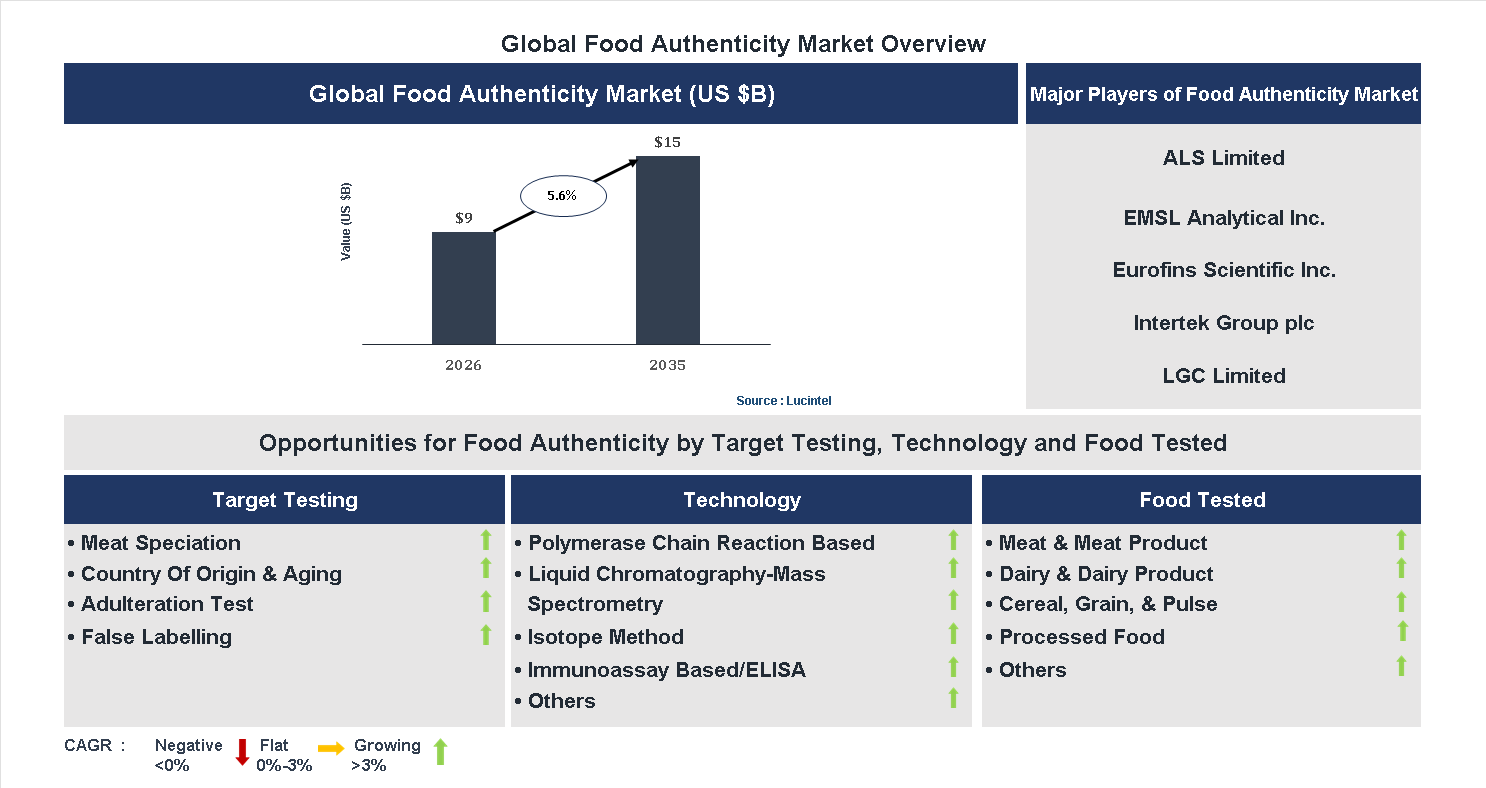
Key data points: The market size in 2035 = $15 billion, growth forecast = 5.6% annually for the next 8 years. Scroll below to get more insights. This market report covers trends, opportunities and forecasts in food authenticity market to 2035 by target testing (meat speciation, country of origin & aging, adulteration test, and false labelling), technology (polymerase chain reaction based, liquid chromatography-mass spectrometry, isotope method, immunoassay based/ELISA, and others), food tested (meat & meat product, dairy & dairy product, cereal, grain, & pulse, processed food, and others), and region (North America, Europe, Asia Pacific, and the Rest of the World)
We'll send your sample report shortly.
• Lucintel forecasts that, within the target testing category, adulteration test is expected to witness the highest growth over the forecast period.
• Within the food tested category, meat & meat product is expected to witness the highest growth.
• In terms of region, APAC is expected to witness the highest growth over the forecast period. Gain valuable insights for your business decisions with our comprehensive 150+ page report. Sample figures with some insights are shown below.
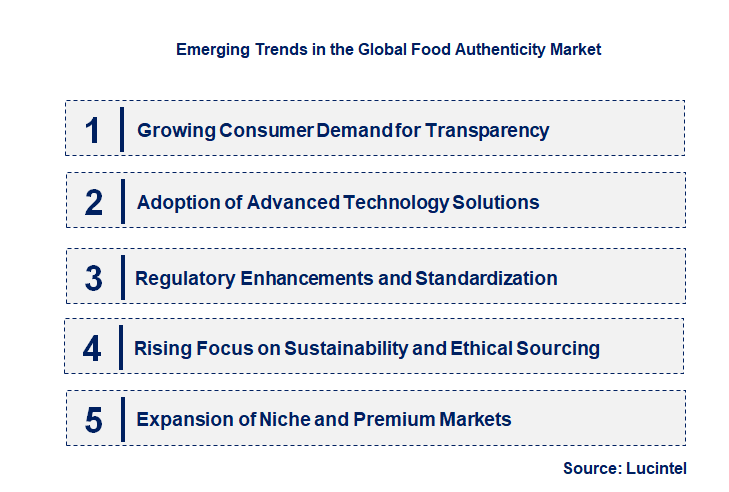
• Growing Consumer Demand for Transparency: Consumers are increasingly seeking detailed information about food origins, ingredients, and production processes. This demand is driven by health concerns, ethical considerations, and a desire for sustainable choices. As a result, brands are investing in traceability technologies and transparent labeling to build trust and differentiate themselves in a competitive market. This trend encourages companies to adopt more rigorous authenticity verification methods, ultimately fostering a more informed and empowered consumer base.
• Adoption of Advanced Technology Solutions: Technologies such as blockchain, DNA testing, and spectroscopy are becoming integral to verifying food authenticity. Blockchain provides secure, transparent records of supply chains, while DNA testing confirms species and origin. Spectroscopy offers rapid, non-destructive analysis of food products. These innovations enhance accuracy, reduce fraud, and streamline compliance with regulations. The integration of such technologies is transforming quality assurance processes, making authenticity verification more reliable and efficient across the supply chain.
• Regulatory Enhancements and Standardisation: Governments and industry bodies are implementing stricter regulations and standards to combat food fraud and ensure authenticity. Initiatives include mandatory labeling, certification schemes, and testing protocols. These measures aim to protect consumers, promote fair trade, and maintain market integrity. Increased regulatory oversight compels companies to adopt more rigorous verification practices, fostering greater transparency and accountability within the food supply chain.
• Rising Focus on Sustainability and Ethical Sourcing: Consumers and companies are prioritizing sustainability and ethical practices in food production. Authenticity verification now extends to environmental impact, fair labor practices, and sustainable sourcing. Certifications such as organic, fair trade, and eco-labels are gaining prominence. This trend encourages brands to adopt responsible sourcing strategies and transparent reporting, aligning market offerings with ethical consumer values and promoting long-term sustainability.
• Expansion of Niche and Premium Markets: Authenticity is increasingly a key differentiator in premium and niche food segments, such as organic, artisanal, and specialty products. Consumers are willing to pay a premium for verified authenticity and quality assurance. This trend drives innovation in product development, marketing, and certification processes, creating opportunities for brands to establish premium positioning and build consumer loyalty through verified authenticity. These trends are fundamentally reshaping the food authenticity market by fostering greater transparency, leveraging innovative technologies, strengthening regulatory frameworks, emphasizing sustainability, and expanding premium offerings. Collectively, they are enhancing consumer trust, reducing fraud, and promoting a more sustainable and ethical food industry.
• Growing Consumer Demand for Transparency: Consumers seek verified, authentic food products, pushing brands to adopt advanced testing and certification methods to ensure product integrity and build trust.
• Technological Advancements in Testing Methods: Innovations like DNA analysis and blockchain enhance traceability and authenticity verification, reducing fraud and increasing consumer confidence.
• Stricter Government Regulations: Governments worldwide are implementing tighter standards and labeling requirements, encouraging industry compliance and fostering a more trustworthy market environment.
• Rising Popularity of Organic and Local Foods: Consumers favor organic and locally sourced products, prompting brands to authenticate supply chains and promote genuine origin claims.
• Expansion of E-commerce Platforms: Online sales channels facilitate access to authentic products globally, increasing market reach and consumer awareness about product origins and quality. These developments are significantly impacting the food authenticity market by fostering greater consumer trust, ensuring product safety, and encouraging innovation. Enhanced transparency and regulatory compliance are driving industry standards upward, leading to increased market growth and competitiveness. As technology and consumer preferences evolve, the market is poised for sustained expansion, benefiting both consumers and industry stakeholders through improved product integrity and confidence.
• Growing Demand for Supply Chain Transparency: The increasing consumer focus on food safety and origin verification is driving the adoption of advanced testing and authentication methods. Companies are investing in blockchain, DNA-based testing, and spectrometry to ensure product authenticity from farm to fork. This trend enhances traceability, reduces fraud, and builds consumer trust, creating significant growth opportunities for providers of food authenticity solutions across global markets.
• Expansion of Regulatory Compliance and Standards: Governments and industry bodies are implementing stricter regulations to combat food fraud and ensure product integrity. This regulatory environment compels food producers and retailers to adopt authentication technologies such as isotope analysis and molecular diagnostics. The need to meet compliance standards fosters innovation and investment in authentication solutions, opening new markets and increasing demand for reliable, scalable verification systems.
• Adoption of Advanced Testing Technologies: Innovations like portable spectrometers, rapid DNA testing kits, and AI-powered data analysis are transforming food authenticity verification. These technologies enable faster, more accurate detection of adulteration and mislabeling at various points in the supply chain. As technology costs decrease and accessibility improves, more stakeholders can implement these solutions, significantly expanding the market for advanced testing tools.
• Rising Consumer Awareness and Preference for Authentic Products: Consumers are increasingly seeking transparency about food origins, ingredients, and production methods. This shift influences brands to prioritize authenticity verification to differentiate themselves and meet consumer expectations. Companies investing in traceability and certification programs can enhance brand loyalty and market share, fueling growth in authentication services and solutions tailored to consumer-facing applications.
• Integration of Blockchain and Digital Solutions for Traceability: Blockchain technology offers immutable records of product history, enhancing transparency and reducing fraud. Its integration with IoT sensors and data analytics provides real-time tracking and verification of food products. This technological synergy supports end-to-end traceability, appeals to regulatory bodies, and reassures consumers, creating a robust growth avenue for digital authentication platforms and fostering trust across the food supply chain. The food authenticity market is poised for substantial growth as technological innovations, regulatory pressures, and consumer preferences converge. These opportunities enable stakeholders to enhance transparency, reduce fraud, and meet evolving standards, ultimately strengthening trust in food products. Embracing these developments will drive market expansion, foster innovation, and support sustainable growth within the global food industry.
• Increasing Consumer Awareness: Consumers are more informed and concerned about food safety, origin, and quality, leading to higher demand for authentic products. This shift is driven by rising incidences of food fraud and contamination scandals, prompting consumers to seek verified and transparent food sources. As a result, brands and retailers are investing in authenticity verification to build trust, which fuels market growth. The demand for organic, non-GMO, and locally sourced foods further amplifies this trend, creating a robust market for authenticity solutions.
• Technological Advancements: Innovations such as DNA fingerprinting, isotope analysis, and blockchain technology are revolutionizing food verification processes. These tools enable precise identification of food origin, composition, and authenticity, reducing fraud and ensuring compliance with safety standards. Blockchain, in particular, offers transparent, tamper-proof supply chain records, enhancing traceability from farm to fork. The adoption of these technologies improves consumer confidence and streamlines regulatory compliance, thereby accelerating market expansion and encouraging investment in authenticity solutions.
• Regulatory and Certification Standards: Governments and international bodies are implementing stricter regulations and certification protocols to combat food fraud and ensure authenticity. Standards such as ISO certifications, HACCP, and country-specific labeling requirements compel producers and suppliers to adopt verification measures. These regulations not only protect consumers but also create a competitive advantage for compliant companies. The evolving regulatory landscape encourages innovation in testing and certification methods, fostering growth in the food authenticity market.
• Growing Global Trade and Supply Chain Complexity: The globalization of food supply chains has increased the complexity and risk of food fraud. Multiple intermediaries, long transportation routes, and diverse sourcing increase the likelihood of adulteration and mislabeling. This complexity necessitates advanced authenticity verification to ensure product integrity across borders. As international trade expands, so does the need for standardized testing and traceability solutions, driving market demand for reliable authenticity measures and fostering cross-border collaborations.
• Rising Investment and Market Initiatives: Increased investments from private and public sectors are fueling research, development, and deployment of food authenticity technologies. Initiatives by governments, industry consortia, and startups aim to develop cost-effective, scalable solutions for verifying food origin and safety. Funding for innovation accelerates the adoption of new testing methods and digital platforms, expanding market reach. These investments also promote awareness and education, encouraging stakeholders to prioritize authenticity, which sustains long-term market growth. The challenges facing the food authenticity market include:
• High Testing and Certification Costs: Implementing advanced authenticity verification methods often involves significant expenses, including sophisticated laboratory equipment, skilled personnel, and ongoing testing. Small and medium-sized enterprises may find these costs prohibitive, limiting their ability to comply with standards and participate fully in the market. This financial barrier can hinder widespread adoption of authenticity solutions, creating disparities between large corporations and smaller players, and potentially slowing overall market growth.
• Regulatory Inconsistencies and Lack of Standardization: Variations in regulations and standards across countries and regions pose challenges for global food authenticity verification. Inconsistent requirements can lead to confusion, increased compliance costs, and delays in product approval. The absence of universally accepted testing protocols complicates cross-border trade and hampers the development of integrated supply chain solutions. This fragmentation undermines consumer confidence and can impede the harmonization necessary for a truly global market.
• Consumer Skepticism and Lack of Awareness: Despite rising concerns, some consumers remain skeptical about the effectiveness of authenticity verification methods or are unaware of the importance of food traceability. Misinformation and distrust in certification labels can diminish demand for verified products. Overcoming this skepticism requires extensive education and transparent communication, which can be resource-intensive. Without consumer buy-in, market growth may be constrained, and the full potential of authenticity solutions may not be realized. The food authenticity market is driven by technological innovations, increasing consumer awareness, regulatory pressures, and globalization, all of which create significant growth opportunities. However, high costs, regulatory disparities, and consumer skepticism present notable challenges that could hinder progress. Addressing these issues through technological advancements, standardization efforts, and consumer education will be crucial for sustainable market development. Overall, the markets future depends on balancing these drivers and challenges to foster trust, innovation, and global cooperation.
• ALS Limited
• EMSL Analytical Inc.
• Eurofins Scientific Inc.
• Intertek Group plc
• LGC Limited
• Mérieux NutriSciences
• Microbac Laboratories Inc.
• Meat Speciation
• Country Of Origin & Aging
• Adulteration Test
• False Labelling
• Polymerase Chain Reaction Based
• Liquid Chromatography-Mass Spectrometry
• Isotope Method
• Immunoassay Based/ELISA
• Others
• Meat & Meat Product
• Dairy & Dairy Product
• Cereal, Grain, & Pulse
• Processed Food
• Others
• North America
• Europe
• Asia Pacific
• The Rest of the World
• United States: The U.S. market has experienced rapid adoption of advanced testing technologies such as DNA analysis and blockchain for traceability. Regulatory agencies like the FDA have increased efforts to combat food fraud, leading to stricter compliance standards. Consumer demand for organic and authentic products has driven innovation in labeling and certification processes. Additionally, collaborations between private companies and government bodies are enhancing supply chain transparency. The market is also witnessing growth in startups offering rapid testing kits, making authenticity verification more accessible to producers and consumers.
• China: China has intensified efforts to combat food fraud through the implementation of stricter regulations and enhanced surveillance systems. The government has invested heavily in developing advanced testing laboratories and technologies such as near-infrared spectroscopy and DNA barcoding. Consumer awareness about food safety has increased, prompting brands to adopt more transparent practices. E-commerce platforms are also adopting authenticity verification measures to build consumer trust. The market is witnessing a rise in domestic testing service providers and international collaborations to improve food authenticity standards across the supply chain.
• Germany: Germanys food authenticity market is characterized by rigorous regulatory frameworks and high consumer expectations for quality. The country has adopted cutting-edge analytical techniques like mass spectrometry and isotope analysis to verify product origins and authenticity. The integration of digital traceability systems is becoming more prevalent, ensuring transparency from farm to fork. German companies are also investing in research to develop non-invasive testing methods. The emphasis on organic and sustainable food products has further driven demand for reliable authenticity verification, positioning Germany as a leader in food safety and quality assurance within Europe.
• India: India is witnessing a surge in demand for authentic and safe food products, driven by increasing awareness and regulatory reforms. The government has introduced stricter food safety standards and is promoting the use of advanced testing methods such as chromatography and DNA fingerprinting. Local startups are emerging with innovative solutions for rapid testing and verification. The organic food sector is expanding, requiring robust authenticity checks. Additionally, efforts to improve supply chain transparency are underway, especially in rural and semi-urban markets, to combat food adulteration and ensure consumer trust.
• Japan: Japans market emphasizes high standards of food authenticity, supported by advanced technological adoption. The country employs sophisticated techniques like isotope ratio mass spectrometry and DNA analysis to verify product origins, especially for seafood and premium ingredients. Consumer preferences for authentic, high-quality food have led to increased use of blockchain and digital traceability systems. Japan also collaborates with international agencies to harmonize standards and improve verification processes. The focus on sustainability and organic products further enhances the demand for reliable authenticity testing, positioning Japan as a key player in maintaining food integrity in Asia.


• ALS Limited
• EMSL Analytical Inc.
• Eurofins Scientific Inc.
• Intertek Group plc
• LGC Limited
• Mérieux NutriSciences
• Microbac Laboratories Inc. Q6. Which food authenticity market segment will be the largest in future? Answer: Lucintel forecasts that, within the target testing category, adulteration test is expected to witness the highest growth over the forecast period. Q7. In food authenticity market, which region is expected to be the largest in next 5 years? Answer: In terms of region, APAC is expected to witness the highest growth over the forecast period. Q8. Do we receive customization in this report? Answer: Yes, Lucintel provides 10% customization without any additional cost.


Choose a license that fits your team. Instant PDF delivery.
Prices exclude taxes. Instant delivery. Custom licensing available on request.
Market Report · July 22, 2026
Market Report · July 22, 2026
Market Report · July 22, 2026
Trusted partner for strategic intelligence and business growth


Receive a complimentary market analysis tailored to your industry. Our analysts will identify key growth opportunities and competitive dynamics specific to your business.

Market size, growth rate, and key trend analysis for your specific sector.

Top competitor positioning and market share analysis.

Strategic recommendations backed by data-driven insights.
Get curated market intelligence and competitive moves straight to your inbox.
By subscribing, you agree to receive our monthly insights. Unsubscribe anytime.
Receive a complimentary market analysis tailored to your industry. Our analysts will identify key growth opportunities and competitive dynamics specific to your business.
Market size, growth rate, and key trend analysis for your specific sector.
Top competitor positioning and market share analysis.
Strategic recommendations backed by data-driven insights.
Get curated market intelligence, emerging trends, and competitive moves straight to your inbox each month.
By subscribing, you agree to receive our monthly insights. Unsubscribe anytime.
We'll send your sample report shortly.