
Report Feature
Foam Plastic Market Trends and Forecast
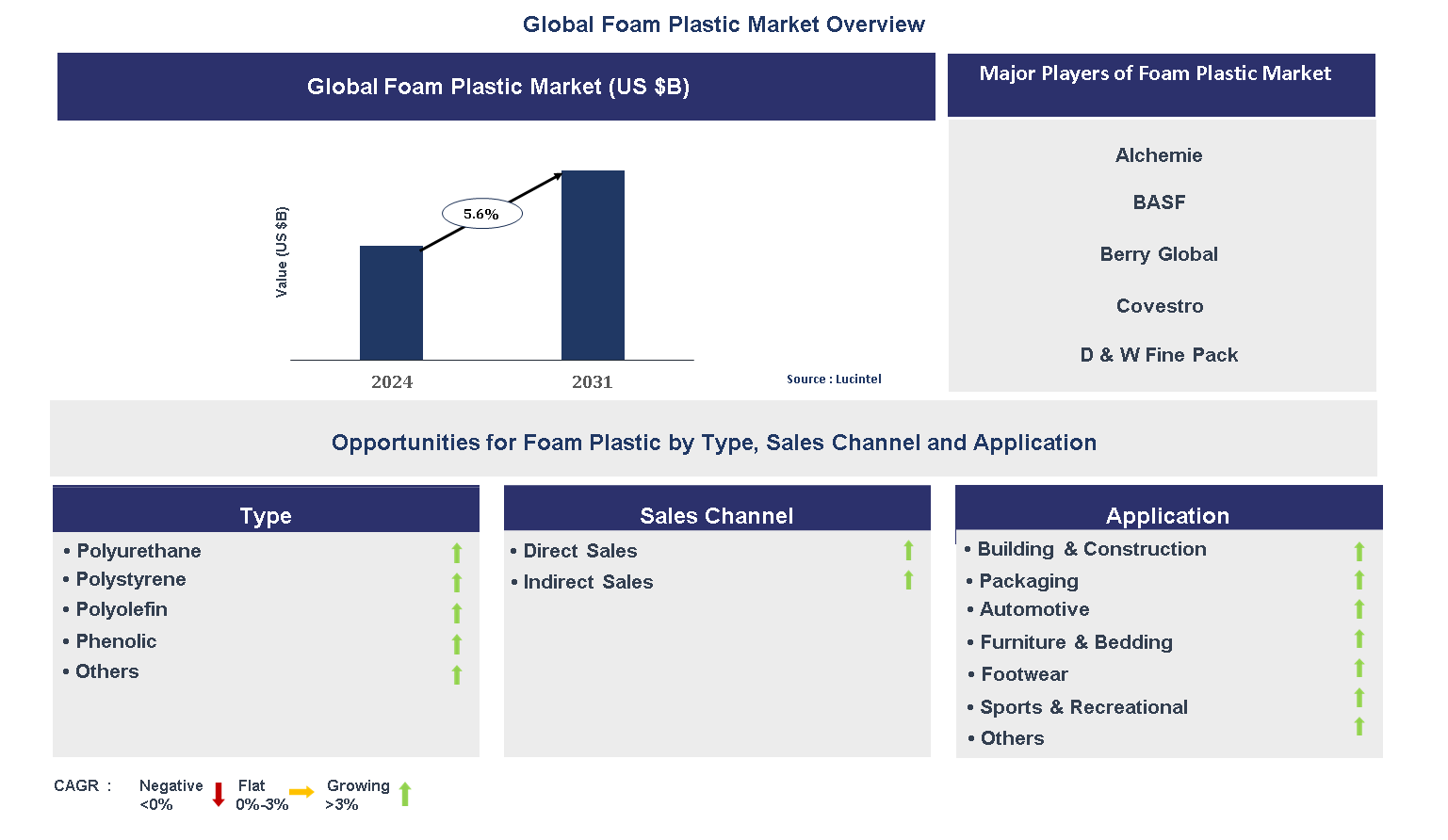
The future of the global foam plastic market looks promising with opportunities in the building & construction, packaging, automotive, furniture & bedding, footwear, and sport & recreational markets. The global foam plastic market is expected to grow with a CAGR of 5.6% from 2025 to 2031. The major drivers for this market are the increasing demand for lightweight automotive materials, the rising use in construction for insulation, and the growing adoption in packaging & cushioning solutions.• Lucintel forecasts that, within the type category, polyurethane is expected to witness the highest growth over the forecast period.
• Within the application category, building & construction is expected to witness the highest growth.
• In terms of region, APAC is expected to witness the highest growth over the forecast period. Gain valuable insights for your business decisions with our comprehensive 150+ page report. Sample figures with some insights are shown below.
Emerging Trends in the Foam Plastic Market
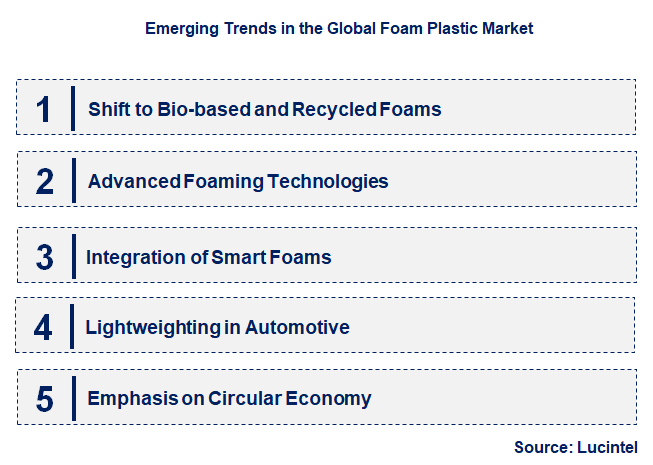
The foam plastic market is being reshaped by several powerful trends that are pushing the industry towards greater sustainability, efficiency, and advanced functionality. These emerging developments reflect a global response to environmental concerns and the demand for smarter materials. The focus is shifting from a commodity-based market to one that provides innovative, high-value solutions.• Shift to Bio-based and Recycled Foams: This trend involves using renewable raw materials or recycled plastics to create foam products. Its impact is a reduction in the carbon footprint and reliance on fossil fuels, appealing to environmentally conscious consumers and helping companies meet sustainability targets and regulatory requirements.
• Advanced Foaming Technologies: Innovations in manufacturing, such as supercritical fluid foaming and physical blowing agents, are becoming more prevalent. This leads to the production of foams with finer cell structures, resulting in improved thermal insulation and mechanical properties. This enhances product performance and broadens application possibilities.
• Integration of Smart Foams: The development of "smart" foams that can sense and respond to changes in their environment is a key trend. This impacts the market by creating high-value niche applications in areas like medical devices, wearable electronics, and smart packaging, opening up new and lucrative market segments.
• Lightweighting in Automotive: The automotive industry is increasingly adopting foam plastics to reduce vehicle weight. This trend directly impacts fuel efficiency and reduces emissions, which is a major regulatory and consumer concern. Foam plastics offer a high strength-to-weight ratio, making them ideal for a range of components.
• Emphasis on Circular Economy: Manufacturers are focusing on designing foam plastics that are easier to recycle and can be reintegrated into the production cycle. This reshapes the market by promoting waste reduction and resource efficiency, which is a significant factor in a world grappling with plastic waste and raw material scarcity. These trends are collectively reshaping the foam plastic market by steering it towards a more sustainable, technologically advanced, and consumer-centric future. The industry is moving away from a traditional manufacturing model to one that is driven by innovation and a commitment to circularity, creating a more responsible and dynamic market.
Recent Development in the Foam Plastic Market
The foam plastic market is experiencing a wave of recent developments driven by technological innovation and shifting industry demands. These changes are impacting how foam plastics are manufactured, their applications, and their end-of-life management. The market is actively responding to the need for greater efficiency and sustainability.• Focus on Bio-based Foams: The industry is heavily investing in research and development to create foams from renewable sources, such as starch or plant-based oils. The impact is a direct effort to reduce dependence on petrochemicals, lower the environmental footprint of foam production, and meet the growing demand for sustainable materials.
• Adoption of Advanced Manufacturing Techniques: New production methods, like physical foaming with eco-friendly blowing agents (e.g., CO2), are gaining traction. This development’s impact is a reduction in the use of harmful chemical agents, leading to a safer and more environmentally sound manufacturing process while also improving the quality and performance of the final product.
• Integration into Lightweighting Initiatives: Foam plastics are increasingly being used in industries, especially automotive and aerospace, for "lightweighting" applications. The impact of this is a significant improvement in fuel efficiency and a reduction in greenhouse gas emissions. Foam’s high strength-to-weight ratio makes it ideal for these applications.
• Development of Recyclable Foam Systems: Manufacturers are focusing on creating foam plastics that are easier to collect, sort, and process for recycling. This development’s impact is a step towards a circular economy, which helps address the global plastic waste problem and creates a new revenue stream from recycled materials.
• Rise of Smart and Functional Foams: There is growing interest in developing foam plastics with built-in functionalities, such as conductivity, fire resistance, or antimicrobial properties. The impact is the creation of high-value, specialized products for industries like healthcare, electronics, and technical textiles, expanding the market into niche areas. These recent developments are collectively transforming the foam plastic market by pushing it towards a more sustainable and technologically sophisticated future. The industry is moving from a traditional, volume-based approach to a more innovative, value-driven one, ensuring it remains a vital and responsible player in the global economy.
Strategic Growth Opportunities in the Foam Plastic Market
Strategic growth opportunities in the foam plastic market are emerging across a diverse range of applications, driven by the demand for high-performance and sustainable materials. These opportunities extend beyond traditional uses, enabling manufacturers to innovate and expand their market presence.• Building and Construction Insulation: The increasing global focus on energy efficiency in buildings presents a major growth opportunity for foam plastics. The impact is a sustained, high-volume demand for insulation materials like polyurethane and polystyrene foams, as they are crucial for reducing energy consumption and lowering heating and cooling costs.
• Automotive Lightweighting: The automotive industry’s push for improved fuel efficiency and reduced emissions offers a significant opportunity for foam plastics. The impact is a growing market for lightweight foam components for car seats, dashboards, and body panels, which contributes to overall vehicle weight reduction and enhances performance.
• Protective Packaging for E-commerce: The booming e-commerce sector is creating a huge demand for lightweight, durable, and protective packaging materials. The impact is a rapidly expanding market for foam plastics that can absorb shocks and protect delicate items during transit, ensuring product integrity and reducing shipping costs.
• Medical and Healthcare Devices: The healthcare sector presents a high-value opportunity for specialized foam plastics used in medical devices and equipment. The impact is a growing market for hygienic, lightweight, and customizable foams used in wound dressings, prosthetics, and medical packaging, where performance and safety are paramount.
• Sports and Recreational Equipment: The sports industry offers a growing opportunity for foam plastics in the production of protective gear and equipment. The impact is driven by the demand for lightweight, shock-absorbing materials for helmets, padding, and footwear, which enhance athlete safety and comfort while also improving performance. These strategic growth opportunities are reshaping the foam plastic market by diversifying its applications and pushing for innovation. By targeting these high-growth sectors, manufacturers can not only expand their market share but also create high-value products that meet the specific needs of a modern and discerning customer base.
Foam Plastic Market Driver and Challenges
The foam plastic market is a dynamic industry shaped by a combination of powerful drivers and significant challenges. The major drivers include increasing demand for lightweight and sustainable materials and innovation in manufacturing, while key challenges such as environmental concerns and volatile raw material prices pose hurdles. The factors responsible for driving the foam plastic market include: 1. Growing Construction and Infrastructure: The global boom in construction, driven by urbanization and renovation projects, is a primary driver. The implication is a continuous high demand for foam plastics in insulation, roofing, and structural applications, as they improve energy efficiency and reduce building costs. 2. Demand for Lightweight Automotive Parts: The automotive industry’s drive to improve fuel efficiency and reduce emissions is a key driver. The implication is an increased use of foam plastics in vehicle interiors and body components, as their light weight helps reduce the overall mass of the vehicle. 3. Expansion of E-commerce Packaging: The rapid growth of the e-commerce sector has created a huge demand for protective packaging. The implication is a sustained demand for foam plastics that can provide excellent cushioning and protection for products during shipping, ensuring they arrive safely to the consumer. 4. Technological Innovation: Ongoing advancements in manufacturing processes and material science are a major driver. The implication is the development of foams with superior properties, such as enhanced insulation and flame resistance, which enables new applications and reinforces foam plastics’ competitive edge. 5. Sustainability and Bio-based Foams: The growing consumer and regulatory push for sustainable materials is a powerful driver. The implication is that manufacturers are compelled to innovate and offer bio-based and recycled foam products, creating a new, environmentally friendly market segment. Challenges in the foam plastic market are: 1. Environmental and Disposal Concerns: The non-biodegradable nature of many traditional foam plastics is a significant challenge. The implication is that a negative public perception and stringent regulations on plastic waste and single-use foam are forcing the industry to invest heavily in recycling and alternative materials. 2. Volatile Raw Material Prices: The primary raw materials for foam plastics are petroleum derivatives, whose prices are subject to global fluctuations. The implication is that manufacturers face unstable production costs, which can impact profitability and make it difficult to maintain stable pricing and financial predictability. 3. Regulatory Scrutiny: Governments worldwide are implementing stricter regulations on the production and use of certain foam plastics and their blowing agents. The implication is that companies must invest in new, more compliant technologies and materials, which can be costly and slow down innovation. The foam plastic market is at a pivotal point, with its growth being propelled by strong demand from key industries, while simultaneously navigating significant environmental and economic challenges. The industry’s ability to innovate towards sustainable solutions and overcome regulatory hurdles will determine its long-term viability and success.List of Foam Plastic Companies
Companies in the market compete on the basis of product quality offered. Major players in this market focus on expanding their manufacturing facilities, R&D investments, infrastructural development, and leverage integration opportunities across the value chain. With these strategies foam plastic companies cater increasing demand, ensure competitive effectiveness, develop innovative products & technologies, reduce production costs, and expand their customer base. Some of the foam plastic companies profiled in this report include-• Alchemie
• BASF
• Berry Global
• Covestro
• D & W Fine Pack
• Dart Container Corporation
• Genpak
• Groupe Guillin
• Hexion
• Huntsman International
Foam Plastic Market by Segment
The study includes a forecast for the global foam plastic market by type, sales channel, application, and region.Foam Plastic Market by Type [Value from 2019 to 2031]:
• Polyurethane
• Polystyrene
• Polyolefin
• Phenolic
• Others
Foam Plastic Market by Sales Channel [Value from 2019 to 2031]:
• Direct Sales
• Indirect Sales
Foam Plastic Market by Application [Value from 2019 to 2031]:
• Building & Construction
• Packaging
• Automotive
• Furniture & Bedding
• Footwear
• Sports & Recreational
• Others
Foam Plastic Market by Region [Value from 2019 to 2031]:
• North America
• Europe
• Asia Pacific
• The Rest of the World
Country Wise Outlook for the Foam Plastic Market
The foam plastic market is undergoing significant transformation, driven by a growing emphasis on sustainability, technological innovation, and evolving demands across key industries. Recent developments highlight a global shift toward lightweight, high-performance, and eco-friendly solutions, impacting sectors from construction and automotive to packaging. These changes are reshaping the market landscape.• United States: The U.S. market is prioritizing sustainable solutions, with significant investment in bio-based and recyclable foam plastics. The construction and automotive sectors are key drivers, demanding lightweight materials for energy efficiency and reduced emissions. This has led to an increased focus on polyurethane foams for insulation and specialty foams for vehicle components.
• China: China’s foam plastic market is a major growth engine, with recent developments focusing on scaling up production and technological modernization. The country is diversifying its foam types and applications, particularly for automotive interiors and packaging for its booming e-commerce industry. The government is also pushing for more sustainable production methods.
• Germany: Germany’s market is characterized by a strong emphasis on high-quality and technical foam plastics. Recent developments are centered on innovation for high-value applications, particularly in the automotive and industrial sectors. The market is also heavily influenced by stringent EU regulations, driving research into bio-based and recyclable foam alternatives.
• India: India is witnessing rapid growth in its foam plastic market, fueled by expanding construction and automotive industries. Recent developments are focused on capacity expansion and new product introductions to meet growing domestic demand. There is also a nascent but growing trend towards sustainable foam solutions to address environmental concerns.
• Japan: The Japanese market is distinguished by a focus on high-performance and functional foam plastics. Key developments include continued innovation in advanced manufacturing processes to produce foams with superior properties like flame retardance and insulation. The market is also actively exploring the use of foam plastics in high-tech and specialized applications.

Features of the Global Foam Plastic Market
Market Size Estimates: Foam plastic market size estimation in terms of value ($B). Trend and Forecast Analysis: Market trends (2019 to 2024) and forecast (2025 to 2031) by various segments and regions. Segmentation Analysis: Foam plastic market size by type, sales channel, application, and region in terms of value ($B). Regional Analysis: Foam plastic market breakdown by North America, Europe, Asia Pacific, and Rest of the World. Growth Opportunities: Analysis of growth opportunities in different types, sales channels, applications, and regions for the foam plastic market. Strategic Analysis: This includes M&A, new product development, and competitive landscape of the foam plastic market. Analysis of competitive intensity of the industry based on Porter’s Five Forces model.
FAQ
Q1. What is the growth forecast for foam plastic market? Answer: The global foam plastic market is expected to grow with a CAGR of 5.6% from 2025 to 2031. Q2. What are the major drivers influencing the growth of the foam plastic market? Answer: The major drivers for this market are the increasing demand for lightweight automotive materials, the rising use in construction for insulation, and the growing adoption in packaging & cushioning solutions. Q3. What are the major segments for foam plastic market? Answer: The future of the foam plastic market looks promising with opportunities in the building & construction, packaging, automotive, furniture & bedding, footwear, and sport & recreational markets. Q4. Who are the key foam plastic market companies? Answer: Some of the key foam plastic companies are as follows:• Alchemie
• BASF
• Berry Global
• Covestro
• D & W Fine Pack
• Dart Container Corporation
• Genpak
• Groupe Guillin
• Hexion
• Huntsman International Q5. Which foam plastic market segment will be the largest in future? Answer: Lucintel forecasts that, within the type category, polyurethane is expected to witness the highest growth over the forecast period. Q6. In foam plastic market, which region is expected to be the largest in next 5 years? Answer: In terms of region, APAC is expected to witness the highest growth over the forecast period. Q7. Do we receive customization in this report? Answer: Yes, Lucintel provides 10% customization without any additional cost.
Table of Contents
List of Figures
List of Tables
Methodology
- In-depth interviews of the major players in this market
- Detailed secondary research from competitors’ financial statements and published data
- Extensive searches of published works, market, and database information pertaining to industry news, company press releases, and customer intentions
- A compilation of the experiences, judgments, and insights of Lucintel’s professionals, who have analyzed and tracked this market over the years.


Buy Now
Choose a license that fits your team. Instant PDF delivery.
Prices exclude taxes. Instant delivery. Custom licensing available on request.
Key Questions
- • What are some of the most promising, high-growth opportunities for the foam plastic market by type (polyurethane, polystyrene, polyolefin, phenolic, and others), sales channel (direct sales and indirect sales), application (building & construction, packaging, automotive, furniture & bedding, footwear, sports & recreational, and others), and region (North America, Europe, Asia Pacific, and the Rest of the World)?
- • Which segments will grow at a faster pace and why?
- • Which region will grow at a faster pace and why?
- • What are the key factors affecting market dynamics? What are the key challenges and business risks in this market?
- • What are the business risks and competitive threats in this market?
- • What are the emerging trends in this market and the reasons behind them?
- • What are some of the changing demands of customers in the market?
- • What are the new developments in the market? Which companies are leading these developments?
- • Who are the major players in this market? What strategic initiatives are key players pursuing for business growth?
- • What are some of the competing products in this market and how big of a threat do they pose for loss of market share by material or product substitution?
- • What M&A activity has occurred in the last 5 years and what has its impact been on the industry? For any questions related to Foam Plastic Market, Foam Plastic Market Size, Foam Plastic Market Growth, Foam Plastic Market Analysis, Foam Plastic Market Report, Foam Plastic Market Share, Foam Plastic Market Trends, Foam Plastic Market Forecast, Foam Plastic Companies, write Lucintel analyst at email: helpdesk@lucintel.com. We will be glad to get back to you soon.


