
Market Report · May 16, 2026

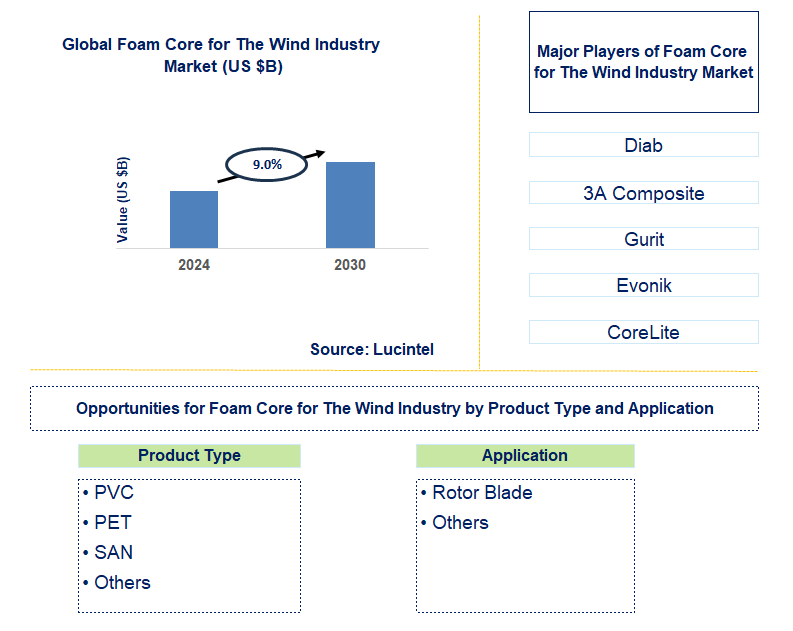
Key data points: The growth forecast = 9.0% annually for the next 6 years. Scroll below to get more insights. This market report covers trends, opportunities, and forecasts in the global foam core for the wind industry market to 2030 by product type (PET, PET, SAN, and others), application (rotor blade and others), and region (North America, Europe, Asia Pacific, and the Rest of the World)
We'll send your sample report shortly.
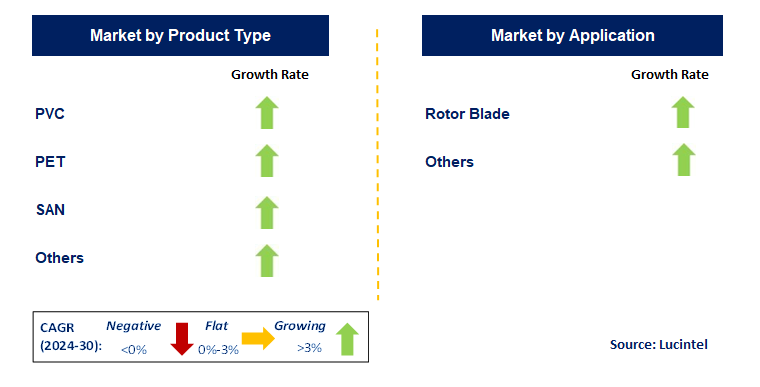
• Lucintel forecasts that, within the product type category, pvc is expected to witness the highest growth over the forecast period.
• Within the application category, rotor blade will remain the largest segment.
• In terms of regions, APAC is expected to witness highest growth over the forecast period. A more than 150-page report is developed to help in your business decisions.
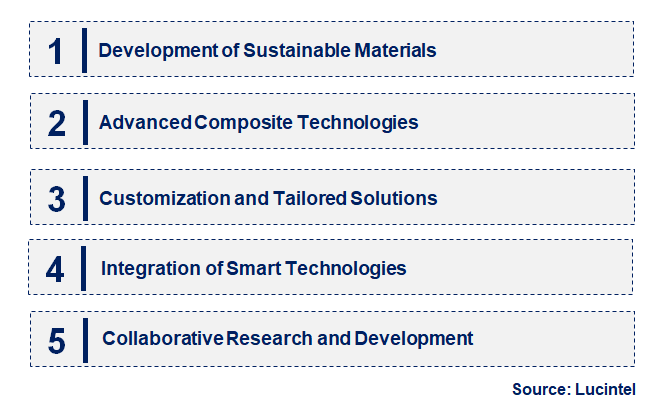
• Development of Sustainable Materials: The enhancement in the usage of renewable materials is promoting the creation of bio-based and recyclable foam cores. Companies have resorted to purchasing raw materials and manufacturing in a responsible manner in an effort to go green and meet global targets on sustainability.
• Advanced Composite Technologies: The incorporation of improved composite technologies is producing better, thinner foam cores. Because of recent achievements in material science, hybrid foams are being developed to perform longer in wind turbine applications by using several different materials.
• Customization and Tailored Solutions: Fewer companies are offering foam core solutions that are optimized for a certain blade design and customization of the wind turbine blade designs. This trend ensures that the blade structure, weighing components, strength, and performance characteristics can be adjusted to suit different locations.
• Integration of Smart Technologies: The latest trend has been the emergence of smart materials incorporated into the foam core design. Such components include performance optimization and maintenance systems, which are designed to enhance the efficiency of the wind energy systems.
• Collaborative Research and Development: Innovation in foam core materials is achieved through collaboration between industry players and academic/research institutions. These ventures help quicken and ease the transfer of knowledge to the wind foam systems being developed. These trends are evolving the foam core market for the wind sector towards sustainability, efficiency, and the development of technologies that meet the market demands for renewable energy.
• Upgraded Material Compositions: Recent advances in the formulation of foam cores, especially regarding polyurethanes and polystyrenes, have increased the working and aging resistance of the materials, making them suitable for use in wind turbines.
• Green Manufacturing: More manufacturers are incorporating environmentally safe processes in the manufacture of foam cores. This includes the use of biopolymers that have a conservative impact on the environment as per sustainable development objectives.
• Reduced Weight Options: New types of lightweight foam core materials are currently being used to enhance the efficiency of turbines. These solutions reduce the weight while maintaining adequate stiffness, thus helping in energy production.
• Automation in Production: The implementation of automated processes in the foam core material production is improving the yield, and more consistent foam core materials are being obtained, implying higher quality at lower costs.
• Global Collaborations: Global collaboration among companies and research organizations is helping to improve foam core technology. These collaborations help transfer knowledge and bring new and innovative solutions to the wind sector. These advancements are changing the game for the foam core market in the wind sector by improving performance, sustainability, and the cost of wind energy.
• Renewable Energy Integration: As more and more people seek renewable energy sources, the use of foam cores in the production of wind turbines has great potential to increase the overall efficiency of the system.
• Offshore Wind Projects: With the development of offshore wind power farms, new foam core applications emerge. The lightweight yet strong foam cores can make turbines more efficient and increase their benefits in severe sea environments.
• Customization for Performance: Turbine manufacturers can improve their competitiveness by providing custom-designed foam core solutions for different turbine types, as customers have different requirements.
• Recycling Initiatives: The formulation of recycling strategies for foam core materials can result in the establishment of a cradle-to-cradle lifecycle for products, which is now becoming acceptable to consumers and industries concerned about the environment.
• Expansion into Emerging Markets: Countries in emerging markets in Asia and Africa continue to invest in renewable energy. Such regions can be targeted with custom-made foam core solutions, providing new directions for growth for such manufacturers. These growth opportunities highlight the possibility of expanding the foam core market in the wind sector, with innovation, customization, and sustainability as the driving factors of the future.
• Growing Acceptance of Renewable Sources of Energy: There is an increasing trend in the use of wind energy worldwide, which necessitates the use of high-performance foam cores that would improve the efficiency and reliability of turbines to meet this growing demand.
• Technological Advancements: The discovery and development of advanced materials and manufacturing processes are revolutionizing the execution of wind turbines by offering more effective foam core technologies at cheaper prices.
• Sustainability Design: The focus on sustainability in the energy markets enables manufacturers to move to construction materials and practices that pose a lower environmental risk, and thus there is demand for recyclable and bio-inclusive foam cores.
• Government Support and Incentives: Government legislations and policies that support the implementation of renewable energy, as well as encourage the adoption of green technologies, favor investments in the foam core market and enhance growth.
• Global Collaboration and Research: Increased engagement of industry players with R&D institutions has been a catalyst for innovation, leading to the development of new types of foam core technologies designed for the wind energy sector. Challenges in the foam core market for the wind industry are:
• High Material Costs: The production costs for advanced materials providing foam cores may be high, which can deter adoption, particularly among small-scale manufacturers or those in emerging markets.
• Market Competition: Manufacturer rivalry is sometimes cutthroat, as companies price their products at a loss during market entry, leading to price competition that erodes investors' profit margins and puts companies at risk of losing innovation.
• Supply Chain Disruptions: Global market trends, including recent events, have consequences for the supply of raw materials needed in foam core manufacturing, affecting the time duration and cost of manufacturing. The drivers and constraints summarized above play a critical role in determining the dynamics of the foam core market for the wind industry, affecting strategic choices and future development in the renewable energy sphere. Understanding these factors is critical for any growth in the market.
• PVC
• PET
• SAN
• Others
• Rotor Blade
• Others
• North America
• Europe
• Asia Pacific
• The Rest of the World
• United States: In the USA, novel improvements and changes in foam core materials emphasize enhancing mechanical properties and reducing weight—both of which are essential for turbine efficiency. Research and development of polymer foams have produced high-performance core materials with good insulation qualities and impact strength. Many manufacturers are also looking for bio-based and recyclable foams in adherence to green policies. The focus on in-country sourcing and production is increasing due to supply chain issues and the urgency of meeting market requirements.
• China: China is rapidly growing its foam core market for the wind industry due to strict policies regarding the use of renewable energy sources. There has also been a rise in the use of advanced engineering procedures, enhancing the quality and effectiveness of foam core materials. Further research on composite materials continues, with new turbine blades being lighter and more durable than the existing ones. Government policies supporting renewable energy development provide the necessary grounds for investments in advanced foams, helping China lead the global wind energy market.
• Germany: Germany has been at the forefront of the wind energy market and technology. This has not changed, given the development of foam core materials. Research on the formulation of polyurethane and polystyrene foams has opened new possibilities in cost optimization and improved performance. Due to the demand for energy efficiency, turbine blade manufacturers have partnered with research institutions to deliver innovative designs of foam core tubes. Germany's commitment to sustainability has created a strong demand for greener foam products, which in turn supports the reliance of the wind industry on green technologies.
• India: Current developments in India's wind energy industry regarding foam core technology are driven by government policies aimed at the renewable energy sector. Recent efforts focus on developing cost-effective foam components to meet the growing demand for wind turbine installations. To cut down operational costs and enhance supply chain stability, manufacturers are investing in the local production of components. Additionally, strategic alliances with foreign companies are accelerating knowledge transfer and technological integration, positioning foam cores as a new entrant in India’s wind industry.
• Japan: In Japan, the foam core market for the wind industry is also maturing due to transformational innovation and eco-friendliness. One such innovation is using foam materials that are both lightweight and strong to improve turbine efficiency. Efforts are being made to enhance foam core manufacturing processes, minimizing the chances of failure due to excessive load. Japanese companies are also working on supporting devices in the foam core’s framework to facilitate the performance of the rotating parts and maintenance, which are essential cycles in wind energy system design.




Choose a license that fits your team. Instant PDF delivery.
Prices exclude taxes. Instant delivery. Custom licensing available on request.
Market Report · May 16, 2026
Market Report · May 16, 2026
Market Report · May 16, 2026
Trusted partner for strategic intelligence and business growth


Receive a complimentary market analysis tailored to your industry. Our analysts will identify key growth opportunities and competitive dynamics specific to your business.

Market size, growth rate, and key trend analysis for your specific sector.

Top competitor positioning and market share analysis.

Strategic recommendations backed by data-driven insights.
Get curated market intelligence and competitive moves straight to your inbox.
By subscribing, you agree to receive our monthly insights. Unsubscribe anytime.
Receive a complimentary market analysis tailored to your industry. Our analysts will identify key growth opportunities and competitive dynamics specific to your business.
Market size, growth rate, and key trend analysis for your specific sector.
Top competitor positioning and market share analysis.
Strategic recommendations backed by data-driven insights.
Get curated market intelligence, emerging trends, and competitive moves straight to your inbox each month.
By subscribing, you agree to receive our monthly insights. Unsubscribe anytime.
We'll send your sample report shortly.