
Report Feature
Flushing System Market Trends and Forecast
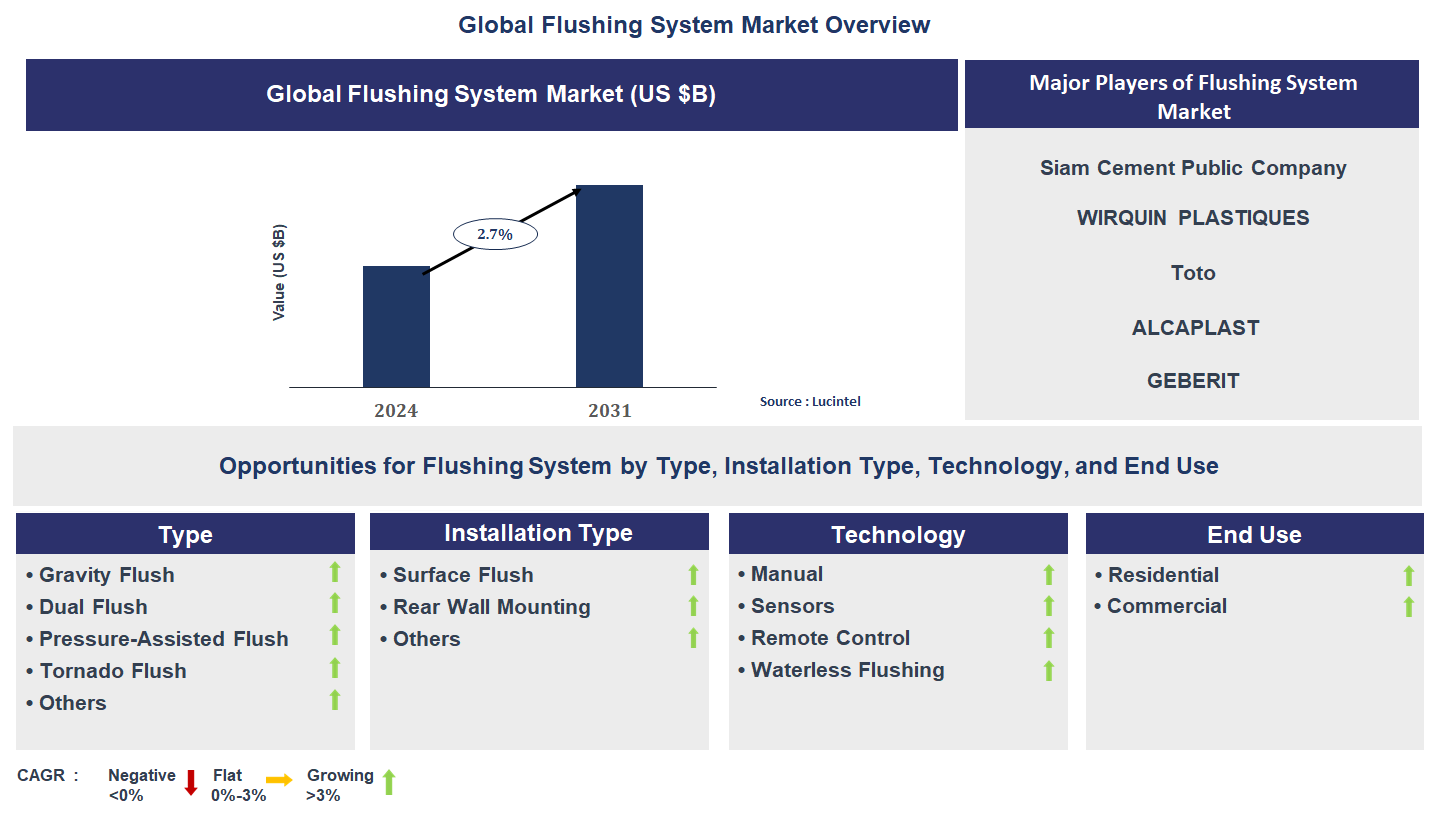
The future of the global flushing system market looks promising with opportunities in the residential and commercial markets. The global flushing system market is expected to grow with a CAGR of 2.7% from 2025 to 2031. The major drivers for this market are the increasing demand for water-efficient systems, the rising focus on eco-friendly solutions, and the growing need for advanced sanitation systems.• Lucintel forecasts that, within the type category, dual flush is expected to witness the highest growth over the forecast period.
• Within the end use category, residential is expected to witness higher growth.
• In terms of region, APAC is expected to witness the highest growth over the forecast period. Gain valuable insights for your business decisions with our comprehensive 150+ page report. Sample figures with some insights are shown below.
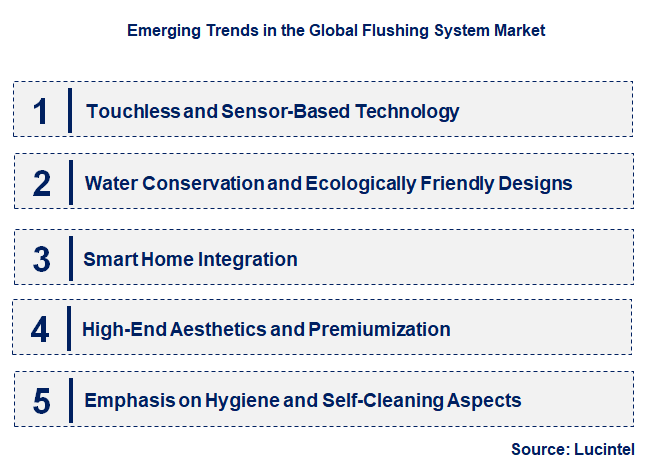
Emerging Trends in the Flushing System Market
The flushing system market is undergoing rapid transformation, with a number of prominent trends defining its future. The trends represent a fundamental shift in consumer values towards sustainability, sanitation, and integration of technology. The business is shifting away from mere functionality to provide products that are not just useful but also compatible with a consumer’s lifestyle and the environment. The increased trend towards smart homes and greater sensitization of the public about health are the two key drivers of these movements.• Touchless and Sensor-Based Technology: One key trend is the mass installation of touchless, sensor-based flushing technologies. This technology makes hands-free convenience a reality, greatly enhancing hygiene, particularly in public toilet facilities and commercial establishments. The result is a new benchmark for cleanliness in high-traffic environments and higher demand for products that provide a germ-free experience. This trend is driving manufacturers to create more robust and affordable sensor technologies for residential and commercial use.
• Water Conservation and Ecologically Friendly Designs: Flushing systems are being designed with special emphasis on water conservation in the market. This also involves the common use of dual-flush systems and the evolution of ultra-low-flow and vacuum-assisted technologies. The effect is considerable decline in the water usage of a building and a reduced environmental impact. This is a major impetus for consumer consumption, as it provides environmental advantages and long-term savings in the form of lower water bills.
• Smart Home Integration: The market is witnessing a new development where flushing systems are being integrated into the larger smart home system. These include remote operation, customized flush patterns, and monitoring of water use through an app. The effect is a transition from a simple fixture to a smart, networked product. Smart systems resonate with a technologically sophisticated consumer market, providing a higher level of convenience and control that heightens the overall user experience and makes the product a contemporary luxury item.
• High-End Aesthetics and Premiumization: There has been an increasing consumer willingness to pay a premium for superior quality, durable, and good-looking flushing systems. This is because consumers are seeking products that provide better performance as well as a design that will complement bathroom furniture today. The effect is a profitable premium segment in the market where manufacturers are producing minimalist, hidden, and elegantly shaped products.
• Emphasis on Hygiene and Self-Cleaning Aspects: Global concern about health and hygiene is a strong trend in the flushing system market. Companies are designing products with aspects of self-cleaning, like rimless bowls, anti-bacterial finishes, and aggressive, cyclonic flushing actions that lower the concentration of germs. The effect is an increased consumer confidence and decrease in fear of bacteria and cleanliness. The trend is significant in the upkeep of market growth and is inspiring a new generation of equipment that emphasizes sanitation. All these trends are combined to transform the flushing system market into something that is more consumer-focused, high-tech, and eco-friendly. The emphasis on touchless and intelligent features is driving the user experience, while the attention on water conservation and cleanliness is building a more mature and sophisticated market. In the end, all of these trends are shifting the market from a plain utility item to a sleek, lifestyle-integrated product that embodies a consumer’s values and ambitions.
Recent Development in the Flushing System Market
The flushing system market has seen a number of notable developments that are essentially reshaping its operational and strategic architecture. These developments are shaped by the convergence of technological innovation, a shift in corporate strategy, and an increasing focus on sustainability and user experience. The industry is reacting to demands for more effective production methods, fresh uses for systems, and an integrated bathroom design. The developments described below demonstrate the industry’s forward-thinking in adapting and expanding, whereby the flushing system becomes a working tool and central part of an efficient bathroom system.• Mass Market Penetration of Dual-Flush Technology: The most notable development is the mass market penetration of dual-flush technology as a stock feature in residential and commercial properties. With this technology, the user gets to select between a full flush for solids or a half flush for liquids and thereby conserve a lot of water. This innovation is affecting the market by greatly elevating a product’s value proposition for eco-friendly consumers and by bringing the industry in line with worldwide water conservation initiatives.
• Miniaturization and Enhanced Design for Hidden Systems: One important development is the ongoing miniaturization of internal elements and enhanced design for hidden flushing systems. These systems are concealed behind the wall, which opens up floor space and produces a cleaner, more modern look. The effect is a better-looking and more convenient product that solves a big consumer aggravation for smaller living spaces.
• Expansion in the Smart Toilet and Bidet Seat Market: Whereas historically centered on the flush mechanism, a key development is the rapid expansion of the smart toilet and bidet seat market, which combines a flush system with a set of sophisticated features. The effect is a considerable new source of revenue and significant impetus for innovation in sensor technology, water heating, and user personalization. This shift is establishing a high-value consumer market that is less price-sensitive to conventional pricing and more concerned with luxury and comfort.
• Growth of E-commerce and Professional Installation Services: Flushing system market has witnessed a speedy growth of its channels of distribution. Apart from conventional retailing, an important growth has been the increase in the e-commerce websites and an emphasis on offering professional installation services. Such growth is affecting the market by increasing the availability of products worldwide and by assuring that sophisticated systems are properly installed, which may avoid subsequent maintenance problems and also increase the level of customer satisfaction.
• Emphasis on Anti-Bacterial Materials and Coatings: As people become more health-conscious, a newer trend is the emphasis on anti-bacterial materials and coatings for both the toilet bowl as well as the components of the flushing system. The manufacturers apply special glazes and surfaces that prevent the germs from growing. The result is an enhanced degree of consumer confidence and less worry about cleanliness. This innovation is vital in order to sustain market expansion and is causing a new breed of products to focus on sanitation and user health. These advances are collectively influencing the flushing system industry by creating a more innovative, consumer-oriented, and forward-thinking business. They are not just enhancing the standard of the products but are also turning them into an increasingly integral aspect of a contemporary way of life. By adapting to these changes, the industry is safeguarding its sustained growth and viability within a global world that appreciates technology, environment-friendliness, and individual wellness.
Strategic Growth Opportunities in the Flushing System Market
The flushing system market offers many strategic growth opportunities among the major applications, fueled by changing consumer preferences, advancements in technology, and the growth of the construction and renovation markets. The opportunities are allowing the market participants to diversify their portfolios, attract new consumer groups, and strengthen their foothold in a competitive market.• Growth in Commercial and Institutional Uses: One of the primary growth opportunities exists in the business-to-business (B2B) market. The strategy is to focus on commercial properties, including hotels, airports, and corporate buildings, with high-performance, long-lasting, and low-maintenance flushing systems. The effect is a secure, high-volume revenue source that is less subject to seasonal consumer patterns. This market also offers an extremely effective brand visibility platform, as high-visibility installations can be a constant endorsement for the company’s products.
• Smart Feature and Technology Innovation: Merging smart technology is a key strategic potential. The approach is to create flushing systems with functionality such as built-in apps for monitoring water usage, motion sensing flushing, and self-diagnosis for maintenance notification. The result is a high-end product with a unique value proposition greater than mere functionality.
• Strategic Partnerships with Architects and Real Estate Builders: One major growth area is in establishing partnerships with top architects, designers, and real estate builders. The approach is getting flushing systems specified in new residential and commercial buildings. The effect is a strong network effect in encouraging the use of a brand’s products from the beginning and guaranteeing long-term sales.
• Diversification into Waterless and Sustainable Technologies: The business can expand by serving well-defined niche consumer segments. The plan is to invest in and create waterless and sustainable flush technologies, for example, composting or vacuum systems. The effect is a more diversified line of products that can take a larger share of the market in water-scarce areas or for niche uses, like in recreational vehicles or off-grid residential applications.
• Target the High-Growth Asia-Pacific Market: The Asia-Pacific region, specifically China and India, is an enormous growth market. The approach is to customize products and promotion to local tastes and channels in these markets. The effect is being able to access a fast-growing consumer market with increasing disposable incomes and an increasing desire for modern, hygienic bathroom products. The regional orientation necessitates gaining insight into local trends, including the need for low-cost and multi-purpose products, in order to establish a strong presence. These growth opportunities, collectively, are influencing the flushing system market by making it a more dynamic, diversified, and consumer-driven market. They are allowing businesses to transcend conventional retail and access new, high-growth applications, including integration with smart homes and commercial ventures. By becoming attuned to these opportunities, players in the market are not only guaranteeing the long-term sustainability of their businesses but are also positioning themselves as leaders in a rapidly evolving global environment.
Flushing System Market Driver and Challenges
The flushing system market is driven by a complicated combination of drivers that propel its expansion and issues that may hinder its advancement. The most important drivers are mainly based on a worldwide expanding environmental awareness, rising hygiene consciousness, and ongoing product innovation. On the other hand, the chief challenges tend to be high upfront installation costs, high market competition, and stricter regulatory compliance. These factors must be well understood in order for any analysis of the market. The factors responsible for driving the flushing system market include: 1. Increasing Water Scarcity and Water Conservation Mandates: The key impetus for the flushing system market is the growing worldwide consciousness of water scarcity and imposing stringent water conservation mandates. Governments and environmental authorities are requiring the adoption of low-flow and water-efficient systems. The effect is a paradigm change in the market, generating long-term and increasing demand for products that help conserve water and lower utility bills for homes and businesses. 2. Greater Emphasis on Sanitation and Hygiene: One of the prime drivers is worldwide heightened awareness of health and hygiene, especially in the post-pandemic landscape. Consumers are increasingly aware of touch points in the public and private domains. The effect is a big surge in demand for touchless, sensor-activated, and self-cleaning flushing toilets. The driver is driving makers to keep sanitation at the forefront of product design, bringing out innovations such as anti-bacterial coatings and rimless toilets. 3. Smart Home Industry Growth: Growth in the smart home industry is a key growth driver for the flushing system market. Homeowners are eager to bring all elements of their homes into a connected world. The result is a new product category of smart flushing systems with features such as remote control, water usage monitoring, and automated testing. 4. Increasing Urbanization and Building Work: The fast growth of urbanization, especially in emerging economies, is one of the key drivers. With growth in cities and new residential and office buildings being built, there is a steady need for new flushing fixtures. The effect is a steady, underlying requirement for flushing systems. This driver also provides opportunities for manufacturers to bring advanced, water-saving systems to new markets. 5. Technological Improvement in Flushing Mechanisms: Ongoing improvement in the flushing mechanism itself is a strong stimulant. New technologies such as tornado and pressure-assisted flushes provide enhanced cleaning power using less water. The effect is an improved product that reflects consumer concerns regarding performance and efficiency. The driver gives consumers a high motivation to replace their systems with the latest technology. Challenges in the flushing system market are: 1. High Initial Installation Expense: One of the main difficulties of the flushing system market is the high installation cost of buying and installing sophisticated systems, particularly smart and hidden units. These systems have specific plumbing needs and professional installations, which may scare budget-smart consumers away. This difficulty is a limitation of market penetration and needs manufacturers to provide more affordable choices or inform consumers about long-run savings. 2. High Market Competition: The market for the flushing system is extremely competitive with a high number of both foreign and local players. The high competition makes it challenging for new brands to penetrate and for old brands to retain market share. This is a challenge that results in price wars, lower profitability margins, and the constant need for innovation and differentiation to differentiate themselves in a saturated market. 3. Regulation and Compliance Barriers: The industry is governed by different regional and national rules on water consumption, materials, and safety requirements. Adherence to the multitude of regulations may prove to be a significant obstacle for manufacturers, particularly those in an international market. The barrier may raise the cost and intricacy of production, and non-compliance may result in product recalls or loss of access to the market. The net effect of these drivers and challenges is a market that is in the middle of dynamic change. The drivers, particularly water conservation and hygiene, are compelling the market to more innovation and expanded consumer base. Nevertheless, the challenges, most notably high costs and stiff competition, call for the industry to be proactive and strategic. The market is becoming more centered on a pragmatic approach that aims to balance maximizing profitability with risk mitigation and consumer sensitivity to concerns over practicality and longevity.List of Flushing System Companies
Companies in the market compete on the basis of product quality offered. Major players in this market focus on expanding their manufacturing facilities, R&D investments, infrastructural development, and leverage integration opportunities across the value chain. With these strategies flushing system companies cater increasing demand, ensure competitive effectiveness, develop innovative products & technologies, reduce production costs, and expand their customer base. Some of the flushing system companies profiled in this report include-• Siam Cement Public Company
• WIRQUIN PLASTIQUES
• Toto
• ALCAPLAST
• GEBERIT
• SANIPEX Group
• Schell
• Roca Corporation Empresarial
• KAZEMA General Trading
• LIXIL Group Corporation
Flushing System Market by Segment
The study includes a forecast for the global flushing system market by type, installation type, technology, end use, and region.Flushing System Market by Type [Value from 2019 to 2031]:
• Gravity Flush
• Dual Flush
• Pressure-Assisted Flush
• Tornado Flush
• Others
Flushing System Market by Installation Type [Value from 2019 to 2031]:
• Surface Flush
• Rear Wall Mounting
• Others
Flushing System Market by Technology [Value from 2019 to 2031]:
• Manual
• Sensors
• Remote Control
• Waterless Flushing
Flushing System Market by End Use [Value from 2019 to 2031]:
• Residential
• Commercial
Flushing System Market by Region [Value from 2019 to 2031]:
• North America
• Europe
• Asia Pacific
• The Rest of the World
Country Wise Outlook for the Flushing System Market
The market for flushing system is now going through a dynamic phase of change, fueled by a convergence of forces such as increased emphasis on water conservation, evolution of smart home technology, and world-wide awareness of health and hygiene. No longer merely a functional piece of hardware, today’s flushing system is a cutting-edge, hi-tech product that combines efficiency, convenience, and sustainability. This transition is being driven by the imposition of strict environmental laws and an increasing consumer need for products that are not only effective and functional but also environmentally friendly and good-looking.• United States: The American flushing system market is at the forefront of technological integration and water conservation. Recent trends are characterized by the extensive use of dual-flush systems and the increasing demand for touchless, sensor-operated flushes in both residential and commercial properties. These developments are fueled by federal and state legislation on water use, like that in California, and an increasingly concerned consumer base that wants to minimize its environmental impact and enhance hygiene.
• China: China’s flushing system industry is witnessing speedy growth, driven by urbanization, growing disposable incomes, and megaproject infrastructures. Recent trends revolve around the expansion of the smart toilet market, encompassing flushing systems with features such as automated flushing, warm seats, and bidets. Chinese vendors are developing newer flushing technologies, such as tornado and rimless flushes, which provide improved cleaning with less water.
• Germany: The German flushing system market is marked by a strong focus on precision engineering, water efficiency, and longevity. Market developments are recently led by stringent European Union regulations on water usage and an ingrained ecologically-aware consumer culture. German brands are at the forefront when it comes to creating highly efficient, low-flow systems and concealed cisterns, which are not only compact in space but also visually attractive.
• India: India’s flushing system industry is a growth market, driven by a huge spurt in building construction and government efforts to enhance sanitation. Trends are characterized by a shift from conventional manual flushes to more water-conserving and hygienic ones. The industry is witnessing a surge in cheaper dual-flush products that appeal to a broad user base.
• Japan: The flushing system market in Japan is famous for being a mix of cutting-edge technology and user-oriented design. New innovations are aimed at developing intensely integrated smart toilet systems that feature a variety of attributes from automatic flushing and bidet functionality to deodorizing and self-cleaning features. These products are headed by Japanese brands, which dominate the market in terms of innovations in the bathroom space.

Features of the Global Flushing System Market
Market Size Estimates: Flushing system market size estimation in terms of value ($B). Trend and Forecast Analysis: Market trends (2019 to 2024) and forecast (2025 to 2031) by various segments and regions. Segmentation Analysis: Flushing system market size by various segments, such as by type, installation type, technology, end use, and region in terms of value ($B). Regional Analysis: Flushing system market breakdown by North America, Europe, Asia Pacific, and Rest of the World. Growth Opportunities: Analysis of growth opportunities in different types, installation types, technologies, end uses, and regions for the flushing system market. Strategic Analysis: This includes M&A, new product development, and competitive landscape of the flushing system market. Analysis of competitive intensity of the industry based on Porter’s Five Forces model.
FAQ
Q1. What is the growth forecast for flushing system market? Answer: The global flushing system market is expected to grow with a CAGR of 2.7% from 2025 to 2031. Q2. What are the major drivers influencing the growth of the flushing system market? Answer: The major drivers for this market are the increasing demand for water-efficient systems, the rising focus on eco-friendly solutions, and the growing need for advanced sanitation systems. Q3. What are the major segments for flushing system market? Answer: The future of the flushing system market looks promising with opportunities in the residential and commercial markets. Q4. Who are the key flushing system market companies? Answer: Some of the key flushing system companies are as follows:• Siam Cement Public Company
• WIRQUIN PLASTIQUES
• Toto
• ALCAPLAST
• GEBERIT
• SANIPEX Group
• Schell
• Roca Corporation Empresarial
• KAZEMA General Trading
• LIXIL Group Corporation Q5. Which flushing system market segment will be the largest in future? Answer: Lucintel forecasts that, within the type category, dual flush is expected to witness the highest growth over the forecast period. Q6. In flushing system market, which region is expected to be the largest in next 5 years? Answer: In terms of region, APAC is expected to witness the highest growth over the forecast period. Q7. Do we receive customization in this report? Answer: Yes, Lucintel provides 10% customization without any additional cost.
Table of Contents
List of Figures
List of Tables
Methodology
- In-depth interviews of the major players in this market
- Detailed secondary research from competitors’ financial statements and published data
- Extensive searches of published works, market, and database information pertaining to industry news, company press releases, and customer intentions
- A compilation of the experiences, judgments, and insights of Lucintel’s professionals, who have analyzed and tracked this market over the years.


Buy Now
Choose a license that fits your team. Instant PDF delivery.
Prices exclude taxes. Instant delivery. Custom licensing available on request.
Key Questions
- • What are some of the most promising, high-growth opportunities for the flushing system market by type (gravity flush, dual flush, pressure-assisted flush, tornado flush, and others), installation type (surface flush, rear wall mounting, and others), technology (manual, sensors, remote control, and waterless flushing), end use (residential and commercial), and region (North America, Europe, Asia Pacific, and the Rest of the World)?
- • Which segments will grow at a faster pace and why?
- • Which region will grow at a faster pace and why?
- • What are the key factors affecting market dynamics? What are the key challenges and business risks in this market?
- • What are the business risks and competitive threats in this market?
- • What are the emerging trends in this market and the reasons behind them?
- • What are some of the changing demands of customers in the market?
- • What are the new developments in the market? Which companies are leading these developments?
- • Who are the major players in this market? What strategic initiatives are key players pursuing for business growth?
- • What are some of the competing products in this market and how big of a threat do they pose for loss of market share by material or product substitution?
- • What M&A activity has occurred in the last 5 years and what has its impact been on the industry? For any questions related to Flushing System Market, Flushing System Market Size, Flushing System Market Growth, Flushing System Market Analysis, Flushing System Market Report, Flushing System Market Share, Flushing System Market Trends, Flushing System Market Forecast, Flushing System Companies, write Lucintel analyst at email: helpdesk@lucintel.com. We will be glad to get back to you soon.


