
Report Feature
Fluoropolymer Film Market Trends and Forecast
The future of the global fluoropolymer film market looks promising with opportunities in the electrical & electronic, consumer electronic, construction, packaging, transportation, and industrial markets. The global fluoropolymer film market is expected to reach an estimated $3887 million by 2035 with a CAGR of 5.0% from 2026 to 2035. The major drivers for this market are the increasing demand for electronics industry for high-performance, the growing adoption in automotive applications for heat & chemical, and the rising demand for high-performance coatings & protective films.• Lucintel forecasts that, within the type category, ptfe film is expected to witness the highest growth over the forecast period.
• Within the end use category, electrical & electronic is expected to witness the highest growth.
• In terms of region, APAC is expected to witness the highest growth over the forecast period.
Gain valuable insights for your business decisions with our comprehensive 150+ page report. Sample figures with some insights are shown below.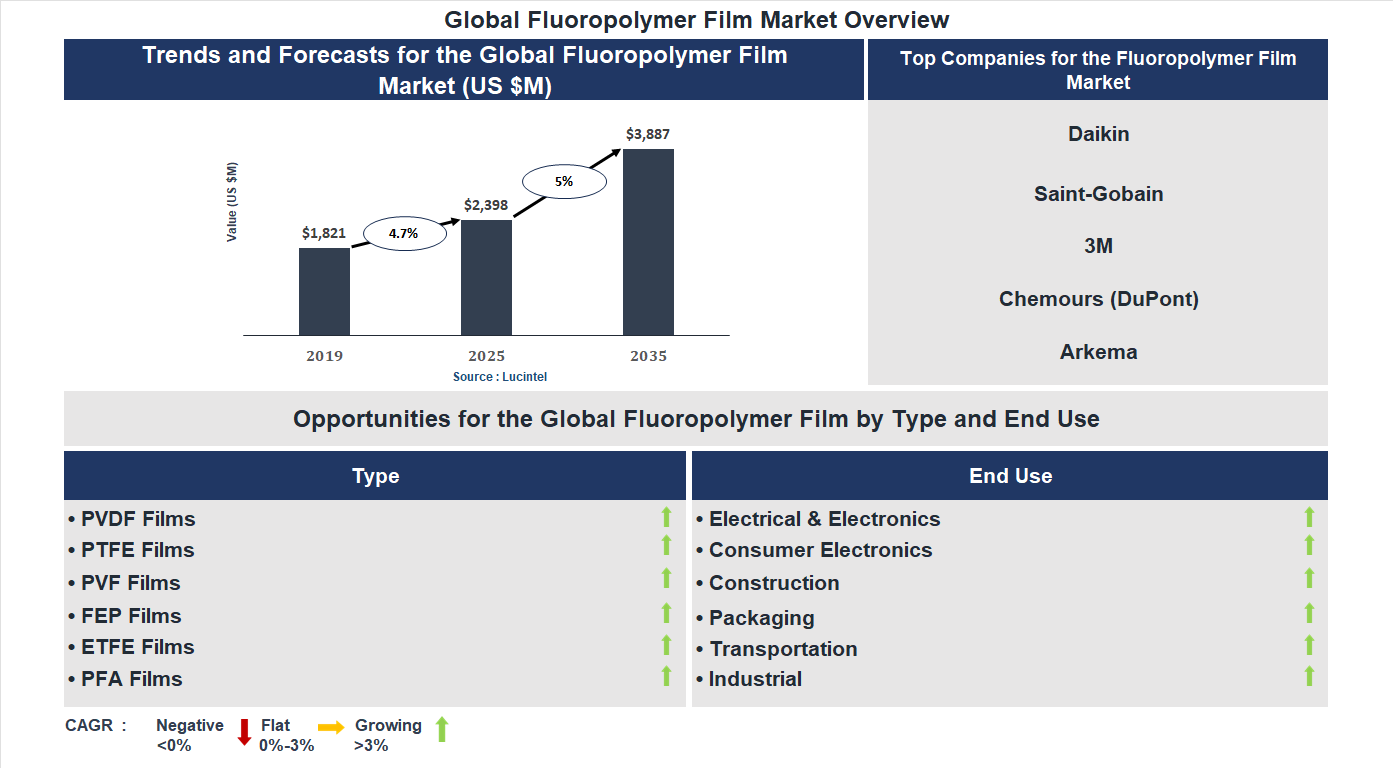
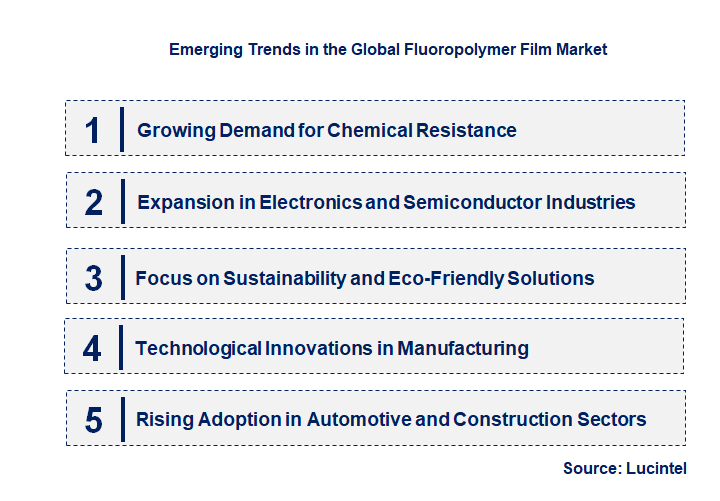
Emerging Trends in the Fluoropolymer Film Market
The fluoropolymer film market is experiencing rapid evolution driven by technological advancements, increasing demand across various industries, and a focus on sustainability. As industries such as electronics, automotive, and construction seek materials with superior chemical resistance, durability, and environmental benefits, the market is adapting to meet these needs. Emerging trends are shaping the future landscape, influencing product development, manufacturing processes, and application strategies. These developments are not only expanding the market’s scope but also enhancing its resilience and innovation capacity, positioning fluoropolymer films as critical components in high-performance applications worldwide.• Growing Demand for Chemical Resistance: The increasing need for materials that withstand harsh chemicals is driving fluoropolymer film adoption. Industries such as chemical processing, electronics, and healthcare require films that resist corrosion, ensuring longevity and safety. This trend encourages manufacturers to develop advanced formulations with enhanced chemical stability, expanding application possibilities and boosting market growth.
• Expansion in Electronics and Semiconductor Industries: The electronics sector’s demand for high-performance, insulating, and protective films is fueling market expansion. Fluoropolymer films offer excellent dielectric properties, thermal stability, and moisture resistance, making them ideal for flexible circuits, displays, and semiconductors. This trend is prompting innovation in film thickness, transparency, and flexibility, thereby opening new avenues for market players.
• Focus on Sustainability and Eco-Friendly Solutions: Environmental concerns are prompting a shift toward sustainable fluoropolymer films. Manufacturers are investing in recyclable, low-emission production processes and bio-based alternatives. This trend enhances market appeal by aligning with regulatory standards and consumer preferences for eco-friendly products, ultimately fostering a more sustainable industry landscape.
• Technological Innovations in Manufacturing: Advances in coating, extrusion, and lamination techniques are improving film quality, uniformity, and performance. Innovations such as nanocomposite integration and surface modification are enabling films with enhanced properties like anti-fouling, anti-scratch, and self-cleaning features. These technological developments are increasing application versatility and market competitiveness.
• Rising Adoption in Automotive and Construction Sectors: The automotive industry’s need for lightweight, durable, and weather-resistant materials is boosting fluoropolymer film use in coatings and insulation. Similarly, the construction sector utilizes these films for roofing, glazing, and protective barriers. This trend is expanding market reach, encouraging product customization, and fostering cross-industry collaborations.
These trends are collectively transforming the fluoropolymer film market by enhancing product performance, promoting sustainability, and expanding application domains. They are driving innovation, increasing market competitiveness, and ensuring the industry’s adaptability to future technological and environmental challenges.
Recent Development in the Fluoropolymer Film Market
The fluoropolymer film industry has experienced significant advancements driven by technological innovations, increasing demand across various sectors, and a focus on sustainability. These developments are shaping the market landscape, creating new opportunities for manufacturers and consumers alike. As industries such as electronics, automotive, and construction expand their use of fluoropolymer films, understanding these key growth areas becomes essential for stakeholders aiming to capitalize on emerging trends and maintain competitive advantage.• Innovation in Material Formulations: Enhanced durability and chemical resistance : Recent breakthroughs in fluoropolymer formulations have resulted in films with superior durability, chemical resistance, and UV stability. These improvements enable wider application in harsh environments, including chemical processing, outdoor signage, and protective coatings. The innovations also reduce maintenance costs and extend product lifespan, making fluoropolymer films more attractive to end-users. This growth opportunity is expected to boost market penetration and open new industrial segments.
• Expansion in Electronics Industry: High-performance insulation and flexible circuits : The electronics sector is increasingly adopting fluoropolymer films for insulation, flexible circuits, and display technologies. Their excellent electrical properties, transparency, and heat resistance make them ideal for advanced electronic devices. As demand for miniaturization and high-performance electronics grows, fluoropolymer films are becoming essential components. This expansion enhances market revenue, encourages R&D investments, and fosters integration into next-generation electronic products, solidifying their role in high-tech manufacturing.
• Sustainability and Eco-friendly Solutions: Biodegradable and recyclable films : Growing environmental concerns are prompting the development of sustainable fluoropolymer films. Innovations include biodegradable options and recyclable materials that meet eco-standards without compromising performance. These environmentally friendly solutions appeal to eco-conscious consumers and regulatory bodies, opening new markets. The shift towards sustainability not only enhances brand reputation but also aligns with global efforts to reduce plastic waste, thereby expanding the market’s scope and acceptance.
• Automotive Industry Adoption: Lightweight, heat-resistant films for vehicles : The automotive industry is increasingly utilizing fluoropolymer films for lightweight, heat-resistant, and weatherproof applications. These films improve vehicle durability, reduce weight, and enhance safety features. As automakers focus on electric vehicles and advanced safety systems, fluoropolymer films offer critical benefits. This trend drives market growth, encourages innovation in automotive coatings and insulation, and positions fluoropolymer films as vital components in future mobility solutions.
• Technological Advancements in Coating Applications: Enhanced adhesion and transparency : Recent technological progress has improved the adhesion, transparency, and ease of application of fluoropolymer films in coatings. These advancements enable their use in architectural glass, solar panels, and protective overlays, providing superior weather resistance and aesthetic appeal. The enhanced properties expand application possibilities, increase market competitiveness, and foster integration into high-end construction and renewable energy sectors. This development significantly boosts the market’s growth potential and application diversity.
The overall impact of these developments is a dynamic, expanding fluoropolymer film market characterized by increased innovation, broader application scope, and heightened sustainability efforts. These opportunities are driving growth, attracting investments, and fostering technological progress, ultimately positioning fluoropolymer films as essential materials across multiple industries and ensuring sustained market evolution.
Strategic Growth Opportunities in the Fluoropolymer Film Market
The fluoropolymer film market are experiencing rapid growth driven by increasing demand across various industries such as electronics, automotive, and packaging. Its unique properties like chemical resistance, high-temperature stability, and low friction make it highly desirable for specialized applications. Innovations in manufacturing and expanding end-use sectors are creating new opportunities for market players. As environmental regulations tighten, sustainable and recyclable fluoropolymer films are gaining importance, further fueling market expansion. This dynamic landscape offers significant potential for strategic investments and product development to meet evolving industry needs.• Growing Demand in Electronics Manufacturing: Fluoropolymer films are increasingly used in electronic components due to their excellent dielectric properties, chemical resistance, and thermal stability. The miniaturization of electronic devices and the need for high-performance insulating materials are driving demand. Additionally, their use in flexible printed circuits and display technologies enhances device durability and performance, creating substantial growth opportunities for manufacturers to innovate and expand their product portfolios in this sector.
• Expansion of Automotive Applications: The automotive industry is adopting fluoropolymer films for applications such as wiring insulation, gaskets, and protective coatings due to their high temperature resistance, chemical inertness, and low friction. As electric vehicles and advanced driver-assistance systems grow, the need for durable, lightweight, and high-performance materials increases. This trend opens avenues for fluoropolymer film manufacturers to develop specialized products tailored to automotive specifications, supporting industry safety and efficiency standards.
• Increasing use in Packaging and Labeling: Fluoropolymer films are increasingly utilized in packaging for their non-stick, chemical resistance, and barrier properties. They are ideal for food packaging, pharmaceutical labels, and industrial containers that require contamination-free surfaces and durability. The demand for high-quality, sustainable packaging solutions is prompting innovation in recyclable fluoropolymer films, offering growth opportunities for companies to meet stringent environmental regulations and consumer preferences.
• Rising Demand in Industrial and Chemical Processing: The chemical and industrial sectors utilize fluoropolymer films for lining tanks, pipes, and protective covers due to their excellent chemical resistance and high-temperature stability. As industries seek safer, more durable materials to handle aggressive chemicals and extreme conditions, the market for specialized fluoropolymer films expands. Developing cost-effective, environmentally friendly options can further enhance market penetration and support the growth of chemical processing infrastructure.
• Innovation in Sustainable and Recyclable Fluoropolymer Films: Environmental concerns and regulatory pressures are pushing manufacturers to develop eco-friendly fluoropolymer films. Advances in recycling technologies and bio-based alternatives are creating new growth avenues. Sustainable films with comparable performance characteristics are gaining traction in various applications, including electronics and packaging. Investing in green manufacturing processes and recyclable product lines will be crucial for market players to capitalize on the shift toward environmentally responsible solutions.
These growth opportunities are poised to significantly influence the fluoropolymer film market by fostering innovation, expanding application scopes, and aligning with sustainability trends. Companies that strategically leverage these opportunities can enhance their market position, meet evolving customer demands, and drive long-term growth in this competitive landscape.
Fluoropolymer Film Market Driver and Challenges
The fluoropolymer film market is influenced by a variety of technological, economic, and regulatory factors that shape its growth trajectory. Advances in manufacturing processes and material innovations drive demand for high-performance films across multiple industries. Economic conditions, including industrial expansion and infrastructure development, further impact market dynamics. Regulatory standards concerning environmental safety and product sustainability also play a crucial role in shaping market strategies and compliance requirements. Navigating these drivers and challenges is essential for stakeholders aiming to capitalize on emerging opportunities while addressing potential risks in this evolving landscape.The factors responsible for driving the fluoropolymer film market include:-
• Technological Innovation: The development of advanced manufacturing techniques has led to the production of high-quality, durable fluoropolymer films. These innovations improve film performance, such as chemical resistance, UV stability, and temperature tolerance, making them suitable for diverse applications like electronics, automotive, and construction. Continuous R&D efforts are expected to further enhance film properties, expanding their usability and market penetration. This technological progress not only boosts demand but also enables manufacturers to meet stringent industry standards, fostering competitive advantages and opening new growth avenues.
• Growing Industrial Applications: The expanding use of fluoropolymer films in electronics, aerospace, and healthcare sectors significantly propels market growth. Their excellent chemical resistance, electrical insulation, and non-stick properties make them ideal for specialized applications. For instance, in electronics, they are used in flexible circuits and insulation layers, while in aerospace, they serve as protective coatings. The increasing adoption of these films in emerging industries, coupled with rising infrastructure projects, fuels demand. As industries seek materials that offer durability and safety, fluoropolymer films are becoming indispensable, thereby driving market expansion.
• Environmental Regulations and Sustainability Initiatives: Stricter environmental policies and sustainability goals influence the market by encouraging the development of eco-friendly fluoropolymer films. Manufacturers are investing in recyclable and low-emission production processes to comply with regulations. These initiatives promote innovation in biodegradable or more sustainable fluoropolymer formulations, aligning with global efforts to reduce environmental impact. Such regulatory pressures also create opportunities for market differentiation and premium pricing for compliant products, ultimately shaping the competitive landscape and encouraging sustainable growth.
• Price Trends and Raw Material Availability: Fluctuations in raw material prices, such as fluorinated monomers, directly impact production costs and profit margins. Supply chain disruptions or shortages can lead to price volatility, affecting market stability. Conversely, increased raw material availability and cost-effective manufacturing techniques can lower prices, making fluoropolymer films more accessible across various sectors. Market players are also exploring alternative sourcing and material substitutions to mitigate risks, which influences overall market dynamics and competitiveness.
The challenges facing the fluoropolymer film market include:-
• Environmental and Regulatory Constraints: The production and disposal of fluoropolymer films are associated with environmental concerns, including the release of hazardous chemicals. Stringent regulations aimed at reducing environmental impact pose compliance challenges for manufacturers, often requiring costly modifications to production processes. These constraints can limit market growth, increase operational costs, and restrict the adoption of certain fluoropolymer formulations, especially in regions with strict environmental standards.
• High Production Costs: The manufacturing of fluoropolymer films involves complex processes and expensive raw materials, leading to high production costs. These costs can hinder market penetration, especially in price-sensitive sectors. Additionally, the need for specialized equipment and skilled labor further elevates expenses, impacting overall profitability and limiting the ability of some players to compete effectively. Cost pressures may also restrict innovation and the development of more affordable alternatives.
• Market Competition and Price Pressures: The market is characterized by intense competition among established players and new entrants, which can lead to price wars and reduced profit margins. Companies are compelled to innovate continuously while managing costs, creating a challenging environment. Additionally, the commoditization of fluoropolymer films in certain applications can lead to price erosion, affecting revenue streams and investment in R&D. This competitive landscape necessitates strategic differentiation and operational efficiency to sustain growth.
The fluoropolymer film market is shaped by significant technological advancements, expanding industrial applications, and evolving regulatory standards. While these drivers foster growth and innovation, challenges such as environmental constraints, high production costs, and intense competition pose risks to market stability. The overall impact is a dynamic environment where proactive adaptation and sustainable practices are essential for long-term success. Stakeholders must balance innovation with compliance to capitalize on emerging opportunities while mitigating potential setbacks in this competitive landscape.
List of Fluoropolymer Film Companies
Companies in the market compete on the basis of product quality offered. Major players in this market focus on expanding their manufacturing facilities, R&D investments, infrastructural development, and leverage integration opportunities across the value chain. With these strategies fluoropolymer film companies cater increasing demand, ensure competitive effectiveness, develop innovative products & technologies, reduce production costs, and expand their customer base. Some of the fluoropolymer film companies profiled in this report include-• Daikin
• Saint-Gobain
• 3M
• Chemours (DuPont)
• Arkema
• Asahi Glass Corporation
• Kureha Corporation
• Honeywell Inc.
• SOLVAY Solexis S.P.A
• DUNMORE Corporation
Fluoropolymer Film Market by Segment
The study includes a forecast for the global fluoropolymer film market by type, end use, and region.Fluoropolymer Film Market by Type [Value from 2019 to 2035]:
• PVDF Films
• PTFE Films
• PVF Films
• FEP Films
• ETFE Films
• PFA Films
Fluoropolymer Film Market by End Use [Value from 2019 to 2035]:
• Electrical & Electronics
• Consumer Electronics
• Construction
• Packaging
• Transportation
• Industrial
Fluoropolymer Film Market by Region [Value from 2019 to 2035]:
• North America
• Europe
• Asia Pacific
• The Rest of the World
Country Wise Outlook for the Fluoropolymer Film Market
The fluoropolymer film market has experienced significant growth driven by increasing demand across various industries such as electronics, automotive, construction, and healthcare. Innovations in manufacturing processes, environmental regulations, and the expansion of applications have shaped recent developments. Countries like the United States, China, Germany, India, and Japan are at the forefront, each contributing uniquely to the market‘s evolution through technological advancements, policy changes, and expanding industrial use. These developments reflect a global shift towards more durable, high-performance materials that meet stringent safety and environmental standards.• United States: The US market has seen increased adoption of fluoropolymer films in electronics and aerospace industries, driven by technological innovation and stricter environmental regulations. Companies are investing in sustainable manufacturing processes, leading to eco-friendly product lines. The government’s focus on advanced manufacturing and R&D has fostered new applications, especially in renewable energy and medical devices, boosting overall market growth.
• China: China remains the largest consumer and producer of fluoropolymer films, with rapid industrial expansion fueling demand. The country has made significant investments in manufacturing capacity and technology upgrades, leading to higher quality and more diverse product offerings. Government policies supporting high-tech industries and infrastructure projects have further expanded the market, especially in electronics, automotive, and construction sectors.
• Germany: Germany’s market is characterized by high-quality standards and innovation in fluoropolymer film applications, particularly in automotive and industrial sectors. The country emphasizes sustainable production methods and recyclability, aligning with EU environmental directives. German companies are also focusing on developing advanced, high-performance films for use in renewable energy and precision engineering, maintaining a competitive edge in the global market.
• India: India’s fluoropolymer film market is experiencing rapid growth due to expanding infrastructure, electronics, and automotive industries. Increasing domestic manufacturing and foreign investments are driving demand. The government’s initiatives to promote Make in India and sustainable development are encouraging local production and innovation, leading to a broader application base and improved product quality in the region.
• Japan: Japan continues to lead in technological innovation and high-quality manufacturing of fluoropolymer films. The focus is on developing films with enhanced durability, chemical resistance, and environmental safety. The country’s strong automotive, electronics, and healthcare sectors are primary consumers. Japan’s emphasis on eco-friendly production and recycling aligns with global sustainability trends, ensuring its position as a key player in the market.

Features of the Global Fluoropolymer Film Market
Market Size Estimates: Fluoropolymer film market size estimation in terms of value ($M).Trend and Forecast Analysis: Market trends (2019 to 2025) and forecast (2026 to 2035) by various segments and regions.
Segmentation Analysis: Fluoropolymer film market size by type, end use, and region in terms of value ($M).
Regional Analysis: Fluoropolymer film market breakdown by North America, Europe, Asia Pacific, and Rest of the World.
Growth Opportunities: Analysis of growth opportunities in different type, end use, and regions for the fluoropolymer film market.
Strategic Analysis: This includes M&A, new product development, and competitive landscape of the fluoropolymer film market.
Analysis of competitive intensity of the industry based on Porter’s Five Forces model.

FAQ
Q1. What is the fluoropolymer film market size?Answer: The global fluoropolymer film market is expected to reach an estimated $3887 million by 2035.
Q2. What is the growth forecast for fluoropolymer film market?
Answer: The global fluoropolymer film market is expected to grow with a CAGR of 5.0% from 2026 to 2035.
Q3. What are the major drivers influencing the growth of the fluoropolymer film market?
Answer: The major drivers for this market are the increasing demand for electronics industry for high-performance, the growing adoption in automotive applications for heat & chemical, and the rising demand for high-performance coatings & protective films.
Q4. What are the major segments for fluoropolymer film market?
Answer: The future of the fluoropolymer film market looks promising with opportunities in the electrical & electronic, consumer electronic, construction, packaging, transportation, and industrial markets.
Q5. Who are the key fluoropolymer film market companies?
Answer: Some of the key fluoropolymer film companies are as follows:
• Daikin
• Saint-Gobain
• 3M
• Chemours (DuPont)
• Arkema
• Asahi Glass Corporation
• Kureha Corporation
• Honeywell Inc.
• SOLVAY Solexis S.P.A
• DUNMORE Corporation
Q6. Which fluoropolymer film market segment will be the largest in future?Answer: Lucintel forecasts that, within the type category, ptfe film is expected to witness the highest growth over the forecast period.
Q7. In fluoropolymer film market, which region is expected to be the largest in next 8 years?
Answer: In terms of region, APAC is expected to witness the highest growth over the forecast period.
Q8. Do we receive customization in this report?
Answer: Yes, Lucintel provides 10% customization without any additional cost.
Table of Contents
List of Figures
List of Tables
Methodology
- In-depth interviews of the major players in this market
- Detailed secondary research from competitors’ financial statements and published data
- Extensive searches of published works, market, and database information pertaining to industry news, company press releases, and customer intentions
- A compilation of the experiences, judgments, and insights of Lucintel’s professionals, who have analyzed and tracked this market over the years.


Buy Now
Choose a license that fits your team. Instant PDF delivery.
Prices exclude taxes. Instant delivery. Custom licensing available on request.
Key Questions
- • What are some of the most promising, high-growth opportunities for the fluoropolymer film market by type (PVDF films, PTFE films, PVF films, FEP films, ETFE films, and PFA films), end use (electrical & electronics, consumer electronics, construction, packaging, transportation, and industrial), and region (North America, Europe, Asia Pacific, and the Rest of the World)?
- • Which segments will grow at a faster pace and why?
- • Which region will grow at a faster pace and why?
- • What are the key factors affecting market dynamics? What are the key challenges and business risks in this market?
- • What are the business risks and competitive threats in this market?
- • What are the emerging trends in this market and the reasons behind them?
- • What are some of the changing demands of customers in the market?
- • What are the new developments in the market? Which companies are leading these developments?
- • Who are the major players in this market? What strategic initiatives are key players pursuing for business growth?
- • What are some of the competing products in this market and how big of a threat do they pose for loss of market share by material or product substitution?
- • What M&A activity has occurred in the last 7 years and what has its impact been on the industry? For any questions related to Fluoropolymer Film Market, Fluoropolymer Film Market Size, Fluoropolymer Film Market Growth, Fluoropolymer Film Market Analysis, Fluoropolymer Film Market Report, Fluoropolymer Film Market Share, Fluoropolymer Film Market Trends, Fluoropolymer Film Market Forecast, Fluoropolymer Film Companies, write Lucintel analyst at email: helpdesk@lucintel.com. We will be glad to get back to you soon.


