
Report Feature
Fluoride Free Toothpaste Market Trends and Forecast
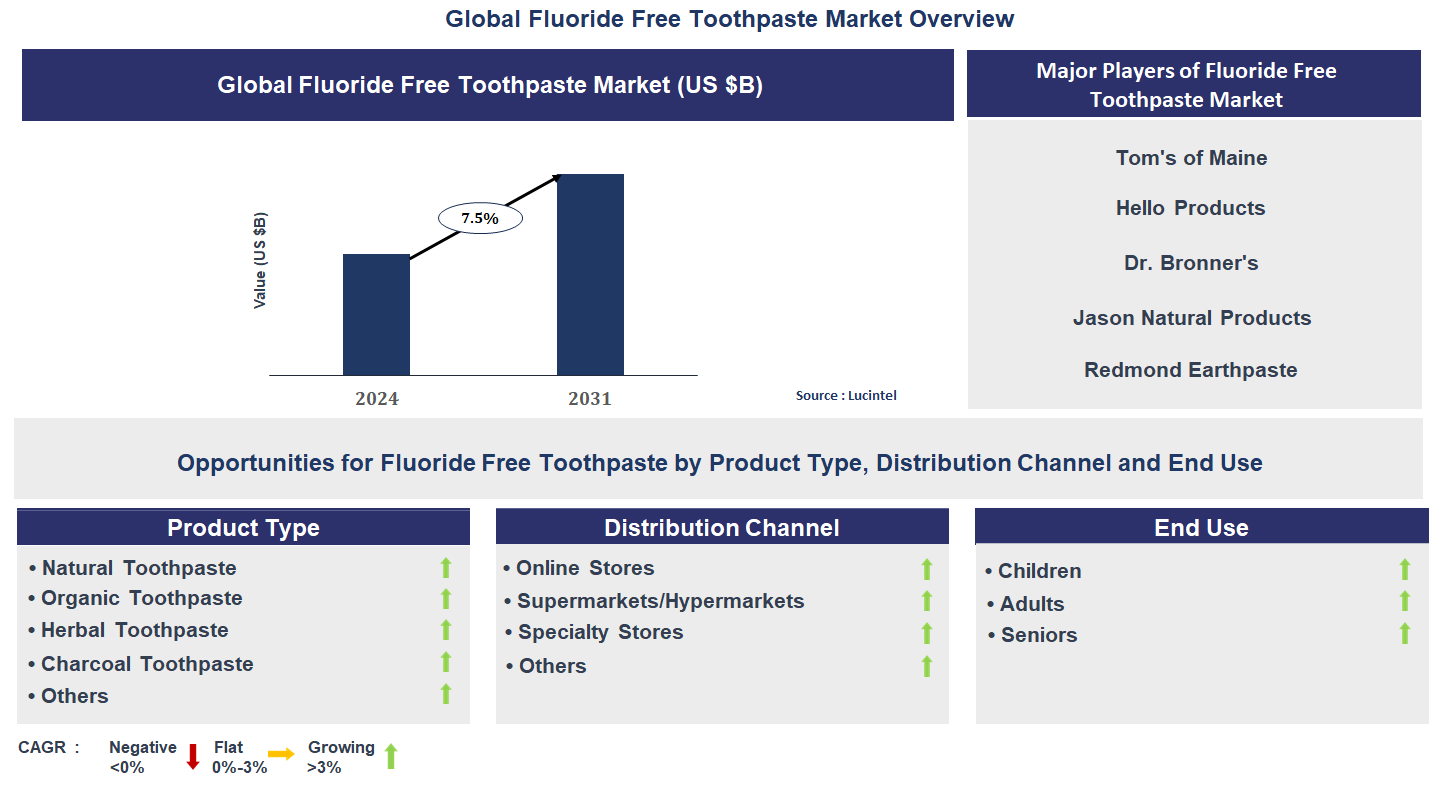
The future of the global fluoride free toothpaste market looks promising with opportunities in the natural toothpaste, organic toothpaste, herbal toothpaste, and charcoal toothpaste markets. The global fluoride free toothpaste market is expected to grow with a CAGR of 7.5% from 2025 to 2031. The major drivers for this market are the increasing demand for natural oral care, the rising awareness about fluoride alternatives, and the growing preference for chemical-free products.• Lucintel forecasts that, within the end use category, adult is expected to witness the highest growth over the forecast period.
• Within the product type category, natural toothpaste is expected to witness the highest growth.
• In terms of region, North America is expected to witness the highest growth over the forecast period. Gain valuable insights for your business decisions with our comprehensive 150+ page report. Sample figures with some insights are shown below.
Emerging Trends in the Fluoride Free Toothpaste Market
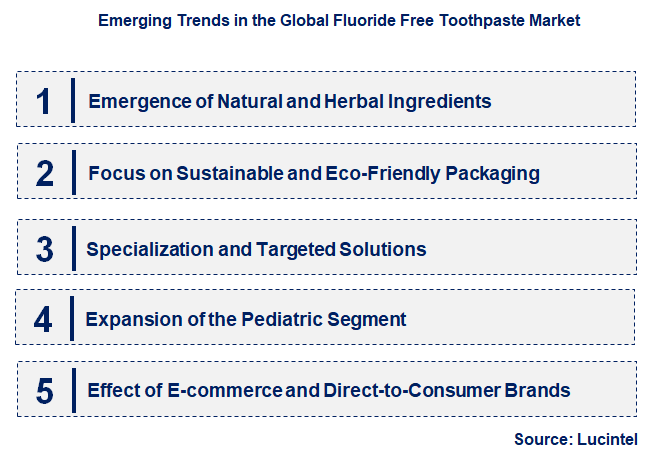
The market for fluoride free toothpaste is changing dramatically, fueled by shifting consumer demands and advances in product innovation. These growing trends mirror a wider cultural shift towards holistic well-being, sustainability, and individualization. Consumers no longer simply want a generic cleaning product; they want oral care solutions that complement their lifestyle and values. From activated charcoal becoming a household name to the importance of environmentally friendly packaging, these trends are revolutionizing the competitive environment and opening up new avenues for both old and new brands.• Emergence of Natural and Herbal Ingredients: This trend is around customer demand for clean-label products that do not contain synthetic chemicals. Companies are now more and more using natural and herbal ingredients like activated charcoal, neem, clove oil, miswak, and essential oils like tea tree and peppermint. These are being sold for their natural antibacterial, whitening, or calming characteristics. The effect is a shift in the marketplace away from strictly chemical-based products to those that are seen as safer and more natural. This trend is particularly strong in Asia and Europe, where traditional and natural remedies have a long-standing history of consumer trust.
• Focus on Sustainable and Eco-Friendly Packaging: Driven by environmental concerns, this trend involves a move away from traditional plastic tubes towards more sustainable packaging solutions. Brands are introducing products in recyclable materials, glass jars, aluminum tubes, and even compostable containers. Others are also providing toothpaste tablets or powders that render liquid toothpaste and its packaging obsolete. The effect is to permit companies to tap into ecologically aware consumers, engender loyalty and a good public image for the brand.
• Specialization and Targeted Solutions: The market is shifting away from a one-size-fits-all model for oral care. Brands are creating niche fluoride-free toothpastes that take care of particular dental concerns, including sensitive teeth, gum care, whitening, or halitosis. For instance, sensitive teeth products may include ingredients such as nano-hydroxyapatite, which is a fluoride-free, safe option for enamel remineralization.
• Expansion of the Pediatric Segment: Parents increasingly are choosing fluoride-free toothpaste for kids because of fluoride ingestion fear and dental fluorosis. This has created a thriving market for fluoride-free toothpaste for children, which may have exciting flavors such as strawberry and bubblegum. These are usually made with safer, food-grade chemicals.
• Effect of E-commerce and Direct-to-Consumer Brands: The move to online shopping has democratized the marketplace, with smaller, new-age brands cutting through traditional retail. Research indicates that DTC brands can speak directly to consumers, creating loyal communities and brand following through social media and direct-to-consumer advertising. This is fueled by the ease of online shopping and access to niche products not found in physical stores. These shifts are remaking the fluoride free toothpaste market by moving away from traditional oral care and towards a more comprehensive, natural, and sustainable model. Brands are reacting to consumer pressure for more transparency, customization, and eco-friendliness, which is resulting in a new era of product innovation and marketing campaigns. The market is becoming increasingly diverse, with products targeted to individual needs and values, creating a more splintered but very dynamic industry.
Recent Development in the Fluoride Free Toothpaste Market
The fluoride free toothpaste market is rapidly evolving with an increasing number of consumers who are better informed and more discerning about their personal care items. Recent trends constitute a strategic move by both well-established corporations and quick-footed startups to reap the benefits of this growing segment. These trends include product innovation, strategic acquisition, and increased emphasis on sustainable and ethical methods.• Strategic Partnerships and Acquisitions: Big companies are buying up successful niche brands in order to establish rapid market presence within the fluoride-free sector. For instance, Colgate-Palmolive bought Hello Products, a fast-growing natural oral care brand, to diversify its portfolio. These purchases enable incumbent firms to add innovative products and loyal consumers to their existing businesses.
• Integration of Sophisticated Natural Ingredients: Companies are going beyond fundamental herbal extracts to feature sophisticated, science-based natural ingredients. For instance, nano-hydroxyapatite is increasingly being used as a fluoride-free remineralizer of tooth enamel and sensitivity reducer. Similar ingredients such as xylitol, which is sourced from birch bark, are used due to their established anticaries activities.
• Product Format Diversification: The industry is experiencing an increase in novel and innovative product formats alternative to the conventional toothpaste tube. Firms are launching toothpaste tablets, powders, and gels packaged in plastic-free or recyclable containers. These formats resonate with consumers who want convenience and a lighter environmental impact. The effect is a wider set of choices for consumers and a shift towards a more environmentally friendly and waste-reduced oral hygiene routine.
• Increased Emphasis on Children’s Oral Hygiene: A significant rise in the availability of fluoride-free products designed especially for children can be seen. Parents, who are concerned their children are ingesting fluoride, are one of the prime target groups. Brands are reacting by producing products featuring kid-friendly flavors, appealing graphics, and clear ingredient listings. The result is a thriving pediatric segment that is a key growth driver for the fluoride-free market.
• Greater Digital Marketing and E-commerce Presence: Brands are making significant investments in online marketing and influencer collaboration to engage with their target consumers. They are using social media channels to inform consumers about the advantages of using fluoride-free products and about communicating their brand values, like sustainability and purity. The effect is a more personal and direct relationship with consumers, through which brands can create a community and generate sales via online mediums. These innovations are having a profound effect on the fluoride-free toothpaste market by expanding its reach and making it a legitimate and successful alternative to traditional oral care products. No longer a niche, the market is becoming a mainstream option for an increasing base of consumers. This is stimulating innovation, drawing investment, and reshaping new and old players’ strategies in the oral care space.
Strategic Growth Opportunities in the Fluoride Free Toothpaste Market
The market for fluoride free toothpaste is filled with strategic growth opportunities, especially in different applications that address the needs of the consumers. As the market becomes mature, firms cannot depend on one product anymore but need to diversify to address various segments of the consuming population. The opportunities come from the consumers’ demand for products that are not only fluoride-free but that are imbued with extra benefits, address certain lifestyles, and treat targeted oral health concerns.• Child Oral Care: The oral care of children is a sizeable growth prospect. Parents are growing more concerned about the risks to the health of young children from fluoride ingestion and represent a prime market for fluoride-free alternatives. This segment can be addressed by introducing toothpastes with gentle, natural flavors such as fruit and safe, food-grade ingredients. Colorful and fun packaging will also appeal to children.
• Solutions for Sensitive Teeth: Most of the population experiences dental sensitivity, and many are searching for fluoride-free solutions. This application presents a chance to create products based on alternative ingredients that remineralizer enamel and stop pain signals. Ingredients such as nano-hydroxyapatite and potassium nitrate can be positioned as being effective and fluoride-free. The effect of this emphasis is to gain a substantial market share by offering a focused remedy for a prevalent oral health problem.
• Whitening and Cosmetic Uses: A key driver in the oral care industry is the need for a whiter smile. Businesses can take advantage of this by developing toothpastes that are free from fluoride but contain natural whiteners such as activated charcoal, baking soda, and coconut oil. Products along these lines attract people who seek cosmetic advantage without the inclusion of harmful chemicals. The effect of this opportunity for growth is that it broadens the market from strictly health-oriented consumers to those who are concerned with beauty benefits as well, thus expanding total market size and revenue.
• Wellness and Holistic Products: There exists an increasingly larger consumer group that sees oral care as a part of an overall holistic wellness regimen. This offers a chance to create fluoride-free toothpastes with ingredients that provide added values, like probiotics for oral microbiome health or herbal extracts for calming effects. These lines are marketed alongside other personal and wellness care products.
• Sustainable and Eco-Conscious Consumers: The green consumer segment is one of the major growth areas. Companies can target this use by providing fluoride-free toothpaste in sustainable packaging, like glass jars or refillable packs, and ensuring that their ingredients are produced ethically. Promotion can highlight the minimal environmental impact of the product. The effect of this strategic method is to distinguish the brand in a competitive market and establish a robust, favorable brand image. These growth prospects are affecting the fluoride free toothpaste market by promoting product innovation and diversification. They are encouraging manufacturers to produce specialized, value-added products that are more than just a cleaning solution. By targeting these applications, firms can profitably reach niche consumer groups, build their market share, and help the market continue to grow and develop.
Fluoride Free Toothpaste Market Driver and Challenges
The fluoride free toothpaste market is witnessing dynamic growth, driven by a mix of influential drivers and faced with certain challenges. The prime drivers are all the different technological, economic, and regulatory factors that are making the market environment conducive to growth. At the same time, the market is confronted with certain challenges, including consumer disbelief, increased cost of production, and the ready availability of traditional products. Understanding these drivers is key for any business in this sector, as they will dictate the future direction of the market as well as the competitive environment. The factors responsible for driving the fluoride free toothpaste market include: 1. Growing Consumer Health Awareness: One of the key drivers is the increasing consciousness of consumers regarding the possible health hazards of prolonged fluoride exposure. This is especially common in parents who worry about dental fluorosis among children. Consumers are consciously looking for safer, natural products, hence the push for fluoride-free products. The effect is behavioral change, where there is a willingness to pay extra for healthier and safer products. 2. Growing Demand for Natural and Organic Products: The larger overall trend towards consumers using natural and organic personal care products is a major driver. Toothpaste without fluoride, frequently made from herbal and plant extracts, fits in ideally with this. Buyers are seeking out products that contain no synthetic additives and chemicals. The effect is that the trend offers a solid basis for the market’s expansion because it is one of a broader lifestyle decision and not a short-lived fad. 3. Expansion of the E-commerce Industry: The growth of e-commerce has exposed niche products such as fluoride-free toothpaste to a worldwide market. Online platforms enable small brands to cut out intermediaries and directly access the consumer. Digital promotion and influencer collaborations on social media have also played a crucial role in consumer awareness and sales promotion. The result is an equalized market where new entrants can challenge traditional brands, promoting innovation and product ubiquity. 4. Product Development and Diversification: Advances in the technology of natural ingredients have resulted in the creation of highly effective fluoride-free products. Ingredients such as nano-hydroxyapatite and xylitol have anticaries and remineralization benefits that are equal to fluoride. This technology is overcoming a major hurdle to adoption—the perception of reduced effectiveness. The effect is a stronger value proposition for the consumer, as they no longer need to compromise on performance for a fluoride-free product. 5. Positive Demographic Trends: Demographic changes, in the form of the growth of millennials and Gen Z populations that are more concerned about health and the environment, are driving market expansion. The generation is more likely to challenge traditional products and look for alternatives that resonate with their values. The effect is a robust, expanding consumer market that is open to the messaging and value proposition of fluoride-free toothpaste. This wave of change guarantees continued future demand for such products. Challenges in the fluoride free toothpaste market are: 1. Lack of Consumer Awareness: Notwithstanding the increased interest, most consumers are not familiar with fluoride-free toothpaste or its advantages. Years of public campaigns in favor of fluoride have fostered a common belief that fluoride is essential for oral health. The effect is that companies have to spend a great deal on educating consumers and marketing to overcome this deeply rooted perception. 2. Higher Product Price: Fluoride-free toothpaste, especially ones with natural and niche ingredients, tend to be priced higher than traditional brands. This acts as a deterrent for price-conscious customers. Production and harvesting of natural ingredients can prove more costly. The effect is that the market ends up being mostly concentrated among more affluent consumers, thus limiting its reach to a wider population. 3. Competition from Traditional Toothpaste: The industry is dominated by entrenched, multinational companies with a robust presence through their fluoride-based brands. These organizations enjoy huge marketing budgets and extensive distribution channels, so it becomes challenging for new brands that are free from fluoride to get shelf space and visibility. The result is a highly competitive environment in which the small players have to slog hard to differentiate themselves and establish brand recognition. This can translate into vicious price wars and marketing battles. The drivers and challenges are colliding to redefine the market into a more dynamic and segmented industry. The drivers are propelling the market towards tremendous growth and innovation, especially in the natural and wellness markets. This is creating a more varied product landscape and a more knowledgeable consumer base. On the other hand, the hurdles are serving as a brake on fast, mass adoption, so keeping the market relatively niche and competitive.List of Fluoride Free Toothpaste Companies
Companies in the market compete on the basis of product quality offered. Major players in this market focus on expanding their manufacturing facilities, R&D investments, infrastructural development, and leverage integration opportunities across the value chain. With these strategies fluoride free toothpaste companies cater increasing demand, ensure competitive effectiveness, develop innovative products & technologies, reduce production costs, and expand their customer base. Some of the fluoride free toothpaste companies profiled in this report include-• Tom’s of Maine
• Hello Products
• Dr. Bronner’s
• Jason Natural Products
• Redmond Earthpaste
• Davids Natural Toothpaste
• The Natural Dentist
• Weleda
• Desert Essence
• Green People
Fluoride Free Toothpaste Market by Segment
The study includes a forecast for the global fluoride free toothpaste market by product type, distribution channel, end use, and region.Fluoride Free Toothpaste Market by Product Type [Value from 2019 to 2031]:
• Natural Toothpaste
• Organic Toothpaste
• Herbal Toothpaste
• Charcoal Toothpaste
• Others
Fluoride Free Toothpaste Market by Distribution Channel [Value from 2019 to 2031]:
• Online Stores
• Supermarkets/Hypermarkets
• Specialty Stores
• Others
Fluoride Free Toothpaste Market by End Use [Value from 2019 to 2031]:
• Children
• Adults
• Seniors
Fluoride Free Toothpaste Market by Region [Value from 2019 to 2031]:
• North America
• Europe
• Asia Pacific
• The Rest of the World
Country Wise Outlook for the Fluoride Free Toothpaste Market
The market for fluoride free toothpaste is expanding substantially, thanks to an emerging trend toward organic and natural personal care products globally. Consumers are becoming more health-conscious about the possible impact of fluoride and hence are looking toward safer alternatives for themselves and their kids. The trend is supported by increasing oral health awareness, growing disposable incomes, and growth in e-commerce that improves access to niche products.• United States: The US market is dominated by a high consumer demand for clean-label and natural products. Large brands such as Colgate and Tom’s of Maine have added or launched fluoride-free offerings to address this demand. There is significant emphasis on niche formulations for children, with parents worrying about exposing their children to fluoride. Online retailers are a key driver of growth, offering a broad range of options from small, independent companies that tend to pioneer innovation in this category.
• China: China’s market for fluoride free toothpaste is growing at a fast pace, with growth being primarily driven by rising urbanization and growing disposable incomes. Consumers are health-aware and are willing to spend extra for a product that is safer and more effective in their opinion. Herbal and traditional Chinese medicine (TCM) inspired products have strong demand. Such local brands as Dabur and Patanjali are capturing market share with these cultural inclinations. Social media marketing and e-commerce contribute importantly to communicating with the younger, more affluent consumer segment.
• Germany: The fluoride-free market in Germany is strong, with a long consumer history of preference for natural and organic products. This is reflective of a wider European tendency for sustainable and chemical-free personal care. German consumers are especially conscientious about ingredients in products and tend to choose certified natural and organic toothpastes. The market is controlled by specialty, niche brands located in pharmacies and health food stores.
• India: India is a major growth center, driven by the unprecedented popularity of herbal and Ayurvedic products. Fluoride toothpaste, where the toothpaste is made without fluoride and may include ingredients such as neem, clove, and miswak, is in line with natural practices. Popular local brands Patanjali and Dabur have ridden this wave, offering fluoride-free toothpastes affordably and in reach of the masses. The trend also spurs growth into rural and semi-urban locales as health-consciousness and spending power grow.
• Japan: The Japanese market for fluoride-free toothpaste is comparatively smaller but is experiencing consistent growth, fueled by preventative oral care and high-end, specialist products. There is a demand for toothpastes that provide unique benefits such as gum care, removal of plaque, and whitening without the presence of fluoride. The Japanese market is characterized by technological advances and high-end product offerings. Although some mass brands are providing fluoride-free alternatives, the market is dominated by niche brands catering to health-aware consumers and individuals with certain sensitivities.

Features of the Global Fluoride Free Toothpaste Market
Market Size Estimates: Fluoride free toothpaste market size estimation in terms of value ($B). Trend and Forecast Analysis: Market trends (2019 to 2024) and forecast (2025 to 2031) by various segments and regions. Segmentation Analysis: Fluoride free toothpaste market size by product type, distribution channel, end use, and region in terms of value ($B). Regional Analysis: Fluoride free toothpaste market breakdown by North America, Europe, Asia Pacific, and Rest of the World. Growth Opportunities: Analysis of growth opportunities in different product types, distribution channels, end uses, and regions for the fluoride free toothpaste market. Strategic Analysis: This includes M&A, new product development, and competitive landscape of the fluoride free toothpaste market. Analysis of competitive intensity of the industry based on Porter’s Five Forces model.
FAQ
Q1. What is the growth forecast for fluoride free toothpaste market? Answer: The global fluoride free toothpaste market is expected to grow with a CAGR of 7.5% from 2025 to 2031. Q2. What are the major drivers influencing the growth of the fluoride free toothpaste market? Answer: The major drivers for this market are the increasing demand for natural oral care, the rising awareness about fluoride alternatives, and the growing preference for chemical-free products. Q3. What are the major segments for fluoride free toothpaste market? Answer: The future of the fluoride free toothpaste market looks promising with opportunities in the natural toothpaste, organic toothpaste, herbal toothpaste, and charcoal toothpaste markets. Q4. Who are the key fluoride free toothpaste market companies? Answer: Some of the key fluoride free toothpaste companies are as follows:• Tom’s of Maine
• Hello Products
• Dr. Bronner’s
• Jason Natural Products
• Redmond Earthpaste
• Davids Natural Toothpaste
• The Natural Dentist
• Weleda
• Desert Essence
• Green People Q5. Which fluoride free toothpaste market segment will be the largest in future? Answer: Lucintel forecasts that, within the end use category, adult is expected to witness the highest growth over the forecast period. Q6. In fluoride free toothpaste market, which region is expected to be the largest in next 5 years? Answer: In terms of region, North America is expected to witness the highest growth over the forecast period. Q7. Do we receive customization in this report? Answer: Yes, Lucintel provides 10% customization without any additional cost.
Table of Contents
List of Figures
List of Tables
Methodology
- In-depth interviews of the major players in this market
- Detailed secondary research from competitors’ financial statements and published data
- Extensive searches of published works, market, and database information pertaining to industry news, company press releases, and customer intentions
- A compilation of the experiences, judgments, and insights of Lucintel’s professionals, who have analyzed and tracked this market over the years.


Buy Now
Choose a license that fits your team. Instant PDF delivery.
Prices exclude taxes. Instant delivery. Custom licensing available on request.
Key Questions
- • What are some of the most promising, high-growth opportunities for the fluoride free toothpaste market by product type (natural toothpaste, organic toothpaste, herbal toothpaste, charcoal toothpaste, and others), distribution channel (online stores, supermarkets/hypermarkets, specialty stores, and others), end use (children, adults, and seniors), and region (North America, Europe, Asia Pacific, and the Rest of the World)?
- • Which segments will grow at a faster pace and why?
- • Which region will grow at a faster pace and why?
- • What are the key factors affecting market dynamics? What are the key challenges and business risks in this market?
- • What are the business risks and competitive threats in this market?
- • What are the emerging trends in this market and the reasons behind them?
- • What are some of the changing demands of customers in the market?
- • What are the new developments in the market? Which companies are leading these developments?
- • Who are the major players in this market? What strategic initiatives are key players pursuing for business growth?
- • What are some of the competing products in this market and how big of a threat do they pose for loss of market share by material or product substitution?
- • What M&A activity has occurred in the last 5 years and what has its impact been on the industry? For any questions related to Fluoride Free Toothpaste Market, Fluoride Free Toothpaste Market Size, Fluoride Free Toothpaste Market Growth, Fluoride Free Toothpaste Market Analysis, Fluoride Free Toothpaste Market Report, Fluoride Free Toothpaste Market Share, Fluoride Free Toothpaste Market Trends, Fluoride Free Toothpaste Market Forecast, Fluoride Free Toothpaste Companies, write Lucintel analyst at email: helpdesk@lucintel.com. We will be glad to get back to you soon.


